

Explain the causes of glacial lake outburst flood. (2025)
- A glacial lake outburst flood (GLOF) is the sudden release of water stored in a lake in, on, beside or in front of a glacier, when the dam holding it — moraine, ice or bedrock-and-debris — fails or is overtopped, sending a flood wave many times larger than normal river discharge down the valley within minutes to hours.
- Whether a lake bursts depends on the nature of the damming material, the lake’s volume and position, the behaviour of the parent glacier and the steepness and stability of the surrounding slopes.
- The causes are best explained at three levels: the conditions that create a large, unstable lake; the dam weaknesses that make failure possible; and the trigger that delivers the breach.
1. Conditioning Cause: Glacier Retreat and Lake Growth
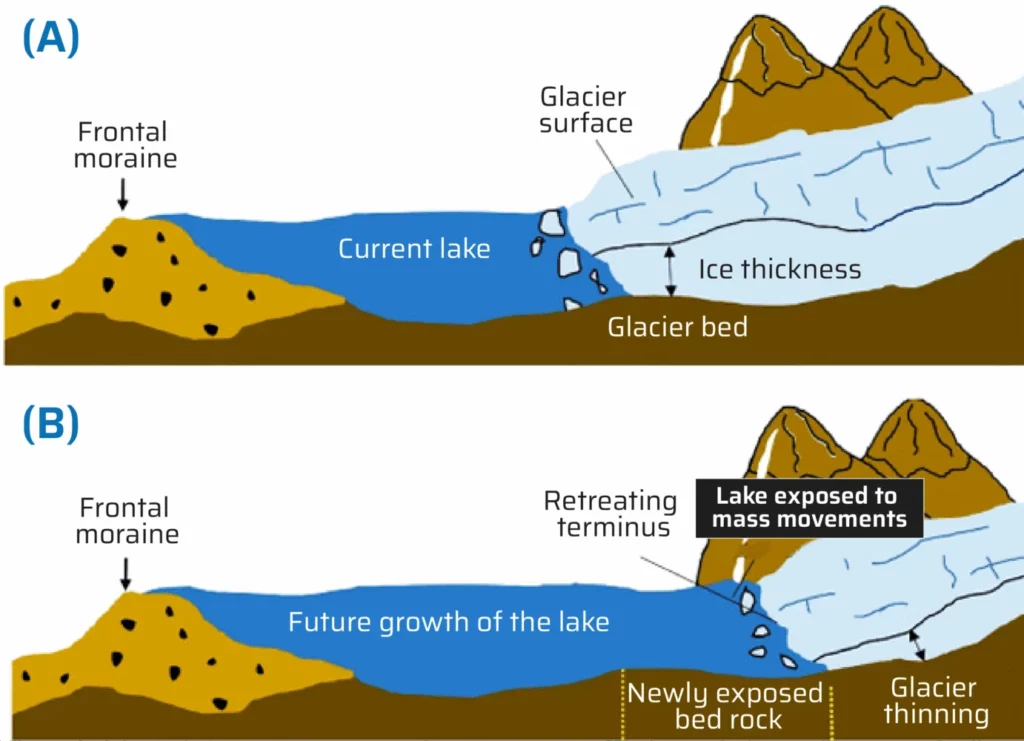
- Warming makes glaciers thin and retreat, leaving meltwater ponded behind the terminal moraine in the overdeepened basin the glacier once occupied.
- As the snout calves back, the lake lengthens and deepens, and newly exposed valley walls lose the support of the ice — so the lake grows exactly where rockfalls and avalanches can reach it.
- Dan H. Shugar and colleagues (2020) found that between 1990 and 2018 the world’s glacial lakes grew by about 53% in number, 51% in area and 48% in volume (to about 156 km³).
2. Predisposing Causes: Weak Dams
Moraine dams — the main Himalayan type
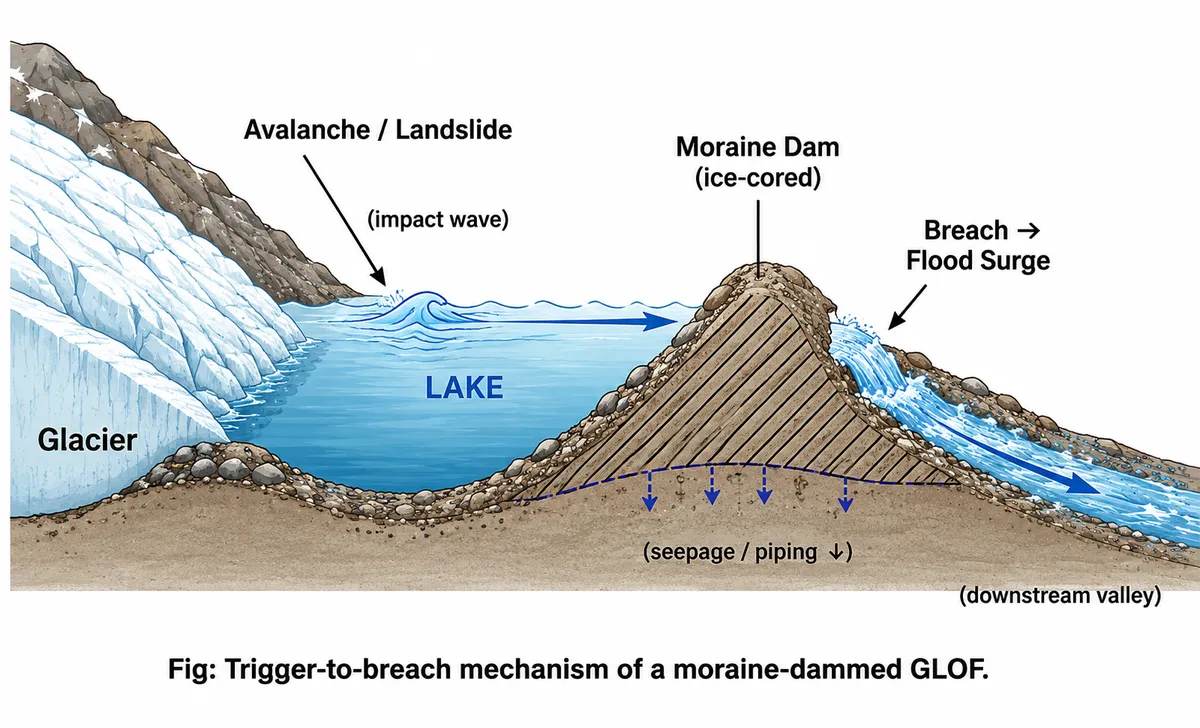
- Loose, unsorted debris with little cohesion, steep faces and low freeboard (height of dam crest above water).
- Ice-cored moraines: melting of buried “dead ice” and permafrost thaw make the dam subside, crack and lose strength.
- Seepage and piping: water moving through porous moraine washes out fines and enlarges tunnels until the dam collapses from within.
Ice dams
- Flotation: when lake depth approaches about nine-tenths of the ice-dam thickness, the ice is buoyed up and water escapes beneath it.
- Conduit enlargement: water flowing under the ice melts its tunnel wider, so drainage accelerates — the classic jökulhlaup.
Supraglacial, englacial and subglacial lakes
- Drain suddenly through crevasses, moulins or tunnels; under ice caps on volcanoes, as in Iceland, geothermal or eruptive heat melts the ice and fills the subglacial lake.
3. Triggering Causes
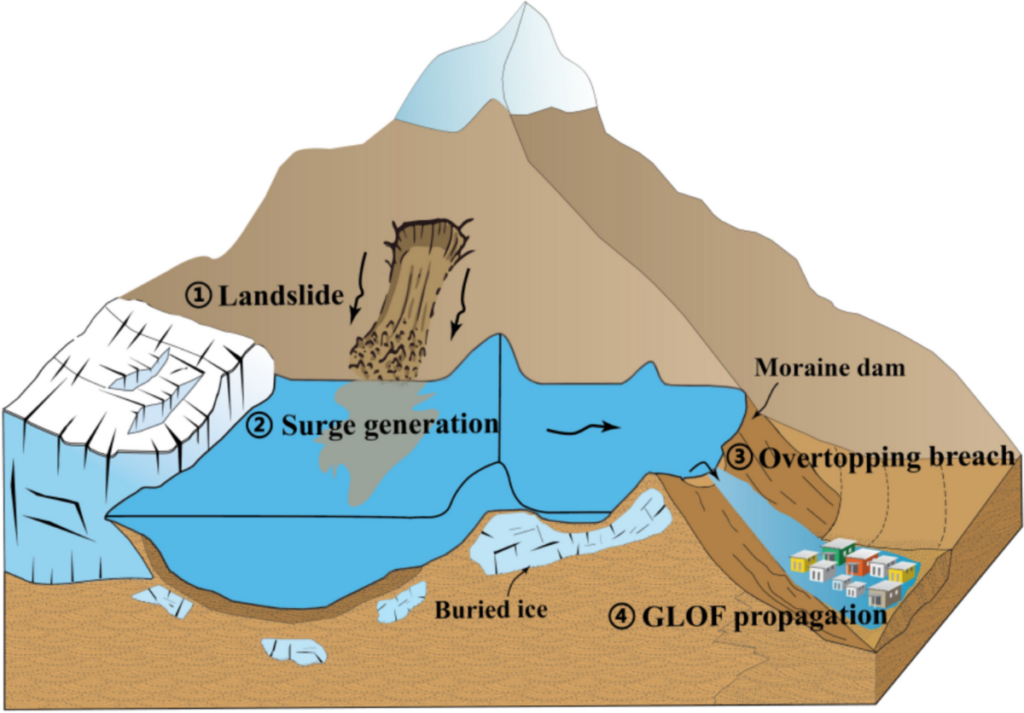
- Mass movement into the lake — rockfall, landslide, moraine collapse or ice avalanche — creates a displacement (impulse) wave that overtops and incises the dam; this is the most common trigger in the Himalaya.
- South Lhonak Lake, Sikkim (3–4 October 2023): 14.7 million m³ of frozen lateral moraine collapsed into the lake, raising a ~20 m wave that breached the frontal moraine and drained ~50 million m³ of water; the flood eroded about 270 million m³ of sediment, destroyed the 1,200 MW Teesta-III dam at Chungthang, and left 92 people confirmed dead by mid-October (Ashim Sattar and colleagues, 2025).
- Dig Tsho, Nepal (1985): an ice avalanche from the Langmoche Glacier overtopped the moraine and wrecked a hydropower plant under construction downstream.
- Extreme rainfall and rapid snowmelt raise lake level and saturate the dam — the Chorabari Lake breach of 17 June 2013 added to the Kedarnath disaster.
- Earthquakes can crack moraine dams directly or set off the slope failures that generate impulse waves.
- Cascading failures: the flood from one lake breaches another downstream, or a GLOF turns into a debris flow by eroding its own channel.
Is the Hazard Rising? A Live Disagreement
- The textbook account — echoed by regional inventories that now count tens of thousands of glacial lakes across the Hindu Kush Himalaya — holds that more lakes mean more GLOFs.
- Georg Veh, Oliver Korup and colleagues (2019), mapping Himalayan GLOFs from satellite images since the late 1980s, found an average of 1.3 GLOFs a year with no detectable upward trend, and fewer outbursts per unit lake area.
- Their reading: lake growth alone does not set GLOF frequency — triggers do; South Lhonak, where a permafrost-weakened moraine failed into a fast-growing lake, shows how the two causes combine.
- Judgement: a GLOF is caused by the meeting of a slow, climate-driven predisposition (lake growth, ice-cored and permafrost-weakened moraines) with a fast, local trigger (mass movement, rain or earthquake); because triggers are hard to predict, monitoring the dam and the slopes above the lake matters as much as counting lakes.