

Examine the recent views on mountain building process and divide the world mountains on the basis of their genesis. (2024)
- Orogeny is the folding, faulting, thickening and uplift of crust into mountain belts. Earlier theories split into two camps:
- contraction theories — Harold Jeffreys’s thermal contraction and Leopold Kober’s geosynclinal theory — blamed a cooling, shrinking Earth;
- drift theories — Frank Bursley Taylor, Alfred Wegener, Reginald Aldworth Daly’s sliding continents, John Joly’s radioactivity cycles and Arthur Holmes’s convection currents — moved continents sideways but lacked a proven mechanism.
- “Recent views” are those built since the 1960s on plate tectonics and its later refinements; each is examined below against its evidence and its limits.
1. Plate tectonics — the type of convergence decides the mountain
- Sea-floor spreading (Harry Hammond Hess), magnetic striping and Benioff zones showed that oceanic lithosphere is created at ridges and consumed at trenches; the compression that builds mountains comes from plate convergence, not global contraction.
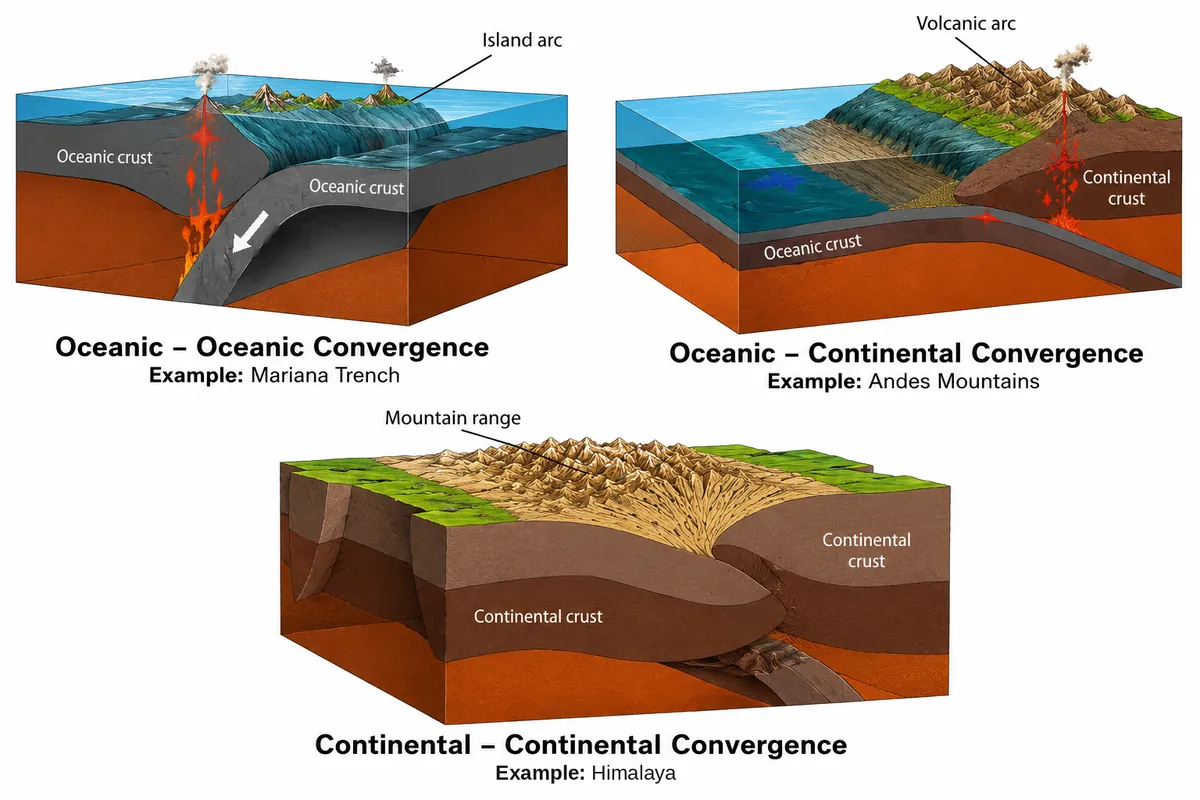
- Three convergent settings yield three genetic families: ocean–ocean (island arcs), ocean–continent (Cordilleran or Andean ranges), continent–continent (collision ranges).
- Strength: it explains volcanism, deep earthquakes, ophiolites at sutures and the linear, plate-edge distribution of young ranges — all beyond contraction theory.
- Limit: some ranges lie far inside plates — the Tien Shan, more than 1,000 km north of the Indian collision front, and the Laramide Rockies — needing stress transmitted through the plate or flat-slab subduction to explain them.
2. Critical taper — how a belt grows internally
- Dan Davis, John Suppe and Francis Anthony Dahlen (1983) modelled fold-thrust belts and accretionary wedges like soil pushed ahead of a bulldozer: the wedge deforms until it reaches a critical taper angle set by basal friction and rock strength, then slides forward as a unit.
- Evidence: forward-stepping thrust sequences in the Siwaliks, Taiwan and accretionary prisms; erosion that lowers the taper makes the wedge deform internally again to rebuild it.
- Limit: it treats the wedge as uniform brittle material, so it struggles with hot, ductile cores such as the Greater Himalaya.
3. Terrane accretion — mountains as collages
- Peter J. Coney, David L. Jones and James W. H. Monger (1980) showed that much of the North American Cordillera is a mosaic of “suspect” terranes — island arcs, oceanic plateaus and microcontinents — carried in on subducting plates and docked one after another.
- Tibet is likewise a stack of blocks (Qiangtang, Lhasa) accreted before India arrived — a mountain belt can be built over hundreds of millions of years, not in one collision.
4. Lithospheric removal — why plateaus rise in pulses
- Thickened mountain roots grow dense and can delaminate or drip into the mantle; the lighter crust then rebounds.
- Carmala N. Garzione, Nadine McQuarrie and colleagues (2017) found the Central Andean Plateau rose in pulses — punctuated removal of dense lower lithosphere in the latest Oligocene–early Miocene and again in the late Miocene–early Pliocene — not by slow, steady shortening alone.
- Implication: surface height is controlled partly by the mantle beneath the range, not only by folding at the surface.
5. Climate–tectonic coupling
- Where rainfall is concentrated, erosion removes mass fastest and rock uplift and exhumation focus there — as on the wet western side of New Zealand’s Southern Alps. Climate is now treated as an active partner in orogeny, not just a sculptor.
- Examination: plate convergence remains the master explanation of where and why; critical taper, terrane accretion, lithospheric removal and climate coupling explain how a belt grows, stalls or rises in bursts. The recent view is pluralist, not a rival to plate tectonics.
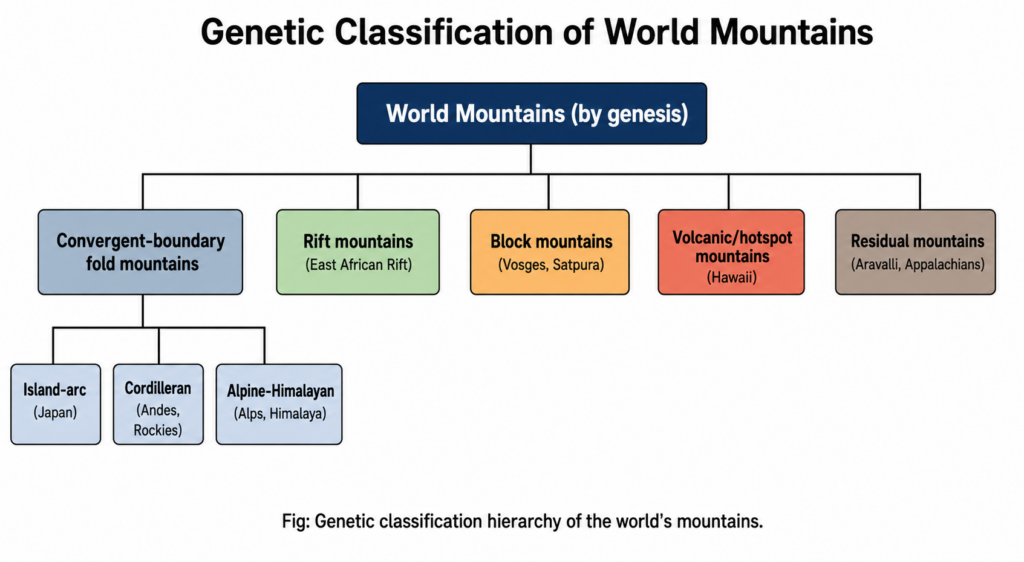
Genetic classification of world mountains
A. Orogenic (plate-boundary) mountains
- Island-arc mountains (ocean–ocean subduction): water released from the sinking slab melts the mantle wedge where the slab lies roughly 100 km deep, building a curved volcanic chain behind a trench — Mariana, Aleutian and Lesser Antilles arcs; Japan (an arc built partly on continental fragments).
- Cordilleran or Andean mountains (ocean–continent subduction): folded marginal sediments plus a volcanic arc — Andes; the western Cordillera of North America, including the Rockies (uplifted far inland during flat-slab subduction).
- Collisional (Alpine–Himalayan) mountains (continent–continent): ocean closes, Tethyan sediments are folded, thrust into nappes and thickened — Himalaya, Alps, Zagros.
- Accretionary mountains: collages of docked terranes — Coast Mountains of British Columbia and Alaska.
B. Non-collisional mountains
- Rift mountains (divergent settings): uplifted rift shoulders and horsts — East African Rift highlands such as the Ruwenzori; the submarine Mid-Atlantic Ridge.
- Block (fault) mountains: horsts between normal faults or tilted blocks — Vosges and Black Forest flanking the Rhine Graben, Sierra Nevada, Satpura in India.
- Dome mountains: crust arched up over intrusions or deep-seated uplift — the Henry Mountains (laccoliths) and the Black Hills of the USA.
- Volcanic (hotspot) mountains: plume-fed shields far from plate edges — Hawaii (Mauna Loa, Mauna Kea).
- Residual mountains: worn-down roots of dead orogens — Aravalli, Appalachians, Urals.
- Time overlay: each genetic type also has an age — Precambrian, Caledonian, Hercynian (Variscan) and Alpine orogenies — so the Aravalli (Precambrian) and Himalaya (Alpine) are both orogenic in origin but at opposite ends of the denudation path.
- Judgement: recent views have turned mountain building from a single global squeeze into a family of plate-driven processes modulated by mantle and climate; a genetic classification therefore has to start from the plate setting and then recognise accretion, delamination and denudation as the forces that make each range distinctive.