

Discuss the contributions of the American School of Subaerial Denudation in geomorphology. (2015)
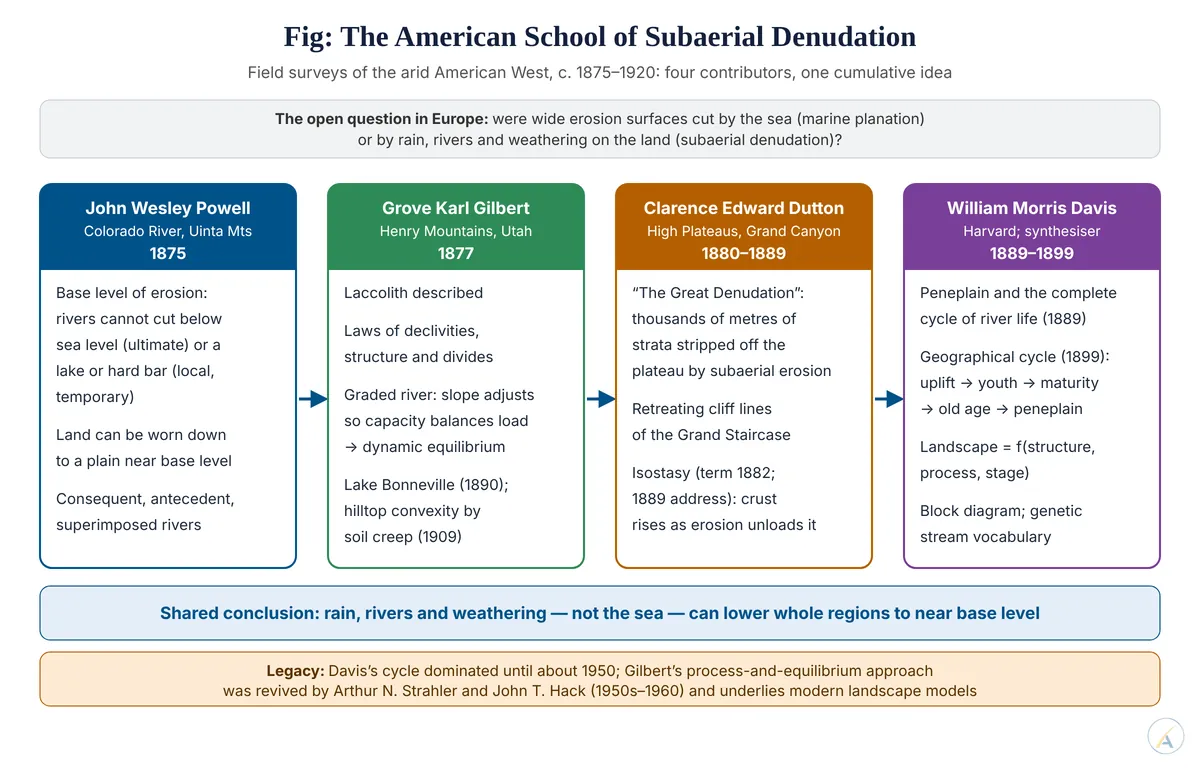
- The American School of Subaerial Denudation is the group of field geologists — John Wesley Powell, Grove Karl Gilbert, Clarence Edward Dutton and, as synthesiser, William Morris Davis — whose work between about 1875 and 1920, often called the “golden age” of geomorphology, established that rain, rivers, weathering and mass movement on the land surface can lower whole regions without marine planation or catastrophe.
- In Europe the debate was still open: Andrew Crombie Ramsay and Ferdinand von Richthofen favoured marine planation, while George Greenwood (1857) and Joseph Beete Jukes argued for rain and rivers.
- The arid, sparsely vegetated Colorado Plateau and Great Basin, opened by the post-Civil War surveys, laid bare structure and erosion on a scale that settled the argument in favour of subaerialism.
John Wesley Powell — Base Level and Genetic Valleys
- After his 1869 descent of the Colorado River, John Wesley Powell (1875) introduced the base level of erosion: the lowest level to which a river can cut, ultimately sea level, with temporary or local base levels at lakes and resistant bars — later formalised as ultimate, local and temporary base levels.
- He reasoned that, given time, rivers could lower a landmass to a plain just above base level — the idea William Morris Davis would name the peneplain.
- He began the genetic classification of valleys and rivers, introducing consequent, antecedent and superimposed drainage and using structure as a basis for classifying landforms (Uinta Mountains, 1876).
Grove Karl Gilbert — Process and Equilibrium
- His Henry Mountains report (1877) described the laccolite (laccolith) and, more importantly, stated laws of land sculpture from physical reasoning:
- law of declivities — erosion is fastest where slopes are steepest;
- law of structure — hard rocks stand out as ridges and soft rocks are worn into valleys;
- law of divides — the steeper side of a divide erodes faster, so the divide migrates towards the gentler side;
- equality of action — a landscape tends towards a state in which forces and resistances are balanced.
- He defined the graded river, whose slope adjusts so that transporting capacity balances load — the root of the later dynamic equilibrium concept.
- He explained the convexity of hilltops by soil creep (1909), measured sediment transport in flume experiments (1914) and used the Lake Bonneville shorelines (1890) to show crustal rebound after the lake shrank.
- Grove Karl Gilbert’s emphasis on measurable process made him, in hindsight, the most modern member of the school.
Clarence Edward Dutton — The Great Denudation and Isostasy
- In the High Plateaus of Utah and the Tertiary History of the Grand Cañon District (1882), Clarence Edward Dutton reconstructed “the Great Denudation” — the stripping of thousands of metres of strata from the plateau by subaerial erosion.
- His retreating cliff lines of the Grand Staircase showed scarps receding through flat-lying beds — evidence of scarp retreat long before Lester Charles King’s pediplanation.
- He introduced the term isostasy (1882; developed in his 1889 address), linking denudation of the land to compensating crustal rise, so that erosion and uplift are coupled.
- He supported John Wesley Powell’s base level with regional evidence.
William Morris Davis — The Synthesis
- William Morris Davis fused these ideas into the “complete cycle of river life” and the term peneplain (1889), and then the geographical cycle (1899): uplift, then youth, maturity and old age, ending in a peneplain graded to base level, explained by structure, process and stage.
- He gave the discipline its genetic vocabulary (adding obsequent and resequent streams to the consequent and subsequent types), the block diagram and an explanatory description that teachers worldwide adopted.
- The cycle was extended to glacial (1900) and arid (1905) landscapes by William Morris Davis himself, to coasts by Douglas Wilson Johnson (1919) and to karst by Jovan Cvijić.
Overall Contributions
- Conceptual: subaerial denudation as the normal agent of planation; base level, grade and equilibrium; the link between erosion and isostasy.
- Methodological: physics-based laws and experiment (Grove Karl Gilbert) alongside historical, evolutionary explanation (William Morris Davis) — the two approaches geomorphology still balances.
- Practical: survey-based mapping of the American West, water and land classification, and the first general theory of landscape development.
- Lasting toolkit: base level, rejuvenation and erosion surfaces remain the tools of denudation chronology — Indian studies read the stepped erosion surfaces of the Chotanagpur plateau and the rejuvenated, terraced valleys of the Damodar and Narmada in exactly these terms.
Limitations and Present Standing
- William Morris Davis’s historical, stage-bound model eclipsed Grove Karl Gilbert’s process approach for half a century; it was challenged by Walther Penck (simultaneous uplift and erosion) and Lester Charles King (parallel retreat, pediplain), and true peneplains near sea level are rare.
- Arthur Newell Strahler (1950s) and John Tilton Hack (1960) revived Grove Karl Gilbert explicitly through dynamic equilibrium, and his laws now underpin numerical landscape-evolution models.
- His law of divides is being tested directly: Adam M. Forte and Kelin X. Whipple (2018) found that contrasts in mean slope and local relief across a divide are the most reliable signs that the divide is migrating.
- Judgement: the school’s lasting contribution is the conviction that ordinary surface processes acting over long time, adjusted to base level and balanced by isostasy, make landscapes; William Morris Davis gave it its widest reach, but it is Grove Karl Gilbert’s process-and-equilibrium strand that modern geomorphology has most fully vindicated.