

Describe the concept of ‘Altiplanation’. (2021)
- Altiplanation (Latin altus, “high”, + planation) is the planation of hilltops, spurs and upper hillslopes in cold, unglaciated (periglacial) regions by frost action and mass wasting, producing flattened summits and staircases of bedrock benches.
- The term was coined by Henry M. Eakin in 1916 from the Yukon–Koyukuk region of Alaska, who saw it as a special phase of solifluction that levels high ground into terrace-like forms.
- Its landforms are altiplanation terraces, now usually called cryoplanation terraces (after Kirk Bryan’s 1946 “cryo-” terminology) and in Siberia goletz terraces (from golets, a bare, treeless summit).
Form of an Altiplanation Terrace
- A tread — a nearly flat or gently sloping bench cut across bedrock — backed by a steep scarp (riser) of frost-shattered rock, often with a frost-riven cliff at its base.
- Repeated benches give a giant staircase leading up to a broad, flat summit.
- In Richard D. Reger’s survey of 686 Alaskan terraces, scarps were 3–76 m high with rubble slopes of 9–32°; treads generally slope only 1–10°, many cutting cleanly across rock structure, under a debris cover about 0.8–2.5 m thick.
How Altiplanation Works
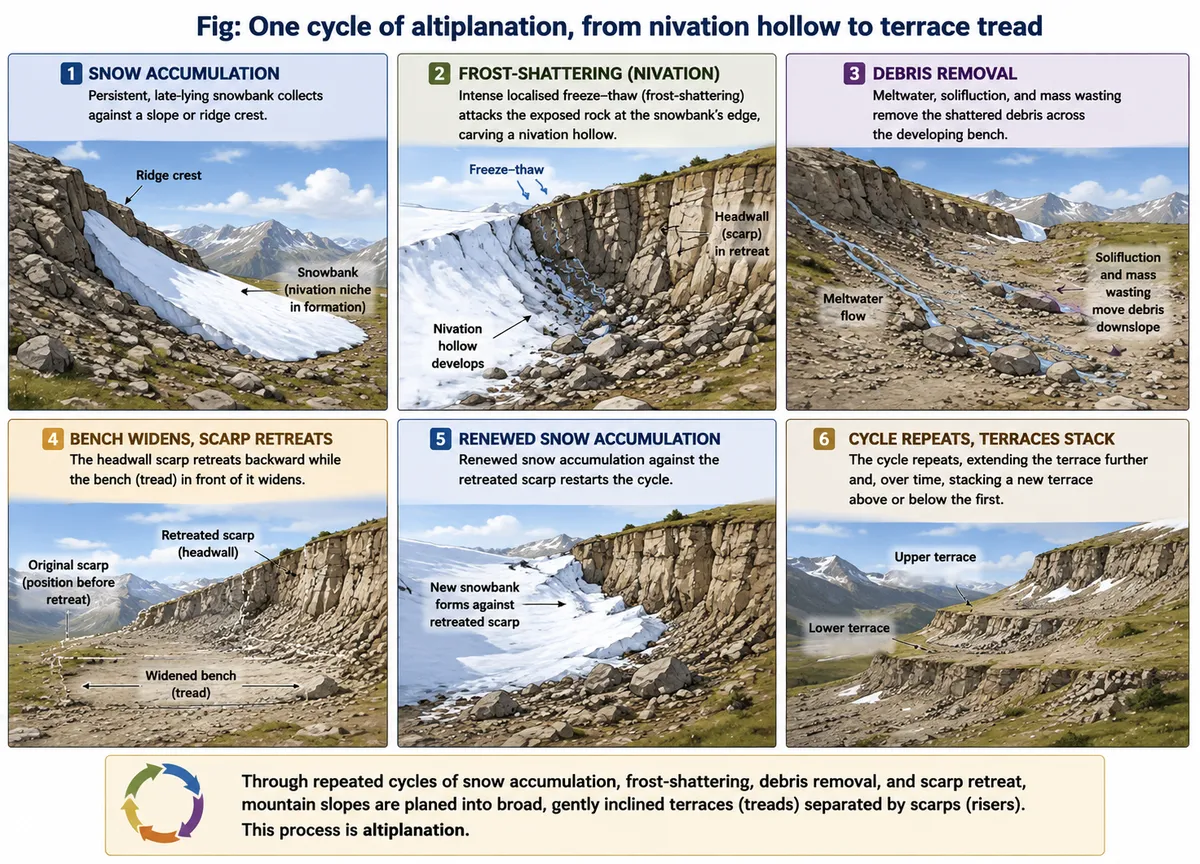
- Snow accumulation: a late-lying snowbank collects against the foot of a scarp or in a hollow on the slope.
- Nivation: around the snowbank’s margin, repeated freeze–thaw and abundant meltwater shatter the rock (congelifraction), cutting a nivation hollow.
- Debris removal: solifluction, meltwater wash and other mass movements carry the shattered debris across the tread and down the side slopes.
- Scarp retreat: the scarp is driven back parallel to itself while the tread in front of it widens — the cold-climate counterpart of pediment growth by slope retreat.
- Repetition: renewed snow accumulation against the retreated scarp restarts the cycle; terraces at several levels merge into a stepped summit and, in the limit, a near-level cryoplain (altiplain), the end-form of Louis C. Peltier’s periglacial cycle.
Controls: Structure or Climate? A Long Debate
- Structural view: benches follow resistant beds, horizontal strata or joint patterns, with frost merely sharpening a structural template.
- Climatic (nivation) view: terraces mark the altitude band where snowbanks persist long enough to drive concentrated frost action.
- Colin E. Thorn and Kevin Hall (2002) warned that nivation and cryoplanation had been invoked far more often than measured in the field.
- Recent work tips the balance towards climate:
- Frederick E. Nelson and Kelsey E. Nyland (2017) showed that terrace elevations across eastern Beringia rise and fall regionally in parallel with glacial cirques, as a climatically controlled landform should.
- Kelsey E. Nyland and Frederick E. Nelson (2020) measured clast weathering on Alaskan treads and found material less weathered near the scarp — direct evidence that scarps have retreated progressively (time-transgressively) by nivation.
- Structure still matters locally — jointing and rock strength set where benches start — so the two are best seen as complementary.
Distribution and Significance
- Type areas: unglaciated Beringia (interior Alaska and Yukon), Siberia, the Urals and the Sakha Republic.
- Relict terraces occur on mid-latitude uplands — the Appalachians, Carpathians and British Isles — where they record Pleistocene periglacial climates.
- Richard D. Reger and Troy L. Péwé (1976) treated cryoplanation terraces as indicators of a permafrost environment, making them a tool for reconstructing former climates.
- Altiplanation also extends planation theory: William Morris Davis’s peneplain and Lester King’s pediplain have a cold-climate partner in the cryoplain.
- Judgement: altiplanation is best understood as nivation-driven parallel scarp retreat on cold uplands; once a disputed and loosely defined idea, it is now supported by field evidence of progressive scarp retreat and climatic control of terrace altitude, which also makes relict terraces reliable markers of past permafrost.