

Describe phreatic eruptions and their consequences. (2019)
- A phreatic eruption (Greek phreatos, “a well”; also called a steam-blast or ultravulcanian eruption) is a steam-driven explosion that occurs when groundwater, crater-lake water or meltwater is flash-heated by magma, hot rock or volcanic gas and expands faster than it can escape.
- It ejects steam, ash and shattered older rock of the volcano itself; no fresh (juvenile) magma reaches the surface — the test that separates it from a magmatic eruption.
- It also differs from a phreatomagmatic eruption, in which rising magma physically mixes with water and fragments, so the deposits contain new volcanic glass.
- Steam and water vapour make up roughly 60–90% of the gases a volcano emits; a phreatic eruption is the case where this phreatic (groundwater) vapour rather than magma does the work.
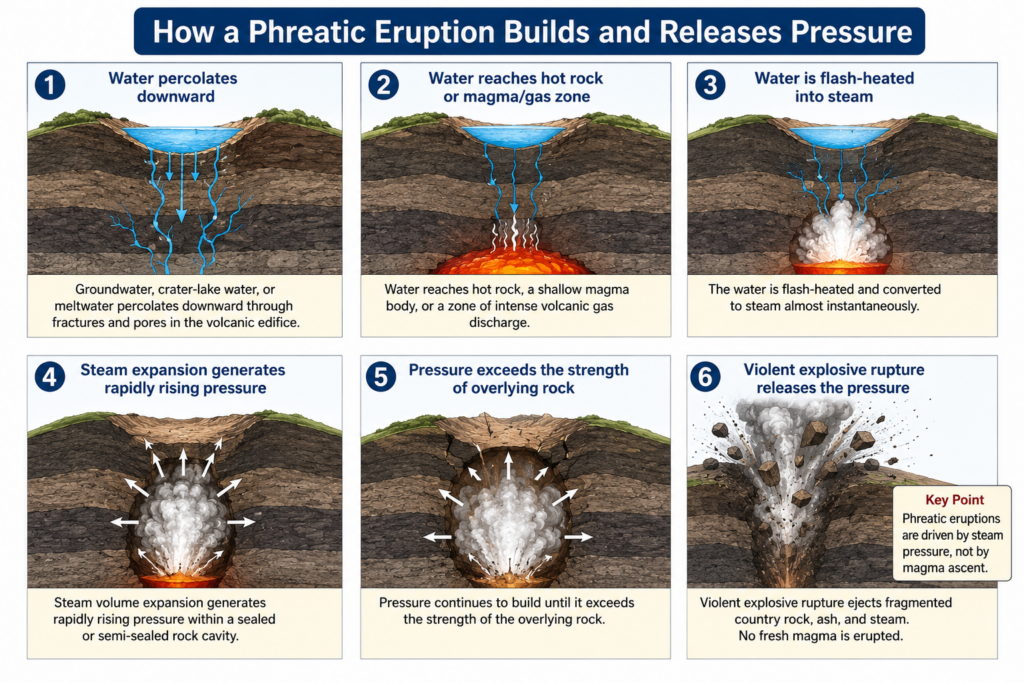
Mechanism: Water Meeting Heat Beneath the Surface
- Water supply: rain, a crater lake or snowmelt percolates through fractures into a hydrothermal system above a magma body.
- Sealing: mineral precipitation (silica, sulphur, clays) clogs pores and builds a low-permeability cap, so steam and gas pressure accumulate.
- Trigger: a pulse of heat or gas from below, a drop in confining pressure (earthquake shaking, lake-level fall) or failure of the seal lets superheated water flash to steam; its volume expands up to about 1,700-fold.
- Explosion: pressure exceeds rock strength and the cap is blasted out as a ballistic and ash jet, often within seconds of onset.
- Because no large body of magma is moving, the classic magmatic warnings — volcano-tectonic earthquake swarms and strong ground inflation — are weak or absent.
Settings
- Crater-lake volcanoes: Taal (Philippines) and Ruapehu (New Zealand), where a lake sits directly over the heat source.
- Vigorous hydrothermal fields: Whakaari/White Island (New Zealand) and Mount Ontake (Japan).
- Opening phase of magmatic eruptions: Kīlauea’s 1924 explosions came as its lava lake drained and groundwater met hot rock; Mount St. Helens began with phreatic blasts in March 1980.
Consequences
Direct hazards
- Ballistic blocks thrown hundreds of metres from the vent — the main killer of people near the crater.
- Ash fall disrupting aviation, water supply and breathing downwind.
- Base surges and toxic gas (H₂S, SO₂, CO₂) sweeping the crater floor and causing burns.
- Lahars where a crater lake is ejected or loose ash on steep slopes is remobilised.
Notable events
- Mount Ontake, 27 September 2014: an eruption at midday in peak hiking season killed 63 people — Japan’s deadliest eruption since 1902 — after a mid-September earthquake swarm that did not prompt any rise in alert level.
- Whakaari/White Island, 9 December 2019: 22 of 47 people on the island died and 25 were injured, although the alert level had been raised to 2 three weeks earlier.
- Taal, 12 January 2020: a phreatic opening escalated to phreatomagmatic activity and lava fountaining; about 459,000 people lived inside the 14-km danger zone and the crater lake dried up.
Wider consequences
- Escalation: a phreatic blast can open pathways for magma, as at Taal and St. Helens — so it is a hazard and a possible precursor at once.
- Geomorphic: explosion craters, collapse pits and drained or reshaped crater lakes.
- Management: exclusion zones, closure of crater tourism, and legal accountability — the Whakaari operator was convicted in 2023, but the conviction was overturned on appeal in 2025.
Can They Be Forecast? A Current Disagreement
- The orthodox view treats phreatic eruptions as essentially unforecastable: Ontake’s unmistakable signal came only about 10 minutes before the blast.
- David E. Dempsey, Shane J. Cronin and colleagues (2020) trained a machine-learning model on Whakaari’s continuous seismic tremor; it would have given at least four hours’ warning of the 2019 eruption and flagged four of five past eruptions in retrospective tests.
- Monitoring has therefore shifted toward tremor patterns, gas flux and crater-lake temperature and chemistry, not earthquake counts alone.
- Judgement: phreatic eruptions are small in volume but disproportionately lethal because they strike people standing at the crater with minimal warning; recent tremor-based forecasting shows the warning is short rather than absent, so the real safeguard is restricting access to active hydrothermal craters.