

Define the term ‘meander’ and describe the basic characteristics of entrenched meander and ingrown meander. (2014)
- A meander is a smoothly curving, loop-like bend in a river channel, formed as the river erodes its outer (concave) bank and deposits on its inner (convex) bank, so the bend grows and migrates. The word comes from the winding Büyük Menderes (ancient Maeander) river of western Turkey.
- Luna Bergere Leopold and Markley Gordon Wolman (1957) classed a single-thread channel as meandering when its sinuosity — channel length ÷ straight valley length — is 1.5 or more.
- Free meanders wander across loose alluvium on floodplains. When base level falls — tectonic uplift, regional warping or a fall in sea level — the rejuvenated river cuts its loops down into bedrock as incised meanders. Following John Lyon Rich (1914), William D. Thornbury split incised meanders by cross-profile into entrenched and ingrown types.
Entrenched Meander: Basic Characteristics
- Symmetrical cross-profile: both valley walls are equally steep, giving a deep, narrow, gorge-like trench.
- Downcutting far outpaces lateral erosion, so the loop’s plan shape is inherited almost unchanged from the older surface; there is little or no slip-off slope.
- Narrow valley floor: the river occupies nearly all of it, with little alluvium.
- Conditions: rapid uplift or base-level fall, often in resistant, massive rock that resists sideways cutting.
- Example: the Goosenecks of the San Juan River, Utah — loops cut more than 300 m (1,000 ft) deep as the Monument Upwarp rose.
Ingrown Meander: Basic Characteristics
- Asymmetrical cross-profile: a steep, undercut cliff on the concave (outer) side faces a gentle rock-cut slip-off slope on the convex (inner) side, often veneered with sand and gravel.
- Lateral and vertical erosion operate together: each loop keeps growing outward and shifting downvalley while it deepens, so the loop is visibly enlarged and skewed.
- Wider valley floor with slip-off slope terraces where incision paused; loops may be cut through at the neck, leaving a meander core — an isolated hill ringed by an abandoned incised loop.
- Conditions: slower uplift or base-level fall, or weaker rock that yields to sideways attack.
| Criterion | Entrenched meander | Ingrown meander |
|---|---|---|
| Cross-profile | Symmetrical | Asymmetrical |
| Inner (convex) side | Steep, like the outer side | Gentle slip-off slope |
| Loop shape | Inherited, little changed | Enlarged, shifted downvalley |
| Erosion balance | Vertical ≫ lateral | Vertical with active lateral |
| Usual setting | Fast uplift, resistant rock | Slow uplift, weaker rock |
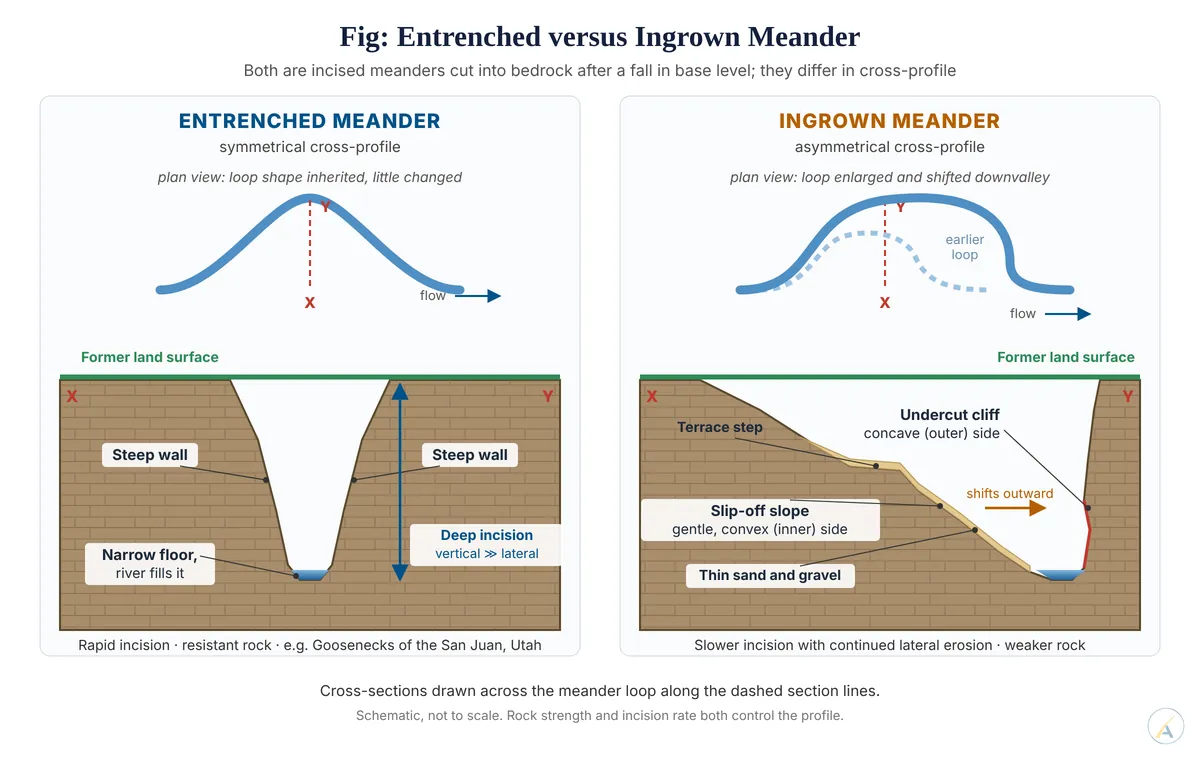
Reading the Two Types
- Classical reading: entrenched loops record a quick pulse of uplift; ingrown loops record slow, prolonged uplift — useful evidence in denudation chronology and polycyclic relief.
- Indian examples: on the rejuvenated Chotanagpur plateau, the Karo river at the southern edge of the Ranchi plateau and the Damodar near Rajrappa flow in incised meanders below knickpoint falls.
- The contrary evidence: John Tilton Hack and Robert S. Young (1959) showed that the incised meanders of the North Fork Shenandoah, Virginia, are controlled by planar structures in the shale they cross, needing neither inheritance nor a base-level fall. Ajay B. S. Limaye and Michael P. Lamb (2014) modelled bedrock valleys under steady uplift: resistant rock and fast incision gave narrow, deep valleys; weak rock and slow incision gave wide, shallow ones. In 2016 they showed terraces can form by meander migration alone, without any change in climate or tectonics.
- Judgement: symmetry records the ratio of vertical to lateral erosion, and rock strength controls that ratio as much as uplift rate does. An entrenched or ingrown profile usually signals rejuvenation, though not always, and timing the uplift from it needs independent dating of terraces or valley fills.