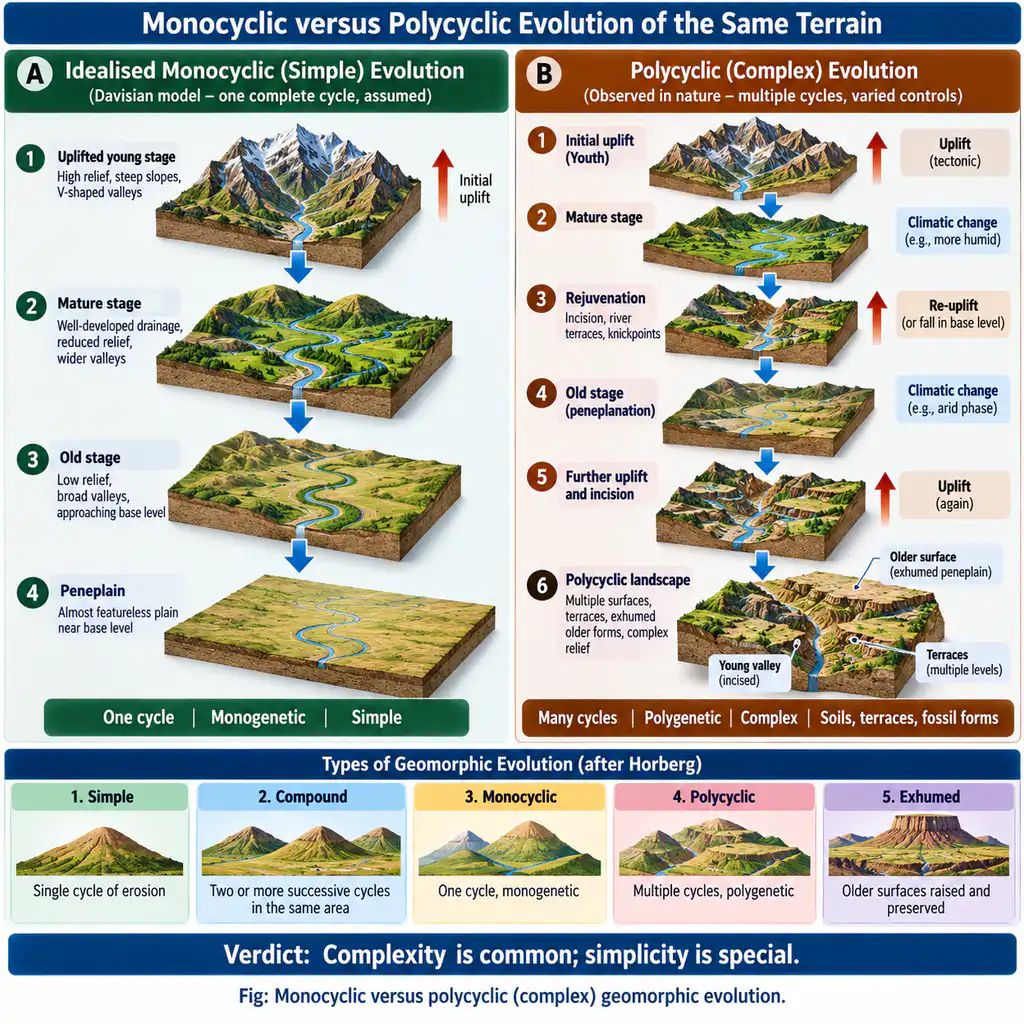
Question: “Complexity of geomorphic evolution is more common than simplicity.” Comment.
Introduction: Against the Monocyclic Ideal
The statement challenges the founding ideal of the Davisian geographical cycle (1899) — that a landscape evolves through a single, simple, monogenetic sequence (youth→maturity→old age) to a peneplain, and that most landscapes are monocyclic (one completed cycle). The geomorphological record says otherwise: complexity is the norm, simplicity the exception. Most landforms are compound (multi-genetic — shaped by several successive processes), polycyclic (each having passed through more than one erosional cycle), exhumed/resurrected (re-exposed after burial), or palimpsest (re-engraved over inherited forms). This is not merely an academic correction — it decides how denudation chronology, erosion-surface identification and present-process monitoring must be conducted. The statement is correct, demonstrably so, and its verification runs through Indian as well as global terrain.
1. The Ideal: Davis’s Simple (Monogenetic, Monocyclic) World
- Davis’s assumptions — all required for simplicity:
- A rapid initial uplift of a defined structure.
- Tectonic stability throughout the cycle (no renewed uplift).
- Stable base level (no eustatic/isostatic change).
- Uniform climatic environment (one process suite: fluvial).
- One uninterrupted cycle completing to a peneplain.
- Result: a simple, monogenetic landform — a single-genesis, single-cycle form — reachable only if all five conditions hold simultaneously over Ma.
- Horberg’s (1950) classification gives the taxonomy used in the exam: simple, compound, monocyclic, polycyclic, exhumed.
2. The Reality: Five Sources of Complexity
- 1. Interrupted cycles — polycyclicity: any base-level fall or renewed uplift re-opens the cycle: entrenched meanders, superimposed/rejuvenated drainage, multiple abandoned surfaces. Indian example: Chotanagpur — Netarhat (Jurassic), Ranchi Plateau (mid-Tertiary), Chaibasa plain (late Pliocene–Pleistocene) = three stacked cycles of planation; the Belan Basin shows Kaimur (427 m) → Panna (305–366 m) → Rewa (240 m) → Trans-Yamuna-Ganga (150 m) stepwise surfaces.
- 2. Climatic change — compound genesis: Pleistocene glacial–interglacial oscillation (4 glacial/4 interglacial episodes in classical numbering) changed the process suite repeatedly: glacial scour followed by fluvial adjustment, then periglacial modification — the same landform receives multiple genetic stamps. Fossil periglacial features in mid-latitudes, fossil dunes in Rajasthan, laterite caps in the humid tropics record successive different processes on the same ground.
- 3. Eustasy and isostasy — base-level instability: glacio-eustatic sea-level swings (up to ~100 m amplitude) and isostatic rebound (Scandinavia up to ~cm/yr) reset base levels; every reset is a new cycle. Unabated uplift (Himalaya rising at ~13.6–18 mm/yr GPS convergence; Nanga Parbat ~15 mm/yr vertical throw) guarantees the region is perpetually mid-cycle or multi-cyclic.
- 4. Structural inheritance — exhumation/resurrection: buried and re-exposed surfaces give exhumed (resurrected) landforms — a peneplain can be re-excavated and re-cycled; the Indian Gondwana surface, capped by Cretaceous Deccan basalt (~65 Ma), was exhumed in tracts where the cover has since eroded.
- 5. Palimpsest overprinting: young processes engrave over old forms without erasing them — a landscape carries several partially preserved generations of form (Ollier’s “palimpsest topography”); the present morphology is a hybrid, rarely a single-process, single-cycle product.
3. Validation through Evidence
- Dating-based proof: cosmogenic ¹⁰Be denudation rates across the Himalaya (basin-wide 0.7–1.2 mm/yr; Kosi pitting to 4.4 mm/yr in the Holocene) show accelerating, non-steady, episodic denudation histories — direct measurements of complexity in the present.
- Terrace and surface stratigraphy: every well-dated river sequence (e.g., Himalayan strath terraces) contains multiple generation landscapes; each terrace level is a record of a separate base-level/climate episode.
- Modern process tends to obscure, not resolve: today’s measurement windows (years-decades) capture transient adjustment — aggradation, knickpoint migration, avulsion (Kosi 2008 Kusaha breach inundated ~3,000 km², displacing ~3.5 million) — permanent nonequilibrium rather than a grading-to-peneplain.
- Equifinality compounds misreading: different complex histories can converge on similar-looking forms — reinforcing the warning that simple interpretation is usually an artefact of the observer’s model, not of the landscape.
4. Response and Reconciliation: Davis’s Own Capitulation
- Davis himself conceded the point (1909–1912): he introduced the “second cycle of erosion”, the multi-cyclic landscape and the concept of polygenesis to absorb the evidence — implicitly abandoning the strict monocyclic claim this statement critiques. Crickmay (1933), King (1953) and Büdel (1957) pushed further toward non-Davisian polygenesis (panplains, pediplains, etchplains).
- The modern synthesis: geomorphologists embrace complexity — episodic erosion (Schumm), polycyclic surfaces established by field + geochronology, and hierarchical scale (Q27) — while retaining the Davisian sequence as a modal template for single-cycle segments. Complexity is the hypothesis to be tested; simplicity is the special case to be proven.
5. Conclusion
The statement is correct and fundamental. Landscape evolution in the real world is overwhelmingly complex and compound: polycyclic surfaces, multi-genetic forms, exhumed/resurrected features and palimpsest overprinting — all driven by repeated uplift, eustatic/isostatic base-level change, Pleistocene climatic oscillation, and structural inheritance — are the common record; truly simple, monogenetic, monocyclic landforms require such restrictive conditions (stable structure, stable base level, constant climate, single uninterrupted cycle) that they are the exception. The discipline’s own history — Davis’s retreat to second cycles, the rise of denudation chronology, and the modern geochronological verification of episodic denudation — confirms that complexity is the norm, simplicity the ideal limit. Every interpretation of an Indian landscape — from the stacked surfaces of Chotanagpur to the avulsing Kosi fan and the rising, glacier-milled Himalaya — must therefore begin from complexity and demonstrate simplicity only where the evidence (introspection-free stratigraphy, geochronology, and scale-appropriate analysis) supports it.