

Compare and contrast different types of plate boundaries. (2019)
- A plate boundary is the narrow zone where two lithospheric plates meet; the direction of relative motion across it decides what happens to the crust, the landforms built, and the depth and size of earthquakes.
- J. Tuzo Wilson (1965) recognised three types: divergent (constructive), convergent (destructive) and transform (conservative) — named after whether lithosphere is created, destroyed or conserved.
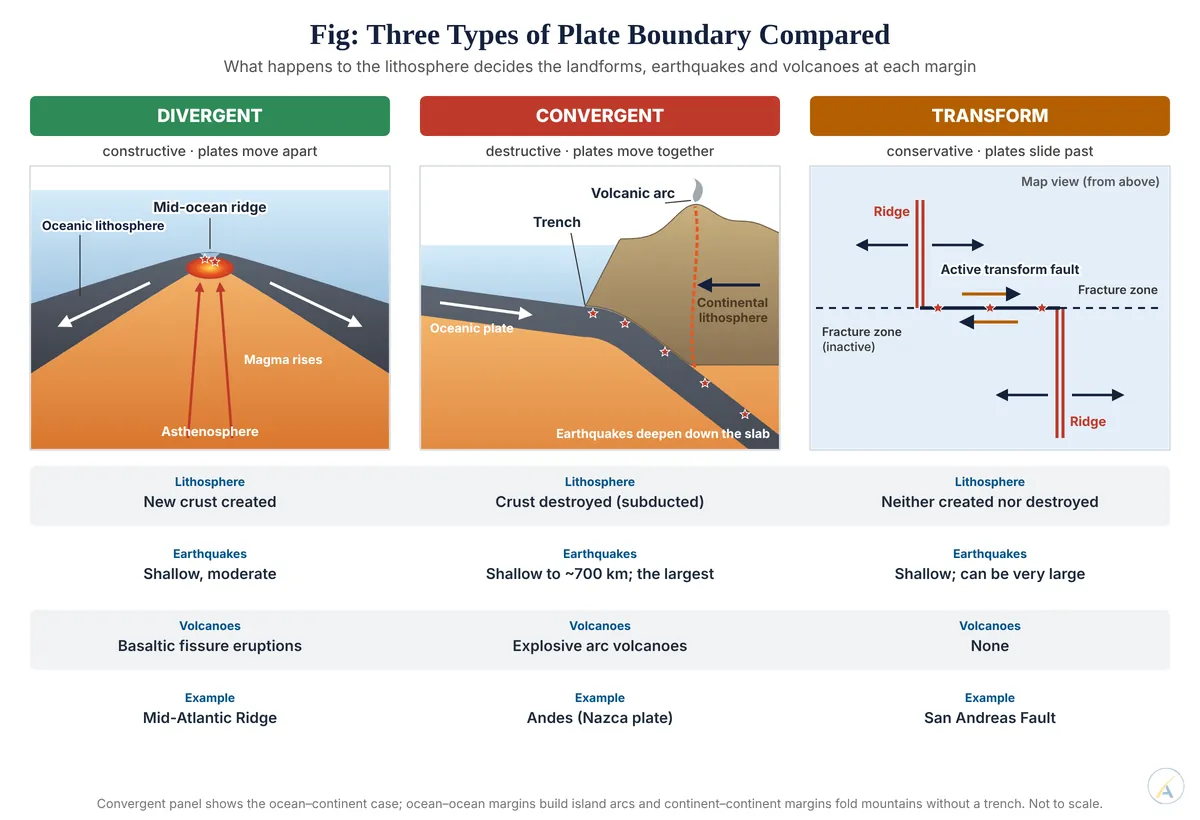
- The comparison below uses the same criteria for each: motion, fate of crust, landforms, seismicity, volcanism and examples.
What All Boundaries Share
- Each is a zone of concentrated stress and deformation: the great majority of the world’s earthquakes and active volcanoes lie along plate boundaries, while plate interiors are comparatively quiet.
- Each is driven by the same engine — slab pull at trenches, ridge push at spreading centres and mantle convection beneath — so the three types are linked parts of one moving system, not independent features.
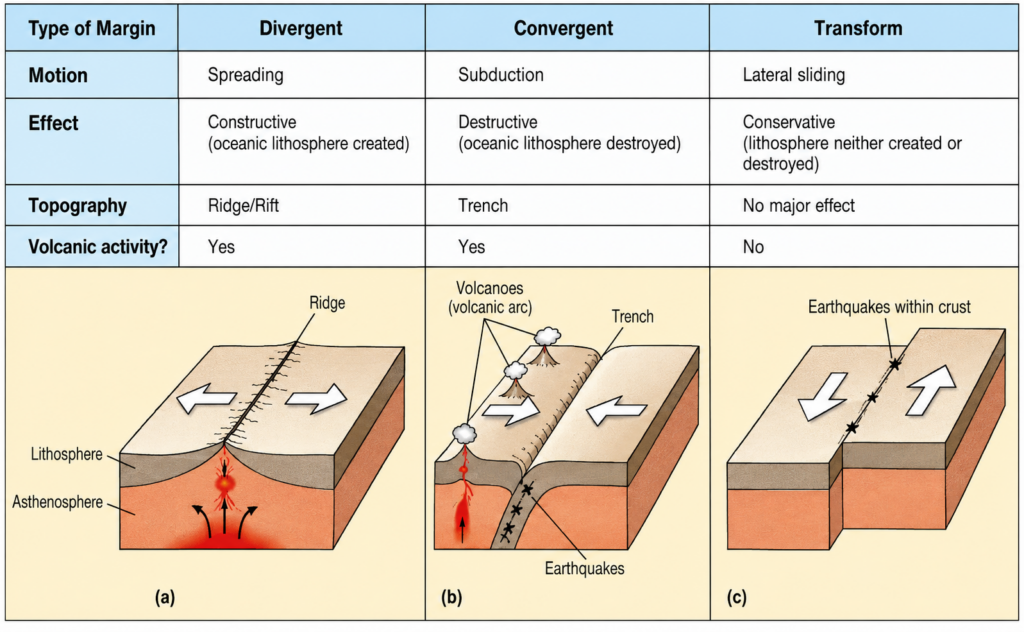
Divergent (Constructive) Boundaries
- Motion: plates move apart; mantle rock rises, partly melts and fills the gap as new basaltic crust.
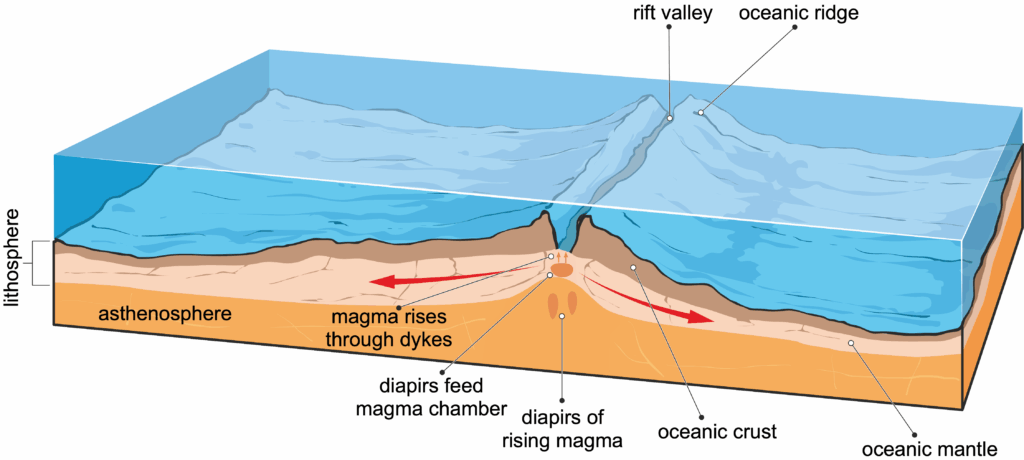
- Oceanic divergence builds the mid-ocean ridge system, about 65,000 km long — the longest mountain chain on Earth.
- Spreading rate shapes the ridge: slow ridges (under about 4 cm a year, such as the Mid-Atlantic Ridge) carry a deep axial rift valley; fast ridges (over about 9 cm a year, such as the East Pacific Rise) have a smooth crest and no rift valley.
- Iceland is a ridge segment raised above sea level by a hotspot.
- Continental divergence produces rift valleys bounded by normal faults: the East African Rift (an early stage) and the Red Sea (a young ocean).
- Seismicity: shallow-focus, mostly moderate earthquakes; volcanism: quiet basaltic fissure eruptions.
Convergent (Destructive) Boundaries
- Motion: plates move towards each other; the outcome depends on the density of the lithosphere on each side.
Oceanic–continental
- Dense oceanic lithosphere subducts beneath the continent, forming a deep trench, a continental volcanic arc and a dipping Benioff zone of earthquakes reaching down to about 700 km.
- Example: the Nazca plate beneath South America — the Peru–Chile Trench and the Andes.
Oceanic–oceanic
- The older, colder, denser plate sinks beneath the younger one, producing a trench and an island arc.
- Example: the Pacific plate beneath the Philippine Sea plate — the Mariana Trench and the Mariana Islands; also the Tonga arc.
- Indian example: the Indian plate subducts beneath the Burma microplate along the Andaman arc (the Sumatra segment, under Sundaland, is ocean–continent), which produced the 2004 Sumatra–Andaman earthquake (Mw 9.1) and the tsunami; Barren Island, India’s only active volcano, lies on this arc.
Continental–continental
- Continental lithosphere is too buoyant to subduct deeply; collision shortens, thickens and folds the crust into the highest mountains, with little or no volcanism.
- Example: India–Eurasia — the Himalaya, along whose Main Himalayan Thrust the 2015 Gorkha (Nepal) earthquake (Mw 7.8) occurred.
- Seismicity contrast: earthquakes are mostly shallow, spread over a broad zone, with intermediate-depth clusters only where an old slab survives, as beneath the Hindu Kush.
Transform (Conservative) Boundaries
- Motion: plates slide horizontally past one another along near-vertical strike-slip faults; crust is neither made nor destroyed.
- Oceanic transforms offset ridge segments; earthquakes occur only between the offset ridge tips — beyond them the scar continues as an inactive fracture zone.
- Continental transforms cut through populated land:
- The San Andreas Fault (Pacific–North American plates).
- Indian examples: the Chaman Fault on India’s north-western margin and the Owen Fracture Zone between the Indian and Arabian plates.
- Seismicity: shallow-focus but potentially very large, because long locked segments store strain; volcanism: generally absent.
Comparison on Common Criteria
| Criterion | Divergent | Convergent | Transform |
|---|---|---|---|
| Motion and crust | Apart; crust created | Together; crust destroyed or thickened | Side by side; crust conserved |
| Landforms | Ridge, rift valley | Trench, volcanic arc, fold mountains | Linear fault valley, offset ridges |
| Earthquakes | Shallow, moderate | Shallow to 700 km; the largest (Mw 9) | Shallow; can be very large |
| Volcanism | Basaltic, effusive | Andesitic, explosive (none in collision) | Absent |
| Examples | Mid-Atlantic Ridge, East African Rift | Andes, Mariana, Himalaya | San Andreas, Chaman |
- Gradient within convergence: from oceanic–oceanic to continental–continental, subduction becomes less complete, volcanism weaker and crustal thickening stronger.
Where the Neat Classes Blur
- 2016 Kaikōura earthquake (Mw 7.8), New Zealand: about 25 faults ruptured in one event, where the southern end of the Hikurangi subduction zone meets the Marlborough strike-slip faults — one of the most complex ruptures ever recorded.
- 2023 Türkiye–Syria earthquakes (Mw 7.8 and 7.7): strike-slip rupture on the East Anatolian Fault, a continental transform, caused over 50,000 deaths — “conservative” describes the crust, not the hazard.
- Diffuse boundaries: the 2012 Indian Ocean earthquake (Mw 8.6), the largest strike-slip event recorded, struck inside the Indo-Australian plate, where the Indian and Australian parts move slightly differently and deform across a zone hundreds of kilometres wide rather than along a sharp line.
- Judgement: the three types differ fundamentally in what happens to the crust — created, destroyed or conserved — and that one difference drives every contrast in landform, earthquake and volcano; but real margins are often mixed or diffuse, so the classes are best treated as end-members of a continuum, with convergent margins by far the most hazardous and transforms more dangerous than their name implies.