337,362+ aspirants visit every month


Unlock Elite Access: Level Up Your Preparation with Exclusive Content
PSIR Optional PYQ Solutions · Model answer
Does the idea of the 21st century as ‘Asian century’ continue to remain feasible given the growing friction between India and China?
- UPSC 2024
- 15 marks
- India and the Global Centres of Power
Unlock the full answer · ₹1,770 ↓
The idea has an Indian–Chinese birth certificate: Deng Xiaoping told Rajiv Gandhi in Beijing in December 1988 that no genuine Asia-Pacific century could come unless China and India both developed. Parag Khanna's The Future Is Asian (2019) gives the popular form: a world Europeanised in the nineteenth century, Americanised in the twentieth and now being…
You are reading the opening of the model answer. The full answer is part of the PSIR Optional PYQ Solutions.
What the full answer covers
- What the Asian century claims
- Why India–China friction undermines it
- Why the idea survives
- Conclusion
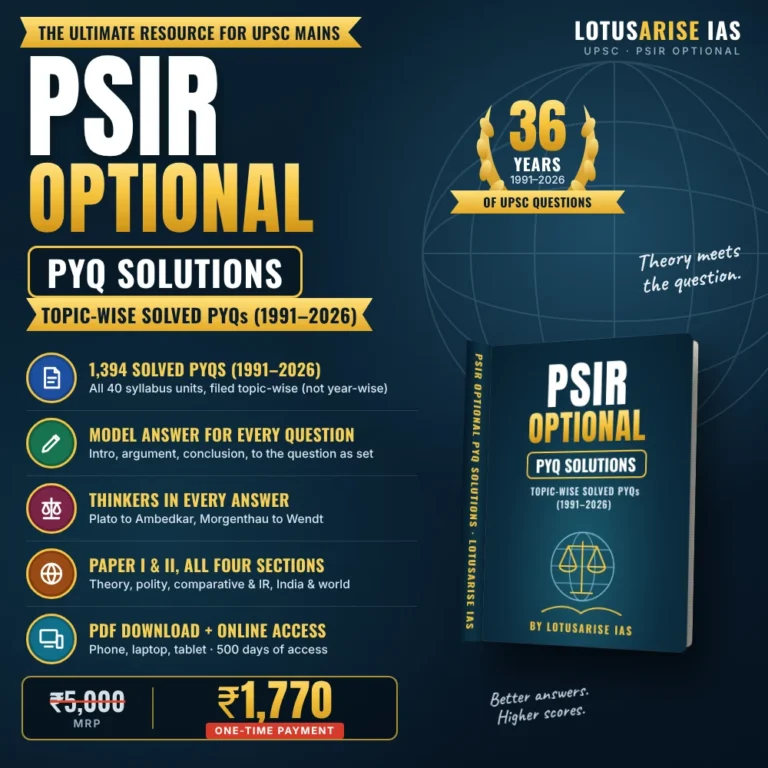
PSIR Optional PYQ Solutions
Unlock this answer and 1,393 more
- 1,394 solved UPSC PSIR PYQs from 1991 to 2026, Paper-1 and Paper-2
- Topic-wise across all 40 syllabus units
- A full model answer for every question
- Read online on lotusarise.com, plus PDF download
- 500 days of access from the day you enrol
₹1,770₹5,00064% off
One-time payment · No subscription · Instant access · UPI, cards, RuPay
See every India and the Global Centres of Power question (65 solved) →Already enrolled? Log in
PSIR Optional · Kits & packs
Score more in PSIR Optional.
PSIR PYQ Solutions give you a full model answer to all 1,394 PSIR PYQs, topic by topic. The Mains Master Kit gives you the complete self-study system for Paper 1 and Paper 2.
- 1,394 solved PYQs from 1991 to 2026, across all 40 units
- Notes for all four sections, updated with current developments
- One-time payment · instant access · no subscription
Trusted by 3,00,000+ aspirants every month · Secure checkout · UPI, cards, RuPay
Most enrolled in PSIR Optional