

Question: “Although structure can create variations in the details, the cycle of erosion will ultimately achieve its objectives in the same sequence.” Discuss.
Introduction: Davis’s Claim of Convergent Denudation
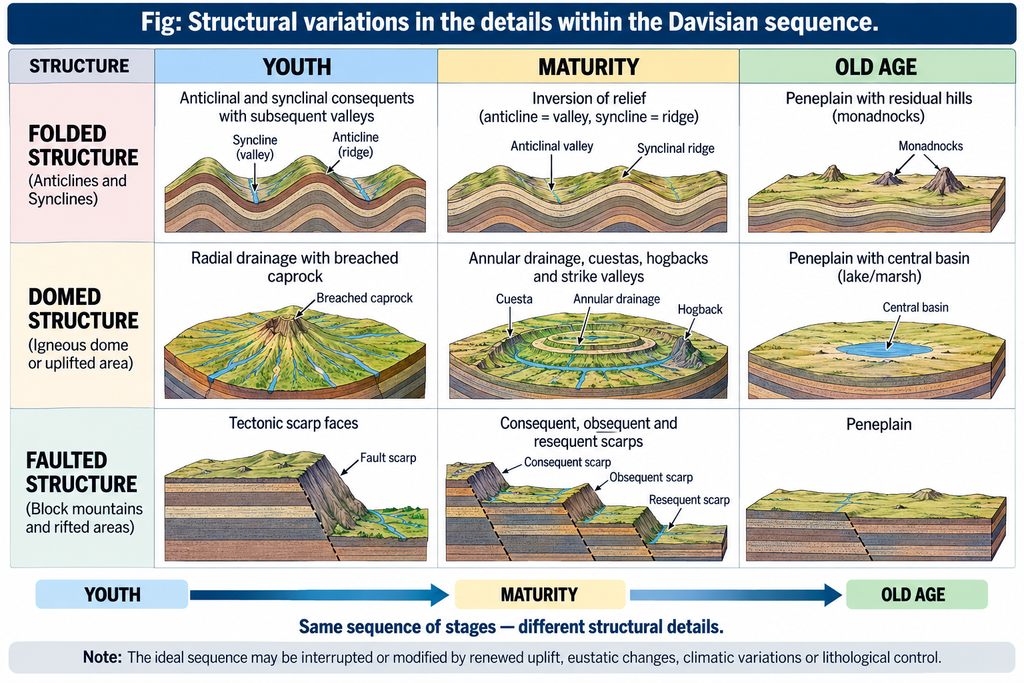
The statement is the classic Davisian thesis of the geographical cycle (1899) transposed onto structural geology: whatever the initial geological structure — folded, domed, faulted, plateau, or simply tilted — the sequence of the erosional cycle (youth → maturity → old age) runs to the same destination (peneplain), with structure merely modulating the details: drainage adjustment, local relief, landform type. In Davis’s own vocabulary, structure is the passive framework, process the agent, stage the progress. The statement is broadly correct as a modal model — but it is also the single most-criticised claim in geomorphology, because episodic uplift, polycyclicity and structural inheritance repeatedly violate the assumption of one uninterrupted cycle on one stable structure. The correct verdict: structure controls the route; process deposits the timetable; neither guarantees a single, convergent sequence.
1. The Theoretical Basis: Structure, Process, Stage
- Davis’s trio: “Landscape is a function of structure, process and stage” (L = f(S, P, T)). The cycle assumes (i) a rapid uplift of a defined structure, (ii) tectonic stability thereafter, (iii) long, uninterrupted denudation, and (iv) a fixed base level.
- Under these assumptions, the sequence is invariant: youth (steep gradients, V-valleys, waterfalls, adjustment of drainage to structure) → maturity (maximum relief, integration of drainage, interfluves reduced) → old age (gently undulating peneplain with residual monadnocks).
- The same sequence claim therefore means: every landscape, whatever its structure, traverses an ordered, non-reversible developmental ladder toward base level. Structure intervenes only in which minor landforms appear along the way.
2. Structure’s Role in Detailed Variation: Three Case Landscapes
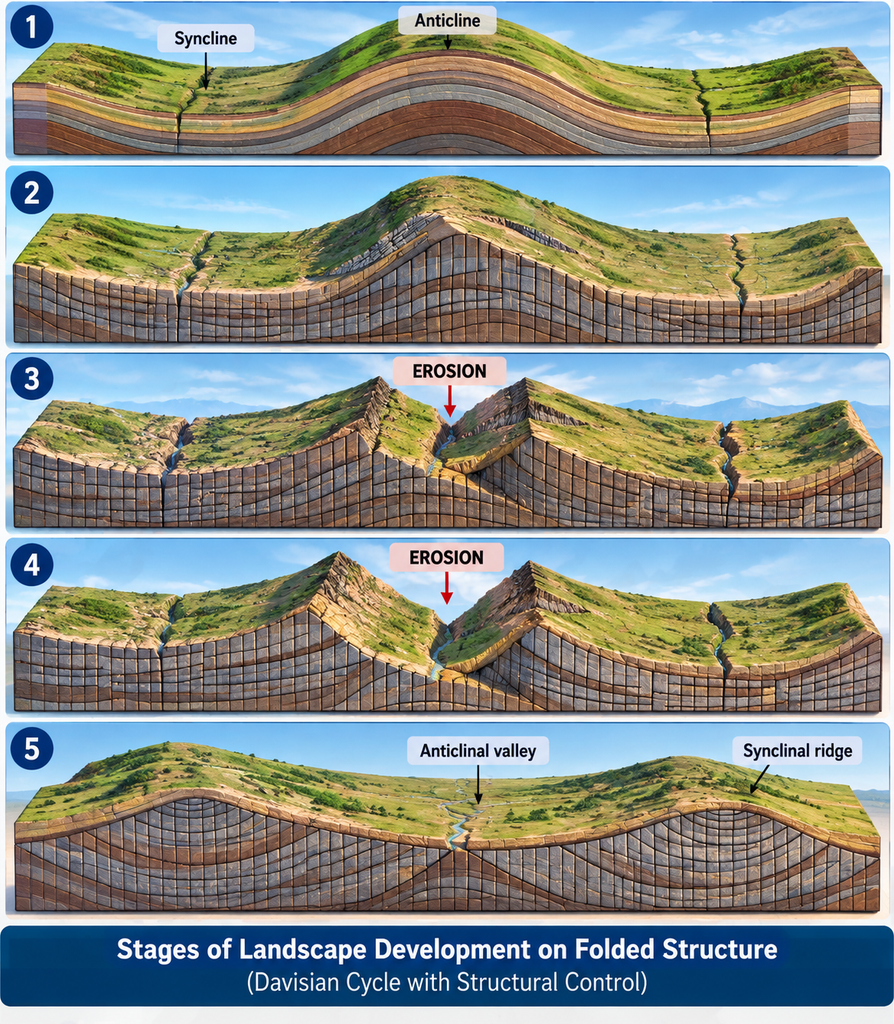
A. Folded Landforms — Inversion of Relief
- Youth — drainage genesis: Master consequent (synclinal) streams flow longitudinally in troughs; lateral consequents flow down dip slopes of anticlines; subsequent streams later develop along anticlinal axes by headward erosion. All initally sequent — adjusted to structure.
- Maturity — inversion of relief: anticlinal crests, cracked by tension and cored by soft beds, erode fastest; the original anticlines become valleys, synclines become ridges. Resequent streams reappear on resurrected dips; uniclinal/homoclinal shifting carries subsequent streams down dip.
- Old age: relief is reduced; streams cease to be structure-controlled; the folds are buried under alluvium; the peneplain is structurally blind.
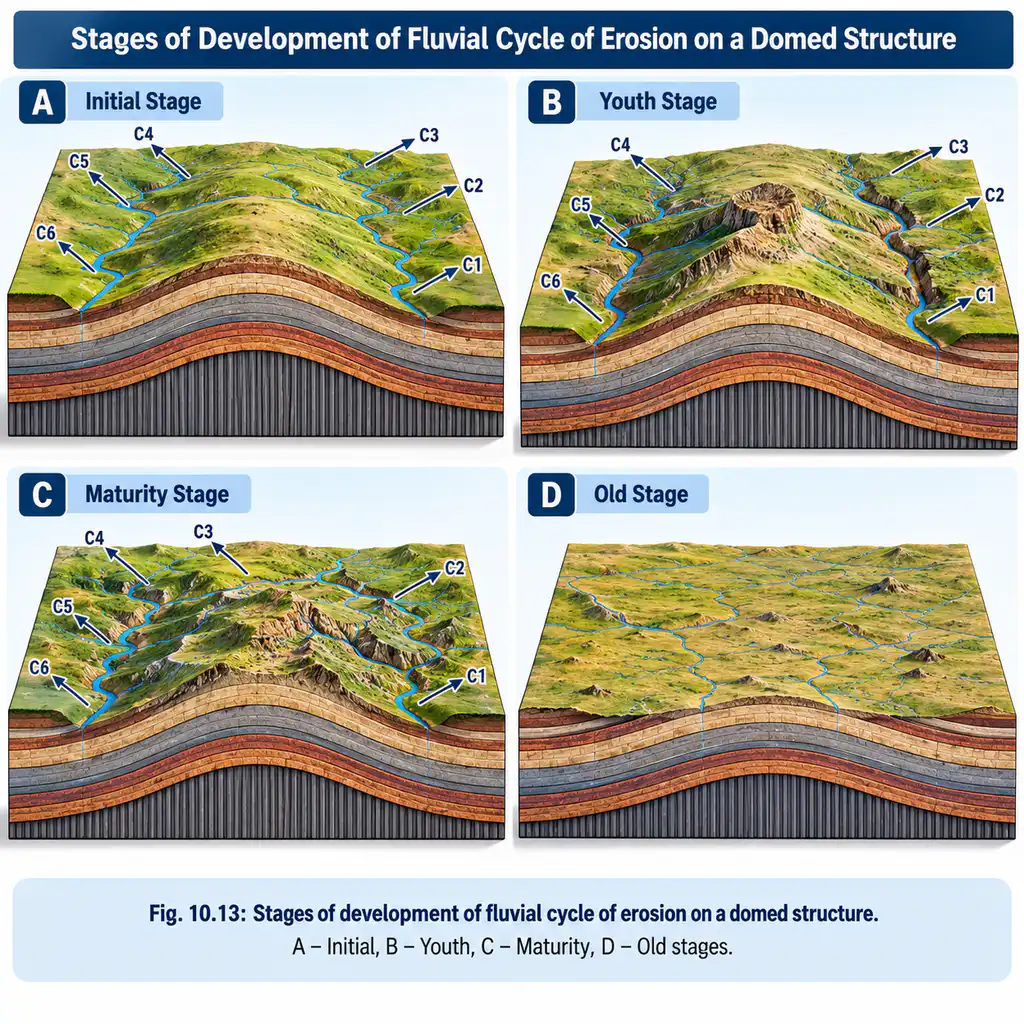
B. Domed Landforms — Radial to Annular Drainage
- Youth: radial (centrifugal) consequent streams run off the dome; headward erosion breaches the resistant caprock; basins and scarps (steep on resistant beds, gentle on soft) develop; the crystalline core begins to be exposed.
- Maturity: vertical erosion slackens, lateral erosion and branching intensify; subsequent streams at right angles to consequents emerge; river capture is common; annular drainage encircles the breached dome; cuestas (asymmetric ridges) and hogbacks (symmetric) separate strike valleys on soft beds; a dissected plateau or broad central basin forms over the dissected or weak core.
- Old age: hogbacks, cuestas and strike valleys are levelled; the core is worn; total convergence to peneplain.
- Even within one structure the “details” vary: dome size and core resistance decide plateau vs basin — but the sequence is identical to the folded case.
C. Faulted Landforms — Fault-line Scarps
- Faulting supplies the initial structure; erosion then re-reads it lithologically:
- Consequent fault-line scarp — erosion of the downthrown block’s weak strata, scarp aligned with the original tectonic scarp (normal orientation) though faulting is now inactive.
- Obsequent fault-line scarp — erosion of the upthrown block’s weak beds produces a scarp opposite in orientation.
- Resequent fault-line scarp — renewed erosion after base-level fall, same orientation as the original, and older than the original scarp.
- Composite fault-line scarp — part tectonic, part erosional (either the lower base or upper crest erosional).
- Exhumed (resurrected) fault-line scarp — an older scarp buried then re-exposed by erosion of the cover, “as if reborn”.
- The variety here is entirely structural — yet the long-run state is still planation. Structure, in Davis’s idiom, writes the details; the process still writes the sequence.
3. Where the Claim Holds — Evidence for the Convergence Thesis
- Field examples of near-sequential denudation: the Chotanagpur polycyclic surfaces (R.P. Singh, 1969) — Netarhat Patland ~1,065 m (Jurassic laterite-capped peneplain) → Ranchi Plateau ~650–700 m (mid-Tertiary) → Chaibasa Plain 150–300 m (late Pliocene–Pleistocene) — show successive stages of planation read as one evolving sequence.
- Belan Basin (Singh & Srivastava, 1976): Kaimur ~427 m → Panna 305–366 m → Rewa ~240 m → Trans-Yamuna-Ganga ~150 m; a stepped record of sequential cycles on a rising craton.
- Structural uniformity of the sequence: in stable shield territories (Aravallis, Chotanagpur, Bundelkhand), the youth→peneplain ladder is empirically documented; structure (fold/fault/eruption) rarely reverses the direction of denudation — it only locally changes relief morphology.
4. Where the Claim Fails — Six Substantive Critiques
- 1. No single uninterrupted cycle: Davis himself (1909) conceded second and later cycles of erosion — rejuvenation by uplift or base-level fall interrupts the sequence, producing polycyclic (multicyclic) forms: entrenched meanders, vanished peneplains, residual surfaces. A single “objectives in the same sequence” holds only for monocyclic (Davisian) accident-free cases.
- 2. Base level is not stable: eustatic changes (Pleistocene glacio-eustasy ~100 m amplitude), isostatic rebound (Scandinavia rising at up to ~1 cm/yr near the Gulf of Bothnia), and deltaic/sediment base-level shifts violate the fixed-base-level assumption. The sequence resets repeatedly.
- 3. Structure as dynamic, not passive: Holistic structure includes ongoing tectonics — e.g., the Himalaya rising at GPS-measured convergence rates of ~13.6–18 mm/yr across the NW Himalaya (Kashmir frontal arc ~13.6, Kumaun ~18); the MFT locked and building strain. A system actively changing structure cannot converge to a Davisian peneplain; it has reached, instead, a dynamic equilibrium profile (J.T. Hack) with relief equilibrium sustained by continued uplift, not peneplanation.
- 4. Process variability breaks the timetable: arid, semi-arid and glacial regimes (pediplanation by King; etchplanation by Büdel’s double planation; glacial overdeepening) deliver different end-states — pediplains, etchplains, inselberg landscapes — not the humid-climate peneplain. The “objectives” differ by climate regime before structure is consulted.
- 5. Competing length-time linkage: Penck emphasised the uplift–denudation ratio (parallel decline, waxing/waning development); with continuous uplift no peneplain forms at all. Where uplift is continuous, the cycle’s sequence is never completed.
- 6. Inheritance and palimpsest: Structure often encodes ancient episodes. Exhumed surfaces and palaeo-forms under thin cover (e.g., Gondwana surface capped by Cretaceous Deccan basalt ~65 Ma in the peninsular shields) show that present “stage” mixes several different cycles — complexity, not sequence.
5. Reconciliation: Structure, Process and Stage Re-Jointed
- Modern geomorphology keeps Davis’s triad but drops his determinism:
- Structure = framework + active tectonics (lithology, joints, faulting, uplift rate).
- Process = sani life of climate-controlled agents (fluvial, glacial, arid, karst, coastal).
- Stage/Time scale = a spectrum (Schumm & Lichty’s cyclic, graded, steady time), not one ladder.
- Verdict on the statement: true only under restrictive assumptions (single cycle, stable base level, uniform climate, stable structure). Where those hold — the classic plateaux and folded belts — structure indeed varies only the details and the sequence is achieved. Where they fail — most of the real Earth — the sequence is interrupted, redirected and re-begun, and the landscape records complexity more commonly than simplicity (Horberg’s compound/polycyclic/exhumed types).
Conclusion
The statement is a faithful statement of Davis’s optimistic, monocyclic vision: structure varies the details (drainage pattern, relief inversion, scarp types, hogback-curved domes), but the sequence — youth, maturity, old age, peneplain — is the “objective” achieved if one uninterrupted cycle runs its course. The twentieth-century correction is decisive, however: base-level instability, tectonic activity, climatic change and inherited structures repeatedly interrupt the sequence, so that most real landscape histories are polycyclic and compound. The balanced answer is that structure shapes the details and often the timing and type of landforms; process can carry the same sequence to its objective; but only a rare combination — stable structure, stable base level, single climatic regime, and long tectonic quiescence — ever lets the cycle finish. For the Himalaya, the DMIC corridor of the Indus, and most of the world’s rising orogens, the cycle’s “objectives” are perpetually deferred — equilibrium, not peneplain, is the achieved state.