337,362+ aspirants visit every month


Unlock Elite Access: Level Up Your Preparation with Exclusive Content
PSIR Optional PYQ Solutions · Model answer
Do you think that India’s capacity building role in Afghanistan has shrunk the strategic space for Pakistan there? Discuss.
- UPSC 2018
- 20 marks
- Recent Developments in Indian Foreign Policy
Unlock the full answer · ₹1,770 ↓
Kautilya's mandala theory holds that the neighbour is a natural rival and the state beyond it a natural friend. Afghanistan, Pakistan's other neighbour, therefore matters to India's dealings with Pakistan. After 2001 India chose to compete there not with troops but with capacity building. The honest answer is that this narrowed Pakistan's soft space considerably,…
You are reading the opening of the model answer. The full answer is part of the PSIR Optional PYQ Solutions.
What the full answer covers
- India's model: building a state and a society
- Where India did shrink Pakistan's space
- Why it did not shrink Pakistan's hard space
- The post-2021 inversion
- Conclusion
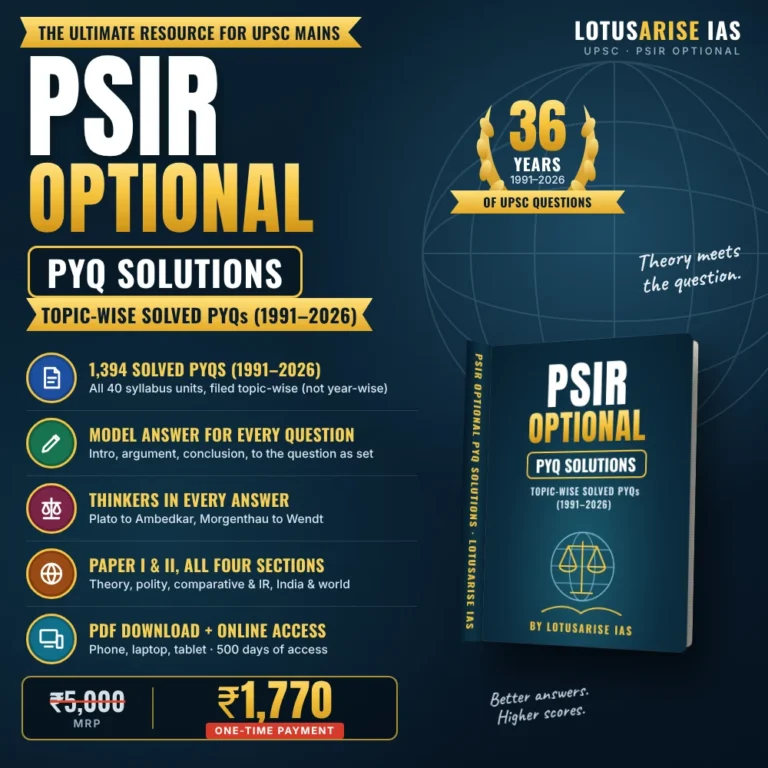
PSIR Optional PYQ Solutions
Unlock this answer and 1,393 more
- 1,394 solved UPSC PSIR PYQs from 1991 to 2026, Paper-1 and Paper-2
- Topic-wise across all 40 syllabus units
- A full model answer for every question
- Read online on lotusarise.com, plus PDF download
- 500 days of access from the day you enrol
₹1,770₹5,00064% off
One-time payment · No subscription · Instant access · UPI, cards, RuPay
See every Recent Developments in Indian Foreign Policy question (49 solved) →Already enrolled? Log in
PSIR Optional · Kits & packs
Score more in PSIR Optional.
PSIR PYQ Solutions give you a full model answer to all 1,394 PSIR PYQs, topic by topic. The Mains Master Kit gives you the complete self-study system for Paper 1 and Paper 2.
- 1,394 solved PYQs from 1991 to 2026, across all 40 units
- Notes for all four sections, updated with current developments
- One-time payment · instant access · no subscription
Trusted by 3,00,000+ aspirants every month · Secure checkout · UPI, cards, RuPay
Most enrolled in PSIR Optional