

Religious Experience: Nature and Object (Indian and Western).
Official Syllabus: Paper II, Section B, Unit 6
Every religious experience claims to be an experience of something — of God, of the Holy, of Brahman, of nirvāṇa, of the unity of nature. But the objects reported are strikingly different, and the most important of them — an infinite God, an attributeless Brahman, an unconditioned nirvāṇa — seem to be the kind of thing that can never be an object at all. This article asks: what is the object of religious experience in the Indian and Western traditions? Is it empirical or trans-empirical? How much of what mystics report is experience and how much is interpretation? And can the many objects be seen as faces of one Reality — as the perennialists and John Hick claim — or are they genuinely different, as Steven Katz argues?
In simple words
You are walking home at night and hear footsteps behind you. If you have just been talking about thieves, you “hear” a thief; if you are expecting your brother, you “hear” your brother. Something real is there — the footsteps — but what you take it to be depends partly on what you bring. The puzzle of the object of religious experience is the same: how much comes from the reality encountered, and how much from the mind that meets it?
Context & Problem
Why the Object Matters
- Experience is directed. An emotion like a vague sadness may have no object, but an experience in the full sense — seeing, hearing, meeting — is always of something. Religious experiencers do not say “I felt odd”; they say “God spoke to me”, “I realised I am Brahman“, “I saw that all is empty“.
- The variety is great. Studies suggest that a large share of humanity — around a third in some surveys — report some religious experience; but they report very different objects.
- The questions.
- What objects do the different traditions claim?
- Can the ultimate be an “object” at all?
- Is the object empirical (given to the senses) or trans-empirical (beyond them)?
- How much is experience and how much interpretation?
- Is there one object behind the many reports?
Core Doctrine
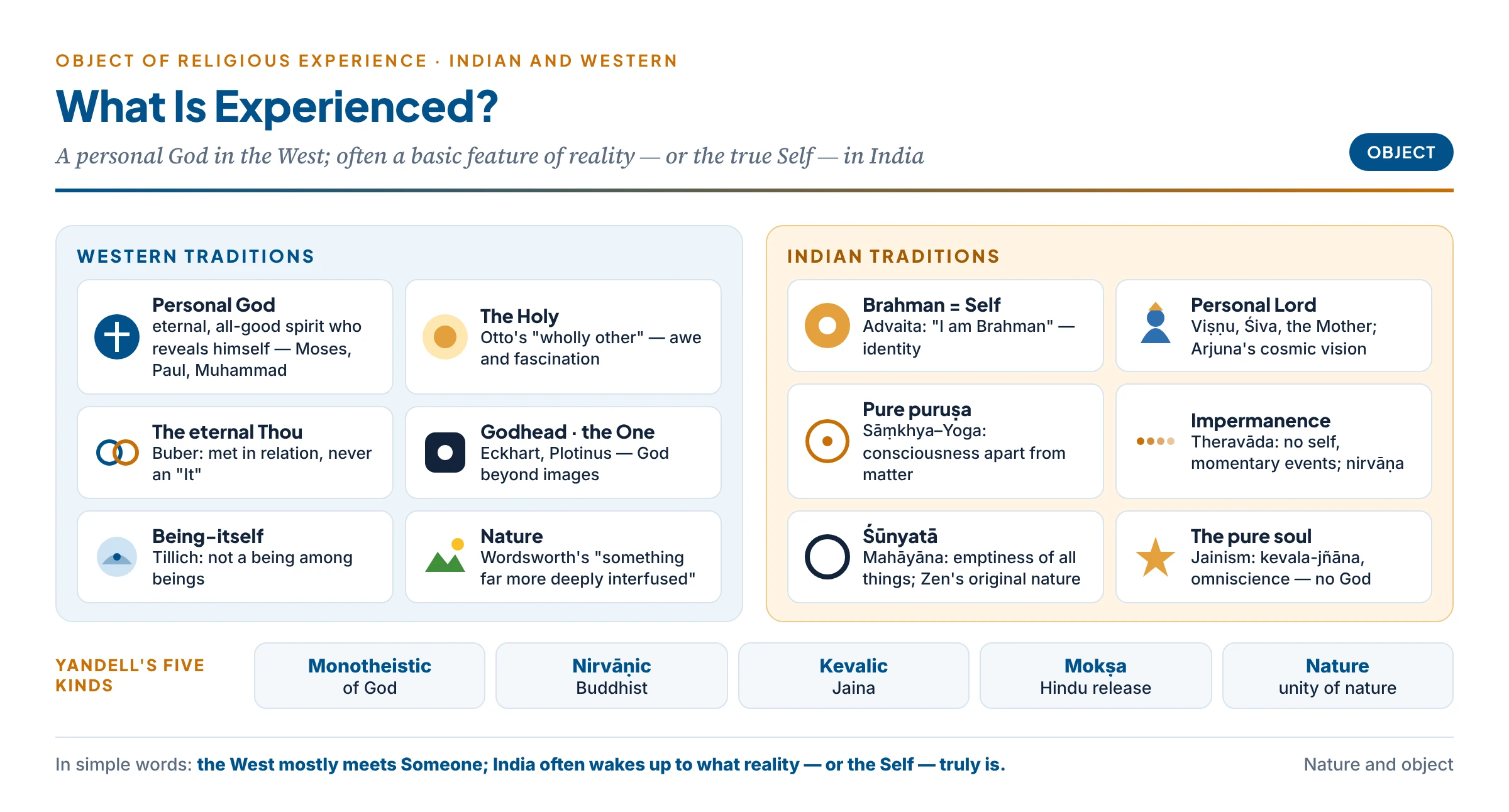
1. The Objects Claimed in the Western Religions
- The personal God of theism. In Judaism, Christianity and Islam the object is typically God himself — an eternal, omniscient, omnipotent, free and perfectly good spirit. God reveals himself, sometimes unbidden (Moses at the burning bush, Muhammad in the cave of Ḥirā, Paul on the road to Damascus), sometimes to those who undertake a rigorous practice to draw near (the mystics).
- Other supernatural objects. Angels, demons, saints, the Virgin Mary, heaven and hell. This is why Swinburne defines religious experience as an experience “of God or of some other supernatural thing” — otherwise Bernadette’s vision of Mary would not count.
- The Holy (Otto). The object of the numinous experience is the “wholly other” — an overpowering presence felt with awe and fascination; “a separate self or will or power which forces itself upon the consciousness of the experiencer, unexpectedly and profoundly”.
- The Infinite (Schleiermacher). The object is the “Whence” of our feeling of absolute dependence — the Infinite felt in and through the finite.
- The Godhead and the One. In mystical union the object is God beyond images: Eckhart’s silent Godhead, Plotinus’ One.
- The eternal Thou (Buber). Martin Buber held that God can never become an “It”, a thing observed; God is met only in the I–Thou relation, as one meets a person rather than examines a stone.
- Being-itself (Tillich). Paul Tillich: God is not a being alongside other beings but Being-itself, the ground of being; “God does not exist” as one thing among things. The object of faith is what concerns us ultimately.
- Nature. In nature mysticism the object is the unity or sacredness of nature — Wordsworth’s “sense sublime / Of something far more deeply interfused“. Here even an atheist may have a “religious” experience.
2. The Objects Claimed in the Indian Religions
- A basic feature of reality, not a separate being. In the Indian traditions the object of religious experience is often some basic fact or feature of reality rather than an entity separate from the universe.
- Hinduism.
- Gods and the personal Lord — Arjuna’s encounter with Kṛṣṇa’s cosmic form (viśvarūpa) in the Gītā; the bhakta’s vision of Viṣṇu, Śiva or the Mother.
- Brahman and its identity with the Self — the central object of Upaniṣadic and Advaitic experience (Article 6).
- The pure self (puruṣa) — in Sāṃkhya–Yoga, the experience of kaivalya: consciousness standing apart from matter (prakṛti).
- Theravāda Buddhism. The goal is to “see things as they are” — unsatisfactory, impermanent, not-self; as sequences of momentary events, each dependent on what went before (“this being, that arises“). The object is not a positive transcendent being but an insight into the fundamental reality of the world — that it is momentary, impermanent, always “becoming”. Seeing this extinguishes the fires of craving. Yet the Buddha also spoke of nirvāṇa as “the unborn, unbecome, unmade, unconditioned“.
- Mahāyāna Buddhism. Enlightenment is the direct realisation of śūnyatā — the emptiness of all things of independent existence — as a basic fact about reality; in Zen, seeing one’s original nature.
- Jainism. The object is the soul’s own pure nature: infinite knowledge, perception, bliss and energy, realised in kevala-jñāna — omniscience — without any creator God.
- Yandell’s five categories (classified by object):
- Monotheistic — of God;
- Nirvāṇic — Buddhist enlightenment;
- Kevalic — Jaina omniscience;
- Mokṣa — release from karma, as in Hinduism;
- Nature experiences.
| Tradition | Object of religious experience | Personal? | Separate from the self? |
|---|---|---|---|
| Judaism, Christianity, Islam | God; angels, saints, the Holy | Yes | Yes — Creator and creature |
| Christian and Sufi mysticism | Godhead; union with God; the Real | Beyond person | Union, rarely identity |
| Advaita Vedānta | Brahman = the Self | No (nirguṇa) | No — identity |
| Bhakti, Viśiṣṭādvaita, Dvaita | Viṣṇu, Śiva, the Mother | Yes | Yes — part or servant |
| Sāṃkhya–Yoga | The pure puruṣa (and Īśvara for Yoga) | No / special puruṣa | The self as it truly is |
| Theravāda | Impermanence, not-self; nirvāṇa | No | No self to be separate |
| Mahāyāna, Zen | Śūnyatā; original nature | No | Non-dual |
| Jainism | The pure soul; kevala-jñāna | No God | The self as it truly is |
| Nature mysticism | Unity of nature | No | Self expands into the whole |
3. Indian Schools on Whether the Suprasensible Can Be Experienced
- Nyāya–Vaiśeṣika accepts an extraordinary yogic perception (yogaja pratyakṣa) by which perfected yogins perceive subtle, distant, past and future objects; God is known by inference and scripture.
- Yoga holds that in samādhi the yogin directly perceives what ordinary perception cannot.
- Mīmāṃsā (Kumārila) denies that any human being can perceive the suprasensible or be omniscient: dharma is known only through the Veda.
- Advaita accepts direct realisation of Brahman, but only as the fruit of understanding śruti.
- Cārvāka denies any object beyond sense perception: “perception is the only means of knowledge”; God, soul and the beyond are not experienced at all.
- Buddhists and Jainas accept the direct insight of the Buddha and the omniscience of the kevalin, without a God.
4. Can the Ultimate Be an Object at All?
The difficulty:
- An object stands over against a subject, is limited and located, and is one thing among others. God and Brahman are said to be infinite, everywhere and beyond all limits.
- Kant: God is an idea of reason, not an object of possible experience; all our experience is of things in space and time shaped by our concepts.
- Recognition problem: even if something were present to me, how could I recognise it as infinite, omnipotent, the Creator? “To recognise omniscience, you would have to be omniscient yourself — it takes one to know one.”
- No body, no place: God is not material and has no definite location; an encounter with God is radically unlike an encounter with a table or a person.
The replies:
- Partial perception (theists such as Alston). We can perceive that God is present — loving, forgiving, strengthening — without perceiving all of God, just as I really see the sea while seeing only a small part of it.
- Advaita. Brahman is not an object (aviṣaya) but the subject — the witness of all objects. It is not “known” as a pot is known, yet it is not unknown: it is self-luminous and realised by being it.
- Buber. God is met as the eternal Thou, in relation, not observed as an It.
- Tillich. God is Being-itself; we cannot speak of Him literally, but symbols point to and participate in Him; the object of religion is our ultimate concern.
- Otto. The “wholly other” is felt, not conceived; it is known through the feeling-response and expressed only by analogies (ideograms) — “awful”, “majestic”, “fascinating”.
- Buddhism. There need be no object in the ordinary sense: nirvāṇa is the cessation of craving and of the grasping that turns everything into objects; śūnyatā is the nature of all objects, not one more object.
In simple words
Your eyes see everything in front of you — but they cannot see themselves (without a mirror). That does not mean your eyes do not exist; it means they are on the seeing side, not the seen side. Advaita says the Self is like that: it is the seer of every object, and so can never become one more object. You come to know it not by looking at it but by recognising that you are it.
5. The Sacred and the Holy as the Object of Religion — Can God Be the Object?
- Sacred and holy became general names for the object of religion because they cover both theistic and non-theistic traditions: the Holy of the Hebrew prophets, the sacred cow, river or mountain, the sacred Dharma of Buddhism, the holy Tīrthaṅkara.
- Why not simply “God”? If God is defined as a personal creator, then Buddhism, Jainism, Sāṃkhya and early Mīmāṃsā would be religions without an object — which is absurd. “The sacred” is wider.
- Yes, God can be the object — for theistic religion God is the highest form of the sacred; Otto himself held that the numinous is the core of religion and, in Christianity, is fully schematised as the holy and loving God.
- But God need not be the only object — nirvāṇa, Brahman and the pure soul are equally sacred objects of religious life. And for Tillich and Buber, God is the object of religion only in a special sense — never as a thing.
6. Is the Object Empirical or Trans-empirical?
Meaning of the terms:
- Empirical — given in sense experience, located in space and time, publicly observable and checkable by others.
- Trans-empirical — beyond sense experience, beyond space and time, not publicly checkable. “Trans-empirical” does not mean “unreal” or “irrational”; it means that the senses are not the way to it.
Arguments that the object is trans-empirical:
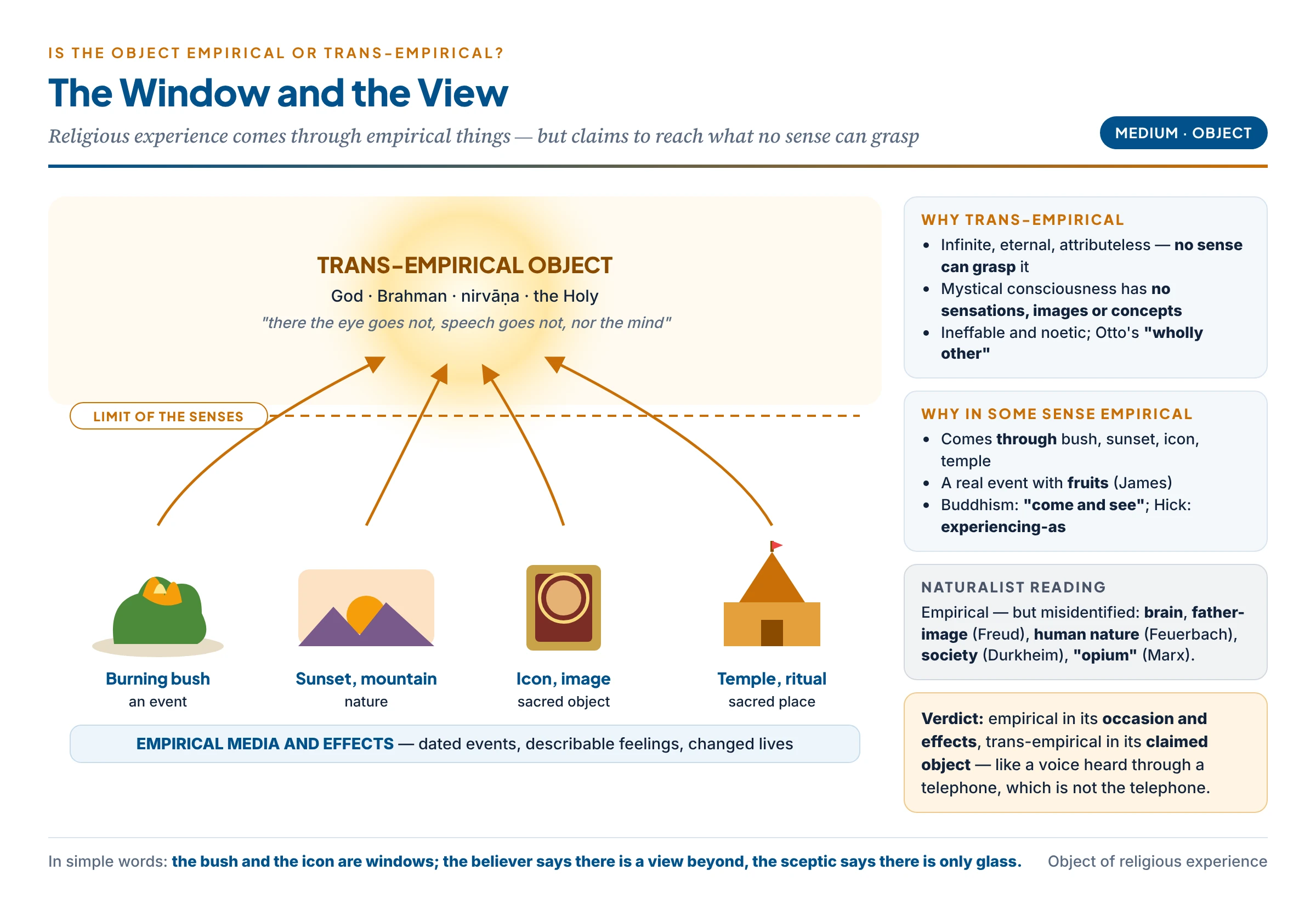
- What is claimed. The objects — an infinite, eternal, omnipresent God; an attributeless Brahman; an unconditioned nirvāṇa — cannot be seen, heard, touched or measured.
- What mystical consciousness is like. Ordinary consciousness is a building of three floors — sensations, images and concepts. Mystical consciousness has none of these: no sensations, no images, no thoughts. Its object therefore cannot be a sense-object.
- What the mystics say. It is ineffable and noetic — knowledge of “domains closed off to ordinary thought”. The Upaniṣad: “there the eye goes not, speech goes not, nor the mind”.
- The “wholly other”. For Otto, the object is precisely what is not of this world.
Arguments that the object is (in some sense) empirical:
- The media are empirical. The sacred is met through things: the burning bush, a sunset, a mountain, a river, an icon or image, a sacred stone or tree. In tribal religions supernatural power is felt in stones, amulets, groves and the heavenly bodies. Swinburne’s two “public” types of religious experience are experiences of God in ordinary or extraordinary public objects.
- The experience is an empirical event. It happens to a person at a time and place, has describable psychological features and observable effects — a criminal’s life transformed, a persecutor turned apostle. William James studied it as a fact of human life, judging it by its “fruits“.
- Buddhist “come and see”. The Dhamma is called ehipassiko — “come and see”: its truths about impermanence and suffering are to be verified in one’s own experience of ordinary phenomena; the Kālāma Sutta tells people to test teachings by experience, not authority.
- Experiencing-as (Hick). Religious experience is not a separate sixth sense but the whole experience of the religious person: the ordinary world is experienced as God’s creation, events as God’s acts, conscience as God’s command.
- “Experimental” religion. Radhakrishnan and Vivekananda presented religion as empirical in method — its truths can be re-experienced by anyone who meets the conditions.
- Naturalist reductions. Critics agree that the object is empirical — but they say it is misidentified:
- Freud — the object is the father-image projected from childhood helplessness;
- Feuerbach — the object is human nature itself, projected and worshipped;
- Durkheim — the object is society, worshipped in symbolic form;
- Marx — religion is “the opium of the people“, a consolation produced by social suffering;
- Neuroscience — the object is a pattern of activity in the brain (Article 8).
Resolution:
- The medium and the occasion of religious experience are empirical; its effects are empirical; but its claimed object is trans-empirical.
- This matches Indian categories: the personal Lord with form is Brahman as it appears (vyāvahārika), while Brahman in itself (pāramārthika) is beyond the senses; and Kant’s distinction between the phenomenon and the thing-in-itself, used by Hick.
- The trans-empirical claim is not refuted by its empirical medium — a voice heard through a telephone is not the telephone. But it means religious claims cannot be checked like ordinary empirical claims — which leads to the question of validity (Article 8).
Common confusion
Does “trans-empirical” mean that religious experience has nothing to do with the empirical world? No. Almost every religious experience is occasioned by something empirical — a place, a text, an image, an event in one’s life — and shows itself in empirical effects on character and conduct. “Trans-empirical” is a claim only about its object: that what is encountered through these media is not itself a sense-object. That is why the safest answer to “empirical or trans-empirical?” is: empirical in its occasion and effects, trans-empirical in its object.
7. Experience and Interpretation
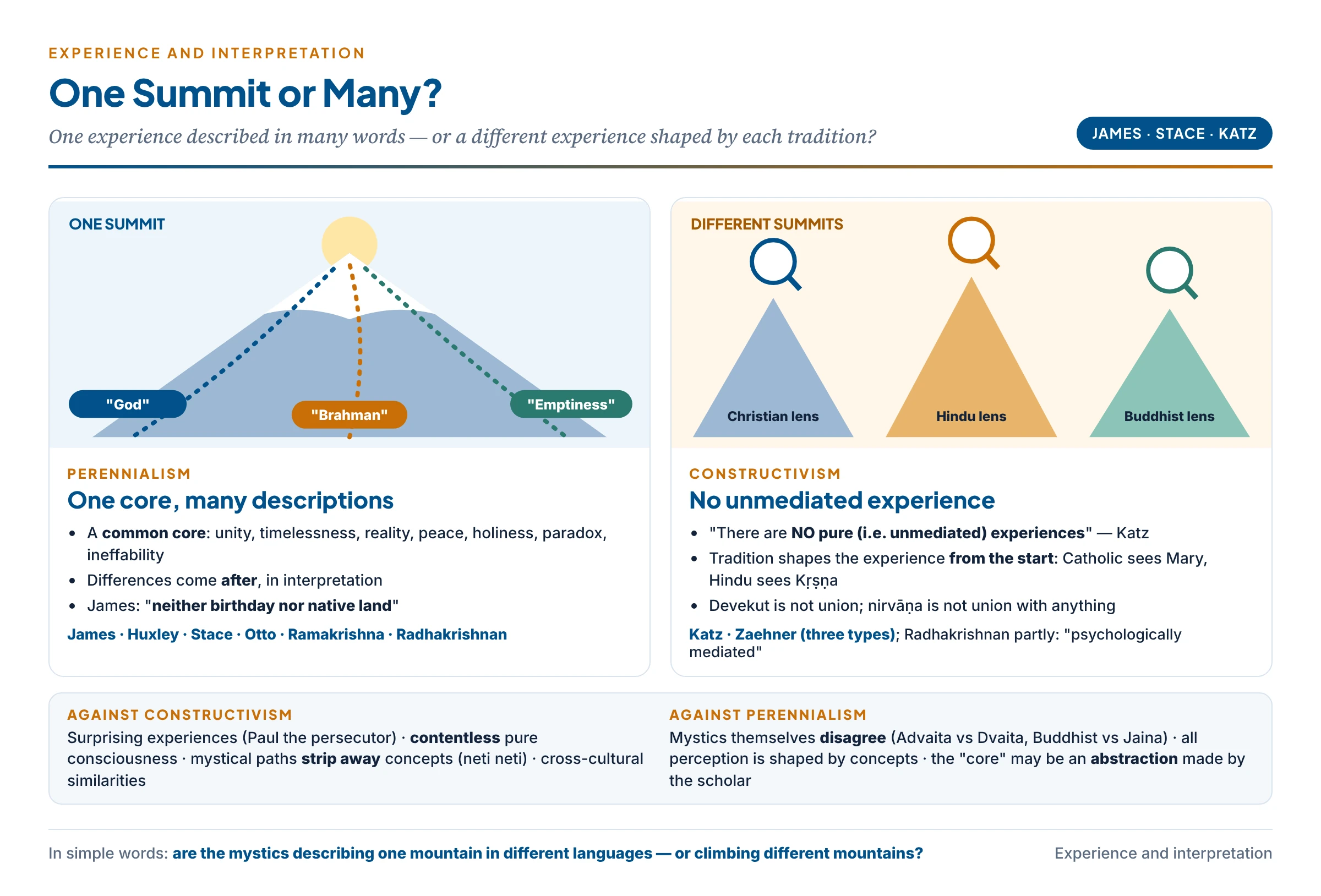
- Two aspects. Every numinous or mystical experience has two aspects: (1) the raw experience itself, and (2) the experience with its interpretation by ideas.
- Levels of interpretation.
- Low-level — close to the experience: “I felt a unity in which all distinctions vanished; it was timeless and peaceful.”
- High-level — loaded with doctrine: “My soul was united with the Holy Trinity“, “I realised I am Brahman“, “I saw śūnyatā.”
- The same experience, different interpretations. If mystical experience is stripped of intellectual interpretation, what is left is an undifferentiated unity. Eckhart and Ruysbroeck interpreted it as the Trinitarian God; Muslim mystics as the one God of Islam; Advaitins as the impersonal Absolute; Buddhists as śūnyatā, with no God at all.
- Why it usually takes a religious form.
- The melting away of individuality into the infinite (the Sufi fanāʾ) — and the Infinite is, for most minds, God;
- the experience is beyond time — an “Eternal Now” — and the Eternal is another name for God;
- it brings exalted peace and joy, identified with “the peace of God” — or, in Buddhism, with nirvāṇa.
- Is mystical experience open to different interpretations? In fact, yes — the history of mysticism shows it. The real questions are: (a) is interpretation added after the experience or built into it? and (b) are some interpretations better than others? Reasonable tests are faithfulness to what the mystic actually reports, coherence with the rest of our knowledge, agreement among independent mystics, and the moral fruits in life.
In simple words
In a dark room you see a dim white shape. One person cries “a ghost!”, another says “a sheet thrown over a chair”. What they saw is the same; what they took it to be differs. Mystics may likewise share a deep experience of unity and peace — and then one calls it God, another Brahman, a third emptiness.
8. Perennialism — One Core, Many Interpretations
- William James: “In mystic states we both become one with the Absolute and we become aware of our oneness… In Hinduism, in Neoplatonism, in Sufism, in Christian mysticism, in Whitmanism, we find the same recurring note, so that there is about mystical utterances an eternal unanimity which ought to make a critic stop and think, and which bring it about that the mystical classics have, as has been said, neither birthday nor native land.”
- Aldous Huxley — The Perennial Philosophy (1945): a divine Ground of all being, knowable by direct intuition, and man’s final end is unitive knowledge of it — a teaching found in every tradition.
- W. T. Stace — a common core of mystical experience across cultures: a unitary consciousness, beyond space and time; a sense of objectivity or reality; blessedness and peace; a feeling of the holy; paradoxicality; and alleged ineffability. Differences arise in interpretation, not in the experience.
- Otto compared Eckhart and Śaṅkara and found a striking kinship.
- Indian perennialists — Ramakrishna (“as many faiths, so many paths”), Vivekananda, Radhakrishnan (“Intuitions abide, interpretations change”).
- Supporting evidence. Remarkable similarities among mystics who could not have influenced one another; contentless states in meditation — “pure consciousness” without any object — in which there seems to be nothing for concepts to shape.
9. Constructivism — There Is No Unmediated Experience (Katz)
- The thesis. Steven Katz, in “Language, Epistemology, and Mysticism” (1978): “There are NO pure (i.e. unmediated) experiences.” The mystic’s beliefs, training, expectations and language shape the experience itself, not merely the later report of it.
- The argument.
- All experience is processed through concepts and expectations — as Kant showed for ordinary perception.
- Mystics are formed by years of training in a tradition — its texts, practices and goals.
- So the Hindu mystic does not have a neutral experience and then call it Brahman; he has an experience of Brahman, shaped in advance. The Jewish mystic’s devekut (“cleaving” to God) is not union; the Buddhist’s nirvāṇa is not union with anything.
- Therefore there is no common core: there are as many kinds of mystical experience as there are traditions.
- Examples. A Catholic mystic sees the Virgin Mary, a Hindu mystic sees Kṛṣṇa; Bernadette’s and Teresa’s visions follow Christian imagery; Arjuna’s vision follows the Vaiṣṇava picture of God.
- Allies. Zaehner argued for three different types of mysticism — nature (panenhenic), monistic and theistic — not one experience differently named. Radhakrishnan himself admitted that experience is “psychologically mediated” and that “there is no such thing as pure experience, raw and undigested”.
Criticisms of constructivism:
- Novelty and surprise. Many experiences go against expectation — Paul was a persecutor of Christians; sudden converts often had no faith before. Expectations cannot fully explain them.
- Contentless states. In “pure consciousness” there are no thoughts or images — so what is there for concepts to construct?
- Deconstruction, not construction. Mystical disciplines aim to strip away concepts — neti neti, the “cloud of unknowing”, the emptying of the mind in Yoga and Zen.
- Cross-cultural similarities remain unexplained.
- Overgeneralisation. “No experience is unmediated” is a sweeping claim about every possible experience, which no survey could establish.
- Mediation does not mean falsity. Ordinary perception is also shaped by concepts, yet it is often true. Even if religious experience is mediated, it may still be an experience of something real.
10. Hick — the Real and Its Personae and Impersonae
- The Kantian framework. Kant distinguished the thing-in-itself (noumenon), which we cannot know, from the thing as it appears to us (phenomenon), shaped by our concepts. Hick applies this to religion.
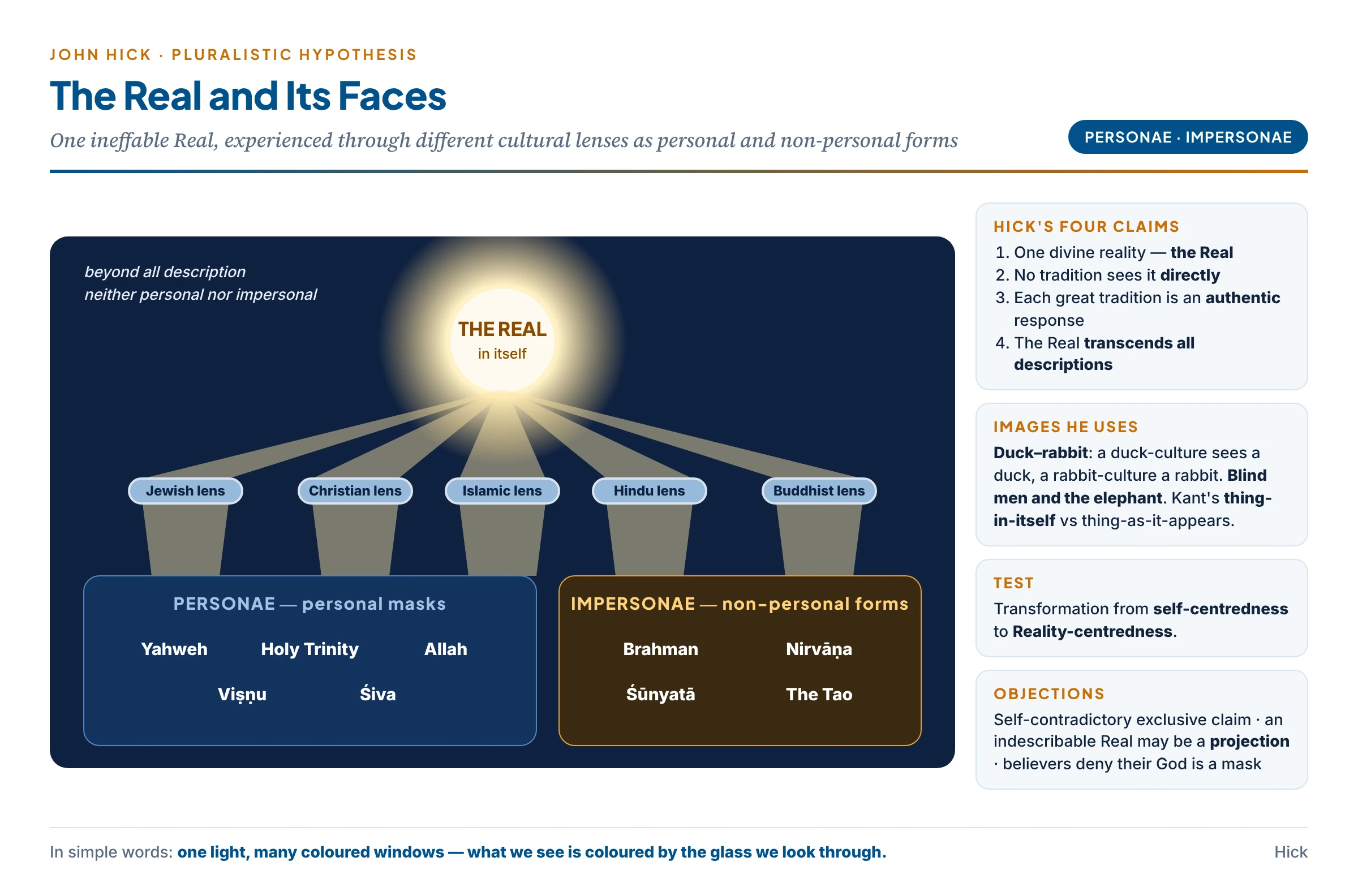
- The Real in itself. There is one ultimate divine reality — the Real — which no human concept fits. It is “beyond characterisation”, neither personal nor impersonal in itself. Humans can speak of it directly only in formal terms — “the ultimate”, “the ground of experience”.
- The Real as experienced. Through the concepts of different cultures, the Real is authentically experienced as:
- personae — personal faces, like masks (Latin persona) worn in a play: Yahweh, the Holy Trinity, Allah, Viṣṇu, Śiva;
- impersonae — non-personal forms: Brahman, nirvāṇa, śūnyatā, the Tao.
- The duck–rabbit. A culture that knows only ducks sees Wittgenstein’s ambiguous drawing as a duck; one that knows only rabbits sees a rabbit — neither is even aware of the ambiguity. So the Real is experienced as Yahweh, Allah or Viṣṇu depending on one’s concepts. The blind men and the elephant — a Jaina and Buddhist parable — makes the same point.
- Hick’s four claims.
- There is one divine reality, the Real, the ultimate source of all religious experience.
- No tradition perceives the Real directly.
- Each great tradition is an authentic way of conceiving and experiencing the Real.
- The Real transcends all descriptions, positive and negative.
- The test. A tradition is a genuine response to the Real if it produces transformation from self-centredness to Reality-centredness — saintliness, compassion, love.
In simple words
Six blind men touch an elephant. The one holding the trunk says “it is a snake”, the one at the leg “a pillar”, the one at the ear “a fan”, the one at the side “a wall”. Each is partly right and none sees the whole animal. Hick says the religions are like this: each meets the same Real, but only through the part — and the concepts — available to it. (The critic’s question: who, then, is the person who sees the whole elephant?)
Objections to Hick:
- Self-contradiction. In saying no religion’s view is truer than another’s, Hick claims that his own view is truer than all of them.
- Scepticism about the Real. If nothing we say — good, loving, powerful, or impersonal, non-dual — truly applies to the Real, how do we know it is not just a projection or wish? Hick replies, in Kantian fashion, that we must posit an objective Real to account for the rich experiences and transformations of the traditions. But a Real “beyond characterisation” seems too empty to explain why love and compassion are the right responses to it.
- Believers disagree. Few Christians, Muslims or Vaiṣṇavas accept that their God is a mask of something else.
- Misuse of Kant. Kant denied that we experience the noumenon at all; Hick says we experience it through phenomena.
Common confusion
Is Hick’s “Real” just another name for Advaita’s nirguṇa Brahman? Not exactly. For Advaita, nirguṇa Brahman is the Real itself, and the personal God (Īśvara) is a lower, appearance-level form. For Hick, Brahman is only one impersona — one human image of the Real — on the same level as Allah or Viṣṇu; the Real is beyond both personal and impersonal. So Advaita ranks the forms (as Radhakrishnan does); Hick refuses to rank them.
11. Indian Perspectives on Experience and Interpretation
- Nyāya’s two stages of perception. Perception begins as indeterminate (nirvikalpaka) — a bare grasp of the thing without name or concept — and becomes determinate (savikalpaka) — “this is a pot”. This is the Indian form of the distinction between raw experience and interpretation.
- Buddhist logicians (Dignāga). True perception is free from conceptual construction (kalpanāpoḍha); concepts and names are added afterwards. Meditation aims at seeing without proliferating concepts (prapañca). This is the opposite of Katz: Buddhism holds that unconstructed experience is possible and liberating.
- Advaita. The forms of God are Brahman seen through māyā — real at the level of worship (vyāvahārika), but not the final truth (pāramārthika). Worship of forms (saguṇa upāsanā) purifies the mind and leads to the formless.
- Jainism. Anekāntavāda and syādvāda — reality is many-sided; each view is true “in some respect” (syāt) — the blind men each touch part of the elephant.
- The Ṛg Veda: “The One Real sages name variously” (ekaṃ sad viprā bahudhā vadanti).
- Radhakrishnan: “The Divine reveals itself to men within the framework of their intimate prejudices.”
Indian Connect — Indian Connect — experience and interpretation
- Nyāya’s nirvikalpaka → savikalpaka perception and Dignāga’s concept-free perception anticipate the Western debate about raw experience vs interpretation by over a thousand years.
- Indian thought mostly sides with the perennialists: an unconstructed, non-conceptual experience is possible (nirvikalpa samādhi, turīya, śūnyatā).
- But it also gives tools to handle conflict without scepticism: anekāntavāda, the two levels of truth, and ekaṃ sad viprā bahudhā vadanti.
Critical Evaluation
Objections Concerning the Object
- Conflicting objects cancel each other. Hume argued that in religion “whatever is different is contrary”: the miracles and experiences of rival religions destroy one another’s credit. If Advaitins experience identity and Muslims a transcendent Allah, both cannot be literally right.
- Reduction. Freud, Feuerbach, Durkheim and Marx explain the object as something natural — father-image, human nature, society, social suffering.
- Constructivism. If each tradition constructs its own object, there may be no common object at all.
- Impossibility. The infinite cannot be an object of finite experience (Kant).
Replies
- Diversity is expected if the object is infinite and the receivers finite — Radhakrishnan’s “one mountain, many paintings”; Hick’s personae and impersonae.
- Reduction explains the occasion, not necessarily the object. That religious feelings have psychological or social causes does not prove that they have no transcendent object — the genetic fallacy.
- Mediation is not falsification. All perception is shaped by concepts, yet it often reaches reality.
- Partial perception of the infinite is possible, as one sees the sea without seeing all of it.
Critics and Defenders
Criticism — Critics
- Kant: God is not an object of possible experience.
- Hume: rival religious claims cancel each other.
- Freud, Feuerbach, Durkheim, Marx: the object is father, humanity, society or social misery.
- Katz: no unmediated experience, so no common object.
- Zaehner: theistic, monistic and nature mysticism are different experiences.
- Critics of Hick: an indescribable Real is empty and self-refuting.
Defence — Defenders and strengths
- James, Huxley, Stace: a common core across traditions.
- Radhakrishnan: one Reality, psychologically mediated pictures.
- Hick: one Real, many authentic personae and impersonae.
- Alston: God can be perceived without being perceived completely.
- Advaita and Buddhism: the ultimate is not an object but the ground or nature of all objects.
- Nyāya and Dignāga: raw, concept-free experience is possible.
Cross-Tradition Comparison
Western and Indian Views of the Object
| Point | Western view | Indian view |
|---|---|---|
| Typical object | A personal, transcendent God | Brahman–Ātman; the personal Lord; nirvāṇa; śūnyatā; the pure soul |
| Relation to the self | Distinct: creature before Creator | Often identity (Advaita) or insight into no-self (Buddhism) |
| Is God required? | Usually yes | No — Buddhism, Jainism, Sāṃkhya have religious experience without God |
| Can the ultimate be an object? | Tillich, Buber: not as a thing | Advaita: never — it is the witness |
| Experience and interpretation | Stace vs Katz; Hick’s Kantian model | Nirvikalpaka vs savikalpaka; two levels of truth |
| Handling diversity | Exclusivism, inclusivism, Hick’s pluralism | Anekāntavāda; “the One Real sages name variously”; graded forms of worship |
| Empirical side | James’s fruits; Hick’s experiencing-as | Buddhist “come and see”; Vivekananda’s “religion is realisation” |
Indian Connect — Takeaways
- The object of Indian religious experience is often not a separate being but the true nature of reality or of the self — which is why “religion without God” is natural in India.
- The Indian distinction between saguṇa and nirguṇa, and between conventional and ultimate truth, gives a ready framework for Hick-style answers to the problem of conflicting objects.
Synthesis (Siddhānta)
- What is the object? In the Western religions mainly a personal, transcendent God (and other supernatural beings); in the Indian religions often a basic feature of reality — Brahman as the Self, impermanence and not-self, emptiness, the pure soul — as well as the personal Lord of bhakti. “The sacred” or “the holy” is the widest name that covers them all.
- Empirical or trans-empirical? Empirical in its occasions, media and effects; trans-empirical in its claimed object. The naturalist says the object is empirical but misidentified; the believer says the empirical is a window, not the view.
- Experience and interpretation. All mystical reports carry interpretation; the open question is whether a common core lies beneath them (James, Stace, Radhakrishnan) or whether traditions construct different experiences (Katz). The truth probably lies between: there are real cross-cultural similarities and real differences shaped by tradition.
- One Real? Hick’s hypothesis and the Indian ideas of ekaṃ sad and anekāntavāda offer a way to honour all traditions — at the cost of saying that none describes the ultimate as it is in itself.
- Contemporary relevance. In plural societies like India, recognising that one Reality may be experienced in many forms underpins interfaith respect and the constitutional ideal of equal respect for all religions, while honest acknowledgement of differences keeps dialogue truthful.
Previous Year Questions
- 2018The terms ‘Sacred’ and ‘Holy’ have come to serve as generic names for the object of religion. Do you agree that one can have God as the object of religion? Discuss.
- 2013Is mystical experience open to different interpretations?
- 2012What is the object of religious experience? Is it empirical or trans-empirical? Explain in detail.