

Nyāya–Vaiśeṣika: Theory of Categories; Theory of Appearance; Theory of Pramāṇa; Self, Liberation; God; Proofs for the Existence of God; Theory of Causation; Atomistic Theory of Creation
Official Syllabus: Paper I, Section B, Unit 15
Perception (pratyakṣa) is the first and most basic pramāṇa of Nyāya. Every other source of knowledge rests on it: we infer fire only after seeing smoke, we learn from testimony only after hearing words. Yet Indian logicians did not take perception for granted. Western logic long assumed that “what is given in perception must be true” and examined only inference; Nyāya examined perception itself — what counts as perceiving, how the senses reach their objects, how a bare sensation becomes the judgement “this is a pot”, and how we can “perceive” things no ordinary contact reaches — a universal, the coldness of ice seen from afar, or the atoms seen by a yogi. This article covers Gautama’s definition and why later Naiyāyikas revised it, the six kinds of sense–object contact, the stages of perception (nirvikalpa, savikalpa, pratyabhijñā), and the three kinds of extraordinary (alaukika) perception.
In simple words
You glance at a mango on the table. For a split second you just take in a yellowish, roundish something — you have not yet said to yourself “mango”. A moment later you know: “This is a ripe mango.” A day later you see it again and think: “That’s the same mango I saw yesterday.” Nyāya calls these three moments indeterminate perception, determinate perception and recognition. And if you say “the mango looks sweet”, Nyāya says you are “seeing” sweetness through a revived memory — an extraordinary perception.
Context & Problem
Why Examine Perception at All?
- Perception is the bedrock. It is the most direct means of knowing reality, and inference, comparison and testimony all presuppose it. If perception were unreliable, everything built on it would fall.
- But perception can mislead. A distant figure may be “a man or a post”; a rope may look like a snake; a jaundiced eye sees a white conch as yellow. So we need a definition that separates genuine perception from doubt and error.
- Realism is at stake. Nyāya’s whole realism rests on perception giving us external objects as they are. The Buddhists held that perception gives only bare, momentary particulars, and that everything we “see” as a pot, a cow or a quality is a mental construction. Nyāya must show that we really perceive substances, qualities and even universals.
- The puzzle of the special cases. How do we know “all men are mortal” when we have seen only some? How do we “see” that ice is cold? How do yogis know distant or subtle things? Nyāya answers these with its theory of extraordinary perception.
Three Components of Perception
- Indriya — the sense organ. Nyāya accepts six senses: five external — smell (ghrāṇa), taste (rasanā), sight (cakṣus), touch (tvak), hearing (śrotra) — and one internal, the mind (manas).
- Each external sense is made of the element whose quality it grasps: the eye is made of fire (light) and grasps colour; the ear is a portion of ether (ākāśa) and grasps sound; the nose is earthy and grasps smell. The principle is “like perceives like“.
- The mind is the inner sense (antar-indriya). It perceives the qualities of the self — desire, aversion, effort, pleasure, pain and cognition — and it is the common organ through which every external sense must work.
- This view of mind as an inner sense is accepted by Vaiśeṣika, Sāṃkhya and Mīmāṃsā; some Vedāntins reject it.
- Artha — the object. An external thing, its qualities, or an inner state of the self.
- Sannikarṣa — the contact. The connection between the sense and the object; when it occurs (with self, mind and sense joined), perception arises at once.
The Chain of Contact
Perception arises only when four links are joined: self → mind → sense → object. Because the mind is atomic, it joins only one sense at a time; seemingly simultaneous perceptions are really rapid successions.
Core Doctrine
1. Gautama’s Definition of Perception
Gautama defines perception in the Nyāya-sūtra as: indriyārtha-sannikarṣotpannaṃ jñānam avyapadeśyam avyabhicāri vyavasāyātmakaṃ pratyakṣam — “Perception is the cognition that is produced by the contact of a sense with its object, that is not dependent on words, non-erroneous, and definite.”
The 2025 paper asked for a detailed account of this definition. Each phrase does a job — it includes genuine perception and shuts out something that only looks like it.
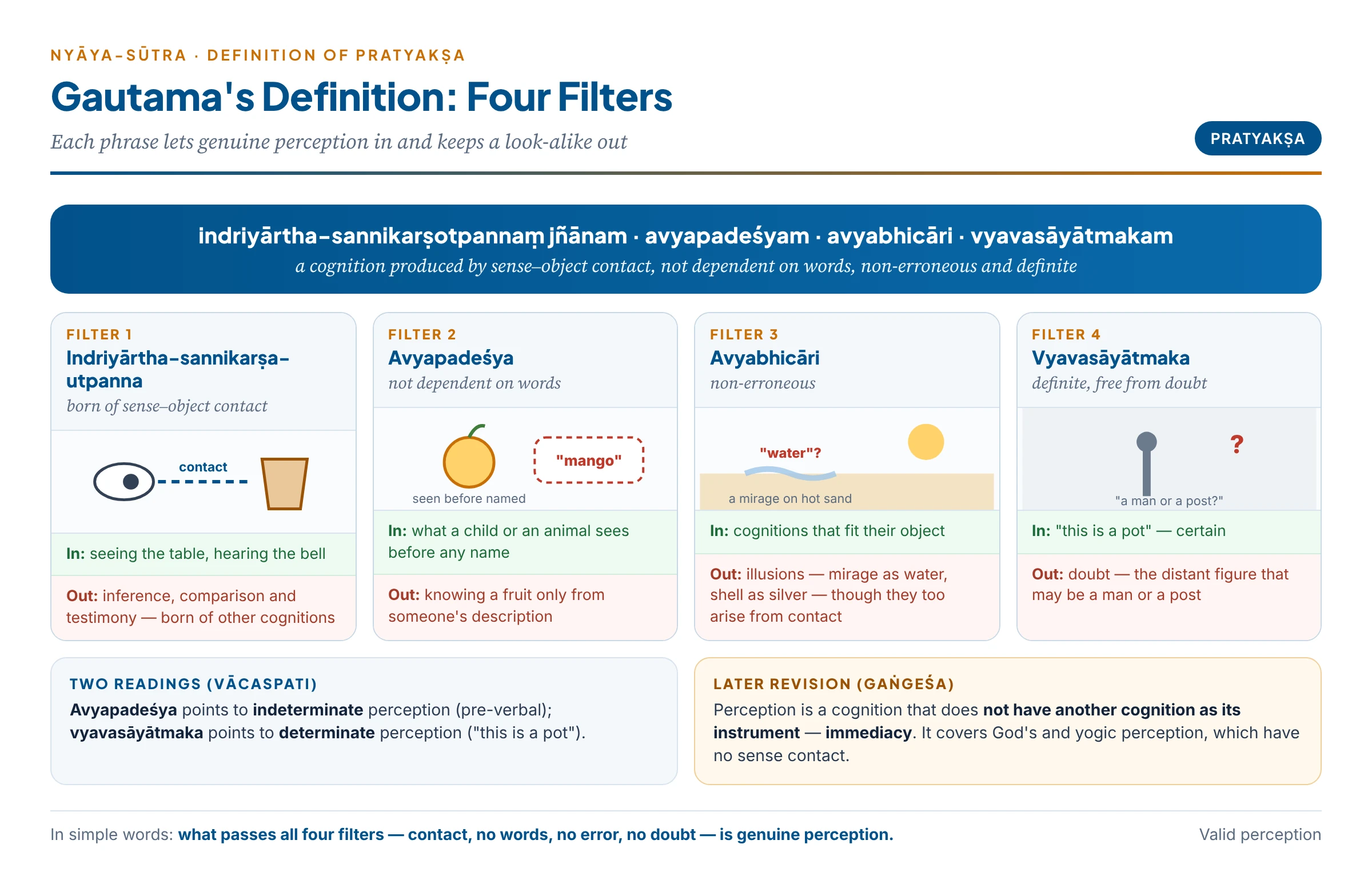
- Indriyārtha-sannikarṣa-utpanna — “produced by sense–object contact”.
- This is the cause of perception. It separates perception from inference (produced by the knowledge of a universal relation), comparison (by the knowledge of similarity) and testimony (by the knowledge of words).
- Example: I see the table because my eyes are in contact with it.
- Jñānam — “a cognition”.
- Perception is a kind of knowledge, a quality of the self — not a physical event in the eye. The contact is its cause; the cognition is the perception.
- Avyapadeśya — “not dependent on words” (non-verbal).
- Perception does not arise from naming the object. We see a thing before we call it anything; a child or an animal perceives without words.
- It excludes verbal knowledge — knowing a fruit from someone’s description of it.
- Vācaspati Miśra read this word as pointing to indeterminate perception (pre-verbal).
- Avyabhicāri — “non-erroneous” (non-deviating).
- The cognition must fit its object. This excludes illusions — the mirage seen as water, the shell seen as silver — even though they too arise from a sense contact.
- Vyavasāyātmaka — “definite” (certain).
- The cognition must be determinate and free from doubt. This excludes doubt: “Is that a man or a post?” is produced by sense contact, yet it is not perception.
- Vācaspati read this word as pointing to determinate perception (“this is a pot”).
- Result. Gautama’s definition picks out perception as a true, definite, non-verbal cognition caused by sense contact. It is a definition of valid perception — perception as a pramāṇa.
In simple words
Think of the definition as four filters. Sense contact lets in seeing and hearing but shuts out inference and testimony. “Non-verbal” shuts out knowing a thing from its name alone. “Non-erroneous” shuts out the mirage. “Definite” shuts out the man-or-post doubt. What passes all four filters is genuine perception.
2. Why Later Naiyāyikas Found the Early Definition Inadequate
The 2017 paper asked why the early Nyāya definition was considered inadequate by later Naiyāyikas.
- Problem 1 — God’s perception. God is said to perceive all things directly, yet God has no sense organs. A definition tied to sense contact would deny God perception altogether.
- Problem 2 — Perception without a present object. In the illusion of a snake in a rope, there is no snake to touch the eyes, yet we have a perception-like cognition. Contact with the object cannot be the essence of perception-like awareness.
- Problem 3 — Inner states. Pleasure, pain and desire are cognised directly, without any external sense contact (only the mind is involved).
- Problem 4 — Yogic and extraordinary perception. Yogis perceive past, distant and subtle objects with no ordinary contact.
- Problem 5 — It defines by the cause, not the nature. Sense contact is a cause of most perception, but what makes a cognition a perception is how it appears — as direct. The existence of the sense organs themselves is known only by inference; so defining perception through them puts an inferred item at the base of the most basic pramāṇa.
- The later definition. Gaṅgeśa and others defined perception as:
- Jñānākaraṇakaṃ jñānam — “a cognition that does not have another cognition as its instrument“. Inference needs the cognition of a universal relation; testimony needs the cognition of words; comparison needs the cognition of similarity. Perception needs no prior cognition as its instrument.
- Sākṣāt-pratīti or sākṣātkāritva — immediacy, the felt directness of “I see it”.
- The sun at noon. If at midday you turn your eyes upward, you see the sun directly — with no time or need for any reasoning. That directness is what is common to all perceptions.
- Sense contact is not abandoned. Later Naiyāyikas still admit that almost all human perception is conditioned by sense contact; they only deny that contact is its defining mark.
3. The Six Kinds of Sense–Object Contact (Sannikarṣa)
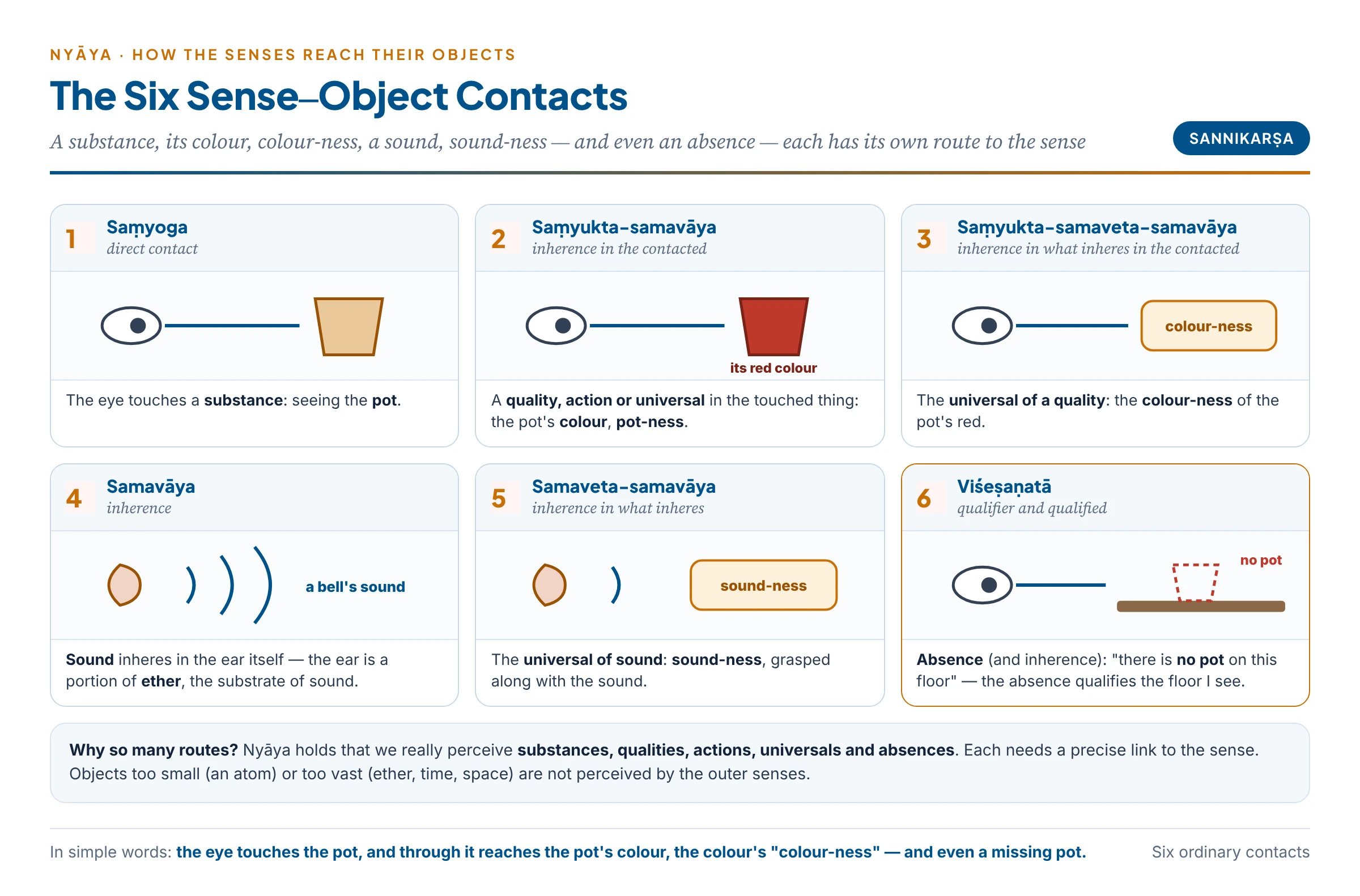
Nyāya explains exactly how a sense “reaches” a substance, its qualities, the universals in them, and even an absence. There are six ordinary contacts:
| # | Contact | What it reaches | Example |
|---|---|---|---|
| 1 | Saṃyoga — direct contact | A substance | The eye touches the pot |
| 2 | Saṃyukta-samavāya — inherence in what is contacted | A quality, action or universal in a substance | The colour of the pot; pot-ness |
| 3 | Saṃyukta-samaveta-samavāya — inherence in what inheres in the contacted | A universal of a quality | Colour-ness of the pot’s colour |
| 4 | Samavāya — inherence | Sound, which inheres in the ear itself (the ear is a portion of ether) | Hearing a sound |
| 5 | Samaveta-samavāya — inherence in what inheres | The universal of sound | Sound-ness |
| 6 | Viśeṣaṇatā (or viśeṣaṇa-viśeṣya-bhāva) — the relation of qualifier and qualified | Absence and inherence | “There is no pot on this floor” |
In simple words
Think of a phone camera pointed at a red pot. The lens “touches” the pot (contact); through the pot it records the red (a quality in what is touched); through the red it registers that this is a colour at all (the universal of a quality). Point it at an empty floor and it records the floor as empty — the absence shows up as a feature of the floor. Nyāya gives each of these its own “route”.
- Why such detail? Because Nyāya holds that we really perceive not only things but their qualities, actions, universals and even absences. Each needs a precise route from the sense to the object. The sixth contact is how Nyāya explains our perception of absence without a separate pramāṇa of non-apprehension (Article 9).
- Size matters. An object must be of perceptible magnitude: the infinitesimal (an atom) and the all-pervading (ether, time, space, self) are not perceived by the outer senses.
4. Kinds of Ordinary (Laukika) Perception
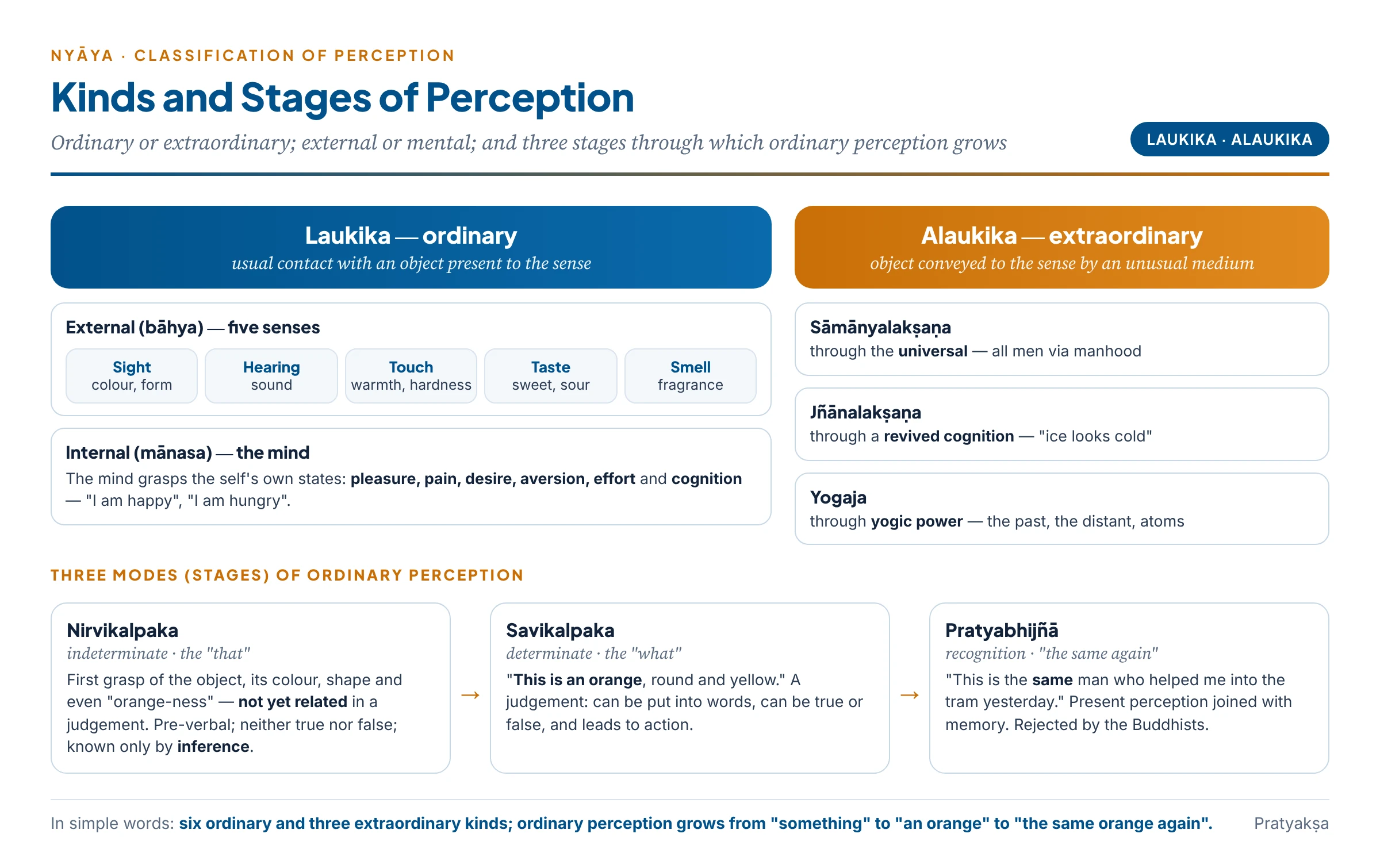
- Ordinary perception arises through the usual contact of a sense with an object present to it.
- External (bāhya) — five kinds.
- Visual (cākṣuṣa) — colour and form: seeing a pot.
- Auditory (śrautra) — sound: hearing a bell.
- Tactual (spārśana) — touch: feeling the warmth of fire.
- Gustatory (rāsana) — taste.
- Olfactory (ghrāṇaja) — smell.
- Internal or mental (mānasa). The mind’s contact with the states of the self — pleasure, pain, desire, aversion, effort and cognition itself: being aware of one’s own sadness, joy or hunger.
- So there are six kinds of ordinary perception.
5. Three Modes of Ordinary Perception
Ordinary perception develops through stages. These are not different kinds of perception but earlier and later phases of one complex process.
(a) Nirvikalpaka — indeterminate perception.
- The first apprehension of an object and its features without relating them in a judgement. At the first moment of contact you grasp the colour, shape and even the universal “orange-ness” of an orange — but you do not yet think “this is an orange” or “it is round”.
- The bathroom example. On the first day of an exam, absorbed in thinking of the questions, you may finish your bath without ever thinking “this is water”, “it is cold” — yet you did perceive the water, or you could not have bathed.
- Its marks.
- Pre-verbal — it cannot be expressed in words.
- Non-relational — it grasps the “that” but not yet the “what“.
- Neither true nor false — since it asserts nothing, it is neither pramā nor apramā.
- Known only by inference. We are never directly aware of it; we infer it because a determinate cognition of “a thing qualified by a feature” presupposes a prior grasp of the thing and the feature separately — just as knowing “a man with a stick” presupposes knowing a man and a stick.
(b) Savikalpaka — determinate perception.
- The cognition of an object as possessed of some character: “This is an orange“, “this is round and yellow”. The “that” becomes a “what”.
- It is a judgement: the existent thing is the subject, and its class, qualities and name are predicates.
- It can be true or false, can be expressed in language, and can be known by after-cognition (“I see an orange”).
- No determinate without indeterminate. “Unless I first perceive water, coldness, liquidity, I cannot know it as water, as cold, as liquid.”
| Point | Nirvikalpaka (indeterminate) | Savikalpaka (determinate) |
|---|---|---|
| Stage | Earlier | Later |
| Content | Object and features unrelated — the “that” | Object as qualified — the “what” |
| Language | Cannot be expressed in words | Can be expressed in words |
| Truth-value | Neither pramā nor apramā | Either pramā or apramā |
| Known by after-cognition? | No — only inferred | Yes — “I see a pot” |
| Leads to action? | Not directly (for Nyāya) | Yes — we reach for the orange |
| Kind of knowing | Only perceptual | Can enter inference, comparison and testimony |
(c) Pratyabhijñā — recognition.
- The cognition of an object as the same one cognised before: “This is the same man who helped me into the tram yesterday“; “this is the same cow I saw in the forest”.
- It combines present perception with memory, but it is a perception, because the present object is presented through the senses.
- Accepted by Nyāya, Vaiśeṣika, Sāṃkhya and Mīmāṃsā. The Buddhists reject it — for them nothing lasts two moments, so “the same” thing can never be met again; recognition is a confusion of similar moments (Unit 14, Article 4). Advaita too explains it differently.
6. Indeterminate and Determinate Perception: The Great Debate
- Buddhist view (Dignāga, Dharmakīrti). Perception is free from conceptual construction (kalpanāpoḍha) and non-erroneous (abhrānta). Only the indeterminate stage is genuine perception; it grasps the bare, momentary particular (svalakṣaṇa). The determinate stage — “this is a cow, white, moving” — adds class, quality, action and name, which are mental constructions; so it is not perception but a kind of erroneous construction.
- Nyāya reply.
- Things are not bare particulars. They are endowed with universals, qualities and actions, which are real and are perceived along with the thing. Predicating them of the thing is not error.
- The indeterminate already grasps the universal. Even at the first glance, “orange-ness” is apprehended — only not yet related to the object.
- Language follows perception, it does not create it. The name is applied because we see the cow-ness; we do not see the cow-ness because we apply the name.
- Action needs the determinate. We reach for an orange as an orange; bare particulars guide no action.
- Other schools.
- Jainas treat only determinate cognition as a pramāṇa; the indeterminate glimpse (darśana) is not knowledge proper.
- Mīmāṃsā accepts both stages, and adds that indeterminate perception too can guide action — in children, animals, and in adults acting in haste.
- Sāṃkhya accepts both stages.
- Advaita holds that the indeterminate grasps pure being (sattā) — ultimately Brahman — while the determinate imposes names and forms.
Common confusion
Is indeterminate perception a vague, blurry view, like seeing something in fog? No. “Indeterminate” does not mean unclear; it means not yet judged. Nyāya holds that the first moment of perception grasps the object, its features and even its universal quite fully — it simply has not related them in a judgement such as “this is a pot”. A blurred view of a distant figure (“man or post?”) is not indeterminate perception at all; it is doubt, which is a form of determinate but uncertain cognition.
7. Extraordinary (Alaukika) Perception
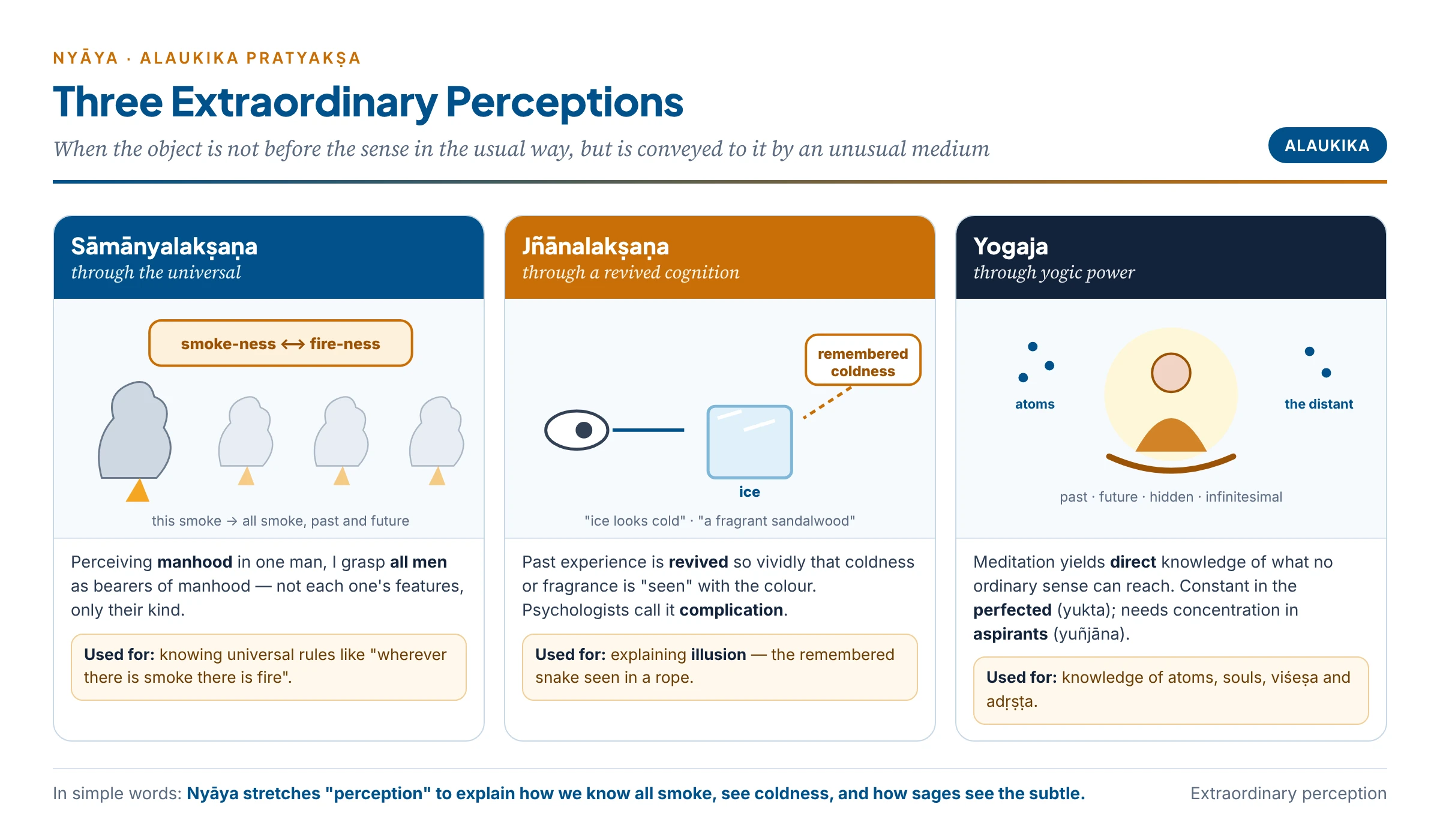
In extraordinary perception, the object is not ordinarily present to the sense but is conveyed to it through an unusual medium. There are three kinds. Extraordinary perception is always determinate.
(a) Sāmānyalakṣaṇa — perception through the universal.
- The problem. When we ask whether all men are mortal, we are asking about men past, present and future. But all men cannot be present to our senses. How then do we know the class?
- The answer. When I perceive a man as a man, I perceive the universal manhood in him. Through this universal, all individuals possessing manhood are presented to me — not with their individual features, but as bearers of manhood. To perceive manhood is, in this special way, to perceive all men.
- Its uses.
- Grounding vyāpti. We perceive smoke-ness and fire-ness and their relation; through them, all smoke and all fire are presented, so the universal rule “wherever there is smoke there is fire” can be known (Article 4).
- Negative judgements. “This cloth is not a pot” requires some grasp of the class of pots as a whole.
- Doubt about a class. Even to doubt whether all men are mortal, we must already have the class “all men” in mind.
In simple words
Seeing one person as “a human being”, you already know what any human being would be — you have grasped the kind. That is why you can at once ask, “Are all human beings mortal?” Nyāya says the kind, perceived in one, opens a window on the whole class.
(b) Jñānalakṣaṇa — perception through a revived cognition.
- The problem. We say “ice looks cold“, “the stone looks hard”, “I see a fragrant sandalwood” or “a fragrant rose”. But coldness and hardness belong to touch, fragrance to smell — how can the eyes perceive them?
- The answer. Our past experience — every time we smelt sandalwood we also saw it — is so vividly revived that the remembered fragrance is presented together with the present colour. The revived cognition itself acts as the connecting medium. The resulting cognition is a perception, but an extraordinary one.
- Western parallel. Psychologists such as Wundt, Ward and Stout called this “complication”: sensations of different senses become so associated that they form parts of a single perception.
- Its key use — error. Nyāya explains illusion — the snake seen in a rope, silver seen in a shell — as jñānalakṣaṇa perception: the memory of a snake seen elsewhere is presented as if seen here (Article 6).
(c) Yogaja — yogic perception.
- The intuitive perception of all objects — past and future, hidden and infinitesimal — by one who has gained a special power through meditation (yogābhyāsa).
- Two kinds of yogins.
- Yukta (the perfected) — such knowledge is constant and spontaneous.
- Yuñjāna (those on the way) — it needs concentration as an aid.
- Its objects include things no ordinary sense can reach — atoms, souls, the ultimate particularities (viśeṣa) of eternal things, and the adṛṣṭa (merit and demerit) of beings.
8. Why Nyāya Introduced Extraordinary Perception
The 2010 and 2014 papers asked for the reasons for introducing extraordinary perception and its philosophical implications.
- Epistemological reasons.
- To ground universal propositions. Without sāmānyalakṣaṇa, “all smoke is accompanied by fire” could never be known — only guessed from limited cases. This is Nyāya’s answer to the problem of induction raised by the Cārvāka (and, in the West, by Hume).
- To explain cross-sense experience. “Ice looks cold” and “sandalwood looks fragrant” are common experiences that ordinary contact cannot explain.
- To explain error. Illusion presents an absent object as present; jñānalakṣaṇa explains how, while keeping both the shell and the silver real.
- To make room for higher knowledge. Yogic perception explains how sages could know subtle realities on which scripture is based.
- Metaphysical implications.
- Realism about universals. If universals can be perceived, they are real, not mere names — a direct answer to Buddhist nominalism.
- Perception of the imperceptible. Atoms, souls and viśeṣa become, in principle, perceptible to yogins; this keeps the categories from being mere postulates.
- Support for theism. An all-perceiving God is easier to conceive once perception is not tied to bodily senses.
- Logical implications.
- Perception extends into generality. The boundary between perception and inference becomes thin: perception now delivers universal knowledge.
- Negative and classificatory judgements become possible.
- Soteriological implication. Yogic perception is the culmination of the path to liberation — the direct vision of the self and the categories.
- Criticisms.
- Ad hoc. Critics say sāmānyalakṣaṇa is a device invented to rescue the theory of vyāpti — it answers the induction problem “by fiat rather than argument”.
- Too much knowledge. If perceiving smoke-ness presents all smoke, one should know every smoky thing — even those in the future — which is absurd. Nyāya’s reply: they are presented only as bearers of the universal, not with their individual features.
- Blurs the pramāṇas. If perception gives universal knowledge, what is left for inference?
- Buddhist objection. Universals are not real; so they cannot be perceived at all.
- Unverifiable. Yogic perception cannot be checked by ordinary people.
9. Are Universals Really Perceived?
The 2023 paper asked for Nyāya’s view of ordinary and extraordinary perception and whether the Naiyāyikas are justified in holding that universals are perceived.
- Two ways universals are perceived.
- In ordinary perception — when I see a cow, my eye touches the cow (saṃyoga) and through inherence in what is touched (saṃyukta-samavāya) it grasps cow-ness as well. This is ordinary, determinate perception: “this is a cow”.
- In extraordinary perception — the perceived universal serves as a medium through which all its instances are presented (sāmānyalakṣaṇa).
- Arguments for the Nyāya view.
- Recognition of kinds is immediate. I do not infer that the animal before me is a cow; I see it as one. The “as” is part of the perception.
- Common character must be grasped somewhere. We place different cows — black, white, small, large — under one word at once; a common character must be given, not constructed after the event.
- Language presupposes it. Words apply to many things because those things share a real feature; the feature must be accessible to perception before the word can be learned.
- Without it, induction is blind. The step from “these” to “all” needs some grasp of what “all” ranges over.
- Objections.
- Buddhist (apoha). Only the unique particular is perceived; “cow-ness” is a mental construction formed by excluding non-cows. If universals were real, they would be either identical in all instances (making all cows one) or different (making them particulars).
- No sense organ for universals. Universals have no colour or shape; how can an eye touch them?
- Family resemblance. Wittgenstein argued that many classes (games, chairs) share no single common feature, only overlapping similarities.
- Evaluation.
- The ordinary perception of universals is well justified: our seeing things as kinds is a datum that any theory must respect, and Nyāya explains it more naturally than the Buddhist theory, which must explain away the “as”.
- The extraordinary perception of whole classes is less secure: it reads as a theoretical requirement of the theory of vyāpti rather than as an observed fact.
- A balanced view: Nyāya is justified that we perceive things as instances of kinds; it is on weaker ground when it claims that this perception gives us all instances of a kind.
10. Nyāya and Vijñānavāda on Perception
The 1992 paper compared the nature, conditions and validity of perception in Nyāya and Vijñānavāda (Yogācāra).
- Nyāya. Perception is caused by contact with an external object, which exists independently; the object is outside the cognition; validity depends on the excellence of the causes and is confirmed by successful activity.
- Vijñānavāda. There is no external object. What appears as an object is a form of consciousness itself, projected as if outside (ātma-khyāti). Arguments: we always perceive a thing together with its cognition (sahopalambha); dreams show that object-like appearances need no external objects.
- Nyāya’s reply.
- Being always known together does not prove identity; a lamp and the pot it shows are always seen together, yet they are two.
- Dreams are known to be dreams only by contrast with waking perception; the contrast presupposes real objects.
- The determinate order of experience — I cannot see a mountain wherever I wish — shows that perception is constrained by objects, not created by the mind.
Critical Evaluation
Objections (Pūrva-pakṣa)
- Buddhist. Perception is non-conceptual; the determinate is construction; recognition is impossible in a momentary world; universals are not perceived.
- Advaita. Perception is valid only at the empirical level; the indeterminate grasps pure being; the mind is not a sense organ.
- Cārvāka. Accepts perception but rejects extraordinary perception as a disguised inference — and rejects inference.
- Critics of the definition. Gautama’s definition is too narrow (God, yogins, inner states) and defines perception by its cause; the later “not having a cognition as instrument” is negative and still leaves the nature of perception to the feeling of immediacy.
- Modern psychology. Perception is heavily constructive — the brain fills gaps, expects and interprets — which seems closer to the Buddhist picture of construction.
Defences and Strengths
- A layered theory. The stages of indeterminate, determinate and recognition anticipate modern accounts of perception as moving from sensation to recognition.
- Realism with error built in. Nyāya shows how perception can be both generally reliable and occasionally false.
- Precision. The six contacts give each kind of object — substance, quality, universal, sound, absence — its proper route.
- Self-correction. The tradition revised its own definition when it found it too narrow — a mark of critical method.
- Constructive psychology fits Nyāya too. The brain’s “filling in” is close to jñānalakṣaṇa — revived past experience entering present perception.
Critics and Defenders
Criticism — Critics
- Dignāga, Dharmakīrti: only bare particulars are perceived; determinate perception is mental construction; universals are fictions (apoha).
- Buddhists: recognition (“the same pot”) is impossible in a world of moments.
- Advaitins: the mind is not a sense; perception is only empirically valid.
- Critics of alaukika perception: sāmānyalakṣaṇa is an ad hoc rescue of induction; yogic perception is unverifiable.
- Later Naiyāyikas themselves: Gautama’s definition is too narrow and defines perception by its cause.
Defence — Defenders and strengths
- We see things as kinds; the “as” is given, not added.
- Indeterminate perception is a logical necessity: a qualified cognition presupposes knowing the qualifier and the qualified.
- Recognition is a fact of daily life; a theory that denies it must explain it away.
- Jñānalakṣaṇa matches the psychology of “complication” and modern multisensory perception.
- The revised definition (immediacy, no cognitive instrument) captures what is common to all perceptions, human and divine.
Cross-Tradition Comparison
Nyāya and Western Theories of Perception
| Issue | Nyāya | Western parallel |
|---|---|---|
| What we perceive | External objects, their qualities and universals — directly | Direct realism (Reid, Moore); against Locke’s representative realism |
| Stages of perception | Indeterminate → determinate → recognition | Kant: intuitions without concepts are blind — sensation needs conceptualisation; psychology: sensation → perception → recognition |
| Construction | Determinate perception discovers real features | Buddhist and Kantian: the mind organises what it receives |
| Universals | Perceived (saṃyukta-samavāya) | Aristotle: the universal is grasped in the particular; Husserl’s seeing of essences |
| Cross-sense perception | Jñānalakṣaṇa — “ice looks cold” | Complication (Wundt, Ward, Stout); modern multisensory integration |
| Inner perception | Mind (manas) as inner sense | Locke’s reflection; Kant’s inner sense |
| Perception of absence | Through a special relation (viśeṣaṇatā) | Sartre: “Pierre is not in the café” — absence is experienced |
Indian Connect — Key takeaways
- Nyāya’s indeterminate → determinate distinction anticipates Kant’s point that perception involves both a given and a conceptual element — but, unlike Kant, Nyāya holds that the concepts match real features of the world.
- Jñānalakṣaṇa gives an Indian account of what Western psychology calls complication.
- The Nyāya–Buddhist debate on determinate perception is the Indian form of the Western debate between direct realism and constructivism.
Synthesis (Siddhānta)
- Definition. Perception is a true, definite, non-verbal cognition produced by sense–object contact (Gautama); later Nyāya defines it more widely as a cognition not produced through another cognition — immediate awareness.
- Mechanism. Six senses, six kinds of contact; the mind is the inner sense through which all perception passes.
- Stages. Indeterminate (the “that”), determinate (the “what”) and recognition (“the same again”).
- Extraordinary perception. Through the universal (grounding universal knowledge), through a revived cognition (cross-sense perception and error) and through yogic power (knowledge of the subtle).
- Philosophical weight. Perception is the foundation of Nyāya realism: it gives us things, qualities and universals as they are.
- Contemporary relevance.
- Cognitive science. Perception as staged processing — feature detection before object recognition — echoes indeterminate and determinate perception.
- Eyewitness testimony. Courts and psychologists now know that memory and expectation enter perception — the Nyāya insight of jñānalakṣaṇa — so eyewitness accounts must be tested.
- Artificial intelligence. Machine vision “recognises” objects by classes; whether it perceives universals or only statistical patterns revives the Nyāya–Buddhist debate.
- Multisensory design. Food packaging and advertising exploit “looks crunchy”, “looks fresh” — jñānalakṣaṇa in daily commerce.
“Perception is the cognition produced by sense–object contact, non-verbal, non-erroneous and definite.” — Gautama, Nyāya-sūtra
Previous Year Questions
- 2025Present a detailed account of Gautama’s definition of Perception.
- 2023Elucidate Naiyāyikas view of ordinary and extraordinary perception. Are they justified in accepting that universals are perceived? Discuss.
- 2017Explain the early Nyaya definition of perception. Why this definition is considered inadequate by the later Naiyayikas?
- 2014Bring out the philosophical implications of introducing extraordinary (alaukika) perception in Nyaya philosophy.
- 2010Explain the reason for introducing the notion of extraordinary perception in nyaya-epistemology.
- 2005Natures and kinds of Pratyaksha according to Nyaya. Short Notes.
- 1998Define perception according to Nyaya and explain clearly various types of perception.
- 1996Alaukika-Pratyaksa. Short Notes.
- 1995Modes of perception according to Nyaya. Short Notes.
- 1992Explain and critically examine the nature, conditions and validity of pratyaksa pramana according to the Nyaya and Vijnanavada schools.
- 1991Analyze the definition of Perception and explain with examples the classification of Perception according to Nyaya.