

Schools of Vedānta: Brahman; Īśvara; Ātman; Jīva; Jagat; Māyā; Avidyā; Adhyāsa; Mokṣa; Apṛthaksiddhi; Pañcavidhabheda.
Official Syllabus: Paper I, Section B, Unit 19
Between Śaṅkara’s strict non-dualism and Madhva’s strict dualism lies a family of Vedānta schools that hold both — that God, souls and the world are different and yet not different. This is the old doctrine of bhedābheda (difference-and-non-difference). Nimbārka made it “natural” (svābhāvika) — Dvaitādvaita, dualism-cum-non-dualism. Vallabha pushed it towards identity — Śuddhādvaita, “pure non-dualism”, free from any taint of māyā. Caitanya declared the relation inconceivable — Acintya-bhedābheda. All three are Vaiṣṇava, all make Kṛṣṇa the supreme Brahman, all take the world as real, and all put devotion at the centre. This article explains each system — its Brahman, souls, matter, relation and liberation — evaluates Nimbārka’s account of God, souls and matter, and then compares all six schools on Brahman, jīva, jagat and mokṣa.
In simple words
Think of the ocean and its waves. Is a wave the ocean? Yes — it is nothing but ocean water. Is it different from the ocean? Also yes — it has its own shape, size and moment, and the ocean is far more than any wave. Both answers are true at once. The bhedābheda schools say God and the soul are like ocean and wave: one and different, both naturally.
Context & Problem
The Old Bhedābheda Tradition
- Before Śaṅkara, teachers such as Āśmarathya and Bhartṛprapañca already held that Brahman and the world are both different and non-different; after him, Bhāskara and Yādavaprakāśa (Rāmānuja’s teacher) defended it.
- Bhāskara’s form (aupādhika bhedābheda). Identity is natural; difference is due to real limiting adjuncts (upādhis) — as space in a pot is one with space outside, but limited by the real pot.
- The problem. If Brahman really becomes the limited souls, Brahman suffers their ignorance and pain. Rāmānuja therefore made difference subordinate (souls as attributes and body); Madhva made it absolute. Nimbārka, Vallabha and Caitanya each tried another way to keep both identity and difference.
Core Doctrine
Nimbārka: Svābhāvika Bhedābheda (Dvaitādvaita)
Life and works
- A Telugu Brahmin, earlier named Niyamānanda, who lived near Vṛndāvana. His date is uncertain (often given as the 12th century; some place him later).
- Works. Vedānta-pārijāta-saurabha (a short commentary on the Brahma-sūtra) and Daśaślokī (ten verses summarising his teaching). His disciple Śrīnivāsa wrote the Vedānta-kaustubha.
- School. The Sanaka (Kumāra) sampradāya; devotion to Rādhā and Kṛṣṇa.
Three realities (tattva-traya)
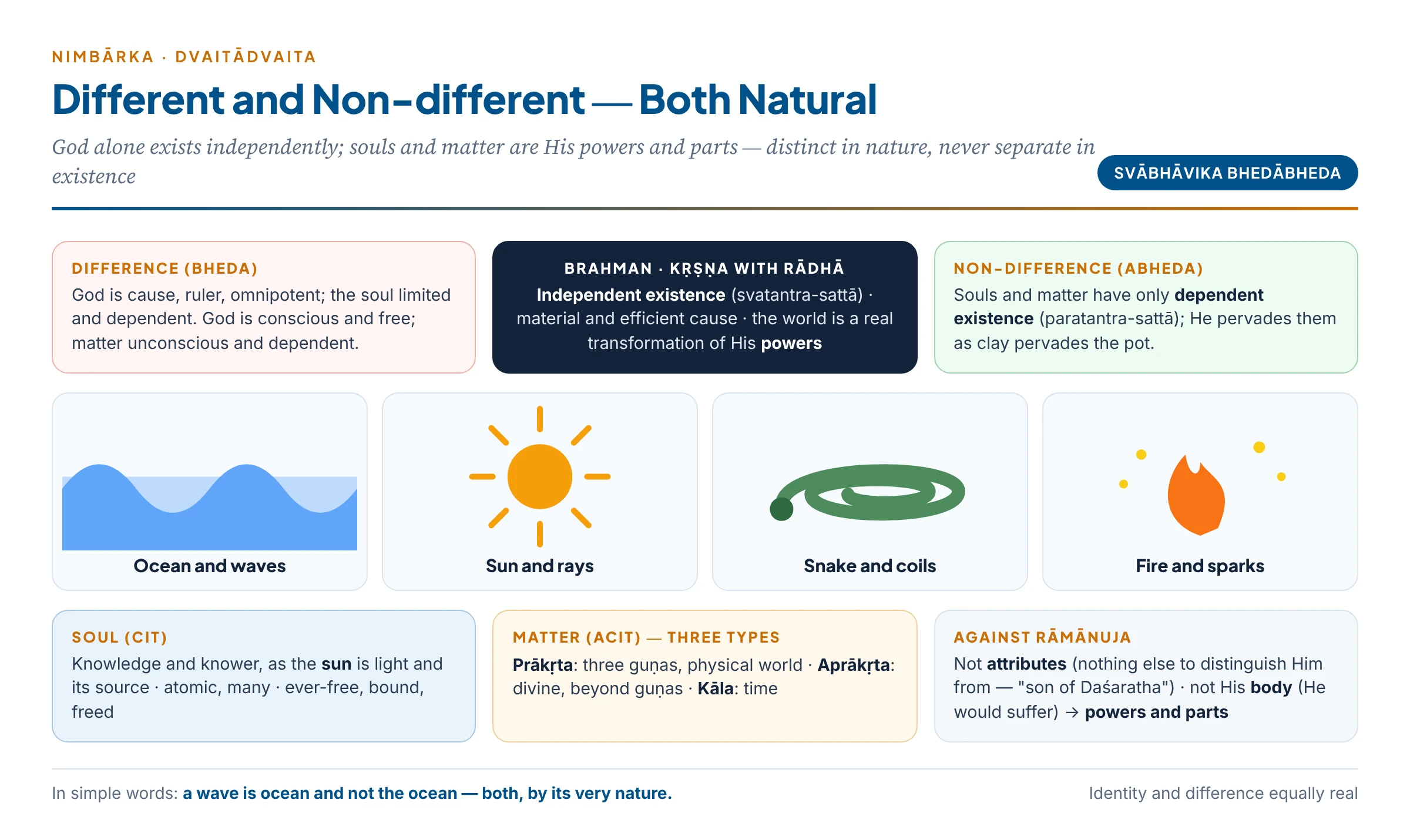
- Brahman — God, identified with Kṛṣṇa together with Rādhā; infinite, omniscient, omnipotent, independent; saguṇa, full of auspicious qualities, free from all defects.
- Cit — innumerable conscious souls.
- Acit — unconscious matter.
- Brahman as both causes. Brahman is the material and efficient cause of the world. The world is a real transformation (pariṇāma) of Brahman’s powers (śakti), not an illusion — Brahman itself remains unaffected.
Difference and non-difference — both natural
- Difference (bheda).
- God and souls — God is the eternal cause, ruler and controller; the soul is limited, dependent and liable to bondage. Souls can attain Brahman’s nature but never become omnipotent.
- God and matter — God is spiritual, conscious and independent; matter is unconscious and dependent. This difference is even sharper.
- Non-difference (abheda). Souls and matter have no independent existence; they are pervaded and sustained by Brahman, as clay pervades the pot or fire pervades its sparks.
- Independent and dependent existence. Brahman has independent existence (svatantra-sattā); souls and matter have only dependent existence (paratantra-sattā). Their non-difference means this dependence: they are not separate existents.
- Both are natural (svābhāvika). Neither identity nor difference is imposed by adjuncts (as in Bhāskara) or by ignorance (as in Śaṅkara); both belong to reality itself and coexist without contradiction.
- Analogies.
- Ocean and waves — waves are water, yet distinct forms.
- Sun and rays — rays depend on the sun, yet are distinct from it.
- Snake and its coils — coils differ in form, yet are nothing but the snake.
- Fire and sparks — sparks differ in size and power, yet share the fiery nature.
The soul (jīva)
- Knowledge as essence and attribute. The soul is of the nature of knowledge (jñāna-svarūpa) and also the substrate of knowledge (jñānāśraya), as the sun is light and also the source of light — a relation of substance and attribute (dharmi-dharma-bhāva) that is itself one of difference and non-difference.
- Atomic, eternal, many; a real knower, agent and enjoyer — though its agency depends on God.
- Three kinds of souls.
- Nitya-mukta — ever free.
- Baddha — bound in saṃsāra.
- Baddha-mukta — once bound, now freed.
Matter (acit): nature and types
- Nature.
- Real and eternal in its subtle form, mutable in its gross forms.
- Dependent on Brahman for existence and function.
- Unconscious (jaḍa) substance, the material basis of the universe, existing in subtle (sūkṣma) and gross (sthūla) states.
- A real transformation of Brahman’s power, not an illusion.
- Three types.
- Prākṛta — natural matter, prakṛti composed of the three guṇas (the Upaniṣad’s “unborn one, red, white and black“); root of the physical universe — elements, bodies and senses. Eternal and uncreated as in Sāṃkhya, but not independent — controlled by Brahman.
- Aprākṛta — non-natural, divine matter, not made of the guṇas, beyond decay; the stuff of God’s abode, divine forms and incarnations.
- Kāla — time, real and eternal, the condition of change in prakṛti, also under God’s control.
Tat tvam asi
- “That” is Brahman, “thou” the soul, and “art” expresses their natural relation of difference-cum-non-difference — the soul is non-different as Brahman’s part and power, and different as finite and dependent.
How Nimbārka differs from Rāmānuja
- Status of difference. Rāmānuja: identity is primary, difference subordinate (attributes qualifying one substance). Nimbārka: identity and difference are equally real and natural.
- Not attributes. An attribute distinguishes its substance from other things — “son of Daśaratha” distinguishes Rāma from other Rāmas. But there is nothing other than Brahman from which souls and matter could distinguish Him; so they cannot be His attributes.
- Not God’s body. If souls and matter were God’s body, God would suffer the body’s pains as an embodied soul does. Nimbārka calls them Brahman’s powers (śakti) and parts (aṃśa) instead.
- Devotion. Nimbārka centres devotion on Rādhā–Kṛṣṇa in the mood of sweet love (mādhurya); Rāmānuja on Nārāyaṇa–Lakṣmī in the mood of majesty.
Common confusion
Did Nimbārka make souls and matter the “body” of God? Some notes describe Nimbārka’s cit and acit as God’s body (śarīra) and modes (prakāra), as in Rāmānuja. Nimbārka in fact rejects the body–soul model — a God with a body would share its pains — and describes souls and matter as Brahman’s powers and parts, naturally different from and non-different from Him. The body–soul language belongs to Rāmānuja.
Liberation in Nimbārka
- Bondage is due to beginningless karma and ignorance of the soul’s true nature as a part of Brahman.
- Five means are recognised: action (karma), knowledge (vidyā), meditation (upāsanā), surrender to God (prapatti) and surrender to the teacher (gurūpasatti).
- The chain. Surrender and devotion win God’s grace; grace produces knowledge of Brahman; knowledge brings release.
- The liberated soul realises its nature as Brahman’s part, attains likeness to Brahman and enjoys His bliss — but remains distinct. Liberation comes after death.
Evaluating Nimbārka’s Account of God, Souls and Matter
- Reasons to agree.
- Fidelity to scripture. It accepts both unity texts and difference texts without explaining either away.
- Avoids Rāmānuja’s attribute problem — souls are not “attributes” that would need something to be distinguished from.
- Avoids the body problem — God does not suffer through a body.
- Keeps realism — souls and matter are real; the world is not illusion.
- Balance — it is the middle path between Śaṅkara and Madhva.
- Religious richness — devotion to a personal God of love.
- Reasons to doubt.
- Contradiction. To say two things are both identical and different in the same respect is contradictory — “like light and darkness in the same place”. Śaṅkara made this objection against Bhāskara’s bhedābheda.
- Different respects collapse the view. If they are identical in one respect and different in another, the system becomes either Rāmānuja’s (identity primary) or Madhva’s (difference primary).
- “Natural” names the problem rather than solving it — calling the relation svābhāvika does not show how it is possible.
- Brahman’s perfection. If Brahman’s own powers become suffering souls and changing matter, does change and suffering touch Brahman? (Rāmānuja’s objection to bhedābheda.)
- Three kinds of matter — the non-natural, divine matter seems introduced to suit theology, as critics say of Rāmānuja’s pure sattva.
- A balanced verdict. Nimbārka’s account is attractive as a description of how God, souls and matter are related — real dependence, real distinctness — but it does not explain how identity and difference can both be fully real. That gap is exactly what Caitanya’s school later admitted by calling the relation inconceivable.
Vallabha: Śuddhādvaita (Pure Non-dualism)
Life and works
- Vallabha (1479–1531), of a Telugu family; associated with the Viṣṇusvāmin (Rudra) sampradāya.
- Works. Aṇubhāṣya (on the Brahma-sūtra), Subodhinī (on the Bhāgavata), Tattvārtha-dīpa-nibandha and sixteen short treatises. He treated the Bhāgavata Purāṇa as a fourth authority beside the three classical texts.
Why “pure” non-dualism?
- Free from māyā (māyā-sambandha-rahita). Śaṅkara’s non-dualism is “impure” because it makes Brahman associated with māyā to explain the world. Vallabha’s is “pure“: pure Brahman alone, without māyā, is both the cause and the effect of the world.
- The world is real. God and world are ultimately the same and both are real; māyā is only God’s own power, not illusion.
- Brahman = Kṛṣṇa = Puruṣottama, sat–cit–ānanda, the abode of contradictory attributes (viruddha-dharmāśraya) — both saguṇa and nirguṇa, one and many, greater and smaller.
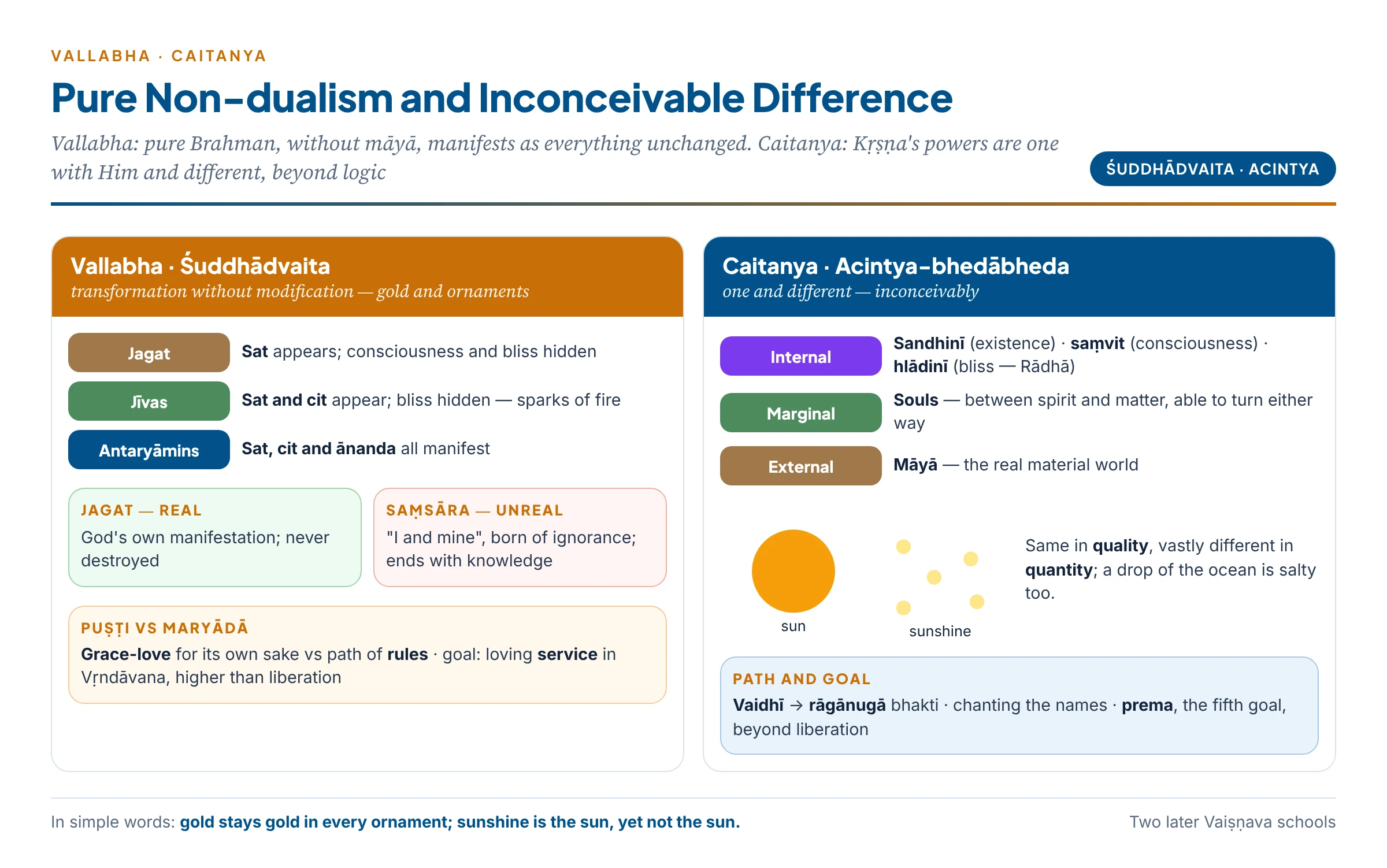
Avikṛta-pariṇāmavāda — transformation without modification
- Between vivarta and pariṇāma. The world is a real transformation (not appearance, as in vivarta), yet Brahman undergoes no modification (unlike ordinary pariṇāma).
- Essence and power to cause. In God, the essence stays the same while the power to cause acts. If essence and causal power were the same, everything would be causing all the time.
- Creation is manifestation (āvirbhāva) of Brahman; dissolution is withdrawal (tirobhāva). “Brahman desired to become many, and became many” — the Bṛhadāraṇyaka’s account.
- Identity, not inherence. Vallabha rejects Nyāya’s samavāya; cause and effect are related by identity (tādātmya) — as the cloth is its threads. Brahman is the inherent (material) cause.
- Illustrations. Gold and ornaments (gold unchanged), the spider and its web, sparks from fire.
In simple words
A goldsmith makes a necklace, then melts it into bangles, then into earrings. The forms come and go — and every one of them is truly gold — but the gold itself never becomes anything other than gold. Vallabha says the world is Brahman’s ornament in just this way: real, ever-changing in form, while Brahman’s essence stays untouched.
Three manifestations of sat–cit–ānanda
| Manifestation | What appears | What is hidden | Kind of difference from Brahman |
|---|---|---|---|
| Jagat (matter) | Sat (existence) | Consciousness and bliss | Different in kind (vijātīya) |
| Jīvas (souls) | Sat and cit (consciousness) | Bliss | Same in kind (sajātīya) |
| Antaryāmins (inner controllers) | Sat, cit and ānanda (bliss) | — | Internal (svagata) |
Souls, world and ignorance
- The soul is Brahman itself with bliss (ānanda) concealed — a spark of the fire, a part of the whole; atomic, yet pervading the body by its intelligence, “as sandalwood is felt everywhere by its scent“. It is a real doer and enjoyer.
- Jagat versus saṃsāra.
- Jagat — the world as God’s real manifestation; never destroyed by knowledge.
- Saṃsāra — the soul’s private world of “I and mine“, created by ignorance; it is unreal and ends with knowledge.
- Fivefold ignorance — ignorance of the soul’s true nature and false identification with the inner organ, the vital breath, the senses and the body.
Path and goal
- Bhakti is the means: “firm and all-surpassing love for God, with full sense of His greatness“. Knowledge helps; action precedes and continues even after knowledge — the liberated perform all actions.
- Two paths.
- Maryādā-mārga — the path of rules: Vedic duties, knowledge, disciplines; leads to liberation by effort.
- Puṣṭi-mārga — the path of grace (puṣṭi = nourishment, God’s grace): love for love’s sake, depending wholly on Kṛṣṇa’s grace; open to all, including householders.
- The highest goal is not liberation but eternal loving service (sevā) of Kṛṣṇa and sharing His sport (līlā) in His divine Vṛndāvana.
Caitanya: Acintya-bhedābheda (Inconceivable Difference-in-Identity)
Life and school
- Caitanya (1486–1534) of Navadvīpa (Bengal), revered as Kṛṣṇa in the mood of Rādhā; he wrote no treatises (only eight devotional verses).
- His teaching was systematised by the Gosvāmīs of Vṛndāvana — Rūpa, Sanātana and Jīva Gosvāmī — and by Baladeva Vidyābhūṣaṇa, who wrote the Govinda-bhāṣya on the Brahma-sūtra. The school is called Gauḍīya Vaiṣṇavism and claims descent from Madhva’s lineage.
The central doctrine
- Bheda — God, souls and world are distinct.
- Abheda — yet inseparable, being God’s energies (śakti).
- Acintya — this relation is inconceivable to the intellect; it is grasped only through devotion. Where reason sees a contradiction, God’s power reconciles what reason cannot.
- Viśeṣa borrowed from Madhva — God’s power of distinctness allows unity and distinction together.
Kṛṣṇa and His three powers
- Internal power (antaraṅga / svarūpa-śakti) — God’s own nature, with three aspects:
- Sandhinī — the power of existence (sat).
- Saṃvit — the power of consciousness (cit).
- Hlādinī — the power of bliss (ānanda), personified as Rādhā.
- Marginal power (taṭastha / jīva-śakti) — the souls, standing between spirit and matter, able to turn to either.
- External power (bahiraṅga / māyā-śakti) — the material world, real but outer.
Illustrations of the relation
- Sun and sunshine — the same in quality, vastly different in quantity.
- A drop of the ocean is salty like the ocean — the soul has God’s qualities in a minute measure.
- Gold and gold particles; the spider sending out and drawing in its thread; plants growing from the earth; hair growing on the head.
- Souls are eternal parts (aṃśa) of God — qualitatively one with Him, quantitatively finite, eternally dependent.
Devotion and goal
- Two stages of devotion.
- Vaidhī bhakti — devotion regulated by scriptural rules.
- Rāgānugā bhakti — spontaneous devotion that follows the love of Kṛṣṇa’s companions in Vraja.
- Five relationships (rasa) with God: peace, servant, friend, parent, and — highest — lover (mādhurya), modelled on Rādhā’s love.
- Nāma-saṅkīrtana — congregational chanting of God’s names — is the easiest path in the present age (Kali-yuga).
- Prema (pure love) is the supreme goal — the “fifth goal of life“, higher than liberation — eternal communion in Nitya-Vṛndāvana.
In simple words
Sunshine fills your room. Is it the sun? In one sense yes — it is the sun’s own light, the same in nature. In another sense no — the sun is vast and far away, the sunshine a tiny portion. Caitanya says the soul is like sunshine: one in quality with God, infinitely smaller in quantity — and how both are true at once is beyond our logic.
Common confusion
Is Vallabha’s “pure non-dualism” a purer form of Śaṅkara’s Advaita? No. “Pure” (śuddha) means free from māyā: Vallabha calls Śaṅkara’s system impure because it needs māyā to explain the world. In content Vallabha is far from Śaṅkara — the world is real, God is personal (Kṛṣṇa), the goal is devotional service, not merging. It is a theistic, devotional non-dualism.
Critical Evaluation
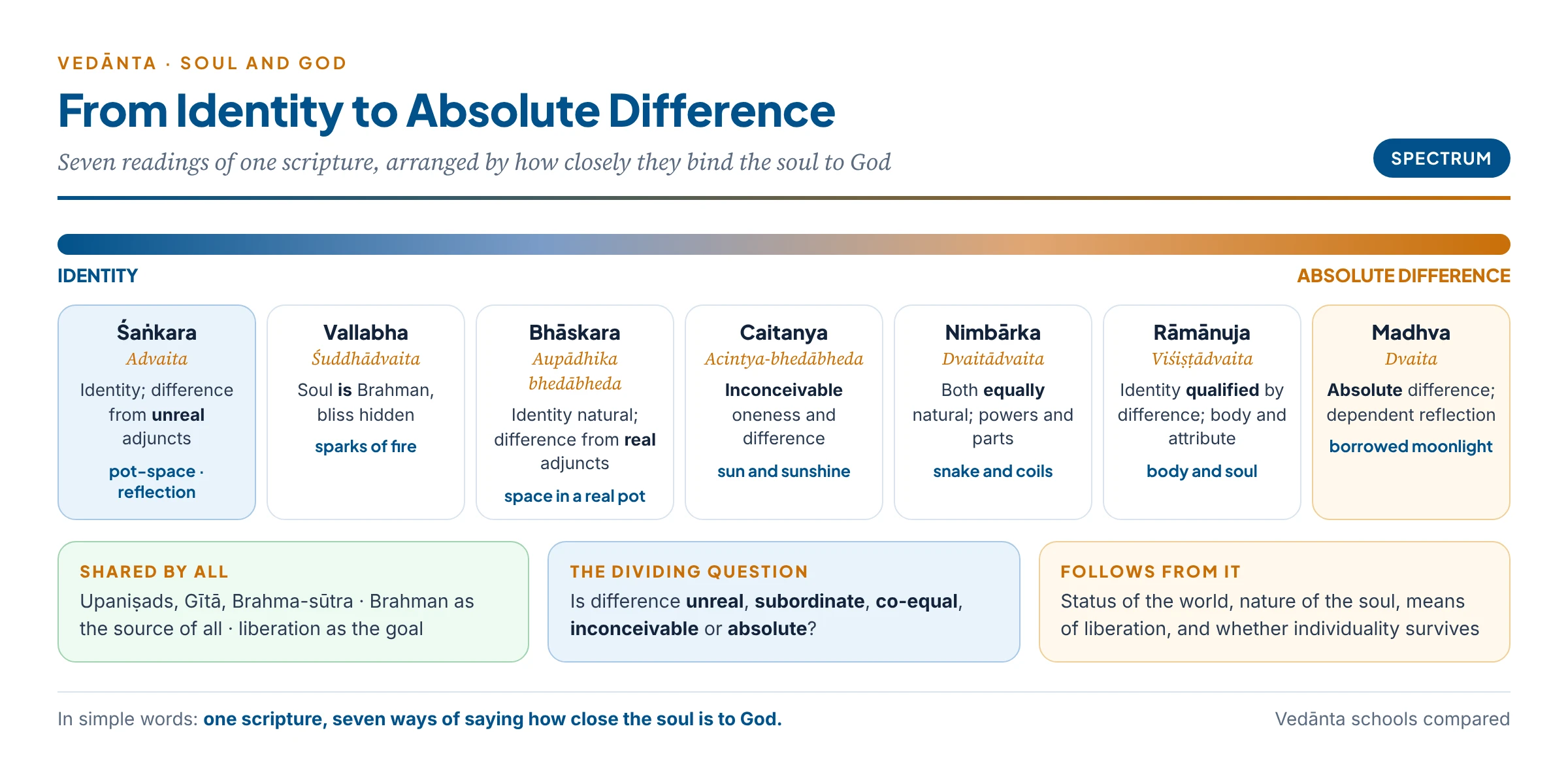
The Soul–God Relation Across the Schools
| School | How the soul is related to God | Image |
|---|---|---|
| Śaṅkara | Identity; difference due to unreal adjuncts | Pot-space and total space; reflection |
| Bhāskara | Identity natural; difference due to real adjuncts | Space limited by a real pot |
| Rāmānuja | Soul is God’s body / attribute — inseparable, subordinate | Body and soul; blue lotus |
| Nimbārka | Soul is God’s power / part — difference and identity equally natural | Sun and rays; snake and coils |
| Vallabha | Soul is Brahman with bliss hidden — pure identity | Sparks of fire |
| Caitanya | Inconceivable difference-in-identity | Sun and sunshine; drop and ocean |
| Madhva | Absolute difference; soul a dependent reflection | Moonlight borrowed from the sun |
Brahman in Śaṅkara, Rāmānuja and Madhva
| Point | Śaṅkara | Rāmānuja | Madhva |
|---|---|---|---|
| Nature | Nirguṇa, pure consciousness; saguṇa Īśvara empirical | Saviśeṣa, infinite good qualities | Viṣṇu, infinite good qualities |
| Brahman and Īśvara | Distinct levels | Identical | Identical |
| Internal difference | None | Svagata (souls and matter within) | None (qualities one with Him by viśeṣa) |
| Causality | Material and efficient through māyā (vivarta) | Material and efficient through body (pariṇāma) | Efficient only |
| Knowability | Not as object; realised as Self | Through scripture, devotion, vision | Through scripture; reason only supports |
| Relation to world | World is appearance | World is His body | World is His dependent |
| Critique | Quality-less Brahman unknowable (Rāmānuja) | Half-hen problem (Advaita) | God limited by eternal prakṛti? |
Grand Comparison of Six Schools
| School (teacher) | Brahman | World and māyā | Jīva | Means → goal |
|---|---|---|---|---|
| Advaita (Śaṅkara) | Nirguṇa | Mithyā (vivarta); māyā indescribable appearance | Brahman itself | Knowledge → identity; jīvanmukti accepted |
| Viśiṣṭādvaita (Rāmānuja) | Nārāyaṇa, qualified | Real, God’s body; māyā God’s real power | Mode, atomic | Bhakti, prapatti → likeness and service; no jīvanmukti |
| Dvaita (Madhva) | Viṣṇu, independent | Real, dependent; māyā God’s will | Distinct, graded | Bhakti, grace → graded bliss near God; no jīvanmukti |
| Dvaitādvaita (Nimbārka) | Kṛṣṇa with Rādhā | Real, transformation of His power | Power and part | Prapatti, grace, knowledge → likeness, communion |
| Śuddhādvaita (Vallabha) | Kṛṣṇa, pure, contradictory attributes | Real, unmodified transformation; no taint of māyā | Brahman with bliss hidden | Puṣṭi (grace-love) → service in Vṛndāvana; the liberated still act |
| Acintya-bhedābheda (Caitanya) | Kṛṣṇa with three powers | Real, His external power | Marginal power, part | Prema, saṅkīrtana → prema in Nitya-Vṛndāvana |
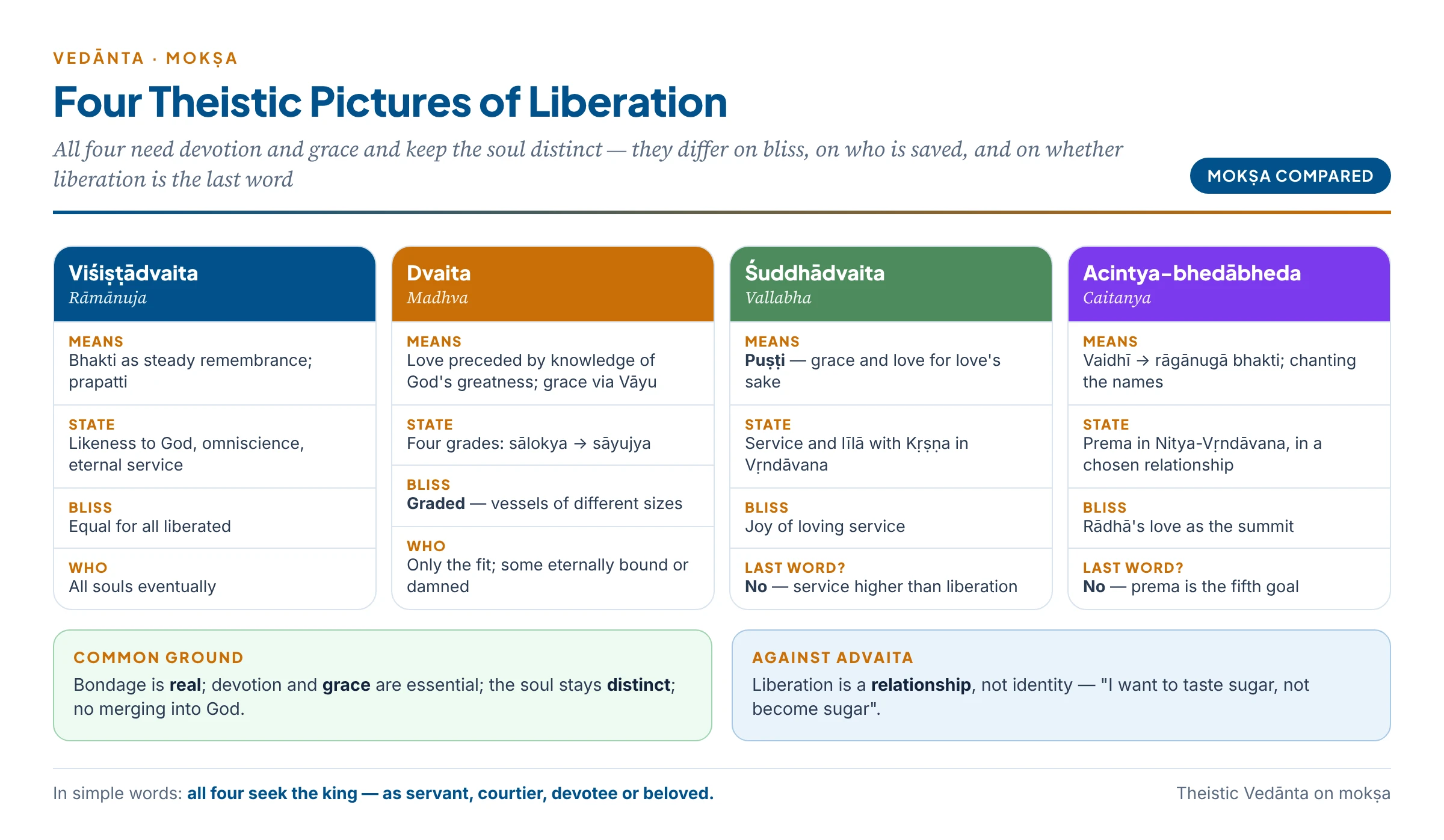
Mokṣa in Viśiṣṭādvaita, Dvaita, Śuddhādvaita and Acintya-bhedābheda
| Point | Viśiṣṭādvaita | Dvaita | Śuddhādvaita | Acintya-bhedābheda |
|---|---|---|---|---|
| Nature of bondage | Real karma; ignorance of dependence | Real ignorance and karma, maintained by God’s will | Saṃsāra of “I and mine”; fivefold ignorance | Forgetfulness of Kṛṣṇa under external power |
| Means | Bhakti as steady remembrance; prapatti | Bhakti preceded by knowledge of God’s greatness | Puṣṭi — grace-love; maryādā for others | Vaidhī and rāgānugā bhakti; chanting |
| Role of grace | Essential | Essential (through Vāyu) | Everything (puṣṭi) | Essential |
| State | Sādharmya — likeness, omniscience, service | Four grades; graded bliss | Sevā and līlā with Kṛṣṇa | Prema in the moods of Vraja |
| Individuality | Kept | Kept, graded | Kept, as part | Kept, as part |
| Is mokṣa the highest? | Yes | Yes | No — loving service is higher | No — prema is the fifth, highest goal |
| Universality | All souls eventually | Only the fit; some damned | Through grace | Open to all through the name |
In simple words
Four people want to reach the king. One wants to live in his palace as a trusted servant (Rāmānuja). One accepts a place in the court according to his rank (Madhva). One wants simply to keep serving the king lovingly, not caring about rewards (Vallabha). One wants to be the king’s beloved friend, lost in love (Caitanya). All four want the king; they differ in the relationship they seek.
Critics and Defenders
Criticism — Critics
- Śaṅkara (against bhedābheda): identity and difference in the same thing are contradictory, like light and darkness.
- Rāmānuja (against bhedābheda): if Brahman really becomes souls, Brahman suffers.
- Madhva: any identity blurs God’s absolute supremacy.
- Logicians: “natural” and “inconceivable” relations are labels, not explanations.
Defence — Defenders and strengths
- Nimbārka: identity and difference are both natural; scripture teaches both.
- Vallabha: pure Brahman needs no māyā; transformation without modification keeps God unchanged.
- Caitanya’s school: God’s power can reconcile what reason cannot; devotion grasps the inconceivable.
- Strength: realism, personal God, accessible devotion, joyful religion open to all.
Cross-Tradition Comparison
The Bhedābheda Schools and Western Thought
| Point | Bhedābheda schools | Western parallel | Similarity | Difference |
|---|---|---|---|---|
| Identity-in-difference | Nimbārka’s natural bhedābheda | Hegel — concrete universal, identity-in-difference | Unity containing real difference | Hegel’s Absolute develops dialectically |
| Coincidence of opposites | Vallabha’s God of contradictory attributes; Caitanya’s acintya | Nicholas of Cusa — God as coincidence of opposites | God beyond the law of contradiction | — |
| Emanation | Vallabha’s manifestation and withdrawal | Plotinus — emanation from the One | World flows from God without depleting Him | Vallabha’s world is identical with God |
| Love as highest | Caitanya’s prema beyond liberation | Christian mysticism — love of God, bridal mysticism | Love higher than knowledge | — |
| Panentheism | All in God, God more than all | Modern panentheism | God immanent and transcendent | — |
Indian Connect — Key takeaways
- The six schools share one scripture — Upaniṣads, Gītā, Brahma-sūtra — yet produce a full range from identity to difference: a model of philosophical pluralism within a tradition.
- Nimbārka, Vallabha and Caitanya are all Kṛṣṇa-centred and devotional, and shaped the Bhakti movement of north and east India.
- Swami Vivekananda saw Dvaita, Viśiṣṭādvaita and Advaita as stages of one spiritual journey; Sri Aurobindo’s integral Advaita affirms both the Absolute and a real world.
Synthesis (Siddhānta)
- Nimbārka (Dvaitādvaita): three realities; Brahman (Kṛṣṇa with Rādhā) as both causes; natural difference and non-difference; souls as knowledge and knower, atomic, three kinds; matter as prākṛta, aprākṛta and kāla, real and dependent; souls and matter as God’s powers and parts, not His body or attributes; liberation by surrender, grace and knowledge.
- Evaluation of Nimbārka: faithful to scripture and balanced, but the coexistence of equally real identity and difference remains unexplained.
- Vallabha (Śuddhādvaita): pure Brahman without māyā; transformation without modification; matter, souls and inner controllers as manifestations of sat, cit and ānanda; jagat real, saṃsāra unreal; puṣṭi-mārga; loving service higher than liberation.
- Caitanya (Acintya-bhedābheda): Kṛṣṇa with internal, marginal and external powers; souls as sunshine to the sun; inconceivable relation; vaidhī and rāgānugā bhakti, saṅkīrtana; prema as the highest goal.
- Comparisons: the soul–God relation runs from Śaṅkara’s identity to Madhva’s absolute difference; Brahman, world, means and goal differ in each school; mokṣa ranges from identity to graded bliss to loving service.
- Contemporary relevance.
- Pluralism. The six schools show how one scriptural tradition can support many reasoned interpretations — a lesson in tolerance.
- Inclusive religion. Puṣṭi-mārga and saṅkīrtana made spirituality available regardless of caste, gender or learning.
- Philosophy of relation. The debate about identity and difference anticipates modern questions about part and whole, self and community, and unity in diversity — India’s own civic ideal.
“As the spider sends forth and draws in its thread, as plants grow on the earth, as hair grows on a living man, so does everything here arise from the Imperishable.” — Muṇḍaka Upaniṣad
Previous Year Questions
- 2026Do you agree with Nimbārka’s explanation of the nature of God, Souls and Matter? Justify your answer.
- 2020Discuss the nature and types of matter according to Nimbārka.
- 2018Give a comparative exposition of the concept of Mokṣa as found in the systems of Viśiṣṭādvaita, Dvaita, Śuddhādvaita and Acintyabhedābheda.
- 2014How does nature of Brahman differ in the philosophy of Śaṅkara, Rāmānuja and Madhva? Discuss critically.