

Schools of Buddhism: Pratītyasamutpāda; Kṣaṇikavāda, Nairātmyavāda
Official Syllabus: Paper I, Section B, Unit 14
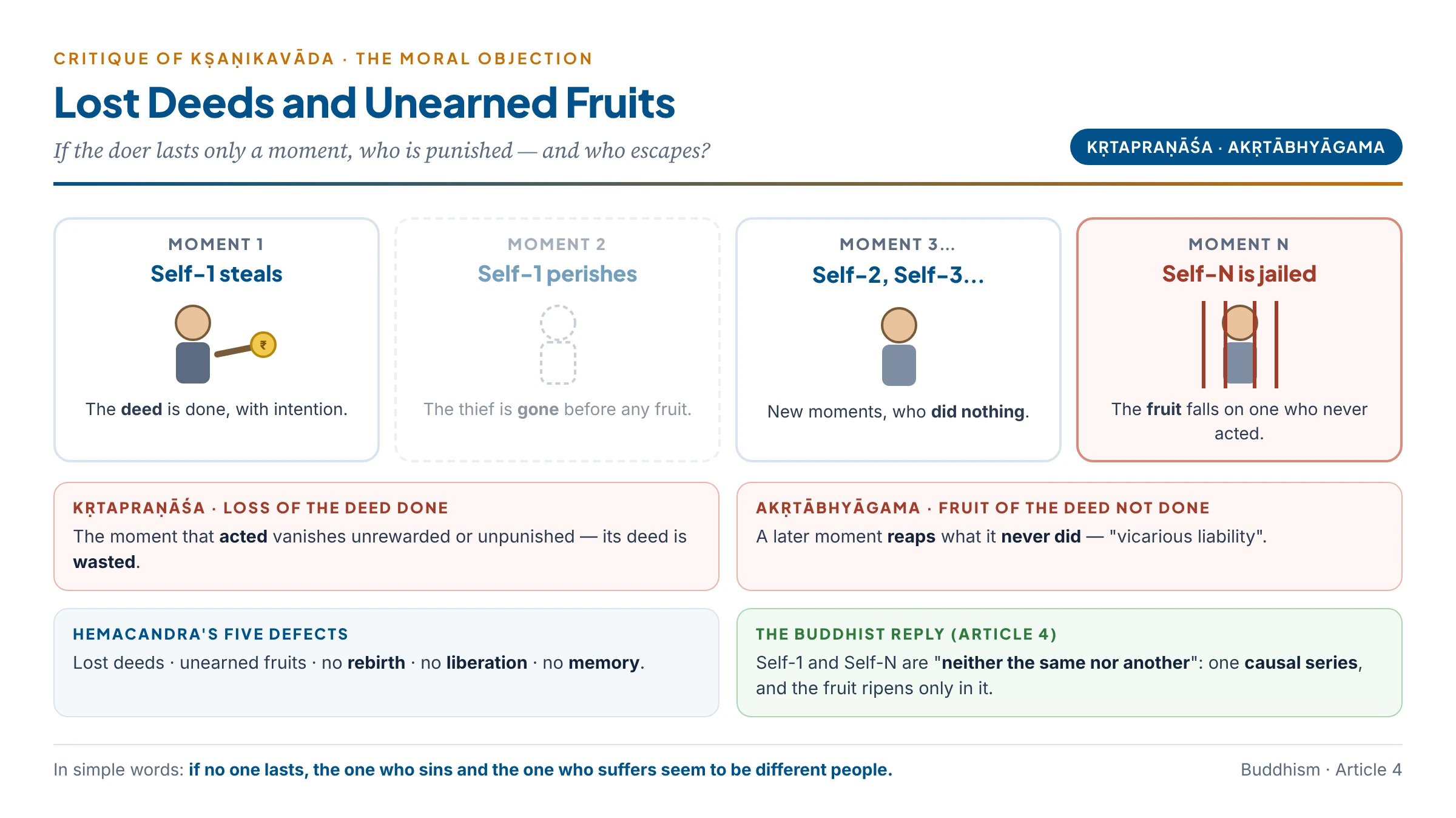
If everything lasts only a moment, then the person who did a deed yesterday is not the person who reaps its fruit today; the self that saw a friend last year is not the self that remembers him now; and the monk who strives for nirvāṇa is not the one who attains it. Every rival school of India pressed this point against Kṣaṇikavāda. The most famous form of the charge is that momentariness leads to two absurdities: kṛtapraṇāśa — “the loss of what has been done” (the doer vanishes before reaping the fruit) — and akṛtābhyāgama — “the arrival of what has not been done” (someone reaps a fruit he never earned). This article sets out the objections from memory, recognition, personal identity, action, karma, responsibility, bondage and liberation, and the Buddhist replies built on the idea of a causal series (santāna).
In simple words
A man borrows ₹10,000 in January. In June the lender asks for it back. The man says: “I’m not the person who borrowed — every cell and every thought of that man is gone; you’ll have to find him.” We would laugh. Yet if everything is momentary, isn’t he right? This is the problem of this article. The Buddhist answer will be: he is not the same person, but he is not another person either — he is the continuation of the series that borrowed, and the debt travels with the series.
Context & Problem
Why the Charge Is So Serious
- Karma is central to Buddhism. The Buddha taught that “beings are owners of their deeds, heirs of their deeds”; the law of karma takes the place of God. If momentariness makes karma impossible, Buddhism undermines itself.
- The path presupposes a traveller. The Four Noble Truths assume someone who suffers, someone who walks the path, someone who reaches nirvāṇa. If “suffering itself is momentary”, “why should a person at all try to overcome suffering when he himself together with the suffering will vanish in the next moment?”
- Knowledge presupposes a knower. Perception, inference, memory and recognition all join past and present. If no one lasts, who joins them?
- Ordinary life presupposes persons. Promises, debts, praise and blame, punishment, gratitude, love — all assume that the person today is in some sense the person of yesterday.
Who Raised the Objections
- Nyāya and Mīmāṃsā — defenders of a permanent self (ātman) proved by memory, desire and recognition.
- Jainas — above all Hemacandra, who listed the five defects of momentariness.
- Advaita Vedānta — Śaṅkara’s classic critique in his commentary on the Brahma Sūtra.
- Sāṃkhya and Yoga — defenders of a constant witness-consciousness (Puruṣa).
- King Milinda himself, in the dialogue with Nāgasena: “If there is no permanent soul, who is it that enjoys robes, food and lodging? Who lives a life of righteousness? Who attains nirvāṇa? … If a man were to kill you, there would be no murder.”
Core Doctrine
1. The Five Defects (Hemacandra)
The Jaina logician Hemacandra summed up the case: one who accepts universal momentariness, “ignoring the defects of loss of the deed done, enjoyment of fruits of deeds not done, destruction of the world-cycle, destruction of liberation, and destruction of memory, is indeed reckless!”
| # | Defect | Sanskrit | In plain words |
|---|---|---|---|
| 1 | Loss of the deed done | kṛtapraṇāśa | The momentary self that acted vanishes before its action bears fruit; the deed is wasted |
| 2 | Fruit of the deed not done | akṛtābhyāgama (akṛta-karma-bhoga) | A later momentary self reaps the fruit of an action it never performed |
| 3 | Destruction of the cycle of births | bhava-bhaṅga | With no one to pass from life to life, rebirth — the cycle the path aims to end — makes no sense |
| 4 | Destruction of liberation | pramokṣa-bhaṅga | One moment is bound, another is liberated; no one is ever freed |
| 5 | Destruction of memory | smṛti-bhaṅga | The one who experienced is gone; the one who “remembers” never experienced |
- Vicarious liability. “There will be vicarious liability in moral life. He who performs an act will lose its fruit and another will have to reap it.” This is the heart of kṛtapraṇāśa and akṛtābhyāgama.
- The verdict of critics. “To maintain action without an agent is to have a marriage without a bride, an alehouse without a customer, a drama without an actor.”
Common confusion
Do “kṛtanāśa” and “akṛtābhyupagama” mean “everything produced is destroyed” and “nothing permanent can be accepted”? No. Some notes give these meanings, treating the two words as Buddhist doctrines. They are not doctrines but objections raised by opponents of momentariness. Kṛta-(pra)ṇāśa means “the destruction (loss) of what was done” — the doer perishes and his deed goes unrewarded or unpunished. Akṛta-abhyāgama (often written akṛtābhyupagama) means “the coming of what was not done” — someone receives the fruit of a deed he never did. When a question asks whether the Buddhist arguments “lead to kṛtanāśa and akṛtābhyupagama“, it is asking whether momentariness destroys the moral law of karma.
2. The Objection from Memory (Smṛti)
- The argument. Memory is “I remember what I experienced”. The rememberer and the experiencer must be the same. If the self of yesterday perished, today’s self can no more remember yesterday’s experience than Yajñadatta can remember what Devadatta saw.
- The Nyāya form. Memory is one of the marks of the self: the Nyāya lists desire, aversion, effort, pleasure, pain and cognition as its signs. I desire a mango today because I remember enjoying one before; desire joins a past experience to a present wish in one subject.
- “The fact of memory and recognition gives a death-blow to the theory of momentariness.”
3. The Objection from Recognition (Pratyabhijñā)
- The argument. In recognition — “this is that Devadatta whom I saw in Delhi” — past and present are joined in one cognition. Only a subject who lasts from then to now can make this comparison.
- Śaṅkara’s sharpening. “The past is recognized and remembered in the present, and this implies the existence of a permanent, synthesizing subject, without whom knowledge shall always remain an impossibility.” “When the Buddhist himself recognizes all his successive cognitions, till he breathes his last, as belonging to the same self, should he not tremble in maintaining shamelessly the doctrine of momentariness?“
- Identity cannot be similarity.
- Similarity cannot account for identity. Two similar coins are two coins; recognising “the same friend” is not recognising “a friend-like person”.
- Similarity itself presupposes identity. To judge that moment B is similar to moment A, one comparer must hold both before the mind. “There must be a self which is not itself momentary to recognize and compare two things as similar.”
4. The Objection from the Unity of Knowledge
- One perception cannot perceive another. “The momentary idea cannot ideate itself.” For many sense-data to become knowledge of one object, they must be united in one consciousness.
- “He who experiences the flux is, for that very reason, above the flux.” To know that things change, one must be the unchanging witness of the change.
- Inference needs a lasting reasoner. In inferring fire from smoke, I must remember the rule (“where there is smoke, there is fire”), perceive the smoke, and join them. A momentary mind could do only one of these.
- The self cannot be doubted. “Everything may be doubted, but the self can never be doubted, for the very idea of doubt presupposes the self.” (Compare Descartes.)
- The Western echo. Kant called this the transcendental unity of apperception: the “I think” must be able to accompany all my representations, or they would not be mine.
5. The Objection from Action and Responsibility
- Action takes time. Deciding to help a friend, walking to his house, and handing over the money are spread over many moments. The momentary self that intends is not the one that acts, and neither is the one that sees the result. Who, then, acted?
- Intention and fruit separated. Buddhism itself defines karma as intention (cetanā). But the intending moment vanishes before the fruit; the fruit falls on a moment that intended nothing.
- Responsibility. Praise, blame, punishment and reward are just only if they fall on the one who acted. Punishing today’s person for yesterday’s crime is punishing an innocent stranger; rewarding him is rewarding someone who earned nothing.
- Promises, debts and trust. A promise binds the future self; a debt binds the later self. Momentariness seems to dissolve every commitment.
- Milinda’s challenge. “There is neither merit nor demerit; there is neither doer nor causer of good or evil deeds; there is neither fruit nor result of good or evil karma. If, most reverend Nāgasena, we are to think that were a man to kill you there would be no murder, then it follows that there are no real masters or teachers in your Order.”
- How momentariness “problematizes” human action. It raises four questions at once: (1) who acts, (2) who is responsible, (3) why act for a future that is not “mine”, and (4) how effort on the path can benefit the one who makes it.
6. The Objection from Bondage and Liberation
- “If the soul is momentary, whose is the bondage and whose is the liberation?” “One momentary idea is bound and another is liberated.”
- Suffering is momentary. If my suffering vanishes by itself in the next moment, and I vanish with it, the first noble truth loses its urgency, and “the noble eightfold path becomes uninspiring. The very aim of the Buddha becomes defeated.”
- Ignorance destroyed by knowledge? If everything perishes of itself (causeless destruction), why is knowledge needed to destroy ignorance? If ignorance perishes of itself, the path is useless; if knowledge destroys it, destruction has a cause after all (Śaṅkara).
7. The Buddhist Reply: Continuity of the Series (Santāna)
The Buddhist answer to every objection is the same idea, applied with care: there is no permanent self, but there is a causal series whose moments are neither identical nor unrelated.
- Neither the same nor another. Asked whether the one who is reborn is the same as the one who died, or another, Nāgasena answers: “Neither the same, nor another” (na ca so, na ca añño).
- Not the same — there is no unchanging soul (against eternalism).
- Not another — the later moment is caused by the earlier and inherits its character (against annihilationism).
- Transmission of content. “The preceding link does not perish before transmitting its content to the succeeding link, and so the continuity is never broken. The successor bears all the burden of the predecessor.“
- The lamp through the night. The flame of the first watch, the second watch and the third watch are not one flame; nor are they different flames; they are one series, each depending on the one before. “Similarly, the end-state of this life may cause the beginning of the next.”
- Memory explained. “As the present state of consciousness inherits its characters from the previous ones, the past in a way continues in the present, through its effect. Memory thus becomes explicable even without a soul.” Memory is the arising, in a later moment of the same series, of an image caused by an earlier experience in that series — which is why Yajñadatta cannot remember Devadatta’s experiences: they are in a different series.
8. The Buddhist Reply to Kṛtapraṇāśa and Akṛtābhyāgama
- The same-series principle. “In the very series in which the karmic impression has been deposited, there alone the fruit appears — just as redness appears in the cotton flower from a cotton seed soaked in lac-dye.”
- No loss of the deed done (against kṛtapraṇāśa): the deed leaves an impression (vāsanā, bīja) in the series, which does not vanish until it ripens — as the dye passes from seed to sprout to flower.
- No fruit of a deed not done (against akṛtābhyāgama): the fruit ripens only in the series that acted, never in another — as red flowers grow only from the dyed seed, not from other seeds.
- Each school’s mechanism.
- Vaibhāṣika — past deeds still exist (as past dharmas), so they can bear fruit later; a special factor called “possession” (prāpti) links them to the series.
- Sautrāntika — deeds leave seeds (bīja) in the mental series that mature into future experiences; continuity without past or future dharmas.
- Yogācāra — seeds are stored in the storehouse-consciousness (ālaya-vijñāna) and ripen when conditions are favourable.
- Mādhyamika (Nāgārjuna) — turns the argument round: if karma had a fixed own-nature and lasted, it would either never bear fruit or bear it for ever; it is precisely because deeds are empty and dependent that they can ripen.

9. The Milinda Analogies: Responsibility in a Series
Nāgasena’s famous replies to King Milinda show that we already hold people responsible along series, not for unchanging souls.
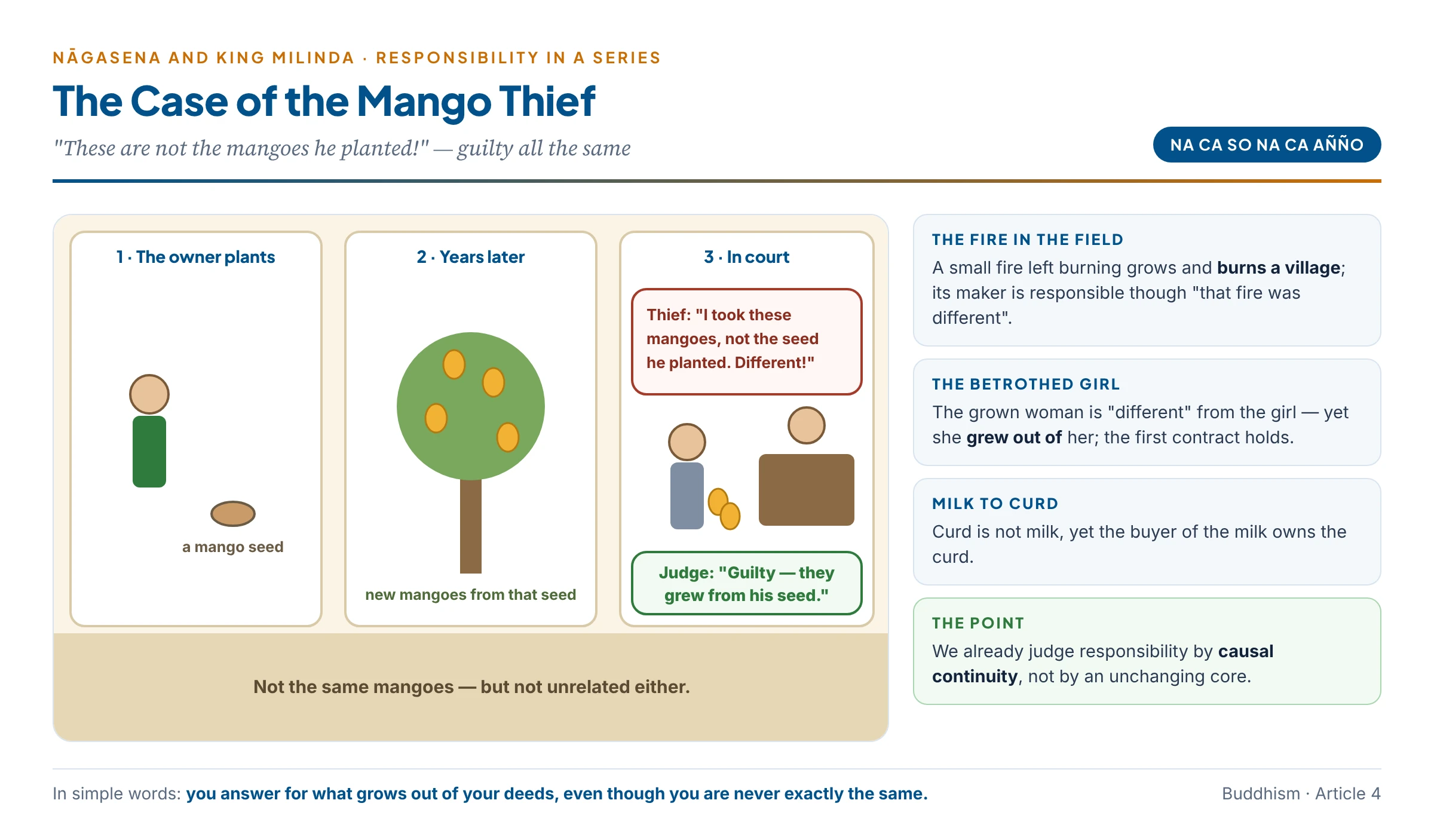
- The mango thief. A man steals mangoes from another’s tree. In court he says: “These are not the mangoes the owner planted — he planted a seed; these mangoes are different.” Is he guilty? “Yes, because these mangoes grew from the one he planted.” So too, the person reborn is not the same, yet reaps the deeds of the one whose series he continues.
- The fire in the field. A man lights a fire to warm himself and walks away; it spreads and burns a village. He says: “I did not burn the village — that fire was different from the little fire I lit.” Is he responsible? “Yes, because the great fire arose from his fire.”
- The betrothed girl. A man pays the bride-price for a young girl and goes away; years later another man marries her, grown up. The first claims: “She is my wife.” The second: “The girl you paid for is not this woman.” Whose is she? “The first man’s — because the woman grew out of that girl.”
- Milk, curd, butter, ghee. A man buys milk, leaves it, and returns to find it has become curd. Curd is not milk, yet the seller cannot say “you bought milk, not curd — the curd is mine”. Each stage arises from the previous.
- The lesson. “In the same way, though the name-and-form that is reborn is different from the name-and-form that died, it has arisen from it; therefore one is not freed from one’s evil deeds.”
In simple words
A company like Indian Railways is over 150 years old. Not one employee, engine or coach from 1853 is still in service — yet the Railways still honours its old contracts, pays its pensions and answers in court for past decisions. Nobody thinks there must be an unchanging railway-soul for this to be fair. Responsibility follows the organised continuity of the institution. The Buddhist says a person is like this: a well-ordered series, responsible along its whole length.
10. The Buddhist Reply on Memory, Recognition and Identity
- Recognition is a construction. Śāntarakṣita and Kamalaśīla: “Identity means only similarity. Recognition is due to memory, and memory is due to false imagination.” A present perception and a revived impression combine into the judgment “this is that”; the sense of sameness is supplied by the mind, as we call the night’s flames “the same flame”.
- The unity of the series is conventional, not nothing. “The notion of the ‘doer‘ or ‘enjoyer‘ becomes possible in reference to the supposed unity of the chain.” This unity is “a creation of the intellect”, but it is useful and correct at the conventional level (saṃvṛti) on which all moral and legal life proceeds.
- “Mere suffering exists.” As Buddhaghosa put it: “Suffering exists, but no sufferer is found; the deed is done, but there is no doer; nirvāṇa is, but no one who enters it; the path is, but no traveller on it is seen.” Agency, suffering and liberation are real as processes; what is denied is a separate owner behind them.
- The synthesizing subject. The Buddhist grants that experience is unified, but holds that unity is achieved by causal integration within the series (each moment taking up the content of the last), not by an extra substance standing outside time.
11. The Buddhist Reply on Action, Effort and Liberation
- Why strive if I will not last?
- The future moments of this series will suffer or be free depending on what is done now; effort is as rational as saving for one’s old age.
- Liberation is a change of the series. “Bondage means the flow of an impure series beginning with ignorance; liberation means the transformation of this flow into that of a pure series beginning with knowledge.” Something real changes: the series stops producing suffering.
- Ethics becomes less selfish. If my “future self” is not strictly me, then caring for it is already a kind of care for others; the line between self-interest and compassion softens. The Mahāyāna drew exactly this conclusion: work for the liberation of all.
- Turning the tables: a permanent soul is worse. “Bondage and liberation cannot be explained on the basis of an eternal soul.”
- An unchangeable soul could never fall into bondage, or, if impure by nature, never become pure.
- A permanent soul could not regulate the body, for regulating is an activity, and activity is change.
- An unchangeable soul would perform neither good nor bad deeds, so the law of karma would have nothing to work on.
- An eternal soul could not be reborn, since rebirth is a change of state.
- Conclusion. Only a changing being can act, be responsible, improve and be freed. Momentariness, on this view, is not the enemy of karma but its condition.
In simple words
Ask a sculptor to carve a statue out of mist — impossible, it has no shape to hold. Ask him to carve it out of a block that can never change — equally impossible, the chisel cannot touch it. Only workable stone, which changes under the chisel yet keeps the cuts it receives, can become a statue. The Buddhist says the person is like workable stone: changing every moment, yet carrying forward what is done to it — exactly what moral training needs.
Critical Evaluation
A. Do the Arguments for Momentariness Necessarily Lead to Kṛtapraṇāśa and Akṛtābhyāgama?
- The critics: yes.
- Strictly, the moment that acts and the moment that reaps are numerically different; whatever we call it, the reaper did not act.
- The “series” is either real — then it is a lasting subject, a self under another name — or unreal, a mere name — then the objection returns in full. “Momentary atoms and skandhas cannot form a whole without an intelligent uniting principle.”
- “These answers are unavailing. Knowledge itself becomes impossible without a synthesizing subject.”
- The Buddhists: no.
- Karma needs causal continuity, not identity. The fruit falls on the series caused by the deed and only on it — so there is neither loss nor unearned gain.
- Our own practice (the mango thief, the fire, the company) shows that responsibility tracks causal continuity, not an unchanging core.
- A permanent soul makes action and change impossible; it is the soul-theory that destroys karma.
- Balanced view. The arguments do not necessarily lead to the two defects, provided we accept that moral and legal responsibility rest on causal continuity within a series. They do create real strain: the unity of the series can be explained only as a conventional construction, and many find it hard to see how a convention can deserve reward or punishment. The debate turns on whether identity is what matters in morality, or continuity.
B. Further Objections and Replies
- “The series is a soul in disguise.” The Vātsīputrīya Buddhists (Pudgalavāda) themselves admitted a person (pudgala) “neither identical with nor different from” the skandhas — evidence that the pressure of these objections was felt inside Buddhism. The mainstream (Vasubandhu, Śāntarakṣita) rejected this as “a sky-lotus“, holding that the Buddha taught the “person” only provisionally.
- “Rebirth needs a carrier.” If nothing passes from one life to the next, what makes the new life the continuation of the old? Reply: the last moment of one life conditions the first of the next, as one candle lights another.
- “Memory without a self is a series of false identifications.” Reply: memory is a causal trace, not an identification; its reliability depends on the causal chain, not on an owner.
- “Moral psychology needs a stable character.” Reply: Buddhism has a rich account of character as habit-tendencies (saṃskāra, vāsanā) that persist as patterns in the series.
Critics and Defenders
Criticism — Critics
- Hemacandra (Jaina): five defects — lost deeds, unearned fruits, no rebirth, no liberation, no memory.
- Śaṅkara: memory and recognition need a synthesizing subject; similarity presupposes identity; the self cannot be doubted.
- Nyāya: desire, aversion, effort and memory are marks of a lasting self.
- Milinda: no doer, no merit, no murder, no teacher.
- Logical: the series is either a disguised self or a mere name.
Defence — Defenders and strengths
- Nāgasena: “neither the same nor another”; the mango thief, the fire, the betrothed girl, milk and curd.
- Same-series principle: the fruit ripens only where the impression was laid — the dyed cotton seed.
- Seeds and storehouse: Sautrāntika bīja, Yogācāra ālaya explain how deeds wait to ripen.
- Śāntarakṣita: identity is similarity; the unity of the series is conventional but sufficient for practice.
- A permanent soul makes action, change, bondage and liberation impossible.
Cross-Tradition Comparison
| Thinker | Personal identity rests on… | Compared with the Buddhist series |
|---|---|---|
| Nyāya | A permanent ātman, known through desire, aversion, effort, pleasure, pain and cognition | The main Indian opponent; memory proves the self |
| Śaṅkara | The self-luminous witness (sākṣin) that cannot be doubted | Like Kant’s “I think”; momentary ideas cannot know themselves |
| Locke | Memory — the person extends as far back as consciousness reaches | Close to the series view; Reid’s “brave officer” objection (the general remembers the officer but not the boy) shows memory alone breaks identity — the Buddhist adds causal continuity |
| Hume | A bundle of perceptions; identity is a fiction of the imagination based on resemblance and causation | Almost the Buddhist reply; Hume later admitted he was lost in a “labyrinth” — the same strain the critics press |
| Kant | The transcendental unity of apperception as a condition of knowledge | Restates Śaṅkara’s “synthesizing subject” objection |
| Derek Parfit | Identity is not what matters; what matters is psychological connectedness and continuity (“Relation R”) | Parfit himself cited the Buddha; he too thought this view makes ethics less self-centred |
| Ship of Theseus | A ship whose planks are all replaced — is it the same ship? | The classic puzzle; Buddhism answers “neither the same nor another“ |
Indian Connect — Key takeaways
- The Jaina five defects and Śaṅkara’s synthesizing subject are the two strongest Indian attacks; both demand something that lasts through change.
- The Buddhist answer — causal continuity of a series — anticipates modern reductionist theories of persons.
- The Pudgalavāda concession and the later ālaya-vijñāna show that Buddhists themselves felt the need for something more than bare moments to carry karma.
Synthesis (Siddhānta)
- The objections. Momentariness seems to make memory, recognition, knowledge, action, responsibility, karma, rebirth and liberation impossible: the doer and the reaper, the experiencer and the rememberer, the bound and the freed, are different moments.
- The reply. There is no permanent self, but there is a causal series whose moments are “neither the same nor another“. Deeds leave impressions that ripen only in the same series (the dyed cotton seed); memory is a causal trace; responsibility follows continuity, as our own practice with mango thieves, fires and institutions shows.
- The verdict. Kṣaṇikavāda does not necessarily lead to kṛtapraṇāśa and akṛtābhyāgama, but it relocates personal unity from a substance to a conventional but causally grounded series — a solution that satisfies those for whom continuity is enough, and leaves unsatisfied those for whom only identity can bear moral weight.
- Contemporary relevance.
- Criminal justice. Courts already weigh change of character — reformative sentencing, parole, juvenile justice — implicitly treating the offender as a changing series rather than a fixed soul.
- Dementia and identity. When memory fails, families and doctors ask whether the person is “still there”; continuity-based views give a humane framework.
- Corporate and state responsibility. Apologies and reparations for historical wrongs by states and companies rest on institutional continuity, not identity of members.
- Self-improvement. Seeing oneself as a workable series supports habit change and recovery from addiction better than a belief in a fixed nature.
“Neither the same, nor another.” — Nāgasena
Previous Year Questions
- 2026How does the Buddhist theory of momentariness problematize the issue of human action and responsibility? Critically discuss.
- 2025Is Buddhist notion of Nirvana in consonance with their conception of Kṣanikavāda (momentariness) and Nairātmyavāda (no-soul theory)? Critically discuss.
- 2022How compatible is Buddhist theory of momentariness with their theory of Karma? In this regard how do Buddhists respond to objections raised by their opponents? Critically discuss.
- 2021If everything is momentary then how do the Buddhists explain the problem of memory and personal identity? Critically discuss.
- 2017What are the arguments of the Buddhists to establish Kshanikvada? Do they necessarily lead to krtanasa and akrtabhyupagam?