

Public Policy: Models of policy-making and their critique; Processes of conceptualisation, planning, implementation, monitoring, evaluation and review and their limitations; State theories and public policy formulation.
This article: Meaning and nature of public policy (Dye, Easton, Anderson, Lasswell’s policy sciences, non-decisions, Vickers’ appreciative systems); decision-centred models (rational-comprehensive, Simon’s bounded rationality, Lindblom’s incrementalism, Etzioni’s mixed scanning, Dror’s optimal model); power-centred models (group, elite, institutional and neo-institutional, Easton’s systems model, public choice); agenda and change models (garbage can, Kingdon’s multiple streams, Sabatier’s advocacy coalition framework, Baumgartner and Jones’ punctuated equilibrium); game theory and policy networks; a comparison of all models; state theories (pluralist, elitist, Marxist, neo-pluralist, corporatist, feminist, developmental state) and how each explains policy formulation; Indian illustrations.
Official Syllabus: Paper I · Unit 1-10 Public Policy
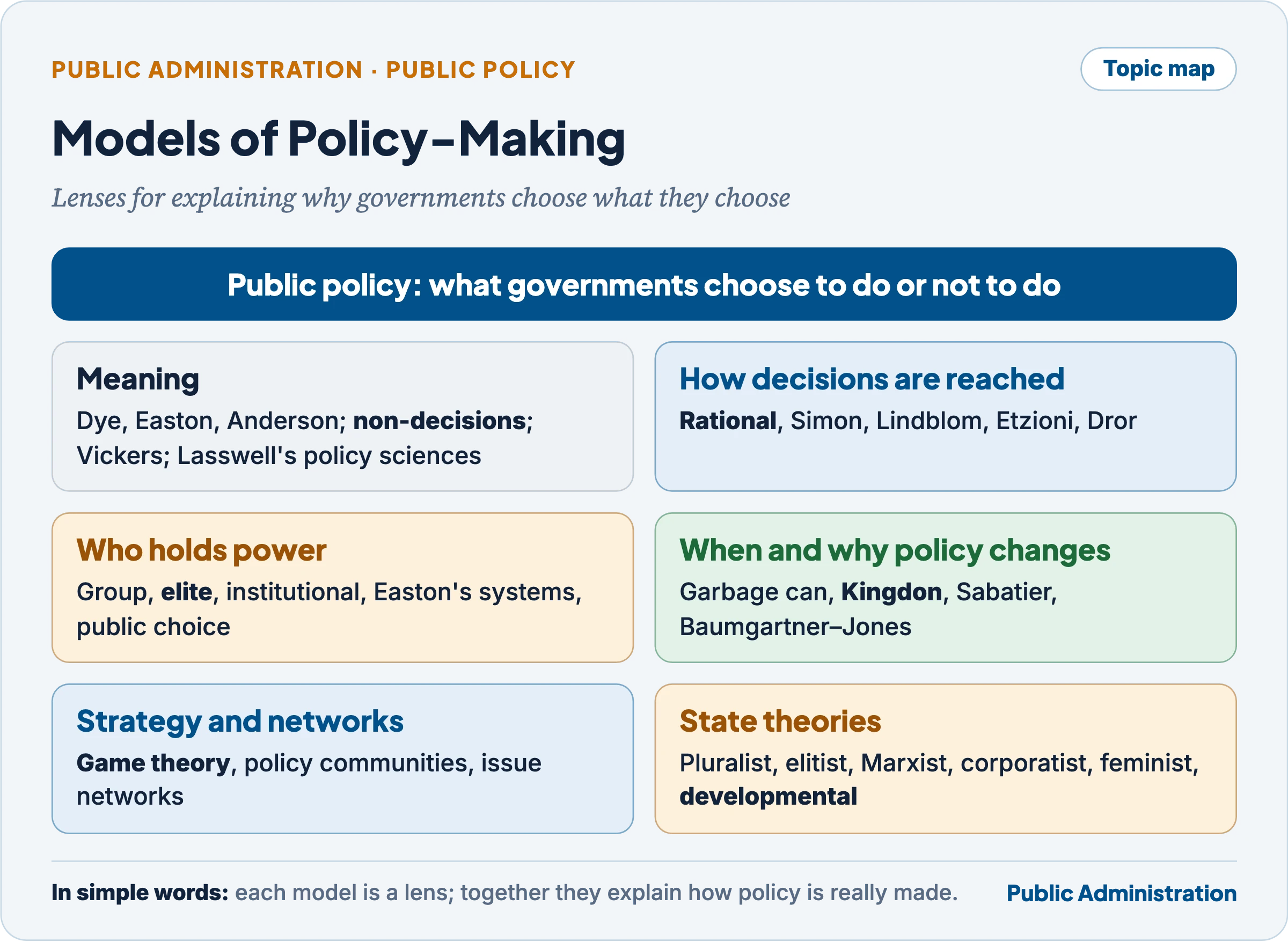
Public policy is what a government decides to do, or deliberately decides not to do, about a public problem. Every scheme, law, tax rate and budget line is the end point of a policy process, and public administration is involved at every point of it: officials define problems, draft options, bargain with ministers and groups, and then carry policy into the field. A model of policy-making is a simplified picture of that process. Each model picks out one factor (reason, bargaining, power, institutions, chance, ideas) and claims that it explains why policy looks the way it does.
- No single model explains every policy. The models are best read as lenses: the same decision (say, the 1991 economic reforms) looks like a rational response to a crisis through one lens, an elite choice through another and a “window of opportunity” through a third.
- The models fall into four families: models about how decisions are reached (rational to incremental), models about who holds power (groups, elites, institutions, the system), models about how issues reach the agenda and why policy changes (garbage can, streams, coalitions, punctuations) and state theories, which ask whose interests the state serves.
In simple words
A family planning a holiday can do it in different ways. The parents can list every destination, compare costs and pick the best (rational). They can go where they went last year with a small change (incremental). The loudest child can get their way (group pressure). The parent who earns the money can simply decide (elite). Or the plan can fall into place because a friend offers a cheap flat just when the school holidays start (chance and timing). Policy models are these same stories, told about governments.
The steps of the policy process itself (conceptualisation, planning, implementation, monitoring, evaluation and review, and their limits) are treated in the companion article on the policy process. This article stays with the models and the state theories that explain how policy is formulated.
1. Meaning and Nature of Public Policy
In simple words
A policy is a standing decision that guides many smaller decisions. “Every village will get an all-weather road” is a policy; deciding which road to build first in a block is a decision taken within it.
1.1 Classic definitions
There is no single agreed definition. Sir Charles Cunningham, a senior British civil servant, compared policy to an elephant: easy to recognise, hard to define. The definitions below each stress one element.
| Thinker | Definition (paraphrased unless quoted) | What it stresses |
|---|---|---|
| Thomas R. Dye, Understanding Public Policy (1972) | “whatever governments choose to do or not to do” | Choice, including deliberate inaction |
| David Easton, The Political System (1953) | The authoritative allocation of values for the whole society | Authority and society-wide reach |
| James E. Anderson, Public Policymaking (1975) | A purposive course of action followed by an actor or set of actors in dealing with a problem or matter of concern | Purpose, many actors, a problem |
| Harold Lasswell and Abraham Kaplan, Power and Society (1950) | A projected programme of goal values and practices | Goals and values |
| William Jenkins, Policy Analysis (1978) | A set of interrelated decisions by political actors about goals and the means of achieving them in a given situation | A set of decisions, not one |
| Carl Friedrich | A proposed course of action within a given environment, with obstacles and opportunities, aimed at a goal | Environment and goal |
| Yehezkel Dror | General directives on the main lines of action to be followed | Direction |
| Peter Self | Changing directives as to how tasks should be interpreted and performed | Policy as continuously revised |
| Nicholas Henry | What public administrators execute | The administrative face of policy |
- Dye’s definition is short but has a sharp edge: a government that does nothing about a problem has also made policy. Not regulating a sector, not revising a tax, not counting caste in a census for seven decades: each is a choice with effects.
- Easton’s definition places policy inside the political system: policy is the output that binds everyone, because it carries the state’s authority.
- Anderson adds two points that matter for administration: policies are usually made by many actors scattered through government, and they are about what is actually done, not only what is announced.
1.2 Features of public policy
- Purposive: policy is goal-directed behaviour, not random action. Goals (the end state, such as removing poverty) are distinct from policies (the instruments, such as a rural employment guarantee).
- Policy is wider than a decision: a decision is one act of choice; a policy is a cluster of decisions tied into a course of action over time. Policy decisions have general application and a long time frame; routine decisions are taken within them. Hence the old maxim that all policy-making is decision-making, but not all decision-making is policy-making.
- Action and inaction: both count. A declared policy that is never implemented (prohibition, a Directive Principle under Article 47, is a classic Indian example) shows that practice is the real test of policy.
- Outputs differ from outcomes: an output is what government delivers (toilets built, loans sanctioned); an outcome is the change in society (open defecation reduced, incomes raised). Policies can have unintended outcomes.
- Dynamic and continuous: policy is formed, implemented, adjusted and reformed in a loop. As one PYQ puts it, policy is “made as it is being administered and administered as it is being made”: implementers fill gaps that the law leaves open.
- Many actors: ministers, legislators, civil servants, courts, parties, interest groups, experts, media and, increasingly, international bodies all take part.
- Backed by authority: public policy carries the state’s legal and coercive power, which separates it from a private organisation’s policy.
Austin Ranney broke a policy into five parts: a particular object (the part of society to be affected), a desired course of events, a selected line of action, a declaration of intent and the implementation of intent. The last item again shows that a policy is incomplete until it is carried out.
1.3 Non-decisions and the “second face of power”
Peter Bachrach and Morton Baratz, in “Two Faces of Power” (American Political Science Review, 1962), argued that power is exercised not only when an issue is decided but also when it is kept off the agenda. They called this non-decision-making: the suppression of demands before they reach the decision stage, through rules, procedures, the “mobilisation of bias” or the quiet threat of sanctions.
- Why it matters: pluralist studies of who wins open contests (see Section 7) miss the issues that never become contests. A group that cannot get its problem discussed has lost before the game begins.
- Indian illustration: demands of informal-sector workers, manual scavengers or nomadic communities stayed off the national agenda for decades not because they were rejected in a vote but because they rarely reached the table. Court petitions, social movements and media campaigns are ways of breaking such non-decisions.
- Steven Lukes (Power: A Radical View, 1974) later added a third face: shaping people’s wants so that they do not even feel a grievance.
1.4 Vickers: policy as judgement
Sir Geoffrey Vickers, a British administrator and systems thinker, in The Art of Judgment (1965), saw policy-making as the exercise of judgement within an appreciative system: the set of readiness to notice, value and respond that a policy-maker builds up over time.
- Three judgements: a reality judgement (what is the situation?), a value judgement (is it good or bad, and how much does it matter?) and an instrumental judgement (what can be done about it?). The first two together make an “appreciation”; the third is the action choice.
- Norms over goals: Vickers argued that policy-makers mostly maintain relationships within acceptable norms rather than chase fixed goals. Goals are subsidiary to the norms and values through which a situation is seen. A health ministry does not simply “maximise lives saved”; it keeps many relationships (with states, doctors, patients, budgets) within tolerable limits.
- Significance: Vickers anticipated later work on framing and on the role of values in policy, and gave a strong reason why pure rational models misdescribe what policy-makers do.
1.5 Lasswell and the policy sciences
Harold Lasswell, the American political scientist who wrote Politics: Who Gets What, When, How (1936), launched the policy sciences with his essay “The Policy Orientation” in The Policy Sciences, edited with Daniel Lerner (1951).
- Two kinds of knowledge: knowledge of the policy process (how policies are actually made) and knowledge in the process (using the best available knowledge to improve decisions).
- Three features: the policy sciences are problem-oriented (they start from real problems, not disciplinary boundaries), multi-disciplinary (they draw on economics, sociology, psychology, law and management) and normative (they serve the goal of human dignity and democracy, not only efficiency).
- Contextual: problems must be understood in their social and historical context; Lasswell warned against technique divorced from values.
- Dror’s contribution: Yehezkel Dror, the Israeli policy scientist, in Design for Policy Sciences (1971) and Ventures in Policy Sciences (1971), argued for a new professional discipline with its own methods: alternative futures, metapolicy (policy about how to make policy) and better policy-making systems. He lamented that only a small part of existing knowledge reaches policy-makers and an even smaller part is used.
- Tools that came from the movement: operations research, systems analysis, cost-benefit analysis, Planning-Programming-Budgeting System (PPBS), forecasting, simulation and gaming.
Indian Connect — Policy sciences in Indian institutions
- NITI Aayog (set up on 1 January 2015, replacing the Planning Commission) houses the Development Monitoring and Evaluation Office (DMEO), which evaluates Centrally Sponsored Schemes, and runs data platforms that put administrative statistics in the public domain.
- Policy units, think tanks and university schools of public policy have multiplied; several ministries use fellowship and consultancy routes to bring in analysts. The aim is Lasswell’s “knowledge in the process”; the risk, as critics note, is that analysis becomes advocacy for decisions already taken.
1.6 Two branches of policy study
Policy study has two branches that map onto the models below.
- Descriptive or processual branch: studies how policy is actually made, usually one sector at a time (“the politics of” health, water, land). It has been led by political scientists and is close to the incrementalist view.
- Prescriptive or normative branch: studies how policy should be made and how to improve it. It has been led by public administration and management scholars and is close to the rationalist view.
- Strategic planning in the public sector (long-range goals combined with participative, adaptive steps) is often presented as a practical bridge between the two.
- Thomas Dye’s “output studies” approach links the two: it treats policy as the dependent variable and asks which environmental and political factors (income, urbanisation, party competition) explain differences in policy outputs across states. Critics said it overstresses measurable, allocative outputs (spending levels) and understates symbolic, regulatory and process aspects of policy.
Common confusion
Is policy always the dependent variable, explained by politics? Not always. Theodore Lowi turned the usual view around: in “Four Systems of Policy, Politics and Choice” (Public Administration Review, 1972) he argued that “policies determine politics”. The type of policy (distributive, regulatory, redistributive, constituent) shapes the kind of political conflict around it. A distributive subsidy produces quiet logrolling; a redistributive land reform produces class conflict. Policy is therefore both a product of politics and a cause of it. Critics reply that the categories overlap and that one policy can move between them, so Lowi’s claim is a useful tendency, not a law.
2. The Rational-Comprehensive Model
In simple words
The rational model is the textbook way to decide: write down every goal, list every option, work out every consequence, and pick the option with the best balance of benefits over costs. It is what a perfectly informed, unhurried, neutral planner would do.
2.1 What the model says
The rational-comprehensive model (also called the synoptic or rationalist model) treats policy as a choice that maximises social gain: no policy should be adopted if its costs exceed its benefits, and among policies the one with the greatest net benefit should be chosen. It is the normative ideal behind cost-benefit analysis, PPBS, operations research and zero-based budgeting.
The model requires the policy-maker to:
- Identify the problem and separate it from other problems.
- Know all the value preferences of society and their relative weights.
- Know all the policy alternatives available.
- Know all the consequences of each alternative, including opportunity costs.
- Calculate the ratio of benefits to costs for each alternative.
- Select the most efficient alternative.
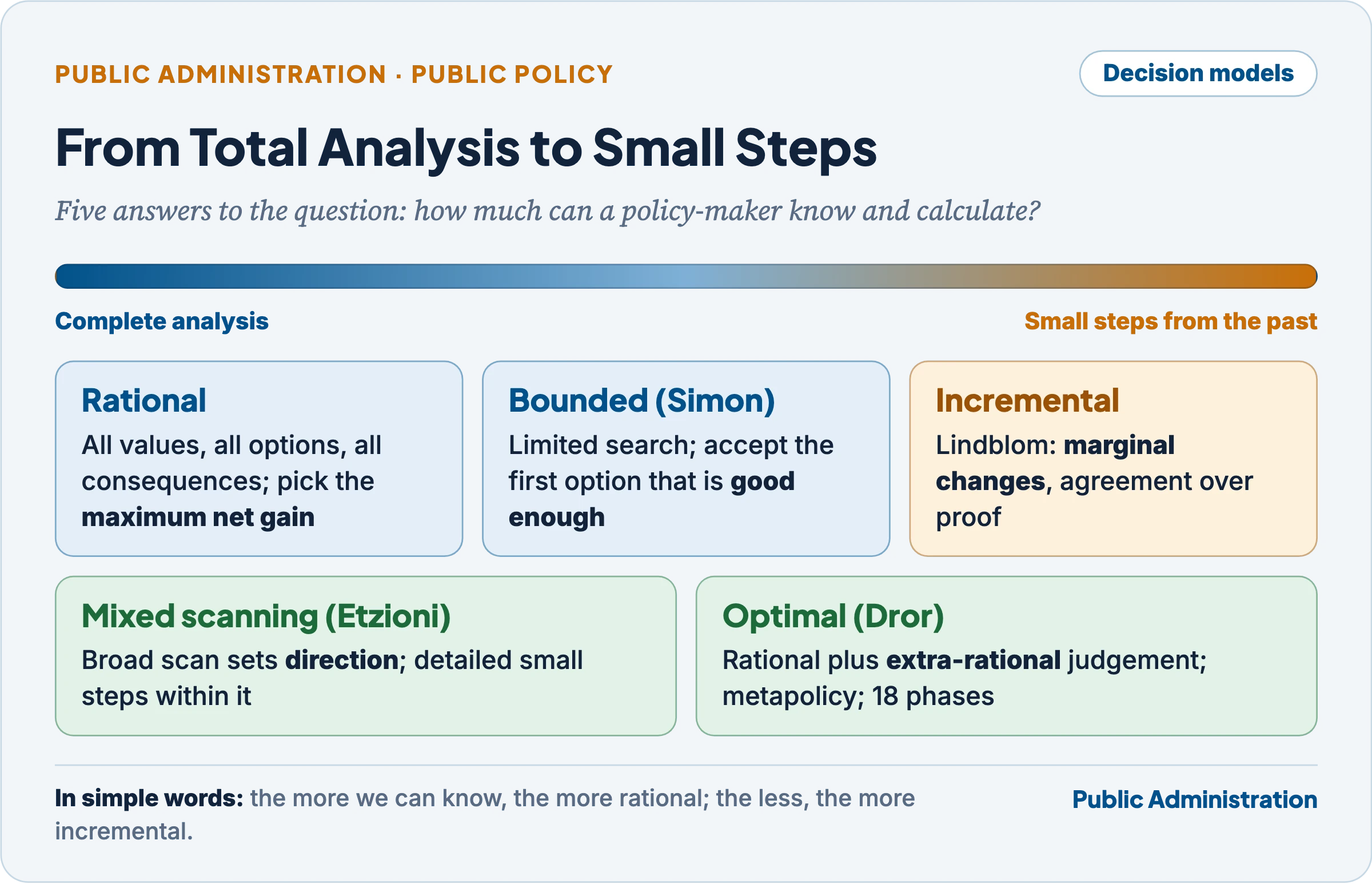
- Ends before means: the model assumes that goals can be fixed first and means chosen afterwards. This ends-means analysis is the feature Lindblom attacked most sharply.
- Pareto ideas: in its economic form, rationality looks for Pareto improvements (changes that make someone better off without making anyone worse off) and, ideally, Pareto optimality (a state where no such change is left). Every gain in one value is a trade-off against others, and policies create externalities (spillovers into other sectors).
2.2 Critique
The rational model is criticised less for being wrong as an ideal than for being impossible in practice.
- Cognitive limits: no human or organisation can know all values, alternatives and consequences. Herbert Simon made this the basis of bounded rationality (Section 3).
- No agreed social values: society has many publics with conflicting values; there is no single “social welfare function” to maximise. Kenneth Arrow‘s impossibility theorem (Social Choice and Individual Values, 1951) showed that no voting rule can turn individual rankings into a consistent social ranking under a few reasonable conditions.
- Sunk costs: past investments, programmes and commitments close off options. A government cannot start from a blank sheet.
- Time and money: comprehensive analysis is slow and expensive; critics said large rational planning exercises often cost more than they save.
- Politics intrudes: technical questions are entangled with political ones, and experts disagree (economists and environmentalists over a large dam are a standing Indian example).
- Plans gather dust: there is a wide gap between a rational plan and its implementation; plans ignore the role of people, leadership and the policy entrepreneur who makes ideas happen.
- Non-linear reality: the policy process is not a linear flow chart; it is multi-dimensional, iterative and full of feedback.
- Poor forecasting: rational planners have had a weak record of predicting the future accurately.
Indian Connect — Rational planning in India
- Mahalanobis-model planning in the Second Five Year Plan (1956–61) was India’s most ambitious attempt at comprehensive rational allocation, using an input-output framework to set investment priorities for heavy industry.
- Cost-benefit and outcome tools live on: project appraisal by the Expenditure Finance Committee and Public Investment Board, the Outcome Budget (since 2005–06) and the Output-Outcome Monitoring Framework run with NITI Aayog.
- The gap between plan and outcome in many Five Year Plans was cited by critics as proof that comprehensive rationality outruns administrative capacity.
3. Simon’s Bounded Rationality
In simple words
Nobody searching for a flat in a big city sees every flat. You look at a few, and you take the first one that is good enough on rent, distance and safety. That is satisficing: stopping at “good enough” because looking further costs too much.
Herbert Simon, the American Nobel-winning theorist of decision-making, in Administrative Behavior (1947) and Models of Man (1957), replaced the all-knowing “economic man” with administrative man.
- Bounded rationality: people are “intendedly rational, but only limitedly so”. They are limited by incomplete information, limited computational ability, time, habits, values and the organisation’s own premises.
- Satisficing: administrative man searches for alternatives sequentially and accepts the first that meets an aspiration level (a standard of “good enough”). If good options are found easily, the aspiration level rises; if not, it falls. These three features (search, satisficing and aspiration adaptation) are the core of Simon’s view.
- Simplified world: administrative man works with a simplified model of reality, ignoring factors that seem irrelevant.
- Organisation as the remedy: organisations raise rationality by dividing work, setting routines, training staff, supplying information and fixing decision premises. Simon thus did not abandon rationality; he made it procedural (a good process) rather than substantive (the best result).
Critique.
- Dror argued that satisficing is conservative: it lowers sights and discourages bold innovation.
- Critics of the fact-value split (notably Dwight Waldo) said Simon’s sharp separation of factual and value premises in decisions is untenable in public life.
- Behavioural economics has since confirmed and extended Simon: work on heuristics and biases (Kahneman and Tversky) and on “nudges” builds directly on bounded rationality.
Indian Connect — Bounded rationality in Indian policy
- Behavioural design in schemes: default options, reminders and social comparison have been used in sanitation, tax compliance and immunisation campaigns; the Economic Survey 2018–19 devoted a chapter to applying behavioural economics to policy. These tools accept that citizens (and officials) satisfice rather than optimise.
- District officers facing dozens of schemes, review meetings and targets routinely satisfice: they meet the indicator being monitored rather than optimise outcomes, which is why the choice of indicators matters so much.
4. Lindblom’s Incrementalism
In simple words
A city does not redesign its bus network every year. It adds a route here, changes timings there and watches what happens. If a change works, it is kept; if not, it is undone. Policy-making by small, reversible steps is incrementalism.
4.1 Lindblom’s argument
Charles E. Lindblom, the Yale economist and political scientist, set out incrementalism in “The Science of ‘Muddling Through'” (Public Administration Review, 1959), developed it with David Braybrooke in A Strategy of Decision (1963) as disjointed incrementalism, and defended it again in “Still Muddling, Not Yet Through” (1979).
Lindblom contrasted the rational-comprehensive (“root”) method, which starts afresh each time, with the successive limited comparisons (“branch”) method, which builds out from the present situation step by step.
| Feature | Root (rational-comprehensive) | Branch (successive limited comparisons) |
|---|---|---|
| Values and analysis | Values clarified first, separately | Values and analysis intertwined |
| Ends and means | Ends fixed, then means sought | Ends and means chosen together |
| Test of a good policy | Shown to be the best means to the end | Agreement among analysts and actors on the policy itself |
| Analysis | Comprehensive: every relevant factor | Drastically limited: important outcomes, alternatives and values neglected |
| Reliance on theory | Heavy | Light; successive comparison reduces the need for theory |
- Disjointed: analysis is spread across many actors and agencies in society, uncoordinated, each handling part of the problem.
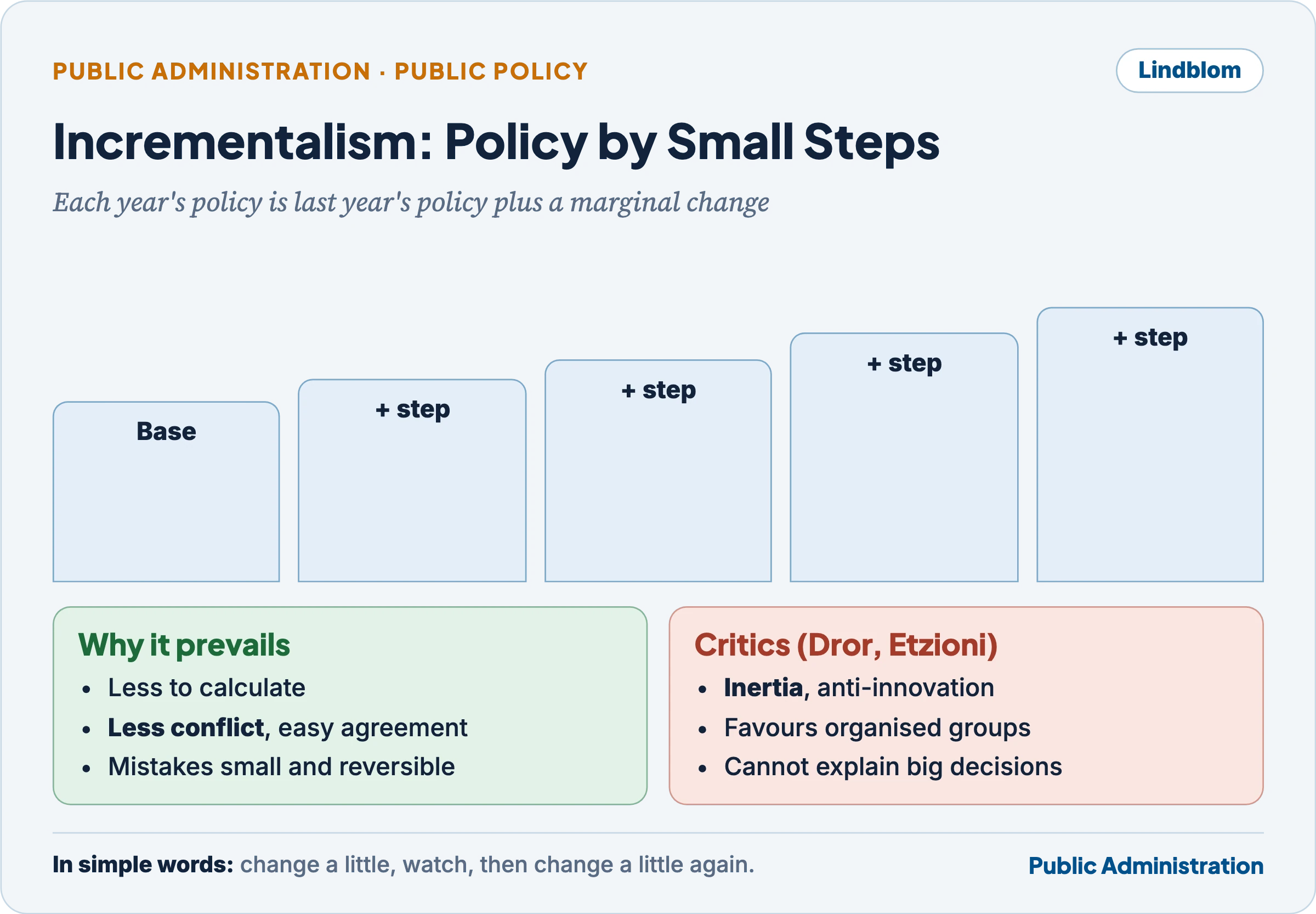
- Incremental: only alternatives that differ marginally from existing policy are considered.
- Remedial and serial: policy moves away from present ills rather than towards a grand ideal; it is made and remade endlessly.
- Partisan mutual adjustment: in The Intelligence of Democracy (1965) Lindblom argued that coordination in a pluralist democracy comes from bargaining and adjustment among partisan actors, not from a central planner. The “intelligence” of the system lies in this distributed adjustment.
Why incrementalism prevails (its defence):
- It reduces the cognitive burden: only a few alternatives and consequences need study.
- It reduces conflict: small changes are easier to agree on than radical ones in a society with many interests; it is politically expedient.
- It respects sunk costs and keeps working programmes intact.
- It is reversible: mistakes are small and can be corrected by the next step.
- It matches democratic pluralism: policy emerges from many actors, none of whom has to agree on ultimate values.
- Aaron Wildavsky‘s The Politics of the Budgetary Process (1964) showed budgets behaving exactly this way: this year’s base plus a fair share of the increase. Even zero-based budgeting, designed to break incrementalism, tended in practice to become incremental, because agencies could not re-justify every rupee each year.
4.2 Critique
- Conservatism and inertia (Dror): in “Muddling Through: ‘Science’ or Inertia?” (Public Administration Review, 1964), Dror argued that incrementalism is valid only when (a) present policies are broadly satisfactory, (b) the nature of problems is stable and (c) the means available are stable. Where these conditions fail, as in developing societies seeking rapid change, muddling through becomes a reinforcement of pro-inertia and anti-innovation forces.
- Biased towards the organised (Etzioni): partisan mutual adjustment reflects the interests of the most powerful and organised groups; the poor and unorganised are under-represented in the bargaining.
- No fundamental decisions: incrementalism cannot explain big decisions (declaring war, launching a space programme, opening an economy) that set the frame for later increments.
- Drift into disaster: a chain of small steps can add up to a large outcome nobody chose. American critics cited the escalation into Vietnam and the Bay of Pigs (1961) as incremental drift.
- Bargaining needs slack: negotiation works when there is something extra to divide; in times of scarcity hard choices need analysis, not just bargaining.
- The “beagle fallacy”: like a beagle with a superb nose but weak eyesight, incrementalists may miss what is directly in front of them because they only follow the scent of past policy.
- No vision: critics charged incrementalists with an over-developed power of political calculation and an under-developed power of social imagination.
- Lindblom’s reply: the alternative to incrementalism is not real comprehensiveness but pretended comprehensiveness; and a fast sequence of small steps can add up to substantial change. He also accepted later (in Politics and Markets, 1977) that business holds a privileged position in pluralist bargaining.
Indian Connect — Incrementalism and its limits in India
- Budgeting: most Union budget allocations move as increments over the previous year’s base, which is why outcome budgeting and expenditure reviews are repeatedly proposed to break the pattern.
- Pension policy: the Unified Pension Scheme, approved by the Union Cabinet on 24 August 2024 and effective from 1 April 2025 as an option within the National Pension System, did not return to the old pension or scrap NPS; it added an assured pension of 50% of average basic pay of the last 12 months (for 25 years’ service) on top of the existing architecture. It is a textbook incremental compromise between fiscal prudence and employee pressure.
- Non-incremental breaks show the other side: the 1991 reforms, demonetisation (November 2016) and GST (2017) were large shifts that incrementalism cannot explain on its own.
Common confusion
Is incrementalism necessarily slow? No. Lindblom insisted that incrementalism is about the size and reversibility of each step, not the speed of change. A rapid sequence of small steps can transform a policy within a few years, while a single grand plan may never be implemented at all. The 1988 PYQ makes this point: incrementalism can be “a fast moving sequence of small changes” that alters the status quo. The real weakness is not slowness but direction: small steps without a scan of the wider field may keep a country on the wrong path.
5. Etzioni’s Mixed Scanning
In simple words
A weather satellite first scans the whole sky with a wide-angle camera to spot where storms are forming, then zooms in on those areas for close detail. It neither photographs every square metre in detail (too costly) nor looks only where it looked yesterday (too risky).
Amitai Etzioni, the German-born American sociologist, offered mixed scanning as a “third approach” in “Mixed-Scanning: A ‘Third’ Approach to Decision-Making” (Public Administration Review, 1967), developed in The Active Society (1968).
- Two levels of decision:
- Fundamental (contextuating) decisions: a broad, high-order scan of the main alternatives in light of basic goals, without detailed analysis. These set the direction.
- Incremental (bit) decisions: detailed, small-step decisions taken within the context set by the fundamental decisions, which prepare for and revise them.
- Avoids both errors: rationalism’s unrealistic demand for complete detail, and incrementalism’s blindness to new options and its bias towards the powerful.
- Flexible depth: how much scanning to do depends on the stakes, the cost of error and the capacity of the decision-maker; in a crisis, more fundamental scanning is needed.
- Societal guidance: Etzioni linked mixed scanning to an “active society” that guides its own change, rather than drifting through bargaining.
Critique.
- Vague boundary: critics asked how to tell a fundamental from an incremental decision; Etzioni gives no clear rule.
- Not new: some (including Lindblom’s defenders) argued that good incrementalists already scan the field before taking steps, so mixed scanning restates practice rather than adding a model.
- Descriptive or prescriptive? It is both, and critics said it is not sharp enough as either.
- Strength: it is the model that best fits planning in mixed economies, where long-range goals are set centrally and annual programmes adjust within them.
Indian Connect — Mixed scanning in Indian planning
- NITI Aayog’s move from Five Year Plans to long-range vision and strategy documents, with annual budgets and programme reviews within them, follows the mixed-scanning logic: a broad scan sets direction, and incremental steps carry it out.
- The Aspirational Districts Programme (2018) sets a few national goals across health, education, agriculture, financial inclusion and infrastructure, then lets districts improve step by step against monthly rankings.
6. Dror’s Optimal Model
In simple words
A good doctor uses test reports and data, but also experience and a “feel” for the patient, especially when the case is unusual. Dror wanted policy-making to work the same way: data and analysis wherever possible, and disciplined judgement and creativity where data runs out.
6.1 The model
Yehezkel Dror, in Public Policymaking Reexamined (1968), proposed a normative optimal model that fuses the economically rational model with extra-rational processes.
- Extra-rational elements: intuition, judgement, creativity, tacit knowledge, “brainstorming” and leadership vision are not irrational; they are needed when information is short, problems are new and stakes are high.
- Economic rationality, not pure rationality: analysis should be pursued only as far as its benefits exceed its costs; the effort spent on analysis is itself a policy choice.
- Metapolicy: improving the policy-making system (its structures, personnel, information, procedures) is the highest-order task. Dror called this “policy on policymaking”.
- Feedback and learning: the system must monitor results and learn.
- Political feasibility: Dror treated feasibility as a probabilistic concept: each policy alternative has a probability of being accepted and carried out by the relevant actors. Feasibility is therefore attached to each alternative, can be estimated and can be increased by design, coalition-building and timing. This made politics part of rational analysis rather than an excuse for avoiding it.
- Megapolicies: broad master policies (postures, goals, boundaries, time preferences, risk preferences) that frame many specific policies.
6.2 The 18 phases
Dror divided optimal policy-making into three stages and 18 phases.
| Stage | Phases (summarised) |
|---|---|
| Metapolicymaking (phases 1–7) | Processing values; processing reality; processing problems; surveying, processing and developing resources; designing, evaluating and redesigning the policy-making system; allocating problems, values and resources; determining policy-making strategy |
| Policymaking (phases 8–14) | Sub-allocating resources; establishing operational goals with priorities; establishing other significant values; preparing major alternatives; predicting benefits and costs; comparing them and identifying the best; evaluating the best alternative and deciding whether it is “good” |
| Post-policymaking (phases 15–17) | Motivating the execution of policy; executing policy; evaluating policy-making after execution |
| Feedback (phase 18) | Communication and feedback channels linking all phases |
- Several summaries split the phases as 7, 6 and 5; Dror’s own scheme is 7 metapolicy, 7 policymaking and 3 post-policymaking phases, plus a feedback phase.
6.3 Critique
- Academic, low operational utility: critics said the model is a checklist of everything a good system should do, with little guidance on how to do it; it is normative and hard to apply.
- Extra-rationality is undefined: how to tell disciplined intuition from prejudice or political whim is left open; it may be used to justify arbitrary decisions.
- Elitist bias: the model trusts expert policy-makers and leaders; it says little about citizen participation.
- Demanding: few governments, least of all those in developing countries, have the analytical capacity it assumes.
- Defence: the model is meant as an ideal to improve towards, not a description; its stress on metapolicy, capacity-building and learning has proved prescient, and it was the first model to treat creativity and judgement as legitimate parts of policy analysis.
Indian Connect — Optimal-model thinking in India
- Digital public infrastructure (Aadhaar, the Unified Payments Interface, the “JAM” trinity of Jan Dhan accounts, Aadhaar and mobile phones) combined data-driven design with a bold, non-incremental leap that analysis alone would not have recommended at the time.
- Metapolicy shows in institutional redesign: the replacement of the Planning Commission by NITI Aayog (2015), the creation of DMEO, and Mission Karmayogi (2020) for civil service capacity are attempts to improve the policy-making system itself.
7. Group Theory
In simple words
Think of a tug-of-war with many ropes. Farmers, traders, industry, unions and consumers each pull. Policy settles wherever the pulls balance at that moment, and it moves whenever one side gains strength.
- Origins: Arthur F. Bentley, The Process of Government (1908), argued that politics is the activity of groups; David Truman, The Governmental Process (1951), and Earl Latham, The Group Basis of Politics (1952), developed it.
- Core claim: public policy is the equilibrium reached in the struggle among groups at a given time. As groups gain or lose influence, policy shifts towards the gainers. Latham described the legislature as a referee that ratifies the victories of successful coalitions.
- Hydraulic thesis: the polity is a system of forces and pressures acting on one another; policy is the resultant.
- Checks in the system: Truman argued that overlapping memberships (a person is a farmer, a parent and a member of a caste association at once) and potential groups (latent interests that organise if threatened) keep any group from dominating.
- Regulatory capture: studies of regulatory agencies found many were eventually captured by the industries they were meant to regulate; “what is good for the group is good for the nation” in the eyes of the regulators. George Stigler‘s theory of economic regulation (1971) formalised this.
Critique.
- Unequal groups: organised, well-funded groups win; the poor, consumers and future generations are weakly organised. Mancur Olson, The Logic of Collective Action (1965), showed that small groups with concentrated stakes organise more easily than large groups with diffuse stakes.
- State as a passive referee: the model underrates the autonomy of the state and of officials, who have their own interests and ideas.
- Non-decisions ignored: it studies open contests only (Bachrach and Baratz).
- Developing countries: where many groups are weak, caste- or patronage-based, or excluded, the model explains less.
Indian Connect — Group pressure in Indian policy
- Farm laws: the three farm laws of 2020 were repealed by the Farm Laws Repeal Act, 2021 after a year-long protest led by farmers’ unions, a vivid case of organised groups reversing policy.
- Industry associations (FICCI, CII, ASSOCHAM), trade unions, professional bodies and caste associations press their demands through consultations, pre-budget meetings and media.
- Drug pricing and other regulatory fields show the risk of capture that the group model predicts.
8. Elite Theory
In simple words
In many societies a small circle of top politicians, senior officials, business leaders and media owners decides most big questions, and most citizens simply accept the results. Elite theory says this is how policy is really made, whatever the formal rules say.
- Classical elitists:
- Vilfredo Pareto (The Mind and Society, 1916): every society has a governing elite, a non-governing elite and the masses; elites rise and fall in a “circulation of elites” (the “lions” who rule by force and the “foxes” who rule by cunning).
- Gaetano Mosca (The Ruling Class, 1896): in all societies there are two classes, a ruling minority that monopolises power and a ruled majority; the minority rules because it is organised.
- Robert Michels (Political Parties, 1911): the iron law of oligarchy: every organisation, even a democratic party, comes to be run by a few.
- C. Wright Mills, the American sociologist, in The Power Elite (1956), argued that the USA was ruled by an interlocking elite of corporate, military and political leaders who share backgrounds and values.
- Thomas Dye and Harmon Zeigler, The Irony of Democracy (1970), turned this into a policy model:
- Society is divided into the few who have power and the many who do not.
- Elites share a consensus on basic values (preserving the system); policy reflects elite values, not mass demands.
- Policy flows downward, from elites through officials to the masses; the masses are largely apathetic and ill-informed, and their opinions are shaped by elites more than the reverse.
- Change is incremental because elites seek to preserve the system; it happens when events threaten it.
- Elite competition within the consensus gives some choice, but on narrow terms.
- Bureaucracy as elite: in some versions the higher civil service itself is the ruling elite, using policy to protect its own position (“Leviathan” state).
Critique.
- Hard to test: who counts as elite, and how unity is shown, is often assumed rather than demonstrated. Robert Dahl (Who Governs?, 1961, a study of New Haven) found that different elites dominated different issues, with no single ruling group.
- Underrates mass politics: elections, movements and courts do force elites to change course.
- Static: it describes power but explains change poorly.
- Strength: it explains the persistence of policies that serve the powerful and the frequent gap between public opinion and policy.
Indian Connect — Elite influence in Indian policy
- Political funding: in Association for Democratic Reforms v. Union of India (15 February 2024) a Constitution Bench struck down the Electoral Bond Scheme, 2018. It held that anonymous funding violated voters’ right to information under Article 19(1)(a), and that the amendment allowing unlimited corporate donations was arbitrary under Article 14. The Court reasoned that such funding could buy access to policy-makers, which is the elite model’s central worry.
- Technocratic drafting: policies drafted within a small circle of ministers and officials without wide consultation (often cited for the 2020 farm laws) fit the elite pattern, and their reversal shows its limits in a mass democracy.
9. Institutional and Neo-institutional Models
In simple words
The same cricket team plays differently under Test rules and T20 rules. Rules and structures shape behaviour. The institutional model says the same about government: constitutions, legislatures, courts and departments shape what policy can look like.
9.1 The traditional institutional model
- Focus: the formal structures of government (constitution, legislature, executive, courts, departments) and their legal powers and duties. Policy is what these institutions authoritatively determine, implement and enforce.
- Three features of institutional policy (Dye): it has legitimacy (legal obligation), universality (it applies to everyone) and a monopoly of coercion.
- Representative work: Carl J. Friedrich, Constitutional Government and Democracy (1937 and later editions).
- Weakness: the old model described organisation charts and legal powers but ignored the living links between institutions and the policy that flows from them. The behavioural revolution of the 1950s swept it aside.
9.2 Neo-institutionalism
- Lowi’s arenas of power: Theodore Lowi (“American Business, Public Policy, Case-Studies, and Political Theory”, World Politics, 1964; extended in 1972) classified policies by two dimensions, the likelihood of coercion (remote or immediate) and its target (individual conduct or the environment of conduct):
| Policy type | Coercion | Example | Typical politics |
|---|---|---|---|
| Distributive | Remote, individual | Subsidies, local projects | Quiet logrolling, low conflict |
| Regulatory | Immediate, individual | Licensing, pollution control | Group bargaining |
| Redistributive | Immediate, environment | Progressive tax, land reform | Class-like conflict, ideological, centred in the bureaucracy and executive |
| Constituent | Remote, environment | Creating agencies, reorganising government | Elite and administrative politics |
- New institutionalism: James March and Johan Olsen (Rediscovering Institutions, 1989) argued that institutions shape preferences through a “logic of appropriateness“: actors do what their role and rules make proper. Variants include historical institutionalism (path dependence: early choices lock in later ones) and rational choice institutionalism (rules shape incentives).
- Path dependence explains why reforms are hard: an established programme creates beneficiaries, staff and expectations that defend it.
Critique. The model can be static and legalistic; it says less about why institutions themselves change; new institutionalism is criticised for stretching “institution” to mean almost anything.
Indian Connect — Institutions shaping Indian policy
- Federal institutions: the GST Council under Article 279A institutionalised Union–State bargaining over indirect tax. Its 56th meeting (3 September 2025) moved to a two-rate structure of 5% and 18% (with a 40% rate for a few goods), mostly effective from 22 September 2025. The forum, not the Union alone, shaped the outcome.
- Path dependence: caste was excluded from every census after Independence, and the decision of the Cabinet Committee on Political Affairs on 30 April 2025 to include caste enumeration in the next census shows how long an institutional default can last before it is broken.
10. Easton’s Systems Model
In simple words
A machine takes in raw material, processes it and turns out a product; customers’ reactions come back and change what goes in next time. Easton described government the same way: demands and support go in, policies come out, and their effects come back as new demands.
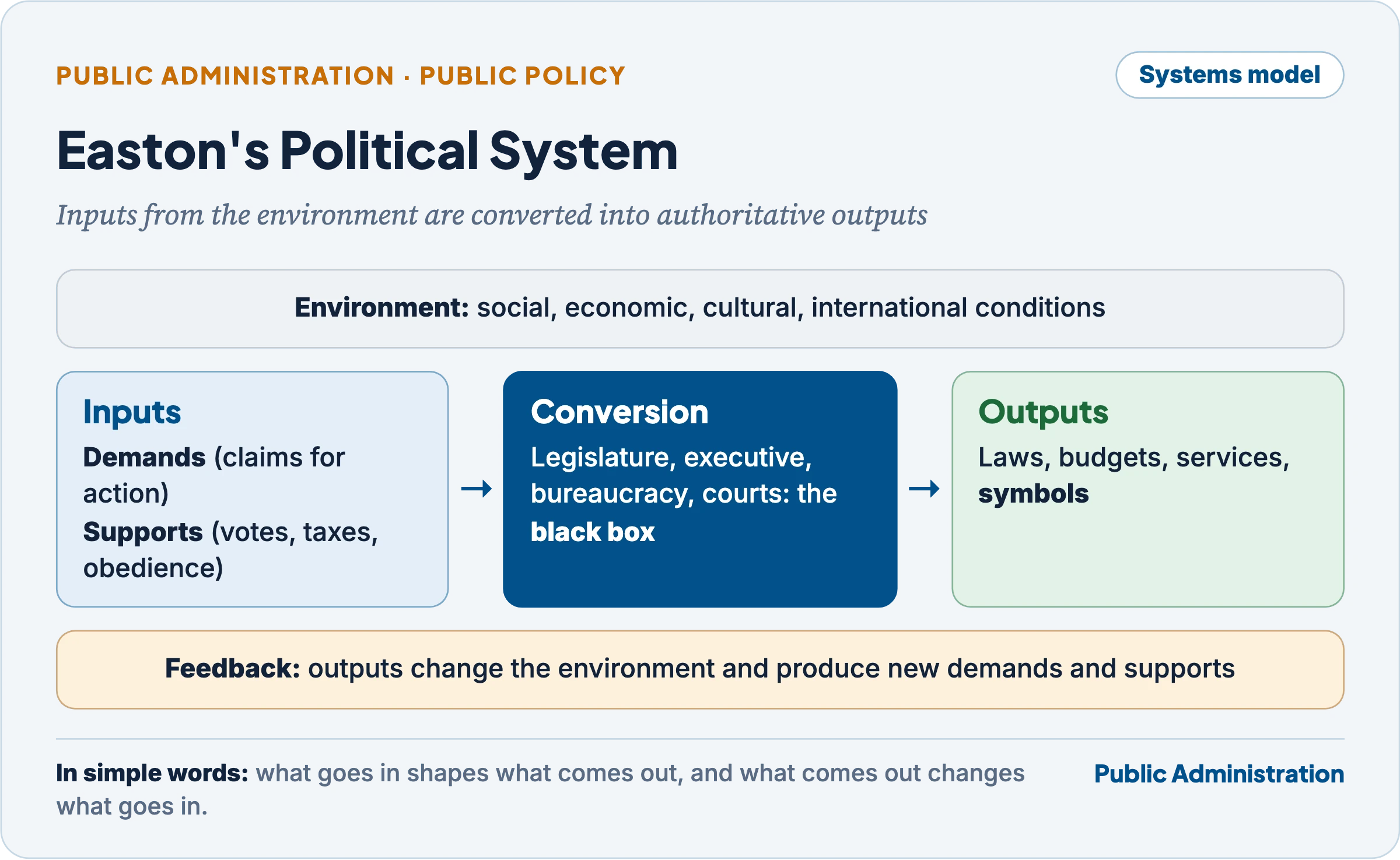
David Easton, the Canadian-born American political scientist, developed the systems model in The Political System (1953), A Framework for Political Analysis (1965) and A Systems Analysis of Political Life (1965).
- Environment: the social, economic, cultural and international conditions that surround the political system.
- Inputs:
- Demands: claims by individuals and groups for action (higher crop prices, safer roads).
- Supports: acts that sustain the system (voting, obeying laws, paying taxes, patriotism).
- Conversion process (“black box”): the institutions and processes (legislature, executive, bureaucracy, parties, courts) that turn inputs into decisions. Gatekeepers (parties, officials, media) filter demands; “withinputs” are demands generated inside the system itself.
- Outputs: authoritative decisions and actions (laws, budgets, services, symbols). Outcomes are their effects on society.
- Feedback: outputs change the environment, which produces new demands and supports; the system adapts to survive.
- Persistence: the system preserves itself by producing reasonably satisfying outputs, relying on deep-rooted attachment (diffuse support) and, if necessary, force.
Critique.
- Black box: the model says little about how conversion happens: who decides, how and why. It names the box but does not open it.
- Conservative bias: the stress on system persistence and equilibrium sits uneasily with conflict, revolution and radical change.
- Abstract: concepts are broad and hard to measure.
- Strength: it gives a comprehensive map of the policy environment and a language (inputs, outputs, feedback) used by every later model, and it shows that policy depends on environmental pressures, not only on government will. Gabriel Almond adapted it into structural-functional analysis for comparative politics.
11. Public Choice Model
In simple words
If you assume that a shopkeeper wants profit, you can predict a lot about how he behaves. Public choice makes the same assumption about voters, politicians and officials: each pursues self-interest, and policy is what results when all these self-interested choices meet.
- Founders: James Buchanan and Gordon Tullock, The Calculus of Consent (1962), founded the Virginia school; Anthony Downs, An Economic Theory of Democracy (1957) and Inside Bureaucracy (1967); William Niskanen, Bureaucracy and Representative Government (1971); Vincent and Elinor Ostrom applied it to public administration and local public economies.
- Core assumption: methodological individualism and self-interest: voters maximise utility, politicians maximise votes, bureaucrats maximise their budgets or power.
- Key claims:
- Downs classified officials by motive (climbers, conservers, zealots, advocates, statesmen); his model rests on a theory of psychological motivation. Bureaus grow, become rigid and resist change.
- Niskanen used neo-classical economic reasoning: bureaucrats, holding a monopoly of information over their output, maximise budgets, so public services are over-supplied relative to what citizens would choose.
- Rent-seeking (Tullock): groups spend resources to win privileges (licences, tariffs) that transfer wealth rather than create it.
- Logrolling and vote-trading produce bundles of policies that no majority would accept separately.
- Policy prescriptions: smaller government, competition among agencies, contracting out, user charges, decentralisation to many small jurisdictions, and constitutional rules that limit spending. Public choice gave intellectual backing to New Public Management (“steering, not rowing”).
- Goods classification: public choice writers sorted goods by exclusion (can non-payers be kept out?) and consumption (individual or joint): private goods (a meal), toll goods (cable TV, electricity), common-pool goods (fish in the sea, groundwater) and collective goods (defence, street lighting). Government’s role is greatest for collective and common-pool goods, where free riders and the “tragedy of the commons” (Garrett Hardin, 1968) defeat the market.
Critique.
- Narrow view of human motive: officials and citizens also act from duty, professional norms and public spirit (the “public service motivation” literature).
- Imperfect markets: the remedies assume that markets work well, but information gaps, monopolies and externalities limit them; contracting out often creates new rent-seeking.
- Political factors: budget decisions are made by politicians and finance ministries, not by bureaus alone; Niskanen later softened his budget-maximising claim.
- Equity: market-like solutions can neglect the poor and redistribution.
- Strength: it explains regulatory capture, subsidy lock-in and bureaucratic growth, and it pushed public administration to design incentives carefully.
12. Garbage Can, Multiple Streams, Advocacy Coalitions and Punctuated Equilibrium
In simple words
Sometimes a solution is waiting for a problem. A group of experts has a well-worked plan, and nobody listens until a crisis suddenly makes everyone ask, “What can we do?” Then the waiting plan is picked up. These models explain how such moments arrive and why policy can stay stuck for years, then change all at once.
12.1 The garbage can model
Michael Cohen, James March and Johan Olsen, “A Garbage Can Model of Organizational Choice” (Administrative Science Quarterly, 1972), studied universities and described them as organised anarchies.
- Three conditions: problematic preferences (goals are unclear and discovered through action), unclear technology (members do not understand how the organisation works) and fluid participation (people come and go).
- Four streams: problems, solutions, participants and choice opportunities flow independently, like items tossed into a garbage can. Decisions happen when they happen to meet.
- Consequences: solutions often come before problems; many decisions are made by oversight or flight rather than by resolving the problem.
- Critique: it describes disorder but predicts little; real governments are more structured than universities.
12.2 Kingdon’s multiple streams
John W. Kingdon, Agendas, Alternatives, and Public Policies (1984), adapted the garbage can to national policy, especially agenda setting.
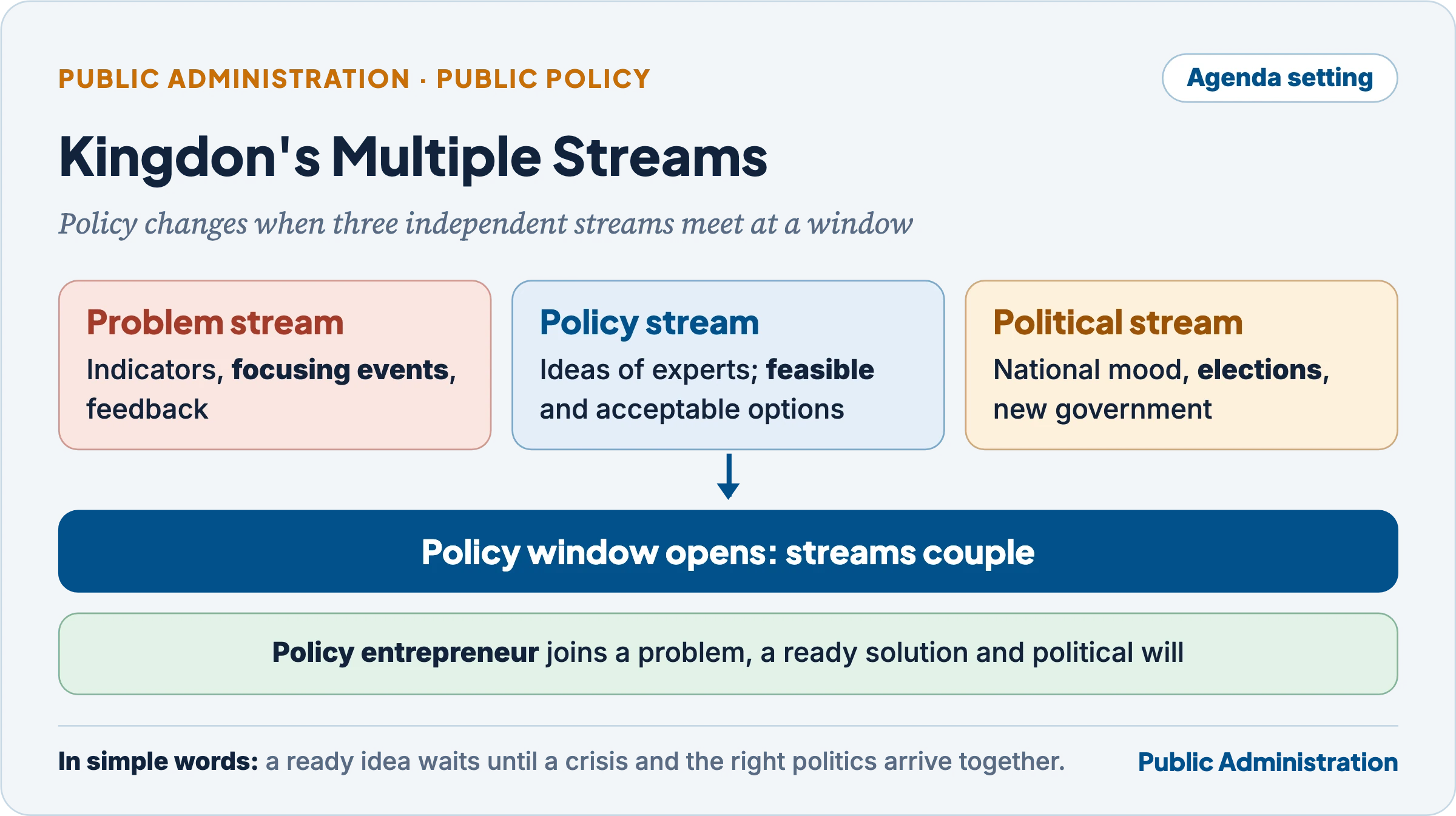
- Problem stream: conditions become “problems” through indicators (statistics), focusing events (disasters, crises) and feedback from existing programmes. Problems can also fade from view.
- Policy stream: a “primeval soup” of ideas floats among specialists (officials, academics, analysts). Ideas survive if they are technically feasible, fit dominant values and are within budgetary and political limits; a “softening up” phase, with trial balloons, prepares acceptance. Consensus here is built by persuasion.
- Political stream: the national mood, elections, changes of government and interest group campaigns. Consensus here is built by bargaining, ending in a “bandwagon” or “tilt”.
- Actors: the visible cluster (ministers, legislators, media, parties) shapes the governmental agenda; the hidden cluster (career officials, academics, staff) shapes the alternatives.
- Policy window: when the three streams couple, a window opens. Windows are short; they open because of a compelling problem or a political shift.
- Policy entrepreneurs: people who invest time and reputation in a pet proposal, wait for a window and couple problem, solution and politics.
Critique. The streams are not truly independent; the model is better at explaining agenda setting after the fact than predicting it; it was built on the US federal system and needs adapting to parliamentary and federal-cooperative systems.
Indian Connect — Policy windows in India
- 1991: the balance of payments crisis (problem stream), long-discussed liberalisation proposals (policy stream) and a new government (political stream) coupled into the economic reforms.
- Disaster management: the December 2004 Indian Ocean tsunami was the focusing event behind the Disaster Management Act, 2005.
- Criminal law: the Delhi gang rape of December 2012 led to the Justice J.S. Verma Committee (report, January 2013) and the Criminal Law (Amendment) Act, 2013.
- Lateral entry: the UPSC advertisement of 17 August 2024 for 45 lateral posts was cancelled on 20 August 2024 after the government asked for a review to include reservation, showing how a shift in the political stream can close a window as fast as it opens.
12.3 The advocacy coalition framework
Paul Sabatier, the American policy scholar, set out the ACF in Policy Sciences (1988) and, with Hank Jenkins-Smith, in Policy Change and Learning (1993).
- Policy subsystem: policy is made within a subsystem of actors from many institutions (officials, legislators, interest groups, researchers, journalists) focused on one policy area.
- Advocacy coalitions: actors group into usually two to four coalitions that share beliefs and coordinate their actions.
- Belief system in three layers:
- Deep core: basic values about human nature and society; very hard to change.
- Policy core: basic positions within the subsystem (state vs market in health, for instance); hard to change.
- Secondary aspects: details of instruments and budgets; change readily.
- Policy brokers mediate between coalitions.
- Change comes from external shocks (economic crises, a change of ruling coalition), policy-oriented learning (mostly in secondary aspects) and negotiated agreements. Understanding change requires a time perspective of a decade or more.
- Critique: coalitions are hard to identify; the framework fits pluralist democracies with many organised groups better than centralised systems.
Indian Connect — Coalitions in Indian policy
- Right to Information: a coalition of grassroots activists, journalists, lawyers and sympathetic officials, built over the 1990s around the Mazdoor Kisan Shakti Sangathan and the National Campaign for People’s Right to Information, moved from state laws to the RTI Act, 2005.
- Rural employment: long contests between a rights-based coalition and a fiscal-efficiency coalition shaped MGNREGA (2005) and its replacement, the Viksit Bharat – Guarantee for Rozgar and Ajeevika Mission (Gramin) Act, 2025 (assent 20 December 2025), which raises the statutory guarantee to 125 days. The debate turned on policy-core beliefs about rights, demand-driven work and fiscal control.
12.4 Punctuated equilibrium
Frank Baumgartner and Bryan Jones, Agendas and Instability in American Politics (1993), borrowed the term from evolutionary biology.
- Long stability, sudden change: most policies stay stable for long periods (incremental change) and then change sharply in short bursts.
- Policy monopolies: stability rests on a closed community that controls a policy image (how the issue is understood) and a policy venue (where it is decided).
- Breaking monopolies: challengers redefine the image (for example from “progress” to “risk”) and shift the issue to new venues (courts, other committees, states, media). When attention shifts, change cascades.
- Bounded rationality at system level: governments cannot attend to everything at once; issues are processed in parallel in subsystems until they jump into serial, macro-political attention.
- Critique: it describes the pattern well but finds it hard to predict when a punctuation will occur; the threshold for “sharp” change is arbitrary.
Indian Connect — Punctuations in Indian policy
- Labour law: four labour codes were passed in 2019–2020 but remained unenforced for years; they were brought into force together on 21 November 2025, replacing 29 central labour laws: a long stasis followed by a sudden break.
- Indirect tax: GST took nearly two decades of discussion before the Constitution (One Hundred and First Amendment) Act, 2016 and its launch in July 2017, and another large reset in September 2025.
13. Game Theory and Policy Networks
In simple words
In chess, your best move depends on what you expect your opponent to do. Many policy choices are like that: a state’s choice on water sharing or a tax rate depends on what other states or the Centre will do.
13.1 Game theory
- Origin: John von Neumann and Oskar Morgenstern, Theory of Games and Economic Behavior (1944).
- Core idea: a rational choice in interdependent situations: the best outcome for each player depends on what others choose. A conflict situation is a “game”; players choose strategies; outcomes are pay-offs.
- Types: zero-sum games (one’s gain is another’s loss) and non-zero-sum games (both can gain or lose). Games of strategy, not chance.
- Prisoners’ dilemma: two suspects, held separately, each do better by confessing whatever the other does, yet both would be better off if neither confessed. Individually rational choices produce a collectively worse result. This explains arms races, overuse of groundwater, competitive tax concessions by states and the difficulty of climate agreements.
- Uses in policy: war and peace, diplomacy, coalition bargaining, federal fiscal bargaining, regulation and auctions (spectrum auctions are designed with game theory).
- Critique: assumes rational, well-informed players and known pay-offs; real players misjudge each other and have mixed motives. Its main value is in forcing careful thinking through of options and counter-moves before acting; rigid faith in it can mislead.
13.2 Policy networks
- From triangles to networks: older American work spoke of iron triangles (agency, legislative committee and interest group). Hugh Heclo (“Issue Networks and the Executive Establishment”, 1978) found looser, more open issue networks of experts and activists.
- Rhodes–Marsh typology (Policy Networks in British Government, 1992): a continuum from policy communities (few members, stable, shared values, frequent contact, resource exchange; for example agriculture) to issue networks (many members, fluctuating access, conflict, unequal power; for example environment).
- Governance view: R.A.W. Rhodes argued that policy is increasingly made through self-organising networks of state and non-state actors; the state steers rather than commands.
- Globalisation: networks now cross borders. International organisations, credit rating agencies, global NGOs, treaty bodies and policy transfer among countries shape national agendas (climate commitments, financial regulation, Sustainable Development Goals), so the national policy agenda becomes partly international.
- Critique: “network” is often a metaphor rather than an explanation; networks can be closed and unaccountable; they describe structure better than they explain outcomes.
Indian Connect — Networks and games in Indian policy
- GST Council decisions involve repeated games between the Union and States, with compensation as a side-payment that eased agreement.
- Inter-state river disputes show the prisoners’ dilemma: each riparian state’s short-term interest in drawing more water damages all.
- CoWIN and the COVID-19 vaccination drive ran through a network of Union and State health departments, private hospitals, manufacturers and technology teams.
14. Comparing the Models
In simple words
Different maps of the same city show different things: roads, metro lines, wards. None is wrong, and none shows everything. The policy models are maps of this kind.
The table below sets the models side by side. Each answers a different question, so the comparison is about focus and blind spots, not about which one is “true”.
| Model | Key thinkers (work, year) | Policy is… | Main strength | Main criticism |
|---|---|---|---|---|
| Rational-comprehensive | Lasswell; PPBS planners | The option with maximum net social gain | Clear standard of good policy | Impossible information demands; ignores politics |
| Bounded rationality | Simon, Administrative Behavior (1947) | A satisficing choice | Realistic picture of decision-makers | Conservative; fact-value split |
| Incrementalism | Lindblom (1959); Braybrooke and Lindblom (1963) | Small adjustments to the past | Realistic, low-conflict, reversible | Inertia; bias to the powerful; no big decisions |
| Mixed scanning | Etzioni (1967) | Broad scan plus incremental steps | Joins direction with realism | Vague line between levels |
| Optimal | Dror (1968) | Rational plus extra-rational, with metapolicy | Values creativity, learning, capacity | Normative, hard to operate |
| Group | Bentley (1908); Truman (1951) | Equilibrium of group pressure | Explains bargaining and capture | Unequal groups; passive state |
| Elite | Mosca; Pareto; Mills (1956); Dye and Zeigler (1970) | Elite preferences | Explains bias and continuity | Hard to prove; underrates mass politics |
| Institutional | Friedrich; Lowi (1964, 1972); March and Olsen (1989) | Output of institutions and rules | Shows how structure shapes choice | Static; legalistic |
| Systems | Easton (1953, 1965) | Output of the system in response to inputs | Comprehensive map with feedback | Black box; equilibrium bias |
| Public choice | Buchanan and Tullock (1962); Downs; Niskanen (1971) | Result of self-interested choices | Explains rent-seeking and growth of bureaus | Narrow view of motive; market bias |
| Garbage can | Cohen, March and Olsen (1972) | Chance coupling of streams | Explains disorderly decisions | Little predictive power |
| Multiple streams | Kingdon (1984) | Coupling of problem, policy, politics at a window | Explains agenda setting and timing | Streams not independent; ex post |
| Advocacy coalition | Sabatier (1988); Sabatier and Jenkins-Smith (1993) | Contest of belief coalitions over a decade | Explains long-run change and learning | Coalitions hard to identify |
| Punctuated equilibrium | Baumgartner and Jones (1993) | Long stability broken by bursts | Joins incremental and radical change | Cannot predict punctuations |
| Game theory | von Neumann and Morgenstern (1944) | Strategic choice among interdependent players | Clarifies options and counter-moves | Unrealistic rationality |
| Policy networks | Heclo (1978); Rhodes and Marsh (1992) | Product of state–society networks | Fits governance and globalisation | Metaphor more than theory |
- Decision models (rational to optimal) ask how a choice is reached; power models (group, elite, institutional, systems, public choice) ask who shapes it; agenda and change models ask when and why policy moves.
- The models are complementary: Indian policy often shows an elite or institutional core, group pressure at the edges, incremental routine punctuated by crises, and windows opened by focusing events.
Criticism — The case against models of policy-making
- Partial: each model isolates one factor and so misdescribes the whole process.
- Western origin: most were built on the USA, with its separation of powers, strong interest groups and weak parties; they fit India’s parliamentary, federal and coalition politics only partly.
- Descriptive or prescriptive confusion: models slide between saying how policy is made and how it should be made.
- Little predictive power: the agenda models in particular explain change after the fact.
- Neglect of implementation: most models stop at the decision, though implementation can change policy as much as the decision itself.
Defence — The case for policy models
- Simplification is the point: a model highlights what matters most in a given case and suggests what evidence to look for.
- Plural lenses improve understanding: using several models together (as Graham Allison did for the Cuban missile crisis in Essence of Decision, 1971) gives a fuller picture than any one.
- Practical guidance: rational and optimal models supply standards (cost-benefit, evaluation, metapolicy); incremental and stream models warn about feasibility and timing.
- Adaptable: the models have been extended to developing countries, federal bargaining and global networks.
- Democratic value: models expose whose interests shape policy, which supports accountability.
15. State Theories and Public Policy Formulation
In simple words
Who really decides in a country: everyone through many groups, a small top circle, the owners of capital, a bargain between big organisations, men rather than women, or a strong state that leads the economy? Each answer is a state theory, and each gives a different explanation of why policies look the way they do.
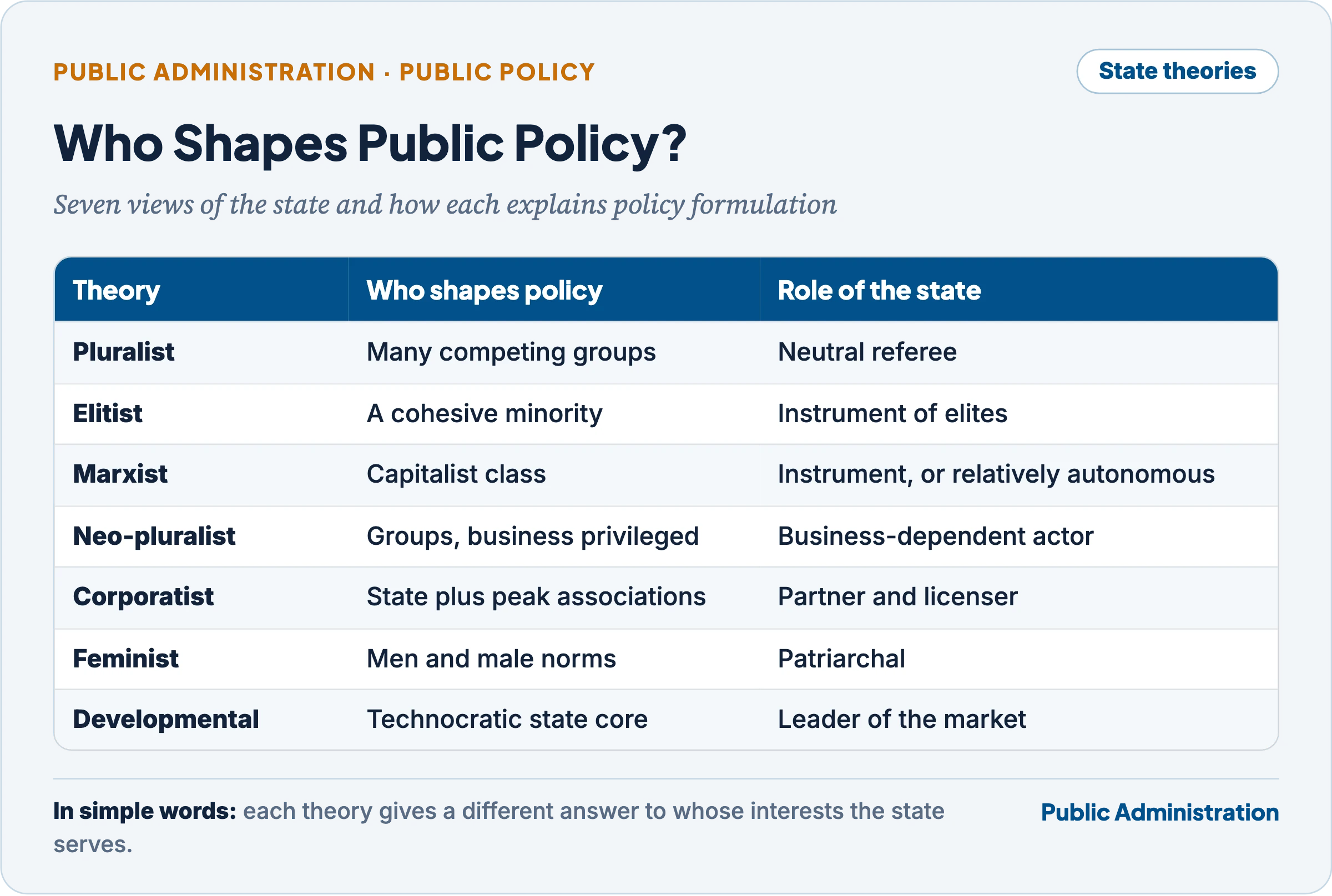
The policy models above ask how a decision is made. State theories go deeper and ask what the state is, whose interests it serves and how much autonomy it has from society. Classical theories of the state’s origin (the social contract of Hobbes, Locke and Rousseau, the liberal theory and its shift from laissez-faire to positive liberalism) form the background; the theories below are the ones that explain policy formulation in modern states.
15.1 Pluralist theory
- Thinkers: Robert Dahl, Who Governs? (1961) and Polyarchy (1971); David Truman; earlier, Harold Laski and the English pluralists, who denied the state’s monistic sovereignty and saw it as an “association of associations”.
- View of the state: a neutral arena or referee; power is dispersed among many groups; resources (money, numbers, expertise, organisation) are unequally but widely spread, and potential power exceeds actual power.
- How policy is formed: by competition and bargaining among groups; policy is a compromise; losers can fight another day. Different groups dominate different issue areas.
- Critique: ignores unequal resources and non-decisions (Bachrach and Baratz); ignores the privileged position of business; assumes a neutral state.
15.2 Elite theory of the state
- Thinkers: Pareto, Mosca, Michels, Mills (Section 8).
- View of the state: run by a cohesive minority; democracy is in part a myth that legitimises elite rule.
- How policy is formed: elites define problems and choose solutions; policy reflects elite consensus; mass opinion is shaped from above. Elite theory stands against both pluralism and theories of state autonomy.
- Critique: Section 8.
15.3 Marxist theory
- Classical view: Marx and Engels, The Communist Manifesto (1848): “the executive of the modern state is but a committee for managing the common affairs of the whole bourgeoisie”. Engels, The Origin of the Family, Private Property and the State (1884), traced the state to the rise of private property and class division; Lenin, The State and Revolution (1917), called it the product of irreconcilable class antagonisms.
- Instrumentalist Marxism: Ralph Miliband, The State in Capitalist Society (1969): the state is an instrument of the capitalist class, because state elites share its social background, values and links.
- Structuralist Marxism: Nicos Poulantzas, Political Power and Social Classes (1968): the state has relative autonomy from individual capitalists so that it can protect the long-run interests of capitalism as a whole, even passing welfare and labour laws that individual capitalists oppose. The Miliband–Poulantzas debate (1969–1970s) is the key exchange.
- Fiscal crisis: James O’Connor, The Fiscal Crisis of the State (1973): the state must serve both accumulation (supporting profit) and legitimation (welfare to keep consent), and the two strain its finances.
- How policy is formed: policy serves capital accumulation and social control; welfare and reform are concessions that stabilise the system.
- Critique: economic reductionism; underrates electoral politics, ideas and state autonomy; the collapse of state socialism weakened its prescriptive side, though its analysis of business power remains influential.
15.4 Neo-pluralist theory
- Thinkers: Charles Lindblom, Politics and Markets (1977); Robert Dahl, Dilemmas of Pluralist Democracy (1982); J.K. Galbraith on countervailing power and the power of large corporations.
- View of the state: pluralism revised: many groups still compete, but business holds a privileged position because governments depend on business confidence for investment, jobs and revenue. The state is not a neutral umpire but a relatively autonomous actor with its own interests.
- How policy is formed: competitive bargaining, structurally tilted towards business; governments anticipate business reaction even without lobbying.
- Critique: sits between pluralism and Marxism; critics say it concedes the key Marxist point without explaining it.
15.5 Corporatist theory
- Thinker: Philippe Schmitter, “Still the Century of Corporatism?” (Review of Politics, 1974), defined corporatism as a system in which a limited number of compulsory, hierarchical, non-competing interest organisations are recognised or licensed by the state and granted a representational monopoly in return for controls on their demands and leaders.
- State corporatism (authoritarian regimes, imposed from above) is distinguished from societal or neo-corporatism (democracies such as Austria, Sweden and Germany, where peak federations of employers and unions bargain with the state).
- How policy is formed: by tripartite bargaining among the state, peak business associations and peak labour federations, especially on wages, prices, welfare and industrial policy.
- Critique: excludes unorganised interests (consumers, informal workers, women, minorities); declined with globalisation and weakened unions; fits small European welfare states better than large diverse ones.
15.6 Feminist theory
- Thinkers: Carole Pateman, The Sexual Contract (1988), argued that the social contract rests on an unstated sexual contract that subordinates women; Catharine MacKinnon saw the liberal state as male in its norms; the slogan “the personal is political” challenged the public–private divide.
- View of the state: patriarchal: dominated by men, it treats male experience as the norm and leaves the “private” sphere (family, care work, domestic violence) outside policy.
- How policy is formed: policy reflects gendered assumptions; unpaid care work is invisible; issues that mainly affect women are kept off the agenda (non-decisions). Liberal feminists seek representation and equal rights; radical and socialist feminists seek deeper change; state feminism works through women’s policy agencies inside the state.
- Tools: gender mainstreaming (endorsed at the Beijing Conference, 1995), gender budgeting, gender impact assessment and quotas.
- Critique: differences among women (class, caste, race) make “women’s interests” plural; gains through the state can be co-opted.
15.7 The developmental state
- Thinkers: Chalmers Johnson, MITI and the Japanese Miracle (1982); Peter Evans, Embedded Autonomy (1995); Alice Amsden and Robert Wade on Korea and Taiwan.
- View of the state: a strong, autonomous, strategic state with a capable, merit-based bureaucracy (a “pilot agency” such as Japan’s MITI) that leads the market towards national development goals.
- Embedded autonomy (Evans): the state is autonomous enough to resist capture by particular interests, yet embedded in dense ties with business so it can gather information and coordinate investment.
- How policy is formed: by a technocratic core that sets industrial priorities, disciplines firms through credit and protection tied to performance, and shields the economy from short-term political pressure.
- Critique: often authoritarian; success depends on rare bureaucratic quality; prone to cronyism when embeddedness becomes capture; harder to replicate in an open, globalised economy.
15.8 Public choice view of the state
- Thinkers: Buchanan, Tullock, Niskanen (Section 11).
- View of the state: not a benevolent guardian but a collection of self-interested politicians and bureaucrats.
- How policy is formed: through vote-seeking, budget-maximising and rent-seeking; hence the case for constitutional limits on government and market alternatives.
The table brings the state theories together.
| Theory | Who shapes policy | Role of the state | Typical policy result |
|---|---|---|---|
| Pluralist | Many competing groups | Neutral referee | Compromise among groups |
| Elitist | A cohesive minority | Instrument of elites | Policies preserving elite values |
| Marxist (instrumental / structural) | Capitalist class | Instrument, or relatively autonomous guardian of capitalism | Accumulation plus legitimising welfare |
| Neo-pluralist | Groups, with business privileged | Relatively autonomous, business-dependent | Bargains tilted to business |
| Corporatist | State plus licensed peak associations | Partner and licenser | Tripartite agreements |
| Feminist | Men and male norms | Patriarchal | Gender-blind policy, invisible care work |
| Developmental | Technocratic state core | Leader of the market | Strategic industrial policy |
| Public choice | Self-interested officials and politicians | Budget- and rent-maximising | Over-supply, rent-seeking |
- The key dividing question is state autonomy: pluralists and public choice theorists see the state as shaped by society or by officials’ self-interest; Marxists and elitists see it as serving a dominant class or elite; developmental-state theorists see it as able to lead society.
- Policy models connect to state theories: group theory is the policy face of pluralism, the elite model of elitism, and public choice of the market view of the state.
Indian Connect — State theories and Indian policy
- Developmental state: the early Nehruvian state, with the Industrial Policy Resolution of 1956, licensing, public sector “commanding heights” and planning, was an Indian attempt at a developmental state; scholars such as Pranab Bardhan argued that a coalition of industrial capitalists, rich farmers and professionals (including the bureaucracy) later captured it, which fits neo-pluralist and Marxist readings. The 1991 reforms moved India towards a more market-friendly, regulatory state.
- Corporatist features: the tripartite Indian Labour Conference (since 1942) and wage boards brought government, employers and unions together, though India’s huge informal workforce kept corporatism weak.
- Pluralist features: a free press, many parties, caste and farmer associations and an active judiciary give many groups access, as the farm-law reversal showed.
- Feminist lens: a Gender Budget Statement has been part of the Union Budget since 2005–06, and the Constitution (One Hundred and Sixth Amendment) Act, 2023 provides one-third reservation for women in the Lok Sabha and State Assemblies, to take effect after the next delimitation.
Common confusion
Is the elite model of policy the same as elite theory of the state? They overlap but answer different questions. Elite theory of the state (Mosca, Pareto, Michels, Mills) is a claim about who rules any society. The elite model of policy-making (Dye and Zeigler) applies that claim to how policy flows: downward, reflecting elite consensus, changing incrementally. One can accept that policy often reflects elite preferences in a sector without accepting that a single ruling elite governs the whole state; Dahl’s research made exactly this distinction.
16. Policy-Making in Developing Countries and India
In simple words
In a rich, stable country, small yearly adjustments may be enough. In a country trying to end mass poverty quickly, the state often has to make big choices, but it also faces weaker data, thinner capacity and louder conflicts. The models have to be read with that in mind.
- Distinct features of policy-making in developing countries:
- Dominant executive and bureaucracy: policy initiative lies with the political executive and higher civil service more than with the legislature or interest groups.
- Narrow, sometimes dependent elites: in many post-colonial states a small urban elite, sometimes tied to external centres, shapes policy; Dror and others argued that independent policy needs metapolicies (such as import substitution and national defence capacity) that secure autonomy.
- Weak, uneven group pressure: many interests (landless labour, informal workers, tribal communities) are unorganised, so group and pluralist models overstate representation.
- Large formal-informal gap: policies are declared but implemented weakly (Riggs’ formalism), so declared policy and actual policy diverge.
- External influence: international lenders, donors and global agreements shape agendas.
- Need for big decisions: developmental goals call for fundamental choices (mixed scanning or optimal approaches) rather than pure incrementalism, as Dror argued; yet capacity limits push towards incrementalism in practice.
- Indian pattern: policy initiative usually comes from party manifestos, the Prime Minister and Cabinet (with Cabinet committees), the Prime Minister’s Office, ministries and NITI Aayog. Parliament legislates and scrutinises through committees; courts shape policy through public interest litigation (the right-to-food orders in PUCL v. Union of India from 2001 preceded the National Food Security Act, 2013); States shape it through federal bargaining; civil society and media set agendas.
- Evidence and politics: India has expanded evidence-based tools (DMEO evaluations, administrative dashboards, randomised evaluations of some schemes), but political realities (electoral cycles, coalition needs, popular announcements) often decide timing and design. Evidence tends to shape secondary aspects (instrument design) more than policy core choices, as the advocacy coalition framework would predict.
- Wicked problems: Horst Rittel and Melvin Webber, “Dilemmas in a General Theory of Planning” (Policy Sciences, 1973), called problems such as poverty, urban congestion, climate change and pandemics wicked: they have no definitive formulation, no stopping rule, no true-or-false solutions, every attempt has consequences, and each is unique. Rational models suit “tame” problems; wicked problems need adaptive, networked, learning approaches, joined-up government and public participation. Air pollution in the National Capital Region, which crosses sectors and States, is a standing Indian example.
- Research use: Carol Weiss (“The Many Meanings of Research Utilization”, Public Administration Review, 1979) distinguished the knowledge-driven model (research leads to application), the problem-solving or decision-driven model (a decision need prompts a search for research), and the interactive, political, tactical and enlightenment models. In practice research seldom settles policy directly; more often it slowly changes how problems are understood (enlightenment) or is used as ammunition (political).
Key Terms
| Term | Meaning in simple words |
|---|---|
| Public policy | What government chooses to do or not to do about a public problem |
| Non-decision | Keeping an issue off the agenda so that it is never decided |
| Appreciative system | Vickers’ term for the ingrained way a policy-maker notices and values a situation |
| Policy sciences | Lasswell’s problem-oriented, multi-disciplinary study of and for policy |
| Metapolicy | Policy about how policy is to be made; improving the policy-making system |
| Bounded rationality | Rationality limited by information, time and mental capacity |
| Satisficing | Choosing the first option that is good enough |
| Incrementalism | Making policy through small changes to existing policy |
| Partisan mutual adjustment | Coordination through bargaining among many actors, not a central planner |
| Mixed scanning | Broad scan for direction plus detailed small steps within it |
| Extra-rationality | Intuition, judgement and creativity used alongside analysis (Dror) |
| Political feasibility | The probability that a policy alternative will be accepted and carried out |
| Regulatory capture | A regulator coming to serve the industry it regulates |
| Iron law of oligarchy | Michels’ claim that every organisation ends up run by a few |
| Black box | The conversion process inside Easton’s political system |
| Rent-seeking | Spending resources to win privileges that transfer, not create, wealth |
| Free rider | Someone who uses a collective good without paying for it |
| Organised anarchy | An organisation with unclear goals, unclear technology and fluid participation |
| Policy window | A short opportunity when problem, solution and politics come together |
| Policy entrepreneur | An actor who promotes a proposal and couples it to a problem and politics |
| Advocacy coalition | Actors who share policy beliefs and act together over time |
| Policy monopoly | Control of an issue’s image and venue by a closed community |
| Prisoners’ dilemma | A game in which individually rational choices give a worse joint result |
| Policy community | A small, stable, closed network sharing values in one sector |
| Issue network | A large, open, unstable network of actors around an issue |
| Relative autonomy | The state’s ability to act against particular capitalists to protect capitalism (Poulantzas) |
| Corporatism | Policy-making through state bargaining with licensed peak associations |
| Embedded autonomy | A state independent of capture yet closely linked to business (Evans) |
| Wicked problem | A complex problem with no clear definition or final solution |
Contemporary Developments
- Unified Pension Scheme (approved 24 August 2024; effective 1 April 2025): an assured pension of 50% of average basic pay of the last 12 months for 25 years’ service, added as an option within NPS; an incremental compromise between rival coalitions on pensions.
- Lateral entry reversal (17–20 August 2024): a UPSC advertisement for 45 lateral posts was cancelled three days after issue at the government’s request, to review reservation; political-stream pressure closing a policy window.
- Electoral bonds judgment (15 February 2024): Association for Democratic Reforms v. Union of India struck down the Electoral Bond Scheme, 2018 and unlimited corporate donations, a judicial check on the channels through which business and elites influence policy.
- Caste enumeration decision (30 April 2025): the Cabinet Committee on Political Affairs decided to include caste enumeration in the next census, breaking a post-Independence institutional default.
- GST rate rationalisation (56th GST Council, 3 September 2025; effective 22 September 2025): a move to a 5% and 18% structure with a 40% demerit rate, decided in the federal bargaining forum of Article 279A.
- Labour codes in force (21 November 2025): four codes passed in 2019–2020, replacing 29 central labour laws, brought into force together after years of stasis, a punctuated-equilibrium pattern.
- VB–G RAM G Act, 2025 (assent 20 December 2025): replaced MGNREGA with a 125-day statutory employment guarantee and Gram Sabha-led planning, after a long contest between policy coalitions over rural employment.
Revision Grid
| Thinker / body | Work or report (year) | Key idea |
|---|---|---|
| Harold Lasswell | The Policy Sciences (with Lerner, 1951) | Problem-oriented, multi-disciplinary, normative policy sciences |
| David Easton | The Political System (1953); A Systems Analysis of Political Life (1965) | Authoritative allocation of values; inputs, conversion, outputs, feedback |
| Thomas Dye | Understanding Public Policy (1972); The Irony of Democracy (with Zeigler, 1970) | Whatever governments choose to do or not to do; elite model |
| James Anderson | Public Policymaking (1975) | Purposive course of action by many actors |
| Bachrach and Baratz | “Two Faces of Power” (1962) | Non-decision-making |
| Geoffrey Vickers | The Art of Judgment (1965) | Appreciative system; reality, value, instrumental judgements |
| Herbert Simon | Administrative Behavior (1947) | Bounded rationality, satisficing |
| Charles Lindblom | “The Science of ‘Muddling Through'” (1959); Politics and Markets (1977) | Incrementalism; partisan mutual adjustment; privileged position of business |
| Aaron Wildavsky | The Politics of the Budgetary Process (1964) | Incremental budgeting |
| Amitai Etzioni | “Mixed-Scanning” (1967) | Fundamental plus incremental decisions |
| Yehezkel Dror | Public Policymaking Reexamined (1968) | Optimal model; extra-rationality; metapolicy; 18 phases |
| Bentley; Truman | The Process of Government (1908); The Governmental Process (1951) | Group equilibrium |
| Mosca; Pareto; Michels; Mills | The Ruling Class; The Mind and Society; Political Parties; The Power Elite (1956) | Elite rule; circulation of elites; iron law of oligarchy |
| Theodore Lowi | World Politics (1964); PAR (1972) | Arenas of power; policies determine politics |
| March and Olsen | Rediscovering Institutions (1989) | Logic of appropriateness |
| Buchanan and Tullock | The Calculus of Consent (1962) | Public choice |
| Downs; Niskanen | Inside Bureaucracy (1967); Bureaucracy and Representative Government (1971) | Bureaucratic motives; budget maximisation |
| Cohen, March and Olsen | ASQ (1972) | Garbage can, organised anarchy |
| John Kingdon | Agendas, Alternatives, and Public Policies (1984) | Three streams, policy window, entrepreneurs |
| Paul Sabatier | Policy Sciences (1988); with Jenkins-Smith (1993) | Advocacy coalitions, belief layers |
| Baumgartner and Jones | Agendas and Instability in American Politics (1993) | Punctuated equilibrium; policy image and venue |
| von Neumann and Morgenstern | Theory of Games and Economic Behavior (1944) | Game theory |
| Heclo; Rhodes and Marsh | “Issue Networks” (1978); Policy Networks in British Government (1992) | Policy communities and issue networks |
| Robert Dahl | Who Governs? (1961) | Pluralism |
| Miliband; Poulantzas | The State in Capitalist Society (1969); Political Power and Social Classes (1968) | Instrumental vs structural Marxism |
| Philippe Schmitter | “Still the Century of Corporatism?” (1974) | Corporatism |
| Carole Pateman | The Sexual Contract (1988) | Patriarchal state |
| Chalmers Johnson; Peter Evans | MITI and the Japanese Miracle (1982); Embedded Autonomy (1995) | Developmental state |
| Rittel and Webber | Policy Sciences (1973) | Wicked problems |
| Carol Weiss | PAR (1979) | Models of research utilisation |
Previous Year Questions
- 2026The objective of policy sciences is to develop policy knowledge for better policy-making. Comment.
- 2026Rationality in policy-making is a challenge, and its absence is a predicament for the policy process. Examine.
- 2025Imperfect market and political factors limit the application of Public Choice approach. Explain.
- 2023“Public policy-making is an effort to apply the methods of political analysis to policy areas but has concerns with processes inside the bureaucracy and stakeholders.” Discuss.
- 2022‘Lindblom regarded rational decision-making as an unattainable goal.’ In the light of the statement, suggest measures to avoid policy failures.
- 2021Policy problems are increasingly tending towards being wicked. Discuss the capacity and preparedness of the State to tackle such problems.
- 2021Groups work to elevate issues on the policy agenda or seek to deny other groups the opportunity to place issues. In this background, discuss the role of interest groups in agenda setting in the developing countries.
- 2021Zero-based budgeting was intended to get away from incrementalism, but ended up being the most incremental of any budgetary approach. Discuss.
- 2020Have political realities thwarted the move towards evidence based policy making? Critically examine.
- 2020“Globalization is impacting the context of national policy making. The national policy agenda is becoming international.” Explain.
- 2019“Maximum social gain” in public policy making is an attractive goal which is rarely found in practices. Discuss.
- 2016“In Public Policy Making, ‘Rationalism’ is the opposite of ‘Incrementalism’.” Examine.
- 2015“In the appreciative systems of policy makers, goals are subsidiary to norms and values.” (Vickers). Explain.
- 2015“The concept of political feasibility in policy alternative is a probabilistic concept and is related to each policy alternative.” In the context of the above statement analyse Dror’s contribution.
- 2014“Policies determine politics as governments constrain.” Attempt a critique of this statement.
- 2014According to Y.Dror, “The Science of Muddling through is essentially a reinforcement of pro inertia and anti-innovation ideas in policy-making.” Comment.
- 2014“The output studies approach to public policy analyses ovestresses the rational techniques and allocative dimension of public policy.” Analyse the statement.
- 2013“The policy process was not structured in the way required by bureaucratic planning. “Arguably, incrementalism now stands most in contrast to neo-liberal nationality that impose markets against both gradual change and democratic liberalism.” Analyse these two statements.
- 2012‘Policy judgements comprise reality judgements, value judgements and instrumental judgements’ (Geoffrey Vickers). Elucidate.
- 2012Would you agree with Bachrach and Baratz that along with decisions, non-decisions are also part of policy? Give reasons for your answer.
- 2012‘On a more sophisticated plane public choice is concerned with “Pareto optimality”, or at least with “Pareto improvements”; Comment.
- 2012‘Three features characterize Simon’s original view of bounded rationality: search for alternatives, satisficing, and aspiration adaptation.’ Elucidate.
- 2011Critically examine the following statements in the field of Policy Sciences: (i)The incrementalist paradigm posits a conservative tendency in public policy making. (ii)Dror’s Optimal Model is a fusion of the economically rational model with the extra-rational model.
- 2011‘Policy is being made as it is being administered and administered as it is being made.’ Comment.
- 2011Whereas Downs’ model is largely dependent on a theory of psychological motivation, Niskanen’s model is framed by neo-classical thinking. In the light if the above, discuss the public choice approach to decision-making.
- 2009“Yehezkel Dror’s normative models of policy making tend to be academic in perspective with poor operational utility.” Comment.
- 2004Policy is a decision driven model of research use. Explain.
- 2004Public Policy is not an independent variable and human history shows little evidence of systematic learning from policy experience. Discuss.
- 2002“Public policy is what politics is about.” – Substantiate.
- 1999Elucidate the political process of policy formulation. Bring out its distinguishing features in developing countries.
- 1998“All policy-making is decision-making, but all decision-making is not policy-making.” Elaborate. How does a policy emanate and what course does policy-making in government follow?
- 1996Sketch and overview of the State of Public Policy Analysis as it is most likely to interest those who have a public administration perspective.
- 1993“The activities of public administrators at various stages of the policy process illustrate the difficulty of divorcing politics from administration.” Comment.
- 1992‘Policy- making is a series of continuing dynamic processes which are plural and composite.’ Explain.
- 1991‘Every public policy is a government decision aimed at solving a problem of its planning and implementation. Comment.
- 1990‘The emerging discipline of policy science aims to work out solutions of problems in policy making. Comment.
- 1989“Public Administration today Stands at the crossroads of public choice theory, pluralism, corporatism & elitism.” Discuss.
- 1988“Incrementalism in administration is not, in principle, a slow- moving tactic of conservatism, instead, it is a fast moving sequence of small changes that after the status que” Examine, in the light of this statement, the desire of development administration, for incrementalist policy-making.