

Mīmāṃsā: Theory of Knowledge.
Official Syllabus: Paper I, Section B, Unit 18
Mīmāṃsā (literally “revered inquiry” or “critical investigation“) is the school that set out to defend the Vedas — and in doing so built one of the sharpest theories of knowledge in Indian philosophy. Its question was practical: how can we be sure that the Vedic commands about ritual duty (dharma) are true, when no one can see or infer the heaven they promise? To answer, the Mīmāṃsakas asked what valid knowledge (pramā) is, how many sources of it (pramāṇas) there are, how knowledge is known, why it is trustworthy, and how error happens. This article lays the foundation: the school and its two great sub-schools, the definition of valid knowledge, the exclusion of memory, the list of pramāṇas, and the realist and atheist worldview on which all of it rests.
In simple words
Imagine a legal system with an ancient constitution that no one wrote, which everyone must obey. A good lawyer has two jobs: to interpret the confusing clauses, and to prove to sceptics that the constitution deserves obedience at all. Mīmāṃsā is that lawyer for the Vedas. Its rules of interpretation explain the rituals; its theory of knowledge is the courtroom argument that the Vedic word is a reliable witness.
Context & Problem
What “Mīmāṃsā” Means
- The word. Mīmāṃsā comes from the root man, “to think”. It means solving a problem by reflection and critical examination — originally the reverent examination of Vedic ritual, later any critical inquiry.
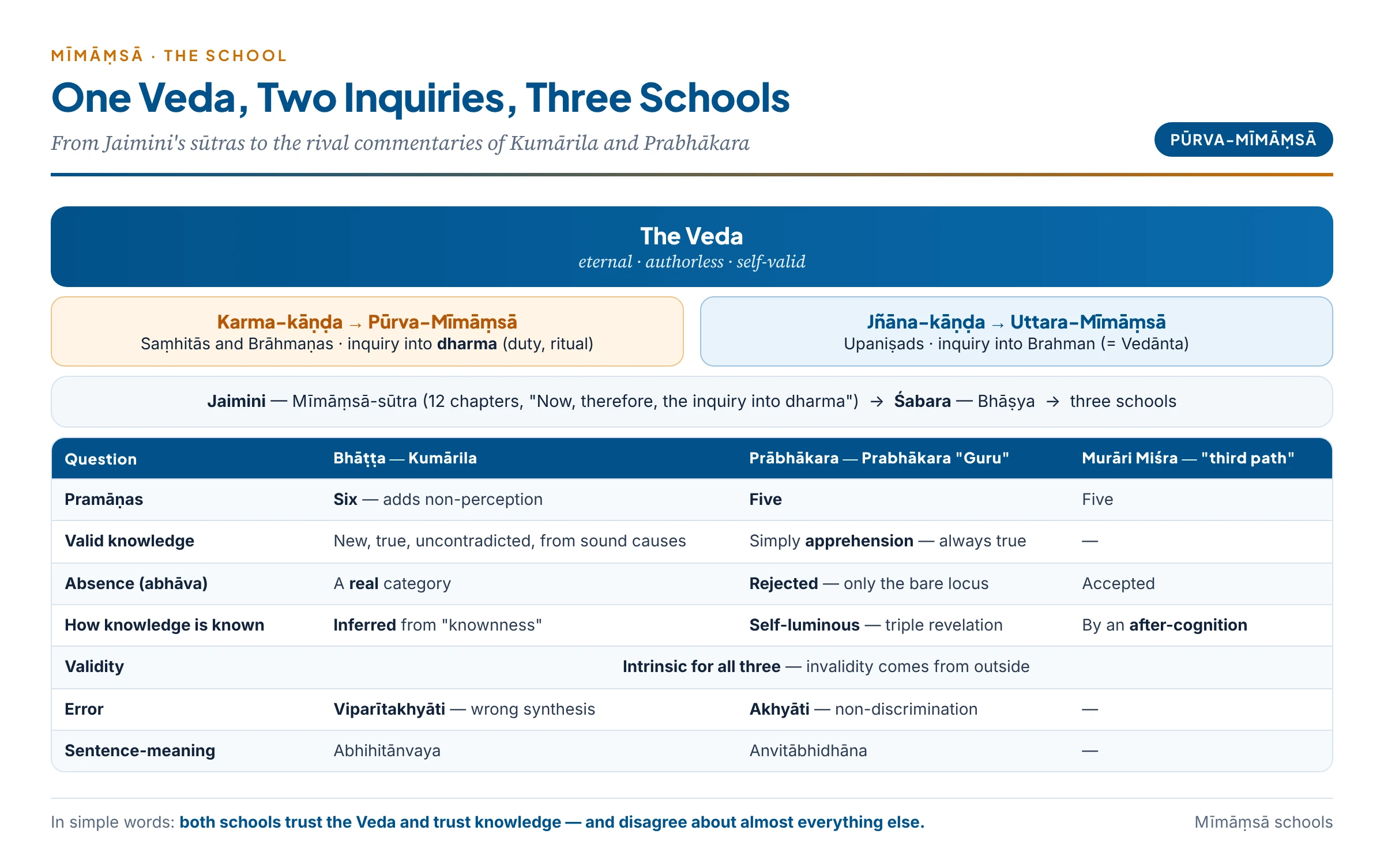
- Two Mīmāṃsās. The Vedas have two parts:
- Karma-kāṇḍa — the earlier part (Saṃhitās and Brāhmaṇas) dealing with action: rites, sacrifices, duties.
- Jñāna-kāṇḍa — the later part (Upaniṣads) dealing with knowledge of reality.
- Pūrva and Uttara. The school that examines the earlier (pūrva) part is Pūrva-Mīmāṃsā — also called Karma-Mīmāṃsā or Dharma-Mīmāṃsā. The school that examines the later (uttara) part is Uttara-Mīmāṃsā, better known as Vedānta (Brahma-Mīmāṃsā). When people say “Mīmāṃsā” alone, they mean Pūrva-Mīmāṃsā.
- A pair of schools. Just as Sāṃkhya–Yoga and Nyāya–Vaiśeṣika are allied, Mīmāṃsā–Vedānta form a pair: one is concerned with duty and practice, the other with knowledge of Brahman.
- Where it differs from the other āstika schools. Nyāya, Vaiśeṣika, Sāṃkhya and Yoga developed their systems independently, though owing allegiance to the Veda. Mīmāṃsā and Vedānta depend directly on the Vedic text — one on its ritual side, the other on its speculative side.
The Founders and Their Books
- Jaimini — the Mīmāṃsā-sūtra, in twelve chapters, the largest of all the philosophical sūtras (about a thousand topics). It opens with “Now, therefore, the inquiry into dharma” (athāto dharma-jijñāsā).
- Śabara Svāmin — the great commentary (Śābara-bhāṣya), which is the starting point of all later Mīmāṃsā.
- Kumārila Bhaṭṭa (c. 7th century) — founder of the Bhāṭṭa school. His huge commentary has three parts: Ślokavārttika (the philosophical part, in verse), Tantravārttika and Ṭupṭīkā. His followers include Pārthasārathi Miśra (Śāstradīpikā).
- Prabhākara Miśra — founder of the Prābhākara school, nicknamed “Guru“. His commentaries Bṛhatī and Laghvī were explained by Śālikanātha, whose Prakaraṇa-pañcikā is the main textbook of the school. Tradition makes Prabhākara a pupil of Kumārila, who called him “Guru” for his brilliance; some scholars, such as Gaṅgānātha Jha, think the Prābhākara school is actually older and closer to the original Mīmāṃsā.
- Murāri Miśra — a later and minor “third path” (murāres tṛtīyaḥ panthāḥ), known mainly through the criticisms of others; on the knowledge of knowledge he sides partly with Nyāya (Article 6).
Why a Ritual School Needed a Theory of Knowledge
- Two jobs. Mīmāṃsā supports Vedic ritualism in two ways:
- It gives a method of interpretation by which complicated and apparently conflicting Vedic injunctions are understood, harmonised and followed.
- It gives a philosophical justification of the beliefs on which ritualism depends.
- The beliefs that needed defending. Ritualism assumes that:
- there is a soul that survives death and enjoys the fruit of rituals in heaven;
- there is some power (apūrva) that preserves the effect of a ritual until it bears fruit;
- the Vedas are infallible;
- the world is real — our life and actions here are not dreams.
- The attackers. Buddhists, Jainas and Cārvākas rejected the authority of the Veda; some Buddhists denied the soul and the world; some Upaniṣads looked down on heaven and ritual. Mīmāṃsā had to answer all of them.
- The key epistemic problem. Dharma is supersensible: no one can see that a sacrifice leads to heaven, nor infer it from any observed sign. So the Veda must be a source of knowledge in its own right, and knowledge as such must be trustworthy without outside proof (Article 7). The whole theory of knowledge grows from this need.
- Its wider influence. Mīmāṃsā’s epistemology became common property. Advaita Vedānta openly follows it in everyday matters (“in practical life, the Bhāṭṭa method”), and even rival schools argue in its terms.
- A bridge to Vedānta. Kumārila links the two Mīmāṃsās: the study of duty prepares the ground for the study of Brahman. Maṇḍana Miśra, who wrote on both Mīmāṃsā and Advaita, and later thinkers argued for a combination of action and knowledge (karma-jñāna-samuccaya) as the path to liberation. Rāmānuja and Bhāskara went further and treated Pūrva- and Uttara-Mīmāṃsā as one continuous science, whose first half teaches what to do and whose second half teaches what is.
Indian Connect — Why it matters beyond ritual
- Mīmāṃsā’s rules of interpretation shaped Hindu law (dharmaśāstra) and the reading of every sacred and legal text.
- Its idea of duty for duty’s sake (section 9) is India’s closest parallel to Kant’s ethics.
- Its theory that knowledge is valid until disproved (Article 7) remains one of the most original contributions of Indian thought to world epistemology.
Core Doctrine
1. Two Kinds of Knowledge
- Immediate and mediate. Like most schools, Mīmāṃsā admits:
- Immediate knowledge — perception, which arises when a really existing object is related to a sense (one of the five external senses or the inner sense, manas).
- Mediate knowledge — all other sources: inference, comparison, testimony, postulation and (for the Bhāṭṭas) non-perception.
- Knowledge itself is the pramāṇa. Both Kumārila and Prabhākara treat the cognition itself, not some separate instrument, as the “means” of knowing.
- Perceptual and non-perceptual. Some teachers put it as a simple division: perceptual valid knowledge and non-perceptual valid knowledge, the latter having five sources for the Bhāṭṭa.
2. What Is Valid Knowledge (Pramā)? The Bhāṭṭa Definition
- The core idea. Valid knowledge is knowledge that gives some new information about something, is not contradicted by any other knowledge, and is not produced by defective conditions.
- Kumārila’s own definition. Valid knowledge is the apprehension of an object, produced by causes free from defects, and not contradicted by later knowledge.
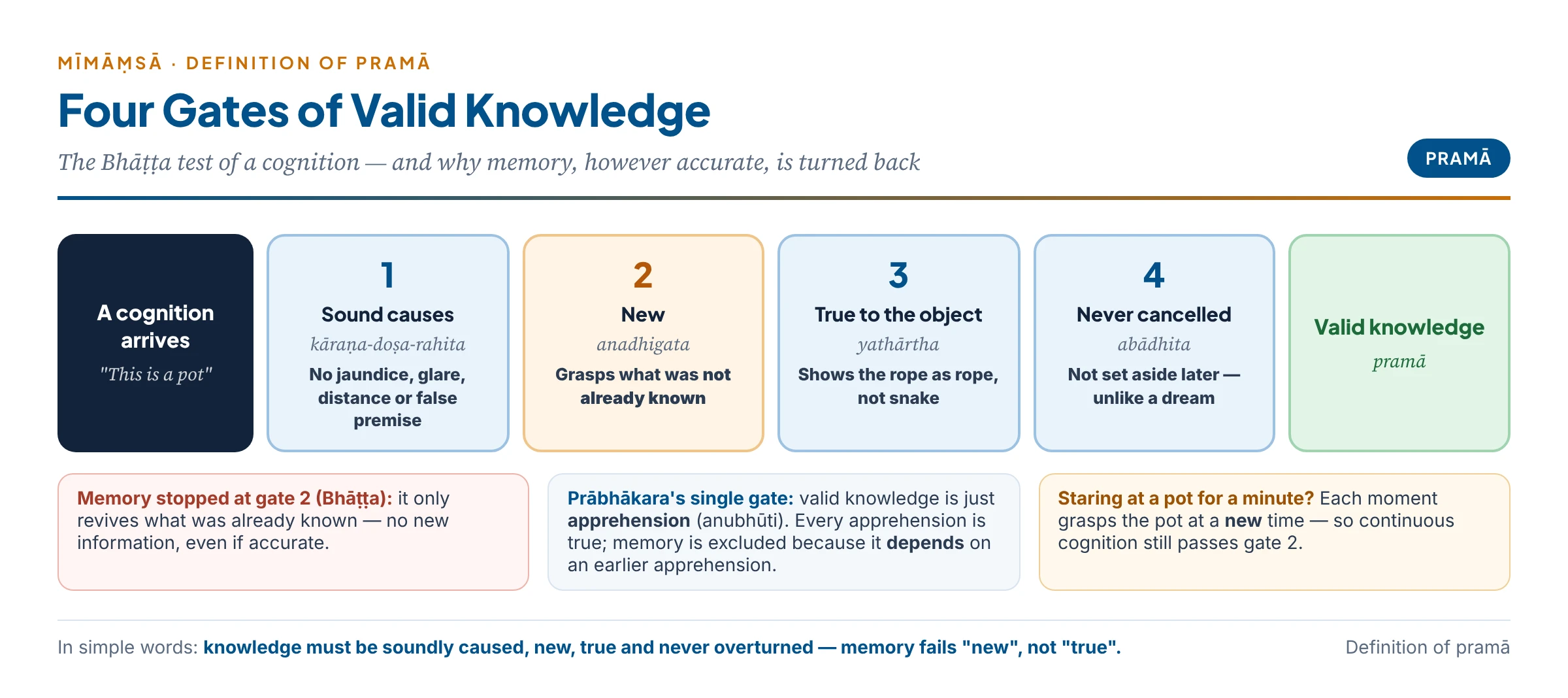
- Pārthasārathi’s fuller definition. Valid knowledge is apprehension of an object (i) not already apprehended, (ii) which truly represents the object, (iii) is not produced by defective causes, and (iv) is free from contradiction. So valid knowledge must pass four tests:
| Mark | Sanskrit | What it excludes | Example |
|---|---|---|---|
| Free from defective causes | kāraṇa-doṣa-rahita | Cognitions from faulty organs, bad light, fallacious premises | A jaundiced eye sees a white conch as yellow |
| Not contradicted later | bādhaka-jñāna-rahita / abādhita | Cognitions cancelled by later knowledge | Dream experiences, cancelled on waking; “snake” cancelled by “rope” |
| New — not already known | agṛhīta-grāhi / anadhigata | Memory and mere repetition | Recalling yesterday’s lecture gives no fresh information |
| True to the object | yathārtha | Error | Seeing a rope as a rope, not as a snake |
- Why “novelty”? Knowledge, for Kumārila, must add something. Memory only revives what was already known, so it is excluded even when it is accurate.
- A puzzle about novelty. What about continuous cognition — staring at a pot for a minute, “pot… pot… pot…” (dhārāvāhika-jñāna)? Is every moment after the first just repetition? The Bhāṭṭa answer: each later cognition grasps the pot as existing at a new moment of time, so it is still new; continuous cognition stays valid.
In simple words
Think of the four marks as four security gates at an airport. A cognition must come from a sound source (no faulty scanner), carry something not already on file (not a copy), match the passenger (truthful), and not be flagged later (not cancelled). Memory fails at the “not already on file” gate, however accurate it is.
3. The Prābhākara Definition: Knowledge Is Apprehension
- One word. Prabhākara defines valid knowledge simply as apprehension (anubhūti): “pramāṇam anubhūtiḥ“.
- All apprehension is valid. Every direct apprehension is, as such, true (sarvaṃ jñānaṃ yathārtham). A cognition that apprehends an object cannot in itself be invalid; there is no false apprehension at all (this leads to his theory of error, Article 8).
- Two classes only. Prabhākara divides cognition into just two classes — apprehension (anubhūti) and memory (smṛti). He does not add a third class of “erroneous cognition”, because so-called error is only a mixture of these two (Article 8).
- Why memory is excluded. Memory is not ruled out because it is false — it may be perfectly accurate — but because it is not apprehension: it arises from the impression (saṃskāra) left by an earlier apprehension and depends on it. It is derived, not direct.
4. Why Memory Is Not Valid Knowledge — Three Answers
The question has been set twice: why is memory not valid knowledge for Mīmāṃsā, and on what grounds do the Prābhākaras and the Naiyāyikas reject it?
- (a) The Bhāṭṭa answer — no novelty.
- Valid knowledge must grasp what was not already known (anadhigata).
- Memory grasps only what was already known; it adds nothing. So it is not pramā, even when true.
- (b) The Prābhākara answer — no direct apprehension.
- Valid knowledge is apprehension.
- Memory is dependent: it arises only from the impression of a previous apprehension, and it presents the object as it was, not as it is now.
- So it is not pramāṇa — not because it misleads, but because it is not an independent grasp of an object.
- (c) The Nyāya answer — not presentative and not about the present object.
- Nyāya defines valid knowledge as true apprehension (yathārtha anubhava). Memory is not anubhava (not a presentative experience) but a representative one: the object is recalled, not presented.
- Memory’s object may no longer exist in the form remembered (the remembered child is now an adult), so its correspondence to the present object is not guaranteed.
- Its validity depends on the original experience; it has no independent standing.
- Where they agree and differ.
| Point | Bhāṭṭa | Prābhākara | Nyāya |
|---|---|---|---|
| Is memory valid knowledge? | No | No | No |
| Main reason | Lacks novelty | Not apprehension; depends on prior apprehension | Not presentative (not anubhava); object may have changed |
| Can memory be true? | Yes, but true is not enough | Yes — all cognition is true | Yes, but its truth is borrowed |
| Does valid knowledge need novelty? | Yes | No — independence is the test | No — continuous cognition is valid |
Common confusion
If Mīmāṃsā rejects memory, does it say memory is false? No. This is the most common slip. For Prabhākara, every cognition — memory included — is true; memory is excluded only because it is not independent apprehension. For Kumārila, memory may be accurate but adds no new information. Memory is “not pramāṇa”, which is different from “error”. Error, for Mīmāṃsā, is a separate problem (Article 8).
5. The Sources of Valid Knowledge (Pramāṇas)
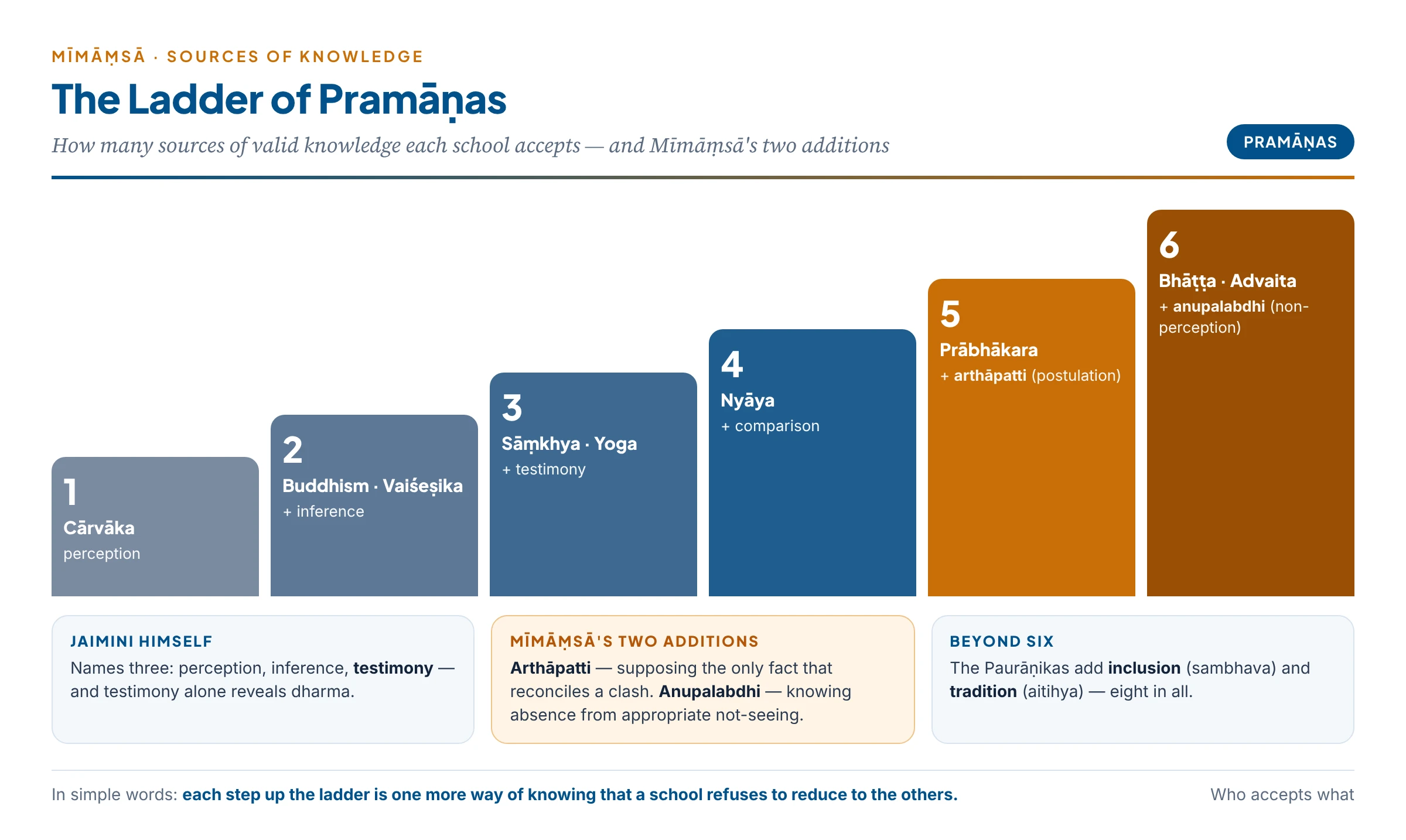
- Jaimini himself mentions three: perception, inference and testimony.
- Prabhākara accepts five: perception (pratyakṣa), inference (anumāna), comparison (upamāna), testimony (śabda — which he calls śāstra) and postulation (arthāpatti).
- Kumārila adds a sixth: non-perception (anupalabdhi), the source of our knowledge of absence.
- The two new pramāṇas. Mīmāṃsā’s distinctive contribution is the pair arthāpatti (postulation) and anupalabdhi (non-perception) — two sources that the four-pramāṇa Nyāya refused to accept as separate.
- Which is supreme? Śabda — especially Vedic testimony — is the highest source, because it alone reveals dharma (Article 3).
| School | Number | Pramāṇas accepted |
|---|---|---|
| Cārvāka | 1 | Perception |
| Buddhism, Vaiśeṣika | 2 | Perception, inference |
| Sāṃkhya, Yoga | 3 | Perception, inference, testimony |
| Nyāya | 4 | + comparison |
| Prābhākara Mīmāṃsā | 5 | + postulation |
| Bhāṭṭa Mīmāṃsā, Advaita Vedānta | 6 | + non-perception |
| Paurāṇikas | 8 | + inclusion (sambhava), tradition (aitihya) |
6. The Worldview behind the Epistemology: Pluralistic Realism
- The world is real. Relying on the validity of perception, Mīmāṃsā believes in the reality of the world with all its diverse objects. It therefore rejects:
- the Buddhist theories of voidness (Mādhyamika) and momentariness, and the idealism that turns objects into ideas (Yogācāra);
- the Advaita theory that the phenomenal world is ultimately unreal.
- Many realities. There are many souls, many material things, eternal substances; besides objects perceived, Mīmāṃsā accepts through other pramāṇas souls, heaven, hell and deities to whom sacrifice is offered.
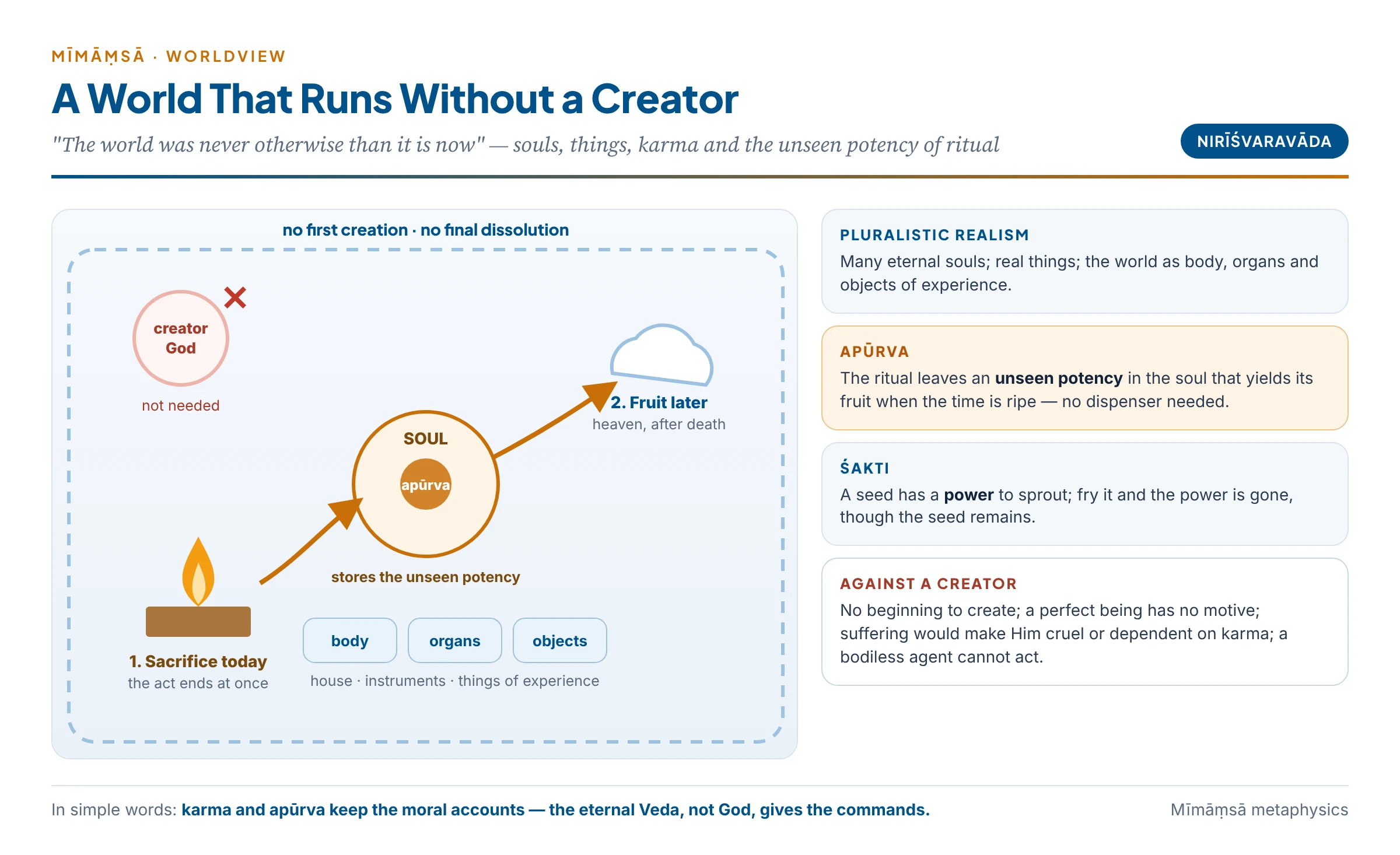
- The world never began and will never end. Mīmāṃsā rejects the Nyāya–Vaiśeṣika idea of periodic creation and dissolution (pralaya). Individual things come and go, but the universe as a whole was never created and will never be destroyed: “the world was never otherwise than it is now” (na kadācid anīdṛśaṃ jagat). This view is unique in Indian philosophy.
- What the world is for. The world consists of:
- bodies, in which souls reap the fruits of past deeds (bhogāyatana — the “house of experience”);
- sense and motor organs, the instruments of enjoying and suffering (bhoga-sādhana);
- objects, which are what is enjoyed or suffered (bhogya-viṣaya).
- Atoms optional. Some Mīmāṃsakas accept the Vaiśeṣika atoms, but — unlike Vaiśeṣika — say atoms need no God to arrange them; the autonomous law of karma regulates them. Kumārila even remarks that Mīmāṃsakas are not bound to believe in atoms at all.
- Realism, not empiricism. Mīmāṃsā is not empiricism, because it accepts a non-empirical source (the Veda) as even more dependable than sense-experience, and believes in realities — apūrva, heaven, hell — that no senses reveal.
In simple words
Mīmāṃsā’s universe is like a cricket league that has always been running. Players come and go, seasons begin and end, but there was no first match and there will be no last one. And no commissioner is needed to run it: the rules themselves (karma) see to it that every performance gets its due score.
7. Categories, Substances, Potency and Apūrva
- The categories (padārthas). Mīmāṃsakas mostly follow the Vaiśeṣika list, with important changes:
| Point | Bhāṭṭa (Kumārila) | Prābhākara |
|---|---|---|
| Number of categories | 5 — substance, quality, action, universal, absence | 8 — substance, quality, action, universal, inherence (called paratantratā), potency (śakti), similarity (sādṛśya), number (saṅkhyā) |
| Absence (abhāva) | A real category, of four kinds — prior, posterior, mutual, absolute (Article 5) | Rejected; absence is only the bare locus |
| Particularity (viśeṣa) | Rejected — reduced to the quality of distinctness | Rejected — reduced to the quality of distinctness |
| Inherence (samavāya) | Rejected; replaced by identity-in-difference (tādātmya, bhedābheda) | Accepted under a new name |
| Substances | The nine of Vaiśeṣika + darkness; many accounts add sound as an eternal substance | The nine of Vaiśeṣika; darkness is only absence of seeing light; sound is a quality of ākāśa |
| Potency and similarity | Included under existing categories | Independent categories |
- Potency (śakti). A seed has an imperceptible power to produce a sprout; fry the seed and the power is destroyed, so no sprout comes though the seed is still there. Fire has a power to burn, a word a power to express meaning.
- Nyāya’s objection. No hidden power is needed: a cause produces its effect when obstructions are absent, and fails when they are present.
- Mīmāṃsā’s reply. Then Nyāya too must add something to the cause — the absence of obstruction. If something must be supposed, it is more reasonable to suppose a positive power in the cause itself to explain a positive effect, and its suppression to explain the effect’s failure.
- Apūrva. How does a sacrifice performed today bear fruit in heaven after death, when the act itself has vanished? Mīmāṃsā answers: the ritual generates in the performer’s soul an unseen potency called apūrva (“what did not exist before”), which stays in the soul and yields the fruit when circumstances ripen — without any God to dispense it. Apūrva is a limited version of the general law of karma, applied to ritual acts.
Common confusion
Did Mīmāṃsā “require the existence of God as the entity of worship” in its rituals? No. Some notes say so, but the Vedic gods in Mīmāṃsā shrink to grammatical datives: a deity is defined as “that which is denoted by the fourth case-ending” (the dative — “to Indra”, “to Agni”) in a sacrificial injunction — that is, simply the one in whose name the oblation is offered. The purpose of a sacrifice, an eminent Mīmāṃsaka says, is not worship, not pleasing a deity, not even moral improvement: it is done because the Veda commands it. No creator God is needed, and none is accepted.
8. The Self
- Many eternal souls. Both schools hold that there are many souls, each an eternal, all-pervading (vibhu) substance — the real knower, enjoyer and agent, distinct from body, senses, mind and intellect, surviving death to reap the fruits of action.
- Consciousness is not the essence of the soul.
- Prabhākara (like Nyāya): the soul is in itself unconscious (jaḍa); consciousness is an adventitious quality that arises when the soul is joined to mind, senses and object.
- Kumārila: the soul is conscious-unconscious (jaḍa-bodhātmaka). As substance it is unchanging; as modes it changes. Consciousness is a modal change (pariṇāma) — an act of the self — and its nature is the potency to know.
- No consciousness in deep sleep or liberation. Because the conditions (sense–object contact) are absent, the soul has no actual consciousness in dreamless sleep and in liberation.
- How the self is known. The Bhāṭṭa says the self is known occasionally, as the object of I-consciousness (ahaṃ-vitti); the Prābhākara replies that the self can never be an object, but is revealed as subject in every cognition. This debate belongs with “how knowledge is known” (Article 6).
9. Dharma, Duty and the Highest Good
- Dharma defined. Jaimini: dharma is that which is indicated by a Vedic injunction (codanā-lakṣaṇo ‘rtho dharmaḥ) — a command that impels a person to act. It is the supreme duty, the “ought”. Artha and kāma (wealth and pleasure) are learnt from worldly dealings; dharma is revealed only by the Veda.
- Kinds of action.
- Obligatory — daily (nitya, e.g. the twilight prayer) and occasional (naimittika, on specific occasions). Neglect brings sin; performance brings no special merit.
- Optional (kāmya) — done for a desired result: “one who desires heaven should sacrifice” (svargakāmo yajeta). Performance brings merit; omission brings no sin.
- Prohibited (pratiṣiddha / niṣiddha) — performing them brings sin and hell.
- Expiatory (prāyaścitta) — to remove or reduce the effect of prohibited acts done.
- Duty for duty’s sake. In the obligatory duties Mīmāṃsā reaches its highest point: an action is to be done because it ought to be done, not because it benefits the doer.
- Prabhākara: obedience to the Veda is an end in itself — pure duty for duty’s sake.
- Kumārila: these duties are performed as a means to liberation — by avoiding the sin that their neglect would bring (a kind of psychological hedonism).
- Heaven to liberation. The early Mīmāṃsā goal was heaven (svarga), a state of unmixed happiness. Later Mīmāṃsakas, like other Indian schools, adopted liberation (apavarga):
- Desire-prompted and prohibited actions bind the soul to rebirth; so the seeker gives up optional and prohibited actions.
- He keeps performing the obligatory duties disinterestedly, so that no fresh sin accrues; with self-knowledge, past karma is gradually exhausted.
- When all karma is worn out, the soul is not born again: it rests in its own nature, freed from body, senses and mind — beyond pleasure and pain, without actual consciousness or bliss (some later Bhāṭṭas, like the Advaitins, call it a state of joy).
In simple words
A soldier on guard duty does not stand at his post because standing there makes him happy, or because he expects a medal; he stands there because it is his duty. Mīmāṃsā’s obligatory rites are like that guard duty: done because they are commanded, not for a reward — though Mīmāṃsā trusts that the moral order of the universe (karma) will not leave such a person unrewarded.
10. Atheism (Nirīśvaravāda)
- Silence, then rejection. The early Mīmāṃsakas are silent about God; the later ones (Kumārila above all) refute the Nyāya proofs of a creator.
- Why the Veda needs no God. To secure the supreme place for the eternal Veda, Mīmāṃsā could not accept a God whose authority would be higher than, or equal to, the Veda’s. The Veda, like the world, is eternal and authorless (Article 3).
- Arguments against a creator.
- No beginning. The world was never created, so it needs no creator.
- Motive dilemma. A perfect being has no unfulfilled desire. If God created out of desire, He is imperfect; if without any purpose, He acts like a madman.
- Compassion and suffering. If He created out of compassion, why is the world full of pain and cruelty? If He distributes pain according to karma, then karma does the real work and God is dependent on it — and therefore unnecessary.
- Bodiless agent. A God without a body cannot act on matter; a God with a body is not eternal or perfect.
- No pramāṇa. God is neither perceived nor validly inferred; the Veda speaks of duties, not of a creator.
- Max Müller’s doubt. Max Müller found it hard to believe that the school most faithful to the Veda could reject the Vedic God; rejecting a creator, he argued, is not rejecting God. But judged by what Mīmāṃsā itself says — silence in the early writers, rejection of the proofs in the later — the label “atheistic” is fair. Some late Mīmāṃsakas (Āpadeva, Laugākṣi Bhāskara) tried to bring God back.
Critical Evaluation
Objections to the Mīmāṃsā Foundations
- On novelty (against Kumārila).
- Nyāya: novelty is not a mark of truth. A continuous cognition of the same pot, or a second look at a known friend, is still knowledge. Making novelty essential confuses informativeness with validity.
- Memory can be knowledge. We rely on memory every day — and the Mīmāṃsaka himself relies on the memorised Veda passed down orally! Excluding memory seems to cut the branch on which tradition sits.
- On Prabhākara’s definition. If all apprehension is valid, the notion of error becomes hard to state (Article 8); the definition seems too generous.
- On realism. Advaita and the Buddhists object that realism about an eternal world rests on taking perception at face value, which is exactly what is in dispute.
- On atheism. Nyāya replies that an ordered world of effects needs an intelligent maker; the law of karma is unconscious and cannot by itself distribute fruits justly. To leave apūrva to work blindly is to give an unconscious principle the work of a judge.
- On the motive. Critics (Cārvāka, Buddhists) see the whole epistemology as reverse-engineered to protect the Veda: the conclusion (infallible scripture) was fixed in advance.
- On liberation. A liberation without consciousness or bliss, in which the soul exists like a stone, seems no better than deep sleep — the same objection Advaita raises against Nyāya’s apavarga.
Mīmāṃsā’s Replies
- Novelty and repetition. Each moment of a continuous cognition grasps the object at a new time, so novelty is preserved; and the remembered Veda is not known by memory but by testimony — every recitation gives fresh verbal knowledge.
- Why memory is still useful. Excluding memory from pramāṇa does not mean distrusting it in life; it means that memory is derivative — its authority comes from the original apprehension.
- Realism. The burden of proof lies on whoever doubts the normal deliverances of perception; doubt needs a reason (Article 7).
- Atheism. An ordered world can be explained by eternal substances and potencies plus karma; adding God explains nothing new and creates the problems of motive and suffering.
Critics and Defenders
Criticism — Critics
- Nyāya: novelty is not essential to truth; continuous cognition is valid; karma needs an intelligent dispenser.
- Cārvāka and Buddhists: the epistemology is built to protect scripture; the “authorless Veda” is a dogma.
- Advaita: the realist world is ultimately an appearance; liberation without consciousness is like a stone.
- General critics: excluding memory threatens the oral tradition the school depends on.
Defence — Defenders and strengths
- A clear definition of valid knowledge — sound causes, truth, novelty, no later defeat — still useful today.
- Memory is excluded for a principled reason (it is derivative), not out of distrust.
- Realism about the world and many selves fits common sense.
- A godless but moral universe run by karma and apūrva — an original and consistent position.
- Duty for duty’s sake anticipates Kant by a thousand years.
Cross-Tradition Comparison
Mīmāṃsā and Western Thought
| Point | Mīmāṃsā | Western parallel |
|---|---|---|
| Defending a text by epistemology | Proves the Veda reliable by a general theory of knowledge | Reformed epistemology (Plantinga, Alston) defends religious belief as “properly basic” |
| Novelty as a mark of knowledge | Kumārila: knowledge must be anadhigata | Kant: synthetic judgments extend knowledge; analytic ones only clarify |
| Memory | Not a pramāṇa — derivative | Locke/Hume: memory ideas are faint copies of impressions; Reid: memory is a basic but distinct faculty |
| Duty for duty’s sake | Obligatory rites done because commanded | Kant: the categorical imperative; but Kant postulates God to unite virtue and happiness, Mīmāṃsā relies on karma |
| Eternal uncreated world | Na kadācid anīdṛśaṃ jagat | Aristotle: the cosmos is eternal; motion has no beginning |
| Potency in causes | Śakti in seed and fire | Aristotle’s potentiality; Locke’s “powers”; modern dispositions |
| Unseen ritual potency | Apūrva preserves the effect of acts | No close parallel; compare a deferred contract or stored energy |
Mīmāṃsā and Other Indian Schools
| Point | Mīmāṃsā | Nyāya–Vaiśeṣika | Advaita Vedānta |
|---|---|---|---|
| Source of Veda’s authority | Authorless, eternal | Authored by God | Authorless (follows Mīmāṃsā) |
| God | Rejected | Accepted as creator | Saguṇa Īśvara empirically real |
| World | Real, eternal, never created | Real, periodically created and dissolved | Empirically real, ultimately an appearance |
| Pramāṇas | 5 (Prābhākara) / 6 (Bhāṭṭa) | 4 | 6 (follows Bhāṭṭa) |
| Highest good | Heaven → liberation without consciousness | Apavarga without consciousness | Liberation as consciousness and bliss |
Indian Connect — Key takeaways
- Mīmāṃsā and Sāṃkhya are the two āstika schools that are atheistic: being “orthodox” means accepting the Veda, not accepting God.
- Mīmāṃsā is an anti-ascetic, anti-mystical school of right practice (orthopraxy): its concern is correct action in the world, not withdrawal from it.
- Advaita borrows Mīmāṃsā’s six pramāṇas, its theory of intrinsic validity and its authorless Veda — while rejecting its ritualism and realism.
Synthesis (Siddhānta)
- Mīmāṃsā is the critical investigation of dharma; its epistemology was built to show that the Veda is a genuine and supreme source of knowledge about a supersensible duty.
- Its two great schools — Bhāṭṭa (Kumārila) and Prābhākara (Prabhākara) — agree on the authorless Veda and the intrinsic validity of knowledge, but differ on almost everything else: the definition of knowledge, the number of pramāṇas, absence, how knowledge is known, and error.
- Valid knowledge for the Bhāṭṭa is new, true, uncontradicted cognition from sound causes; for the Prābhākara it is simply apprehension, which is always true.
- Memory is excluded by both — for lack of novelty (Bhāṭṭa) or of independent apprehension (Prābhākara) — but neither calls memory false.
- Behind the epistemology stands a pluralistic realism: a real, eternal, uncreated world of many souls and things, governed by karma, śakti and apūrva, with no creator God.
- Contemporary relevance.
- Interpretation. Mīmāṃsā’s rules for reading texts are still used in Indian legal interpretation — courts have drawn on its maxims for harmonising conflicting provisions.
- Epistemology. Its default trust in cognition (Article 7) matches modern “innocent until proven guilty” views of belief.
- Ethics. A duty-centred ethics without God shows how moral obligation can be grounded in an impersonal law rather than divine command.
“The world was never otherwise than it is now.” — Kumārila Bhaṭṭa
Previous Year Questions
- 2024On what grounds do the Prābhākaras and the Naiyāyikas reject memory as a source of knowledge? Discuss.
- 2020Why is memory not a valid knowledge according to Mīmāṃsā?
- 1996While describing the chief tenets of the Mīmāṃsā metaphysics, critically consider its view in respect of the reality of the phenomenal world.