

Political Ideologies: Anarchism; Marxism and Socialism
Official Syllabus: Paper II, Section A, Unit 5
The young Marx saw capitalism as more than an unfair way of sharing wealth: it cripples human beings. In the Economic and Philosophic Manuscripts of 1844 he described how the wage worker is alienated (Entfremdung, estranged) from the product of work, from the activity of working, from human nature and from other people. Twenty years later, in Capital (1867), the mature Marx gave the economic mechanism behind this: the worker sells labour power, produces more value than the wage paid, and the difference, surplus value, becomes the capitalist’s profit. This article explains both sides of Marx’s critique of capitalism, the humanist (alienation) and the economic (exploitation through surplus value), with commodity fetishism linking them, and then asks whether ending alienation can bring social progress.
In simple words
A potter in a village makes a pot from start to finish: she chooses the clay, shapes it as she likes, sells it to a neighbour she knows, and feels proud when it is used at a wedding. A worker on a factory line fixes the same handle on ten thousand cups a day, never sees the finished cup, does not own it, cannot decide how to work, and competes with the next worker for the job. Both make pots. Only the first one recognises herself in her work. The second is what Marx calls alienated.
Context & Problem
Where the Idea of Alienation Came From
- Hegel: Spirit “alienates” itself into the world of nature and history and then recognises itself again at a higher level. Alienation is a stage on the road to self-knowledge.
- Feuerbach: religion is alienation. Humans project their best qualities (love, wisdom, power) onto God and then feel small and sinful before him.
- Marx: both missed the root. Alienation is not mainly in the mind or in religion; it is rooted in real economic life, in the way people are forced to work under private property and wage labour. Religious alienation is only a reflection of this.
- The 1844 Manuscripts were published only in 1932; their discovery gave rise to the “humanist” reading of Marx in the twentieth century.
Marx’s View of Human Nature: Species-Being
- Human beings are species-beings (Gattungswesen): what is special about humans is free, conscious, creative, social production.
- An animal produces only for its immediate need, “one-sidedly”; a human being produces universally, even when free from physical need, and can produce “in accordance with the laws of beauty”.
- Through work we shape nature and, in doing so, express and develop ourselves; we see ourselves in a world we have made.
- Work is therefore not just a means of living; it is life itself, the main way human beings realise their nature.
Core Doctrine
The Four Forms of Alienation (1844)
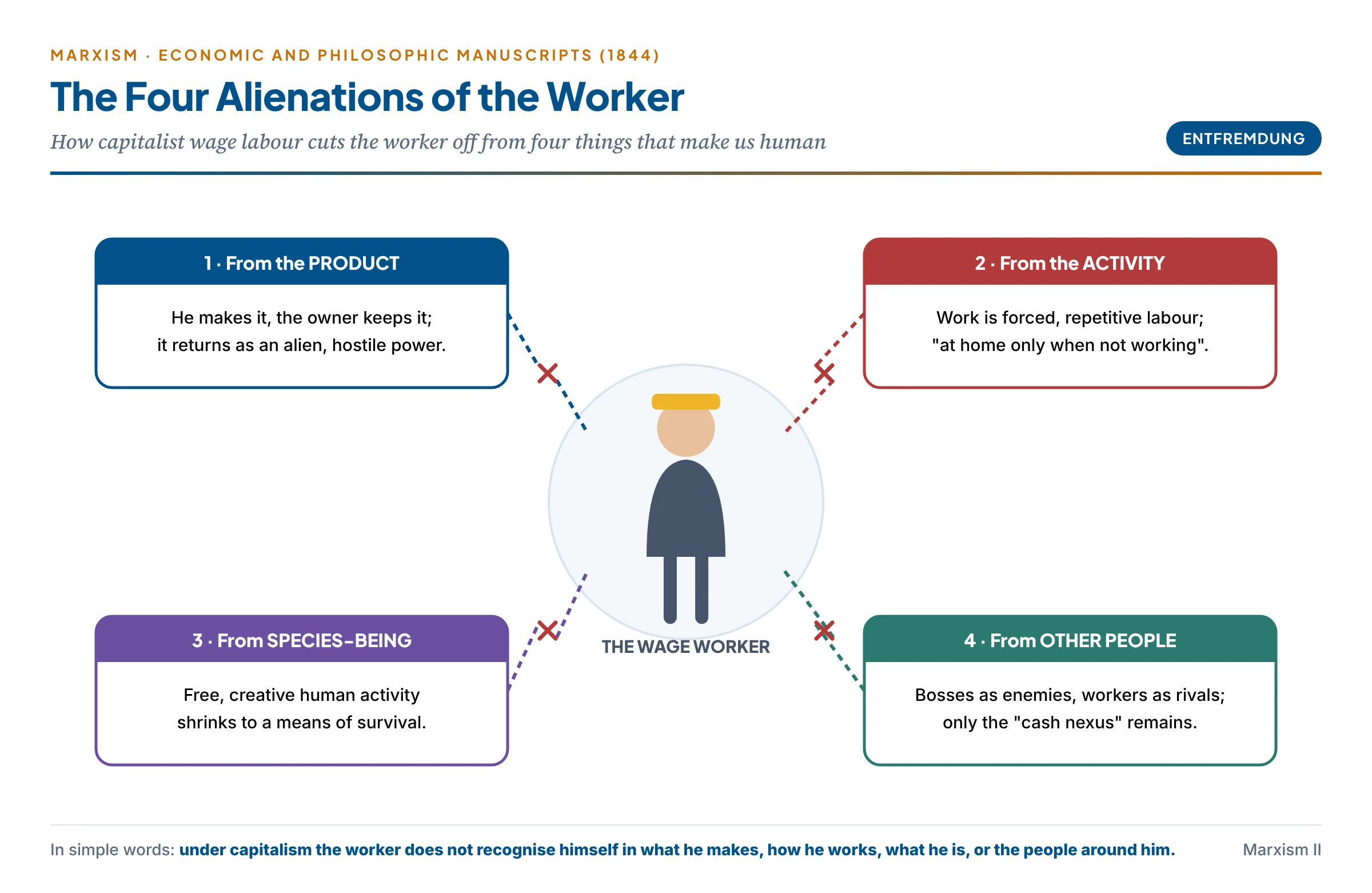
Under capitalism, the wage worker is alienated in four connected ways:
1. Alienation from the product of labour
- The worker puts his life into the object, but the object belongs to the capitalist.
- The more the worker produces, the poorer he becomes, and the richer and more powerful the world of things he has made: “The worker becomes all the poorer the more wealth he produces.”
- The product stands over the worker as an alien, hostile power. The buildings, machines and capital he creates come back to dominate him.
2. Alienation from the act (process) of production
- Work is not voluntary but coerced: forced labour. It is not the satisfaction of a need but a means to satisfy needs outside it: wages, food.
- “The worker therefore only feels himself outside his work, and in his work feels outside himself. He is at home when he is not working, and when he is working he is not at home.”
- The proof: as soon as there is no compulsion, labour is avoided like the plague.
- The famous reversal: “Man (the worker) only feels himself freely active in his animal functions — eating, drinking, procreating, or at most in his dwelling and in dressing-up, etc.; and in his human functions he no longer feels himself to be anything but an animal.”
3. Alienation from species-being (human nature)
- Free, conscious, creative activity, the very essence of being human, is turned into a mere means of staying alive.
- The worker is reduced from a creative, conscious being to a beast of burden, an appendage of the machine.
4. Alienation from other human beings
- If I am estranged from my work and my nature, I am also estranged from other people.
- The worker faces the capitalist as an enemy who owns his product, and faces other workers as competitors for scarce jobs and wages.
- Human relations are reduced to market transactions: the “cash nexus”.
Common confusion
Which four alienations did Marx list — product, act, species-being and others, or product, nature, others and oneself? Both lists are widely used, and they describe the same idea. Marx’s text in the 1844 Manuscripts gives (1) the product, (2) the activity of production, (3) species-being, (4) other human beings. Alienation from nature is part of the first and third (nature becomes merely raw material owned by another), and alienation from oneself is Marx’s name for the second and third (the worker’s own activity and essence become alien). It is safest to use Marx’s own four and mention the other terms as their content.
The Causes of Alienation
- Private property in the means of production: the worker owns nothing but his capacity to work.
- Wage labour: labour power becomes a commodity bought and sold.
- The division of labour: each worker repeats a tiny, meaningless task; mental and manual labour are separated. Adam Smith himself noticed that a man who spends his life on a few simple operations “becomes as stupid and ignorant as it is possible for a human creature to become”.
- Money: in the Manuscripts, Marx described money as the power that turns everything into its opposite: it makes the ugly attractive, the stupid respected, the coward brave, because all qualities can be bought.
Commodity Fetishism
- In Capital, Marx explained a deeper, everyday form of estrangement.
- A commodity is a thing produced for sale on the market.
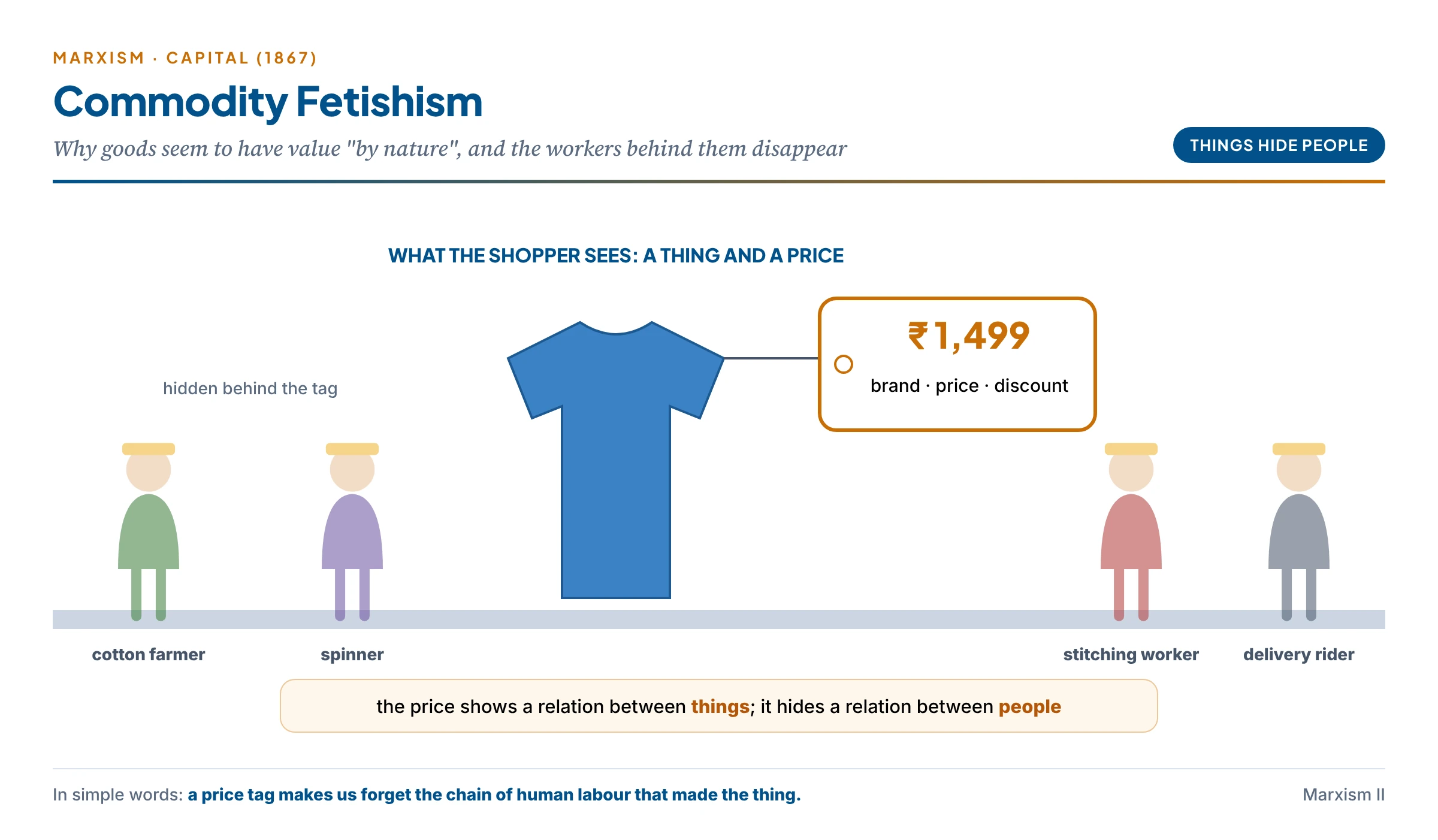
- When goods are exchanged, the social relations between people (the farmer, the miner, the factory worker whose labour went into them) appear as relations between things, prices on a tag.
- Like a religious fetish (an object believed to have magical power), commodities seem to have value in themselves, as if a phone were “worth” its price by nature, and we forget the human labour and social conditions behind it.
- Result: people feel ruled by impersonal market forces (“the market decided”) that are in fact the product of their own collective activity.
- Today: brands, logos and price tags hide the sweatshop, the mine and the delivery rider behind a product.
In simple words
When you order food on an app, you see a price, a photo and a delivery time. You do not see the farmer who grew the rice, the cook in a hot kitchen, or the rider racing through traffic to beat the timer. The app shows a relation between you and a thing; behind it lies a chain of people working for you. Marx calls this hiding of people behind things commodity fetishism.
The Labour Theory of Value and Surplus Value
Surplus value is the economic basis of Marxism: it explains how capitalist exploitation takes place even when every exchange looks fair.
Step 1 — Use value and exchange value:
- Use value: the usefulness of a thing (a coat keeps you warm).
- Exchange value: what a thing can be exchanged for on the market (a coat equals so many kilos of rice).
- What gives things exchange value? Following Smith and Ricardo, Marx answers: human labour. The value of a commodity is determined by the socially necessary labour time needed to produce it, the time an average worker takes with normal tools and skill.
- Labour is the sole creator of value, and the only element of production that produces more value than it costs.
Step 2 — Labour power is a commodity:
- The worker does not sell “labour” but labour power, the capacity to work for a day.
- Like any commodity, its value (the wage) equals the cost of producing it: the food, shelter and clothing needed to keep the worker and his family going.
Step 3 — The working day splits in two:
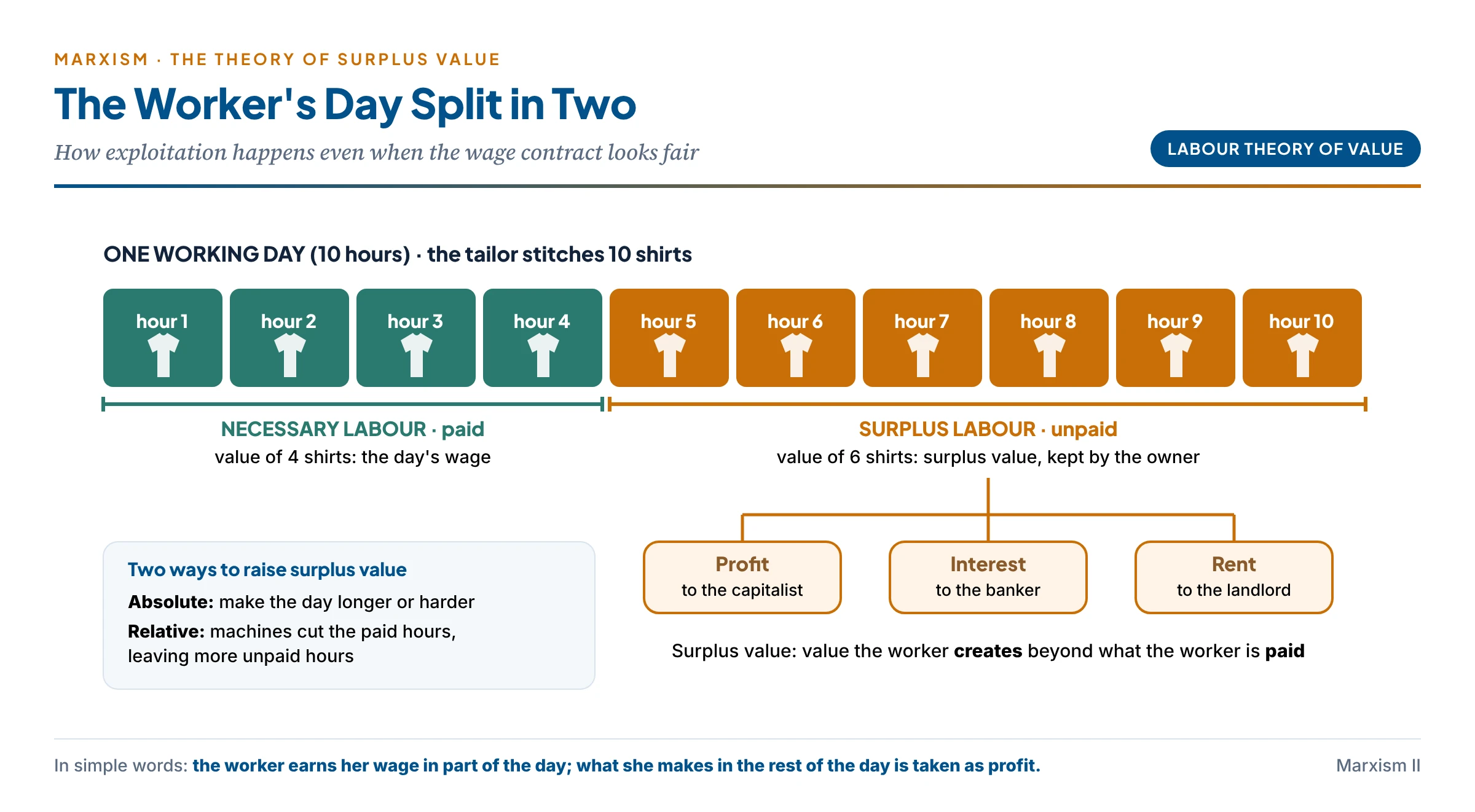
- Suppose a worker’s daily needs can be produced in 4 hours of work; that is the value of his wage (necessary labour).
- But the capitalist has bought his labour power for the whole day, say 8 or 10 hours.
- In the remaining hours the worker produces extra value for which he is not paid: this is surplus labour, and its product is surplus value.
- Surplus value is the value the worker creates over and above what the worker is paid.
- Rent, interest and profit are all paid out of this surplus value, to landlords, bankers and capitalists.
In simple words
A tailor in a garment factory stitches ten shirts a day. The sale of four shirts pays her day’s wage. The other six shirts are produced for nothing as far as she is concerned; their value goes to the owner. Each exchange looked fair (she agreed to the wage), yet she gave more than she got. That hidden gap is surplus value.
Step 4 — How capital grows:
- Two ways to raise surplus value:
- Absolute surplus value: make the working day longer or work harder (the struggle over the eight-hour day).
- Relative surplus value: raise productivity with machines so that the wage is earned in fewer hours, leaving more surplus hours.
- Two parts of capital: constant capital (machines, raw materials), which only passes on its own value, and variable capital (wages), which alone creates new value.
- Simple exchange vs capital: an artisan sells in order to buy (a pot for food); the capitalist buys in order to sell dearer (money becomes more money). Capital is value that grows by itself through the labour it commands.
Step 5 — The laws of capitalism that follow:
- Accumulation: competition forces capitalists to reinvest surplus value and keep expanding.
- Concentration and centralisation: big firms swallow small ones; monopolies grow.
- Reserve army of labour: machines throw workers out of work, creating a pool of unemployed that keeps wages down.
- Pauperisation (immiseration): the condition of the working class worsens relative to the wealth they produce.
- Polarisation: society divides into a small group of very rich owners and a mass of propertyless workers.
- Falling rate of profit: as machines replace workers, the share of capital that creates new value shrinks, and profit rates tend to fall.
- Crises of overproduction: goods pile up that workers cannot afford to buy, leading to slumps, bankruptcies and unemployment.
- These contradictions, Marx argued, would unite and radicalise the proletariat and lead to revolution (Article 6).
Criticisms of the theory of surplus value:
- Labour is not the only source of value. Capital (machines), land, entrepreneurship, risk-taking, management and technology also contribute. A robot factory with few workers produces enormous value.
- Value depends on demand too. The “marginal utility” economists (Jevons, Menger, Walras) argued from the 1870s that value comes from what buyers want; a product nobody wants has no value however much labour went into it.
- The “transformation problem”: critics such as Böhm-Bawerk showed that Marx could not consistently turn labour values into actual market prices.
- M. N. Roy: no economic system can survive without taking some surplus for investment, defence and public services. The Soviet state extracted surplus too; the real question is who controls it and how it is used.
- Prediction failed: workers’ real wages rose in industrial countries; the welfare state, trade unions and labour laws softened exploitation; the middle class grew.
Significance:
- Even if not logically watertight, the theory had great practical significance: it questioned the moral foundation of capitalism and presented it as a system based on exploitation, however free each contract looks.
- It played a huge part in uniting the working class and inspired the struggles for the eight-hour day, minimum wages and the right to unionise.
- The question it asks, who produces the surplus and who gets it?, remains central in debates on inequality and the gig economy.
Overcoming Alienation: Communism as Humanism
- For Marx, alienation is historical, not eternal: it arises from private property and wage labour, and can be abolished with them.
- “Communism, as fully developed naturalism, equals humanism, and as fully developed humanism equals naturalism” (1844 Manuscripts): the conflict between humans and nature, and between individual and society, is resolved.
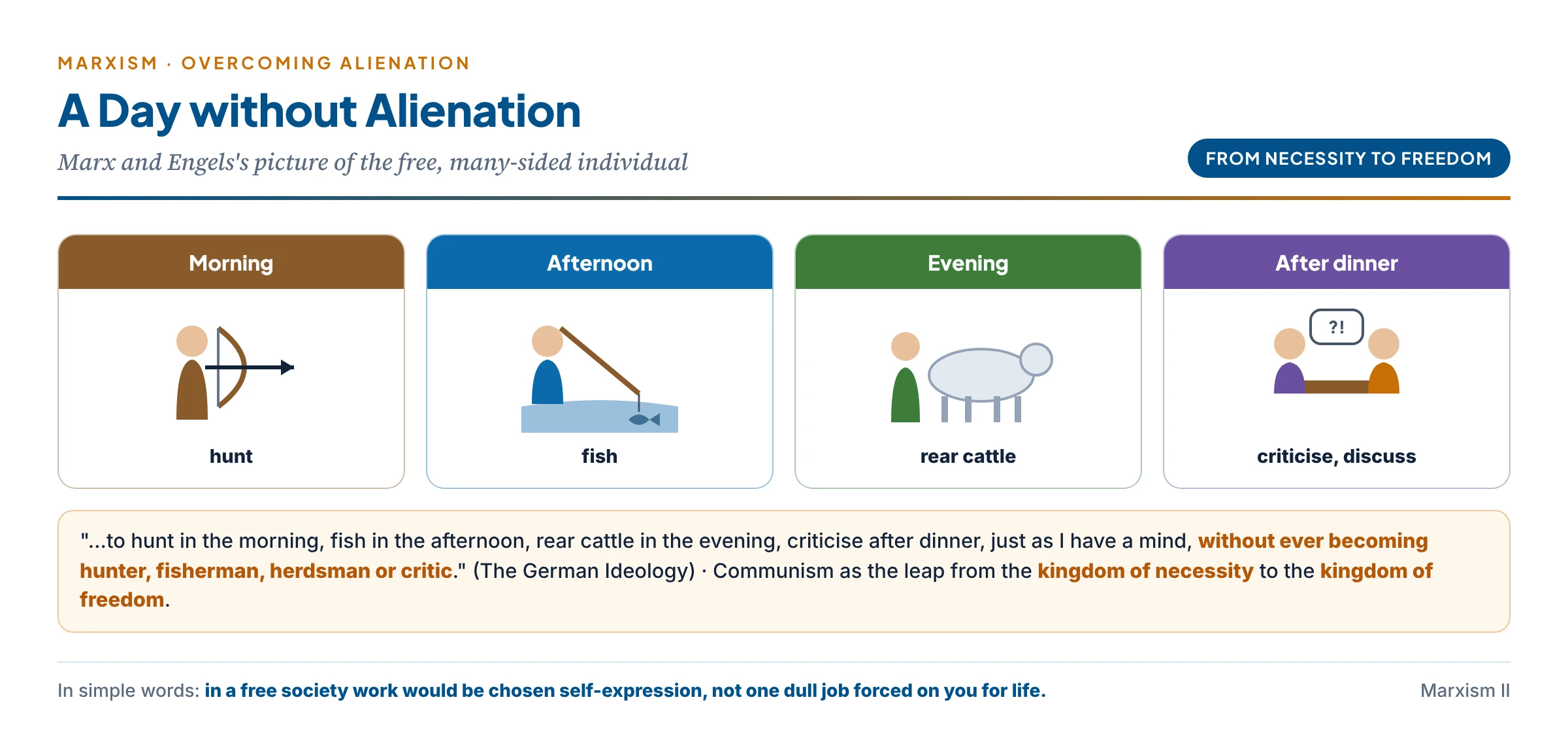
- From the kingdom of necessity to the kingdom of freedom: capitalism is ruled by necessity (working to survive under another’s command); socialist revolution would make the leap to freedom, where work becomes free self-expression and the working day is shortened (Capital, Volume III).
- The free, many-sided individual: in The German Ideology, Marx and Engels imagine a society where no one has an exclusive sphere of activity, and “it is possible for me to do one thing today and another tomorrow, to hunt in the morning, fish in the afternoon, rear cattle in the evening, criticise after dinner, just as I have a mind, without ever becoming hunter, fisherman, herdsman or critic.”
- Early socialist humanism shared this hope: Charles Fourier wanted “attractive work” in cooperative communities (phalansteries) and sought to improve conditions by appealing to the humanist conscience of the capitalists themselves.
Does Alienation Survive in Modern Welfare Societies?
Yes, it has faded (welfare capitalist view):
- Labour laws, the eight-hour day, minimum wages, health care and social security have removed the worst industrial misery.
- Knowledge and service work offers more creativity and flexibility; some firms share ownership through stock options.
No, it has changed form (critical view):
- Herbert Marcuse (One-Dimensional Man, 1964): consumer society creates false needs; people find their soul in their car and gadgets and lose the capacity for critical thought.
- Guy Debord (The Society of the Spectacle, 1967): life is lived through images and media rather than direct experience.
- Harry Braverman (Labor and Monopoly Capital, 1974): modern management de-skills work, separating planning from doing.
- Arlie Hochschild (The Managed Heart, 1983): service workers are paid to manage their feelings (“emotional labour”), alienating them from their own emotions.
- Robert Blauner (Alienation and Freedom, 1964) measured alienation as powerlessness, meaninglessness, isolation and self-estrangement, which vary with the type of technology.
- The gig and platform economy: delivery riders and drivers are controlled by algorithms, paid per task, rated by strangers, with no colleagues and little say: a vivid modern form of all four alienations.
Can Eliminating Alienation Bring Social Progress?
Arguments for:
- Social progress is more than economic growth. If people find meaning, creativity and solidarity in work, society becomes happier, healthier and more cooperative.
- Participation: workers’ cooperatives (such as Amul in India and Mondragon in Spain), works councils and profit-sharing reduce alienation and raise productivity and loyalty.
- Article 43A of the Indian Constitution (added in 1976) directs the state to secure the participation of workers in the management of industries.
- Decent work (the International Labour Organization’s agenda): fair pay, security, voice and dignity are now recognised as measures of development.
Arguments against or limits:
- Abolishing private property did not end alienation in the Soviet Union or Maoist China: workers there were alienated by bureaucracy, quotas and the party-state.
- Some alienation is existential, not economic: Sartre and Heidegger link it to bad faith and inauthentic life, which no economic reform alone can cure.
- Complex societies need division of labour; Marx’s “hunt in the morning, fish in the afternoon” is hard to apply to surgeons and engineers.
- Progress also needs freedom, rights and growth; focusing only on alienation can justify authoritarian “liberation”.
Balanced answer: reducing alienation is a necessary part of social progress, measured in human terms rather than GDP alone, but not sufficient. It must be combined with democracy, rights and material development, and pursued through participation and dignity at work, not by state compulsion.
Critical Evaluation
Criticisms
- Romantic view of pre-capitalist work: peasants and artisans also suffered drudgery, hunger and feudal domination.
- Unclear human nature: Marx’s species-being is a philosophical ideal that is hard to test.
- Economic weaknesses of the labour theory of value (above).
- Practice: communist regimes claimed to end alienation but created new forms of it.
Defences
- A permanent moral standard: the idea that work should express and develop human beings, not degrade them, inspires labour law, cooperative movements and theories of meaningful work.
- Psychological confirmation: studies of job satisfaction confirm that control, variety, meaning and social contact at work matter greatly to well-being.
- Explains modern discontents: burnout, consumerism and gig-work precarity fit the theory well.
Critics and Defenders
Criticism — Critics
- Marginalist economists: value comes from utility and demand, not labour alone.
- Böhm-Bawerk: labour values cannot be transformed consistently into prices.
- M. N. Roy: every economy must take a surplus; what matters is who controls it.
- Experience: Soviet workers were as alienated as capitalist ones.
- Existentialists: alienation is rooted in the human condition, not only in economics.
Defence — Defenders and strengths
- Humanist Marxists (Fromm, Marcuse): the 1844 Manuscripts give the moral heart of Marxism.
- Labour sociologists (Blauner, Braverman): alienation can be observed and measured in actual work.
- Practical gains: the eight-hour day, workers’ participation and cooperatives answer Marx’s critique.
- Gig economy: algorithmic control shows the four alienations in new forms.
Cross-Tradition Comparison
| Point | Marx | Indian thought |
|---|---|---|
| Work and its fruits | Worker deprived of the fruits of labour; this is alienation | Bhagavad Gītā, niṣkāma karma: act without attachment to the fruits; detachment is liberation |
| Ideal work | Free, creative, self-expressive production | Svadharma: one’s own duty performed well; Gandhi’s bread labour: everyone should do manual work |
| Machines | Machines exploit under capitalism but can free humanity under communism | Gandhi (Hind Swaraj): large-scale machinery itself degrades and displaces; prefer the charkha and village industry |
| Remedy | Abolish private property and wage labour | Trusteeship, swadeshi, decentralised production; Buddhism’s right livelihood (sammā ājīva) |
| Alienation beyond economics | Rooted in production relations | Advaita: the deepest estrangement is ignorance (avidyā) of one’s true self; overcome by knowledge |
Indian Connect — Indian takeaways
- The Gītā and Marx seem opposite: Marx condemns the worker’s separation from the fruits of labour, while the Gītā asks us to give up attachment to the fruits. But the Gītā speaks of inner detachment in freely chosen duty, while Marx speaks of external deprivation forced by others. The two can be read as answering different questions.
- Gandhi’s khadi was a programme against alienation: the spinner makes her own cloth, controls her own time and serves her own village, uniting producer and consumer.
- Article 43 of the Constitution directs the state to secure a living wage, decent conditions of work and full enjoyment of leisure, and Article 43A workers’ participation in management: constitutional echoes of the critique of alienated labour.
Synthesis (Siddhānta)
- Marx’s critique of capitalism has a humanist heart (alienation) and an economic skeleton (surplus value), joined by commodity fetishism, the way market relations hide human relations.
- The labour theory of value is economically contested, but its moral question, who creates the surplus and who takes it, remains vital.
- Alienation is Marx’s most lasting idea. It describes the experience of millions of workers, from the nineteenth-century factory to the twenty-first-century delivery app, and gives a human measure of progress: not only how much we produce, but whether people can recognise themselves in their work and in one another.
- Ending alienation is necessary but not sufficient for social progress; the twentieth century showed it cannot be achieved by abolishing property through a dictatorship. It must come through democracy, participation and dignity at work.
Previous Year Questions
- 2024Present an exposition of the concept of alienation as propounded by Marx.
- 2014By eliminating alienation can we bring social progress?