

Social and Political Ideals: Equality, Justice, Liberty.
Official Syllabus: Paper II, Section A, Unit 1
The liberal debate between negative and positive liberty (previous article) is only part of the story. Libertarians revived negative liberty in the twentieth century; Marx argued that capitalist “freedom” is a mask for exploitation and alienation; Herbert Marcuse warned that in advanced industrial society people are made unfree by technology and consumerism while believing themselves free; C. B. Macpherson argued that real freedom is the power to develop one’s capacities; Gandhi understood freedom as swarāj — political, economic and moral self-rule; and Amartya Sen defined development itself as expansion of freedom. Indian philosophy, meanwhile, had long treated the highest freedom as mokṣa — liberation from the cycle of birth and suffering. This article covers all these views, why freedom has been the most contested issue between liberalism and socialism, whether Marxism curbs individual freedom in the name of social justice, whether liberty is realisable in a modern technological society, and freedom as liberation from saṃsāra.
In simple words
A worker in a factory is “free” to leave his job — no one chains him. But if every factory pays the same low wage, if he has no land and no savings, and if he spends his evenings scrolling advertisements for things he cannot afford, how free is he? Marx would point to the factory, Marcuse to the screen, Macpherson to his lack of means to develop himself, Gandhi to his loss of self-rule, and Sen to his missing capabilities.
Context & Problem
Liberty: The Most Contested Ideal between Liberalism and Socialism
Both liberalism and socialism claim to be champions of individual freedom — yet freedom is one of the most contentious issues between them. Why?
- Different meanings of freedom.
- Liberalism: freedom from coercion — especially by the state; civil and political liberties; free market.
- Socialism: freedom from want and exploitation; freedom to develop one’s capacities; real, not formal, freedom.
- Different views of property.
- Liberals see private property as a bulwark of freedom (Locke, Hayek, Friedman).
- Socialists see private ownership of the means of production as the source of unfreedom for those who own nothing.
- Different views of the state.
- Liberals fear the state as the main threat to liberty.
- Socialists see the state (or society) as the instrument that can secure freedom for the many.
- Different views of equality. Liberals often see equality as a threat to liberty; socialists see equality as its condition.
- Different views of the person. The liberal individual is self-owning and choosing; the socialist individual is social, realising himself in cooperation.
- History. Liberal democracies accused communist states of crushing freedom; socialists accused liberal capitalism of formal freedom amid mass poverty — the Cold War sharpened the dispute.
- Convergence. Social democracy, Laski’s liberal socialism, Rawls’s egalitarian liberalism and India’s own democratic socialism (Nehru) try to combine civil and political liberties with social and economic security.
Core Doctrine
The Libertarian Revival of Negative Liberty
- Renewed emphasis on negative liberalism in the later twentieth century — Isaiah Berlin, F. A. Hayek, Milton Friedman and Robert Nozick. Critics say this view is designed to benefit those fortunate people already placed in an advantageous position in a competitive society.
- Berlin — the state can secure only negative liberty; positive liberty belongs to the individual’s own will and capacity (see previous article).
- Hayek:
- Liberalism is the doctrine that minimises the coercive powers of government.
- Individuals differ greatly in skills and abilities; this natural tendency to inequality can be countered only by authoritarian suppression of individual talents and aspirations.
- Critical estimate: Hayek’s conclusions are not consistent with his own assumptions — he begins by treating the individual as an end in himself but ends by reducing him to a means.
- Friedman:
- Capitalism — the competitive market society — is a necessary condition of freedom, which means repudiating equality for the sake of freedom.
- Government is needed only to sustain and supplement the market society — nothing beyond that.
- Critical estimate: Friedman does not distinguish a simple exchange economy from a capitalist economy, in which the labour force has no capital of its own and so no real choice in the market. Capitalism blocks the worker’s attempt to use his labour creatively and by free choice; he is coerced by market forces beyond his control. The only way out is a regulatory welfare state — which Friedman opposes.
- Nozick:
- Rights are the products of voluntary exchanges; the state comes into existence for limited functions, especially protecting property rights — the minimal state.
- Inequalities arising in production should not be rectified at the level of distribution.
The Elitist and Idealist Views
- Elitists (Pareto, Mosca, Michels): every society is divided into a ruling elite and the masses; liberty is possible only under the rule of an elite, which presupposes political inequality.
- Idealists (Rousseau, Hegel, T. H. Green in part, Bosanquet): true freedom is acting according to reason; since the state embodies rational will, freedom lies in obedience to the laws of a rational state. Hegel called the state “the actuality of concrete freedom“. Critics, like Berlin and Hobhouse, warned that this can make the state an object of worship.
The Marxist Concept of Freedom
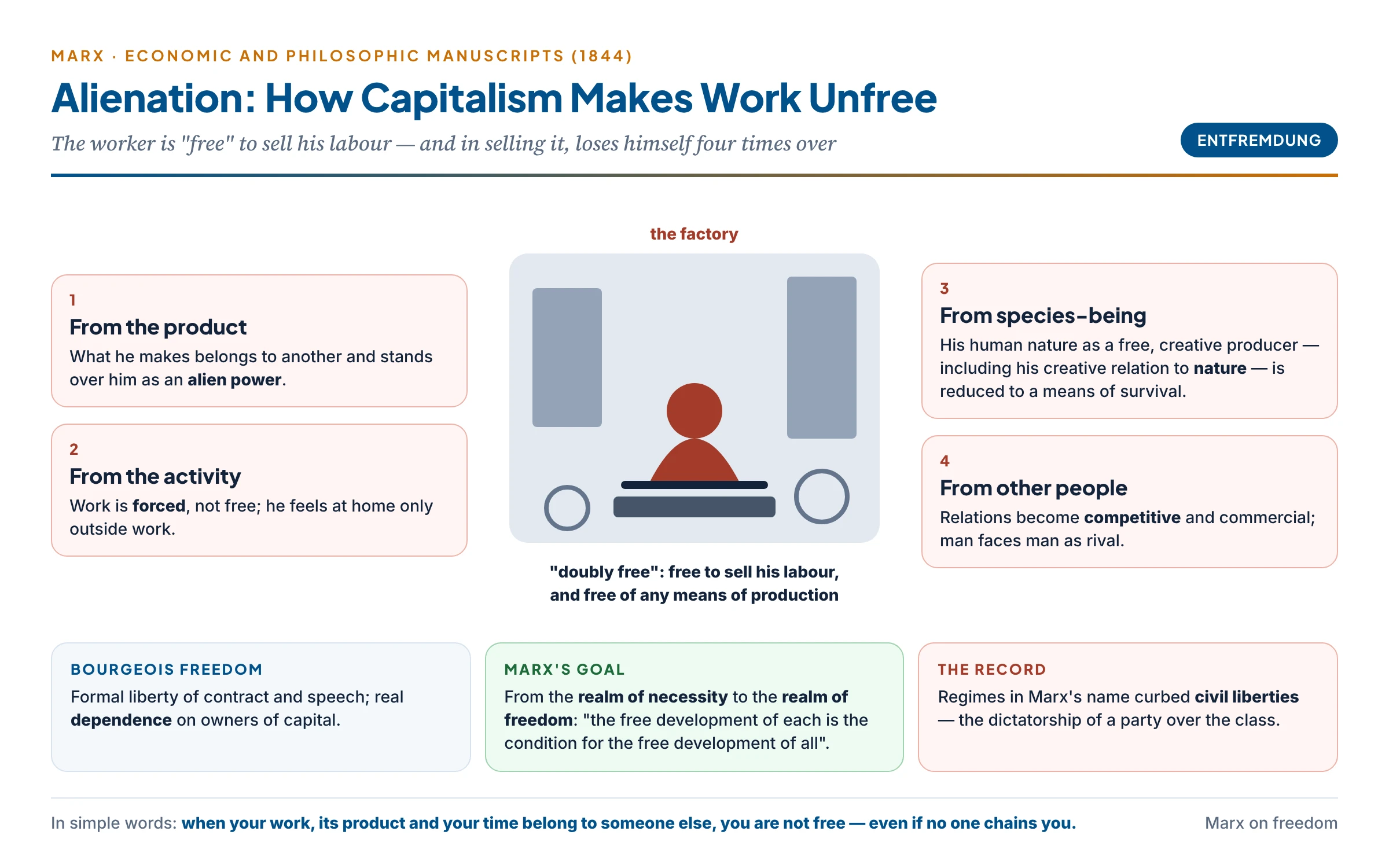
- Bourgeois freedom is formal. Capitalism frees the worker from feudal bonds — but also “frees” him from the means of production. He is “free” in a double sense: free to sell his labour, and free of any property except his labour. He must sell it or starve.
- Alienation. In the Economic and Philosophic Manuscripts (1844), Marx argued that capitalism deforms productive activity, the very essence of human life, and so alienates the worker in four ways:
- From the product of his labour — it belongs to another and stands over him as an alien power.
- From the activity of labour — work is forced, not free; he feels himself only outside work.
- From his species-being — his distinctively human nature as a free, creative, conscious producer (including his creative relation to nature).
- From other human beings — relations become competitive and commercial.
- Freedom requires changing the system. Marxist theory calls for the overthrow of capitalism to secure the conditions of freedom; under communism, the realm of necessity (labour forced by need) gives way to the realm of freedom, where human powers develop as ends in themselves.
- The free development of each. In the Communist Manifesto, the goal is “an association in which the free development of each is the condition for the free development of all“.
- Engels: freedom is the insight into necessity — knowing and controlling the laws of nature and society.
Common confusion
Did Marx name “alienation from nature” as one of his four forms of alienation? Not as a separate form. Many notes list the four forms as alienation from the product, from nature, from other persons and from oneself. Marx’s four are: alienation from the product, from the activity of labour, from species-being (human nature) and from other human beings. Estrangement from nature is part of the third — because, for Marx, human beings realise their species-being by transforming nature creatively; capitalism turns this into forced labour.
Does Marxism Curb Individual Freedom in the Name of Social Justice?
- Yes — the critics’ case:
- Historical record: states calling themselves Marxist — the Soviet Union, Maoist China — suppressed free speech, religion, opposition parties and independent unions; forced collectivisation cost millions of lives.
- The logic of the “dictatorship of the proletariat”: a party claiming to know the true interests of the working class can override what workers actually want — Berlin’s warning about positive liberty.
- Planning and freedom: Hayek argued that central planning requires control over people’s choices of work and consumption — the road to serfdom.
- Class over individual: individuals are treated as members of a class; individual rights are dismissed as “bourgeois”.
- No — the defenders’ case:
- Marx’s aim was the free development of each person; he criticised capitalism precisely for destroying freedom for the majority.
- Formal vs real freedom: freedom of speech and contract mean little to the hungry; social justice is a condition of real freedom.
- Marx vs Marxist-Leninist states: the authoritarian one-party state was a later development (Lenin, Stalin), not Marx’s own teaching; Rosa Luxemburg warned early that “freedom only for the supporters of the government… is no freedom at all”.
- Democratic socialism shows that social justice can be pursued with civil liberties.
- Balanced view. Marx’s goal is freedom; but the means adopted by many Marxist regimes — the vanguard party, abolition of political pluralism, total planning — did curb individual freedom. Social justice and liberty must be pursued together, as in constitutional democracies.
Marcuse: One-Dimensional Man
Herbert Marcuse (One-Dimensional Man, 1964), of the Frankfurt School:
- The paradox. Freedom seems already available in Western society — elections, free press, rising living standards. Yet the individual is deprived of freedom because he has become a slave to technology and consumer capitalism.
- False needs. Advanced industrial society creates false needs — for products, entertainment, status — and satisfies them. Consumer capitalism makes the oppressed insensitive to their real discontent by stimulating trivial, material desires that can be easily satisfied.
- Comfortable unfreedom. “A comfortable, smooth, reasonable, democratic unfreedom prevails in advanced industrial civilisation.” Under the gratification of trivial desires, the genuine urge for freedom disappears; thought and behaviour become one-dimensional — no critical “second dimension” that imagines a different society.
- Technology as control. Technology is not neutral; it becomes a means of social control — organising work, leisure and even thought.
- The remedy. People must first be awakened to arouse their urge for freedom — the “Great Refusal” of the existing order, led by those outside the system (students, the marginalised).
In simple words
A person spends hours each day choosing between a hundred phone models, a thousand shows and endless food-delivery options — and feels very free. Marcuse asks: who created these desires, and why do we never get to choose whether to live this way at all? Being free to choose among products is not the same as being free to shape one’s life.
Macpherson: Creative Freedom and Developmental Power
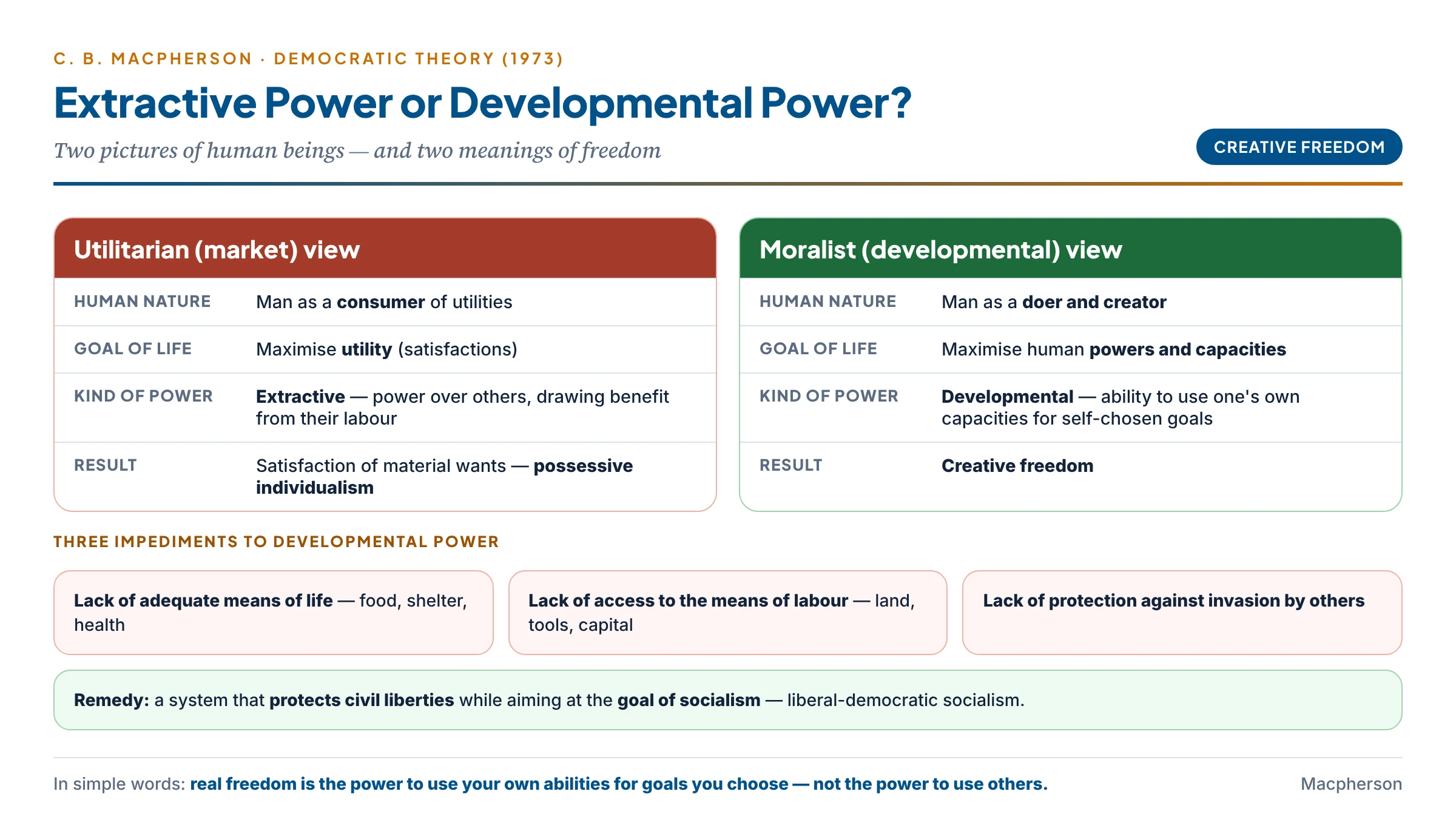
C. B. Macpherson (The Political Theory of Possessive Individualism, 1962; Democratic Theory: Essays in Retrieval, 1973) criticised “possessive individualism” — the liberal view of the individual as the owner of himself, owing nothing to society, and of society as a set of market relations.
| Issue | Utilitarian (market) view | Moralist (developmental) view |
|---|---|---|
| Conception of human nature | Man as a consumer | Man as a doer and creator |
| Goal of human life | Maximisation of utility | Maximisation of powers (capacities) |
| Requisite type of power | Extractive power — power over others, to extract benefit from their labour | Developmental power — ability to use one’s own capacities |
| Consequence of the use of power | Satisfaction of material wants | Creative freedom |
- Developmental power is a person’s ability to use his own capabilities for the fulfilment of his self-appointed goals. Real freedom can be exercised only through developmental power.
- It treats a person as a doer and creator, who should face no constraints while using his capacities to achieve his objectives.
- Three impediments to maximising developmental power:
- Lack of adequate means of life (food, shelter, health).
- Lack of access to the means of labour (land, tools, capital).
- Lack of protection against invasion by others.
In simple words
A gifted carpenter who must work in someone else’s furniture factory, on someone else’s design, for a fixed wage, uses his skill to enrich his employer — that is the employer’s extractive power over him. Give the same carpenter his own tools, a workshop and the chance to design what he wants, and he uses his skill to develop himself — that is developmental power. Macpherson says only the second is real freedom.
- Solution: a new system that protects civil liberties but has the goal of socialism — a liberal-democratic socialism.
Gandhi’s View of Freedom: Swarāj
- Swarāj — “self-rule” — is Gandhi’s word for freedom. It has three dimensions:
- Political — independence from foreign rule.
- Economic and cultural — self-reliance (swadeshi), village industries, freedom from exploitation and cultural imitation.
- Moral — self-control, rule over one’s own passions: “It is swarāj when we learn to rule ourselves” (Hind Swaraj, 1909).
- Moral individualism. Gandhi’s swarāj expresses a firm commitment to moral individualism: the individual is an end in himself, with dignity. It does not close the door to learning from others, but it requires confidence in one’s own potential and decisions.
- Freedom against the state. “Real swarāj will come not by the acquisition of authority by a few but by the acquisition of the capacity by all to resist authority when it is abused.” Increasing the role of the state kills self-dependence.
- Means. Freedom must be won and kept by truth and non-violence; swarāj won by violence would not be true swarāj.
- Freedom to err. Gandhi said that freedom is not worth having if it does not include the freedom to make mistakes.
Indian Connect — Swarāj: inner and outer freedom
Gandhi joined the two sides of freedom that Western thought often separates. Outer swarāj — the nation’s independence, the village’s self-reliance, the citizen’s capacity to resist unjust authority — is negative liberty against domination. Inner swarāj — mastery over greed, fear and anger — is positive liberty as self-mastery. Unlike Berlin’s fear that self-mastery leads to coercion, Gandhi insisted that self-mastery must be self-imposed, never forced; that is why his method was satyagraha, which persuades rather than compels.
Freedom as Development
- Development with dignity. Freedom as development seeks to protect everyone’s dignity and self-esteem while pursuing development — development is measured by how far it enlarges people’s freedom, not only by output.
Amartya Sen: Development-Oriented Freedom
- The capabilities approach champions everybody’s share in development: goods and benefits should be allocated according to the differing capabilities of their beneficiaries.
- Residual abilities. It seeks to identify the residual abilities of each person — a change of outlook from “disabled” to “differently-abled“.
- Freedom as end and means. The main purpose of development is to extend the benefits of freedom to citizens; freedom is both the primary end and the principal means of development (Development as Freedom, 1999).
- Unfreedoms. Sen names social deprivation, political tyranny and cultural authoritarianism as potent impediments to individual freedom; he equates freedom with social justice in a broad sense.
- Two important aspects of human freedom:
- Freedom as the pre-eminent objective of development.
- The effectiveness of different kinds of freedom in reinforcing one another — for example, economic and political freedom (a free press prevents famine; economic opportunity strengthens political voice).
- Criticism. Critics say Sen in practice relies on economic criteria to measure freedom, and that capabilities are hard to list and measure.
Is the Concept of Liberty Realisable in a Modern Technological Society?
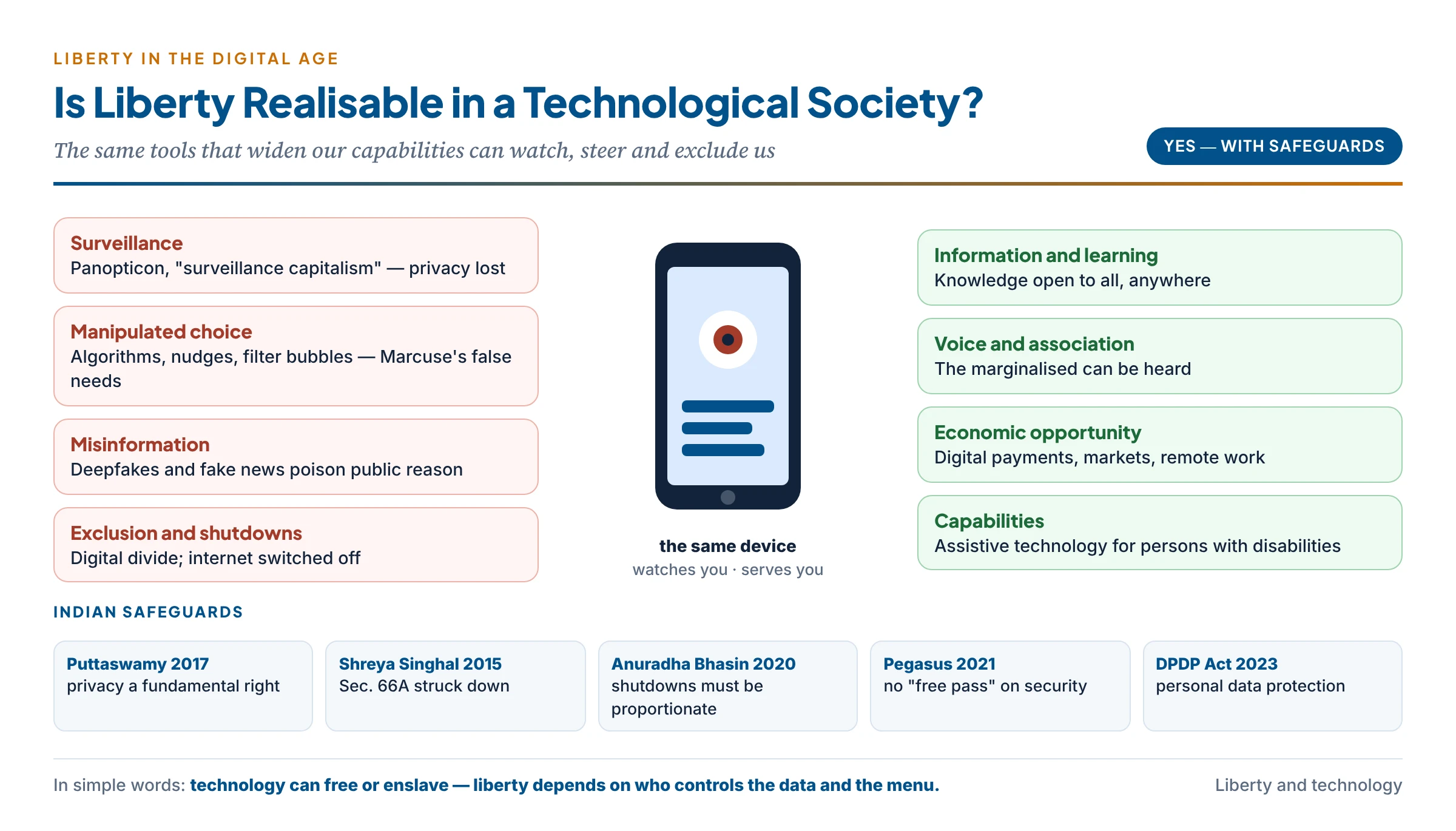
How technology threatens liberty:
- Surveillance. States and companies can watch, record and profile citizens on a scale never before possible — the Panopticon that Michel Foucault described, where people discipline themselves because they might be watched. Shoshana Zuboff calls the business model “surveillance capitalism“.
- Manipulation of choice. Algorithms decide what we see, read and buy; “nudges” and targeted advertising shape desires — Marcuse’s false needs in digital form. Filter bubbles and echo chambers narrow the range of opinions people meet, against Mill’s ideal of free discussion.
- Technological domination. Thinkers such as Jacques Ellul (The Technological Society) and Martin Heidegger argued that technique becomes an autonomous force that organises human life by its own logic of efficiency.
- Misinformation and deepfakes distort the public sphere on which political liberty depends.
- Digital divide. Those without access, skills or devices are excluded from opportunities and services.
- Shutdowns and control. Governments can switch off the internet or block content.
In simple words
A smartphone is like a key that opens a thousand doors — to news, classes, banks, friends and government services. But the same phone also lets others watch which doors you open, when, and for how long — and quietly decides which doors to show you first. Whether the phone makes you freer depends on who controls the record and the menu.
How technology enlarges liberty:
- Access to information and education on an unprecedented scale.
- Communication and association across distances; new forms of civic action.
- Economic opportunity — digital payments, online markets, remote work.
- Voice for the marginalised — people can publicise injustice directly.
- Capabilities — assistive technology widens the freedom of persons with disabilities.
Indian responses:
- Privacy as a fundamental right — K. S. Puttaswamy (2017) held privacy to be part of Article 21.
- Online speech — Shreya Singhal (2015) struck down Section 66A of the IT Act.
- Internet shutdowns — Anuradha Bhasin (2020) required restrictions to be proportionate and orders to be published.
- Spyware — in the Pegasus matter (2021), the Supreme Court appointed an expert committee, saying the state does not get a “free pass” whenever national security is raised.
- Data protection — the Digital Personal Data Protection Act, 2023.
- Verdict. Liberty is realisable in a technological society — but not automatically. It requires legal safeguards (privacy, data protection, transparency of algorithms), democratic control over state surveillance, digital literacy, access for all, and a culture of critical thinking. Technology enlarges positive liberty (capabilities) while threatening negative liberty (privacy, non-interference) and non-domination (Pettit). The task is to keep the tool in human hands. Gandhi’s warning in Hind Swaraj — that people can become slaves of machines — remains relevant.
Freedom as Liberation from Saṃsāra (Mokṣa)
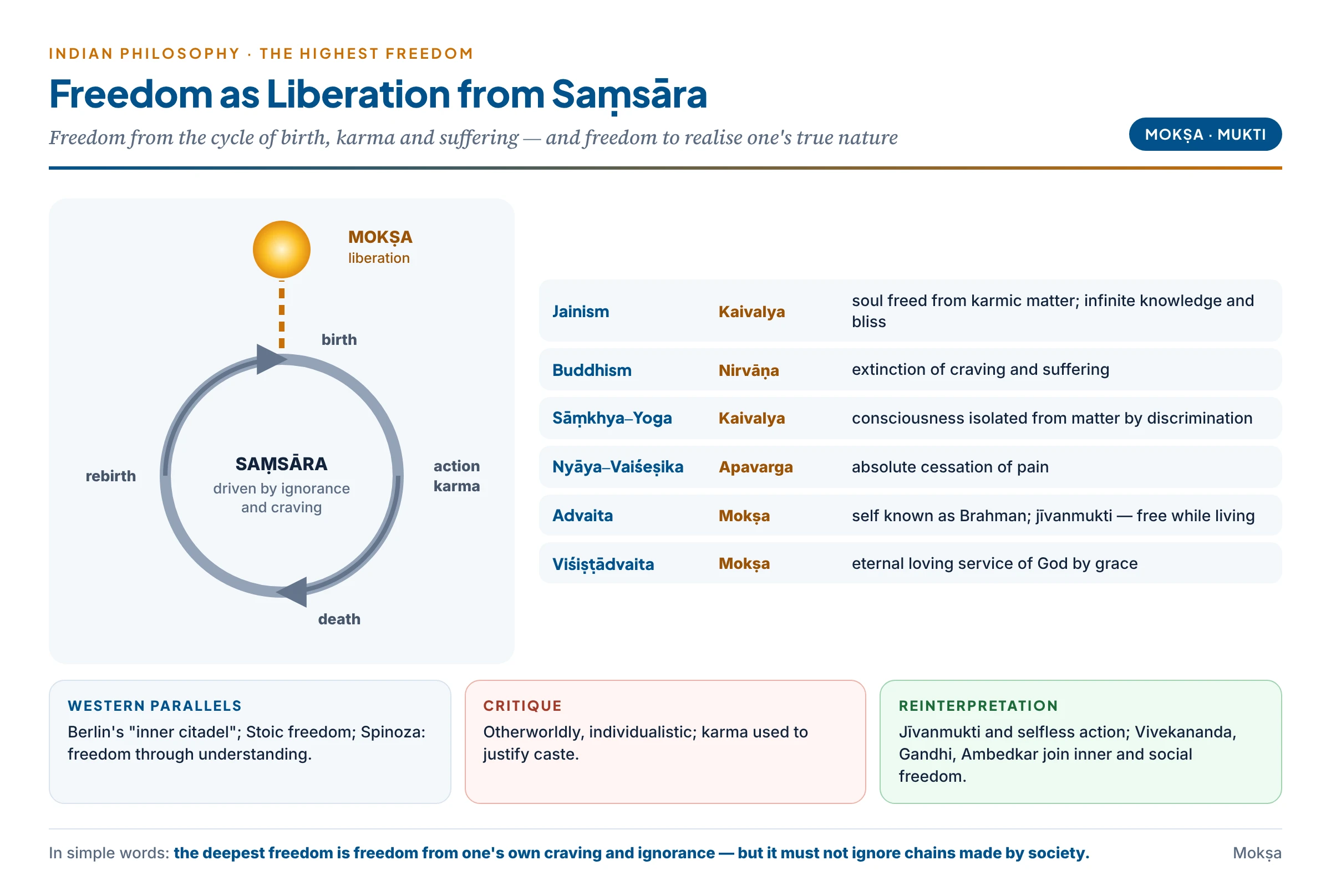
In Indian philosophy, the highest freedom is not political but spiritual: mokṣa or mukti — liberation from saṃsāra, the cycle of birth, death and rebirth driven by karma and ignorance (avidyā).
- Negative aspect: freedom from suffering (duḥkha), from bondage to karma, desire and ignorance.
- Positive aspect: freedom to realise one’s true nature — bliss, knowledge, union with or realisation of the Real.
| School | Name of liberation | What freedom means |
|---|---|---|
| Jainism | Kaivalya | The soul freed from karmic matter regains infinite knowledge, perception, bliss and power |
| Buddhism | Nirvāṇa | Extinction of craving and suffering; no permanent self to be bound |
| Sāṃkhya–Yoga | Kaivalya | Isolation of puruṣa (consciousness) from prakṛti (matter) by discriminating knowledge |
| Nyāya–Vaiśeṣika | Apavarga | Absolute cessation of pain; the self freed of all qualities |
| Advaita Vedānta | Mokṣa (jīvanmukti possible) | Realising the identity of self and Brahman; removal of ignorance — freedom here and now |
| Viśiṣṭādvaita | Mokṣa | Eternal loving service of God, by grace and devotion |
- Comparisons with Western ideas of freedom:
- Berlin’s “retreat to the inner citadel” — freedom by mastering or eliminating desires (Stoics, ascetics) — resembles the ascetic path to mokṣa.
- Spinoza — freedom as understanding necessity and overcoming bondage to the passions — is close to the Indian idea of liberation through knowledge.
- Positive liberty as self-mastery — the “higher self” ruling the “lower self” — has an obvious parallel in the Upaniṣadic and Yogic traditions.
- Criticisms:
- Otherworldly and individualistic — liberation of the individual soul may neglect social and political freedom; Marx would call it consolation for oppression.
- Fatalism — the doctrine of karma has been used to justify social inequality (caste) as the result of past deeds.
- Elitism — in some traditions, only renunciants or the “twice-born” could pursue mokṣa.
- Defence and reinterpretation:
- Inner freedom underpins outer freedom — a person free of greed and fear is less easily dominated; this is the heart of Gandhi’s swarāj.
- Jīvanmukti — liberation while living — means a freed person acts in the world without selfish attachment (niṣkāma karma, the Gītā).
- Modern Indian thinkers joined mokṣa with social service: Vivekananda’s ideal of “one’s own liberation and the welfare of the world“; Aurobindo’s collective spiritual evolution; Ambedkar’s Buddhism as liberation joined to social equality.
- Balanced view. Freedom as liberation from saṃsāra is the deepest form of positive liberty — freedom from internal bondage — but it is incomplete as a social ideal unless joined with freedom from external domination: caste, poverty, injustice.
Critical Evaluation
Conclusion on the Quest for Freedom
- The quest for freedom is continuous; each age discovers new forms of unfreedom — feudal, capitalist, colonial, technological.
- Freedom is sought for individuals, but cannot be achieved by the individual in isolation — it needs society, institutions and solidarity.
- Maximum freedom is possible in a social order where “the free development of each is the condition for the free development of all“.
Critics and Defenders
Criticism — Critics of the radical views
- Marx: Marxist states crushed civil liberty.
- Marcuse: elitist — who decides which needs are “false”?
- Macpherson: socialism with liberty is unproven.
- Gandhi: anti-industrial, impractical.
- Sen: capabilities hard to measure.
- Mokṣa: otherworldly; karma used to justify caste.
Defence — Their lasting insights
- Formal freedom can hide real unfreedom.
- Consumer society can manufacture desires.
- Developmental power: freedom to use one’s capacities.
- Swarāj: inner and outer freedom joined.
- Freedom as development — capabilities.
- Jīvanmukti: freedom expressed in selfless action.
Cross-Tradition Comparison
| Theme | Western critical thought | Indian thought |
|---|---|---|
| Formal vs real freedom | Marx: the worker “free” to starve | Ambedkar: political equality amid social inequality — “a life of contradictions” |
| Manufactured desire | Marcuse: false needs, one-dimensional man | Gītā and Buddhism: craving (tṛṣṇā) as bondage; Gandhi: limit wants |
| Freedom as self-development | Macpherson: developmental power; Sen: capabilities | Swarāj; Aurobindo: the free growth of the individual and the collective |
| Technology | Ellul, Heidegger, Foucault | Gandhi: machinery that enslaves; Tagore’s critique of the “machine” of nationalism |
| Highest freedom | Spinoza, Stoics: inner freedom | Mokṣa, nirvāṇa, kaivalya |
Indian Connect — Freedom, swarāj and mokṣa in modern India
Tilak’s declaration that “Swarāj is my birthright” turned an old spiritual word into a political demand; Gandhi gave it back its moral depth; Ambedkar insisted that political swarāj was hollow without social freedom from caste; and the Constitution’s Preamble promises “liberty of thought, expression, belief, faith and worship”. The Indian idea of freedom thus moves from mokṣa (spiritual liberation) through swarāj (self-rule) to constitutional liberty — each level needing the others.
Synthesis (Siddhānta)
- Beyond the liberal debate, freedom has been rethought as freedom from exploitation (Marx), from manufactured needs (Marcuse), as developmental power (Macpherson), as swarāj (Gandhi), as capabilities (Sen), and as mokṣa — liberation from inner bondage.
- Liberalism and socialism contest freedom because they hold different views of the person, property, state and equality; their best modern forms converge on liberty with social security.
- Marxism’s goal is freedom; but regimes in its name curbed individual freedom — social justice and civil liberty must go together.
- Technology both enlarges and endangers liberty; liberty in the digital age needs privacy, data protection, democratic oversight and access for all.
- Mokṣa reminds us that the deepest freedom is inner; modern Indian thought insists that inner freedom must be joined with freedom from social domination.
Previous Year Questions
- 2020Is the concept of liberty realizable in the modern technological society? Explain.
- 2017Does Marxism curb individual freedom in the name of protecting social justice? Discuss.
- 2004Despite their self-proclaimed commitment to the ideal of individual freedom, this ideal is one of the most contentious issues between socialism and liberalism. Why? Discuss.
- 2003Critically examine – “Freedom as liberation from samsara.”