

Sovereignty: Austin, Bodin, Laski, Kautilya.
Official Syllabus: Paper II, Section A, Unit 2
Sovereignty has two faces. Article 5 studied the inner face of Kautilya’s state — the seven limbs and the king who heads them. This article studies the outer face: how a sovereign state survives, grows and keeps its independence among other states. Kautilya’s answer is the Rājamaṇḍala — the circle of kings — a map of friends, enemies, middle powers and neutrals arranged around an ambitious king, the vijigīṣu (the would-be conqueror). From this map follow the six-fold policy (ṣāḍguṇya), the four means (upāyas), the three powers (śaktis), the theory of conquest, and a detailed science of diplomacy and espionage. It is the oldest systematic theory of international relations in the world, and its core idea — that friendship and enmity among states follow geography and interest, not sentiment — is the origin of the popular line “there is no permanent friend or permanent enemy“. This article covers the maṇḍala and its twelve kings, the kinds of enemies and allies, the three powers, the six policies, the four means, the kinds of conquest, envoys and spies, the importance of the Rājamaṇḍala in the context of sovereignty, the meaning of “no permanent friend or enemy“, and the theory’s relevance for India’s foreign policy today.
In simple words
Think of farmers whose fields lie in a row. Your immediate neighbour wants the same water channel and the same boundary strip — he is your natural rival. But his neighbour on the other side has the same quarrel with him, so that farmer is your natural friend: together you can keep the rival in check. A farmer far away, with no shared boundary, is simply neutral. Kautilya’s maṇḍala is this village logic applied to kingdoms.
Context & Problem
External Sovereignty in Kautilya’s World
- Many states. Ancient India was a world of many kingdoms and republics (saṅghas), often at war; Alexander’s invasion had shown the danger of disunity. The Mauryan state that Kautilya helped to found grew by conquest and alliance into an empire.
- The question. How can a state preserve its independence — its external sovereignty — and, if possible, expand it, in a crowded neighbourhood of rivals?
- The ally as a limb of the state. Kautilya had already made the ally (mitra) one of the seven elements of the state; inter-state relations are part of the state’s very constitution.
- An old idea made systematic. There are hints of a circle of states in Vedic literature and the epics, and Manu spoke of a circle of kings; but it was Kautilya who presented the total and comprehensive picture of the maṇḍala and its place in statecraft.
- The vijigīṣu. The theory is written from the point of view of the vijigīṣu — a king who aspires to become the supreme, undisputed ruler (cakravartin). He is advised to subdue the surrounding states at the right moment, while keeping a balance of power among the kings of the circle, and to remember that he is himself encircled by a variety of relationships — from indifference to alliance to open hostility.
The Basic Assumptions of the Maṇḍala
- No state exists in isolation. Every state is surrounded by others and affected by them.
- Geography shapes relations. A state’s position relative to the conqueror largely decides whether it is a natural enemy or a natural friend.
- Self-interest drives states. Kings act to increase their own power and prosperity; alliances last as long as they serve both sides.
- There are no permanent friends or foes. As power and position change, today’s friend can become tomorrow’s enemy.
- Power must be balanced. The weak combine against the strong; the wise king prevents any rival from becoming overwhelming.
- Power is the means, welfare the end. “Strength is power; happiness is the end.” The aim of all foreign policy is the security and prosperity of one’s own state.
Core Doctrine
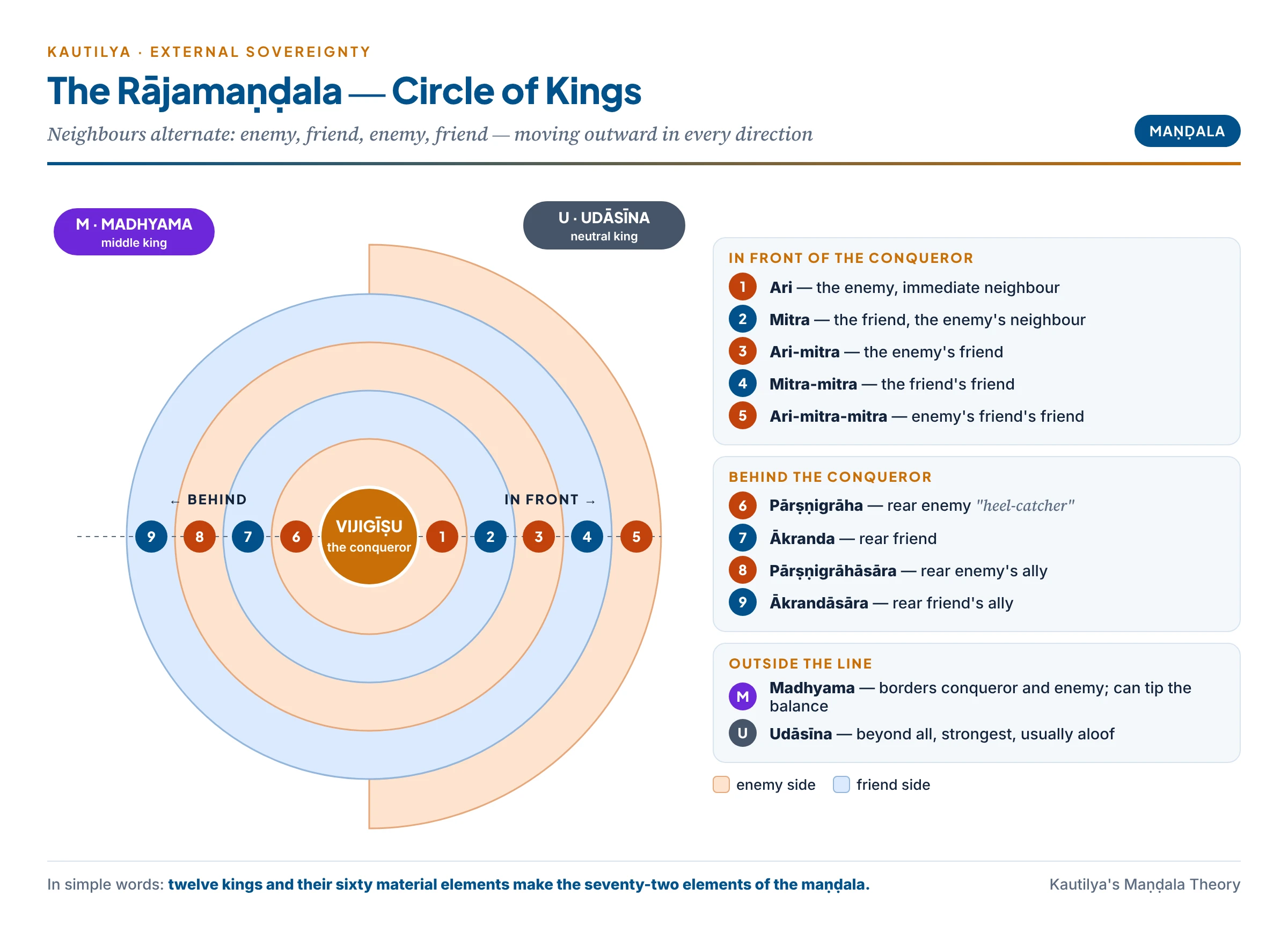
The Circle of Kings: The Twelve States
“The king who is situated anywhere immediately on the circumference of the conqueror’s territory is termed the enemy; the king who is likewise situated close to the enemy, but separated from the conqueror only by the enemy, is termed the friend.” — Kautilya
In front of the conqueror (moving outward):
- Vijigīṣu — the conqueror, at the centre.
- Ari — the enemy, the immediate neighbour.
- Mitra — the friend, the enemy’s neighbour.
- Ari-mitra — the enemy’s friend, beyond the friend.
- Mitra-mitra — the friend’s friend.
- Ari-mitra-mitra — the enemy’s friend’s friend.
Behind the conqueror (in the rear):
- Pārṣṇigrāha — the enemy in the rear, literally “the heel-catcher”: the neighbour behind who will attack when the conqueror marches out.
- Ākranda — the friend in the rear, literally “one who answers the cry for help”.
- Pārṣṇigrāhāsāra — the ally of the rear enemy.
- Ākrandāsāra — the ally of the rear friend.
Outside the line:
- Madhyama — the middle king: bordering both the conqueror and the enemy, and strong enough to help or resist either of them separately (but not both together). His goodwill can decide the contest.
- Udāsīna — the neutral king: situated beyond the others and more powerful than the conqueror, the enemy and the middle king, able to help or resist any of them — usually staying indifferent.
- The pattern: neighbours alternate — enemy, friend, enemy, friend — as one moves outward from the conqueror in any direction. A neighbour’s neighbour is a natural ally, because both share a common rival.
- Seventy-two elements. Each of the twelve kings has five material elements of state (minister, territory, fort, treasury, army). Twelve kings plus sixty material elements give the seventy-two elements of the maṇḍala — the whole system of inter-state power.
- Four circles. The same twelve kings can be grouped into four circles of three: the conqueror with his friend and friend’s friend; the enemy with his friend and friend’s friend; the middle king with his friend and friend’s friend; and the neutral king with his friend and friend’s friend.
Common confusion
Is the “maṇḍala theory” about a strong king, a good bureaucracy, a secure capital and a strong army? No — some notes mix up two theories. Those are the elements of the Saptāṅga theory, which explains the internal structure of the state (Article 5). The maṇḍala theory explains the external relations among states — enemies, friends, the middle and neutral kings — and the policies for dealing with them. The two are linked: each king in the circle has his own seven elements, and the ally (mitra) appears in both.
Kinds of Enemies and Allies
- Enemies:
- The natural enemy (prakṛti-amitra) — the immediate neighbour, whose position makes rivalry almost inevitable.
- The enemy by birth (sahaja) — a rival of the same family or lineage, such as a cousin with a claim to the throne.
- The enemy made by circumstance (kṛtrima) — one who has become hostile through injury or conflict.
- Neighbours by inclination. A neighbour may be hostile, friendly or subservient in intention; policy must read this inclination, not only the map.
- Allies: a natural ally (sahaja), bound by position or kinship, and an acquired ally (kṛtrima), won by protection or benefit. The best ally is hereditary, constant, dependable, not likely to turn hostile, capable of great help and quick to help.
- The ethical ally. Only a man of virtue can be a true friend; a greedy, unjust neighbour is likely to become an enemy. Friendship is not only a matter of advantage.
The Three Powers and the Three Conditions
- Three powers (śaktis):
- Mantra-śakti — the power of counsel: knowledge, intelligence, good advice and diplomacy. Kautilya ranks it highest.
- Prabhu-śakti — the power of might: the treasury and the army.
- Utsāha-śakti — the power of energy: the drive, courage and leadership of the king.
- Comparing kings. A king who has more of these powers is superior; less, inferior; the same, equal. Policy depends on this comparison.
- Three conditions of a state: advancement (vṛddhi), stagnation (sthāna) and decline (kṣaya). The aim of policy is to move one’s own state towards advancement and, where possible, push the enemy towards decline.
- The goal. Attain power and success, or at least deny them to the enemy.
In simple words
A school’s annual sports championship is won by the house with the best coach (counsel), the best equipment and players (might) and the most spirit (energy). A house with a brilliant coach but weak players chooses its events carefully; a house with strong players but no plan wastes them. Kautilya’s three powers are the same: brains, resources and will — and brains count most.
Ṣāḍguṇya: The Six-fold Policy
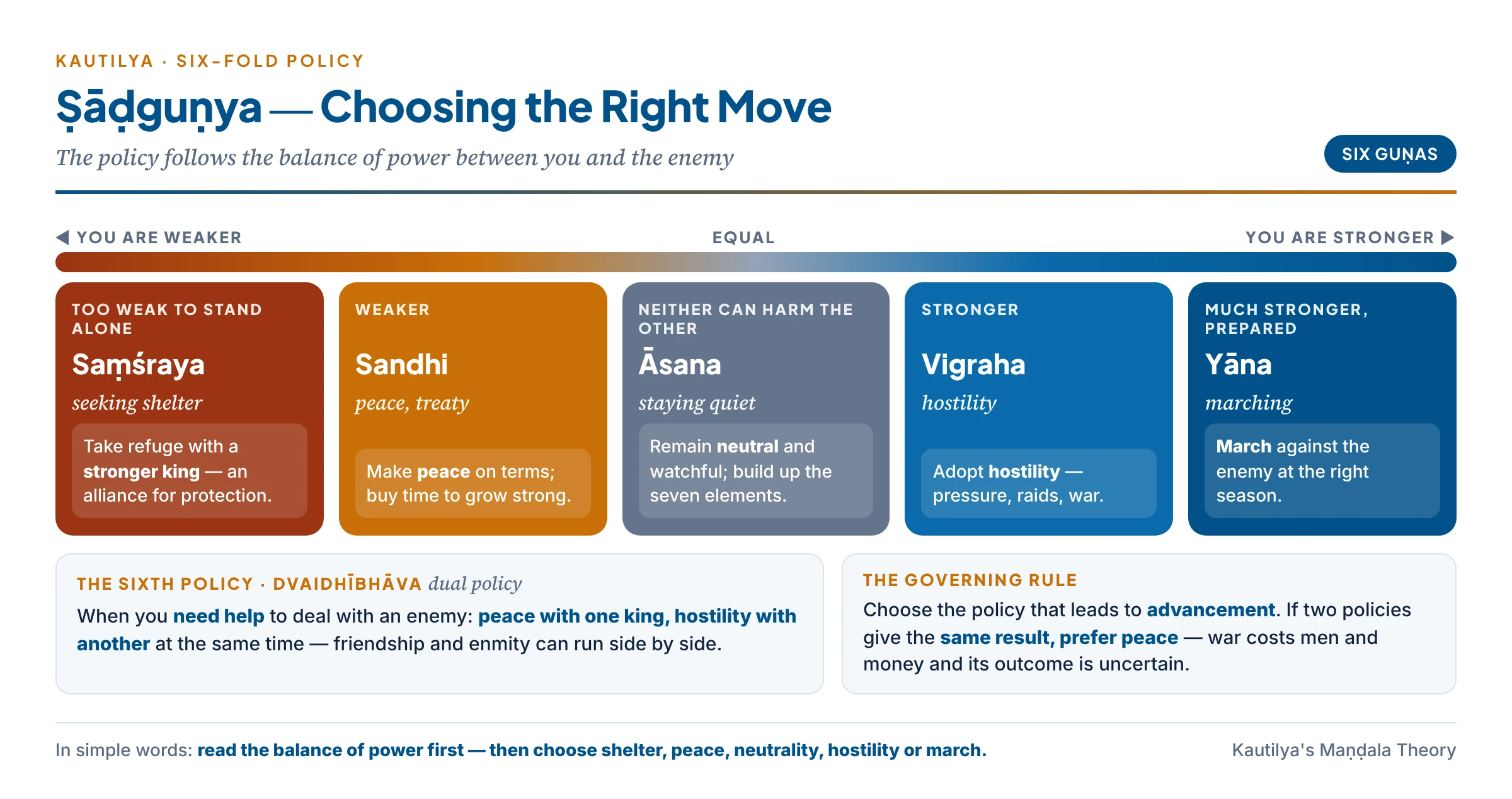
The maṇḍala tells the king where he stands; the six-fold policy tells him what to do. Each policy suits a particular balance of power.
| Policy | Meaning | When to use it |
|---|---|---|
| Sandhi | Peace, treaty | When one is weaker than the enemy |
| Vigraha | Hostility, war | When one is stronger |
| Āsana | Staying quiet, neutrality | When neither can harm the other |
| Yāna | Marching, preparing to attack | When one is much stronger and well prepared |
| Saṃśraya | Seeking shelter, alliance with a stronger king | When one is too weak to defend oneself |
| Dvaidhībhāva | Dual policy — peace with one, war with another | When one needs help to deal with an enemy |
In simple words
A cricket captain reads the scoreboard before choosing his approach. Chasing a small target with wickets in hand, he attacks (vigraha, yāna); with wickets falling, he blocks and waits (āsana); when the match is lost, he plays for a draw (sandhi); a weak team may even borrow a strong player from elsewhere (saṃśraya). The six-fold policy is the same habit — read the balance first, then choose the move.
- The governing rule: choose the policy that leads to advancement; if two policies give the same result, prefer peace, because war brings loss of men and money and uncertain results.
- Modern comparisons that analysts often draw: non-alignment and strategic autonomy as forms of āsana; military mobilisation on a border as yāna; alliances such as NATO as saṃśraya; and “cooperation despite competition” between rival powers as dvaidhībhāva.
The Four Means (Upāyas) and the Forms of Force
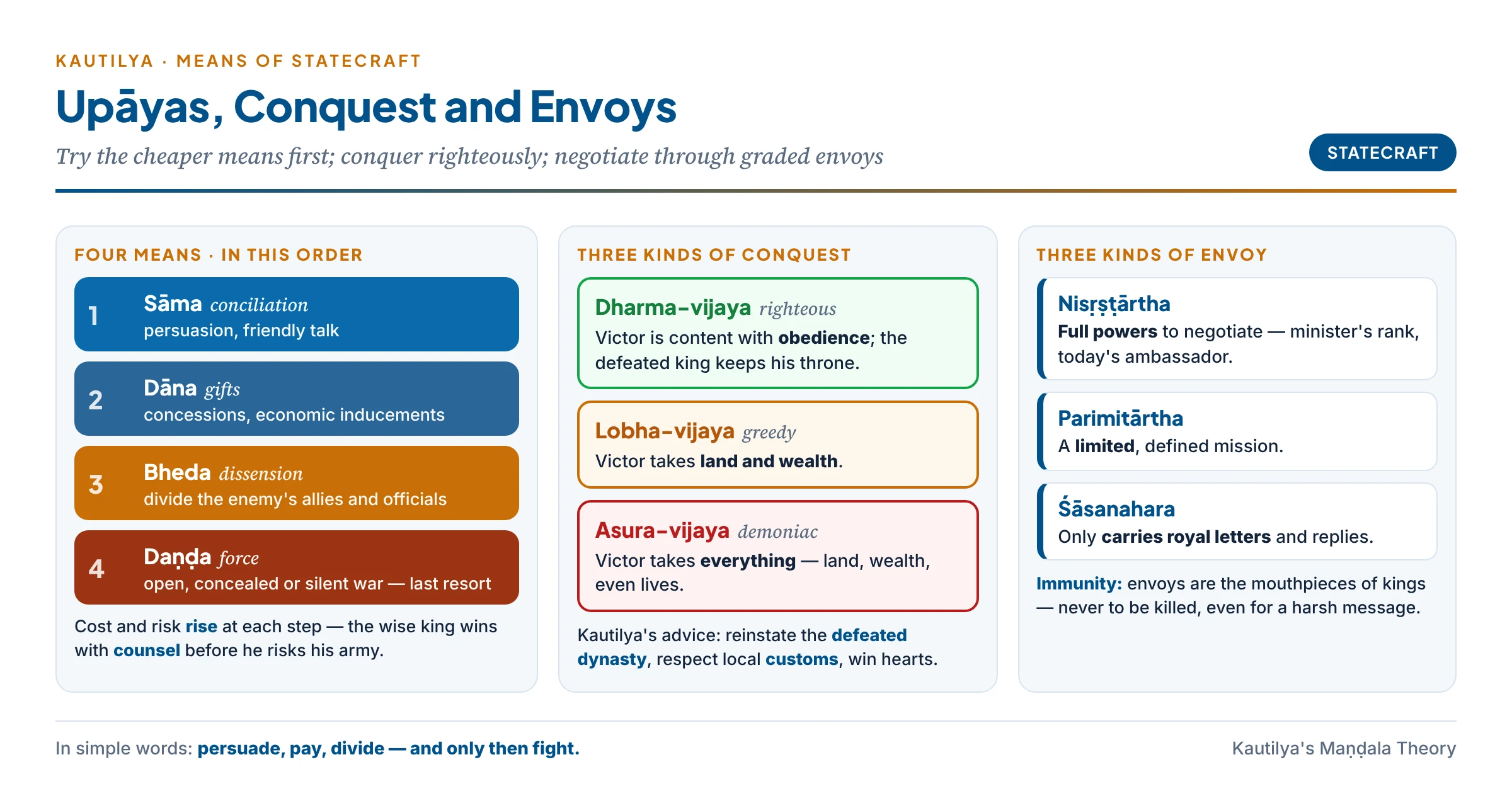
- Four means of dealing with other states, to be used in this order:
- Sāma — conciliation, persuasion, friendly talk.
- Dāna — gifts, concessions, economic inducements.
- Bheda — sowing dissension, dividing the enemy’s allies and officials.
- Daṇḍa — force, including coercion and sanctions — used only when the first three fail.
- Daṇḍa is more than battle. Effective pressure on an enemy — physical, economic or moral — is also daṇḍa.
- Kinds of war:
- Open war (prakāśa-yuddha) — fighting at an agreed time and place.
- Concealed war (kūṭa-yuddha) — surprise attacks, ambushes, treachery in battle.
- Silent war (tūṣṇīm-yuddha) — secret conspiracy, assassination of key enemy figures, subversion through agents — what we would today call covert action.
- Kautilya also lists capturing the enemy in the confusion caused by the fall of his fort.
- Prefer the cheaper means. A wise king wins with counsel and diplomacy before he risks his army.
Conquest and the Treatment of the Conquered
- Three kinds of conquest:
- Dharma-vijaya — righteous conquest: the victor is satisfied with the obedience of the defeated king and leaves him on his throne.
- Lobha-vijaya — conquest from greed: the victor takes land and wealth.
- Asura-vijaya — demoniac conquest: the victor seizes everything, even the lives of the defeated, and slaughters their people.
- Kautilya’s advice on the conquered.
- He rejected the old practice of making captives of the defeated king’s wives and sons.
- The conqueror should, where possible, place a member of the defeated dynasty on the throne and treat the defeated princes kindly.
- He should respect the customs, religion and festivals of the conquered people, reward their leaders and win their hearts — a conquered land is held by goodwill, not by force alone.
- Whom to attack. If the choice is between a strong but unjust king and a weak but just one, attack the unjust one — his own subjects will not help him. A king whose enemy is struck by calamity — epidemic, famine, disaffection — has his best opportunity.
- Advice to the weak. A weak king should seek refuge with a stronger one, or combine with kings of equal strength against the aggressor, or, failing that, with several smaller but energetic kings.
Envoys and Diplomacy
- Qualities of the envoy (dūta). Of noble family, well-versed in all the sciences, with an excellent memory, tact, and the ability to read facial expressions and gestures; above all, loyal and incorruptible.
- Three kinds of envoy:
- Nisṛṣṭārtha — an envoy with full powers to negotiate, of a minister’s rank — the ambassador of today.
- Parimitārtha — an envoy with a limited, defined mission.
- Śāsanahara — a messenger who only carries royal letters and brings back replies.
- Duties of the envoy: transmitting messages; maintaining treaties; issuing ultimatums; winning friends; creating intrigue and sowing dissension among the enemy’s friends; gathering information on the enemy’s forts, treasury, army and weak points; winning over discontented officials; reporting in cipher. The embassy was also a centre of espionage.
- Diplomatic immunity. “Envoys are the mouthpieces of kings”; even if the message is harsh, the envoy must not be killed or imprisoned, so long as he carries out his duty properly. This convention was already well established in Kautilya’s time.
- Spies. Kautilya describes an elaborate secret service: spies disguised as ascetics, merchants, students, householders and entertainers; reports confirmed only when three independent spies agree; spies lulling the enemy into a false sense of security before a surprise attack.
Common confusion
Did Kautilya divide envoys into four categories? Some notes list four. The Arthaśāstra names three: the envoy with full powers (nisṛṣṭārtha), the envoy with a limited mission (parimitārtha) and the bearer of royal letters (śāsanahara). The confusion comes from listing the ordinary spies or messengers attached to embassies as a fourth class.
The Importance of the Rājamaṇḍala in the Context of Sovereignty
- It defines external sovereignty in practice. For Kautilya, independence is not a legal title granted by others but a capacity that must be kept up — through alliances, balance of power and the right policy at the right time.
- It links inner and outer sovereignty. A state’s place in the circle depends on its seven elements; each king in the circle has his own seven limbs. Internal strength (counsel, treasury, army, people) decides external success.
- It recognises a system of sovereign states. The maṇḍala assumes many independent kings who deal with each other through treaties, envoys and wars — an early states-system, with rules such as envoy immunity. It recognises the independence and interests of other states while safeguarding one’s own.
- It teaches the limits of sovereignty. No king is free to do as he likes abroad: geography, rivals, the middle and neutral kings, and the need for allies constrain him. External sovereignty is always exercised within a balance of power.
- It aims at security and expansion. The vijigīṣu seeks to become the supreme ruler — an imperial idea of sovereignty — but the theory equally teaches a weaker king how to survive through alliances and shelter.
- It gives the ally a constitutional place. By making the mitra a limb of the state, Kautilya shows that a sovereign state’s security depends on partnerships as much as on its own army.
- It is realistic but not lawless. Righteous conquest, respect for the conquered and protection of envoys show norms within the competition — a kind of early international law.
“There Is No Permanent Friend or Permanent Enemy”
- What the line means in Kautilya’s terms. Friendship and enmity among states are positional and conditional: they follow geography (the neighbour is the natural rival), interest (alliances last while they serve both) and power (as the balance shifts, roles change). Kautilya advises a king to break an alliance that later proves disadvantageous, and to make peace with an enemy when weakness requires it.
- How the roles change. A friend who grows too powerful may become a threat; an enemy whose own rear is attacked may need your help; the middle king may join either side; even the neutral king may intervene.
- Dvaidhībhāva — friendship with one state and hostility to another at the same time — shows how flexible relations can be.
- But not pure cynicism. Kautilya also praises the hereditary, constant ally and says a true friend is a person of virtue. Interest decides relations among states, but dharma, trust and long friendship still have weight.
In simple words
In a school class, two students who sit at the same desk often quarrel over space and marks; each finds a natural friend in the student on the far side of the other. When seats are changed next term, the old rivals may become friends and the friends rivals. Nothing in their characters changed — only their positions and interests. This is the maṇḍala’s lesson for states.
Common confusion
Are the words “no permanent friends, no permanent enemies” Kautilya’s own? The words are usually traced to the British statesman Lord Palmerston, who told the House of Commons in 1848: “We have no eternal allies, and we have no perpetual enemies. Our interests are eternal and perpetual, and those interests it is our duty to follow.” The idea, however, is thoroughly Kautilyan: the maṇḍala makes friendship and enmity depend on position and interest, some two thousand years before Palmerston.
Illustrations from modern history and India’s experience:
- Shifting partners. Powers that were enemies in one war have been allies in the next; Cold War rivals have become partners on some issues and rivals on others.
- India’s own path. India moved from non-alignment to close ties with the Soviet Union (the 1971 treaty), then to a strategic partnership with the United States after 2005, while keeping its old relationship with Russia — and today it works with the Quad on the Indo-Pacific while sitting in BRICS and the SCO. This multi-alignment is maṇḍala logic: partnerships chosen by interest, issue by issue.
- The enemy’s friend. The close China–Pakistan partnership is a textbook case of the ari-mitra — the enemy’s friend — that Kautilya told the conqueror to watch; India’s ties with countries on the far side of its rivals echo the friend-beyond-the-enemy.
- Cooperation despite competition. India and China compete on the border and in the region, yet cooperate in trade and in groupings such as BRICS — a modern dvaidhībhāva.
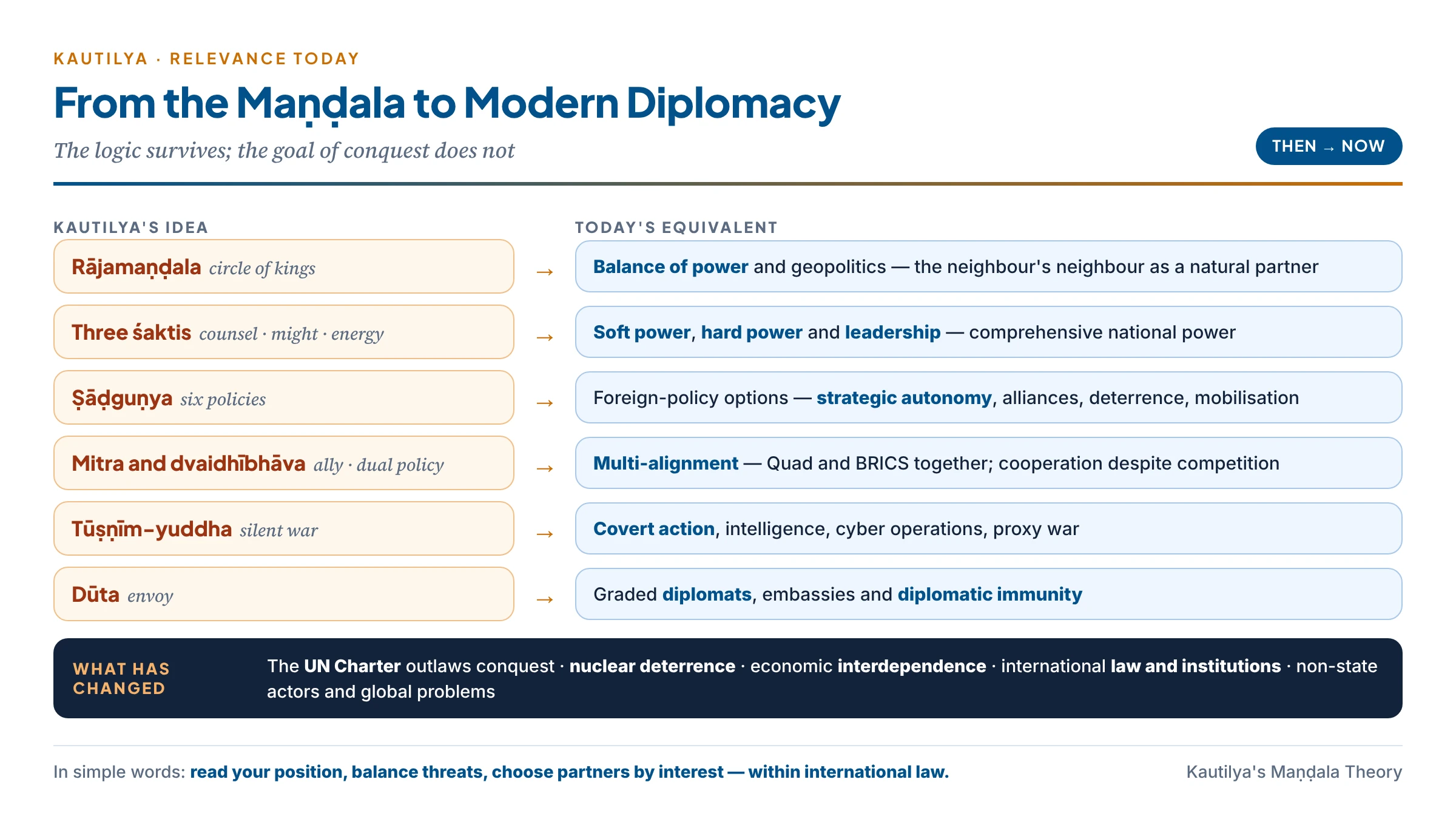
Relevance of the Maṇḍala Today
What remains relevant:
- Realism. Kautilya anticipated the realist school of international relations: states pursue power and security, act on interest and must balance against threats.
- Balance of power and geopolitics. The maṇḍala is an early theory of the balance of power and of how geography shapes strategy.
- Hard and soft power. The three śaktis — counsel, might and energy — resemble the modern distinction between soft power (diplomacy, attraction) and hard power (economy and military), with leadership added.
- Comprehensive national power. The seven elements of state are a fuller measure of a state’s strength than army size alone.
- Intelligence and covert action. Kautilya’s secret service and “silent war” foreshadow modern intelligence agencies, information warfare, cyber-attacks and proxy wars.
- Diplomacy. Envoys with graded powers, immunity and the embassy as an information centre are now standard practice.
- India’s strategic thinking. Policies such as Neighbourhood First and Act East — circles of priority radiating out from India — and the stress on strategic autonomy carry a Kautilyan flavour; the Indian Army’s Project Udbhav (launched October 2023) studies the Arthaśāstra to develop an indigenous strategic vocabulary.
What has changed:
- Conquest is outlawed. The UN Charter forbids the threat or use of force against the territorial integrity of any state; the vijigīṣu’s ambition of conquest is no longer legitimate.
- Nuclear weapons make war between major powers catastrophic, so deterrence replaces conquest.
- Economic interdependence binds rivals together; trade partners are not simply “friends” or “enemies”.
- International law and institutions — the UN, WTO, international courts — add rules Kautilya never knew.
- Non-state actors — terrorist networks, corporations, NGOs — and global problems (climate change, pandemics) cannot be handled through a circle of kings.
- Geography matters less in an age of air power, missiles, cyber-space and global markets.
Verdict: The logic of the maṇḍala — read your position, know your powers, balance against threats, choose partners by interest, prefer cheaper means to war — remains a powerful tool for foreign policy. Its goal of conquest does not. Applied within the limits of international law and cooperation, it supports strategic autonomy and prudent diplomacy rather than expansion.
Critical Evaluation
Criticisms
- Amoral realism. Deceit, assassination, sowing dissension and breaking treaties are permitted; Weber thought Kautilya more ruthless than Machiavelli.
- Expansionism. The vijigīṣu’s aim of conquest makes permanent peace impossible and every neighbour a target.
- Geographical determinism. Treating the neighbour as a “natural enemy” can become a self-fulfilling prophecy and ignores shared interests, culture and trade.
- Zero-sum thinking. One state’s gain is assumed to be another’s loss; cooperation for common goods is neglected.
- Outdated in parts. Kingdoms, forts and armies of elephants belong to another world; modern states face problems the maṇḍala never imagined.
- No international authority. Like Austin, Kautilya recognises no law above sovereign states, only treaties that may be broken when they cease to be useful.
Replies
- Ethics within strategy. Righteous conquest, kindness to the defeated, respect for local customs and immunity of envoys show norms inside the competition.
- Peace preferred. Where results are equal, Kautilya chooses peace; force comes last among the four means.
- Defensive value. The theory equally teaches small and weak states how to survive — by alliance, shelter and balance.
- Realism, not cynicism. Kautilya describes how states actually behave so that his own state can protect its people; the end remains welfare.
- Enduring insight. Balance of power, comprehensive national power and multi-alignment are still the language of foreign policy.
Critics and Defenders
Criticism — Critics
- Moralists and Weber: a doctrine of reason of state without moral limits.
- Liberal internationalists: ignores cooperation, institutions and international law.
- Pacifists and Gandhians: treats war and deceit as normal tools of policy.
- Modern strategists: geography-based friendship and enmity fit poorly in a world of nuclear deterrence and economic interdependence.
Defence — Defenders and strengths
- Realists: the first clear theory of balance of power and interest-based alliances.
- Strategists: the three powers, six policies and four means are a complete toolkit for decision-making.
- Diplomats: envoy grades, immunity and intelligence anticipate modern practice.
- Indian strategic thinkers: a source of indigenous concepts for strategic autonomy and neighbourhood policy.
Cross-Tradition Comparison
| Point | Kautilya (maṇḍala) | Machiavelli | Hobbes | Modern realism (Morgenthau) | Grotius (international law) |
|---|---|---|---|---|---|
| State of the world | Circle of rival and allied kings | Shifting Italian states and foreign powers | States in a state of nature with each other | Anarchy — no world government | A society of states bound by law |
| Driving force | Power and prosperity of one’s own state | Survival and glory of the prince | Fear and security | National interest defined as power | Natural law and agreement |
| Alliances | By position and interest; no permanent friends | Expedient | Not developed | Balance of power | Treaties must be kept |
| Means | Six policies, four upāyas, spies, envoys | Force and cunning | — | Diplomacy and military power | Law, negotiation, just war |
| Ethics | Strategy within dharma; righteous conquest | Separated from ordinary morality | Morality depends on the sovereign | Prudence as the supreme virtue | Moral and legal limits on war |
Indian Connect — Key takeaways
- The maṇḍala is the world’s first systematic theory of international relations, two thousand years before European realism.
- Its stress on position, interest and balance is shared with modern realism; its concern for dharma, righteous conquest and envoy immunity shows norms that realism often ignores.
- India’s foreign policy — from non-alignment to strategic autonomy and multi-alignment — is often read as a continuation of this Kautilyan strategic culture.
Synthesis (Siddhānta)
- The core insight. External sovereignty is not a fixed legal possession but a position to be maintained in a circle of states. Friends and enemies are defined by geography and interest; power must be measured, balanced and used through the right policy at the right time.
- The bridge between the two faces of sovereignty. The maṇḍala depends on the Saptāṅga: a state with a wise king, loyal ministers, a prosperous people, a full treasury and a disciplined army can choose its policy; a weak state must seek shelter.
- Realism with restraint. Kautilya permits harsh methods, but he prefers peace when results are equal, uses force last, protects envoys and treats the conquered with kindness. Realism serves the welfare of the people, not glory for its own sake.
- Contemporary relevance.
- No permanent friends or enemies — multi-alignment and issue-based partnerships are the norm of today’s diplomacy.
- Balance of power in the Indo-Pacific and India’s neighbourhood follows maṇḍala logic.
- Comprehensive national power — economy, technology, institutions and alliances matter as much as armies.
- The limit — the UN Charter, nuclear deterrence and global problems require cooperation that the circle of kings never envisaged.
“Strength is power; happiness is the end.” — Kautilya
Previous Year Questions
- 2026Evaluate the importance of Kautilya’s theory of Rajamandala in the context of sovereignty.
- 2025“There is no permanent friend or permanent enemy.” Discuss this statement in the light of Kautilya’s view on Sovereignty.
- 2024What insights does the Arthaśāstra offer with regard to the concept of sovereignty? Does it have any relevance in the modern times? Critically discuss.