

Religious Pluralism: Religious Pluralism and the Problem of Absolute Truth.
Official Syllabus: Paper II, Section B, Unit 9
John Hick (1922–2012) gave the most complete philosophical defence of religious pluralism — the view that the great world religions are different but equally authentic human responses to one and the same ultimate divine reality, which he called “the Real”. Exclusivism says only one religion is true; inclusivism says one religion has the full truth while others share in it partly. Hick asked a bolder question: what if no religion stands at the centre, and all of them revolve around a Reality that none of them fully captures? His answer — a “Copernican revolution” in theology, built on Kant’s distinction between things as they are in themselves and things as they appear to us — is the main philosophical attempt to solve the problem of conflicting truth claims while keeping the idea of one Absolute Truth. This article explains the hypothesis step by step, Hick’s treatment of the conflicting claims, a milder rival called aspectual pluralism, and the strong objections that have been raised against both.
In simple words
Imagine a mountain whose peak is always hidden in cloud. Climbers start from different valleys — one from the north, one from the south, one from the east. Each climber describes the mountain as he sees it from his own path: one sees snowfields, another sees forests, a third sees bare rock. Their descriptions contradict each other, yet they are all on the same mountain, and nobody has seen the summit itself. Hick says religions are like these climbers: their pictures of God differ because their paths and cultures differ, but they are all climbing towards the same hidden summit — the Real.
Context & Problem
Why Hick Turned to Pluralism
- From exclusivist to pluralist. Hick began as a conservative evangelical Christian. In the 1960s–70s he worked in Birmingham, a city with large Muslim, Sikh, Hindu and Jewish communities. Visiting mosques, gurdwaras, temples and synagogues, he found the same kind of devotion, prayer and moral goodness that he knew in churches. It seemed impossible to believe that God was present only in the church.
- The problem of birthplace. Hick put the problem concretely: if I had been born in India, I would probably be a Hindu; in Egypt, a Muslim; in Sri Lanka, a Buddhist; born in England, I am predictably a Christian. A person’s religion depends very largely on the accident of birth. Can salvation really depend on such an accident?
- The sceptical threat. Religions seem to say incompatible things — Is the Ultimate personal or non-personal? Does God become incarnate? Are we reborn again and again? Is the Bible, the Qur’an or the Gītā the Word of God? David Hume turned this into an argument against all religions: “in matters of religion, whatever is different is contrary“; the miracles claimed by each religion support it and so cancel the miracles of every rival. It is a short step from “they cannot all be true” to “probably none of them is true“. Hick wanted an answer that avoided both exclusivism and this total scepticism.
The Copernican Revolution (1973)
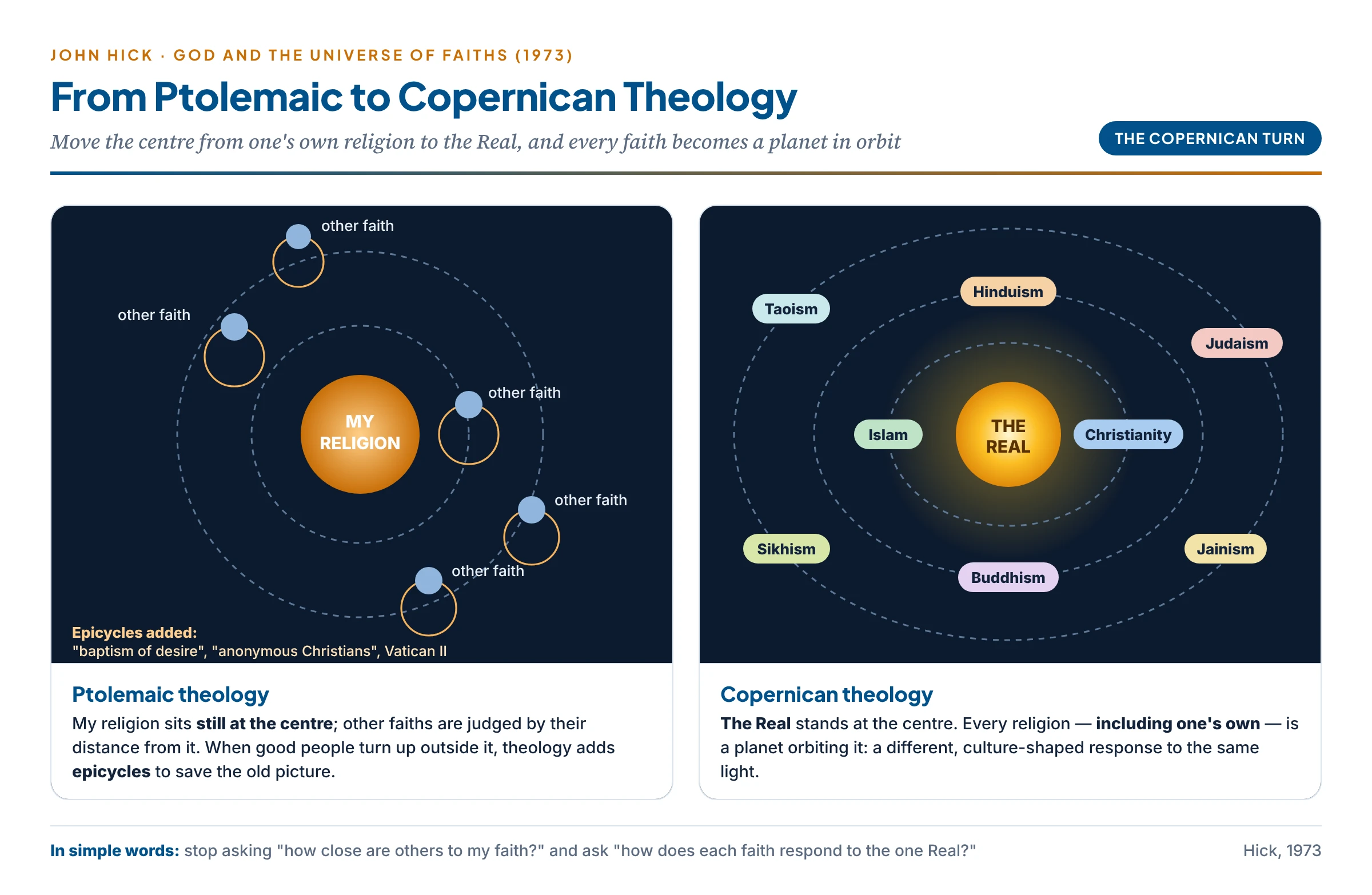
- In God and the Universe of Faiths (1973) Hick used an analogy from astronomy.
- The Ptolemaic picture. In the old astronomy of Ptolemy, the earth stood still at the centre and the sun and planets revolved around it. In the old theology, one’s own religion (for Hick, Christianity) stands at the centre, and all other religions are judged by their distance from it.
- Epicycles. When the planets did not move as the earth-centred model predicted, astronomers added epicycles — small circles on top of circles — to save the old theory. Hick says theology did the same. When it became clear that good and holy people exist outside the church, theologians added epicycles: “baptism of desire”, “anonymous Christians”, and the Second Vatican Council’s teaching that those who, through no fault of their own, do not know the Gospel but sincerely seek God can be saved. Each epicycle complicates the old system instead of going to the heart of the problem.
- The Copernican picture. Copernicus put the sun at the centre, and the earth became one planet among others. Hick puts God — later called “the Real” — at the centre, and all religions, including Christianity, become different “planets” revolving around it.
- Hick asked what the epicycles leave out: what of the non-theistic Buddhists and Advaitins, who do not “seek God” at all? And what of the Muslims, Jews, Hindus and Buddhists who have heard the Christian gospel and have chosen to stay in the faith of their fathers?
From “God” to “the Real” (1989)
- Hick’s full theory appears in An Interpretation of Religion — his Gifford Lectures (1986–87), published in 1989.
- He stopped saying “God” at the centre because the word already means a personal being, which would favour theism over Buddhism and Advaita. He chose a neutral term: the Real (also “the Ultimate”, “the Transcendent”). The Arabic al-Ḥaqq (“the Real”, a Sufi name for God) and the Sanskrit sat (being, truth) carry the same idea.
In simple words
In the Ptolemaic picture, my religion is the sun and everyone else is a planet going round me. In the Copernican picture, none of us is the sun — we are all planets, at different distances and on different orbits, going round a sun we never see directly.
Core Doctrine
1. The Religious Ambiguity of the Universe
- Hick begins from a fact about the world: it is religiously ambiguous. It can be experienced and understood religiously (as God’s creation, as Brahman, as saṃsāra to be escaped) or naturalistically (as matter and energy only). No argument settles the matter either way.
- So there is no epistemological obstacle to experiencing the world from the standpoint of one religion rather than another, or from a non-religious standpoint. Each standpoint is a total interpretation that a person lives by.
- This links to his earlier idea of “experiencing-as”: all experience involves interpretation. A believer experiences a life-event as God’s providence; a non-believer experiences the same event as chance. Religious faith is this interpretive act.
2. Experience and Theory: Two Sides of Religion
- Hick distinguishes two components of every religion:
- Religious experience — the living encounter with the divine (in prayer, worship, meditation, mystical moments);
- Theology or doctrine — the theories people build to explain what those encounters mean.
- They are distinguishable but not separable, like the hen and the egg: experience gives the ground for belief, and belief shapes how later experience is felt.
- So the different religions are different streams of religious experience, each beginning at a different point in history and each forming its own self-understanding within a different culture.
3. Religions as Historical Streams, Not Rival Systems
- The Axial Age. Following the philosopher Karl Jaspers, Hick notes a burst of religious creativity roughly between 800 and 300 BCE: the Hebrew prophets, Zoroaster in Persia, Pythagoras, Socrates and Plato in Greece, Confucius and the Taoist scriptures in China, and in India the Upaniṣads, the Buddha, Mahāvīra and, a little later, the Gītā. Christianity and Islam grew from the Hebrew stream.
- Separate worlds. These revelations happened in cultures that hardly knew of one another. So each grew into a separate religio-cultural world. Their differences are largely the result of history and geography, not of one being right and the others wrong.
- Wilfred Cantwell Smith’s point. In The Meaning and End of Religion (1962) Cantwell Smith argued that the idea of “a religion” — a bounded system of doctrines called “Christianity”, “Hinduism”, “Buddhism”, competing to be “the true one” — is a modern Western invention, mostly of the eighteenth century. Before that, people did not think of themselves as members of rival belief-systems. It is as odd to call a religion “true or false” as to call a civilisation true or false.
- A converging future. Now that the world has become “one world” of communication, religions observe and learn from each other. Hick thought they might slowly converge, so that one day they would differ like the denominations within Christianity today rather than like exclusive totalities.
4. The Kantian Framework: The Real an sich and the Real as Experienced
Kant’s distinction
- Immanuel Kant distinguished the noumenal world — the world as it is in itself (an sich) — from the phenomenal world — the world as it appears to human minds. We never meet things “raw”; our mind organises sense-data through its own categories (such as “thing” and “cause”).
- Hick applies this “without Kant intending it” to religion: there is one divine noumenon and many divine phenomena.
Hick’s everyday examples of how the knower shapes the known
- The narrow window of the senses. Our eyes and ears respond to only a tiny part of the sound and electromagnetic waves around us (light, but not radio, infrared, ultraviolet, X-rays or gamma rays). The world we see is a human selection from a much richer reality.
- The solid table. To us a table is solid and still; to a micro-observer it would be a swirling dance of electrons and quarks. Both are the same table, seen at different levels.
- Aquinas’s principle. Hick quotes Thomas Aquinas: “The thing known is in the knower according to the mode of the knower.” What we know always carries the stamp of how we know.
Applied to the divine
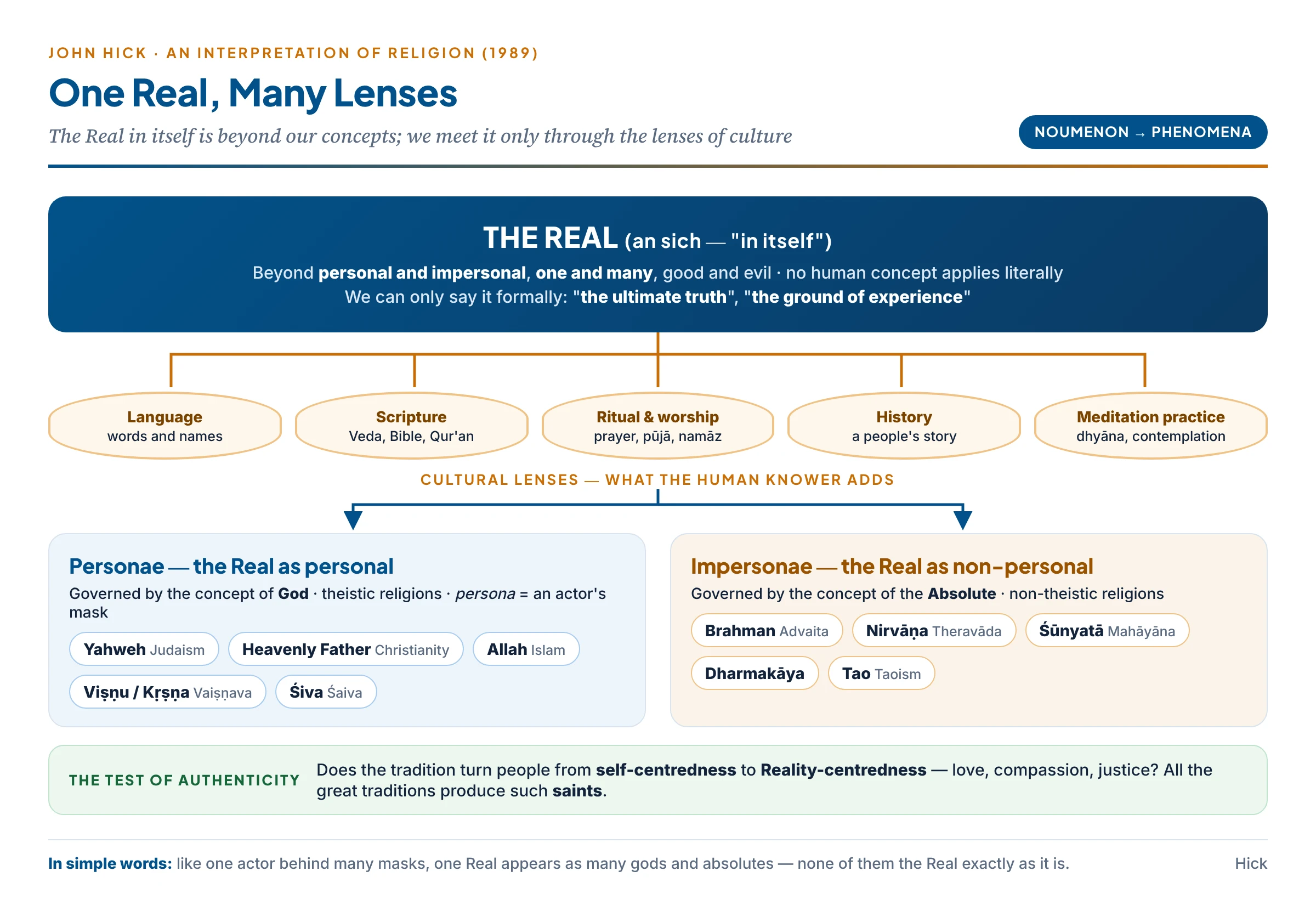
- The Real in itself (the Real an sich) is infinite and lies beyond all human concepts — beyond personal and impersonal, one and many, good and evil, substance and process. No human description applies to it literally.
- The Real as humanly experienced reaches human consciousness only through the “lenses” of a culture: its language, history, rituals, scriptures and meditative practices.
- Two basic religious concepts shape these experiences:
- the concept of God — the Real experienced as personal — governs the theistic religions;
- the concept of the Absolute — the Real experienced as non-personal — governs the non-theistic religions.
- Each basic concept is made concrete — Hick uses Kant’s word schematised — into particular images of God or concepts of the Absolute, formed within particular histories.
5. Personae and Impersonae
- Personae. The personal gods of the theistic traditions — Yahweh of the Jews, the Heavenly Father of Christians, Allah, Viṣṇu/Kṛṣṇa, Śiva — are personae of the Real. Persona is the Latin word for the mask worn by an actor in Roman theatre: the same actor speaks through different masks. Yahweh “exists in interaction with the Jewish people”; he cannot be lifted out of their history. Kṛṣṇa belongs to a different faith-community with its own ethos.
- Impersonae. The non-personal ultimates — Brahman, Nirvāṇa, Śūnyatā (emptiness), the Dharma, the Dharmakāya, the Tao — are impersonae of the Real.
- Both sides contribute. Each persona or impersona is partly the Real’s impact on human consciousness and partly the projection of that consciousness as shaped by culture. From the human side they are our images of God; from the divine side they are God’s personae in relation to different human histories.
- Even mystics are shaped. Hick holds that even the seemingly direct awareness in Hindu mokṣa, Buddhist satori and Western unitive mysticism is still a human experience coloured by the mind’s interpretive “set”. Mystics from different traditions do not have one identical experience reported in different words; they have characteristically different unitive experiences (with important common features). Here Hick agrees with the constructivist reading of mysticism associated with Steven Katz.
In simple words
Think of one actor playing many roles. In one play he wears the mask of a king, in another a beggar, in a third a sage. The audience of each play knows him only through that mask. Hick says Yahweh, Allah and Kṛṣṇa are masks (personae) through which different audiences meet the same hidden Actor — and Brahman and Nirvāṇa are the same Actor met without a personal mask.
6. The Distinction Already Exists Within the Traditions
Hick argued that he was not inventing the gap between the Real-in-itself and the Real-as-experienced; the mystical strands of every major religion already recognise it:
| Tradition | The Ultimate beyond description | The Ultimate as encountered |
|---|---|---|
| Advaita Vedānta | Nirguṇa Brahman — Brahman without attributes | Saguṇa Brahman / Īśvara — the personal Lord |
| Christian mysticism (Meister Eckhart) | The Godhead (Deitas) | God (Deus) |
| Taoism | “The Tao that can be expressed is not the eternal Tao“ | The named Tao |
| Jewish Kabbalah | En Sof — the Infinite beyond description | The God of the Bible |
| Sufism | Al-Ḥaqq — the Real, the abyss of Godhead | The self-revealing Allah |
| Paul Tillich | “The God above the God of theism“ | The God of theism |
| Gordon Kaufman | The “real God“ | The “available God“ |
7. What Can Be Said About the Real?
- Since no human concept applies literally to the Real, we can describe it directly only in formal language — terms that say how it stands to us rather than what it is: “the ultimate truth”, “the ground of experience”, “that to which the religions are a response”.
- Hick also treats the claim made by the religions themselves — that their ultimate is unsayable and incomprehensible (neti neti in the Upaniṣads, the “cloud of unknowing” in Christianity, “nothing is like Him” in the Qur’an) — as support for his view.
- The Real is still the final referent of all the religions’ talk: their claims point at it, though they can only approximate to its truth.
Hick’s hypothesis in four points
- There is one divine reality, the Real, which is the ultimate source of all religious experience.
- No religious tradition has a direct perception of the Real as it is in itself.
- Each major tradition represents an authentic way in which the Real is conceived and experienced.
- The Real transcends all descriptions — both positive and negative.
Hick offered this as the best explanation of the religious phenomena we actually find — better than “only my religion is right” and better than “all religions are human illusion”.
8. The Soteriological Criterion: How Do We Know They Are Valid?
- The common aim. Every major post-axial religion aims at salvation or liberation (soteria, mokṣa, nirvāṇa) — the transformation of human existence from self-centredness to Reality-centredness. The selfish ego is turned towards the Real and therefore towards other people (love, compassion, justice, generosity).
- The test is the fruit. We cannot see the Real directly, but we can see whether a tradition transforms lives. Hick’s criterion is ethical and practical: a tradition is an authentic response to the Real if it produces this transformation.
- The evidence. As far as we can observe, all the great traditions produce saints of comparable moral stature — Francis of Assisi in Christianity, Rūmī in Islam, the Dalai Lama in Buddhism, Gandhi in Hinduism — and ordinary believers of comparable goodness. No single religion is visibly better at producing goodness. Hence they are equally valid salvific spaces.
- A filter, not “anything goes”. The same criterion lets Hick reject religious movements that make people more cruel or self-centred — cults built on hatred, human sacrifice or fraud. So pluralism is not the claim that every religious practice is acceptable.
9. Mythological Truth
- If doctrines are human, culture-shaped responses, in what sense are they true?
- Hick distinguishes literal truth (a statement that matches the facts) from mythological truth: a myth is a story or image that is not literally true but evokes an appropriate attitude towards its subject. A religious doctrine is mythologically true if it orients people rightly towards the Real — producing trust, love and self-giving.
- The incarnation as an example. Hick (in The Myth of God Incarnate, 1977, and later works) treated the doctrine that Jesus is God incarnate as a metaphor: Jesus was so open to God that God’s love was “incarnated” in his life — just as we say Gandhi “embodied” non-violence — not that he was literally God in human form.
In simple words
“The sun rises in the east” is literally false — the earth turns. Yet it is a perfectly useful way of speaking that orients you correctly every morning. Hick treats many doctrines this way: “God is my Father” may not be a literal fact about the Real, but it points you in the right direction — towards trust and love.
10. Hick on the Three Kinds of Conflicting Truth Claims
Hick did not deny that religions say different things. He sorted the conflicts into three kinds and treated each differently.
(a) Different ways of experiencing the divine
- The chief example: the Ultimate experienced as personal (Judaism, Christianity, Islam, theistic Hinduism — as Yahweh, God, Allah, Viṣṇu, Śiva) versus as non-personal (Advaita Vedānta, Theravāda Buddhism). Mahāyāna Buddhism contains both — non-theistic Zen and quasi-theistic Pure Land.
- Hick’s answer: complementary, not contradictory. If the Ultimate is infinite and exceeds our finite categories, it may be both personal Lord and non-personal Ground of being. He points to what Sri Aurobindo called “the logic of the infinite“: predicates that are incompatible when applied to a finite thing may not be incompatible when applied to the infinite.
(b) Different philosophical and theological theories
- Examples: doctrines of creation, of the soul, of rebirth versus one life, of the Trinity versus strict unity.
- Hick’s answer: these conflicts are real but changeable. Theories belong to the historical, culture-shaped side of religion. Christian theology itself changed enormously after Darwin, Einstein and Freud and modern Biblical criticism — a theology book of today would have been unrecognisable as Christian two centuries ago. Other religions too will develop as they meet modern science and each other. Such conflicts may be outgrown.
- Some questions — for instance, whether we are reborn — Hick thought might be settled only by future experience, and he did not regard them as essential to salvation. Hick suggested that what really matters is not having the correct theory but undergoing the transformation.
(c) Different key revelatory events
- Each tradition centres on a holy founder or scripture — the Vedas, the Torah, the Buddha, Christ and the Bible, the Qur’an — that claims an absolute response of faith. To respond absolutely to one seems to rule out responding absolutely to another. Hick admits this is the largest difficulty.
- Hick’s answer: reinterpret the uniqueness claims. Christianity’s doctrine that Christ is the only mediator was formed in an age ignorant of the wider religious life of humanity. Read as metaphor (as in section 9), “Jesus is the Son of God” expresses the believer’s total commitment, like “my wife is the only woman in the world for me” — a statement of love, not a denial that other men love their wives.
In simple words
A lover says, “You are the most beautiful person in the world.” Another lover says the same of someone else. They are not really contradicting each other — each is expressing devotion, not making a measurement. Hick reads the “only Saviour”, “final Prophet” and “eternal Veda” claims in a similar way: as the language of devotion, not rival measurements of the Real.
11. Two Pictures That Illustrate the Hypothesis
The blind men and the elephant
- Several blind men touch an elephant: the one at the trunk says it is a snake, the one at the leg says a pillar (or tree), the one at the ear says a fan, the one at the side says a wall, the one at the tail says a rope. They quarrel; each is partly right in what he affirms and wrong in what he denies.
- For Hick, we are like the blind men in our groping for the Real — our viewpoints are limited by our inherited concepts. (The parable is told in the Jaina and Buddhist traditions; it is developed fully in the article on classical Indian pluralism.)
The duck-rabbit
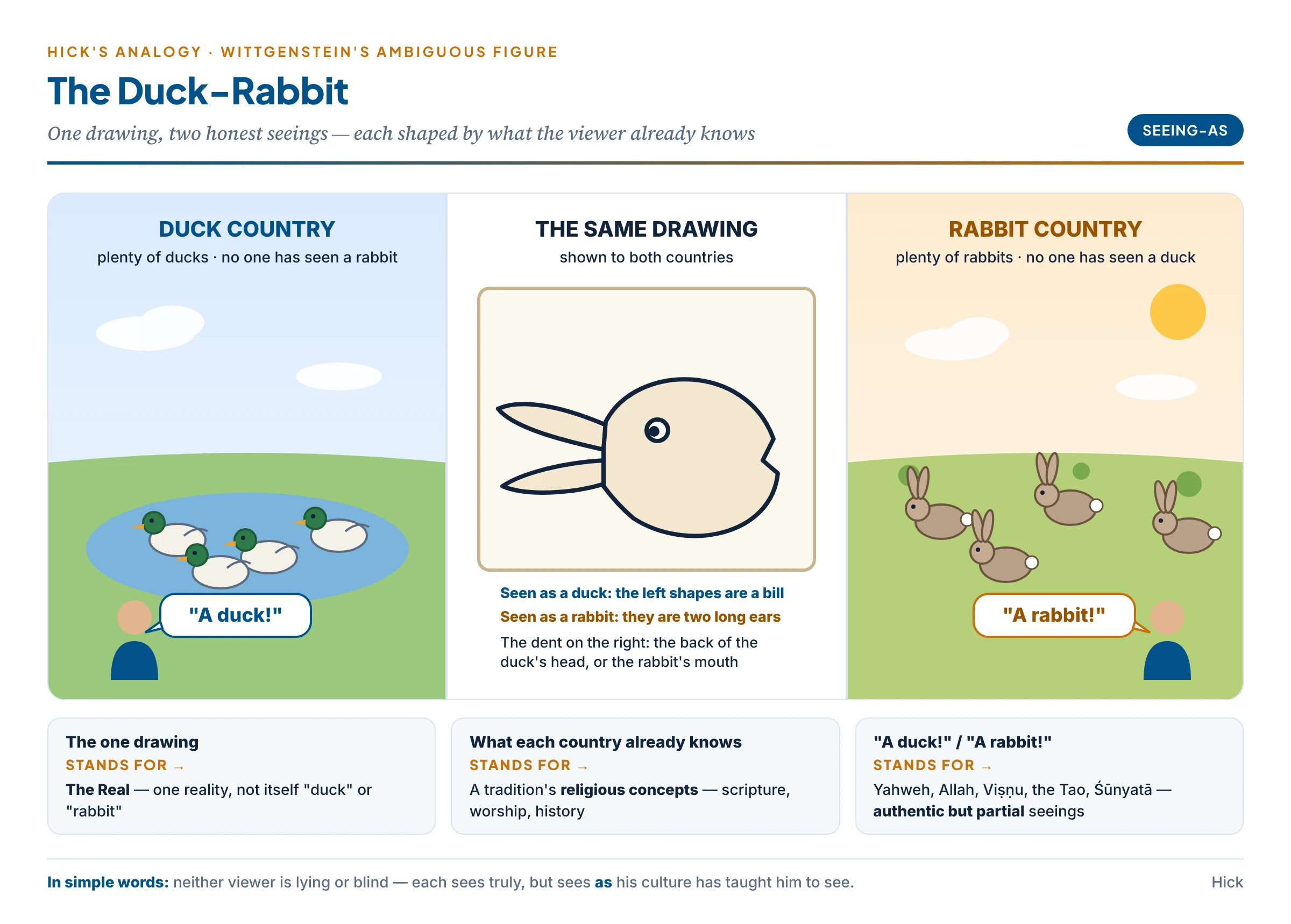
- Ludwig Wittgenstein discussed an ambiguous drawing in Philosophical Investigations that can be seen either as a duck or as a rabbit.
- Imagine a culture with plenty of ducks but no rabbits: its people will see the drawing simply as a duck and will not even notice the ambiguity. A culture with rabbits but no ducks will see it as a rabbit.
- Hick’s point: the ineffable Real can be authentically experienced as Yahweh, as Allah, as Viṣṇu, as the Tao or as Śūnyatā, depending on the religious concepts through which a community meets it. Each sees truly — but sees as.
12. Raimon Panikkar: A Different Pluralist
- Raimon Panikkar (1918–2010), son of a Spanish Catholic mother and an Indian Hindu father, wrote The Unknown Christ of Hinduism (1964).
- Unlike Hick, he did not place a neutral “Real” above the religions. He stressed dialogue from within — “intra-religious dialogue“, in which the believer lets the other faith question him inwardly — and held that pluralism does not mean a “super-system” over all religions, but living with irreducibly different visions in mutual respect.
- His view is often seen as a more participatory pluralism than Hick’s Kantian scheme.
13. Aspectual Pluralism: A Milder Version
- Why it was proposed. Hick’s Real is so far beyond concepts that critics said we can know nothing about it. Aspectual pluralism tries to avoid this.
- The claim. There is an objective Ultimate Reality, and — in a very non-Kantian way — it is knowable: we can give valid descriptions of it, not only of its appearances.
- The natural-kind analogy. Gold has a hidden essence (its atomic structure) and many observable properties — it is yellow, lustrous and hard. Each property is a true fact about gold. Likewise, the Real has an essence and many experienced aspects: it shows personal love to the theist, non-dual being to the Advaitin, emptiness to the Mādhyamika Buddhist. Each religion grasps a real aspect through its own concepts, structures and practices.
- Objections:
- It leads to syncretism. If each religion grasps only one aspect, we would get a better grasp of the Real by mixing religions — building a new syncretistic religion that collects all the aspects. But believers do not see their faith as one ingredient in a recipe.
- It leads back to scepticism. The aspects are still seen through properties that are shaped by each tradition’s culture. So our descriptions of the Real are not adequate knowledge; we are again left with religious scepticism about what the Real is like.
Critical Evaluation
1. Pluralism Is Self-Refuting
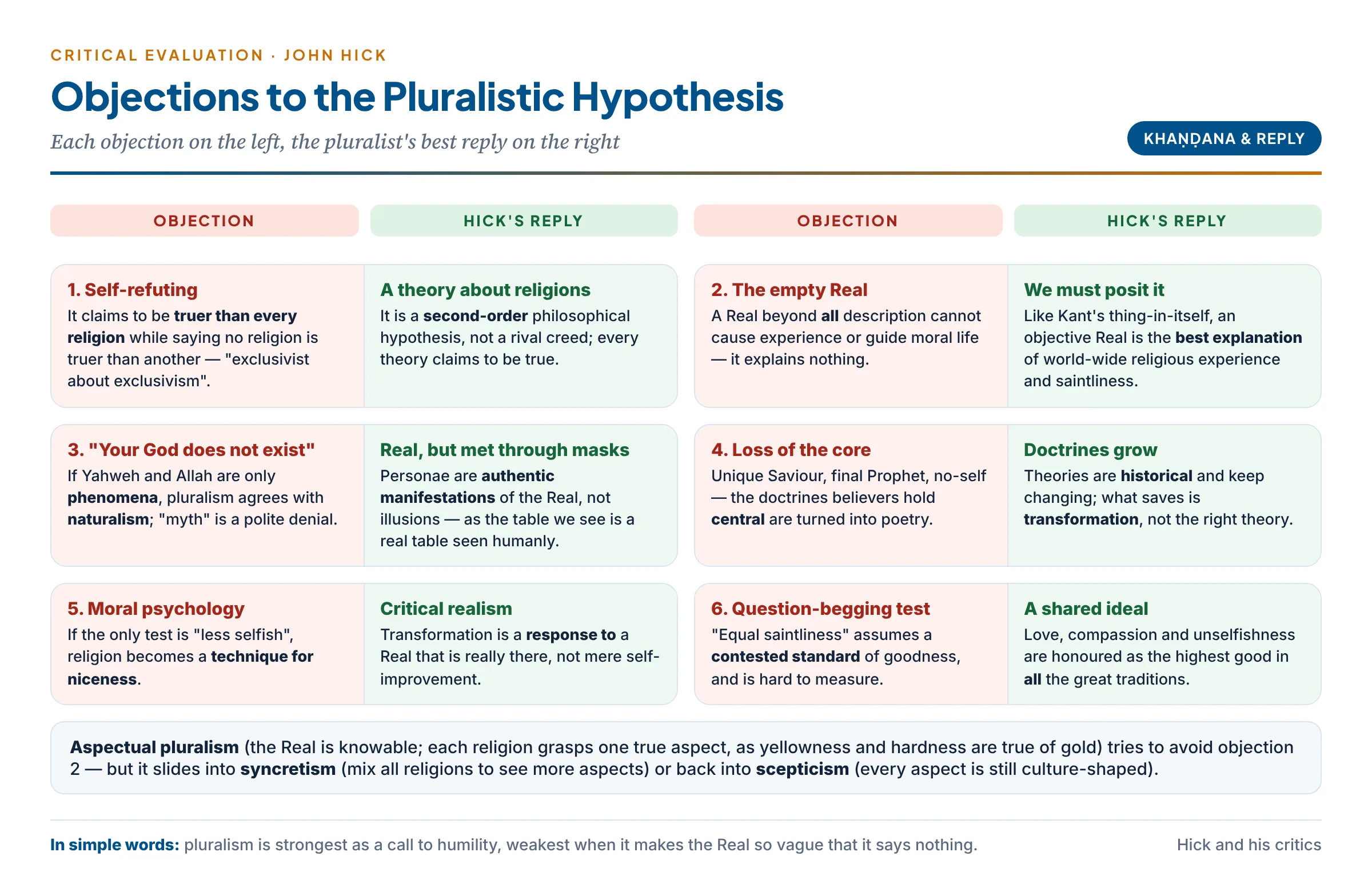
- The charge (Alvin Plantinga and others). Hick says no religion’s view of the Real is truer than any other. But his own view — “the Real is beyond personal and impersonal; all the great religions are equally valid” — is itself a claim about the Real and salvation, and he holds it true against all the religions that deny it. Pluralism is thus exclusivist about exclusivism — a “fourth position” that claims to be truer than every religion.
- It also tells every believer that he is mistaken about his own faith’s uniqueness, while claiming to respect all faiths.
- Hick’s reply. His hypothesis is not a new religion but a second-order philosophical theory about religions — like a theory of language is not itself a language. Every theory claims to be true; that does not make it “exclusivist” in the religious sense. And he admitted that his view does contradict some traditional doctrines.
2. The Ineffable Real Leads to Scepticism — or an Empty Void
- The problem of knowledge (epistemic opacity). If religious claims are only about phenomena and never about the noumenal Real, a knowledge-block arises. If being good, loving, powerful, just — or non-dual, impersonal — do not apply to the Real, how do we know the Real is not just a human projection or wish-fulfilment?
- Hick’s Kantian reply. Just as Kant posited the thing-in-itself to explain our experience, we must posit an objective Real to explain the vast, rich, transforming experiences found across the religions. The best explanation of so much saintliness is that people are responding to something real.
- The rejoinder. But this Real is “beyond characterisation” and “neither personal nor non-personal“. What exactly has been posited? How can such a featureless “something” lead to personal, moral transformation, which is so central to Hick’s own position? An ineffable void cannot serve as the moral or saving goal of human life.
- The Indian echo. The same worry was raised against Advaita’s anirvacanīya (indescribable) Brahman: something that cannot be described at all is hard to distinguish from nothing. Hick’s Real is, in this sense, the anirvacanīya problem in Western dress.
3. The Critique of Hick in Plain Words — Keith Yandell
Yandell points out that religious plurality is simply a fact, while religious pluralism is one interpretation of it. He sums up Hick’s pluralism in nine claims: every religion asks the same vague question (how to get from our present lack to a better future); every religion responds to the same thing; each has its own phenomenal reality; therefore their claims do not conflict; each is equally effective; each is equally valid; doctrines are really myths that elicit behaviour; a myth is “true” if the behaviour is good; and pluralism is accepted as the best explanation of religious diversity. He then argues:
- “Phenomenal” means “does not exist”. If Yahweh, the Father, Allah and Brahman exist only as responses in human minds — as colours were once thought to exist only in the perceiver — then, said without evasion, pluralism tells each religion: “what you believe in does not exist“. On this point it agrees with naturalism.
- Myth is a polite denial. I deny there are roses if I say “there are no roses”; I also deny it if I say “all talk of roses is a useful myth“. The same holds for God or nirvāṇa.
- The problems vanish too. If the things the traditions believe in do not exist, then the problems they diagnose — sin, ignorance (avidyā), craving — do not plague anyone either. The only remaining problem is that we are not morally nice.
- The Real explains nothing. If no ordinary property — not even “being a cause”, “being good” or “being transcendent” — can be ascribed to the Real, then it is a maximally indeterminate being. Such a being cannot cause religious experience, cannot make goodness a better response to it than wickedness, and cannot explain why prayer rather than eating a hamburger or kicking a can is a “response to the Real”. An explanation that says nothing about its cause is empty.
- It cheats on its own rule. Pluralism forbids applying human concepts to the Real, yet itself says the Real is one, transcendent, the condition of our existence and highest good, and what religious experience responds to — all human concepts.
- A new world religion. Pluralism gives its own diagnosis of the human problem (self-centredness) and condemns evangelism as “treason against the peace and diversity of the human family” — while freely evangelising for pluralism. It looks suspiciously like an attempt at a new world religion.
- Yandell’s dilemma. Either we apply to the Real only the properties of one religion’s God (then one religion is true and others false), or we apply all of them (then the Real has contradictory properties — “a whole museum of contradictions”). To avoid both, pluralism must make the Real featureless — and then it explains nothing.
4. Loss of the Cognitive Core — Theological Self-Effacement
- Believers do not experience their faith as “one useful cultural myth among others“. An orthodox Christian believes Christ is the unique Saviour; a Muslim believes the Qur’an is the literal, final revelation; a Theravāda Buddhist believes there is no self (anattā) and no creator.
- By reducing such doctrines — rebirth vs one life, the Trinity vs pure monotheism, ātman vs anattā — to “phenomenal myths”, Hick empties them of their truth claims and turns them into poetic psychology. Pluralism asks believers to surrender the very core of their faith in order to be “respected”.
5. Does Pluralism Reduce Religion to Moral Psychology?
- If the only test of a religion is whether it makes people less selfish, then religion seems to become a technique of moral improvement, and its claims about God, the soul and liberation become secondary.
- Reply. Hick insisted he was a critical realist: the Real is really there, and transformation is a response to it, not a mere change of attitude. But critics reply that a Real about which nothing can be said gives that realism very little content.
6. Is the Moral Criterion Neutral?
- To judge that all traditions produce equally good people, Hick must already use a standard of goodness — love, compassion, unselfishness. But that standard is itself drawn largely from the ethical teachings of the axial religions; and the religions disagree about what the highest good is (union with God, extinction of craving, obedience to the Law).
- Also, “comparable saintliness” is hard to measure. One could argue that the evidence is simply unclear rather than showing equality.
7. Hick’s Kant Is Not Kant
- Kant denied that our categories apply to the thing-in-itself, and he also held that God is not an object of experience at all but a postulate of practical reason. Hick’s claim that we experience the Real (as phenomena) and that the Real causes our religious experiences uses causation across the noumenal–phenomenal line, which Kant forbade. Hick borrows Kant’s structure while relaxing Kant’s rules.
Common confusion
Does Hick say that all religions teach the same thing?
No. This is the most common misreading. Hick openly admits that religions teach very different and often incompatible things. His claim is different: that they are equally authentic responses to the same Real, and that their differing teachings are culturally shaped pictures of that Real. “All religions are the same” is a claim about their content; Hick’s pluralism is a claim about their object and their saving power. Many popular slogans (“all paths say the same”, “all religions teach the same message”) are closer to syncretism, which Hick did not hold.
Critics and Defenders
Criticism — The case against Hick’s pluralism
- Self-refuting: it claims to be truer than every religion while denying that any religion is truer than another (Plantinga).
- Empty Real: a Real beyond all description explains nothing and cannot be the goal of moral transformation (Yandell’s “maximally indeterminate being”).
- Disguised naturalism: if Yahweh, Allah and Brahman are only phenomena, then “what you believe in does not exist”.
- Self-effacement: believers must surrender the unique claims at the heart of their faith.
- Moral psychology: religion becomes a technique for producing niceness.
- Question-begging criterion: the test of “saintliness” presupposes a contested standard of goodness.
- Aspectual pluralism does no better: it slides into syncretism or scepticism.
Defence — The case for Hick’s pluralism
- Takes diversity seriously: it explains why religion tracks birthplace without making salvation a cosmic lottery.
- Avoids scepticism: it is a realist alternative to Hume’s “none of them is true”.
- Rooted in the traditions: the gap between the Real-in-itself and the Real-as-experienced already exists in nirguṇa/saguṇa Brahman, Eckhart’s Godhead, En Sof, al-Ḥaqq and the Tao.
- Second-order, not a new religion: a philosophical hypothesis about religions is not itself a rival creed.
- Respects humility: no finite mind can claim to have grasped the infinite.
- Ethical filter: the soteriological test rejects cruel and fraudulent movements, so it is not “anything goes”.
- Practical fruit: it supports dialogue, tolerance and co-operation among faiths.
Can Conflicting Truth Claims Be Reconciled Within the Framework of Religious Pluralism?
The 2026 paper asked this directly. The answer depends on which kind of conflict is in question.
Where reconciliation succeeds
- Different modes of experience (personal vs non-personal Ultimate): pluralism can treat them as complementary aspects of an infinite Reality — Aurobindo’s “logic of the infinite”, the Jaina idea of many-sided reality, Advaita’s saguṇa/nirguṇa distinction.
- Different images and names (Yahweh, Allah, Viṣṇu): like the duck-rabbit, one reality can be authentically seen in different ways.
- Practical and ethical teachings: there is wide overlap (compassion, honesty, non-violence, the golden rule), so the religions largely agree where it matters most for life.
Where reconciliation is strained
- Historical claims — Did Jesus die on the cross and rise again? The Qur’an says he was not crucified. Both cannot be literally true. Pluralism can reconcile them only by treating one or both as myth, which the believers themselves reject.
- Metaphysical claims — Is there a permanent self (ātman) or no self (anattā)? Are we reborn, or do we live once? These are contradictory if taken literally.
- Claims of uniqueness — “the only Son”, “the final Prophet”, “the eternal, authorless Veda”. Pluralism must reinterpret all of them as devotional language.
Assessment
- Pluralism reconciles the conflicts by lowering their status — from literal truths about the Real to culture-shaped, mythological pictures. The cost is that believers no longer recognise their own faith in the reconciled version.
- A partial reconciliation is defensible: many apparent conflicts are differences of perspective, emphasis and language; some are genuine and remain. Pluralism is most convincing as a framework for humility and dialogue, less convincing as a claim that no real conflict exists.
Can the Pluralist Perspective Vindicate Absolute Truth?
- Yes, in one sense. Pluralism does not deny an Absolute. It affirms one Real — single, objective, infinite — as the source of all religious experience. In this sense pluralism is not relativism: there is one Absolute Truth, the Real itself.
- No, in another sense. Pluralism denies that any human statement about the Absolute is absolutely true. All doctrines are partial and culturally conditioned. So pluralism vindicates an Absolute Reality but not an absolutely true creed.
- The tension. If no statement about the Real is literally true, then even “there is one Real” is in danger. The pluralist must allow at least some formal truths about the Real — that it exists, that it is one, that it is the ground of salvation — or the Absolute dissolves.
- The Indian parallel. Advaita draws the same line: pāramārthika truth (Brahman as it is) is absolute; all vyāvahārika descriptions, including the personal God Īśvara, are true only at the empirical level. Gandhi said the same in ethical form: “Absolute Truth is God“, but for us truth is relative, since we are only seekers.
Are All Religions Essentially the Same?
- The fact of plurality. Religions arose in different places and centuries — the Vedas in the Punjab plains, the Torah among Hebrew tribes, Buddhism in the Gangetic plain, Christianity in Roman Palestine, Islam in Arabia. Plurality is an undeniable fact.
- “Essentially the same” — three possible meanings:
- Same doctrines? No. They differ on God, self, creation, rebirth and salvation. The claim is false at the level of belief.
- Same essence beneath different forms? Many hold that religions share a core — a sense that something is wrong with us as we are, and a way of being put right by connection with a higher reality (William James’s “common nucleus”); a shared ethic; a shared mystical depth. This is partly plausible, but every summary of the “common essence” is drawn up from one religion’s point of view and leaves out what others hold central.
- Same object and goal? This is Hick’s claim: the same Real, the same transformation. It is a hypothesis, not an observed fact.
- Conclusion: religions are not the same in content, but they may be related — as different responses to the same depth of human experience. Saying “all religions are the same” can actually disrespect each religion’s distinctiveness; the better ideal is unity in diversity, not uniformity.
Exclusivism, Inclusivism and Pluralism Compared
| Point of comparison | Exclusivism | Inclusivism | Pluralism |
|---|---|---|---|
| Truth | Only one religion is true; others false where they differ | One religion has the full truth; others have partial truth | Each major religion is an authentic but partial response to the Real |
| Salvation | Only within that one religion | Possible in other religions, but through the one true source | Equally available within all great traditions |
| Centre of the system | My religion (Ptolemaic) | My religion, with “epicycles” | The Real (Copernican) |
| Typical thinkers | Barth, Kraemer, Plantinga | Rahner, Vatican II | Hick, Panikkar (in his own way) |
| Handling of conflicting claims | Settles them by declaring rivals false | Treats rivals as incomplete versions of one’s own | Treats them as culturally conditioned pictures of one Real |
| Main strength | Takes truth claims and the law of non-contradiction seriously | Combines commitment with charity | Takes diversity and the accident of birth seriously |
| Main weakness | Arbitrariness of birthplace; moral problem of excluding most people | Patronising (“anonymous Christian”); still privileges one faith | Self-refuting; empty Real; dilutes the faiths’ own claims |
Cross-Tradition Comparison
| Point | Kant → Hick | Śaṅkara (Advaita Vedānta) | Jaina Anekāntavāda |
|---|---|---|---|
| The Ultimate | The Real an sich, beyond all concepts | Nirguṇa Brahman, beyond all attributes (neti neti) | Reality with infinite aspects (anantadharmātmakam vastu) |
| Why we see it differently | Cultural lenses, concepts, practices | Māyā / avidyā — ignorance superimposes names and forms (adhyāsa) | Each knower grasps one standpoint (naya) |
| Status of the personal God | A persona of the Real | Īśvara — Brahman seen through māyā, real at the empirical level (vyāvahārika) | No creator God; the omniscient Kevalin sees the whole |
| Can the Ultimate be known? | Not as it is in itself; only as experienced | Yes — by direct realisation (aparokṣānubhūti), not by concepts | Yes — by the omniscient (kevala-jñāna) |
| Attitude to other views | All great traditions equally authentic | Other views are lower stages on a ladder towards non-duality | Every view is partly true (syāt); error lies in claiming the whole (durnaya) |
| Key weakness | Real may be empty | Inclusivist: others must end in Advaita | Risk of relativism |
Indian Connect — Indian takeaways
- Hick’s distinction between the Real in itself and the Real as experienced closely parallels nirguṇa and saguṇa Brahman — Hick himself cites it as one of his sources.
- The difference: Śaṅkara holds that the Absolute can be realised directly (Brahman-realisation), whereas Hick’s Kantian Real is never known as it is. Advaita is therefore more confident about the Absolute, and also more hierarchical about other views (they are steps towards Advaita).
- The Jaina naya theory supplies what Hick lacks: a logic for saying how partial views can all be true “in some respect” without contradiction.
- Hick’s soteriological test echoes the Indian idea that a path is judged by its fruit — the reduction of ego (ahaṃkāra) and the growth of compassion — rather than by its creed.
Synthesis (Siddhānta)
- What Hick got right. Religious diversity is a real philosophical problem, not just a social fact. Religion does depend heavily on birthplace; human experience of the divine is always interpreted; and the major traditions themselves admit that the Ultimate exceeds all their words. Hick’s Copernican turn made these points impossible to ignore.
- Where he overreached. In trying to make all great religions equally valid, he made the Real so indescribable that it can hardly explain anything, and he turned the religions’ central claims into myths their followers do not accept. Pluralism thus risks being either self-refuting (a new exclusivism) or empty (a disguised naturalism).
- A balanced position. The most defensible view keeps three things together:
- Metaphysical realism — there is one Absolute Truth or Reality, not many “truths for me”;
- Epistemic humility — no finite human tradition possesses that truth completely; each grasps it partially and from a standpoint;
- Ethical criterion — traditions are judged by their fruits in life, and those that produce cruelty or hatred are rejected.
- Contemporary relevance. In multi-religious societies such as India, Hick’s framework gives a philosophical basis for equal respect and inter-faith dialogue without requiring anyone to believe that all doctrines are identical. Its lasting value lies less in its Kantian metaphysics than in its moral demand: to judge other faiths by how they transform lives, and to hold one’s own faith with conviction without arrogance.
“The thing known is in the knower according to the mode of the knower.” — Thomas Aquinas
Previous Year Questions
- 2026Can conflicting truth claims among religions be reconciled within the framework of religious pluralism? Critically discuss.
- 2018Distinguish between Exclusivism, Inclusivism and Pluralism with regard to the conflicting truth-claims of different religions.
- 2014Can pluralist perspective vindicate Absolute Truth?
- 2010The fact that different religions originated at different places and in different centuries prove that plurality of religion is a fact. How correct would it be to say that all religions are essentially the same? Discuss.