

Schools of Vedānta: Brahman; Īśvara; Ātman; Jīva; Jagat; Māyā; Avidyā; Adhyāsa; Mokṣa; Apṛthaksiddhi; Pañcavidhabheda.
Official Syllabus: Paper I, Section B, Unit 19
If Brahman alone is real and has no qualities, who creates the world, rules the law of karma and answers prayers? Śaṅkara’s answer is Īśvara — Brahman as seen through māyā: the personal God, omniscient, omnipotent, creator, sustainer and destroyer of the universe, the inner ruler of every being and the object of worship. Īśvara is fully real from the empirical standpoint, the highest appearance we have, and the indispensable ladder to the highest truth; yet from the highest standpoint the qualities of Īśvara are seen to belong to the role, not to the actor. This article explains what Īśvara is, why Advaita needs him, how he differs from the jīva and the witness (sākṣī), how he can create without being partial or cruel, and whether the impersonal Brahman or the personal Īśvara is the “better” concept.
In simple words
Think of sunlight passing through a glass prism. The light itself is colourless and one; through the prism it shows up as a rainbow. Nobody can say the rainbow is “nothing” — you can photograph it — yet it is the colourless light appearing under a condition. Īśvara is like the whole rainbow: the one Brahman appearing, through māyā, as a God of many glorious qualities. The rainbow is real for everyone standing in the sun; it vanishes only when the prism is taken away.
Context & Problem
Why Advaita Needs Īśvara
- The scriptures speak of a Lord. The Upaniṣads and the Brahmasūtra describe Brahman as the cause of the world, the inner controller (antaryāmin), the giver of the fruits of action, the one whom the soul worships. A strictly attributeless Brahman seems to leave no room for any of this.
- Religion needs a personal God. Devotion, prayer, grace and moral obedience require a God with qualities — knowledge, power, mercy. If the only reality is attributeless, devotion seems groundless.
- The world needs a cause. As long as the world is experienced as real, its origin, order and moral law need an intelligent ground.
- Śaṅkara’s solution. Keep one reality, Brahman, but recognise two standpoints. From the empirical standpoint (vyāvahārika), Brahman appears through māyā as Īśvara, the personal Lord; from the highest standpoint (pāramārthika), there is only nirguṇa Brahman. This is the celebrated distinction between God and the Absolute, which Śaṅkara takes from the Upaniṣads.
Īśvara in One Sentence
Īśvara is Brahman conditioned by, or reflected in, cosmic māyā — the personal aspect of the impersonal Brahman, also called saguṇa Brahman (Brahman with qualities) or apara Brahman (the lower Brahman), as against nirguṇa or para Brahman (the higher Brahman).
“He is the Lord who has māyā under his control; he is the jīva who is afflicted by it.” — Advaita saying (sa īśo yad-vaśe māyā, sa jīvo yas tayārditaḥ)
Core Doctrine
The Nature of Īśvara
- Saccidānanda. Īśvara is existence–consciousness–bliss — the same as Brahman, but now possessing these as qualities of a perfect personality.
- Lord of māyā (māyā-pati). Māyā is Īśvara’s power (śakti); he wields it and is never deceived by it. The jīva, by contrast, is controlled by māyā.
- Omniscient and omnipotent. He knows everything and can do everything — though these very qualities, Śaṅkara notes, arise from his association with māyā and are not ultimate.
- Creator, sustainer and destroyer of the universe; the source of everything and its final haven.
- Immanent and transcendent. He is immanent in the whole universe as its inner ruler (antaryāmin) — “the soul of souls and the soul of nature” — and yet in his own nature he transcends the universe.
- Object of worship and inspirer of moral life. He is the one to whom devotion is offered, the dispenser of the fruits of karma and the guardian of the moral order.
- The concrete universal. Īśvara is the supreme individual, the whole, the identity-in-difference — all that a theist could ask of God. Hence the remark that the Brahman later described by Rāmānuja is essentially an elaboration of Śaṅkara’s Īśvara.
“All Talk about Brahman Is Talk about Īśvara”
- Finite thought cannot grasp Brahman. The moment we think or speak of Brahman, we bring it under categories — cause, knower, Lord — and it becomes conditioned.
- So even the words “unconditioned Brahman” refer, in use, to Īśvara. “The moment we speak of Brahman, He ceases to be Brahman and becomes Īśvara.”
- Hence, for us, Īśvara is “all in all”. Prayer, theology, ethics and the whole of religious life are directed to Īśvara. Īśvara becomes “unreal” only for the one who has realised his oneness with Brahman by rising above speech and mind — and such a person no longer needs to say anything at all.
Brahman, Māyā and the Three Forms of God
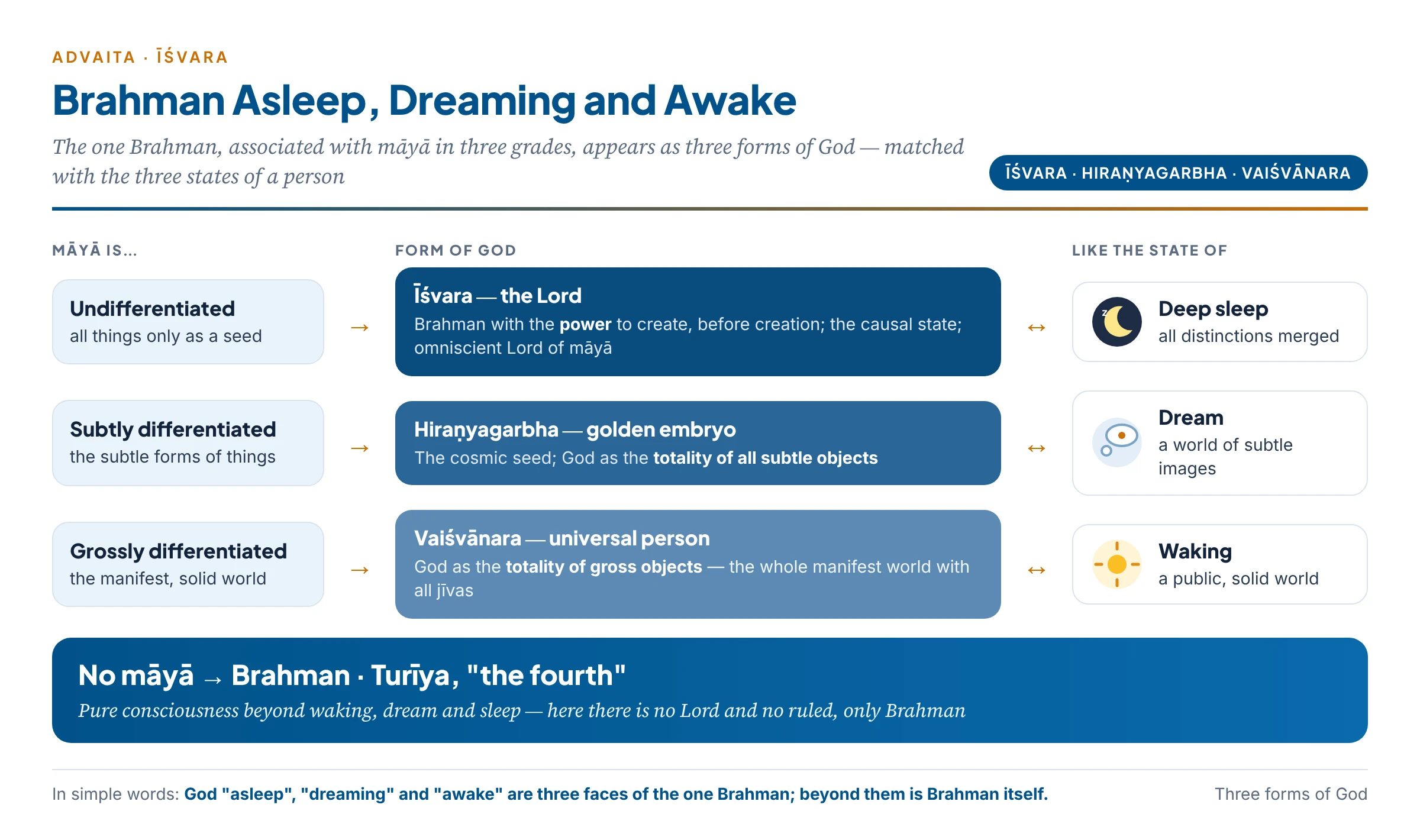
Śaṅkara and his followers describe Brahman’s association with māyā in three grades, matched with the three states of the individual.
| Brahman associated with… | Form of God | Totality of | Like the state of |
|---|---|---|---|
| Undifferentiated māyā (before creation, power of creation latent) | Īśvara (the Lord) | The seed of all things — the causal state | Deep sleep |
| Subtly differentiated māyā | Hiraṇyagarbha (“golden embryo”, the cosmic seed) | All subtle objects | Dream |
| Grossly differentiated māyā | Vaiśvānara (the universal person) | All gross objects — the manifest world with all jīvas | Waking |
| No māyā | Brahman (pure) | — | Turīya (“the fourth”, pure consciousness) |
- Evolution of the world is compared to the waking of a sleeper: Īśvara is “God in deep sleep”, Hiraṇyagarbha “God dreaming”, Vaiśvānara “God fully awake”; in the fourth state (turīya), the purest transcendental state, all is Brahman.
Īśvara as Taṭastha-lakṣaṇa: The Shepherd and the Magician
- The shepherd playing a king. On stage a shepherd plays a king — wages war, conquers, rules. “Shepherd” says what he is (essential definition, svarūpa-lakṣaṇa); “king” is true only from the standpoint of the play (indicative definition, taṭastha-lakṣaṇa). Creatorship and lordship are Brahman’s taṭastha features: true for the world, not its essence.
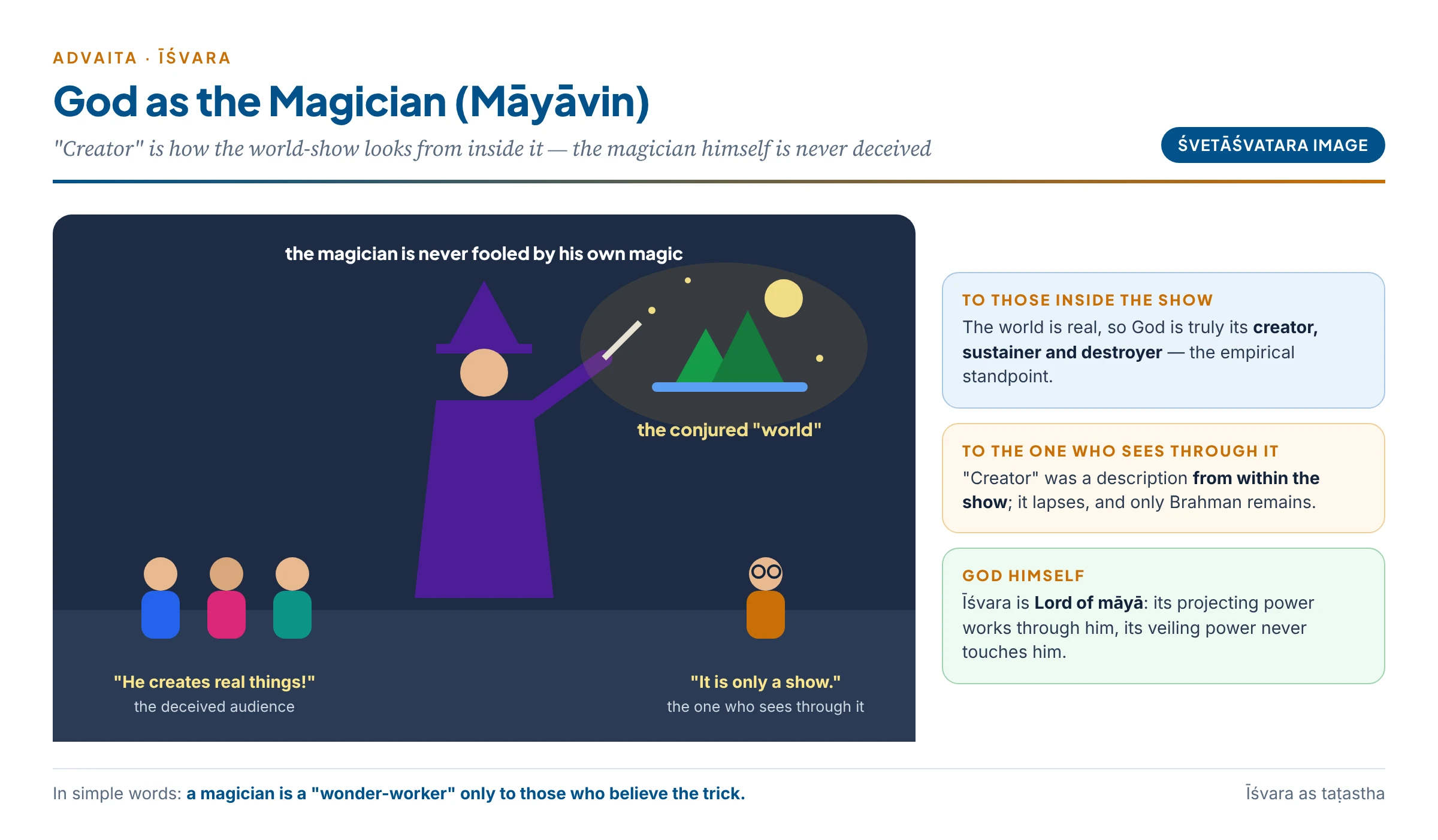
- The magician. The Śvetāśvatara Upaniṣad calls God a magician (māyāvin). A magician is a “wonder-worker” only to those deceived by his trick; to those who see through it he is no wonder-worker, and he himself is never deceived. Similarly, those who take the world-show as real think of God through the show and call him its creator, sustainer and destroyer; for the one who sees through the show, these descriptions lapse — and God himself is never deluded.
- Why this does not make Īśvara a fraud. A role is not a lie; within the play it is entirely real and governs everything that happens on stage. Likewise Īśvara really governs the world as long as the world appears.
The Status of Īśvara: Real, but Not Ultimate
- Vyāvahārika reality. From the practical standpoint Īśvara is completely real — as real as the world, the jīvas and the moral law. He is the highest appearance we have.
- Sublated only by realisation. From the highest standpoint, when the identity of self and Brahman is realised, Īśvara’s qualities are seen as superimposed. “When Brahman is viewed as saṃsāra, God, soul and nature arise together; when Brahman’s own essence is realised, God, soul and nature vanish together.“
- Immanence and transcendence reconciled. By the two standpoints Śaṅkara reconciles God’s immanence (the world, while it appears, is in God) with his transcendence (God is never touched by the world’s imperfections).
- Īśvara never misses the unity. Unlike the jīva, Īśvara is free from the veiling (āvaraṇa) power of māyā; only its projecting (vikṣepa) power works through him. He “never feels himself as God“; he feels himself one with Brahman. God is God only to the jīva who is under avidyā.
- Kāryopādhi and kāraṇopādhi. An Advaita formula puts the difference neatly: “The jīva has the effect (body–mind) as its limiting adjunct; Īśvara has the cause (māyā) as his limiting adjunct.” The jīva is limited by its individual body and mind; Īśvara is “limited” only by the cosmic power of which he is master.
Common confusion
Is Īśvara in Advaita just an illusion, like the snake in the rope? No. The rope-snake is prātibhāsika — a private error cancelled by ordinary waking perception. Īśvara is vyāvahārika — real for everyone, governing the public world, cancelled only by the realisation of Brahman. “Not ultimately real” means “not real for all time”, not “imaginary”. Many notes blur this and make Advaita sound atheistic.
In simple words
In a dream you may meet a wise king who rules the dream kingdom and settles every quarrel justly. Inside the dream he is truly the king, and you would be foolish to disobey him. Only on waking do you see that king and kingdom were your one mind appearing in many forms. Īśvara is the true ruler of the “dream” of saṃsāra; on waking into Brahman, ruler and ruled are seen to be one.
The Ladder of Standpoints: Gradual Revelation of Truth
Śaṅkara believes in the gradual revelation of truth. Each stage is true at its level and leads to the next.
- First stage — the world alone is real. The unreflecting person takes the material world as the only reality.
- Second stage — the world and God are both real. Realising the finiteness of the human intellect, one comes to believe in God as the sustainer of the world; out of reverence one worships him. This is the theistic stage.
- Third stage — Brahman alone is real. Constant contemplation, together with devotion, leads to the highest knowledge: Brahman alone is real. God is no longer an object “over against” me.
- Worship is not useless. Though Īśvara is not real from the highest level, worship purifies the heart (citta-śuddhi) and prepares the mind for the highest knowledge. “It is only through the lower standpoint that we can gradually mount up to the higher.”
In simple words
Think of learning to swim. First you stand in the shallow end holding the rail; then you swim with a float; finally you swim free. The float is not “false” — it truly holds you up while you need it, and you would drown without it. Īśvara-worship is the float of the spiritual life: real and necessary at its stage, set aside only when you no longer need support.
Īśvara, Jīva and Sākṣī
Three conscious principles appear at the empirical level; their ontological status is a favourite question.
| Principle | What it is | Limited by | Status |
|---|---|---|---|
| Īśvara | Brahman reflected in / conditioned by cosmic māyā (pure sattva) | Māyā — which he controls | Vyāvahārika; free of veiling; omniscient |
| Jīva | Brahman reflected in / conditioned by individual avidyā — the internal organ (mind) | Body–mind, which controls him | Vyāvahārika; agent, enjoyer, bound |
| Sākṣī (witness) | The pure consciousness within the jīva that illumines the mind and its states without acting | Only seemingly by the mind | Its essence is Brahman itself; the “seeing” role is empirical |
- The two birds. The Muṇḍaka Upaniṣad pictures two birds on one tree: “one eats the sweet fruit, the other only looks on“. The jīva eats — it enjoys, suffers, earns merit and demerit; Īśvara looks on and makes the other enjoy. The Advaitin adds: the onlooking principle within the jīva is the witness (sākṣī), which in essence is not different from Īśvara’s and Brahman’s consciousness.
- Brahma satyaṃ jagan mithyā, jīvo brahmaiva nāparaḥ. In the light of the famous half-verse: Brahman alone is real (pāramārthika); Īśvara, jīva and the world are vyāvahārika appearances; the sākṣī, being pure consciousness, is the point where the jīva touches Brahman — “the jīva is nothing but Brahman” because its witnessing core is Brahman.
- Different post-Śaṅkara accounts of Īśvara.
- Vivaraṇa school (Prakāśātman’s followers): Īśvara is the original (bimba) — Brahman as conditioned by one cosmic ignorance; jīvas are its reflections in many minds.
- Sarvajñātman: Īśvara is itself a reflection of pure consciousness in cosmic ignorance; jīva is its reflection in the intellect; only pure Brahman is the original.
- Bhāmatī school (Vācaspati): Īśvara is Brahman as the object of ignorance; jīva is Brahman as the seat of ignorance; the jīva is consciousness limited by the mind.
- Ābhāsa view (Sureśvara): both Īśvara and jīva are inexplicable semblances of Brahman.
- Śaṅkara himself uses all these images — reflection of the sun in water, the red flower in the crystal, space in jars — only as metaphors with suggestive value, and seems closest to the appearance view: Īśvara and jīva are inexplicable appearances of Brahman due to māyā. (The jīva-theories are treated fully in the next article.)
Can God Be Proved? Śaṅkara and Kant
- God cannot be proved by finite reason. Like Kant, Śaṅkara holds that the rational proofs fail:
- The cosmological proof can give only a finite creator of a finite creation — and a finite creator is no God.
- The teleological (design) proof can show only that some conscious principle is at work in the world.
- The ontological proof gives only an idea of God, not God as real.
- The Nyāya arguments from effect to maker are therefore futile as proofs.
- Scripture alone reveals God. “God is an article of faith”; śruti is the only proof. As Kant falls back on practical faith, Śaṅkara falls back on scripture.
- No real creation. Śaṅkara agrees with Gauḍapāda’s non-origination (ajāti): there is no real creation; God is not a “real” creator, and the creation is only an appearance of God.
Creation without Partiality or Cruelty
The Brahmasūtra raises an objection that every theist must meet — the Indian form of the problem of evil.
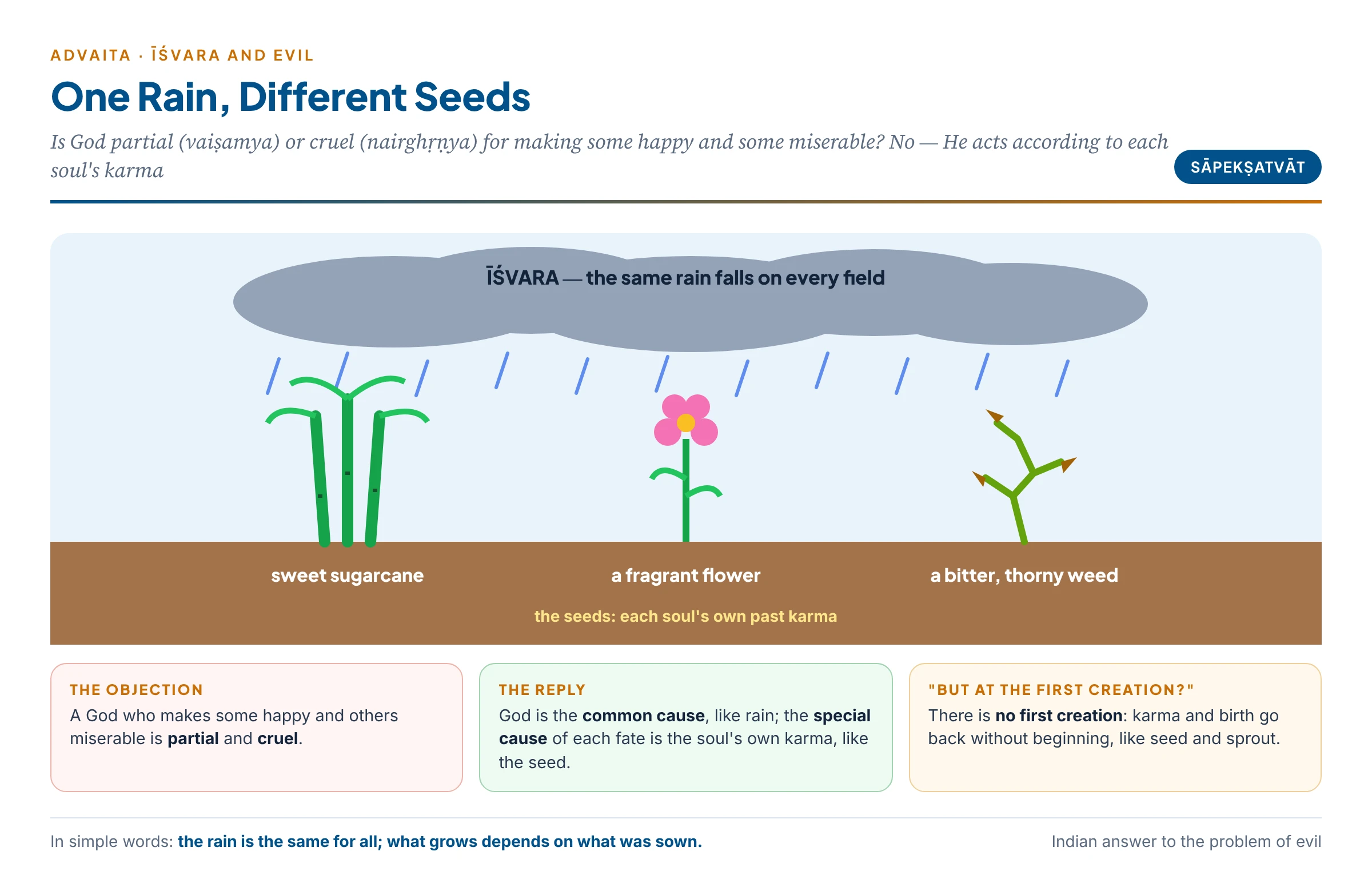
- The objection. If God creates a world where some are happy and others miserable, he is guilty of partiality (vaiṣamya) and cruelty (nairghṛṇya).
- The reply — God acts “with regard to” karma (sāpekṣatvāt). God’s action depends on the merits and demerits of the souls themselves.
- The rain analogy. Rain falls equally on every field; yet from one seed grows sweet sugarcane and from another a bitter weed. The rain is the common cause; the difference comes from the seeds. God is like the rain; each soul’s karma is like the seed.
- No first moment. “But before the first creation there was no karma!” — Creation has no beginning. Karma and inequality, like seed and sprout, are both cause and effect in a beginningless series.
- Why create at all? Brahman has no unfulfilled desire — “what desire can one have whose desires are all fulfilled?” (āptakāmasya kā spṛhā). Creation is play (līlā): like a king who plays though he lacks nothing, or a person who breathes without a purpose. And ultimately, creation is only appearance.
- The spider objection. A spider spins its web from desire to catch insects, using its saliva; what desire and what external means could Brahman have? — None: creation is not ultimately real, and Brahman needs no external means except its own power, māyā.
Dreams and the World: Whose Creation?
- Dreams are private — they are created by the individual jīva (jīva-sṛṣṭa).
- The waking world is public — it is created by Īśvara (īśvara-sṛṣṭa), shared by all, governed by uniform laws.
- This distinction is why the world, though mithyā, is not a private hallucination: Advaita is not subjective idealism. (See the article on Jagat.)
Critical Evaluation
Objections (Pūrva-pakṣa)
- Rāmānuja.
- The distinction between a higher (nirguṇa) and a lower (saguṇa) Brahman is unwarranted; Brahman is God, always qualified by souls and matter.
- Making God a product of māyā and ignorance robs worship of its object: no devotee can love a God he knows to be an appearance.
- If Īśvara’s omniscience and omnipotence are due to ignorance, God depends on ignorance — an absurd position.
- Madhva.
- Īśvara becomes the creation of the jīva’s ignorance, and the jīva’s devotion becomes self-worship.
- If the one Īśvara is associated with all the adjuncts, he would have to undergo the joys and sorrows of all, as one person feels the pains of every part of his body.
- The theist’s worry. If Īśvara is “only” vyāvahārika, Advaita seems to slide towards atheism at the highest level; some critics in India and the West have called it so.
- The charge of uselessness. Some say that in Advaita Īśvara is unreal and useless — a concession to popular religion.
Replies (Siddhānta)
- Īśvara is the highest appearance, not an illusion. “Unreal” means “not real for all time”, not “non-existent”. For every worshipper, at every moment of worship, Īśvara is fully real — “for us, Īśvara is all in all“. The charge of uselessness misses the meaning of māyā.
- God is never deluded. Īśvara is Lord of māyā, free from its veiling power; he never suffers the jīva’s pains because māyā only projects through him and never hides the unity from him. He does not experience the joys and sorrows of the jīvas, as the sun does not suffer from being reflected in muddy water.
- The ladder argument. Advaita does not abolish theism; it includes it as the second step of a gradual revelation and makes worship the means of purification.
- Philosophical honesty. Rāmānuja’s God, who includes the world as his body, must share its imperfections or else be split into a perfect soul and an imperfect body; Śaṅkara keeps God’s perfection by keeping the world’s imperfections at the level of appearance. Thus “Rāmānuja’s Absolute is Śaṅkara’s Brahman bound to this world, while Śaṅkara’s Absolute is Rāmānuja’s Īśvara liberated from this world.“
Which Is Philosophically Better: Brahman or Īśvara?
| Question | Nirguṇa Brahman (impersonal Absolute) | Īśvara (personal God) |
|---|---|---|
| Logical consistency | Free from contradictions of a personal being (evil, change, limitation) | Faces the problem of evil and of a God who both rules and suffers with the world |
| Religious adequacy | Hard to love or pray to | Object of devotion, grace and moral trust |
| Explains the world? | Only as appearance | As real creator and governor |
| Knowledge | Realised by intuition, not described | Described by scripture and theology |
| Universality | Common ground of all religions (“one reality, many names”) | Bound to particular names and forms |
| Advaita’s verdict | Ultimate truth | Highest empirical truth and indispensable path |
- A balanced answer. For metaphysics, the impersonal Absolute is more consistent; for religion, the personal God is indispensable. Advaita’s achievement is to keep both — the Absolute as truth, God as the way — rather than to choose one and lose the other.
Personal and Impersonal Notions of God (Paper II)
- Personalistic notion. God as a person — conscious, willing, loving, with qualities such as omniscience, omnipotence and goodness; one who can be addressed as “Thou”. Examples: Rāmānuja’s Nārāyaṇa, Madhva’s Viṣṇu, the God of Judaism, Christianity and Islam, Śaṅkara’s Īśvara.
- Impersonalistic notion. God or the ultimate as beyond personhood — pure being, consciousness or the ground of being, not a “someone” among others. Examples: Śaṅkara’s nirguṇa Brahman, Spinoza’s Substance, Plotinus’s One, Tillich’s “God beyond God”.
- In the context of devotion.
- Devotion (bhakti) needs a personal God — love, surrender and grace are relations between persons. Hence the bhakti schools (Rāmānuja, Madhva, Caitanya) reject the impersonal Absolute as unworshippable.
- Knowledge (jñāna) aims at the impersonal: the knower seeks identity, not relationship. Śaṅkara allows devotion to the personal God as a preparatory stage.
- The Gītā holds the two together: worship of the unmanifest is “more difficult for embodied beings”, worship of the personal Lord easier, yet both reach the same goal.
- Evaluation. The personal view gives warmth, moral guidance and grace but invites anthropomorphism and the problem of evil; the impersonal view gives philosophical purity and universality but seems cold and remote. Many thinkers — Śaṅkara, Radhakrishnan, Tillich — see the personal God as the face the Absolute turns towards the worshipper.
Critics and Defenders
Criticism — Critics
- Rāmānuja: the split between higher and lower Brahman is unwarranted; a God born of ignorance cannot be worshipped.
- Madhva: Īśvara becomes a product of the jīva’s ignorance; one Lord in all adjuncts would suffer all their pains.
- Theists: Advaita is atheism at the highest level.
- Critics of māyā: if omniscience and omnipotence come from māyā, God depends on ignorance.
Defence — Defenders and strengths
- Śaṅkara: for us, Īśvara is all in all; only the realised soul transcends him.
- Advaitins: Īśvara is Lord of māyā, never veiled, never suffering — like the magician never deceived by his own show.
- Gradual revelation: worship purifies and leads to knowledge; theism is included, not denied.
- Strength: answers vaiṣamya–nairghṛṇya by karma (rain and seeds) and keeps God’s perfection.
- Strength: reconciles immanence and transcendence through the two standpoints.
Cross-Tradition Comparison
Īśvara and Western Ideas of God and the Absolute
| Thinker | Personal God vs Absolute | Parallel with Śaṅkara | Difference |
|---|---|---|---|
| Kant | God not provable; a postulate of practical reason | Rational proofs fail; God grounded outside theoretical reason | Kant grounds God in moral faith, Śaṅkara in scripture and realisation |
| Spinoza | God = impersonal Substance; personal God is imagination | Personal attributes belong to a lower way of knowing | Spinoza denies a personal God altogether; Śaṅkara keeps Īśvara as real at his level |
| Bradley | God is an appearance of the Absolute | Religion’s God is lower than the Absolute | Very close; Bradley calls God “an appearance” in the same spirit |
| Tillich | “God above God” beyond the personal God of theism | The personal God is a symbol of the ground of being | Tillich speaks of symbol; Śaṅkara of māyā |
| Meister Eckhart | Godhead (beyond) vs God (personal) | Same two-level structure | Christian-mystical framework |
Indian Connect — Key takeaways
- The God–Absolute distinction of Śaṅkara (Īśvara and Brahman) is mirrored in Bradley (God as appearance of the Absolute), Eckhart (God and Godhead) and Tillich (God beyond God).
- Śaṅkara’s denial that God can be proved parallels Kant; his answer to the problem of evil (karma as the seed, God as the rain) is one of the classic Indian theodicies.
- The bhakti schools of Rāmānuja and Madhva can be read as making Śaṅkara’s Īśvara the whole and final truth.
Synthesis (Siddhānta)
- Īśvara is Brahman conditioned by cosmic māyā — saguṇa, apara Brahman — the personal aspect of the impersonal: omniscient, omnipotent, creator–sustainer–destroyer, inner ruler, Lord of māyā, object of worship, inspirer of moral life.
- He is described by Brahman’s indicative definition (like the shepherd who is king only on stage, or the magician who is a wonder-worker only to the deceived), not by its essence.
- Brahman with undifferentiated, subtle and gross māyā is Īśvara, Hiraṇyagarbha and Vaiśvānara — God “asleep, dreaming and awake”; pure Brahman is the fourth, turīya.
- Īśvara is fully real at the empirical level, the highest appearance; he is sublated only for the liberated, for whom God, soul and world vanish together. He is free from māyā’s veiling and never feels himself other than Brahman.
- Īśvara, jīva and sākṣī: Īśvara rules māyā, the jīva is ruled by avidyā, and the sākṣī is the witnessing consciousness within the jīva, in essence Brahman.
- God cannot be proved by reason (as in Kant); śruti reveals him. He creates without partiality or cruelty, acting according to karma like rain on different seeds, and creates out of līlā, not need.
- The ladder of standpoints — world alone; world and God; Brahman alone — makes worship a real and necessary stage.
- Rāmānuja’s and Madhva’s objections are answered by the meaning of māyā and the standpoints; the choice between personal and impersonal God is resolved by keeping the personal as the way to the impersonal.
- Contemporary relevance.
- Interfaith dialogue. Treating personal Gods as faces of one ultimate reality supports religious pluralism (Radhakrishnan, John Hick’s “the Real”).
- Theodicy. The karma-and-rain argument remains one of the most discussed answers to the problem of evil.
- Spiritual pedagogy. The ladder of stages respects the needs of different temperaments — a reason why Advaita monasteries also run temples.
“For us, Īśvara is all in all: finite thought can never grasp Brahman, and all talk of Brahman is talk of Īśvara.” — summary of Śaṅkara’s position
Previous Year Questions
- 2026Discuss the difference between personalistic and impersonalistic notions of God in the context of devotion.
- 2023Discuss Rāmānuja’s criticism of Śaṅkara’s conception of Brahman and Īśvara (God).
- 2023Elucidate the personalistic and impersonalistic aspects of God.
- 2022‘Brahma satyam jaganmithyā, jīvo brahmaiva nāparaḥ’. In the light of this statement explain the ontological status of Īśvara, Jīva and Sākṣī as elucidated in Advaita Vedānta.
- 2019State and evaluate the personalistic and impersonalistic aspects of God.
- 2016Evaluate Śaṅkara’s position on Īśvara.
- 2013How can Īśvara (God) be distinguished from Brahman (Absolute)? Which of the two concepts are philosophically better?
- 2012Do the concept of Īśvara and Brahman signify the same reality in Advaita Vedānta?