

Anthropology Optional › Paper II › Unit 04: Emergence and Growth of Anthropology in India
4 Emergence and growth of anthropology in India – Contributions of the 18th, 19th and early 20th Century scholar administrators. Contributions of Indian anthropologists to tribal and caste studies.
Official Syllabus: Paper II, Unit 4
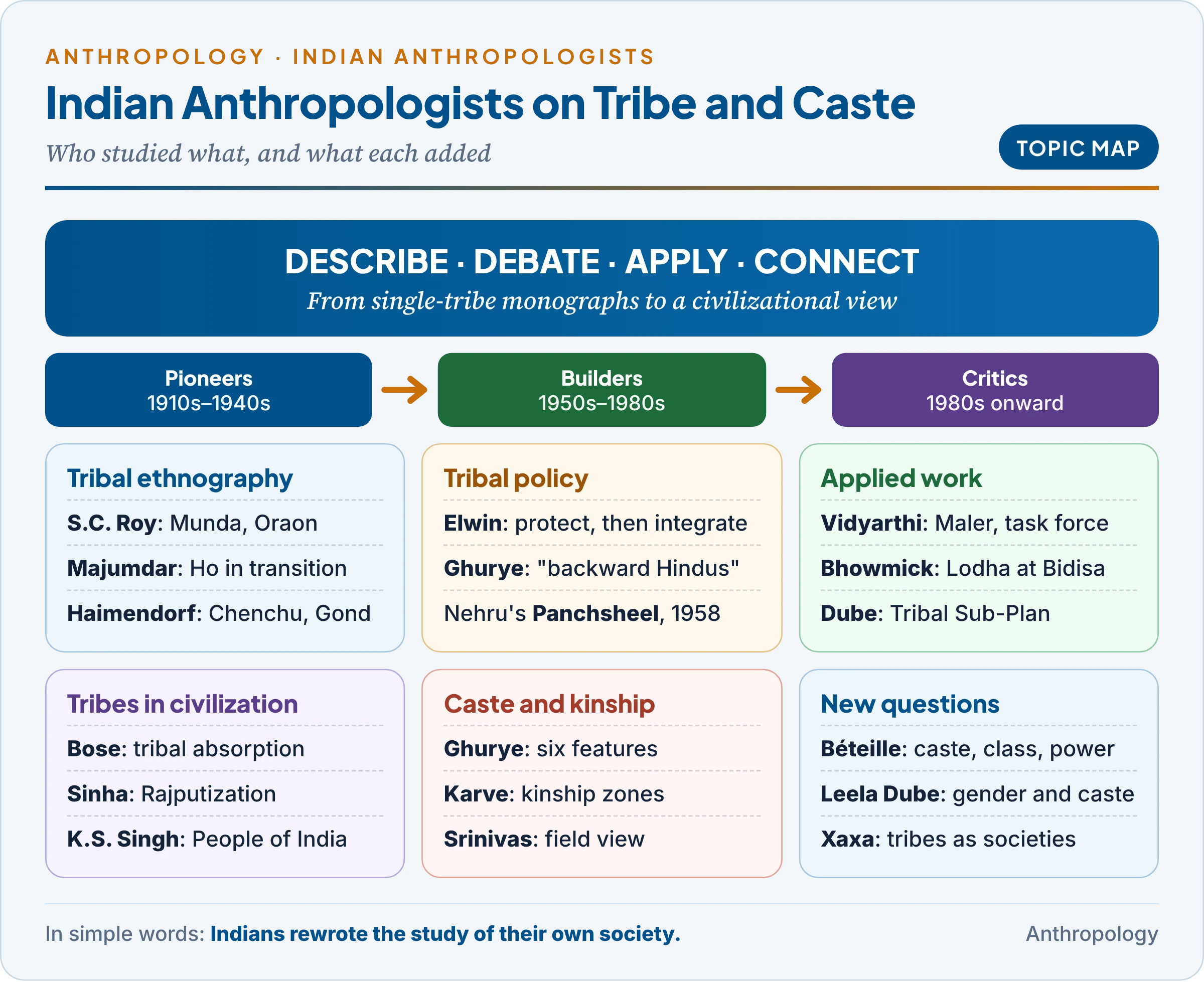
This article covers the second half of the syllabus line: what Indian anthropologists (and two foreign-born scholars who made India their life’s work, Elwin and Haimendorf) contributed to the study of tribes and caste. The colonial scholar-administrators and the growth of the discipline are in 4a. Theories of caste are treated in 3.2a and 3.2b, the sacred complex in 3.3, and Sanskritization in 5.3a; here those ideas are summarised and the focus is on who did what, where, and why it mattered.
1. Three Generations, Three Approaches
In simple words
Indian anthropology was built by a few dozen scholars over about a century. The first generation wrote careful accounts of single tribes. The second asked how tribes and castes fit into Indian civilization and how they were changing. The third questioned the categories themselves and studied power, gender and identity.
The table groups the main scholars by generation and lead question.
| Generation | Scholars | Lead question |
|---|---|---|
| Pioneers (1910s–1940s) | S.C. Roy, L.K.A. Iyer, B.S. Guha, G.S. Ghurye, D.N. Majumdar, N.K. Bose, Verrier Elwin, C. von Fürer-Haimendorf | Who are the tribes and castes, and how should the state treat them? |
| Builders (1950s–1980s) | M.N. Srinivas, Iravati Karve, S.C. Dube, L.P. Vidyarthi, Surajit Sinha, P.K. Bhowmick, T.N. Madan, André Béteille, Leela Dube | How do caste, village and tribe work as systems, and how are they changing? |
| Synthesisers and critics (1980s onward) | K.S. Singh, B.K. Roy Burman, Virginius Xaxa | Who are “the people of India”, and are tribes a stage on the way to caste? |
Three approaches run through their work. The ethnographic approach (Roy, Majumdar, Haimendorf) studies one community in depth through fieldwork. The Indological approach (Ghurye, Karve) reads Sanskrit texts alongside field data. The civilizational approach (Bose, Sinha, Vidyarthi) treats tribes, castes and villages as parts of one Indian civilization. Srinivas added the contrast between the “book view” drawn from texts and the “field view” drawn from village life.
2. The Pioneers of Tribal Ethnography
In simple words
Before the 1920s almost everything written about Indian tribes came from British officials and missionaries. A lawyer in Ranchi changed that: he learnt tribal languages, lived among the people, recorded their laws and myths, and used what he learnt to defend them in court. Others followed with studies of race, kinship and culture contact.
2.1 S.C. Roy: the first Indian ethnographer
Sarat Chandra Roy (1871–1942), a lawyer who practised at Ranchi from 1898, saw Munda and Oraon clients lose cases because courts did not understand their customary law (the unwritten rules a community lives by). To argue their cases he studied their society, and became the first Indian to write full tribal monographs.
- Works: The Mundas and Their Country (1912), The Oraons of Chota Nagpur (1915), The Birhors (1925), Oraon Religion and Customs (1928), The Hill Bhuiyas of Orissa (1935) and The Kharias (1937, with his son R.C. Roy).
- Journal: he founded Man in India at Ranchi in 1921, the first Indian journal of anthropology, giving Indian scholars their own platform.
- Recognition: at the Indian Anthropological Institute in 1938 the British anthropologist-administrator J.H. Hutton hailed him as the “Father of Indian Ethnology“.
Customary law (2021 question). Roy recorded the institutions that governed tribal life and land:
- Land: the Munda khuntkatti system, in which the descendants of the clan that first cleared the forest hold the village land jointly; and the Oraon bhuinhari lands of the original settlers. These showed that tribal land was lineage property, not the zamindar’s.
- Village and inter-village government: the Munda village headman (munda) and priest (pahan), and the parha, a federation of villages under a manki or parha raja that judged disputes and offences beyond one village.
- Youth dormitory: the Oraon dhumkuria, which trained young men in work, dance and discipline.
- Use: his records of khuntkatti and bhuinhari rights supported tribal claims in land and succession cases under the Chota Nagpur Tenancy Act, 1908 (6.2).
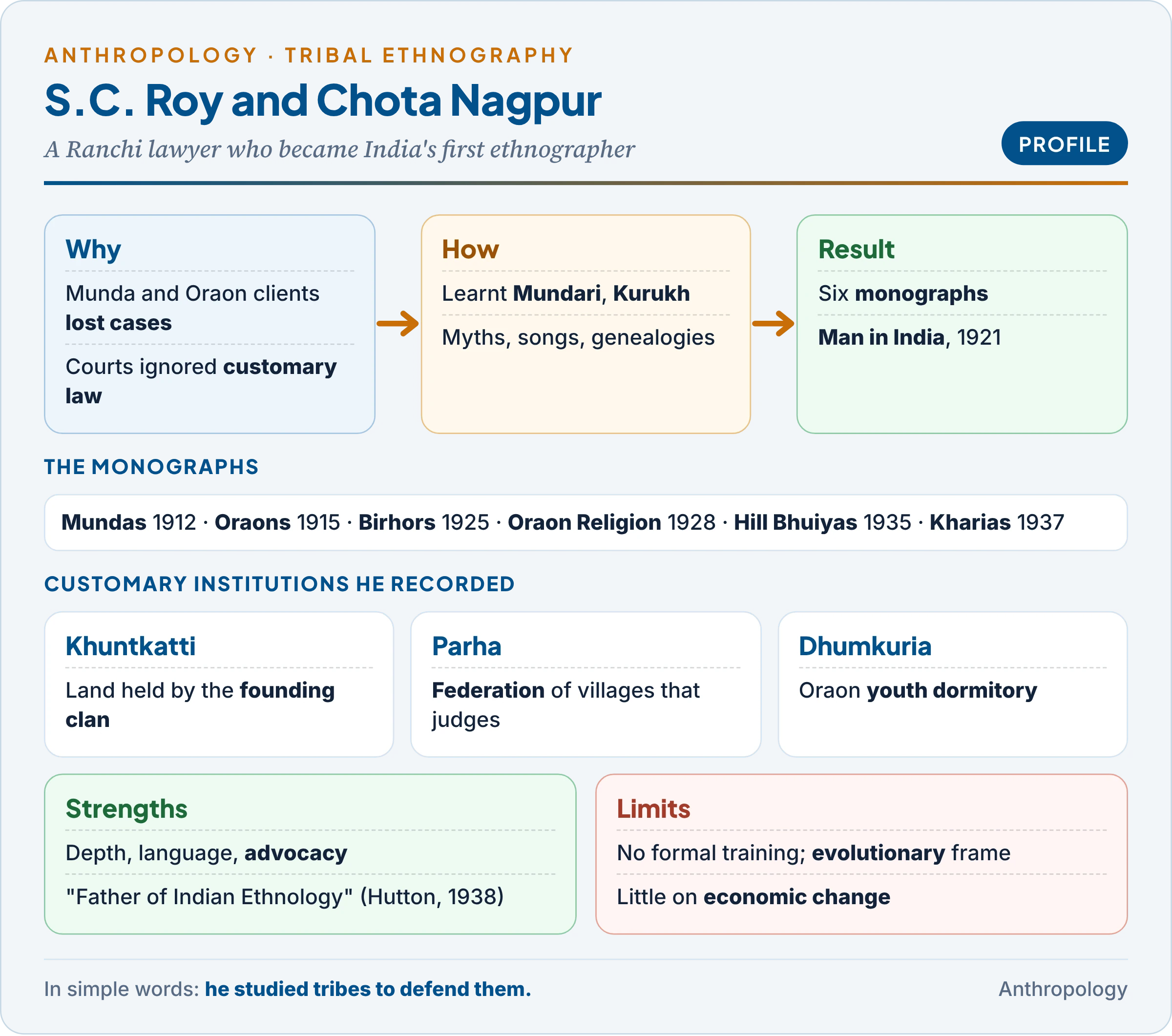
Method and outlook. Roy learnt Mundari and Kurukh, used informants’ own words and recorded myths, songs and genealogies. He worked within the evolutionary and diffusionist ideas of his time, searching for the origins of customs, but his religious analysis of the Oraon stressed “spiritism“, a belief in many spirits, rather than Tylor’s bare animism. He saw anthropology as serving nation-building and justice for the people studied.
Assessment (1996, 2014, 2018, 2023 questions): Roy’s strengths were depth, language and advocacy; he made the tribal monograph an Indian genre a decade before Malinowski’s Argonauts (1922). His limits were no formal training, an evolutionary frame, little attention to economic change under colonial rule, and a descriptive rather than analytical style. Compared with Elwin (2012 question), Roy was an insider-lawyer who wanted tribes protected within Indian society; Elwin was an outsider-missionary who first wanted them protected from it.
2.2 L.K.A. Iyer and B.S. Guha
- L.K. Ananthakrishna Iyer (1861–1937) wrote the Cochin and Mysore “Tribes and Castes” volumes and led the Calcutta department (summary and assessment in 4a).
- Biraja Sankar Guha (1894–1961) took a Harvard Ph.D. (1924) on the racial basis of the caste system, conducted the racial survey of the 1931 Census, and classified Indians into six racial elements (Negrito, Proto-Australoid, Mongoloid, Mediterranean, Western Brachycephals, Nordic; details and critique in 2a). As founder-Director of the Anthropological Survey of India (1945) he kept physical, cultural and prehistoric anthropology together in one institution.
- S.R.K. Chopra, with whom the 2025 question pairs Guha and Karve, built the Panjab University department (1960) into India’s centre of Siwalik palaeoanthropology; with Elwyn Simons he described Gigantopithecus bilaspurensis (1969), and he designed a pelvimeter to measure pelvic torsion in primates (1.2).
3. Tribal Policy: Elwin, Ghurye, Majumdar and Haimendorf
In simple words
At Independence the big question was what to do about the tribes. One scholar said they should be protected from outsiders who exploited them. Another said they were part of Hindu society and should be absorbed into it. A middle path, integration on the tribes’ own terms, became official policy.
3.1 Verrier Elwin: from protection to integration
Verrier Elwin (1902–1964), an Oxford-educated English clergyman, came to India in 1927, joined Gandhi’s circle, left the church and from 1932 lived among the Gond and Baiga of the Maikal hills with his colleague Shamrao Hivale. He became an Indian citizen in 1954.
- Monographs: The Baiga (1939), The Agaria (1942), Maria Murder and Suicide (1943), The Muria and their Ghotul (1947, the youth dormitory of Bastar), The Religion of an Indian Tribe (1955, the Saora), with many volumes of tribal myths, songs and art.
- Protection phase: in The Baiga he proposed a protected area, popularly called a “National Park“, where shifting cultivation and tribal custom would be allowed and outsiders kept out. The Loss of Nerve (1941) argued that contact with traders, landlords and missionaries demoralised tribes, and The Aboriginals (1943) graded tribes into four classes by degree of contact.
- Integration phase: after 1947 Elwin accepted that tribes must share in national development, but at their own pace. As Adviser for Tribal Affairs to the North-East Frontier Agency (NEFA, now Arunachal Pradesh) from 1954, he wrote A Philosophy for NEFA (1957).
- Policy influence (2026 question): Prime Minister Nehru‘s foreword to its second edition (1959) set out the five principles of tribal policy, the “Tribal Panchsheel“: develop along the lines of the people’s own genius; respect rights in land and forest; train tribal people to administer and develop their areas; avoid over-administration and work through tribal institutions; judge results by the quality of human character, not money spent. Elwin chaired the Committee on Special Multipurpose Tribal Blocks (report 1960) and wrote A New Deal for Tribal India (1963).
Elwin’s NEFA philosophy (2025 question): keep the Inner Line to stop outsiders buying land; post specially trained officers; use local languages and tribal dress, dance and craft as the base of a “cultural renaissance“; promote change in agriculture, health and education without forcing Hindu or Christian models; and govern through village councils (kebang of the Adi). His critics said it slowed development and kept NEFA isolated; his defenders point to the survival of tribal land and institutions in Arunachal compared with the land loss of central India.
3.2 Ghurye’s reply: tribes as “backward Hindus”
G.S. Ghurye (1893–1983), the Cambridge-trained founder of sociology at Bombay, replied in The Aborigines “So-Called” and Their Future (1943; later editions as The Scheduled Tribes, 1959).
- Argument: tribes such as the Bhil, Gond, Baiga and Santal had lived beside Hindus for centuries, worshipped Hindu deities, spoke regional languages and followed many Hindu customs. The census line between “animist” tribes and Hindus was arbitrary. Tribes were “backward Hindus“, imperfectly integrated sections of Hindu society.
- Policy: separate treatment would isolate them and, Ghurye feared, encourage missionary conversion and separatism; the remedy was integration into the Hindu peasantry with education and economic help.
- Evidence: Ghurye drew on census tables and colonial ethnography, not his own tribal fieldwork, which his critics noted.
3.3 The debate, fairly stated
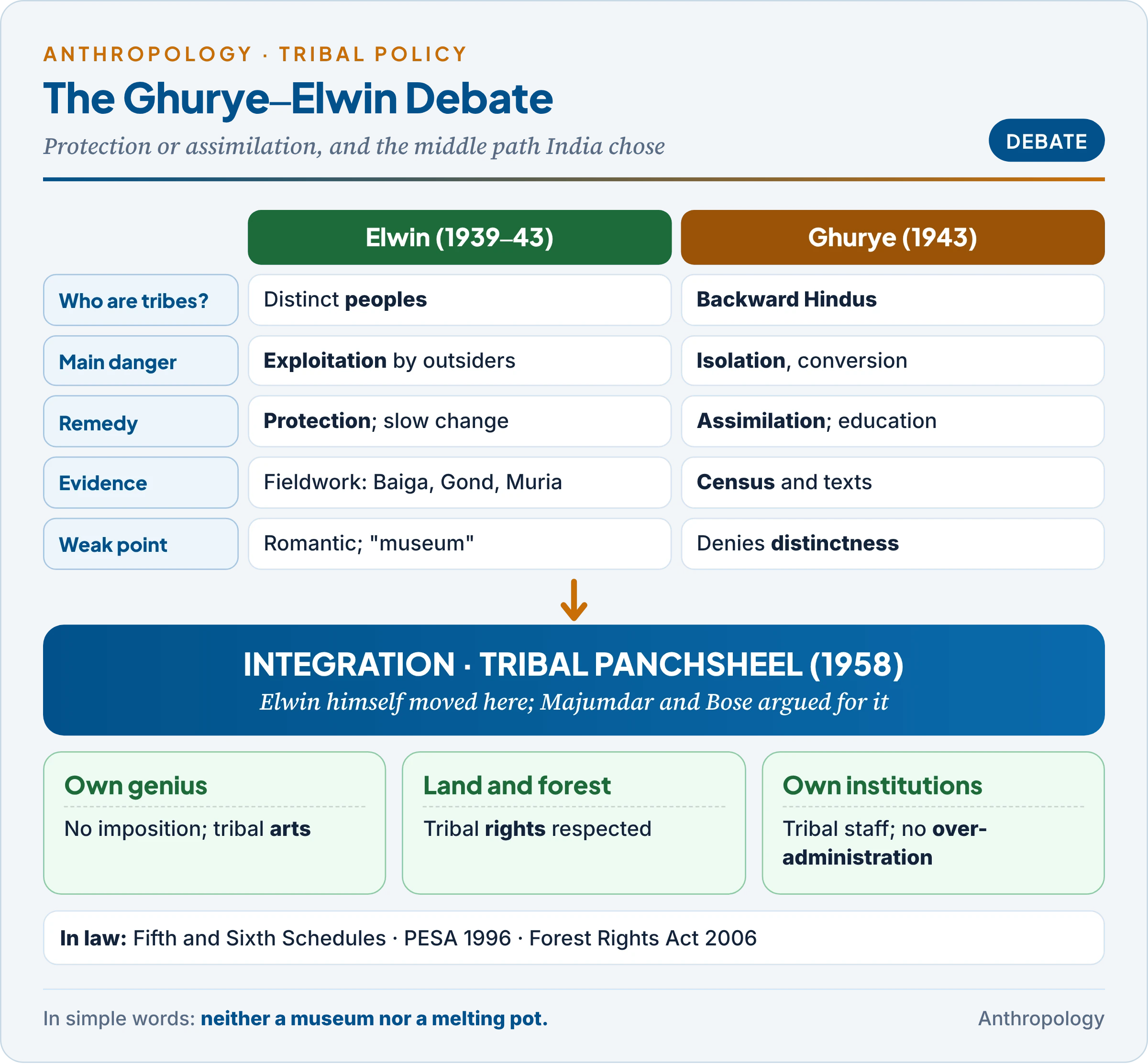
The 2015 and 2022 questions ask for the Ghurye–Elwin debate. The table puts the two positions side by side.
| Issue | Elwin (1939–43) | Ghurye (1943) |
|---|---|---|
| Who are the tribes? | Distinct peoples with their own cultures | Backward sections of Hindu society |
| Main danger | Exploitation by traders, landlords, officials, missionaries | Isolation and missionary-led separatism |
| Remedy | Protection; a protected area; slow, chosen change | Assimilation; education; inclusion in Hindu society |
| Evidence | Long fieldwork among Baiga, Gond, Muria | Census and textual data across India |
| Weak point | Romantic; risked keeping tribes like museum exhibits (Thakkar Bapa’s charge) | Denied tribal distinctiveness; Hindu-centric |
Both men were sincere and both sought tribal welfare; they differed over identity (are tribes separate peoples?) and means (protection or absorption). Each was partly right: Elwin about exploitation and the value of tribal culture, Ghurye about long interaction with Hindu society. The middle path was argued by D.N. Majumdar, who rejected both reserves and absorption in favour of integration with respect for tribal culture, by N.K. Bose, and by A.V. Thakkar (Thakkar Bapa) on the welfare side. It became policy through the Panchsheel, the Fifth and Sixth Schedules and, later, PESA (1996) and the Forest Rights Act (2006). Elwin himself moved to this position.
Common confusion
Was Elwin an “isolationist” all his life? No. His early writings (1939–43) argued for protection, including a protected area, because he saw contact destroying tribal life. After Independence he argued for integration at the tribes’ own pace and helped write the policy that India adopted. Calling him simply an isolationist ignores this change.
3.4 Christoph von Fürer-Haimendorf: the anthropologist-administrator
Christoph von Fürer-Haimendorf (1909–1995), an Austrian trained in Vienna and London, first studied the Konyak Nagas (The Naked Nagas, 1939). Interned as an enemy national in 1939, he was allowed by the Nizam of Hyderabad to work among the state’s tribes.
- Hyderabad monographs: The Chenchus (1943, forest food-gatherers), The Reddis of the Bison Hills (1945, shifting cultivators) and The Raj Gonds of Adilabad (1948, settled farmers), chosen to cover a range of economies.
- Adviser for Tribes and Backward Classes (1945–49): he helped set up a Chenchu reserve on the Amrabad plateau, drafted the Hyderabad Tribal Areas Regulation (1946) protecting Gond land and recognising tribal panchayats, began a Gond education scheme at Marlavai (1943) with primers in Gondi, and trained officers of a Social Service department in anthropology.
- North-East: studies of the Apa Tani (The Apa Tanis and their Neighbours, 1962), whose intensive wet-rice farming and isolation he contrasted with the land loss of the Gonds.
- Later work: restudies of Adilabad from the late 1970s, and Tribes of India: The Struggle for Survival (1982), which documented land alienation and the police firing on Gonds at Indravelli on 20 April 1981.
- Assessment (1995, 2016 questions): unmatched ethnographic detail and a rare record of applied results; weaker on theory, and his preference for protected areas drew the same criticism as Elwin’s.
4. The Lucknow and Ranchi Traditions: Culture Change and Applied Anthropology
In simple words
After the pioneers, Indian anthropologists asked how tribes were changing under contact with markets, missions, industry and the state, and how anthropology could help. Lucknow and Ranchi became centres for this work, and some scholars went further and ran development projects themselves.
4.1 D.N. Majumdar
Dhirendra Nath Majumdar (1903–1960), trained at Calcutta and Cambridge, built anthropology at Lucknow.
- Culture contact: A Tribe in Transition (1937) and The Affairs of a Tribe (1950) studied the Ho of Kolhan (Singhbhum) and how mining, missions and markets changed them; he explained Ho religion through bonga, an impersonal supernatural power.
- Tribal policy: The Fortunes of Primitive Tribes (1944) rejected both isolation and absorption and argued for integration with respect for tribal culture.
- Polyandry and villages: Himalayan Polyandry (1962) on the Khasa of Jaunsar-Bawar (Uttarakhand), and Caste and Communication in an Indian Village (1958) on Mohana near Lucknow.
- Holism: anthropometric and blood-group surveys (with the statistician P.C. Mahalanobis in the 1941 United Provinces survey); Races and Cultures of India; the textbook An Introduction to Social Anthropology (1956, with T.N. Madan); and the journal The Eastern Anthropologist (1947).
4.2 L.P. Vidyarthi
Lalita Prasad Vidyarthi (1931–1985), Majumdar’s student and a Chicago Ph.D. (1958), led anthropology at Ranchi.
- Concepts: the sacred complex of Gaya (1961) and the Nature-Man-Spirit complex of the Maler (Sauria Paharia) of the Rajmahal hills (1963), which linked ecology, society and the supernatural in tribal life (full treatment in 3.3, including the 1995 question on the Maler perception of habitat).
- Tribal studies: Cultural Contours of Tribal Bihar (1964); a large study of tribal leadership in Bihar; The Tribal Culture of India (1977, with B.K. Rai); Applied Anthropology in India (1968); The Rise of Anthropology in India (1978).
- Policy and profession: chaired the Planning Commission’s Task Force on the Development of Tribal Areas (1972); President of the IUAES (1973–78) and host of its world congress in New Delhi (1978).
Economic typology of tribes (2018 question). Vidyarthi and Rai classified Indian tribes into eight economic types. The table lists them.
| Type | Example |
|---|---|
| Forest hunting | Birhor, Hill Kharia, Chenchu, Raji |
| Shifting hill cultivation | Juang, Savara, Garo, many Naga groups |
| Plains settled agriculture | Munda, Oraon, Santal, Tharu |
| Simple artisan | Asur, Agaria (iron smelting), basket-makers |
| Pastoral | Toda, Bakarwal |
| Folk artist | Nat and other performing groups |
| Manual labour (agricultural and industrial) | Santal and Oraon in mines and tea gardens |
| White-collar and trader | Educated members of many tribes |
The scheme differs from older subsistence typologies, which stopped at hunting, shifting cultivation, settled farming, herding and crafts, by adding labour, performing and white-collar types: it recognises that tribes have entered the modern economy, and that a single tribe can contain several types.
Majumdar and Vidyarthi compared (2016 question): Majumdar studied culture contact and decline among single tribes, combined physical and social anthropology, and argued for integration; Vidyarthi studied civilizational linkages (sacred complex), ecology (NMS) and leadership, and made applied anthropology a planning tool.
4.3 P.K. Bhowmick and the Lodha
The 2024 question asks about P.K. Bhowmick and the Lodha.
- The problem: the Lodha of Midnapore (West Bengal), once forest hunter-gatherers, had been notified under the Criminal Tribes Act. Even after denotification (1952) they faced police surveillance, landlessness and social exclusion.
- Research: Bhowmick, a student of N.K. Bose, studied them for his doctorate, published as The Lodhas of West Bengal (1963), showing that “criminality” came from loss of forest livelihood, poverty and stigma, not from any inborn trait.
- Action: from 1955 he built an ashram-cum-research centre, Bidisa, with the Samaj Sevak Sangha (for economic work) and the Institute of Social Research and Applied Anthropology (for research). It settled Lodha families, opened a school for tribal children, provided land, livestock and crafts, and held annual seminars.
- Significance: an Indian example of action anthropology (the American Sol Tax’s idea of working with a community toward its goals), and of anthropology helping a stigmatised group move from “criminal tribe” to citizens. The Lodha are now listed among West Bengal’s Particularly Vulnerable Tribal Groups.
4.4 S.C. Dube among the tribes
S.C. Dube (1922–1996) began with The Kamar (1951), a study of a small hill tribe of Chhattisgarh, before turning to villages (Indian Village, 1955, on Shamirpet near Hyderabad; India’s Changing Villages, 1958). In 1972 he chaired the Expert Committee whose report shaped the Tribal Sub-Plan (9.1). His work on caste dominance and the village is in 3.2b and 5.1.
5. Tribes in Indian Civilization
In simple words
Several Indian anthropologists argued that tribes were never fully separate from Indian society. They traded with castes, served kings, shared gods and slowly took on caste ways, so tribes and castes should be studied together as parts of one civilization. Later scholars warned that this view can hide what is distinct about tribal societies.
5.1 N.K. Bose
Nirmal Kumar Bose (1901–1972), a Calcutta anthropologist, geographer and Gandhian (Gandhi’s secretary during the Noakhali tour of 1946–47), saw Indian unity as a civilizational fact.
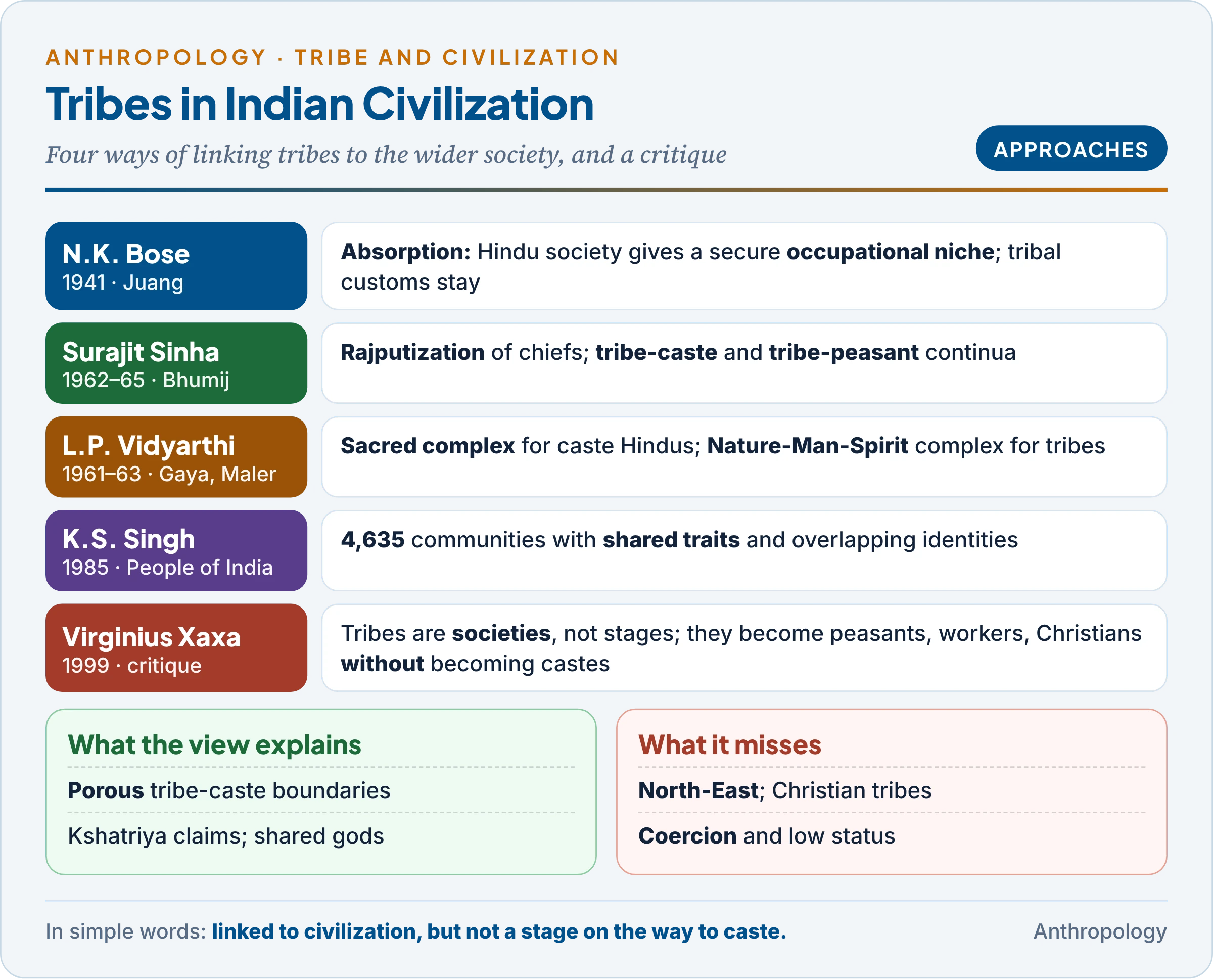
- “The Hindu Method of Tribal Absorption” (1941): from his study of the Juang of Odisha, he argued that Hindu society drew tribes in by offering economic security through a hereditary occupational niche in a non-competitive caste economy, while leaving their customs and gods largely untouched (3.2b).
- Hindu Samajer Gadan (1949), translated by André Béteille as The Structure of Hindu Society (1975): caste as a productive organisation that gave each group a protected monopoly, held together by Brahmanical ideology.
- Material culture and unity: the all-India survey of material traits (house types, ploughs, oil-presses, food) published as Peasant Life in India (1961) showed cultural zones cutting across languages, a “unity in diversity” of the peasant base.
- Public roles: Director of the Anthropological Survey (1959–64) and Commissioner for Scheduled Castes and Scheduled Tribes (1967–70); Tribal Life in India (1971).
- Assessment (2006, 2017, 2021 questions): Bose placed tribes inside Indian civilization and gave Indian anthropology an indigenous theory; critics say the absorption model is Hindu-centric and underplays coercion and the low status absorbed tribes received.
5.2 Surajit Sinha
Surajit Sinha (1926–2002), a Calcutta and Northwestern-trained anthropologist, was later Director of the Anthropological Survey (1972–75).
- Bhumij: his study of the Bhumij of Manbhum showed chiefs adopting a Rajput origin myth and Brahmin priests (Rajputization), while commoners stayed closer to tribal ways (“State Formation and Rajput Myth in Tribal Central India”, 1962).
- Continua: in 1965 he set out tribe-caste and tribe-peasant continua, treating tribes as parts of Indian civilization, linked to castes and peasants through state formation, trade and religion; tribal cultures were, as he put it in 1958, a dimension of the “little tradition” of Indian civilization.
- Critical appraisal (2026 question): the argument explains porous boundaries, Kshatriya claims and mixed groups well. But it is central-Indian and Hindu-centric; it fits the North-East poorly; and it can make tribal identity look like a stage on the way to caste. Virginius Xaxa (§5.5) objects that tribes have changed into peasants, workers and Christians without becoming castes (full treatment of the continuum in 3.2b).
5.3 K.S. Singh
Kumar Suresh Singh (1935–2006), an IAS officer of the Bihar cadre who learnt Mundari, joined history to anthropology.
- Birsa Munda: The Dust-Storm and the Hanging Mist (1966), a study of Birsa Munda’s movement (1874–1901) built from archives and Munda oral tradition.
- Tribal movements (2026 question): as editor of Tribal Movements in India (2 vols, 1982–83) he classified movements into those for political autonomy and statehood, agrarian and forest-based movements, Sanskritization and reform movements, and cultural movements over script and language. He divided colonial-era movements into three phases: 1795–1860, 1861–1920 and 1921–1947.
- People of India (2002 and 2020 questions): as Director-General of the Anthropological Survey he launched (2 October 1985) an all-India profile of every community, its biology, language, economy and links with others. The national volume (1992) counted 4,635 communities; the project ran to 43 volumes. Its message was interaction: communities share traits across religion, region and caste, and identities are overlapping, not sealed.
- Assessment: an unmatched database; critics found the community-by-community format descriptive and the “community” unit itself contestable.
5.4 B.K. Roy Burman
B.K. Roy Burman worked in the office of the Registrar General and with commissions on Scheduled Castes, Scheduled Tribes and backward classes. He argued that tribes should shape their own self-management rather than simply join a “mainstream“, worked for peace and self-governance in the North-East, and took up the cause of indigenous peoples at international forums.
5.5 Virginius Xaxa
Virginius Xaxa, an Indian sociologist, has been the sharpest critic of the continuum view.
- Tribes as societies: in “Transformation of Tribes in India: Terms of Discourse” (1999) he argued that tribes are whole societies, not stages of evolution; they change into peasants, workers or Christians while keeping a separate identity.
- State, Society and Tribes (2008) examined tribal exclusion in the post-colonial state.
- High Level Committee on the socio-economic, health and educational status of tribal communities, chaired by Xaxa, reported in May 2014, documenting land loss, displacement and gaps in health and education.
6. Caste and Indian Society
In simple words
Indian anthropologists turned caste from a colonial category into a field of careful study. Some read it through ancient texts, others through village fieldwork, kinship, power, religion and gender. Their concepts are now used across the world.
6.1 G.S. Ghurye on caste
- Caste and Race in India (1932): the six structural features of caste (segmental division, hierarchy, restrictions on food and social intercourse, civil and religious disabilities, restricted choice of occupation, endogamy) and a Brahmanical origin in the Gangetic plain (3.2a).
- Risley tested: he found the nasal-index link between caste and race only in Hindustan (4a).
- Institution-builder: head of the Bombay department (1924–59), he trained Srinivas, Karve, I.P. Desai, A.R. Desai and K.M. Kapadia; he is often called the father of Indian sociology.
6.2 Iravati Karve
Iravati Karve (1905–1970) took her doctorate in physical anthropology at Berlin (1930, under Eugen Fischer) and led anthropology at Deccan College, Pune.
- Kinship Organisation in India (1953): the first comparative study of Indian kinship. She held that three things are needed to understand any cultural fact in India: linguistic regions, caste and family. She divided India into four kinship zones.
The table compares her zones.
| Zone | Language base | Key rules |
|---|---|---|
| Northern | Indo-Aryan | Village and gotra exogamy; no cross-cousin marriage; bride from a distance; hypergamy; status gap between bride-givers and bride-takers |
| Central | Indo-Aryan (Rajasthan, Gujarat, Maharashtra, Odisha) | Northern pattern with southern features, such as MBD marriage among some Marathi castes |
| Southern | Dravidian | Cross-cousin (MBD) and elder sister’s daughter marriage; marriage close to home; affines are kin; matriliny among Nayar |
| Eastern | Austro-Asiatic (Munda, Khasi) | Tribal clans; bride-price; matriliny among Khasi |
The contrast between north and south shows how marriage rules shape the whole kinship system: the north disperses daughters to strangers, the south keeps them among known kin.
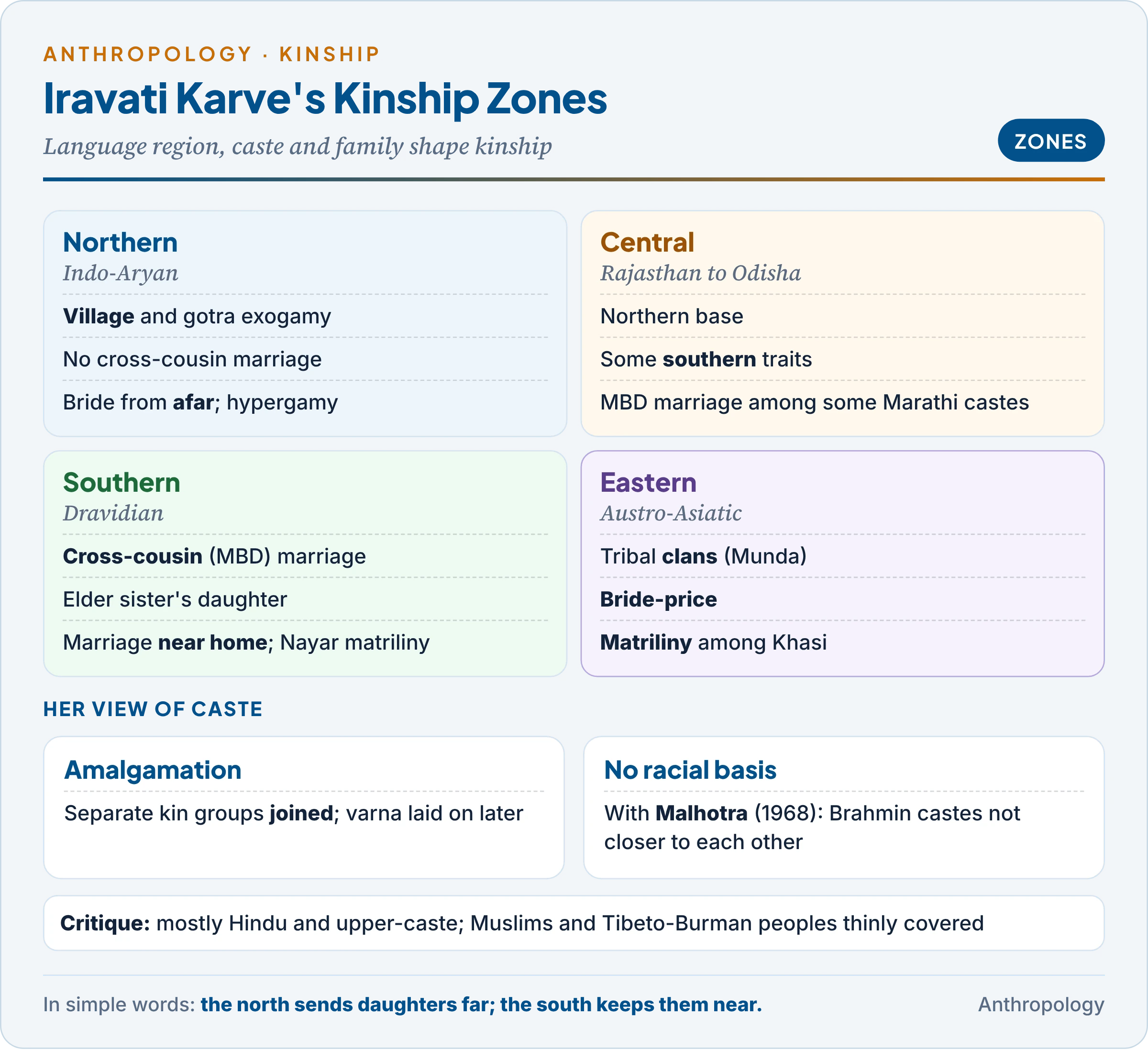
- Hindu Society: An Interpretation (1961): castes are separate groups, each an extended kin group, that came together by amalgamation rather than by splitting from four varnas; caste society is “a loose structure which could take on new units”. Varna was a later scheme laid over existing groups, not a product of race.
- Biology: with K.C. Malhotra (Current Anthropology, 1968) she showed through blood groups and measurements that Brahmin castes of Maharashtra were not closer to each other than to non-Brahmin castes, refuting a racial basis of caste.
- Literary work (2022 question): Yuganta (Marathi 1967; Sahitya Akademi Award, 1968) read the Mahabharata as a record of real people and their society, with sharp attention to the suffering of women (Gandhari, Kunti, Draupadi); she also wrote Marathi essays (Paripurti, Bhovra).
- Critique: her picture is largely Hindu, Sanskritic and upper-caste; Muslims, Tibeto-Burman peoples and landless groups are thinly covered, and her northern joint family is an ideal many households never matched.
6.3 M.N. Srinivas
M.N. Srinivas (1916–1999) studied under Ghurye at Bombay and under A.R. Radcliffe-Brown and E.E. Evans-Pritchard at Oxford (D.Phil. 1947).
- Religion and Society among the Coorgs of South India (1952): analysed ritual purity and pollution as a structure, and introduced Sanskritization (first called Brahminization).
- Rampura (fieldwork 1948 and 1952): the dominant caste (“The Dominant Caste in Rampura”, 1959); The Remembered Village (1976), rewritten from memory after his notes were burnt at Stanford in 1970.
- Caste in Modern India (1962) and Social Change in Modern India (1966): Westernization, caste in politics and the “vote bank“.
- British influence (2015 question): from Radcliffe-Brown, the idea of social structure and the function of ritual in maintaining it; from Evans-Pritchard, interest in meaning and comparison; from both, intensive fieldwork as the basis of knowledge, which led him to set the field view against Ghurye’s book view.
- Social mobility (2010 question): Sanskritization (positional mobility), the dominant caste as local model, Westernization and politics (full treatment in 3.2b and 5.3a). Critics such as Yogendra Singh and Dumont found the concepts descriptive and Sanskritization itself a Brahmanical model.
6.4 Other contributors to caste studies
| Scholar | Work (year) | Contribution |
|---|---|---|
| S.C. Dube | “Caste Dominance and Factionalism” (1968) | Power lies with dominant factions and individuals |
| André Béteille | Caste, Class and Power (1965) | In Sripuram (Thanjavur) caste, class and power were separating |
| T.N. Madan | Family and Kinship (1965); Non-Renunciation (1987) | Kashmiri Pandit household; Hindu values of the householder |
| Leela Dube | Matriliny and Islam (1969); “Caste and Women” (1996) | Muslim matriliny in Lakshadweep; women as gatekeepers of caste purity |
| K.S. Mathur | Caste and Ritual in a Malwa Village (1964) | Purity and pollution in village practice |
| Gopala Sarana | The Methodology of Anthropological Comparisons (1975) | Three kinds of comparison: illustrative, complete universe, hologeistic |
Leela Dube (1923–2012) also served on the committee that produced Towards Equality (1974), the first national report on the status of women, and showed through the “seed and field” image how patriliny and caste controlled women’s sexuality. Her work brought gender into the study of caste and kinship.
Common confusion
Is the “book view” the same as the Indological approach? Not exactly. The Indological approach (Ghurye, Karve) is a method: using Sanskrit texts as evidence alongside fieldwork. The book view is Srinivas’s name for the picture of society that results when texts are taken as a description of reality: four varnas, Brahmin supremacy, fixed occupations. Ghurye and Karve used texts critically, so their work is not simply the book view.
7. Assessment: What Indian Anthropologists Achieved
The 2005, 2006, 2007, 2013 and 1993 questions ask for an overall assessment.
- An Indian ethnographic record: from Roy’s Munda to the People of India, Indian scholars documented hundreds of communities in their own languages.
- Concepts used worldwide: Sanskritization, dominant caste, sacred complex, tribe-caste continuum, tribal absorption, field view.
- A civilizational frame: tribes, castes and villages studied as linked parts of one civilization (Bose, Sinha, Vidyarthi, Karve, K.S. Singh).
- Policy: Panchsheel, protective land law, the Tribal Sub-Plan, PVTG programmes and action projects such as Bidisa.
- Autonomy (2024 question): working with colonial tools, Indian anthropologists reversed their use: Roy defended tribal law in court, Ghurye and Karve refuted the race theory of caste, Bose and Sinha replaced “primitive isolates” with civilizational links, and Xaxa questioned the Hindu-centric frame itself.
- Limits: thin theory in much tribal work, a long Hindu and upper-caste bias in caste and kinship studies, and late attention to Dalits, Muslims, women and the North-East.
Key Terms
| Term | Meaning in simple words |
|---|---|
| Customary law | Unwritten rules a community follows, enforced by its own councils |
| Khuntkatti | Munda land held jointly by the clan that first cleared the forest |
| Parha | A federation of Oraon or Munda villages that settles disputes |
| Dhumkuria | The Oraon youth dormitory |
| Bonga | Majumdar’s term for the Ho idea of an impersonal sacred power |
| Isolation (protection) | Keeping outsiders out of tribal areas to stop exploitation |
| Assimilation | Absorbing tribes fully into the surrounding society |
| Integration | Joining national life while keeping one’s own culture |
| Tribal Panchsheel | Nehru’s five principles of tribal policy (1958) |
| Tribal absorption | Bose’s idea that Hindu society drew tribes in through secure occupations |
| Rajputization | Tribal chiefs claiming Rajput descent to gain status |
| Kinship zone | Karve’s region sharing language and marriage rules |
| Amalgamation | Karve’s view that castes formed by separate groups joining society |
| Book view and field view | Society as texts describe it versus as fieldwork finds it |
| Action anthropology | Research done with a community to help it reach its own goals |
| Denotified Tribe | A community once labelled “criminal” under colonial law |
| People of India | The Anthropological Survey’s profile of every Indian community |
Contemporary Developments
- Census 2027 and caste: the schedule notified on 14 August 2026 records “SC/ST/Caste“, the first full caste count since 1931; the debate between Ghurye’s census-based view of caste and Srinivas’s field view returns with national data.
- PVTG mission: PM-JANMAN (launched 15 November 2023) targets the 75 Particularly Vulnerable Tribal Groups, including communities first studied by Indian anthropologists: the Birhor (Roy), Chenchu (Haimendorf) and Lodha (Bhowmick).
- Denotified Tribes and the law: in Sukanya Shantha (3 October 2024) the Supreme Court struck down prison rules that treated Denotified Tribes as habitual offenders, the stigma Bhowmick fought among the Lodha.
- Xaxa Committee as benchmark: the 2014 High Level Committee report remains the main reference for land alienation, displacement and the health and education gaps of Scheduled Tribes.
Diagrams to Master
- Topic map: pioneers, tribal policy, applied tradition, civilizational view, caste and kinship.
- S.C. Roy: Ranchi lawyer, six monographs, customary institutions (khuntkatti, parha, dhumkuria), Man in India, strengths and limits.
- Ghurye–Elwin debate: two columns (identity, danger, remedy, evidence, weakness) leading to Panchsheel and the Schedules, PESA and FRA.
- Tribes in civilization: Bose, Sinha, Vidyarthi, K.S. Singh and Xaxa’s critique.
- Karve’s kinship zones: four zones with language base and marriage rules; amalgamation theory.
Revision Grid
| Scholar | Work (year) | Key idea |
|---|---|---|
| S.C. Roy | The Mundas and Their Country (1912); Man in India (1921) | First Indian tribal ethnography; customary law |
| B.S. Guha | 1931 Census racial survey | Six racial elements; founder of the Anthropological Survey |
| G.S. Ghurye | Caste and Race in India (1932); The Aborigines “So-Called” (1943) | Six features of caste; tribes as backward Hindus |
| D.N. Majumdar | A Tribe in Transition (1937); Himalayan Polyandry (1962) | Culture contact; integration |
| Verrier Elwin | The Baiga (1939); A Philosophy for NEFA (1957) | Protection, then integration; Panchsheel |
| N.K. Bose | “The Hindu Method of Tribal Absorption” (1941); Peasant Life in India (1961) | Absorption; cultural unity |
| C. von Fürer-Haimendorf | The Chenchus (1943); Tribes of India (1982) | Applied protection in Hyderabad |
| M.N. Srinivas | Coorgs (1952); “Dominant Caste” (1959) | Sanskritization; field view |
| Iravati Karve | Kinship Organisation in India (1953); Yuganta (1967) | Four kinship zones; amalgamation |
| S.C. Dube | The Kamar (1951); Indian Village (1955) | Tribe and village studies; Tribal Sub-Plan |
| L.P. Vidyarthi | The Maler (1963); The Tribal Culture of India (1977) | NMS complex; economic types |
| Surajit Sinha | “State Formation and Rajput Myth” (1962) | Rajputization; tribe-caste-peasant continua |
| P.K. Bhowmick | The Lodhas of West Bengal (1963) | Action anthropology with a denotified tribe |
| André Béteille | Caste, Class and Power (1965) | Caste, class and power separate |
| K.S. Singh | The Dust-Storm and the Hanging Mist (1966); People of India (1985) | Tribal movements; interlinked communities |
| Leela Dube | Matriliny and Islam (1969) | Gender in caste and kinship |
| Virginius Xaxa | “Transformation of Tribes” (1999) | Tribes change without becoming castes |
Previous Year Questions
Contributions of Indian anthropologists to tribal and caste studies
- 2026Write notes on: Kumar Suresh Singh’s contribution in studying tribal movements.
- 2026Write an account on the contribution of Verrier Elwin in developing policies for the tribal populations in post-independent India.
- 2026Make a critical appraisal of Surajit Sinha’s line of argument that tribes and castes may not be isolated social categories, but are a part of the great Indian civilization.
- 2025Highlight the significant contributions of B. S. Guha, Irawati Karve and S. R. K. Chopra to Indian Anthropology.
- 2025Write notes on: Verrier Elwin’s philosophy with respect to Arunachal Pradesh.
- 2024Discuss the contribution of P. K. Bhowmick in decriminalising the status of the Lodha tribe.
- 2023Critically evaluate the contributions of S. C. Roy to Indian anthropology.
- 2022Illustrate the contribution of Irawati Karve to Indian Anthropology. Make a special mention of her literary contribution.
- 2021Examine the contributions of S.C. Roy in highlighting the role of customary laws in tribal life.
- 2021Discuss the contributions of N.K. Bose in understanding tribal communities and their place in Indian civilization.
- 2020Write short note on the Contribution of K. S. Singh to Indian Anthropology in about 150 words.
- 2019Give an account of the contributions of Iravati Karve and B.S. Guha to the analysis of race and caste in India.
- 2018Compare and contrast the economic typology of tribes given by different anthropologists.
- 2018Discuss the contribution of S. C. Roy in the study of tribal cultures in India.
- 2017Discuss the contribution of Nirmal Kumar Bose to the understanding of Indian society.
- 2016Write about the contribution made by Christoph von Fürer-Haimendorf to tribal anthropology in India.
- 2016Compare the contribution of L.P. Vidyarthi and D.N. Majumdar to the study of Indian tribes.
- 2015Write a note in 150 words on Elwin Ghurye Debate on Tribes.
- 2015Discuss the contribution of M.N. Srinivas to the study of Indian society. Examine the influence of British social anthropologists on his ideas.
- 2014Discuss the contributions of S.C. Roy to understanding the tribes of India.
- 2013Examine anthropological contributions dealing with tribes and Indian civilization. (375 words).
- 2012Compare the contributions of S.C. Roy and Verrier Elwin to tribal ethnographies in India.
- 2011Assess the contribution of Verrier Elwin to Indian anthropology.
- 2010Assess the contributions of M.N. Srinivas towards Indian Anthropology in general. Add a note on his understanding in the context of studying social mobility in India.
- 2009Write a brief note on the contributions of Prof. L. P. Vidyarthi in the field of anthropology.
- 2007Highlight the contributions of Indian anthropologists in the understanding of tribal life.
- 2006Write a note on N.K. Bose’s contribution to Indian Anthropology.
- 2006Briefly discuss the contribution of Indian anthropologists during 20th century.
- 2005Give an account of the contributions of Indian scholars in the growth and development of Anthropology in India in early 20 th century.
- 2002Write a note on K.S. Singh’s project on the People of India.
- 2001Write a note on S.C. Roy’s contributions to anthropology.
- 1998Write a note on V. Elwin and his contributions contributions.
- 1996Estimate the contributions of S.C. Roy in the field of ethnography and his influence on the growth of Anthropology in India.
- 1995Write a note on Maler’s perception of the habitat.
- 1995Discuss the major contributions of von Furer Haimendorf to Indian Anthropology.
- 1993Critically discuss the major anthropological contributions in the study of Indian tribal population.
Related questions from other units
- 2024Unit 5.1: Compare and contrast the approaches of M. N. Srinivas and L. P. Vidyarthi to social change in village India.
- 2023Unit 3.2: “Tribes are backward Hindus.” Critically comment with reference to the contributions of G. S. Ghurye.
- 2022Unit 9.1: Discuss the views of G. S. Ghurye and Verrier Elwin on the approach towards tribal populations. What are the policies of the Government of India towards Indian tribal populations?
- 2022Unit 5.1: Assess the contributions of S. C. Dube in Indian village studies.
- 2010Unit 5.1: Discuss the contributions of S.C. Dube towards the understanding of the Indian village.
- 2010Unit 2: Discuss the relevance of Guha’s racial classification in the context of India’s ethnic groups.
- 2007Unit 2: Describe ethnic elements in the Indian population focussing either on Risley’s or Guha’s classification.
- 1991Unit 2: Write a note on Critical approach of Guha’s classification of ethnic elements in Indian population.
- 1989Unit 2: Write a note on : Guha’s classification on the ethnic composition of the people of India is not adequate. Comment.
More from Emergence and Growth of Anthropology in India: all notes of this unit · every PYQ of this unit · Anthropology Optional hub