

Constitutional position; Structure, recruitment, training and capacity building; Good governance initiatives; Code of conduct and discipline; Staff associations; Political rights; Grievance redressal mechanism; Civil service neutrality; Civil service activism.
This article: Good governance initiatives as they concern the civil services: meaning of good governance (World Bank, UNDP, 2nd ARC, SMART government, “minimum government, maximum governance”); the case for civil service reform; reform committees and commissions (1st ARC, 5th Pay Commission, Surinder Nath, Hota, 2nd ARC 10th and 12th Reports, Pay Commissions); performance management of civil servants (ACR to APAR, multi-source feedback, performance-related pay, Results-Framework Documents and PMES, outcome budgets); accountability and integrity (premature retirement under FR 56(j) and AIS rule 16(3), probity review, CVC and Lokpal, tenure and Civil Services Boards after T.S.R. Subramanian, responsibility and accountability, RTI); citizen-centric initiatives (Citizen’s Charters, Sevottam, Right to Services laws, CPGRAMS in brief, process re-engineering and deregulation, e-governance and Digital India, DBT and Aadhaar, PRAGATI, participation, Good Governance Index and NeSDA); Civil Services Day and the Prime Minister’s Awards; ethics and integrity initiatives; reform debates (generalist and specialist, tenure, politicisation, lateral entry, autonomy and accountability); theory lens. Recruitment, training, conduct and discipline, and neutrality are summarised with links to their own articles.
Official Syllabus: Paper II · Unit 2-08 Civil Services
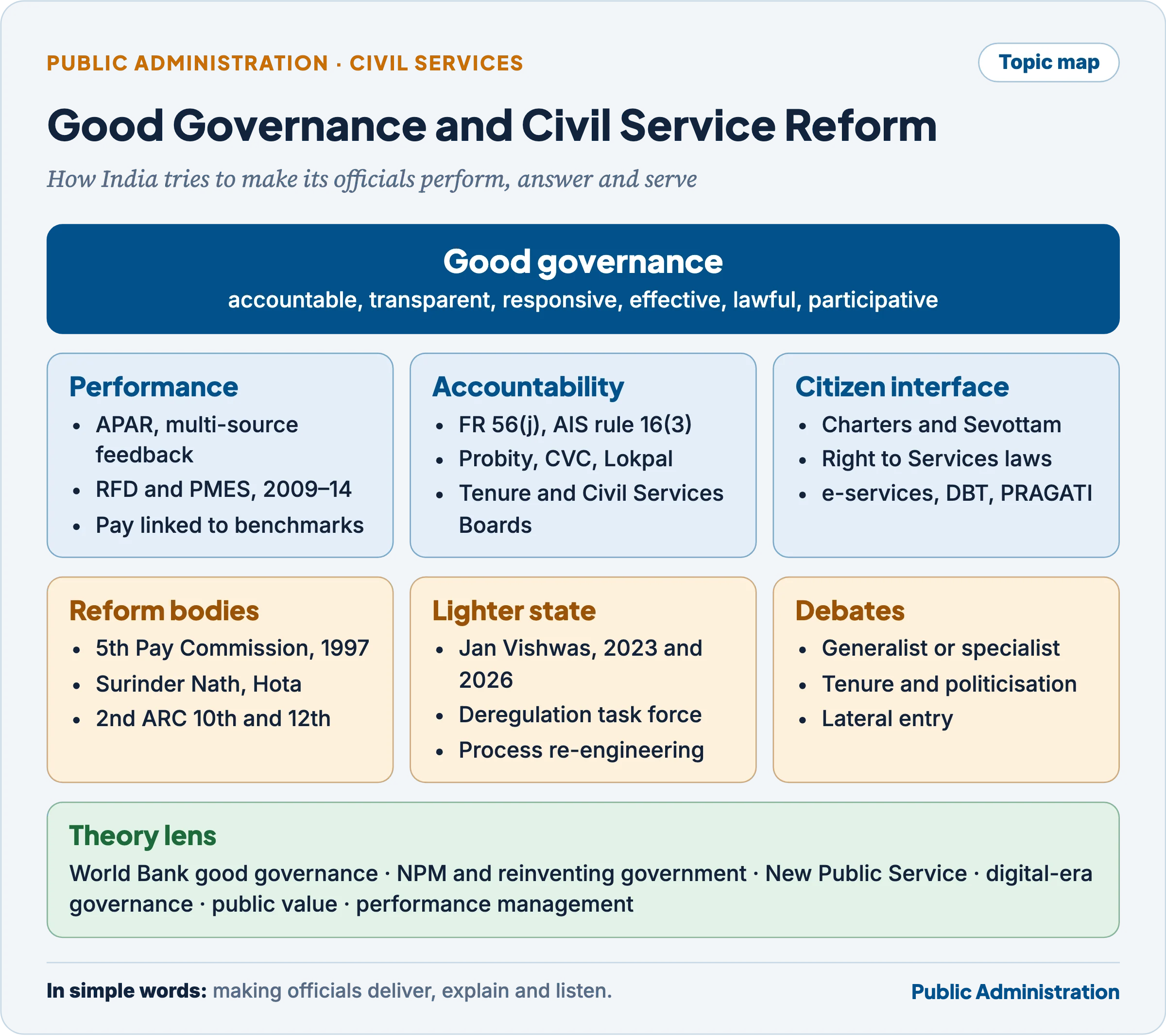
A civil service can be honest, well recruited and well trained and still fail the citizen: a pension that takes a year, a certificate that needs five visits, a project stuck for a decade between two departments. Good governance initiatives are the reforms that try to close this gap. They change how officials are judged (from following rules to delivering results), whom they answer to (not only superiors but citizens), and how the citizen meets the state (through charters, deadlines, portals and direct transfers).
In India these initiatives come from three sources: reform commissions (above all the Second Administrative Reforms Commission, 2005–09), pay commissions that tie pay to performance, and executive programmes such as Sevottam, e-governance, PRAGATI and deregulation. The Supreme Court has added its own push through T.S.R. Subramanian v. Union of India (2013) on tenure and written orders.
In simple words
Think of a railway ticket counter. The old way: the clerk follows the rulebook, the queue is long, and if you complain nothing happens. The good-governance way: a board says the ticket will take five minutes, you can book online instead, a complaint gets a number and a reply, the station is rated against others, and the clerk’s appraisal counts how the counter performed. Same clerk, different system.
1. Good Governance and the Civil Service
In simple words
“Governance” means how a country is actually run, by the government and by others. “Good” governance adds a test: is power used lawfully, openly, efficiently, fairly and answerably? Because civil servants do most of the actual governing, most good governance reforms end up as reforms of the civil service.
1.1 Meaning: from government to governance
- World Bank (1992). Governance and Development defined governance as “the manner in which power is exercised in the management of a country’s economic and social resources for development.” It named four areas of good governance: public sector management, accountability, a legal framework for development, and transparency and information.
- The Bank first used the idea in its 1989 report on Sub-Saharan Africa, which traced the region’s failure to a “crisis of governance”.
- Because its charter bars political interference, the Bank focused on the administrative and economic side: an efficient public service, sound budgeting, predictable law.
- UNDP (1997). Governance for Sustainable Human Development defined governance as the exercise of economic, political and administrative authority to manage a country’s affairs at all levels. It widened the idea beyond the state to civil society and the private sector, and listed characteristics later popularised by UNESCAP: participation, rule of law, transparency, responsiveness, consensus orientation, equity and inclusiveness, effectiveness and efficiency, and accountability.
- What “good” adds. Governance is a description; good governance is a normative standard (what governing ought to be) and an evaluative yardstick (indicators that rank countries and States). See the article on Challenges of Liberalisation, Privatisation and Globalisation; Good Governance for the full concept, its origins and its critics.
1.2 Why the civil service sits at the centre
- Delivery arm. Policies are announced by ministers but implemented by officials. A good law administered by an indifferent or corrupt office produces bad governance.
- Continuity. The permanent service carries institutional memory across elections; reforms that do not reach it do not last.
- Discretion. Officials exercise wide discretion in licensing, inspection, transfers and benefits. Robert Klitgaard, the American economist, in Controlling Corruption (1988), summed up the risk as Corruption = Monopoly + Discretion − Accountability. Good governance reforms try to cut monopoly (competition, choice, online routes), narrow discretion (rules, timelines, automation) and raise accountability (appraisal, disclosure, redress).
- A framework for civil service reform. “Good governance” became an umbrella that linked civil service reform (pay, recruitment, appraisal) to governance reform (law, participation, transparency). Administrative reform rationalises structures; governance reform changes the environment in which officials decide. The two have to move together.
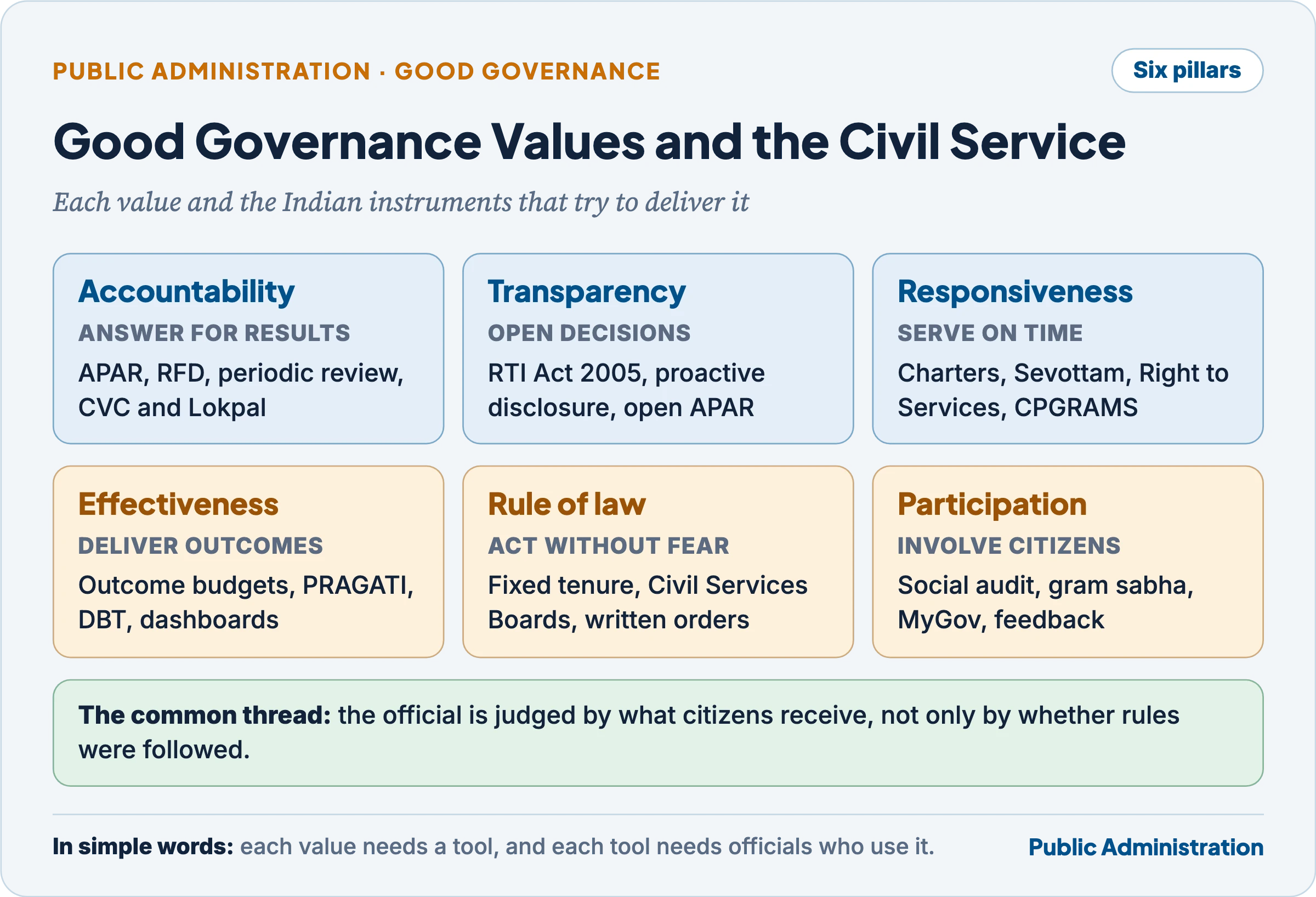
The table links each good governance value to the civil service instruments India uses for it.
| Value | What it asks of officials | Main Indian instruments |
|---|---|---|
| Accountability | Answer for results, not just for following procedure | APAR, periodic review, RFD (2009–14), CVC, Lokpal |
| Transparency | Decisions and reasons open to those affected | RTI Act 2005, proactive disclosure, open APAR |
| Responsiveness | Serve within a known time and standard | Citizen’s Charters, Sevottam, Right to Services laws, CPGRAMS |
| Effectiveness | Deliver outcomes at reasonable cost | Outcome budgets, PRAGATI, DBT, dashboards |
| Rule of law | Act lawfully and impartially without fear | Fixed tenure, Civil Services Boards, written orders |
| Participation | Involve citizens in decisions and monitoring | Social audit, gram sabha, MyGov, feedback systems |
Each value needs an instrument, but each instrument also needs a changed mindset. Most Indian failures in this area are not missing instruments but instruments that exist on paper and are worked as rituals.
1.3 Indian formulations
- 2nd ARC and “SMART” government. The Second Administrative Reforms Commission (chaired by M. Veerappa Moily, later V. Ramachandran) titled its 11th Report Promoting e-Governance: The SMART Way Forward (2008), using the idea of government that is Simple, Moral, Accountable, Responsive and Transparent. Its 12th Report called citizen-centric administration “the heart of governance”.
- Model Code of Governance and the Chief Ministers’ conference (1997). The conference of Chief Ministers in May 1997 adopted an Action Plan for Effective and Responsive Government: accountable and citizen-friendly administration (which produced Citizen’s Charters), transparency and right to information, and improving the performance and integrity of the civil services.
- Good Governance Day. Observed on 25 December since 2014, the birth anniversary of Atal Bihari Vajpayee; the Good Governance Index is released on this day.
- “Minimum government, maximum governance”. The slogan of the government that took office in 2014. It means a smaller, less intrusive state that governs more effectively:
- Less government: decriminalising minor offences (Jan Vishwas Acts), repealing obsolete laws, self-attestation instead of gazetted attestation, ending interviews for junior posts, disinvestment.
- More governance: technology-based delivery (DBT, e-services), real-time review (PRAGATI), outcome monitoring and competitive ranking of districts and States.
- A philosophy, not only a slogan: it echoes Osborne and Gaebler’s “steering rather than rowing” and the NPM idea that government should enable rather than produce.
- Limits: the Union government’s size has not shrunk much; centralisation of monitoring in the Prime Minister’s Office can increase “government” at the top; and a smaller state can mean thinner capacity where India is already under-staffed (police, health, judiciary).
Common confusion
Does “minimum government” mean fewer civil servants? Not necessarily. India has one of the lowest ratios of government employees to population among large economies, and many critics argue it is under-governed rather than over-governed. “Minimum government” in the Indian usage means fewer controls, permits and procedures over citizens and firms, not a smaller workforce. A State can need more teachers, nurses and police and still need fewer inspectors and licences.
1.4 Good governance and democratic governance
- Overlap. Accountability, rule of law, participation and transparency are democratic values; good governance adds effectiveness and efficiency.
- Tension. Some argue that efficient delivery can be achieved by technocratic, centralised means that bypass democratic deliberation (the “developmental state” model). Indian experience suggests the opposite risk too: democracy without capacity produces entitlements that are never delivered.
- India’s answer. The 73rd and 74th Amendments, RTI, social audit and Right to Services laws try to make delivery itself democratic: the citizen is a rights-holder and monitor, not just a beneficiary.
2. The Case for Civil Service Reform
In simple words
India’s top civil servants are among the most able in the world, yet citizens often see the service as slow, rule-bound and unaccountable. Reform starts by naming what is wrong: weak incentives, frequent transfers, opaque appraisal, too many controls, too little contact with citizens.
2.1 The ailments
The diagnoses of the 5th Pay Commission (1997), the Hota Committee (2004) and the 2nd ARC (2008) overlap closely. The main ailments are:
- Weak professionalism and capacity for an economy and society that have become far more complex.
- Incentives that do not separate the good from the bad: almost everyone is graded “outstanding”; promotion is near-automatic; the honest officer is rarely rewarded and the corrupt rarely punished.
- Outmoded rules and procedures that make the officer a checker of compliance rather than a solver of problems.
- Inconsistent promotion and empanelment for senior posts.
- Low transparency and weak accountability, with no real protection for whistle-blowers.
- Arbitrary and frequent transfers, used as reward and punishment, which destroy institutional continuity.
- Political interference and administrative acquiescence: officers who resist are moved; officers who comply are rewarded.
- Erosion of values and ethics, and a perception of a bloated, costly bureaucracy that gives taxpayers poor value.
2.2 Red tape and the “inspector raj”
- Red-tapism (excessive formality, multiple approvals, insistence on paper) is a symptom rather than a cause: it grows when officials are judged on avoiding mistakes rather than on results, and when trust between state and citizen is low.
- From “inspectors and controllers” to “enablers and facilitators”. After 1991 the state was meant to shift from licensing to regulating and facilitating. The shift is incomplete:
- Signs of change: single-window clearances, self-certification and third-party certification, deemed approvals after a deadline, computerised random inspections, decriminalisation of minor offences, faceless tax assessment.
- Signs of continuity: layers of state-level permissions (fire, pollution, land-use change, building plans), discretionary inspection powers, and a vigilance culture that makes officers prefer “no” to “yes”.
- The Collector and district officers remain both regulators and development managers; their training and incentives still reward control more than facilitation. See the article on District Collector.
2.3 Components of civil service reform
The table sets out the components of a full reform package and India’s main measures under each.
| Component | Aim | Indian measures |
|---|---|---|
| Size and structure | Right-size; cut redundant layers | 5th Pay Commission’s 30% cut target (not achieved); delayering and desk system; 2nd ARC 13th Report on fewer levels |
| Recruitment | Merit, diversity, outside talent | CSE reforms, lateral entry 2018–24 (see the article on Civil Services Structure and Recruitment) |
| Capacity building | Skills for changing roles | National Training Policy, Mission Karmayogi (see the article on Training and Capacity Building) |
| Performance and promotion | Reward results, remove non-performers | APAR, Very Good benchmark, MSF, FR 56(j) reviews |
| Professionalism | Domain depth, neutrality | Domain assignment proposals, Civil Services Boards |
| Accountability | Answer to citizens and law | RTI, charters, Right to Services, CVC, Lokpal |
| Modernity | Technology-enabled government | e-Office, e-services, DBT, dashboards |
The table shows that India has acted on almost every component but deeply on few. Technology-based delivery and appraisal disclosure moved far; structural reform, domain specialisation and statutory tenure have moved little.
2.4 From the old to the new civil servant
Reform literature contrasts the traditional mandarin with the public manager that reform aims to create.
| Feature | Traditional civil servant | Reformed civil servant |
|---|---|---|
| Commitment | To the service | To the public and to results |
| Core values | Integrity, neutrality | Integrity, impartiality and delivery |
| Approach to precedent | Follower | Creator of new solutions |
| Work | Policy and ministerial support | Moves between operations, policy and specialist roles |
| Aim | Advise on a policy area | Deliver the outcomes of a policy area |
| Experience | Within government | Includes spells outside government |
| Training | Induction-heavy | Career-long learning |
| Orientation | Status quo, monopoly | Change, competition |
The shift is from a status-oriented to a change-oriented service. It does not drop integrity or neutrality; it adds delivery as a core value.
2.5 What reform needs to succeed
- Political support and will at the highest level, sustained beyond one government.
- Management capacity to implement reforms inside departments.
- Support from civil servants themselves, who must see reform as improving their work rather than as punishment.
- Safety nets for those adversely affected (redeployment, voluntary retirement).
- Fit with the country’s political and institutional environment: copying New Zealand or Britain wholesale does not work.
- Communication among ministers, officials, unions and citizens.
3. Reform Committees and Commissions
In simple words
India does not lack advice on reforming its civil service. Commission after commission has said similar things: judge officers by results, protect them from arbitrary transfers, weed out the incompetent and the corrupt, and make them answer to citizens. The problem has been carrying the advice out.
3.1 Before 2000
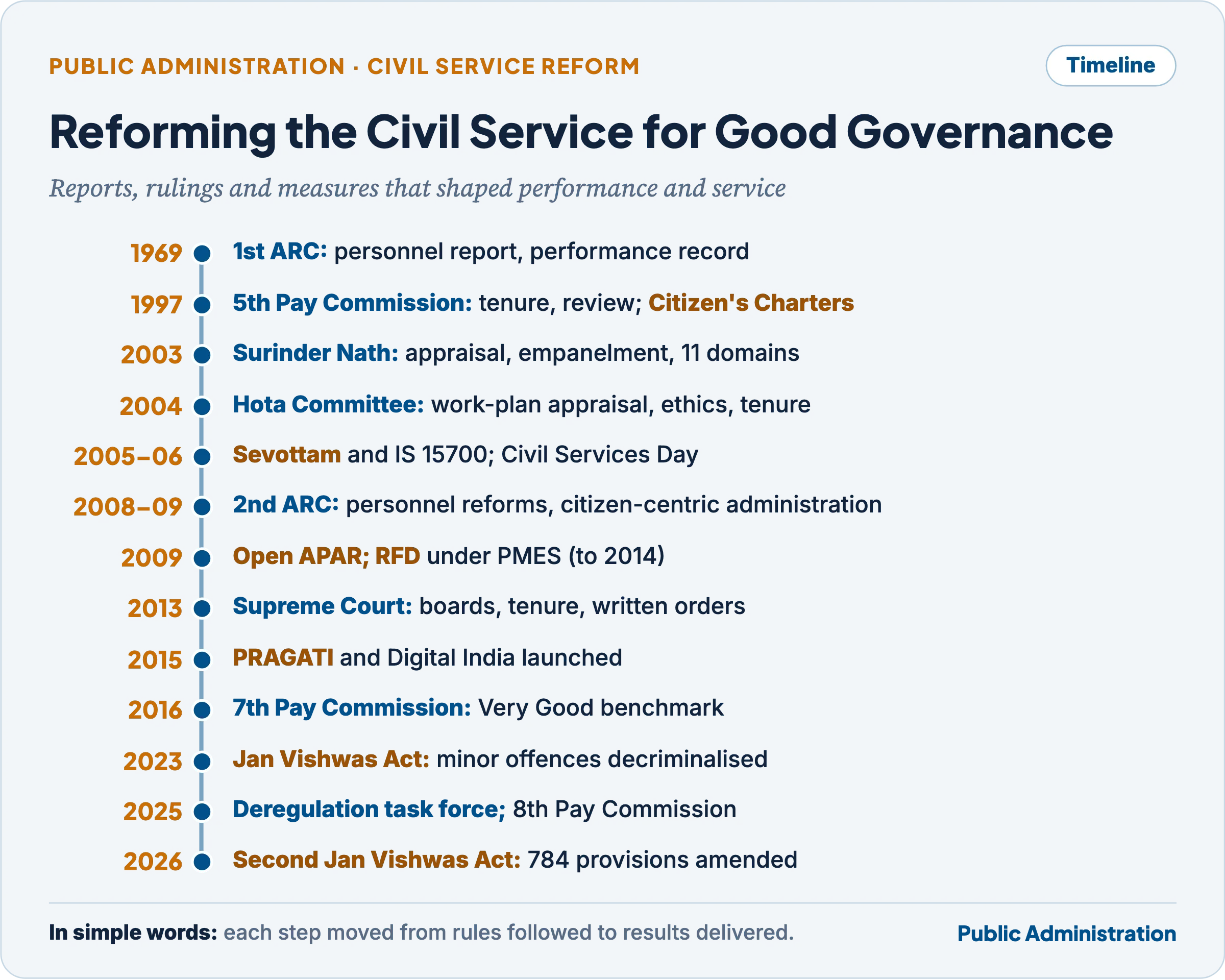
- 1st Administrative Reforms Commission (1966–70). Its Report on Personnel Administration (1969) proposed that the confidential report become a performance record, with officers submitting a brief account of their own work; it also proposed functional specialisation and a senior management pool (see the article on Civil Services Structure and Recruitment).
- 5th Central Pay Commission (1997), chaired by Justice S. Ratnavel Pandian, devoted a whole part of its report to public service management:
- Downsizing: a 30% cut in staff over ten years and abolition of about 3.5 lakh vacant posts;
- Tenure: minimum tenures and a Civil Services Board to clear premature transfers;
- Appraisal: an open ACR and a five-yearly (quinquennial) review of Group A officers, which could lead to premature retirement;
- Transparency: a Right to Information Act and revision of the Official Secrets Act;
- Delayering: fewer levels, “level-jumping” of files, and desk officers in place of large sections;
- Assured Career Progression to deal with stagnation.
- Conference of Chief Ministers (May 1997): the Action Plan on accountable and citizen-friendly administration, transparency, and performance and integrity of the civil services.
3.2 2003–2004: Surinder Nath and Hota
- Surinder Nath Committee (2003). The Group to Review the System of Performance Appraisal, Promotion, Empanelment and Placement for the All India Services and other Group A Services, chaired by Surinder Nath:
- replace the trait-based ACR with an appraisal linked to work targets, including self-appraisal;
- make empanelment for senior posts more objective;
- assign officers to domains: it listed 11 domains (for example, agriculture and rural development, social sectors, public finance, energy and environment, industry and trade, personnel and general administration), with each officer placed in up to three.
- Hota Committee on Civil Services Reforms (2004), chaired by P.C. Hota, former UPSC Chairman, appointed on 3 February 2004:
- Performance: replace the ACR with a performance assessment against agreed work plans; publish an annual State of Governance Report benchmarking States and departments;
- Domain assignment and encouragement of mid-career study and lateral movement to NGOs and the private sector;
- Tenure: a statutory minimum tenure and an inquiry before any premature transfer, through a comprehensive Civil Services Law;
- Ethics: a Code of Ethics and a Model Code of Governance benchmarking standards of service;
- Protection of honest officers against malicious prosecution, through amendments to the Prevention of Corruption Act and Section 197 of the then Code of Criminal Procedure (now Section 218 of the Bharatiya Nagarik Suraksha Sanhita, 2023);
- Recruitment: entry age 21–24 and aptitude and leadership tests.
- Yugandhar Committee (2003) on in-service training of IAS officers recommended mid-career training at the 12th, 20th and 28th years (see the article on Training and Capacity Building).
3.3 The 2nd ARC: the most complete blueprint
Tenth Report: Refurbishing of Personnel Administration: Scaling New Heights (November 2008). Its central idea is to move from appraisal (a yearly rating) to performance management (a year-round system linking individual targets to organisational goals).
- Appraisal reform: job-specific forms; a work plan and mid-year review for all services; clearer rules for numerical grading; making appraisal consultative and open on the AIS pattern.
- Performance agreements: each Secretary to sign an annual agreement with the Minister, with verifiable targets, assessed by a third party and reported to the legislature through the outcome budget.
- Two intensive reviews: at 14 years (to tell the officer strengths and weaknesses and plan training) and at 20 years (to decide fitness to continue); those found unfit at 20 years should leave. New recruits would be appointed for 20 years in the first instance.
- Domain assignment after 13 years of service by an independent authority; no desk jobs in the first 8–10 years.
- Senior Management Pool of all Joint Secretary-level and higher posts, some open to outsiders.
- A Civil Services Law under Article 309 stating values and a code of ethics, run by a Central Civil Services Authority (five members, appointed on the advice of the Prime Minister and the Leader of the Opposition) to assign domains, fix tenures, prepare panels and report to Parliament.
- Faster discipline: a summary disciplinary procedure replacing court-style inquiries, linked to its earlier recommendation (4th Report) to repeal Article 311.
- Performance-related incentives and national, State and district awards.
Twelfth Report: Citizen Centric Administration: The Heart of Governance (February 2009). It endorsed the Sevottam model, proposed a seven-step model for Citizen’s Charters, called for grievance redress with compensation, single-window delivery, and citizen feedback in appraisal (see Section 6).
Fourth Report: Ethics in Governance (January 2007) recommended a national Lokpal (it called it the Rashtriya Lokayukta), a code of ethics for ministers and civil servants, confiscation of illegally acquired property, and treating “abuse of authority unduly favouring or harming someone” as an offence.
Eleventh Report: Promoting e-Governance: The SMART Way Forward (December 2008) insisted that government process re-engineering must precede automation, and proposed an e-governance law and common service centres.
3.4 Pay Commissions and performance
- 6th Central Pay Commission (2008), chaired by Justice B.N. Srikrishna, proposed a Performance Related Incentive Scheme (PRIS) as variable pay over and above salary. It was never generally implemented.
- 7th Central Pay Commission (2015), chaired by Justice A.K. Mathur: raised the benchmark for promotion and for upgrades under the Modified Assured Career Progression (MACP) scheme from “Good” to “Very Good”, and recommended withholding annual increments of employees who fail to meet the benchmark for MACP or promotion within their first 20 years. The government accepted both in July 2016. It also recommended performance-related pay linked to results frameworks and reformed appraisals.
- 8th Central Pay Commission, notified on 3 November 2025, chaired by Justice Ranjana Prakash Desai, is to report within 18 months. Its terms of reference ask it to design an emolument structure that promotes “efficiency, accountability and responsibility” and to recommend a productivity- and performance-linked incentive scheme.
3.5 What has been implemented?
The table sorts the major recommendations by their fate.
| Status | Recommendations |
|---|---|
| Largely implemented | Open APAR with self-appraisal and disclosure; online appraisal; RTI; Lokpal; e-services and DBT; minimum tenure rules for the AIS (2014); periodic reviews under FR 56(j) and AIS rule 16(3); “Very Good” benchmark |
| Partly implemented | Domain-based empanelment (informal); lateral entry (63 appointments, then halted in 2024); Civil Services Boards (set up, but often overridden); citizen’s charters (formal, weakly followed) |
| Not implemented | Civil Services Law and Central Civil Services Authority; 14- and 20-year reviews with exit; performance agreements with third-party assessment (RFDs ended); repeal of Article 311; performance-related pay at scale; State of Governance Report |
The pattern is clear: India has implemented reforms that add information (disclosure, dashboards, portals) and reforms that strengthen the executive’s hand (reviews and premature retirement), but has resisted reforms that would bind the executive (statutory tenure, an independent authority, a civil services law). This is why the 2nd ARC’s proposals look “radical yet implementable” on paper and remain largely unimplemented in practice.
4. Performance Management of Civil Servants
In simple words
A school report card that every child sees and that rates almost everyone “excellent” is useless. Performance management tries to fix this for officers: agree targets at the start of the year, check progress midway, rate honestly at the end, reward or correct, and train for the gaps.
4.1 Appraisal and performance management
- Performance appraisal is the periodic evaluation of an individual, mainly for promotion, confirmation and rewards.
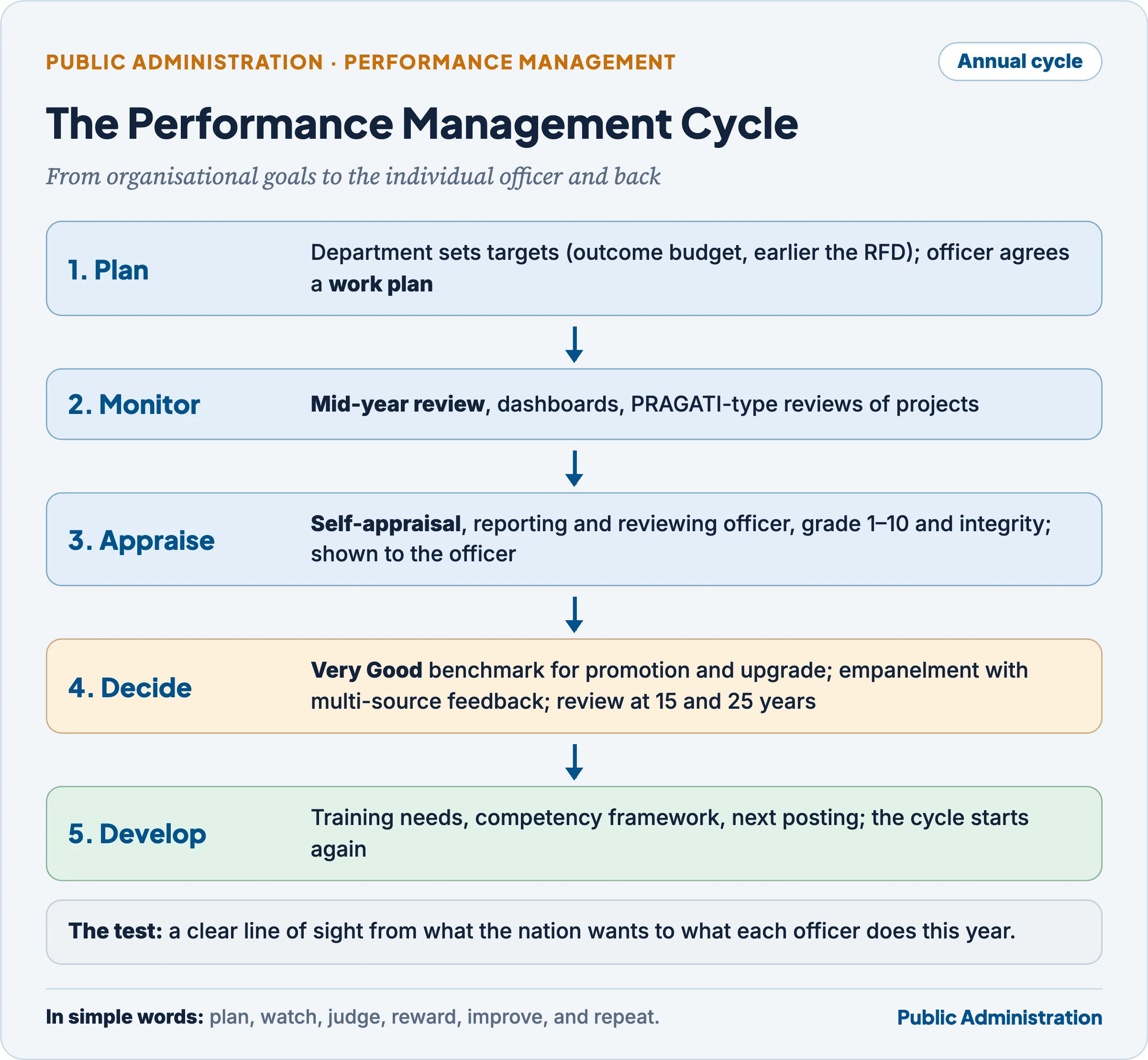
- Performance management is a continuous cycle that links organisational goals, team targets and individual work plans, with monitoring, feedback, rewards and development. Appraisal is one input into it.
- Why the distinction matters in India. The ACR system rated individuals without asking what their departments achieved; the RFD system rated departments without linking results to individual careers. Neither closed the loop. See the article on Discipline, Performance Appraisal, Employer–Employee Relations and Grievance Redressal for methods of appraisal and their errors.
4.2 From ACR to APAR
- The Annual Confidential Report (ACR), inherited from colonial practice, was secret and trait-based. Only adverse remarks were communicated. It was subjective, delayed, inflated, and served as a tool of control rather than development.
- AIS (Performance Appraisal Report) Rules, 2007 replaced the ACR for IAS, IPS and Indian Forest Service officers with a report containing a work plan, self-appraisal, numerical grading on a 1–10 scale and an assessment of integrity.
- Dev Dutt v. Union of India (2008). The Supreme Court held that every entry in the report must be communicated, not only adverse ones, because an undisclosed “Good” can block promotion where the benchmark is “Very Good”; non-disclosure violates fairness under Article 14.
- DoPT Office Memorandum of 14 May 2009 renamed the report for central services the Annual Performance Assessment Report (APAR) and required the full report, including grade and integrity remarks, to be disclosed, with a right of representation.
- Online appraisal. The SPARROW (Smart Performance Appraisal Report Recording Online Window) system moved the APAR online, with timelines for each stage, first for the All India Services and then for other services.
- What remains wrong. Disclosure made reporting officers more cautious, and grade inflation survived: with most officers rated 9 or 10, the APAR barely distinguishes the good from the excellent. A parliamentary standing committee (2017) even suggested partial disclosure, on the armed forces pattern, to restore candour.
4.3 Multi-source (360-degree) feedback
- The problem. Empanelment for Joint Secretary, Additional Secretary and Secretary posts in the Union rested almost entirely on inflated APARs.
- The response. From about 2015–16 the government added multi-source feedback (MSF), collecting confidential views from seniors, peers, juniors and outside stakeholders, alongside the service record and vigilance status. It was first widely reported in the empanelment of Secretaries in 2016. The government has described it to Parliament as a “360-degree appraisal”.
- Criticism.
- The Department-related Parliamentary Standing Committee on Personnel (report of August 2017) found the system “opaque, non-transparent and subjective”, without statutory backing, and open to bias from subordinates who had been disciplined; it asked for notified guidelines.
- Officers who were not empanelled could not know why, which revived the secrecy that Dev Dutt had ended.
- Non-IAS services complained that the empanelment machinery was dominated by one service.
- Making it fairer. Notified criteria; feedback from a minimum number of respondents across levels; trained assessors; weighting that limits single-source bias; a summary shared with the officer; and use for development as well as selection.
4.4 Pay and performance
- Seniority versus merit. Indian promotion is formally seniority-cum-merit, but in practice seniority dominates and promotion is close to automatic if the benchmark is met.
- Performance-related pay has been recommended by the 6th and 7th Pay Commissions and the 2nd ARC, and is in the 8th Pay Commission’s terms of reference. Its practical form so far is negative: the “Very Good” benchmark and withholding of increments (2016), rather than bonuses for high performers.
- Why it is hard in government. Public outputs are often joint, long-term and hard to measure; unions resist individual differentials; and if appraisal itself is inflated, pay linked to it rewards everyone.
4.5 Performance of departments: RFD, PMES and after
- PMES and RFDs (2009–2014). After the President’s address of June 2009 promised mechanisms for performance monitoring within 100 days, the Prime Minister approved the Performance Monitoring and Evaluation System (PMES) in September 2009. Its features:
- Each department prepared an annual Results-Framework Document (RFD): objectives with weights, actions, success indicators and targets on a five-point scale (excellent to poor).
- A Performance Management Division in the Cabinet Secretariat, headed by Prajapati Trivedi as Secretary (Performance Management), ran the system; a non-government task force of former secretaries and experts vetted targets and results.
- By 2011 about 80 departments and some 800 responsibility centres under them prepared RFDs. A composite score for each department allowed comparison.
- Sevottam compliance (citizen’s charter and grievance redress) was built into every RFD as a mandatory objective.
- Departments on average achieved about 80% of their targets.
- Weaknesses. Targets were set by the departments themselves and often modest; results were not made public and were not linked to postings or pay; the planned incentive scheme for departments was approved in principle but never implemented.
- End of the system. The government that took office in 2014 stopped asking departments for RFDs after 2014–15 without formally abolishing PMES. Monitoring moved to PMO-led reviews, PRAGATI, scheme dashboards and NITI Aayog’s Output–Outcome Monitoring Framework (from 2017–18) for central schemes.
- Outcome budgets. Introduced in 2005–06, they present scheme allocations alongside expected physical outputs and outcomes. They are the logical partner of performance agreements, but have often listed outputs (kilometres built, beneficiaries enrolled) rather than outcomes (lives changed). See the article on Budgets: Types, Forms and the Budgetary Process.
- Competitive benchmarking. The Aspirational Districts Programme (January 2018) and Aspirational Blocks Programme (January 2023) rank units monthly on key indicators of health, education, agriculture, infrastructure and financial inclusion. This shifts evaluation from individual officers to programme outcomes in a territory, judged against peers.
Indian Connect — Did PMES transform bureaucratic culture?
- For: for the first time Indian departments had a bottom line: a weighted score of what they had promised and delivered. Officers had to prioritise, and citizen-facing standards entered every department’s targets through Sevottam.
- Against: the system stayed inside government. Without public results, consequences for careers or citizen voice, it became a reporting exercise, and it ended with a change of government. Culture changes when incentives change, and PMES never changed incentives.
- Lesson: performance systems survive only if they are owned by the political leadership, linked to careers, and visible to citizens.
4.6 Limits of measuring performance
- What gets measured gets managed, and gamed. Targets invite gaming: hitting the number while missing the point (closing grievances without fixing them, enrolling beneficiaries who never receive the service).
- Goal displacement. Measurable tasks crowd out important but unmeasurable ones such as policy advice, coordination and preventing crises.
- Attribution. Outcomes depend on many agencies, on States and on events no officer controls.
- Performance management before “taking out deadwood”. Premature retirement is fair only if the system that judges officers is credible. If appraisal is inflated and opaque, retiring officers as “ineffective” looks arbitrary; a working performance management system has to come first, so that exit follows evidence rather than impressions.
5. Accountability and Integrity Mechanisms
In simple words
Accountability means someone can ask an officer “why?” and something follows from the answer. In India this works through superiors (appraisal and review), watchdogs (CVC, Lokpal, CAG), courts, and citizens (RTI, complaints). The newer tools also protect honest officers from being punished for doing their job.
5.1 Responsibility and accountability
- Responsibility is the duty an officer owes: to perform the task, follow the law, use judgment. It can be internal (conscience, professional ethics) as well as external.
- Accountability is answerability with consequences: an obligation to explain one’s actions to someone with power to reward or sanction.
- Both are needed. Carl Friedrich (1940) argued that responsibility in a complex state depends on professional standards and inner conscience; Herman Finer (1941) answered that only external control by elected representatives can make officials accountable. Indian reforms combine both: codes of ethics and training (Friedrich) with appraisal, audit, RTI and courts (Finer). See the article on Accountability and Control.
- In Indian administration: ministerial responsibility to Parliament shields officials (anonymity), but RTI, social audit, Right to Services laws and the citizen’s charter add a direct line of answerability to citizens.
5.2 Premature retirement in public interest
- The rules:
- Fundamental Rule 56(j) lets the government retire a Group A or B officer who entered service before 35 after he attains 50 years, and others after 55, by giving three months’ notice (or pay in lieu), if it is in the public interest.
- Rule 48 of the CCS (Pension) Rules, 1972 (now carried into the CCS (Pension) Rules, 2021) allows similar retirement after 30 years of qualifying service.
- Rule 16(3) of the All India Services (Death-cum-Retirement Benefits) Rules, 1958, amended on 31 January 2012, provides for review of IAS, IPS and Forest Service officers after 15 years of qualifying service and again after 25 years or at age 50, with retirement in public interest on three months’ notice, in consultation with the State.
- Grounds. The two purposes are to weed out officers of doubtful integrity and those who have become ineffective. The review looks at the entire service record, with more weight on recent years.
- Not a punishment. In Baikuntha Nath Das v. Chief District Medical Officer (1992) the Supreme Court held that compulsory retirement in public interest is not a penalty and carries no stigma; it is based on the government’s subjective satisfaction formed on the whole record; courts interfere only if it is mala fide, based on no evidence, or arbitrary. Uncommunicated adverse entries may be considered.
- Use since 2014. The government made periodic review a regular exercise, tracked on DoPT’s Probity Portal:
- July 2014 to May 2019: 36,756 Group A and 82,654 Group B officers reviewed; provisions invoked against 125 Group A and 187 Group B officers.
- July 2014 to June 2022: invoked against 203 Group A and 192 Group B officers.
- 2020 to mid-2023: 122 officers compulsorily retired.
- Under AIS rule 16(3), the records of 1,143 IAS officers were reviewed in 2015–18 and four recommended for retirement.
- In June 2019, the Finance Ministry retired more than two dozen senior income tax and customs officers in two batches.
- Debate. Supporters see an overdue tool against deadwood and corruption that disciplinary proceedings are too slow to reach. Critics fear it can be used against inconvenient or dissenting officers, that “public interest” is vague, and that it bypasses the safeguards of Article 311 and departmental inquiry. Its fairness depends on a credible appraisal system and documented reasons. For the disciplinary process itself, see the article on Code of Conduct, Discipline, Staff Associations and Grievance Redressal.
5.3 Probity, vigilance, CVC and Lokpal
- Integrity in the APAR. Every APAR has an integrity column; an officer whose integrity is doubtful is placed on an “agreed list” or denied vigilance clearance, which blocks empanelment and foreign postings.
- Property returns. AIS and central officers file annual immovable property returns; public servants file declarations under the Lokpal and Lokayuktas Act, 2013.
- Central Vigilance Commission (CVC). Set up in 1964 on the recommendation of the Santhanam Committee, made statutory by the CVC Act, 2003 after Vineet Narain v. Union of India (1997); it supervises vigilance in central organisations and the CBI’s corruption investigations, and advises on major penalty cases.
- Lokpal. The Lokpal and Lokayuktas Act, 2013 created an ombudsman with jurisdiction over the Prime Minister (with limits), ministers, MPs and Group A to D officials. It became functional in March 2019; Justice A.M. Khanwilkar has been Chairperson since March 2024.
- Prevention of Corruption (Amendment) Act, 2018. Made bribe-giving an offence, redefined criminal misconduct, and added Section 17A, requiring prior approval of the competent authority before investigating a public servant for decisions taken in official functions, to protect honest decision-making. Critics see 17A as a shield for the corrupt.
- Whistle-blowers. The Whistle Blowers Protection Act, 2014 has not been brought into force; protection still rests on the Government’s 2004 resolution on Public Interest Disclosure and Protection of Informers, under which the CVC receives such complaints.
- For corruption as a broader issue, see the article on Corruption and Administration.
5.4 Tenure, transfers and Civil Services Boards
- The problem. Frequent and arbitrary transfers are the main lever of political control over officers and a main cause of poor delivery: an officer moved every few months cannot finish anything, and an officer who fears a transfer will not refuse an improper order.
- T.S.R. Subramanian v. Union of India (31 October 2013). On a petition by 83 retired senior officers led by a former Cabinet Secretary, the Supreme Court directed:
- Civil Services Boards (CSBs) at the Centre and in every State and UT to recommend transfers and postings, until Parliament enacts a law under Article 309;
- a fixed minimum tenure for civil servants;
- that civil servants act on written instructions; oral orders, if acted upon in an emergency, must be confirmed in writing;
- and it urged Parliament to enact a Civil Services Act setting up an independent board.
- Compliance. The IAS (Cadre) Amendment Rules, 2014 (notified 28 January 2014, with similar rules for the IPS and Forest Service) provide that all postings of cadre officers be made on the CSB’s recommendation, a minimum tenure of two years in a cadre post, and premature transfer only on the CSB’s recommendation. The State CSB is chaired by the Chief Secretary. But the government may reject the CSB’s recommendation by recording reasons, and the Board is made up of serving officers under the same government.
- Reality. Several States were slow to constitute boards; in 2024 the Karnataka High Court questioned the State for not setting one up ten years after the judgment. Premature transfers continue, usually with recorded reasons.
- Why tenure matters. Fixed tenure raises productivity (time to complete projects), accountability (results can be attributed to an officer) and probity (less incentive to please for the next posting). Its risk is protecting a poor officer; tenure therefore has to come with performance review.
- For political pressure, neutrality and the minister–civil servant relationship, see the article on Civil Service Neutrality and Activism.
Indian Connect — Transfers as a governance problem
- Studies of IAS careers have found average tenure in a post to be well under two years, with transfers rising after changes of government.
- The 2nd ARC, the Hota Committee and the 5th Pay Commission all asked for statutory tenure with an independent board; the Supreme Court in 2013 ordered boards and minimum tenure; the 2014 rules gave the executive the last word.
- A transparent transfer policy (published criteria, online applications, rotation rules, reasons recorded and disclosed) is the administrative counterpart of the legal reform: it narrows discretion even when the law cannot bind ministers.
5.5 Transparency: the Right to Information
- RTI Act, 2005 gives citizens a right to information held by public authorities, with proactive disclosure under Section 4, a 30-day deadline and information commissions as appellate bodies. It is the most powerful single accountability instrument for ordinary citizens.
- Merits: it exposed scams and ration-shop leakages, made reasons for decisions demandable, deters arbitrary action, and supports social audit.
- Demerits and problems: large pendency in information commissions; vacancies; misuse for harassment or blackmail; officers avoiding written notes; attacks on RTI users.
- Changes: the RTI (Amendment) Act, 2019 let the Union government fix the tenure and salaries of information commissioners; the Digital Personal Data Protection Act, 2023 amended Section 8(1)(j) to exempt all personal information without the earlier public-interest override, which critics say will shield officials’ records.
- See the article on Citizen’s Charters, Right to Information and Social Audit.
6. Citizen-Centric Initiatives
In simple words
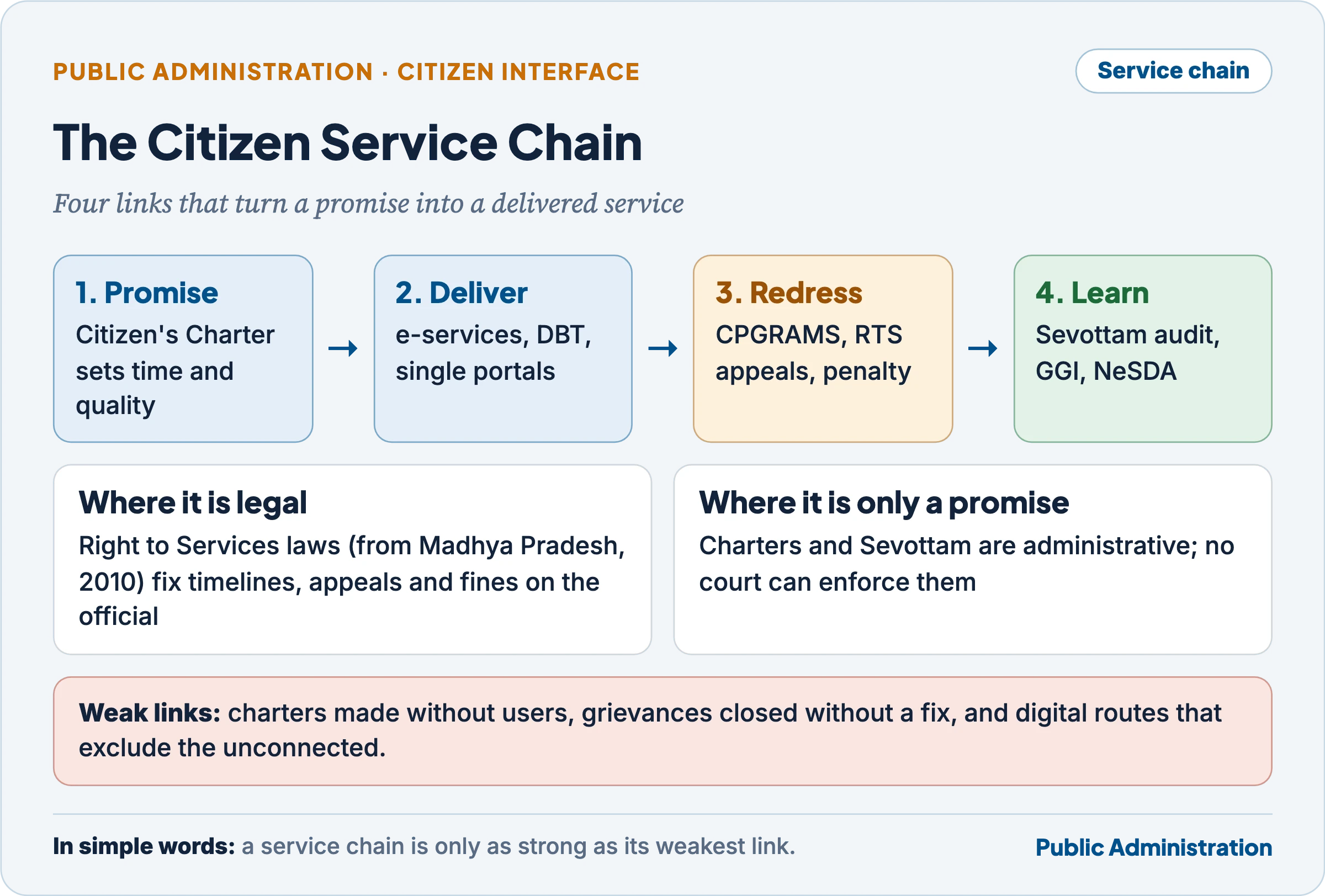
The citizen meets the civil service at a counter, a portal or a phone line. Citizen-centric reforms set promises (charters), make them legal (Right to Services), give a route to complain (grievance systems), cut out unnecessary steps (process re-engineering), move services online, and pay benefits directly into bank accounts.
6.1 Citizen’s Charters
- Origin. The Citizen’s Charter was launched in Britain by John Major in 1991. In India it followed the Chief Ministers’ conference of May 1997; DARPG coordinates the charters of central ministries.
- Contents: the services offered, standards of time and quality, information on how to apply, grievance redress and the officer responsible, and what citizens are expected to do.
- 2nd ARC’s seven-step model: (1) define services, (2) set standards and norms, (3) develop capability to meet them, (4) perform, (5) monitor, (6) evaluate, (7) improve continuously. It also asked that charters be framed with stakeholders, contain firm commitments, provide compensation for default, and be periodically evaluated by outside agencies.
- Why charters have not made administration citizen-centric:
- drafted top-down, often copied, without consulting staff or users;
- vague standards (“as early as possible”) and no penalties;
- poor awareness among citizens and staff; not displayed or not updated;
- no link to individual appraisal or resources;
- not legally enforceable.
- What helped: where promises were converted into law (Right to Services) or automated deadlines (online portals with auto-escalation), the charter idea worked better.
Common confusion
Is a Citizen’s Charter legally enforceable? No. A Citizen’s Charter is a voluntary, administrative declaration; DARPG’s own guidelines say it is not enforceable in a court of law. A citizen cannot sue a department for breaking its charter. What is enforceable is a Right to Services Act, which gives a statutory right to a notified service within a fixed time, appeals, and fines on the defaulting official. A national bill on time-bound delivery and grievance redress was introduced in 2011 but lapsed in 2014.
6.2 Sevottam
- Meaning. Seva (service) + uttam (excellent): a framework for excellence in public service delivery, designed by DARPG in 2005–06 after studying the UK Charter Mark and the US Baldrige model.
- Structure: three modules, each with three criteria and eleven elements (9 criteria, 33 elements in all):
- Citizen’s Charter: standards of service;
- Public Grievance Redress: remedy when the standard is not met;
- Service Delivery Capability: building the organisation’s capacity to keep its promises (employees, infrastructure, customer feedback).
- Certification. The Bureau of Indian Standards issued IS 15700:2005, a quality management standard for public service organisations based on the ISO 9000 series with citizen-centric additions (charter, grievance redress, ombudsman). Organisations certified under it are Sevottam-compliant.
- Endorsement. The 2nd ARC’s 12th Report (2009) recommended Sevottam for all public services, and Sevottam compliance was a mandatory part of every RFD.
- Why the opportunity was “frittered away”:
- it was treated as a certification exercise (a certificate on the wall) rather than a change in how offices work;
- only a small number of offices were certified; the scheme for strengthening State training institutes to spread it reached ten States and was put “under review” after 2021;
- when RFDs ended, Sevottam lost its enforcement hook;
- it never had a legal basis or link to officers’ careers;
- the third module, capability, needed resources that were not provided.
- What survives: its logic lives on in Right to Services laws, CPGRAMS reforms and NeSDA‘s benchmarking of e-services.
6.3 Right to Services laws
- Madhya Pradesh passed the first law, the Lok Sewaon ke Pradan ki Guarantee Adhiniyam, 2010. In 2011 Bihar, Delhi, Himachal Pradesh, Jammu and Kashmir, Punjab, Rajasthan, Uttar Pradesh and Uttarakhand followed; today more than twenty States have such laws.
- Common design: notified services with time limits; a designated officer responsible; first and second appeals; a fine on the officer for delay (often recovered from salary) and sometimes compensation to the citizen.
- Innovations: Karnataka’s Sakala (2012) tracks every application online; Haryana’s auto-appeal escalates delayed cases automatically; Punjab, Uttarakhand and Maharashtra set up Right to Service Commissions to hear revisions and recommend reforms.
- Assessment: RTS laws turn the charter’s promise into a right and make delay costly for the official. Their limits: many services are notified but few appeals are filed; penalties are rarely imposed; and the law guarantees time, not quality or eligibility.
6.4 Grievance redressal (in brief)
- CPGRAMS (Centralised Public Grievance Redress and Monitoring System), run by DARPG, routes grievances to over a hundred central ministries and to States. Grievances have grown from about 2 lakh a year in 2014 to 25–30 lakh now, with over 95% disposed of and an average time of about 12 days (April 2026).
- Concerns: “disposal” often means a reply rather than a remedy; most grievances concern State and local matters that a central system can only forward; there is no integration with State Right to Services systems.
- For the full treatment of CPGRAMS, the Lokpal, administrative tribunals and grievance machinery for employees, see the article on Code of Conduct, Discipline, Staff Associations and Grievance Redressal.
6.5 Process re-engineering and deregulation
- Government Process Re-engineering (GPR). Redesigning a process from the citizen’s point of view before computerising it: removing unnecessary steps, documents, approvals and visits. The 2nd ARC warned that e-governance without re-engineering only automates red tape.
- Examples: self-attestation of documents in place of gazetted attestation (2014); ending interviews for Group C and non-gazetted Group B posts (from 2016); faceless income tax assessment; e-Office for file movement; online single-window clearances; DigiLocker for documents; face authentication for pensioners’ life certificates.
- How GPR promotes good governance: fewer contact points reduce bribery; fixed digital workflows reduce discretion; audit trails improve accountability; shorter processes improve efficiency.
- Limits: processes are often digitised without redesign; back-end departments do not share data; and those without digital access are left behind.
- Deregulation and compliance reduction.
- Jan Vishwas (Amendment of Provisions) Act, 2023 decriminalised 183 provisions in 42 central Acts, replacing imprisonment for minor, technical lapses with penalties.
- Task Force on Compliance Reduction and Deregulation, set up on 24 January 2025 under the Cabinet Secretary, with a Deregulation Cell in the Cabinet Secretariat, works with States on land, labour, building, utilities and inspection rules.
- High-Level Committee on Non-Financial Regulatory Reforms, constituted on 19 August 2025 under NITI Aayog member Rajiv Gauba, reviews laws, certification (such as quality control orders), registrations and inspections.
- Jan Vishwas (Amendment of Provisions) Act, 2026 (assent 7 April 2026) amended 784 provisions in 79 central Acts administered by 23 ministries: 717 decriminalised for ease of doing business and 67 amended for ease of living. It began as a 2025 Bill covering 355 provisions in 16 Acts, which a Select Committee of the Lok Sabha widened.
- Significance for the civil service: these measures reduce the number of points at which an official can withhold something from a citizen, and shift the role from controller to facilitator, the “trust-based governance” that reformers have asked for since 1991.
6.6 E-governance and Digital India
- Evolution: the National e-Governance Plan (approved May 2006) with mission mode projects and Common Service Centres; Digital India (launched 1 July 2015) with digital infrastructure, services on demand and digital empowerment; platforms such as UMANG, DigiLocker and State unified service portals.
- NeSDA. DARPG’s National e-Governance Service Delivery Assessment (framework of 2019, assessed every two years) benchmarks the e-services of States, UTs and central ministries. Its monthly Way Forward tracking shows e-services offered by States and UTs rising from 11,614 (April 2023) to over 24,000 (December 2025), with about 80% saturation of the 59 mandatory e-services; States such as Karnataka (Seva Sindhu), Kerala, Odisha, Assam, Uttarakhand, Jammu and Kashmir and Madhya Pradesh deliver all their services through a single portal.
- Has Indian administration adopted IT? Much more than when this criticism was first made (2001, 2012): payments, land records, taxes, passports and pensions are largely online. The gaps are elsewhere: inter-departmental data sharing, process redesign, digital literacy of both citizens and lower staff, cyber security, and the digital divide by gender, region and age.
- Effect on bureaucracy: e-governance reduces discretion at the counter and moves power to system designers; it can debureaucratise the front office while centralising control at the top. For theory and debates, see the article on E-Governance and Information Technology.
6.7 DBT, JAM and Aadhaar
- Direct Benefit Transfer (DBT), launched on 1 January 2013, pays subsidies and benefits directly into beneficiaries’ bank accounts, using the JAM trinity: Jan Dhan accounts, Aadhaar identity and Mobile phones.
- Savings. According to the DBT Mission, removal of duplicate and fake beneficiaries and plugged leakages saved an estimated ₹5.14 lakh crore cumulatively up to March 2025, the largest share in the public distribution system (deletion of about 6.4 crore duplicate or fake ration cards), followed by LPG subsidy and MGNREGS.
- Aadhaar. The Aadhaar Act, 2016 gives a statutory basis for authentication for subsidies and benefits from the Consolidated Fund (Section 7). In K.S. Puttaswamy v. Union of India (Aadhaar, 26 September 2018) the Supreme Court upheld it for welfare but struck down Section 57, which had allowed private entities to demand it. About 145 crore Aadhaar numbers have been generated, with over 17,500 crore authentications in 2025–26. The Aadhaar Authentication for Good Governance (Social Welfare, Innovation, Knowledge) Rules, 2020, amended on 31 January 2025, allow approved government and private entities to use authentication for “good governance” and ease of living purposes.
- Has Aadhaar promoted inclusive governance and administrative credibility?
- Inclusion: a universal identity for those who had no documents; portable ration entitlements (One Nation One Ration Card); bank accounts for the poor; payments without middlemen.
- Credibility: fewer ghost beneficiaries; auditable, time-stamped transfers; reduced discretion of local officials.
- Concerns: exclusion through authentication failures (worn fingerprints of manual workers, poor connectivity), especially in rations and pensions; the burden of proof shifted to the poorest; privacy and surveillance risks; and “savings” figures that may count excluded genuine beneficiaries as leakage.
- Balance: Aadhaar improved the integrity of transfers more than the quality of services; inclusion requires offline fallbacks and quick grievance redress.
6.8 PRAGATI
- What it is. PRAGATI (Pro-Active Governance and Timely Implementation), launched on 25 March 2015, is an ICT-based platform through which the Prime Minister reviews, by video conference, delayed infrastructure projects, flagship schemes and public grievances with Union Secretaries and State Chief Secretaries together.
- Modalities:
- a three-tier system linking the PMO, Union Government Secretaries and Chief Secretaries of the States;
- issues are drawn from CPGRAMS, the project monitoring group and other databases, and uploaded in advance;
- meetings are held on a fixed schedule; the Prime Minister gives directions on the spot, and follow-up is tracked on the platform.
- Results. At its 50th meeting (31 December 2025) the government reported that PRAGATI had helped accelerate projects worth over ₹85 lakh crore; 377 projects had been reviewed and about 94% of 3,162 identified issues resolved. Long-stuck projects such as the Bogibeel rail-cum-road bridge were completed after review.
- Strengths: breaks departmental silos; brings Centre and States to one table (cooperative federalism); creates accountability at the top for delays.
- Limits: it depends on the Prime Minister’s personal attention; it centralises decision-making in the PMO; it covers a limited number of large projects; and it is reviewed by government itself rather than independently evaluated.
6.9 People’s participation
- Why officials neglect participation. Civil servants are trained, appraised and promoted for implementing schemes on time, not for consulting people; participation is slow and unpredictable; and elected representatives often see officials who mobilise citizens as rivals.
- Instruments: gram sabhas and ward committees; social audit (statutory in rural employment programmes); MyGov (launched July 2014) for consultation; Jan Bhagidari in campaigns; citizen report cards; feedback in Right to Services and CPGRAMS.
- Who participates. Participation is often captured by local elites (landed castes, contractors, party workers); the poor attend but do not shape decisions. Reservations in panchayats and SHG federations have widened the circle but not closed the gap.
- Civil society as a control. Civil society organisations (RTI campaigns, social audit groups, consumer forums, media) act as an external check on administration. They are effective when they have legal tools (RTI, social audit) and weak when they depend only on goodwill. See the article on Citizen and Administration.
The table compares the Gandhian idea of decentralisation with the “reinventing government” movement.
| Feature | Gandhian decentralisation | Reinventing government |
|---|---|---|
| Unit | Self-reliant village republic (gram swaraj) | The public agency and its customers |
| Aim | Self-rule, moral community, minimum state | Efficient, results-oriented, customer-driven government |
| Role of the state | Limited; power flows from the village upward | Steers; others (markets, communities) row |
| Citizen | Participant and self-governor | Customer and owner |
| Shared ground | Distrust of central bureaucracy; community-owned services; decentralised authority | |
| Difference | Moral and political; anti-market | Managerial; uses market mechanisms |
Both reject the large, centralised, rule-bound bureaucracy, and Osborne and Gaebler’s “community-owned government” is close to the Gandhian ideal. But Gandhi’s aim was self-rule and moral community, while reinventing government aims at efficiency. Good governance in India borrows from both: decentralisation from Gandhi and the 73rd Amendment, performance and customer focus from reinvention.
6.10 Measuring good governance
- Good Governance Index (GGI). Prepared by DARPG with the Centre for Good Governance, Hyderabad, on a recommendation of the Sectoral Group of Secretaries on governance:
- GGI 2019 (released 25 December 2019): 10 sectors, 50 indicators;
- GGI 2021 (released 25 December 2021): 10 sectors, 58 indicators (agriculture and allied, commerce and industry, human resource development, public health, public infrastructure and utilities, economic governance, social welfare and development, judicial and public security, environment, and citizen-centric governance); States are grouped into Group A, Group B, North-East and hill States, and UTs. Gujarat, Maharashtra and Goa topped the composite ranking; 20 States improved their scores.
- District Good Governance Indices have followed in some States and UTs, for example Gujarat’s index of 10 sectors and 65 indicators.
- Value: competitive federalism, data-based comparison, focus on outcomes.
- Limits: indicators are mostly outputs and administrative data supplied by governments themselves; equal weighting of very different sectors; no regular release after 2021; a high rank does not mean a citizen gets a certificate on time.
Indian Connect — Governance and development in a State: Karnataka and Madhya Pradesh
- Madhya Pradesh pioneered the Right to Services law (2010) and later the Cyber Tehsil, which completes land mutation online without a visit to the tehsil office; it won the Prime Minister’s Award for innovation (2023).
- Karnataka’s Sakala (2012) put every notified service on an online tracker with timelines and penalties; its Seva Sindhu portal now delivers over 2,000 e-services.
- Lesson: where States combined a legal right, technology and monitoring by the Chief Secretary, service delivery improved measurably; where only one of the three existed, gains faded.
7. Civil Services Day and the Prime Minister’s Awards
In simple words
Incentives are not only about pay. Public recognition of good work, by the Prime Minister, in front of colleagues, motivates officers and spreads good practices. The awards also signal what the government values.
- Civil Services Day. Observed on 21 April every year since 2006, the date on which Sardar Vallabhbhai Patel addressed the first batch of probationers at Metcalfe House in 1947 and called the services the “steel frame” of India. The 18th Civil Services Day was held in 2026.
- Prime Minister’s Awards for Excellence in Public Administration, instituted in 2006 and conferred on Civil Services Day:
- Early years: individual officers and teams for innovation.
- After 2014: awards shifted towards effective implementation of priority programmes in districts (for example, Pradhan Mantri Jan Dhan Yojana, Swachh Bharat, Aspirational Districts) plus innovation categories, judged on outcomes.
- 2025 scheme: three categories: Holistic Development of Districts (11 priority programmes, five awards), Aspirational Blocks Programme (five awards) and Innovation (six awards, for Central ministries, States and districts). Each award carries a trophy, a scroll and ₹20 lakh for public welfare work in the district or organisation.
- Participation: nominations rose from 1,216 (2023) to 1,588 (2024) and 2,035 (2025), with about 95% of districts registering.
- Evaluation: screening committee (Additional Secretaries), expert committee (Secretary, DARPG), Empowered Committee (Cabinet Secretary), approval by the Prime Minister.
- Examples of awarded initiatives:
- 2023 awards: Face Authentication for pensioners’ digital life certificates and PM SVANidhi (Central innovations); Cyber Tehsil of Madhya Pradesh (State innovation); Dhamtari district.
- 2024 awards (conferred 21 April 2025): PM Vishwakarma and Poshan Tracker (Central); Siksha Setu Axom (Assam’s school attendance and teacher management system); Moradabad district innovation; holistic development awards to districts such as Tinsukia and Gomati; and Gamharia block (Jharkhand) in the Aspirational Blocks category.
- Do the awards encourage good governance?
- Yes: they reward outcomes rather than activity, make district collectors compete on saturation of schemes, and create a library of replicable practices (coffee-table books, films, DARPG’s replication workshops).
- But: they favour the visible and measurable; the award is to the district rather than to the frontline worker; government schemes chosen for the award can turn the exercise into a showcase for flagship programmes; and replication of awarded practices is weak.
8. Ethics and Integrity Initiatives
In simple words
Rules can catch a corrupt act after it happens; ethics prevents it. Good governance needs officers who do the right thing when no one is checking. India has tried codes, training, disclosure and law, but has never passed a single statement of civil service values.
- Conduct rules. The AIS (Conduct) Rules, 1968 and CCS (Conduct) Rules, 1964 list prohibited behaviour (gifts, private trade, political activity, unauthorised communication). They are rules of conduct, not a code of ethics stating positive values. See the article on Code of Conduct, Discipline, Staff Associations and Grievance Redressal.
- Values the reformers wanted in law:
- the 2nd ARC (4th and 10th Reports) proposed a statutory code of ethics in a Civil Services Law: integrity, impartiality, commitment to public service, accountability, devotion to duty, exemplary behaviour;
- DoPT drafted a Public Services Bill (2007) and later a Civil Services Standards, Performance and Accountability Bill (2010) on these lines; neither was enacted;
- the Nolan Committee in Britain (1995) set out seven principles of public life (selflessness, integrity, objectivity, accountability, openness, honesty, leadership), often cited as a model.
- Code of ethics for ministers. The 2nd ARC said political neutrality of the services is a joint duty: ministers must not ask civil servants to act against their duties.
- Preventive vigilance: Integrity Pacts in large public procurement (promoted by the CVC), e-procurement, rotation in sensitive posts, and property declarations.
- Capacity and values: Mission Karmayogi’s competency framework includes behavioural and ethical competencies; foundation and mid-career courses include ethics and constitutional values (see the article on Training and Capacity Building).
- Paul Appleby’s dictum. Paul Appleby, the American scholar who reviewed Indian administration in the 1950s, held that “responsible government is ethical government”: in a democracy the official serves the public interest as mediated by politics, and ethics is part of that service. Good governance initiatives rely on this: transparency and accountability tools work only if officials have an internal commitment to the public interest. See the article on Administrative Ethics.
9. Civil Service Reform Debates
In simple words
Reformers agree that the civil service must change but disagree on how: Should top officers be generalists or experts? Should they have fixed tenure? Should outsiders come in? How much freedom should they have, and how should they answer for it?
9.1 Generalist, specialist and technocrat
- The debate in brief. The IAS generalist, with broad experience across sectors, coordinates and sees the whole picture; the specialist and technocrat bring domain expertise needed for a complex economy (finance, digital regulation, health, climate). The Fulton Committee (1968) in Britain attacked the “cult of the generalist”.
- Why technocrats are needed: regulation of telecom, data, energy and finance; large digital public infrastructure; science-based policy.
- Why generalists still matter: inter-departmental coordination, field knowledge of districts, political judgement, and continuity.
- The middle way: domain assignment after mid-career (Surinder Nath, Hota, 2nd ARC), senior posts open to all services on merit, parallel hierarchies with equal pay and status for specialists, lateral entry for specific posts, and competency mapping under Mission Karmayogi to match people to roles.
- For the full debate, see the article on Civil Services Structure and Recruitment.
9.2 Lateral entry (in brief)
- From 2018 to 2024, about 63 domain experts were appointed at Joint Secretary, Director and Deputy Secretary levels through UPSC. The August 2024 advertisement for 45 posts was withdrawn after objections that reservation did not apply to single-post appointments.
- Lateral entry promises expertise and competition for the career service, but risks politicisation, conflicts of interest and demoralisation if it is ad hoc. See the article on Civil Services Structure and Recruitment.
9.3 Capacity building (in brief)
- Mission Karmayogi (National Programme for Civil Services Capacity Building, approved September 2020) moves from rule-based to role-based HR management, with the iGOT Karmayogi platform (over 1.6 crore officials onboarded by April 2026) and the Capacity Building Commission. See the article on Training and Capacity Building.
9.4 Autonomy and accountability
- The NPM argument: “let managers manage”. Give senior officers autonomy over inputs (staff, money, methods) and hold them accountable for results. Autonomy encourages creativity and productivity; the 2nd ARC’s 13th Report proposed executive agencies with chief executives on performance contracts.
- The Indian reality: officers have little autonomy (financial rules, vigilance fear, ministerial control of transfers) and also weak accountability for results. They are controlled on inputs and procedures but not judged on outcomes.
- To make officers both accountable and innovative:
- delegate financial and administrative powers along with clear targets;
- protect bona fide decisions (Section 17A of the Prevention of Corruption Act, guidance on “honest mistakes”);
- reward innovation (PM’s Awards, innovation funds) and tolerate reasonable failure;
- judge by outcomes through transparent appraisal and public data.
9.5 Politicisation and the transfer economy
- Reforms that strengthen executive discretion (premature retirement, confidential MSF, rejection of CSB advice) can serve either performance or political control; which one they serve depends on transparency and on independent checks.
- “Civil service reforms along with a transparent transfer policy” can insulate officers from improper pressure, but only if statutory tenure, reasoned and disclosed transfer orders and an independent board go together. See the article on Civil Service Neutrality and Activism.
9.6 Why reforms stall
- Political interest: transfers and postings are a source of patronage; binding reforms reduce it.
- Bureaucratic interest: officers resist exit reviews, lateral entry and domain specialisation that threaten career certainty.
- Episodic reform: commissions report, groups of ministers dilute, and implementation falls to the very departments being reformed. Gerald Caiden, in Administrative Reform (1969), described reform as an “artificial inducement of administrative transformation against resistance”, which explains why it needs sustained political sponsorship.
- Formalism: in Fred Riggs’ sense, India often adopts the form of reform (charters, Sevottam certificates, boards) without its substance.
Criticism — The case against India’s good governance initiatives
- Form without substance: charters, Sevottam and CSBs exist on paper; officers treat them as compliance rituals.
- Information without consequence: appraisal is disclosed but inflated; grievances are “disposed of” but not resolved; RFD scores were never used.
- Centralisation: PRAGATI, dashboards and confidential empanelment concentrate power in the PMO, weakening ministers, States and the career service’s own norms.
- Selective accountability: premature retirement and vigilance can be used against inconvenient officers, while the transfer industry continues.
- Exclusion: digital and Aadhaar-based delivery can shut out the poorest, who have least power to complain.
- The binding reforms are missing: no civil services law, no independent authority, no statutory tenure.
Defence — The case for them
- Real gains in delivery: DBT has removed crores of fake beneficiaries; e-services and RTS laws have cut visits and delays; PRAGATI has unlocked long-stuck projects.
- Transparency is now normal: RTI, open APAR and online tracking have made the state far more visible than in 2000.
- Accountability has teeth: periodic reviews and the “Very Good” benchmark have ended the assumption of automatic progression.
- Deregulation is under way: two Jan Vishwas Acts and the deregulation task forces are reducing the controls from which red tape and corruption grow.
- Learning and competition: GGI, NeSDA, Aspirational Districts and PM’s Awards spread good practice through comparison.
- Reform is incremental by nature: in a federal democracy, steady change through rules and technology may last longer than a single big-bang law.
10. Theory Lens and Links to Other Civil Service Themes
In simple words
Paper I theories explain why Indian reforms look the way they do: some come from the World Bank’s governance agenda, some from managerial ideas of running government like a business, some from the opposite idea that citizens are not customers but co-owners of the state.
10.1 Theory lens: from rule-bound official to accountable public servant
- Good governance (World Bank, 1992; UNDP, 1997). The World Bank’s governance agenda made public sector management, accountability, legal predictability and transparency conditions for development; UNDP added participation and equity. India’s reform agenda since 1997 (charters, RTI, e-governance, anti-corruption bodies) follows this script, but India adopted it on its own initiative rather than as a loan condition. See the article on Challenges of Liberalisation, Privatisation and Globalisation; Good Governance.
- New Public Management and reinventing government. Christopher Hood, in “A Public Management for All Seasons?” (1991), listed NPM’s doctrines: hands-on management, explicit standards and measures of performance, output controls, disaggregation, competition and private-sector styles of management. David Osborne and Ted Gaebler, in Reinventing Government (1992), proposed ten principles, including catalytic government (steering rather than rowing), results-oriented and customer-driven government, and community-owned government. RFDs, performance-related pay, the “Very Good” benchmark, citizen’s charters (customers), outcome budgets and “minimum government, maximum governance” are Indian NPM. The critique (public service is not a market; citizens are not customers; targets distort) applies equally. See the article on New Public Management and After.
- New Public Service. Janet and Robert Denhardt, in “The New Public Service: Serving Rather than Steering” (2000), argued that officials should serve citizens, not customers, seek the public interest through dialogue, and value citizenship over entrepreneurship. Social audit, gram sabhas, MyGov, RTI and Right to Services laws (which treat citizens as rights-holders) reflect NPS more than NPM.
- Digital-era governance. Patrick Dunleavy, Helen Margetts and colleagues (“New Public Management Is Dead: Long Live Digital-Era Governance” and Digital Era Governance, both 2006) argued that after NPM’s fragmentation, digital technology drives reintegration, needs-based holism (services organised around the citizen) and digitisation. India’s unified service portals, DBT on the JAM platform, DigiLocker and PRAGATI’s integrated review are examples; so is the risk of centralised data power.
- Public value. Mark Moore, in Creating Public Value (1995), asked managers to create value that the public cares about, using a strategic triangle of public value, legitimacy and support, and operational capacity. PM’s Awards for district outcomes and the Aspirational Districts model judge officers on value created in a territory; Sevottam’s third module (capability) mirrors Moore’s operational capacity.
- Performance management theory. Robert Behn (“Why Measure Performance?”, 2003) showed that measures serve different purposes (evaluate, control, budget, motivate, learn), and one measure cannot serve all. Gwyn Bevan and Christopher Hood (“What’s Measured Is What Matters”, 2006) documented gaming of targets: ratchet effects, threshold effects and output distortion. PMES’s modest self-set targets and CPGRAMS’s “disposal” culture show both.
- Principal–agent theory. Citizens (principals) delegate to politicians, who delegate to civil servants (agents) who know more than their principals. Appraisal, RFDs, RTI and grievance systems are attempts to reduce information asymmetry; tenure protection reduces the agent’s fear of an opportunistic principal. Multiple principals (Union, State, ministers, courts, citizens) explain why Indian officers face conflicting signals.
- Weber and Riggs. Max Weber’s legal-rational bureaucracy is rule-bound by design; good governance reforms ask it to become result-bound without losing impartiality. Fred Riggs’ idea of formalism (the gap between formal prescription and actual behaviour) explains why charters, Sevottam certificates and Civil Services Boards often change forms but not conduct. See the articles on Weber’s Bureaucratic Model, its Critique and Post-Weberian Developments and on Riggsian Models and their Critique.
- Development administration. The development administration movement of the 1960s expected a capable bureaucracy to drive development; critics argued that the Indian bureaucracy, built for control, was never “energised” for change. Good governance reforms are a second attempt at the same goal, adding markets, citizens and technology to the bureaucracy’s own capacity. See the article on Development Administration.
10.2 Other civil service themes in brief
- Structure and recruitment: Part XIV, All India Services, Public Service Commissions, the Civil Services Examination, generalists and specialists, lateral entry. See the article on Civil Services Structure and Recruitment.
- Training and capacity building: LBSNAA, mid-career training, National Training Policy, Mission Karmayogi and the Capacity Building Commission. See the article on Training and Capacity Building.
- Conduct, discipline, associations, political rights and grievances: conduct rules, CCS (CCA) Rules, Article 311, staff associations and the JCM, limits on political activity, CAT and CPGRAMS. See the article on Code of Conduct, Discipline, Staff Associations and Grievance Redressal.
- Neutrality and activism: Weberian neutrality, committed bureaucracy, anonymity, the minister–civil servant relationship and activist officers. See the article on Civil Service Neutrality and Activism.
- Broader administrative reforms (the 1st and 2nd ARCs as a whole, financial management reforms, problems of implementation) belong to the articles on Administrative Reforms since Independence.
Key Terms
| Term | Meaning in simple words |
|---|---|
| Governance | How a country’s affairs are actually managed, by government and others |
| Good governance | Governance that is accountable, transparent, lawful, responsive, effective and participative |
| SMART government | Simple, Moral, Accountable, Responsive and Transparent administration (2nd ARC) |
| Minimum government, maximum governance | Fewer controls and procedures, more effective delivery |
| ACR | Annual Confidential Report: the old secret appraisal |
| APAR | Annual Performance Assessment Report: the open appraisal since 2009 |
| Multi-source feedback (360-degree) | Views of seniors, peers, juniors and outsiders used for senior empanelment |
| Performance management | Year-round cycle linking organisational goals to individual targets, review and reward |
| RFD | Results-Framework Document: a department’s annual weighted targets under PMES (2009–14) |
| PMES | Performance Monitoring and Evaluation System for government departments (2009) |
| Outcome budget | Budget document showing expected outputs and outcomes of spending |
| MACP | Modified Assured Career Progression: financial upgrades at 10, 20 and 30 years |
| FR 56(j) | Rule allowing premature retirement of officers in public interest after 50 or 55 years of age |
| Rule 16(3), AIS (DCRB) Rules | Review of AIS officers after 15 and 25 years of service, with possible retirement |
| Probity Portal | DoPT’s online tracker of reviews, vigilance and premature retirement |
| Civil Services Board | Committee of senior officers that recommends postings and premature transfers |
| Citizen’s Charter | A department’s public promise of service standards; not legally enforceable |
| Sevottam | DARPG framework for service excellence: charter, grievance redress, capability |
| Right to Services law | State law guaranteeing notified services within fixed times, with appeals and fines |
| CPGRAMS | Online system for citizens’ grievances against government |
| Government Process Re-engineering | Redesigning a process around the citizen before computerising it |
| DBT and JAM | Direct Benefit Transfer using Jan Dhan accounts, Aadhaar and Mobile phones |
| PRAGATI | Prime Minister’s video-based review platform for projects, schemes and grievances |
| NeSDA | National e-Governance Service Delivery Assessment of e-services |
| Good Governance Index | DARPG’s ranking of States and UTs on governance indicators |
| Jan Vishwas | Laws decriminalising minor offences to build trust-based governance |
| Gaming | Meeting a numerical target in ways that defeat its purpose |
Commissions, Committees and Judgments
| Body / case | Year | Key point |
|---|---|---|
| Santhanam Committee (K. Santhanam) | 1964 | Led to the Central Vigilance Commission |
| 1st ARC, Report on Personnel Administration (K. Hanumanthaiya) | 1969 | Performance record in place of secret report; specialisation |
| 5th Central Pay Commission (Justice S. Ratnavel Pandian) | 1997 | Downsizing, minimum tenure, Civil Services Board, quinquennial review, RTI |
| Conference of Chief Ministers | 1997 | Action Plan: citizen-friendly administration, Citizen’s Charters, transparency |
| Vineet Narain v. Union of India | 1997 | Statutory status and independence for CVC; insulation of investigations |
| Baikuntha Nath Das v. Chief District Medical Officer | 1992 | Compulsory retirement in public interest is not punishment; limited judicial review |
| Surinder Nath Committee (Surinder Nath) | 2003 | Work-target appraisal, objective empanelment, 11 domains |
| Hota Committee on Civil Services Reforms (P.C. Hota) | 2004 | Work-plan appraisal, statutory tenure, code of ethics, State of Governance Report |
| 2nd ARC, Ethics in Governance (M. Veerappa Moily) | 2007 | Lokpal, code of ethics, repeal of Article 311 |
| Dev Dutt v. Union of India | 2008 | Every appraisal entry must be communicated |
| 6th Central Pay Commission (Justice B.N. Srikrishna) | 2008 | Performance Related Incentive Scheme |
| 2nd ARC, Refurbishing of Personnel Administration (M. Veerappa Moily) | 2008 | Performance management, 14- and 20-year reviews, domains, Civil Services Law and Authority |
| 2nd ARC, Promoting e-Governance (M. Veerappa Moily) | 2008 | SMART government; re-engineer before automating |
| 2nd ARC, Citizen Centric Administration (M. Veerappa Moily) | 2009 | Sevottam, seven-step charter model, grievance redress with compensation |
| PMES and RFDs (Performance Management Division, Cabinet Secretariat) | 2009–2014 | Weighted annual targets for about 80 departments |
| T.S.R. Subramanian v. Union of India | 2013 | Civil Services Boards, minimum tenure, written orders |
| IAS (Cadre) Amendment Rules | 2014 | Two-year minimum tenure; postings on CSB recommendation |
| 7th Central Pay Commission (Justice A.K. Mathur) | 2015 | “Very Good” benchmark; increments withheld for non-performers; performance-related pay |
| K.S. Puttaswamy v. Union of India (Aadhaar) | 2018 | Aadhaar for welfare upheld; private use under Section 57 struck down |
| Jan Vishwas (Amendment of Provisions) Act | 2023 | 183 provisions in 42 Acts decriminalised |
| Task Force on Compliance Reduction and Deregulation (Cabinet Secretary) | 2025 | Deregulation with States; Deregulation Cell |
| High-Level Committee on Non-Financial Regulatory Reforms (Rajiv Gauba) | 2025 | Review of laws, certifications, inspections |
| 8th Central Pay Commission (Justice Ranjana Prakash Desai) | 2025 | Efficiency and accountability; performance-linked incentives |
| Jan Vishwas (Amendment of Provisions) Act | 2026 | 784 provisions in 79 Acts amended; 717 decriminalised |
Contemporary Developments
- Second Jan Vishwas Act (April 2026). Passed by Parliament on 1–2 April and assented on 7 April 2026, it amends 784 provisions in 79 central Acts, decriminalising 717 and easing 67 for ease of living; fines rise by 10% every three years.
- Civil Services Day 2026 (21 April 2026). The 18th Civil Services Day; awards restructured around programme outcomes rather than individual profiles. The minister reported CPGRAMS handling 25–30 lakh grievances a year with an average resolution time of about 12 days, and over 1.6 crore officials on iGOT Karmayogi.
- PRAGATI at 50 (31 December 2025). Over ₹85 lakh crore of projects accelerated and about 94% of identified issues resolved; the Prime Minister urged States to create PRAGATI-like reviews for the social sector at Chief Secretary level.
- 8th Central Pay Commission (3 November 2025). Constituted under Justice Ranjana Prakash Desai, with terms of reference on efficiency, accountability and a performance-linked incentive scheme.
- Deregulation machinery (2025). The Task Force on Compliance Reduction and Deregulation (24 January 2025) and the High-Level Committee on Non-Financial Regulatory Reforms (19 August 2025) were set up to cut compliance burdens at Union and State levels.
- NeSDA Way Forward (December 2025 report, January 2026). States and UTs offered 24,090 e-services, with over 80% saturation of mandatory e-services; seven States deliver all services through one portal.
- DBT savings (to March 2025). Estimated cumulative savings of about ₹5.14 lakh crore from removal of fake and duplicate beneficiaries.
- Aadhaar Good Governance Rules amended (31 January 2025) to allow approved private entities to use Aadhaar authentication for ease-of-living services, widening the “good governance” use of Aadhaar.
Revision Grid
| Thinker / body | Work or report (year) | Key idea |
|---|---|---|
| World Bank | Governance and Development (1992) | Governance as the manner of exercising power over resources for development |
| UNDP | Governance for Sustainable Human Development (1997) | Governance includes state, market and civil society; eight characteristics |
| Robert Klitgaard | Controlling Corruption (1988) | Corruption = Monopoly + Discretion − Accountability |
| Christopher Hood | “A Public Management for All Seasons?” (1991) | NPM doctrines: performance measures, output controls, managerialism |
| Osborne and Gaebler | Reinventing Government (1992) | Steering not rowing; results-oriented, customer-driven government |
| Denhardt and Denhardt | “The New Public Service” (2000) | Serve citizens, not customers; public interest through dialogue |
| Dunleavy and Margetts | Digital Era Governance (2006) | Reintegration, citizen-centred holism, digitisation |
| Mark Moore | Creating Public Value (1995) | Strategic triangle: value, legitimacy, capacity |
| Robert Behn | “Why Measure Performance?” (2003) | Different purposes need different measures |
| Bevan and Hood | “What’s Measured Is What Matters” (2006) | Gaming of targets |
| Gerald Caiden | Administrative Reform (1969) | Reform as induced change against resistance |
| Paul Appleby | Reports on Indian administration (1953, 1956) | Responsible government is ethical government |
| 5th Pay Commission | Report (1997) | Tenure, CSB, downsizing, open ACR |
| Surinder Nath Committee | Report (2003) | Appraisal reform and domains |
| Hota Committee | Report (2004) | Work-plan appraisal, tenure, ethics |
| 2nd ARC | 10th Report (2008) | Performance management, intensive reviews, Civil Services Law |
| 2nd ARC | 12th Report (2009) | Sevottam, citizen’s charters, grievance redress |
| Supreme Court | T.S.R. Subramanian (2013) | Boards, tenure, written orders |
| 7th Pay Commission | Report (2015) | Very Good benchmark; increments linked to performance |
Previous Year Questions
- 2025Do you think ‘Aadhaar’ initiative has promoted inclusive governance and administrative credibility? Throw light.
- 2025Assess the role of Government Process Reengineering (GPR) in promoting good governance.
- 2023“Civil Service Reforms along with a transparent transfer policy will go a long way in insulating civil servants from undesired political pulls and pressures.” Discuss.
- 2022Citizens charters in India have not succeeded in their objectives in making administrative system citizen centric. Do you agree? Give reasons.
- 2021Responsibility and accountability are two major goals of Good Governance. Discuss the statement in the context of Indian administration.
- 2021Red-tapism is a major obstacle to the implementation of ‘good governance. Comment.
- 2019‘Sevottam Scheme’ had great potential to reform service delivery, but opportunity is frittered away. Comment.
- 2019Effective ‘Performance Management System’ needs to precede ‘taking deadwood out’ from bureaucracy. Comment.
- 2018“The ‘enablers’ and ‘facilitators’ are yet to replace the inspectors’ and “controllers’ in the civil service in India. Do you agree? Justify.
- 2017“There is a need for greater inclusion of technocrats in bureaucracy to ensure effective governance in India.” Do you agree” Elucidate.
- 2017“The Prime Minister’s awards for Excellence in Public Administration encourage good governance initiatives.” Discuss some such initiatives by the Civil Servants in this context.
- 2017“Pro-Active Governance and Timely implementation (PRAGATI) is an innovative project of the Union Government.” Discuss its features and modalities.
- 2016“Autonomy granted to higher civil servants tends to increase their creativity and productivity.” Argue the case to make the civil service more accountable as well as innovative.
- 2016Do you agree that the Seventh Pay Commission’s recommendations do not reflect and correlate the need for civil service reforms and accountability with pay increase? Justify your answer.
- 2015“‘Minimum government, maximum governance’ is not just a slogan but a philosophy of administration with enormous potentialities.’ Do you agree? Give reasons for your answer.
- 2015“Most Civil Servants in India are competent administrators, but they pay little attention to encourage people’s participation in decision-making.” Comment on the statement.
- 2015What are the major concerns of the Second Administrative Reforms Commission on Civil Service reforms? Indicate the current status of their implementation.
- 2014Supreme Court ruling on 31 st October, 2013 in respect of bureaucracy’s functioning would help achieve good governance. Analyze this ruling and add your comments on it.
- 2013“Gandhian model of decentralization is similar to the process of reinventing governance.” Analyse in the context of good governance.
- 2012‘Good governance is closely aligned with effective democratic governance.’ Elaborate.
- 2012Indian administration is yet to fully appreciate and adopt the benefits of Information Technology. Elucidate.
- 2011‘Performance Appraisal Systems’ with special reference to the Performance Management and Evaluation System (PMES) are expected to transform the bureaucratic culture of Indian administration. Do you agree? Give reasons.
- 2010Comment on the following statements: – “The more developed an administrative system became the greater the likelihood that it would have developmental effects.” “The thrust of development administration failed to energise the Indian bureaucracy.”
- 2009“A fixed tenure in Civil Service postings can increase productivity, accountability, and probity in Government.” Comment.
- 2009Discus the relationship between governance and development in any one Indian State, giving illustrations.
- 2009“The recommendations of the Second Administrative Reforms Commission on reforming the Civil Service are radical yet implementable.” Do you agree?
- 2007Define civil Society. Is it an effective organ to control administrative machinery? Comment.
- 2007“If information is power, nothing can perhaps empower a citizen more that the secret and developmental informations held by various public authorities.” Analyse the merits and demerits of RTI Act, 2005 in the light of this statement.
- 2003“Information technology, if properly used, can bring about sweeping changes in the nature of governance in India.” Discuss the current status and future possibilities about the use of information technology in the governance of India.
- 2001“Indian administration is yet to fully appreciate and adopt the benefits of the information technology.” Elucidate.
- 2000“A middle way should be worked out to utilize the services of both generalists and specialists for the national development.” Comment.
- 1993“People’s participation in administration, being a part of the political mobilisation process in India, is determined by the elite groups at each level of administration.” Comment.
- 2024Good governance adds normative and evaluative attributes to the process of governing. Comment.
- 2024Performance Management and Performance Appraisal are two distinct activities in Public Personnel Administration. Discuss.
- 2021Performance appraisal needs to be seen beyond the mere suitability of the official for vertical promotion. Explain.
- 2019A more effective system of performance appraisal should acknowledge the subjective elements in it and be less obsessed with the objective criteria. Elucidate.
- 2018To what extent has e-governance made the administrative system more citizen-oriented? Can it (e-governance) be made more participative?
- 2017“360° performance appraisal system is a rational idea, but it involves complex and inauthentic procedures.” How can it be made foolproof?
- 2016“A central reason for utilization of Performance Appraisal is performance improvement of the employees.” In the light of the statement, analyze the needs of Performance Appraisal in an Organization.
- 2011Civil Servants must be social moralists in action, living up to Paul Appleby’s dictum that ‘responsible government is ethical government.’ Examine this statement in the light of good governance.
- 2010Explain the basic principles underlying Citizen’s Charter with special reference to Its administrative philosophy. Promoting public accountability. Ensuring standards of public service.
- 1999“Elaborate the World Bank’s concept of ‘Good Governance.”