

Schools of Buddhism: Pratītyasamutpāda; Kṣaṇikavāda, Nairātmyavāda
Official Syllabus: Paper I, Section B, Unit 14
The Buddha refused to answer metaphysical questions; his followers could not. Within a few centuries of his death, Buddhism had split into some eighteen early schools and later into two great vehicles — Hīnayāna and Mahāyāna — with a third, Vajrayāna, growing out of the second. Out of some thirty schools, Indian philosophy remembers four as the classical philosophical schools: the Vaibhāṣika and Sautrāntika (Hīnayāna realists), and the Yogācāra and Mādhyamika (Mahāyāna idealist and dialectical schools). All four accept the Four Noble Truths, dependent origination, momentariness, no-self and nirvāṇa. Yet they reach opposite conclusions about what is real — from “everything is real” to “everything is void“. This article brings the whole unit together: how the schools arose, what divides them, how they argue with each other, and how their journey from realism to idealism to critique mirrors the path of Western philosophy from Locke to Berkeley to Kant.
In simple words
Four people look at a tree. The first says: “I see the tree itself.” The second: “I see only a picture of the tree in my mind; the tree is out there, causing the picture.” The third: “There is only the picture; no tree out there at all.” The fourth: “Neither the tree nor the picture exists by itself — both depend on each other.” These are, in order, the Vaibhāṣika, Sautrāntika, Yogācāra and Mādhyamika answers.
Context & Problem
Why One Teaching Became Many Schools
- The Buddha’s silence. The Buddha left the ten metaphysical questions unanswered (avyākata, Article 1) and spoke against speculation. But his followers were thinking people, and intellectual curiosity cannot be stopped by a ban; the questions he set aside returned. As one writer put it, the many schools were “the nemesis of neglected metaphysics“.
- The silence read in two ways.
- Scepticism — the Buddha knew no answer, or thought none could be known. This fits early (Hīnayāna) realism and its focus on ethics.
- Indescribability — the ultimate truth is beyond words. This is the Mahāyāna reading, which led to Nāgārjuna’s śūnyatā and the two truths.
- The councils and the split.
- First Council (Rājagṛha) — soon after the Buddha’s death; the Vinaya and Suttas recited.
- Second Council (Vaiśālī) — about a century later; disputes over monastic discipline split the order into the conservative Sthaviravāda (“doctrine of the elders”) and the more liberal Mahāsāṅghika (“great assembly”). The Mahāsāṅghika later fed into Mahāyāna.
- Third Council (Pāṭaliputra, under Aśoka) — the Abhidhamma added; the Theravāda canon took shape.
- Fourth Council (Kashmir, under Kaniṣka) — the Sarvāstivāda commentary, the Vibhāṣā, compiled, giving the Vaibhāṣika its name.
Three Phases of Buddhist Thought
| Phase | Character | Schools |
|---|---|---|
| 1. Realistic and pluralistic | Reality is made of many real, momentary elements (dharmas), mental and physical | Early Buddhism; Vaibhāṣika and Sautrāntika |
| 2. Dialectical (“nihilistic” to its critics) | All elements are empty of own-nature; every theory of essence refutes itself | Mādhyamika (Nāgārjuna, c. 2nd century CE) |
| 3. Idealistic | Only consciousness is real; the external world is its projection | Yogācāra (Asaṅga, Vasubandhu, 4th–5th century CE), continued by the logicians Dignāga and Dharmakīrti |
- From pessimism to optimism. Early Buddhism stressed suffering and escape from it; Mahāyāna added a positive ideal — the Bodhisattva’s compassion, the Buddha-nature in all beings, and nirvāṇa as bliss.
- Order of exposition vs order of history. Historically the Mādhyamika (2nd century) came before the Yogācāra (4th century). Logically, many textbooks present the schools as a ladder: realism (Vaibhāṣika) → indirect realism (Sautrāntika) → idealism (Yogācāra) → critique of all views (Mādhyamika).
What All Schools Share
- The Four Noble Truths and the Eightfold Path.
- Dependent origination (pratītyasamutpāda) as the law of all becoming.
- Impermanence, no-self and (in different forms) momentariness.
- Nirvāṇa as the end of suffering, and karma as action bearing fruit without a permanent soul.
- Rejection of God as creator, and of the Vedas as authority.
Core Doctrine
1. Two Questions, Four Answers
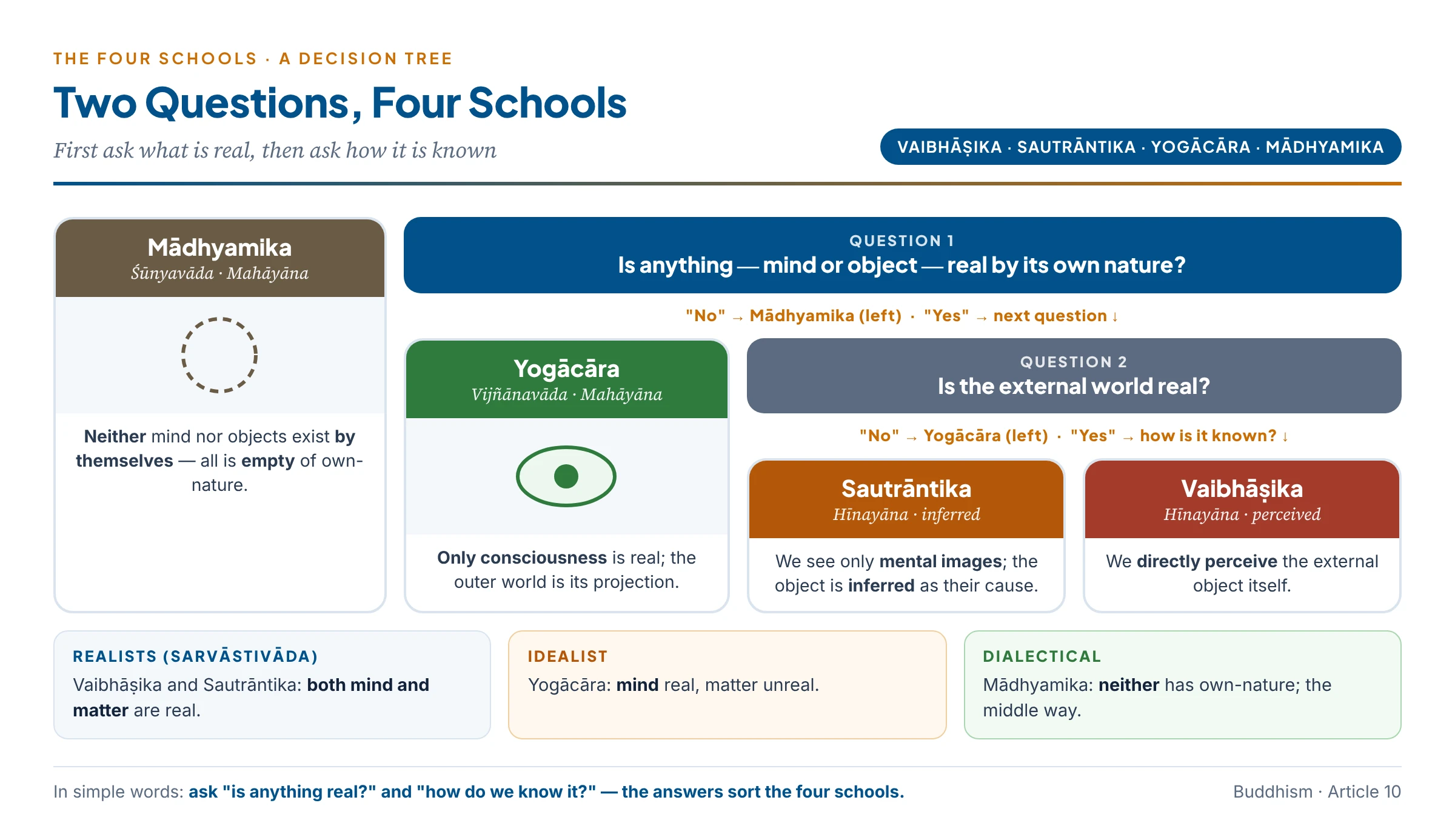
The four schools can be classified by asking two questions — one metaphysical, one epistemological:
Question 1 (metaphysical): What is real — mind, external objects, both, or neither?
- Neither mind nor external objects has own-reality → Mādhyamika (Śūnyavāda).
- Mind only is real; external objects are not → Yogācāra (Vijñānavāda).
- Both mind and external objects are real → the Sarvāstivāda (“all exists”) realists.
Question 2 (epistemological, for the realists): How are external objects known?
- By inference from mental images — the object is never directly seen → Sautrāntika (bāhyārthānumeyavāda, “the external object is inferred”).
- By direct perception — we see the object itself → Vaibhāṣika (bāhyārthapratyakṣavāda, “the external object is perceived”).
2. The Four Schools at a Glance
| Vaibhāṣika | Sautrāntika | Yogācāra | Mādhyamika | |
|---|---|---|---|---|
| Vehicle | Hīnayāna | Hīnayāna | Mahāyāna | Mahāyāna |
| Name means | Followers of the Vibhāṣā commentary | Followers of the sūtras (not the Abhidharma) | Practice of yoga; also called Vijñānavāda (“consciousness doctrine”) | Followers of the middle path; called Śūnyavāda by others |
| Key thinkers | Vasumitra, Saṃghabhadra; Vasubandhu’s Abhidharmakośa (as exposition) | Kumāralāta, Śrīlāta; Vasubandhu’s commentary | Maitreyanātha, Asaṅga, Vasubandhu; later Dignāga, Dharmakīrti | Nāgārjuna, Āryadeva, Buddhapālita, Bhāvaviveka, Candrakīrti |
| External world | Real; directly perceived | Real; inferred from mental images | Unreal; a projection of consciousness | Empty — neither real by itself nor non-existent |
| Mind | Real (momentary dharmas) | Real (momentary) | Alone real — the storehouse-consciousness | Also empty |
| Key idea | Dharmas exist in all three times (75 dharmas) | Only the present moment exists (43 dharmas); time-lag argument | Consciousness-only; ālaya-vijñāna; three natures | Śūnyatā = dependent origination; catuṣkoṭi; two truths |
| Theory of knowledge | Direct realism | Representative realism | Subjective (or absolute) idealism | Critical dialectic; pramāṇas only conventionally valid |
| Western parallel | Naïve or direct realism (Reid, Moore) | Locke’s representative realism; Kant’s unknowable thing-in-itself | Berkeley (esse est percipi) | Kant’s antinomies, Wittgenstein, Bradley |
3. Same Doctrine, Opposite Conclusions: “All Is Real” vs “All Is Void”
All four schools begin from dependent origination. The two extremes show how one premise can be read in opposite directions.
- The Sarvāstivāda reading (“everything is real”).
- Dependent origination is a relation between elements; a relation needs real terms.
- Each element (dharma) has its own defining mark (svalakṣaṇa): earth is solid, water is fluid, feeling is felt.
- A past cause must be real to produce its effect; a future object must be real to be known. So dharmas exist in past, present and future — sarvam asti.
- Only wholes (chariots, persons, forests) are unreal — they are names for collections of real elements.
- The Mādhyamika reading (“everything is void”).
- What arises in dependence on other things cannot exist by itself.
- To have own-nature is to exist by itself.
- So every dependently arisen thing — elements included — is empty of own-nature.
- The analysis that the realists applied to wholes (a chariot is only its parts) is applied to the parts too: the elements are as conventional as the chariot.
- Where they part. The realist reads dependence as a link between real things; the Mādhyamika reads it as proof that nothing is independent. The Sarvāstivādin stops the analysis at the elements; Nāgārjuna refuses to stop.
- The middle positions. The Sautrāntika keeps the elements real but makes external objects only inferred; the Yogācāra keeps consciousness real but drops the external object. Each school takes one step further from the realism of the first.
4. How the Sarvāstivādins Differ Among Themselves on Knowledge
“Sarvāstivāda” in the wide sense covers both Hīnayāna realist schools; they agree that external objects exist but disagree on how we know them.
| Point | Vaibhāṣika | Sautrāntika |
|---|---|---|
| Perception | Direct: we perceive the object itself | Indirect: we perceive a mental image (ākāra) caused by the object |
| External object | Perceived (pratyakṣa) | Inferred (anumeya) from the image |
| Main argument | If we never perceived objects, we could never infer them — inference (like smoke to fire) needs earlier perception of the link | Time-lag: the object of a moment has perished by the time consciousness arises; what we see is its copy |
| Variety of images | Variety comes from the objects themselves | Different images of the same thing (near and far, ill and healthy) show we see images |
| Time | Dharmas exist in all three times | Only the present moment is real |
| Weak point | Cannot explain illusions and the time-gap | Like Locke, it cannot check the copy against the original — which leads to idealism |
- The Vaibhāṣika critique of the Sautrāntika. If no external object is ever perceived, we cannot even know that our ideas are copies of anything; the relation “image – object” can be known only if both terms have been perceived. Inference of the unperceived from the perceived is like inferring fire from smoke without ever having seen fire.
- The road to idealism. The Yogācāra takes the Sautrāntika’s admission — “we see only images” — and asks: why posit an unseen object at all? Exactly so Berkeley took Locke’s “something I know not what” and abolished it (Articles 7 and 8).
5. Mādhyamika and Yogācāra: The Two Mahāyāna Schools
| Point | Mādhyamika | Yogācāra |
|---|---|---|
| Founders | Nāgārjuna, Āryadeva; later Buddhapālita, Bhāvaviveka, Candrakīrti | Maitreyanātha, Asaṅga, Vasubandhu; later Dignāga, Dharmakīrti |
| Key texts | Mūlamadhyamakakārikā, Vigrahavyāvartanī | Laṅkāvatāra Sūtra, Viṃśatikā, Triṃśikā, Trisvabhāvanirdeśa |
| Central doctrine | Śūnyatā: everything lacks own-nature | Vijñapti-mātratā: only consciousness is real |
| Status of the mind | Empty, like everything else | Real (as a stream); the storehouse-consciousness |
| External objects | Empty, but conventionally valid | Unreal; projections of consciousness |
| Framework | Two truths: conventional and ultimate | Three natures: imagined, dependent, perfected |
| Meaning of emptiness | Absence of own-nature in all things, mind included | Absence of subject–object duality; non-dual consciousness remains |
| Self-awareness (svasaṃvedana) | Rejected: “a sword cannot cut itself” | Accepted: consciousness is self-luminous |
| Pramāṇas | Valid only conventionally; mutually dependent | Developed into a full logic by Dignāga and Dharmakīrti |
| Liberation | Seeing emptiness; calming of all concepts | Transformation of consciousness (āśraya-parāvṛtti) into non-dual wisdom |
| Criticism of the other | Yogācāra reifies consciousness and makes the ālaya a hidden self | If mind is unreal, all reasoning — including the Mādhyamika’s — is unreal; “to say that everything is unreal is suicidal“ |
Common confusion
Yogācāra and Vijñānavāda are sometimes listed as two different schools. They are one school under two names: “Yogācāra” names its practice (yoga, meditation), “Vijñānavāda” its doctrine (that consciousness alone is real). Similarly, the Sautrāntika–Yogācāra logicians Dignāga and Dharmakīrti are sometimes treated as a separate “Svatantra-vijñānavāda” (independent idealism), but they continue the same idealist line with a stronger logic.
6. Hīnayāna, Mahāyāna and Vajrayāna
| Point | Hīnayāna (Theravāda and the early schools) | Mahāyāna | Vajrayāna |
|---|---|---|---|
| Meaning | “Lesser vehicle” (a name given by Mahāyānists) | “Great vehicle” — able to carry all beings | “Diamond / thunderbolt vehicle“ |
| Origin | Sthaviravāda after the Second Council; 18 early schools | Grew from about the 1st century BCE–1st century CE, with links to the Mahāsāṅghika | Tantric movement, about the 6th–7th century CE |
| Ideal | The Arhat — one who wins his own liberation | The Bodhisattva — who postpones final nirvāṇa to save all beings | The Siddha — the accomplished master who attains liberation in this life |
| Texts | Pāli canon (Tipiṭaka) | Sanskrit sūtras: Prajñāpāramitā, Lotus Sūtra, Laṅkāvatāra | Tantras |
| Buddha | A great human teacher who showed the way | A divine principle: the three bodies (trikāya) — Dharmakāya, Sambhogakāya, Nirmāṇakāya | A cosmic principle embodied in many Buddha-forms |
| Means | Self-effort: morality, meditation, wisdom | Wisdom and compassion; the six perfections (pāramitās); devotion and grace | Mantra, maṇḍala, ritual, and the guru |
| Nirvāṇa | Mostly described negatively — extinction of craving | Positive — bliss, Buddha-nature; not different from saṃsāra | Union of wisdom and method; enlightenment in one life |
| Philosophical schools | Vaibhāṣika, Sautrāntika | Mādhyamika, Yogācāra | Draws on both Mahāyāna schools |
| Spread | Sri Lanka, Myanmar, Thailand, Cambodia, Laos | China, Japan, Korea, Vietnam, Tibet | Tibet, Bhutan, Mongolia, Nepal |
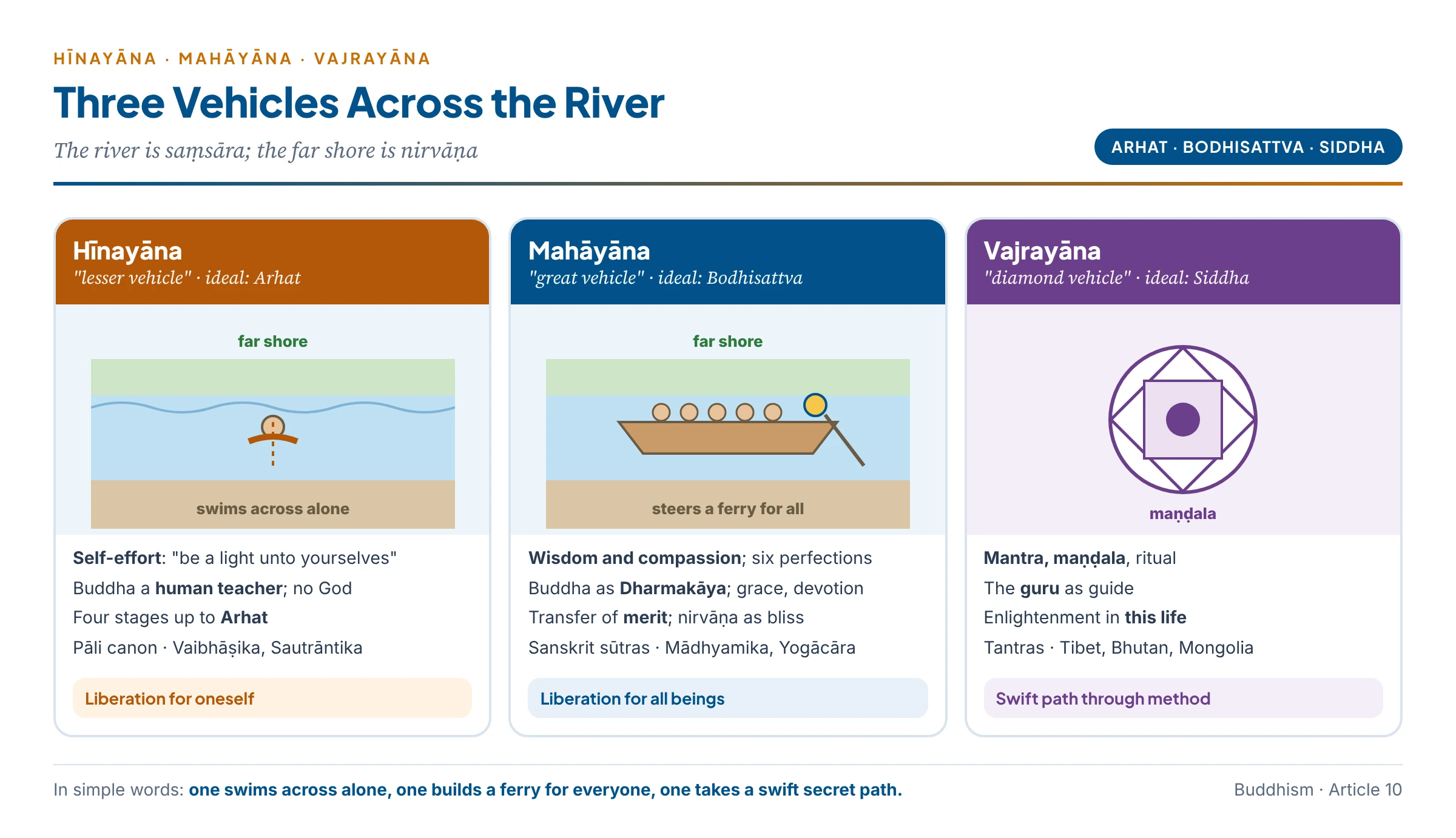
Hīnayāna as a religion without God.
- The Buddha is a teacher, not a saviour; there is no creator God; one takes refuge in the three jewels (tisaraṇa) — Buddha, Dharma, Saṅgha.
- Self-help: “Be a light unto yourselves” (ātmadīpo bhava); the Buddha’s last words — “decay is inherent in all compounded things; work out your liberation with diligence“.
- The path rises through four stages: the stream-enterer (srotāpanna), the once-returner (sakṛdāgāmin), the non-returner (anāgāmin) and the Arhat.
- Nirvāṇa can be attained consciously in this life by one’s own effort.
Mahāyāna’s three changes.
- The Bodhisattva ideal. Liberation for oneself alone is “spiritual selfishness“; the Bodhisattva vows to save all beings, joining wisdom (prajñā) and compassion (karuṇā). Like a lotus that grows in the mud yet stays clean, he lives in the world without being stained by it. He can transfer his merit (pariṇāmanā or parivarta) to others — unlike the strict Hīnayāna rule that each reaps only his own karma. The Bodhisattva ideal is grounded in a vision of one transcendental reality in which all beings share.
- Buddha as God. The Buddha becomes the Dharmakāya — the cosmic body of truth — and saviour figures such as Amitābha offer grace to devotees. The human need for devotion reasserts itself.
- Restoration of the Self. Against the strict no-self of Hīnayāna, some Mahāyāna texts speak of a great Self (mahātman) or Buddha-nature in all beings — the empirical ego is denied, but a higher, universal self is affirmed.
The stream analogy. The Hīnayāna follower is like one who swims across a flooded river alone; the Mahāyāna Bodhisattva is like one who builds a great ferry to carry everyone across, and stays to steer it.
Common confusion
“Hīnayāna” and “Theravāda” are often used as if they were the same. Strictly, “Hīnayāna” (“lesser vehicle”) is a critical label coined by Mahāyānists for all the early schools — including the Vaibhāṣika and Sautrāntika, which were Sarvāstivāda schools, not Theravāda. Theravāda is the one early school that survives today (in Sri Lanka and South-East Asia). Its followers do not call themselves “Hīnayāna”.
7. Was Mahāyāna a Departure or a Fulfilment?
- The departure view. Mahāyāna changed the Buddha’s teaching: it made a teacher into a God, brought back a Self, and added ritual and grace — moving towards Hindu theism.
- The fulfilment view. Mahāyāna claims to bring out what the Buddha really meant:
- The Buddha’s silence pointed to an indescribable ultimate, not to scepticism.
- He adapted his teaching to his hearers (skill in means, upāya-kauśalya); the Hīnayāna teachings were a first step for those not ready for more.
- On this view, the Buddha came “not to destroy but to fulfil” the spiritual insight of the Upaniṣads; later Buddhism, especially Mahāyāna, recovered that link.
- Balanced view. Both vehicles keep the core: suffering, dependent origination, no permanent ego, and liberation through wisdom and conduct. Mahāyāna adds compassion as universal duty and a more positive picture of the goal.
Critical Evaluation
A. How the Schools Criticise Each Other
- Vaibhāṣika → Sautrāntika. If objects are never perceived, how do you know your images are copies of anything? Inference needs prior perception.
- Sautrāntika → Vaibhāṣika. The momentary object has already perished when it is known; illusions prove we see images, not things.
- Yogācāra → Sautrāntika. An object that is never perceived is an idle hypothesis; drop it. Atoms cannot combine; objects and their awareness are always found together.
- Sautrāntika → Yogācāra. Even the Yogācāra says ideas appear “as if external” — which makes sense only if there is an outside. A pot is felt outside while consciousness is felt within; no one says “I am the pot“.
- Mādhyamika → Yogācāra. Consciousness depends on its objects; if objects are empty, so is consciousness. Self-awareness is impossible — “a sword cannot cut itself“. The ālaya is a hidden self.
- Yogācāra → Mādhyamika. If mind too is unreal, the Mādhyamika’s own reasoning is unreal; “to say that everything is unreal is suicidal“.
- Mādhyamika → realists. If dharmas had own-nature, they could not arise, change or cease; the realist’s real elements make dependent origination impossible.
B. External Critiques of the Whole Buddhist Project
- Nyāya-Vaiśeṣika. Momentariness destroys memory, recognition and karma (Article 4); denying substance leaves qualities without a bearer.
- Mīmāṃsā (Kumārila). Dreams borrow their content from waking experience; cognition is formless and reveals real objects.
- Jaina. Momentariness leads to kṛtapraṇāśa (the doer loses the fruit of his action) and akṛtābhyupagama (one gets fruit he did not earn); one-sided views are each partial truths, not the whole truth.
- Śaṅkara (Advaita). Attacks every school: the realists cannot explain how momentary atoms combine without a uniting intelligence; the idealists confuse “known by the mind” with “part of the mind“; the doctrine of the void contradicts all means of knowledge. Yet his two levels of truth closely follow the Mādhyamika — and critics called him a “crypto-Buddhist” (pracchanna-bauddha).
- The general Brahmanical objection. Every school assumes a unifying subject — one who remembers, compares, suffers and is liberated — while denying it. “He who experiences the flux must stand above the flux.“
C. Significance of Buddhism
- Practical and spiritual together. Buddhism joins rigorous philosophical analysis with a way of life; its metaphysics serves liberation.
- Ethics without God. It grounds morality in causality and compassion, not in divine command — a model of secular ethics.
- Philosophical depth. It produced Indian philosophy’s sharpest logic (Dignāga, Dharmakīrti), its most radical critique of metaphysics (Nāgārjuna), and its richest philosophy of mind (Yogācāra).
- Stimulus to other schools. Nyāya logic, Mīmāṃsā epistemology and Advaita’s two truths were all sharpened in debate with Buddhists.
- Wisdom and compassion. The Mahāyāna union of prajñā and karuṇā gave Asia an ideal of the enlightened person as one who serves all beings.
- Social message. It rejected caste as a measure of worth and opened the path to all — later central to Dr B.R. Ambedkar’s Navayāna Buddhism.
Critics and Defenders
Criticism — Critics
- Realists against idealists: “as if external” presupposes the external; pot felt outside; no one says “I am the pot”.
- Idealists against realists: unperceived objects are idle; atoms are incoherent; the copy cannot be checked.
- Mādhyamika against all: own-nature makes change and liberation impossible; even consciousness is empty.
- Yogācāra against Mādhyamika: denying the mind is suicidal for reason.
- Nyāya, Mīmāṃsā, Jaina, Śaṅkara: momentariness and no-self cannot explain memory, karma and a unifying subject; the void contradicts knowledge.
- Departure critics: Mahāyāna turned a teacher into a God and restored a Self.
Defence — Defenders and strengths
- One root, many readings: all schools keep the four truths, dependent origination, no-self and nirvāṇa.
- A self-correcting dialectic: each school answers the weakness of the one before — realism, indirect realism, idealism, critique.
- Two truths: everyday knowledge and ethics stay valid while ultimate questions are kept open.
- Upāya: different teachings for different hearers; Mahāyāna as fulfilment, not betrayal.
- Compassion and wisdom: the Bodhisattva ideal grounds a universal ethic.
Cross-Tradition Comparison
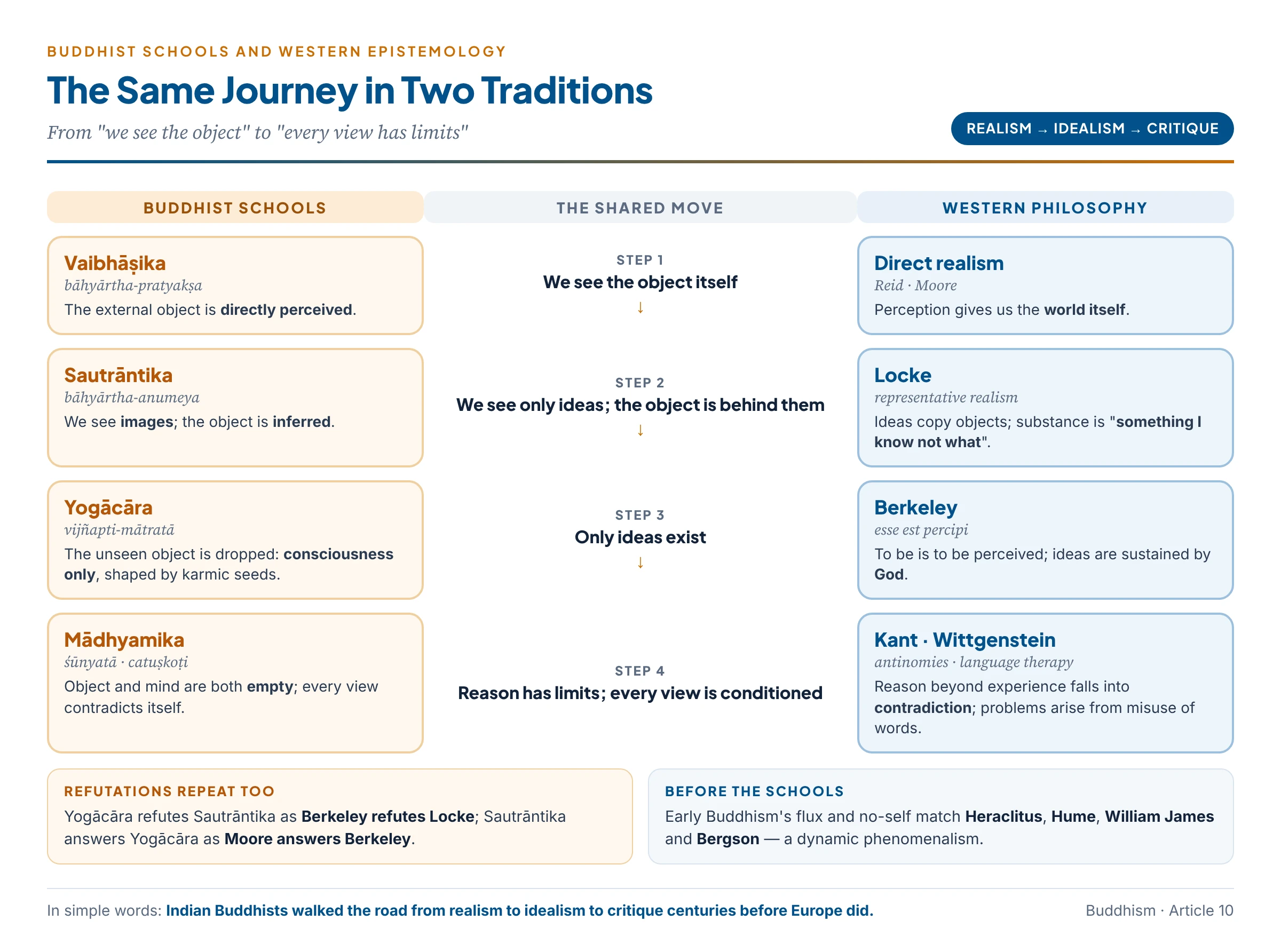
The same journey in two traditions:
| Buddhist school | Western counterpart | Shared move |
|---|---|---|
| Early Buddhism | Heraclitus (“everything flows”), Hume (bundle of perceptions), William James (stream of consciousness), Bergson (life as flux) | No permanent substance or self; reality as process — a “dynamic phenomenalism“ |
| Vaibhāṣika | Direct realism (Reid, Moore) | We perceive objects themselves |
| Sautrāntika | Locke (representative realism); Kant (unknowable thing-in-itself) | We perceive ideas; the object is inferred |
| Yogācāra | Berkeley (esse est percipi); Hegel-style absolute idealism in the absolute reading | The inferred object is dropped; only minds and ideas remain (Berkeley keeps God; Yogācāra uses karmic seeds) |
| Mādhyamika | Kant’s antinomies, Wittgenstein’s therapy of language, Bradley’s critique of relations | Every metaphysical view contradicts itself; reason has limits |
| Sautrāntika refuted by Yogācāra | Locke refuted by Berkeley | “Something I know not what” is abolished |
| Yogācāra refuted by Sautrāntika | Berkeley refuted by Moore (“Refutation of Idealism”) | Awareness and its object are distinct |
Buddhist schools and Vedānta:
| Buddhist school | Vedānta parallel | Difference |
|---|---|---|
| Mādhyamika | Advaita — two levels of truth; the world as māyā; the ultimate beyond words | Advaita’s ultimate is positive (Brahman = being, consciousness, bliss); Mādhyamika names no ultimate |
| Yogācāra | Gauḍapāda’s dream argument; the Advaitic witness-consciousness (sākṣin) | Advaita’s consciousness is eternal and one; Yogācāra’s is a momentary stream, many in number |
| Ālaya-vijñāna | Like Brahman or the ātman as ground of experience | The ālaya is changing and ceases at liberation |
| Svabhāva-śūnya / prapañca-śūnya | Māyā / nirguṇa Brahman | Śūnyatā is not called “being” or “self” |
| Hīnayāna realism | Nyāya-Vaiśeṣika pluralist realism | Buddhists deny substance and permanence; Nyāya affirms both |
Indian Connect — Key takeaways
- Four answers to one question: Vaibhāṣika — object perceived; Sautrāntika — object inferred; Yogācāra — only consciousness; Mādhyamika — neither, everything empty.
- From realism to critique: the Buddhist schools trace the same path as Western philosophy from Locke → Berkeley → Kant.
- Advaita’s debt: Gauḍapāda and Śaṅkara absorbed the dream argument and the two truths, while insisting on an eternal, positive Brahman.
Synthesis (Siddhānta)
- One root, four branches. All four schools grow from dependent origination, momentariness and no-self. They differ on what is real (mind, matter, both or neither) and on how it is known (directly, by inference, as consciousness itself, or only conventionally).
- A dialectical progression. Vaibhāṣika direct realism gives way to Sautrāntika inference; the inferred object is dropped by the Yogācāra; and the Mādhyamika shows that both object and mind are empty. Each step answers the difficulty of the one before.
- Two vehicles, one core. Hīnayāna stresses self-effort and the Arhat; Mahāyāna adds compassion, the Bodhisattva and a positive nirvāṇa; Vajrayāna adds ritual and the guru. All keep the Four Noble Truths.
- The lasting debate. The realist–idealist–dialectical debate within Buddhism anticipated the great debates of Western epistemology and shaped the whole of Indian philosophy, above all Advaita Vedānta.
- Contemporary relevance.
- Philosophy of perception. Direct realism, representationalism and idealism remain live positions in philosophy of mind and cognitive science — the Buddhist debate maps onto them closely.
- Process philosophy and science. The flux-view of early Buddhism echoes modern physics and biology, where “things” are stable patterns of process.
- Ethics of compassion. The Bodhisattva ideal inspires engaged Buddhism — social service, peace work and ecological action.
- Social equality. Buddhism’s rejection of caste remains a resource for social justice in India.
- Pluralism. The fact that one teaching supports many readings models how traditions can hold diversity within unity.
“Be a light unto yourselves; be a refuge unto yourselves.” — The Buddha
Previous Year Questions
- 2024How do the two schools of Buddhism arrive at two opposed conclusions, namely “everything is void” and “everything is real” from the same doctrine of Pratītyasamutpāda? Answer with arguments.
- 2017How do Mādhyamika, Yogācāravādins and Sarvāstivādins differ among themselves concerning the nature of reality? How do Sarvāstivādins differ among themselves with regard to knowledge of reality?