

Focussed group discussions, brain storming, grounded theory approach.
Official Syllabus: Paper I · Unit 2 Methods of Psychology
“A focus group is a carefully planned discussion designed to obtain perceptions on a defined area of interest in a permissive, non-threatening environment.”
— Krueger (1994)
These three belong together because each inverts the logic of the experiment. The experiment fixes the question in advance and controls everything else; these methods treat the participants’ own categories as the data, and treat the interaction between participants as a source of information rather than a contaminant. The whole family answers a different question — not “does this variable produce this effect?” but “what is going on here, in the terms of the people it is happening to?”
Focussed group discussions
A focussed group discussion is an interview conducted with a group rather than an individual, in which a moderator introduces topics and the participants respond to each other as well as to the moderator. Its ancestor is the focused interview of Merton and Kendall (1946), developed for wartime studies of propaganda and morale: respondents known to have shared a concrete experience were interviewed against a flexible guide, so the interview covered the researcher’s areas without dictating the respondents’ answers.
Structure and procedure
- The unit of analysis is the group, not the individual. The sample size is one per group, because individual comments are not independent — eliciting mutual response is the point of the design. Several groups are therefore run, not several people in one group.
- Composition — usually six to twelve participants who share a characteristic relevant to the enquiry: the same occupation, age band, sex, community or health condition. This homogeneity promotes free discussion and lets participants recognise their own experience in each other’s accounts.
- Strangers are preferred to acquaintances, so that existing relationships, hierarchies and histories do not govern who speaks and what can be said.
- The moderator creates conditions for free discussion, speaks the participants’ language, ensures everyone contributes, and deliberately elicits disagreement as well as agreement. The skill is to remain non-directive while still covering the ground.
- The discussion guide lists topics in sequence from the general to the specific, so participants frame the domain in their own terms before the researcher’s specific interests narrow it.
- Analysis proceeds as for qualitative interviews — transcription, coding of recurring themes, comparison across groups — with the added analytic object of the interaction itself: who defers to whom, what is said jokingly, what nobody contradicts.
When a focussed group discussion is preferred to interviewing
This is the sharper version of the question, and the answer is not “when it is cheaper”. There are four conditions under which the group is the right instrument:
- Shared or collective knowledge is the object of study — norms, customary practice, what “people around here” think. These exist between people, so an individual interview reaches only one person’s report of them, while a group discussion produces the thing itself.
- The respondents’ categories are not yet known. Groups generate vocabulary and distinctions the researcher had not thought to ask about, which is why focus groups are used to develop questionnaires before quantitative work rather than after it.
- When disagreement is informative. Watching participants contest a point reveals the range of positions and which of them can be defended in public; an interview yields the modal answer with no indication of its spread.
- Collective licence to disclose makes the topic speakable — stigmatised or embarrassing matters where hearing another participant speak first licenses disclosure.
Conversely, individual interviewing is preferred where the aim is one person’s biography, where experiences are unique rather than shared, where the topic is too sensitive to be raised in front of neighbours, or where the researcher needs control over topic order and the freedom to probe at length.
| Focussed group discussion | Individual interview | |
|---|---|---|
| Unit of analysis | The group | The person |
| Data generated | Shared meanings, norms, range of views | Depth on one life, individual meaning |
| Interaction | The object of study | Confined to interviewer and respondent |
| Moderator control | Low; topic can drift | High; probing at will |
| Disclosure of stigma | Helped by others speaking first | Helped by privacy |
| Best stage of research | Exploratory; instrument development | Depth; case understanding |
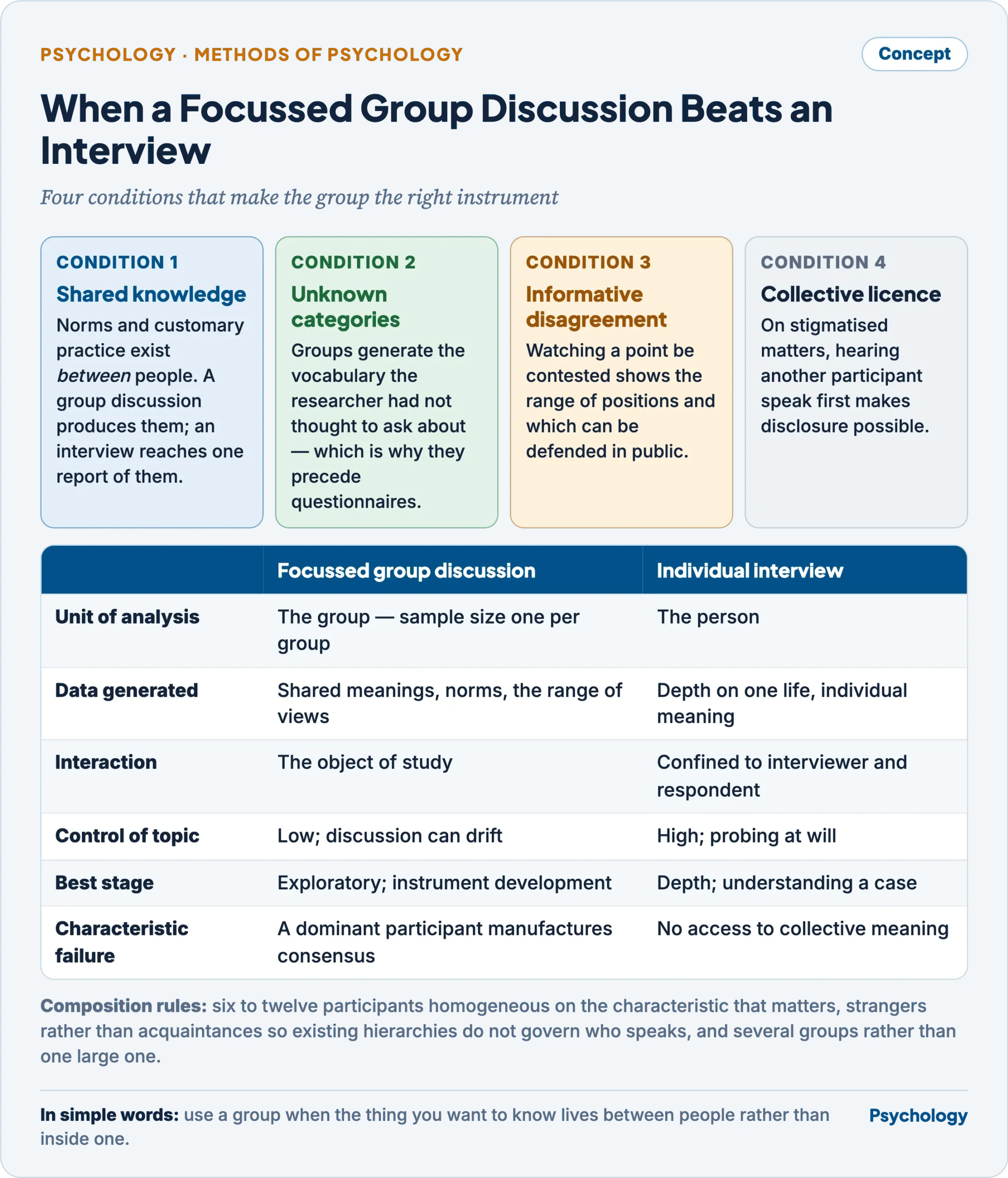
The four conditions that make a group the right instrument.
Limitations
- The moderator has far less freedom to probe, to follow one person’s thread or to control a change of topic than an interviewer does.
- Samples are small and purposive, so findings describe the groups studied and do not estimate anything about a population.
- A dominant participant can set the frame, and a vocal majority can silence a dissenting view, producing an appearance of consensus manufactured by the setting.
- Only one person speaks at a time, so the quantity of material per participant-hour is low.
- It is not a substitute for individual interviewing, and using it as one is the commonest misapplication: a group cannot deliver an individual’s unique experience.
Brain storming
Osborn (1953) proposed brainstorming as a group procedure for generating ideas, resting on a separation of idea production from idea evaluation. Four rules enforce that separation:
- Defer judgement — no criticism of any idea during the generating phase, since fear of criticism is what suppresses unconventional suggestions.
- Freewheeling is welcome — the wilder the idea the better, because a wild idea is easier to tame than a dull one is to enliven.
- Quantity is wanted — a larger pool raises the chance that it contains something good.
- Combination and improvement are sought — participants build on and recombine ideas already offered, a practice usually called piggybacking.
The challenges of group brainstorming
The striking finding is that the procedure does not work as advertised. Taylor, Berry and Block (1958) compared real interacting groups against nominal groups — the same number of people working alone, their ideas pooled afterwards — and found the nominal groups produced more ideas, and more good ideas, than the interacting groups. The result has replicated repeatedly, and the gap widens as group size grows. Four processes explain this productivity loss:
- Production blocking — only one person can speak at a time, so while one member talks the others cannot articulate, rehearse or must hold an idea in memory, where it decays or is displaced. Diehl and Stroebe (1987) separated the candidate causes experimentally and showed blocking to be the principal one, which matters because it is a structural feature of talking in groups rather than a motivational failing that exhortation could fix.
- Evaluation apprehension — the rule against criticism does not abolish the fear of being judged. Participants know their ideas are being heard and assessed, so self-censorship persists even where open criticism is forbidden.
- Social loafing and free riding — effort is not individually identifiable, so each member reduces it, on the reasonable assumption that others will contribute.
- Illusion of group productivity — participants reliably believe their group performed better than it did, partly because they count others’ ideas among their own experience of the session. The illusion is why the technique survives its own evidence.
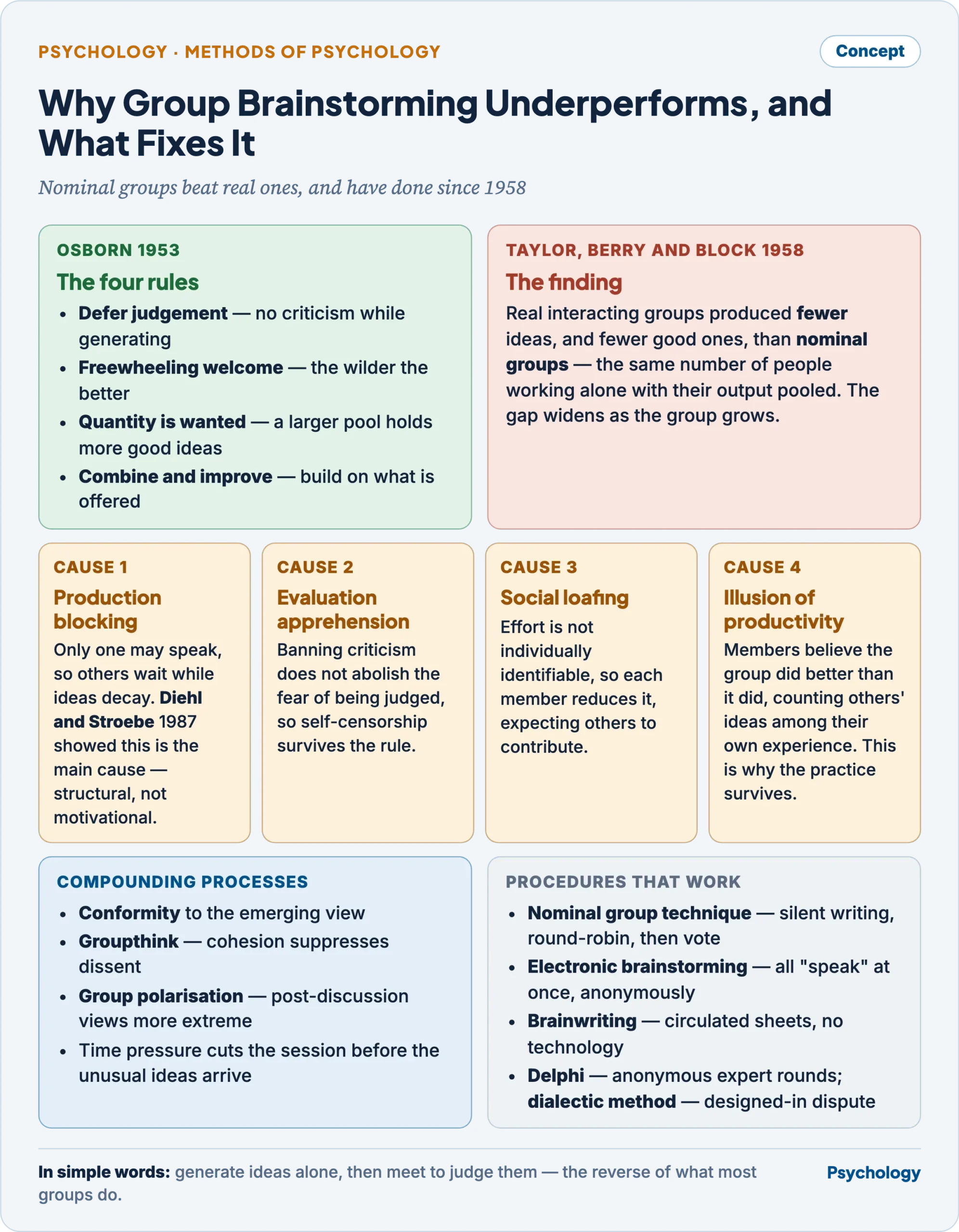
Nominal groups have outperformed interacting ones since 1958.
Three further group processes compound the problem: conformity to the emerging view, groupthink where cohesion and the desire for consensus suppress dissent, and group polarisation, the tendency for the average post-discussion position to be more extreme than the average pre-discussion position. Time pressure cuts the session short before the later, more unusual ideas emerge — which is costly, because quality tends to rise rather than fall across a long session.
Procedures that address these
- Nominal group technique — silent individual generation in writing, then round-robin reporting with each idea recorded publicly, then clarification and discussion of each recorded idea, then individual ranking or voting. The arrangement keeps the productivity of working alone and adds the group’s evaluative judgement, taken at the point where judgement helps.
- Electronic brainstorming — participants enter ideas at their own terminals and see others’ contributions posted anonymously. Everyone can “speak” at once, which removes production blocking outright, and anonymity reduces evaluation apprehension; participants need not share a location or a time.
- Brainwriting — written generation and silent circulation of sheets, the low-technology version of the same insight.
- Delphi technique — successive anonymous rounds among dispersed experts, each round fed back as a summary for further comment until convergence. It eliminates interpersonal pressure and uses expert time efficiently, at the cost of considerable elapsed time.
- Dialectic decision method — competing proposals are stated, their underlying assumptions made explicit, and advocacy sub-groups argue the merits before the whole group decides. Here disagreement is designed in rather than suppressed.
The grounded theory approach
“The discovery of theory from data systematically obtained from social research.”
— Glaser and Strauss (1967)
Barney Glaser and Anselm Strauss published The Discovery of Grounded Theory in 1967 against a methodological orthodoxy in which theory was generated by speculation and research was confined to testing it. Their objection was twofold: that this left qualitative work with no standing as a theory-generating enterprise, and that it guaranteed theories about matters nobody had looked at closely. Grounded theory is the resulting method — theory built upward from data by a specified sequence of analytic operations, such that every concept in the final account can be traced to the material it came from.
Essential features
- Inductive rather than deductive. The analysis does not begin from a hypothesis derived from existing theory; codes and categories are developed from the data.
- Simultaneous collection and analysis. The two are not successive phases. Analysis of early data determines what is collected next, which is what makes the method a method rather than a style of reading.
- Theory as the output. The aim is a substantive theory explaining a process in a particular setting, which further work may extend towards a formal theory of wider scope. Grounded theories are middle-range in Merton’s sense — above everyday explanation, below grand theory.
- Delaying the literature review until the analysis has taken shape, so that existing categories do not pre-empt the participants’.
- Memo-writing throughout, as the medium in which concepts are developed rather than merely recorded.
The analytic procedures
The sequence below is the substance of the method, and the questions on grounded theory are questions about it.
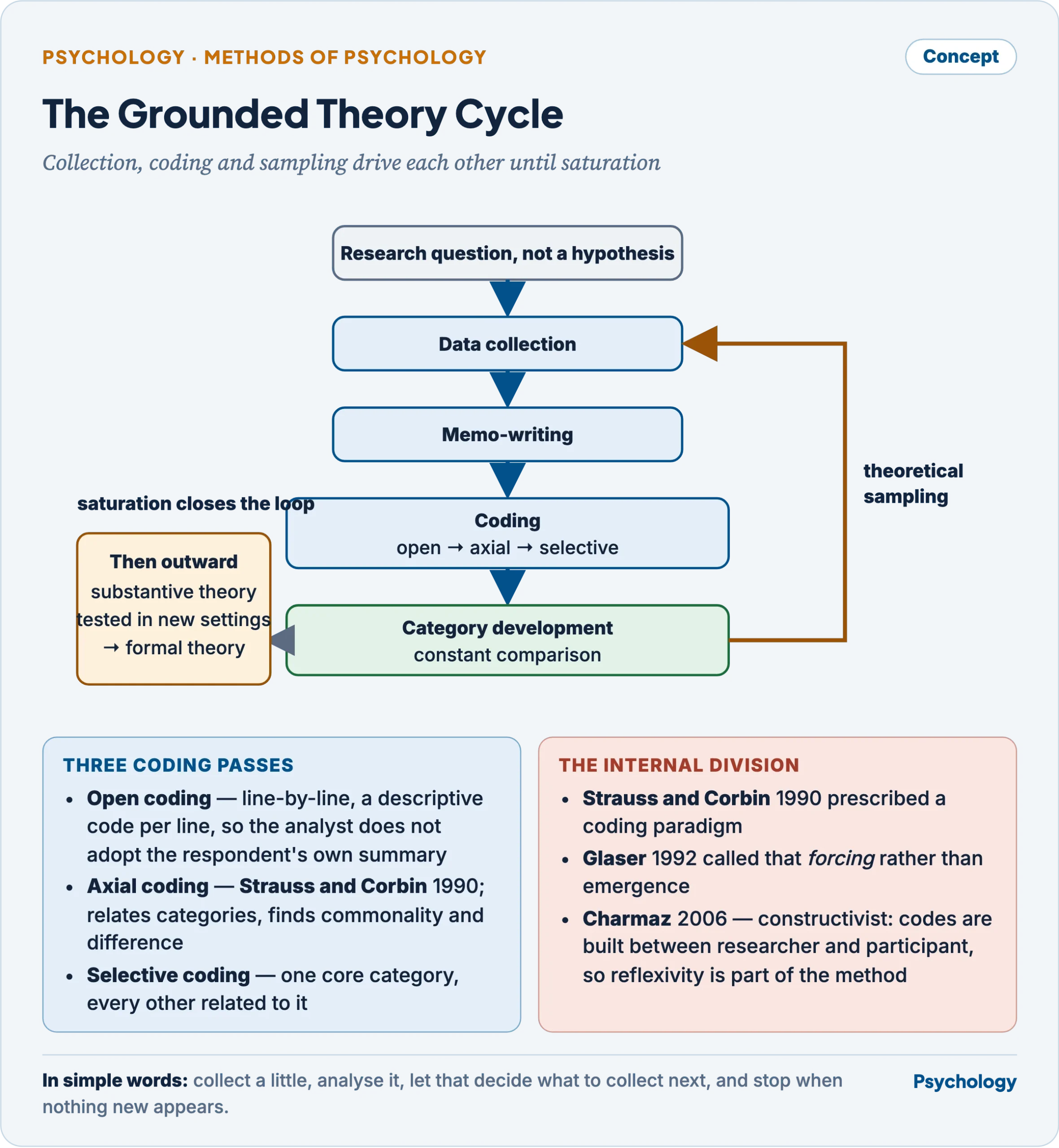
The loop is the method. Collection, coding and sampling drive each other until saturation closes it.
- Theoretical sampling — cases are selected for their capacity to develop the emerging categories, not for representativeness. Sampling typically begins as convenience sampling to gain entry, becomes purposeful sampling as the researcher learns the setting, and becomes theoretical only once provisional categories exist to be refined. It is deliberately selective about which data and from whom, focusing on experiences rather than on persons.
- Data collection — interviews, observation, focus group discussions, documents, press material, records. Grounded theory specifies no data type, and repeated return to the field is required because each round is shaped by the last round’s analysis.
- Memo-writing — analytic notes standing between coding and the written analysis. Four kinds are usually distinguished: observation notes on what was perceived in the field, methodological notes on how procedures were applied, theoretical notes developing the concepts, and personal notes recording the researcher’s own reactions. Memos make the analysis auditable, and they are where major and minor categories get separated.
- Coding, in three progressively more abstract passes:
- Open coding — line-by-line scrutiny, each line given a descriptive code. The point of working this finely is to keep the analyst from sliding into the respondents’ own summary of their lives.
- Axial coding — introduced by Strauss and Corbin (1990); codes are related to one another, commonalities and differences among categories identified, and the initial codes reorganised and integrated.
- Selective coding — one category is identified as the core of the analysis and every other category related to it, producing a single integrating storyline.
- Category development — codes are grouped into categories, each labelled to fix its theme, and categories are checked against each other so they do not overlap.
- Constant comparison — every element of the analysis is checked against every other: datum against datum, datum against concept, concept against concept, one respondent’s account against another’s. This is the engine that forces refinement, and it is what distinguishes grounded theory from thematic summary.
- Theoretical saturation — the point at which further cases yield no new properties of the categories and further comparison produces no refinement. It is the method’s own stopping rule, and the reason sample size cannot be fixed in advance.
A case perspective rather than a variable perspective
Grounded theory treats the case as the unit that must be understood whole, not as a carrier of values on variables abstracted from it. Ragin (1987) drew the contrast sharply: a variable-oriented analysis decomposes cases into measures and studies relations among the measures across many cases, so no individual case need be understood at all; a case-oriented analysis holds the configuration of each case together and compares configurations.
The consequence for grounded theory is concrete. The constant comparative method compares whole accounts with whole accounts; categories are retained because they do analytic work within cases, not because they correlate; and the output is a process model of how something unfolds, not a set of coefficients. The trade is equally concrete: a case perspective yields an account that fits its cases closely and cannot say how much of anything is explained, while a variable perspective yields generalisable magnitudes about relations whose meaning in any particular life is unknown.
This also locates theory-developing against theory-testing research. Theory-testing work begins from a stated hypothesis, fixes the design before data arrive, and asks whether the data are compatible with the prediction; its characteristic risk is a well-tested theory about the wrong thing. Theory-developing work begins from a question rather than a hypothesis, lets the design evolve as the analysis proceeds, and asks what account the data will support; its characteristic risk is an account that fits its own data and nothing else. The two are complementary stages rather than rival schools, and grounded theory’s contribution was to show that the first stage could be as systematic as the second.
The internal division
Glaser and Strauss diverged after 1990. Strauss and Corbin (1990) set out a prescribed coding paradigm with specified analytic steps, which Glaser (1992) attacked as forcing categories onto data rather than letting them emerge. Charmaz (2006) developed a third, constructivist position: codes and categories are constructed in the interaction between researcher and participant rather than discovered lying in the data, so reflexivity about the researcher’s own standpoint becomes part of the method rather than a threat to it. A candidate asked about grounded theory’s analytic procedures should know that “the” procedure is contested, because the dispute is precisely about how far the procedures may be specified before they stop being inductive.
Applications
- Exploring a layperson’s definition of a construct is the paradigm case for grounded theory, because the researcher’s own definition is exactly what must be kept out. For happiness, the design runs: open-ended interviews and focus groups asking people to describe occasions when they were happy, with no scale and no supplied definition; line-by-line open coding of the accounts; categories built from the participants’ own distinctions, which routinely cut across the academic ones — relational and familial content, religious and moral content, and contentment or santosh as against momentary pleasure; theoretical sampling to deliberately recruit cases likely to strain the emerging categories, such as the very poor, the recently bereaved and the renunciant; constant comparison until saturation; and a substantive theory of what happiness consists in for this population. The product is a definition grounded in use, which can then be turned into a scale — the sequence that imported wellbeing measures skip, and the reason they often measure something their respondents were not talking about.
- Focussed group discussions for a behaviour-change problem such as sanitation work because the obstacle is collective rather than informational. Groups are run separately by sex, caste and age, since the matter cannot be discussed across those lines; the guide opens on daily routine and water, not on latrines, so that the relevant categories surface before the researcher’s agenda does; the moderator elicits disagreement about what is clean, what is polluting, who may empty a pit and what visitors would think. What emerges is the belief structure a campaign has to engage, and the material then shapes both the message and the questionnaire for any survey that follows.
Indian context
- Coffey, Gupta, Hathi, Khurana, Spears, Srivastav and Vyas (2014) conducted the sanitation survey of rural Bihar, Haryana, Madhya Pradesh, Rajasthan and Uttar Pradesh that reframed the problem. Among households that owned a working latrine, about 40 per cent had at least one member who regularly defecated in the open. Subsequent qualitative work by the same group attributed this to beliefs about purity and pollution, to the association of pit-emptying with untouchability, and to a positive valuation of open defecation as wholesome, rather than to ignorance of hygiene. The finding is the standard demonstration that provision does not produce use, and that the variables that matter were discoverable only by asking people in their own terms.
- The Swachh Bharat Mission (Gramin), launched in 2014 under what is now the Department of Drinking Water and Sanitation, Ministry of Jal Shakti, shifted from subsidy for construction towards community-led behaviour change, with village-level triggering exercises, community monitoring and declarations of open-defecation-free status. The psychological principle it operationalises is descriptive and injunctive norm change: the target is what people believe their neighbours do and approve of, which is why the unit of intervention is the village rather than the household, and why group methods are the appropriate research instrument for it.
Criticisms and limitations
- Grounded theory’s procedures are specified unevenly. Coding and sampling are set out in detail while the move from categories to a theory is largely tacit, so two competent analysts working the same transcripts may produce different accounts with no procedure for adjudicating between them.
- The claim that categories “emerge” is contestable. The Glaser–Strauss split and Charmaz’s constructivist reply are both about this. No analyst arrives without concepts, and the discipline of delaying the literature review manages that problem without solving it.
- Its cost is concealed. Simultaneous collection and analysis, repeated field contact and the open-ended stopping rule make the method slow and demanding of a trained analyst; studies that claim it while doing one round of interviews and a thematic summary are the commonest misuse of the term.
- Causal and quantitative claims are out of reach. A grounded theory identifies processes and their conditions; it cannot establish that one thing caused another or estimate how much, and extending a substantive theory to new settings is a further empirical task rather than an entitlement.
- Brainstorming’s standing is weaker than its popularity. The evidence has favoured nominal and electronic variants over face-to-face sessions for six decades, and the practice persists mainly because participants enjoy it and misjudge its output. The defensible use is for commitment, shared understanding and the evaluation of ideas, with generation done individually first.
- Group methods purchase breadth with depth. Focussed group discussions and brainstorming both yield material shaped by what can be said in front of others. That is sometimes exactly the data wanted and sometimes a systematic distortion, and nothing within either method distinguishes the two cases.
Previous Year Questions
- 2026“The aim of grounded theory analysis is to develop inductive theory which is closely derived from the data.” Elaborate upon the statement with respect to the analytic procedures followed in the grounded theory approach.
- 2021Discuss the challenges during group brainstorming process.
- 2020How can grounded theory approach help to explore layperson’s definition of happiness?
- 2017How can you use ‘Focus Group Discussion’ to promote use of toilets in rural areas?
- 2010Under what conditions would a researcher prefer to use focused group discussion over interviewing?
- 2008Grounded theory takes a case rather than variable perspective. Elaborate this statement.
- 1996Theory-testing vs Theory-developing research.