

Anthropology Optional › Paper II › Unit 02: Demographic Profile of India
2. Ethnic and linguistic elements in the Indian population and their distribution. Indian population – factors influencing its structure and growth.
Official Syllabus: Paper II, Unit 2
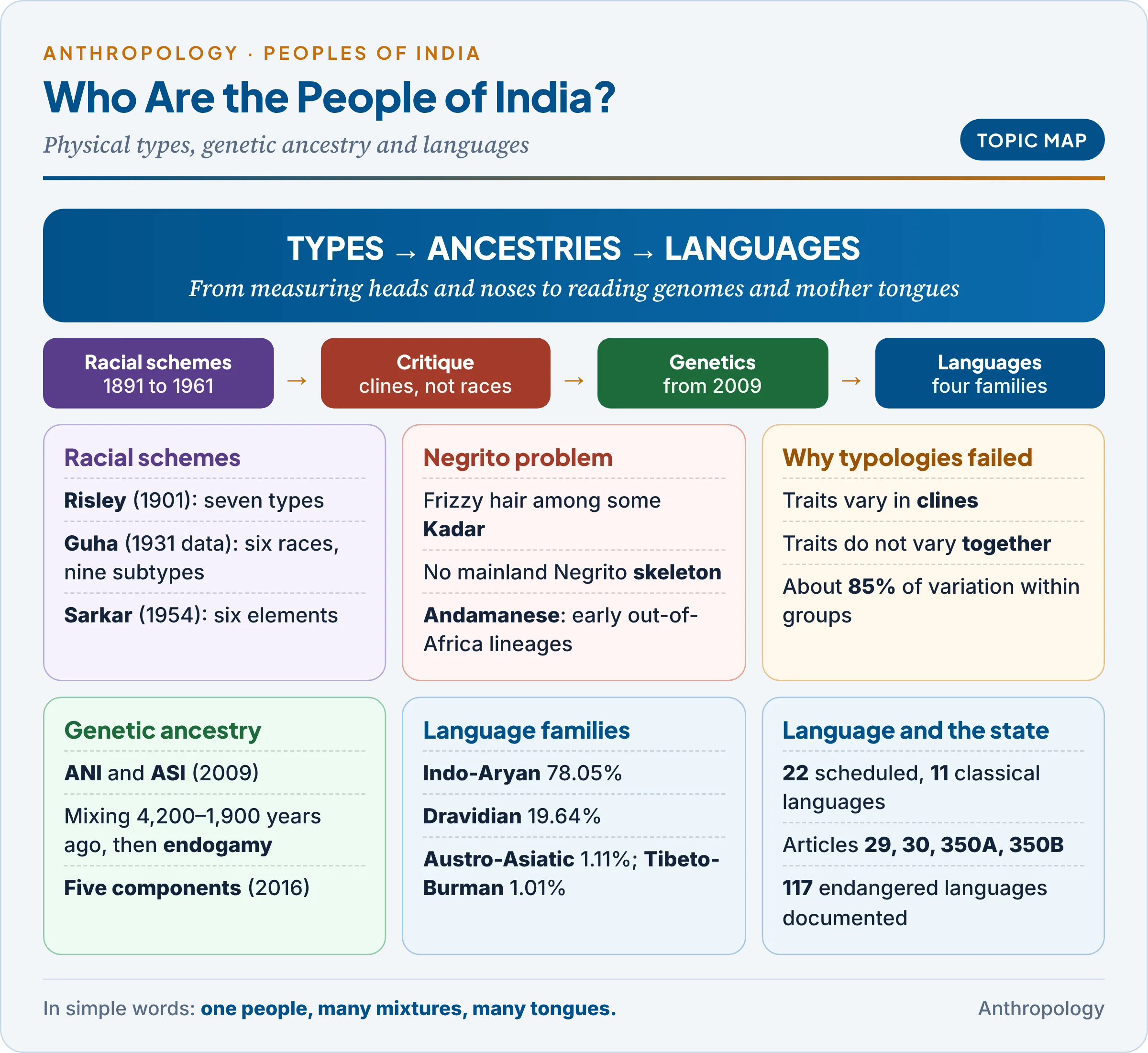
This article covers the first half of the syllabus line: who the people of India are, by physical type, by ancestry and by language, and where each element lives. The second half, the structure and growth of India’s population, is in 2b. The general biology of race (racial criteria, heredity and environment, the validity of race) is in Paper 1, Unit 9.5; here it is applied to India.
1. The Peopling of India and How It Has Been Classified
In simple words
India’s people came from many directions over tens of thousands of years and mixed with one another. Scholars have tried to sort this diversity in three ways: by body measurements, by language and, today, by DNA. Each method sees something real, but the three do not draw the same lines.
India has often been called an ethnological museum: modern humans arrived by the coast more than 50,000 years ago, people related to early populations of the Iranian plateau spread into the north-west, speakers of Austroasiatic and Tibeto-Burman languages came from the east and north-east, and people with Central Asian steppe ancestry entered from the north-west in the second millennium BC, followed in historic times by Greeks, Sakas, Kushans, Huns, Arabs, Turks and others. Mixing, followed by endogamy (marriage only within one’s own group), produced thousands of distinct communities.
Scholars have grouped this diversity by four kinds of element:
- Racial or physical elements: groups defined by somatometry (measuring the body: stature, head and nose shape) and somatoscopy (observing traits such as skin colour, hair form and eye fold).
- Genetic elements: groups defined by ancestry read from blood groups and, since 2009, from genome-wide DNA.
- Linguistic elements: groups defined by the language family of their mother tongue.
- Social elements: caste, tribe and religion, which shape who marries whom and so shape the other three.
Two measurements recur in the classifications below and need a gloss. The cephalic index is head breadth divided by head length, times 100: dolichocephalic (long-headed) below about 75, brachycephalic (round-headed) above about 80. The nasal index is nose breadth divided by nose height, times 100: leptorrhine (narrow-nosed) below 70, platyrrhine (broad-nosed) above 85.
2. The Racial Classifications
In simple words
Between about 1890 and 1960, anthropologists measured thousands of Indians and divided them into “racial types”. Their schemes are now seen as flawed, but they shaped Indian anthropology and the census, so it matters how and why they differed.
2.1 Herbert Risley (1901, 1908)
Herbert Hope Risley, a British civil servant who ran the ethnographic survey of Bengal and was Census Commissioner for 1901, made the first scheme for the whole country. He relied mainly on the cephalic index, nasal index, orbito-nasal index and stature, collected in surveys from the late 1880s, and published it in the 1901 Census and The People of India (1908).
| Type | Region | Example groups | Risley’s explanation |
|---|---|---|---|
| Turko-Iranian | Baluchistan, North-West Frontier | Baluch, Brahui, Afghans | Turkic and Persian mixture |
| Indo-Aryan | Punjab, Rajputana, Kashmir | Rajputs, Khatris, Jats | Nearest to the original “Aryans” |
| Scytho-Dravidian | Gujarat to Coorg | Maratha Brahmins, Kunbis, Coorgs | Scythian invaders with Dravidians |
| Aryo-Dravidian | Uttar Pradesh, Bihar, parts of Rajputana | Hindustani Brahmins; Chamars | Aryan and Dravidian mixture |
| Mongolo-Dravidian | Lower Bengal, Odisha | Bengali Brahmins and Kayasthas | Mongoloid and Dravidian mixture |
| Mongoloid | Himalaya, Assam, Nepal | Kanets of Lahaul and Kulu, Lepchas, Bodos | — |
| Dravidian | Ganga valley to Sri Lanka, Chota Nagpur, South | Santals, Paniyans | The “original” inhabitants |
Most of Risley’s types are mixtures named after languages (Aryan, Dravidian) or invaders (Scythians, Turks), so the scheme was as much a story about conquest as a description of bodies. Risley had earlier compiled The Tribes and Castes of Bengal (1891), and his census work made caste and tribe official categories of colonial administration.
The nasal index and caste. Risley claimed that caste had a racial basis and that the social rank of a caste rose as its nasal index fell: the higher the caste, the narrower the nose. The claim fitted the colonial idea of fair “Aryan” conquerors above dark “Dravidian” natives.
- Bhupendranath Datta, an Indian anthropologist, ranked the castes of Punjab and Rajputana by Risley’s own nasal-index figures and found Gujjars at the top and Rajputs only sixth, the reverse of what the theory required.
- Naming error: using language names (Aryan, Dravidian) for physical types repeats the confusion that the philologist Max Müller had warned against in 1888, that speaking of an “Aryan race” is as wrong as speaking of a long-headed grammar. Müller died in 1900, so his warning was general, not a review of Risley.
- Other faults: the brachycephaly of western India was assumed to come from Scythian invaders, the Bengalis’ origin was guessed as Mongolo-Dravidian, samples were small and the Munda-speaking tribes were lumped with Dravidians.
2.2 Haddon and Eickstedt
- A.C. Haddon (The Races of Man, 1924) grouped India by regions (Himalayan, Hindustan plains, Deccan) and recognised Negrito and Pre-Dravidian strata in the south.
- Egon von Eickstedt, a German anthropologist, used terms such as Weddid (related to the Veddas of Sri Lanka) and Indid for Indian types (1930s).
Both shared Risley’s assumption that discrete types exist; they differed only in how many and where.
2.3 B.S. Guha (1931 Census; published 1935)
B.S. Guha, an Indian physical anthropologist who later became the first Director of the Anthropological Survey of India (founded 1945), measured 2,511 people from 34 groups, used standardised international techniques and Karl Pearson’s coefficient of racial likeness (a statistical measure of similarity between groups), and proposed six main races with nine subtypes.
| Race | Subtypes | Main traits | Example groups |
|---|---|---|---|
| Negrito | — | Very short, dark, woolly or frizzy hair | Kadar, Pulayan, Irula (Western Ghats); Andamanese |
| Proto-Australoid | — | Long head, broad nose, wavy hair, dark | Chenchu, Bhil, Santal, Oraon, Baiga, Urali |
| Mongoloid | Palaeo-Mongoloid (long-headed and broad-headed); Tibeto-Mongoloid | Straight hair, epicanthic fold, flat face | Sema Naga, Limbu; Lepcha, Chakma; Tibetans of Sikkim and Bhutan |
| Mediterranean | Palaeo-Mediterranean, Mediterranean, Oriental | Long head, narrow to convex nose | Tamil and Telugu Brahmins, Nairs; Nambudiris, Brahmins of Allahabad; Punjabi Khatris |
| Western Brachycephals | Alpinoid, Dinaric, Armenoid | Round head, prominent nose | Banias of Gujarat, Kathis; Bengali and Kanarese Brahmins; Parsis |
| Nordic | — | Tall, long head, fair, light eyes | Kalash and others of the north-west; parts of Punjab and Rajasthan |
Guha’s scheme was the most widely used for decades because it rested on standardised measurement and statistics. Its critics noted that it explained nearly every element by migration from outside, treated the Negrito as a separate stratum on the evidence of hair form in a few individuals, and, like Risley’s, assumed pure types behind mixed people.
2.4 S.S. Sarkar (1954, 1958–61)
S.S. Sarkar, an Indian physical anthropologist (The Aboriginal Races of India, 1954), proposed six elements: Australoid (the oldest, including Urali, Kannikar, Paniyan and Kadar), Indo-Aryan, Irano-Scythian, Munda-speaking (Santal, Juang, Savara, with some Mongoloid affinities), Far Eastern (traces on the Tirunelveli and Chittagong coasts) and Mongolian.
The question of whether Sarkar’s scheme was better than Risley’s has a two-sided answer.
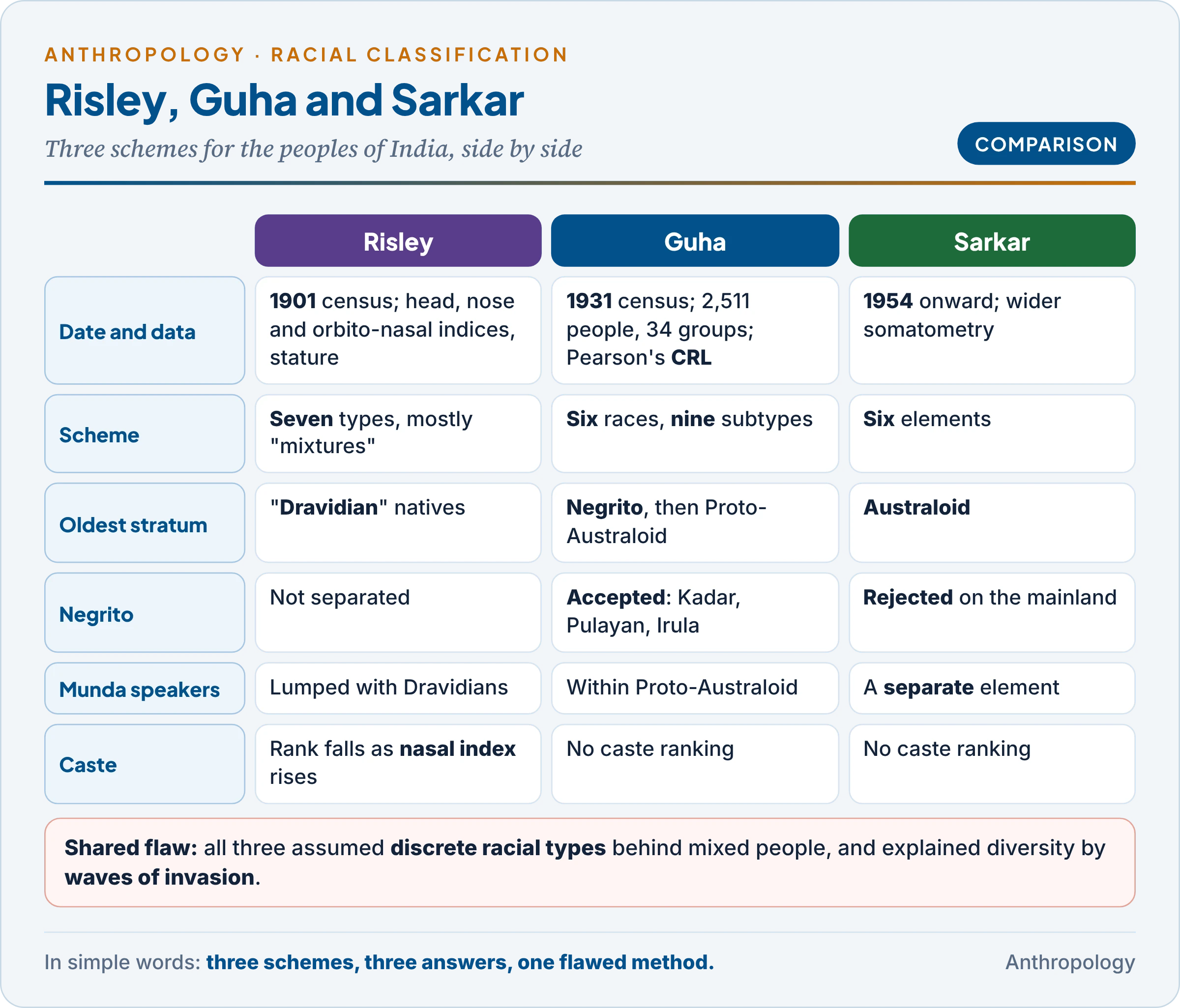
| Risley | Sarkar | |
|---|---|---|
| Data | Indices of head and nose; caste samples | Wider somatometry and later serological data |
| Indigenous base | “Dravidian” as the native type | Australoid as the oldest stratum |
| Negrito | Not separated | Rejected on the mainland; frizzy hair seen as sporadic |
| Munda speakers | Merged with Dravidians | Separate element |
| Caste | Racial basis of caste | No racial ranking of castes |
| Shared flaw | Discrete types, invasion stories, language names for bodies | Same, to a lesser degree |
Sarkar was better at separating language groups and dropping the caste-and-nose theory, but still built types, so both are now read as history rather than as description.
2.5 From typing to statistics
- D.N. Majumdar, with the statisticians P.C. Mahalanobis and C.R. Rao, analysed an anthropometric survey of the United Provinces (1941) using Mahalanobis’ distance (D²), a measure of overall difference between groups computed from many traits at once. This replaced impressionistic “types” with measured distances between real communities.
- Irawati Karve, an Indian anthropologist, with K.C. Malhotra, compared endogamous castes of the same rank in Maharashtra (1968) and found that even they differed biologically: each endogamous caste is its own breeding population, so castes cannot be grouped into a few racial varnas.
3. The Negrito Problem
In simple words
Some forest people of south India are very short and a few have tightly curled hair, like the Andaman Islanders. Scholars argued for a century over whether this showed an ancient “Negrito” race on the mainland. Genetics now separates the Andamanese question from the mainland one.
The debate turns on whether a short, dark, frizzy-haired Negrito stratum, like that of the Andaman Islands, Malaya and the Philippines, once lived on the Indian mainland.
| For a mainland Negrito strain | Against |
|---|---|
| Guha found frizzy hair among some Kadar of the Anaimalai hills, and later among Irula and Pulayan; he rejected African admixture because African slaves were brought to the coast, not the interior hills | Egon von Eickstedt held that genuine frizzy hair had never been found in south India; words such as woolly, spiral and frizzy were used loosely |
| J.H. Hutton saw Melanesian-like traits and cults (exposure of the dead, head-hunting) in Assam | Sarkar read the sporadic frizzy hair as independent mutation or recent admixture; D.N. Majumdar argued that cultural parallels need not mean Melanesian migration |
| Guha and Basu reported Australoid and possibly Negroid skulls among Naga remains | No authentic Negrito skeleton has been found on the mainland |
What genetics says. The Andamanese (Onge, Jarawa, Great Andamanese) carry maternal lineages (mtDNA haplogroups M31 and M32) found nowhere else, pointing to descent from an early coastal dispersal out of Africa (K. Thangaraj and colleagues, 2005). Genome-wide data show their ancestry is distinct from mainland Indians and shared with Pacific Islanders (Basu and colleagues, 2016). Blood-marker studies of the Kadar found only slender evidence of any African admixture (Saha and colleagues, 1974). Their short stature is best explained as an adaptation to forest life, which arose more than once in tropical forests: Asian “Negritos” and African pygmies are genetically different despite their likeness. The mainland “Negrito” question is therefore a question about local variation within Indian populations, not about a separate race.
4. Why the Typological Classifications Failed
In simple words
Racial schemes failed because human traits change gradually across space, different traits do not change together, and bodies are shaped by environment as well as heredity. When genes could be studied directly, the neat boxes disappeared.
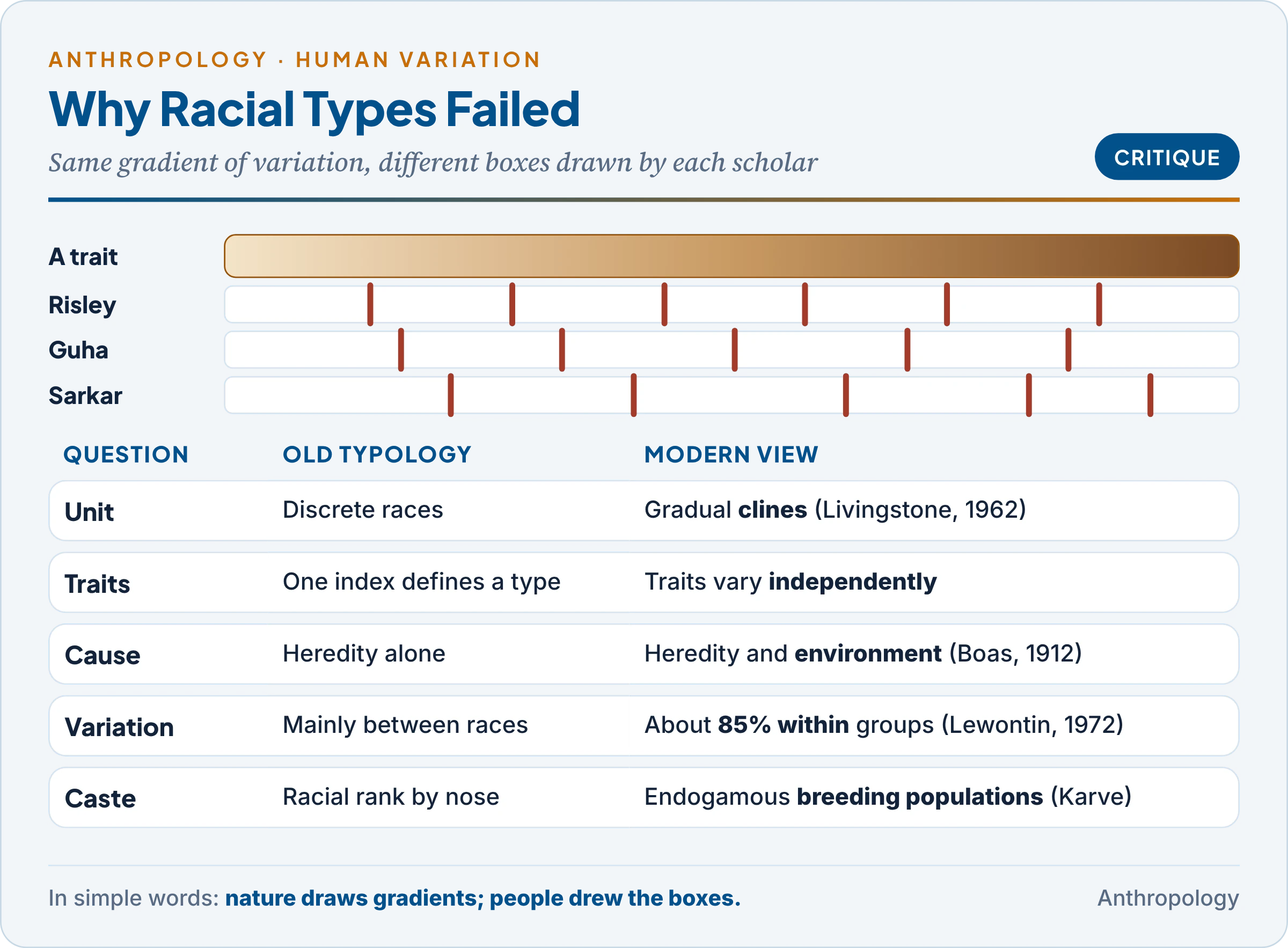
The classical schemes did not converge: Risley found seven types, Guha six with nine subtypes, Sarkar six of a different kind. The reasons explain why the effort was abandoned (Paper 1, Unit 9.5).
- Clinal variation: traits such as skin colour and head form change gradually across geography (clines). Any boundary between “types” is arbitrary, so each scholar drew it differently. Frank Livingstone summed this up (1962): “there are no races, there are only clines”.
- Discordant traits: a classification by nose form does not match one by head form or skin colour, because the traits are inherited independently.
- Plasticity: Franz Boas showed (1912) that the cephalic index of immigrants’ children in the United States differed from their parents’, so the favourite racial measure is partly environmental.
- Within-group variation: Richard Lewontin showed (1972) that about 85% of human genetic variation lies within populations and only a small share between conventional “races”.
- Language mistaken for biology: “Aryan” and “Dravidian” name language families, not bodies (§7).
- Serology did not match the types: India has one of the world’s highest frequencies of blood group B, and Rh-negative blood is uncommon, but blood-group frequencies vary by region and community without sorting into Guha’s types; physically similar groups can differ in blood groups and vice versa.
- Small, selective samples and invasion stories assumed before the data were collected.
- Colonial purpose: Risley’s caste-race theory served a census that classified and ranked subjects; it turned social hierarchy into apparent biology.
Common confusion
Are “race” and “ethnic group” the same? No. A race was meant to be a biological division defined by inherited physical traits, a concept anthropology has largely abandoned. An ethnic group is a community defined by shared culture, language, history and self-identification. The Khasi, for example, are an ethnic group by language and custom, whatever their physical features.
5. Genetic Evidence: From Races to Ancestries
In simple words
DNA studies do not sort Indians into races. They show that almost every Indian group is a mixture, in different proportions, of a few ancient ancestral populations, and that mixing stopped around two thousand years ago when groups began to marry only within themselves.
5.1 Two ancestral populations: ANI and ASI
David Reich, Kumarasamy Thangaraj, Lalji Singh and colleagues (Nature, 2009) analysed genome-wide data from 25 Indian groups and found that most descend from a mixture of two ancient populations:
- Ancestral North Indians (ANI): related to people of Central Asia, the Middle East and Europe.
- Ancestral South Indians (ASI): not closely related to any group outside India, distantly related to the Andamanese.
ANI ancestry ranges from about 39% to 71% across groups, higher in the north and among traditionally higher castes, lower in the south and among tribes. The variation forms a cline, not separate races.
Common confusion
Are ANI and ASI just new names for “Aryan” and “Dravidian” races? No. They are statistical ancestral populations reconstructed from DNA, and every mainland group is a mixture of them. ANI is itself mostly Indus-related ancestry with only part from the steppe, and ASI is found in Indo-Aryan as well as Dravidian speakers. Neither is a race, a caste or a language group.
5.2 When mixing happened, and when it stopped
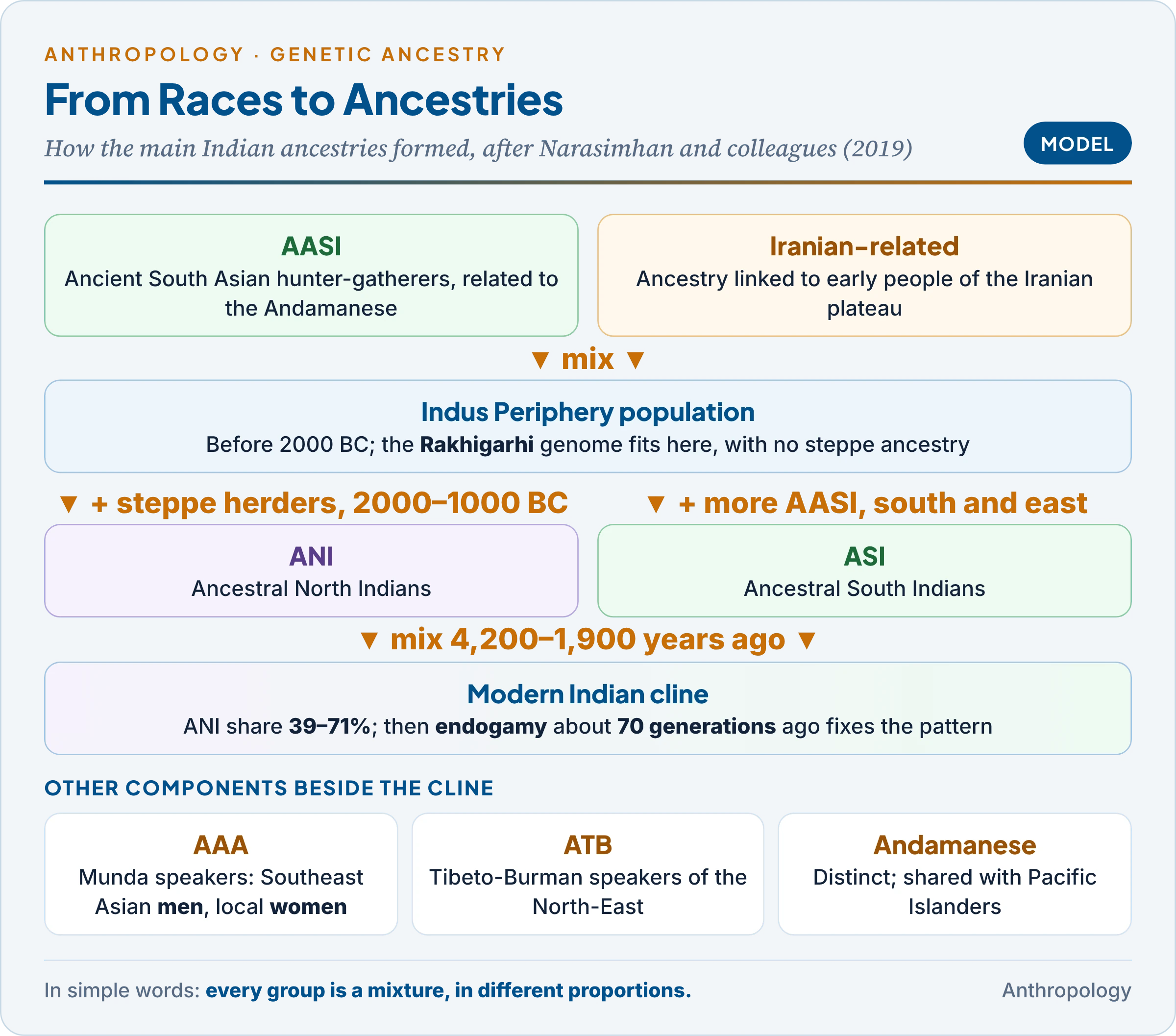
Priya Moorjani and colleagues (2013) dated the ANI-ASI mixture to about 4,200–1,900 years ago. Before that, unmixed groups lived in India; afterwards, mixing became rare, even among closely related groups, because of a shift to endogamy. The Vysya of Andhra Pradesh, for example, show negligible gene flow for about 3,000 years. Analabha Basu, Neeta Sarkar-Roy and Partha Majumder (2016) dated the onset of strict endogamy among upper castes to about 70 generations ago, which they linked to the Gupta period (fourth to sixth centuries AD). Genetics thus dates caste endogamy independently of texts, and it explains why many Indian groups carry founder diseases (inherited disorders concentrated in one community).
5.3 More than two: the five components
Basu and colleagues (2016), sampling more tribal groups, found four ancestries on the mainland and a fifth in the Andamans:
| Component | Highest among | Note |
|---|---|---|
| ANI (Ancestral North Indian) | Northern and upper-caste groups | West Eurasian-related |
| ASI (Ancestral South Indian) | Southern tribes and castes | Indigenous to South Asia |
| AAA (Ancestral Austro-Asiatic) | Munda speakers (Santal, Ho) | East and Southeast Asian-related |
| ATB (Ancestral Tibeto-Burman) | North-East and Himalayan groups | East Asian-related |
| Andamanese | Onge, Jarawa | Shared with Pacific Islanders |
The table shows that genetic components partly follow language families, because language spread with migrating people; it also shows that the AAA and ATB components are more widespread than Austroasiatic and Tibeto-Burman speech, since many groups shifted language but kept ancestry.
5.4 Ancient DNA: how ANI and ASI formed
Vagheesh Narasimhan and colleagues (Science, 2019) added ancient genomes.
- Before 2000 BC, an “Indus Periphery” population mixed Iranian farmer-related ancestry with AASI (Ancient Ancestral South Indian hunter-gatherer) ancestry, the indigenous ancestry related to the Andamanese. The Rakhigarhi genome (Vasant Shinde and colleagues, Cell, 2019) fits this group and has no steppe ancestry.
- After the Indus civilisation declined, this population mixed with steppe pastoralists arriving in the second millennium BC to form the ANI, and with groups richer in AASI ancestry in the south and east to form the ASI.
- Groups such as the Palliyar and other southern tribes are close to direct descendants of the ASI.
Austroasiatic speakers. Gyaneshwer Chaubey and colleagues (2011) found that about two-thirds of Munda speakers’ Y chromosomes belong to haplogroup O2a, which originated in Southeast Asia, while their mitochondrial (maternal) lineages are local Indian. Munda speakers thus came from Southeast Asia, mainly through men, and married local women; the Khasi, who are matrilocal, kept more Southeast Asian maternal lineages.
6. Linguistic Elements: Families and Their Distribution
In simple words
Indians speak languages of four big families. Most northern Indians speak Indo-Aryan languages, most southern Indians Dravidian ones, while Austroasiatic languages survive in the hills of central and eastern India and Tibeto-Burman languages in the Himalaya and the North-East.
6.1 Counting India’s languages
- George Abraham Grierson‘s Linguistic Survey of India (1903–1928) recorded 179 languages and 544 dialects.
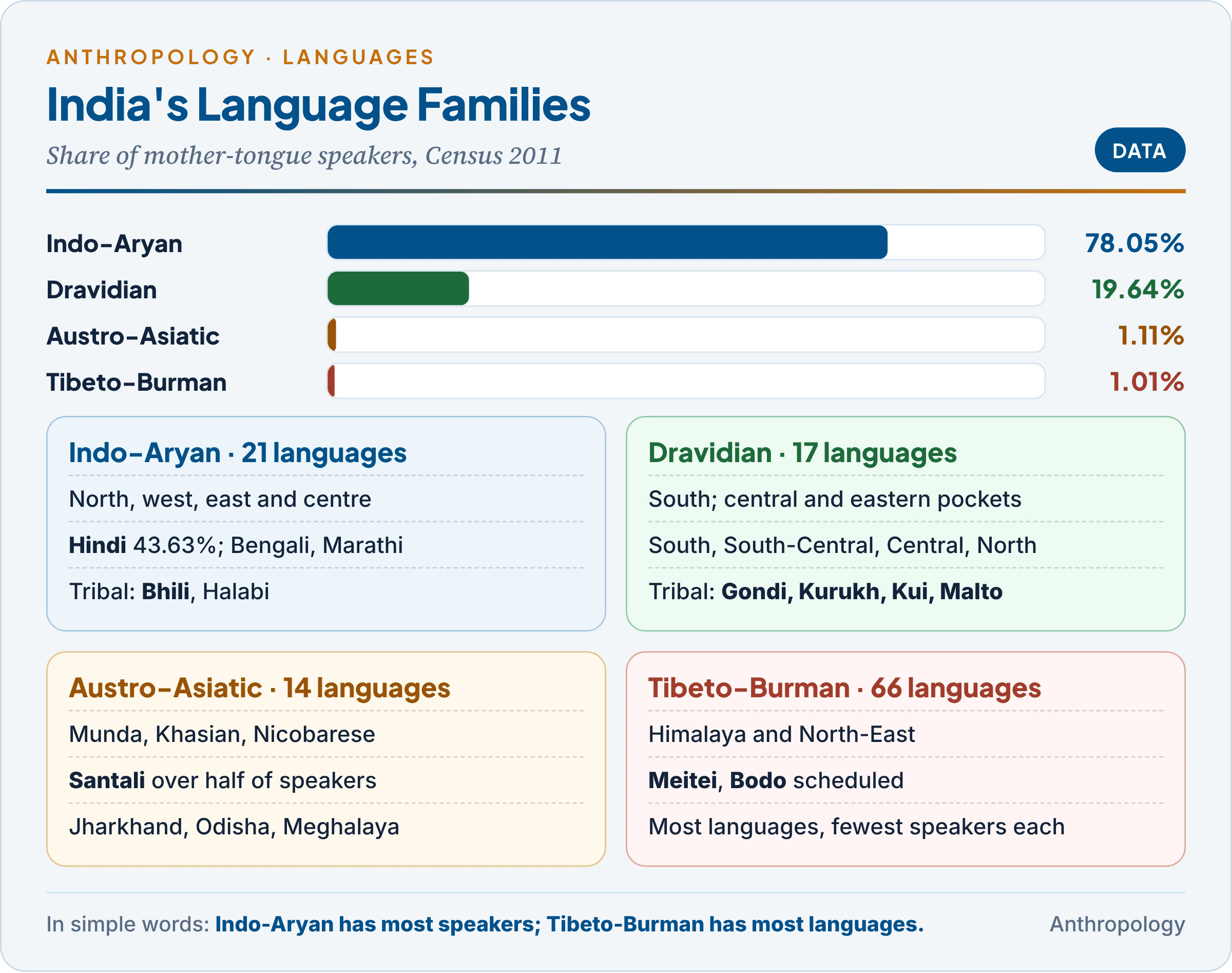
- Census 2011 grouped 1,369 rationalised mother tongues into 121 languages with 10,000 or more speakers: 22 scheduled (in the Eighth Schedule of the Constitution) and 99 non-scheduled. 96.71% of Indians have a scheduled language as mother tongue.
The table gives the Census 2011 share of each family.
| Family | Languages (2011) | Speakers (2011) | Share | Main regions |
|---|---|---|---|---|
| Indo-European (mainly Indo-Aryan) | 21 Indo-Aryan, 1 Iranian, 1 Germanic | 94.5 crore (Indo-Aryan) | 78.05% | North, west, east and centre |
| Dravidian | 17 | 23.8 crore | 19.64% | South; tribal pockets in central and eastern India |
| Austro-Asiatic | 14 | 1.35 crore | 1.11% | Jharkhand, Odisha, West Bengal, central India; Meghalaya; Nicobar |
| Tibeto-Burman | 66 | 1.23 crore | 1.01% | Himalaya and North-East |
| Semito-Hamitic | 1 (Arabic) | 54,947 | negligible | Scattered |
The table shows a striking contrast: Tibeto-Burman has the most languages (66) but only about 1% of speakers, because each small hill community has its own tongue, while Indo-Aryan has 21 languages spoken by over three-quarters of the population. Diversity of languages is greatest where speakers are fewest.
6.2 Indo-Aryan (Indo-European)
- Origin: a branch of Indo-European, brought by people with steppe ancestry in the second millennium BC (§5.4); the oldest form is Vedic Sanskrit.
- Grierson’s grouping (still used in textbooks): an outer band (Lahnda, Sindhi; Marathi, Konkani; Odia, Bihari, Bengali, Assamese), a central core (Hindi, Urdu, Punjabi, Gujarati, Rajasthani, Bhili) and the Pahari languages of the Himalaya (Nepali, Kumaoni, Garhwali, Western Pahari). Dardic languages such as Kashmiri and Shina form a north-western branch.
- Size: Hindi is the mother tongue of 43.63% of Indians (52.8 crore in 2011), followed by Bengali (8.03%) and Marathi (6.86%). The largest non-scheduled language, Bhili/Bhilodi (about 1.04 crore), is also Indo-Aryan: the Bhil, once classed as Proto-Australoid, speak an Indo-Aryan tongue.
- Tribal Indo-Aryan speakers: besides the Bhil, Halabi (about 7.7 lakh) is spoken by tribes of Bastar, and Sadri (Nagpuri) serves as a lingua franca (a link language between groups) among the Munda, Oraon and other tribes of Chota Nagpur. Such shifts show how tribal communities adopt the language of the region while keeping their ancestry and much of their culture.
6.3 Dravidian
The Dravidian family is concentrated in the south, but its northern and central members are tribal languages, which makes it central to the anthropology of tribes. The Indian linguist Bhadriraju Krishnamurti (The Dravidian Languages, 2003) divides it into four subgroups.
| Subgroup | Main languages | Tribal speakers |
|---|---|---|
| South Dravidian | Tamil, Malayalam, Kannada, Tulu, Kodava | Toda, Kota, Irula (Nilgiris) |
| South-Central Dravidian | Telugu, Gondi, Kui, Kuvi, Konda, Koya | Gond, Kondh, Koya, Konda Dora |
| Central Dravidian | Kolami, Parji, Ollari, Naiki | Kolam, Parja, Ollar Gadaba |
| North Dravidian | Kurukh, Malto, Brahui | Oraon, Sauria Paharia; Brahui (Pakistan) |
- Size: Telugu (6.70%), Tamil (5.70%), Kannada (3.61%) and Malayalam (2.88%) are the four scheduled Dravidian languages; Gondi (about 30 lakh) and Kurukh (about 20 lakh) are the largest tribal ones.
- Distribution as history: Brahui in Baluchistan, Kurukh and Malto in the Chota Nagpur and Rajmahal hills, and Gondi in central India show that Dravidian was once spoken far beyond the south. Some scholars link it to the Indus civilisation, a hypothesis not yet proved (1.1b).
- Tribal speakers: many Dravidian-speaking tribes (Gond, Oraon) are physically and genetically close to Munda-speaking neighbours, another case where language and ancestry do not coincide.
6.4 Austro-Asiatic
- Branches: Munda in central and eastern India (North Munda: Santali, Mundari, Ho, Bhumij, Birhor, Asuri, Korku; South Munda: Kharia, Juang, Savara (Sora), Gutob, Remo (Bondo), Gorum); Khasian (Khasi, Pnar, War) in Meghalaya; and Nicobarese.
- Size: Santali, the only scheduled Austroasiatic language (added in 2003), has about 73.7 lakh speakers (0.61%), more than half of all Austroasiatic speakers; Khasi (14.3 lakh), Ho (14.2 lakh) and Mundari (11.3 lakh) follow.
- Distribution: hill and forest belts of Jharkhand, Odisha, West Bengal, Chhattisgarh and Madhya Pradesh (Korku), Meghalaya and the Nicobars. The scattered pattern reflects later spread of Indo-Aryan and Dravidian in the plains, with Austroasiatic surviving in refuge areas.
- Origin: from Southeast Asia, carried largely by men (§5.4).
- Scripts and revival: Pandit Raghunath Murmu devised the Ol Chiki script for Santali (1925), and Lako Bodra the Warang Citi script for Ho. Scripts became symbols of identity, and Santali’s inclusion in the Eighth Schedule was a goal of Santal political mobilisation.
6.5 Tibeto-Burman and the smaller families
- Tibeto-Burman (part of Sino-Tibetan): Bodic languages of Ladakh, Lahaul, Spiti and Sikkim (Ladakhi, Lepcha, Sikkim Bhotia); Himalayan languages (Kinnauri, Limbu, Newari); the Arunachal languages (Adi, Nyishi, Mishmi, Apatani); Bodo-Garo (Bodo, Garo, Dimasa, Tripuri, Rabha); Naga languages (Ao, Angami, Konyak and others); Kuki-Chin (Mizo, Thadou, Hmar) and Meitei (Manipuri). Meitei (17.6 lakh) and Bodo (14.8 lakh) are the two scheduled Tibeto-Burman languages; Garo (11.5 lakh), Tripuri (10.1 lakh) and Mizo (8.3 lakh) are the largest unscheduled ones. Most Tibeto-Burman languages have fewer than a lakh of speakers each, which is why the family has the most languages and the fewest speakers per language.
- Tai-Kadai: Khamti and the Ahom heritage in Assam and Arunachal (Ahom is no longer spoken).
- Andamanese: two separate families, Great Andamanese (nearly extinct) and Ongan (Onge, Jarawa).
- Isolates: Nihali of the Maharashtra-Madhya Pradesh border is a language with no proven relatives.
7. Race, Language and Culture Do Not Coincide
In simple words
People can change their language without changing their ancestry, and two people who look alike may speak unrelated languages. That is why a language family is never a race.
This principle, laid down by Franz Boas, the German-American founder of American anthropology, in Race, Language and Culture (1940), is well illustrated in India.
- Khasi: physically Mongoloid in Risley’s and Guha’s terms, they speak an Austroasiatic language.
- Bhil: classed as Proto-Australoid, they speak Indo-Aryan Bhili.
- Oraon and Munda: neighbours of similar physique and ancestry speak Dravidian (Kurukh) and Austroasiatic (Mundari) languages respectively.
- Brahui: a Dravidian language spoken by people who look like their Baluch neighbours.
- Language shift: many groups with AAA or ATB ancestry now speak Indo-Aryan, which is why Basu found these ancestries far beyond the speakers of the languages.
Genetics adds a qualification: because languages spread with migrating people, ancestry and language are partly correlated at the level of large groups (Munda speakers and Southeast Asian Y chromosomes; Tibeto-Burman speakers and East Asian ancestry). The correlation is historical, not a law, and it breaks down whenever people switch language.
8. Language, Identity and the State
In simple words
In India language is also politics. States were redrawn along language lines, the Constitution protects linguistic minorities, and many small tribal languages are now in danger of disappearing.
8.1 Recognition and protection
- Eighth Schedule: 22 languages, the last four (Bodo, Dogri, Maithili, Santali) added by the 92nd Amendment (2003).
- Classical languages: Tamil (2004), Sanskrit (2005), Telugu and Kannada (2008), Malayalam (2013), Odia (2014), and in October 2024 Marathi, Pali, Prakrit, Assamese and Bengali, making eleven.
- Safeguards for linguistic minorities: Article 29 (right of any section of citizens to conserve its language, script and culture), Article 30 (right of linguistic and religious minorities to establish educational institutions), Article 347 (recognition of a language spoken by a substantial part of a state’s population), Article 350A (instruction in the mother tongue at the primary stage) and Article 350B (a Special Officer for Linguistic Minorities, both added by the Seventh Amendment, 1956).
8.2 Language and ethno-political movements
Language has been a rallying point for identity because it marks who belongs and decides who gets jobs, schooling and political voice. The death of Potti Sriramulu (1952) after a fast for a Telugu state led to Andhra State (1953) and to the States Reorganisation Act, 1956, which redrew most states on linguistic lines. Later movements joined language to tribal or regional identity: the anti-Hindi agitation in Tamil Nadu (1965), the Jharkhand movement (Munda and Kurukh speakers among others, state formed in 2000), the Bodoland movement (Bodo language and the Bodoland Territorial Region) and the Gorkhaland demand of Nepali speakers in Darjeeling. Units 7.3 and 7.4 treat these movements in detail.
8.3 Endangered languages
- Scale: UNESCO’s Atlas of the World’s Languages in Danger (2009) listed about 196 Indian languages as endangered, more than for any other country. The People’s Linguistic Survey of India, led by G.N. Devy, documented about 780 languages.
- Losses: the death of Boa Sr in 2010 ended the Bo language of the Great Andamanese.
- Response: the Scheme for Protection and Preservation of Endangered Languages (SPPEL), begun in 2013 under the Central Institute of Indian Languages, Mysuru, has listed 117 languages with fewer than 10,000 speakers for documentation, among them Birhor, Bondo, Toda, Kadar, Onge, Shompen and Nihali. NEP 2020 encourages teaching in the mother tongue in the early years.
The endangered list overlaps closely with the Particularly Vulnerable Tribal Groups: when a small community loses its land and forest, its language often goes next, because children schooled in a regional language stop using the home tongue.
9. Distribution of Ethnic Elements Today
In simple words
On the map, India’s peoples form broad zones: Indo-Aryan speakers of the plains, Dravidian speakers of the south, tribal belts in the central hills and the North-East, and small island populations. Religion and caste add further layers.
The different elements overlap into zones. L.P. Vidyarthi, an Indian anthropologist, divided the tribal population into Himalayan, Middle Indian, Western Indian and Southern regions, with the islands as a fifth (detail in 6.1).
| Zone | Language and ancestry | Example groups |
|---|---|---|
| Himalaya and North-East | Tibeto-Burman; ATB ancestry; Khasi Austroasiatic | Naga, Mizo, Bodo, Lepcha, Khasi |
| Middle India | Munda and Dravidian tribal languages; AAA and ASI ancestry | Santal, Munda, Ho, Gond, Oraon, Bhil |
| Indo-Gangetic plains and west | Indo-Aryan; ANI-rich cline | Most caste groups of the north |
| South | Dravidian; ASI-rich, with near-ASI tribes | Toda, Irula, Kadar, Paniya, Palliyar |
| Islands | Andamanese families; Nicobarese | Onge, Jarawa; Nicobarese, Shompen |
- Scheduled Tribes: about 10.43 crore people, 8.6% of the population (Census 2011), most numerous in Madhya Pradesh and forming over 90% of the population of Lakshadweep and Mizoram.
- Religion (Census 2011): Hindus 79.8%, Muslims 14.2%, Christians 2.3%, Sikhs 1.7%, Buddhists 0.7%, Jains 0.4%; religious minorities are regionally concentrated (Sikhs in Punjab; Christians in the North-East and Kerala; Buddhists in Maharashtra, Ladakh and Sikkim).
Key Terms
| Term | Meaning in simple words |
|---|---|
| Somatometry | Measuring the body (stature, head, nose) to compare groups |
| Somatoscopy | Observing traits such as skin colour, hair form and eye fold |
| Cephalic index | Head breadth ÷ head length × 100; long-headed below about 75 |
| Nasal index | Nose breadth ÷ nose height × 100; narrow-nosed below 70 |
| Coefficient of racial likeness | Karl Pearson’s statistic of similarity between groups, used by Guha |
| Mahalanobis D² | A statistical distance between groups using many traits together |
| Negrito | Short, dark, frizzy-haired peoples of the Andamans and South-East Asia |
| Proto-Australoid | Guha’s term for an early long-headed, broad-nosed Indian type |
| Cline | Gradual change of a trait across geography |
| Endogamy | Marriage only within one’s own group |
| ANI / ASI | Ancestral North Indian and Ancestral South Indian populations |
| AASI | Ancient Ancestral South Indian hunter-gatherer ancestry, related to the Andamanese |
| Founder disease | An inherited disorder concentrated in one community descended from few ancestors |
| Haplogroup | A family of related DNA lineages on the Y chromosome or mitochondria |
| Language family | Languages descended from one ancestral language |
| Language isolate | A language with no proven relatives (Nihali) |
| Scheduled language | A language listed in the Eighth Schedule of the Constitution |
| Endangered language | A language at risk of falling out of use |
Contemporary Developments
- GenomeIndia (January 2025): whole genomes of 10,000 individuals from across India were archived at the Indian Biological Data Centre, Faridabad, as a reference for Indian genetic diversity.
- Classical languages (October 2024): Marathi, Pali, Prakrit, Assamese and Bengali were declared classical languages, taking the total to eleven.
- Endangered-language documentation (2025): the government reported that SPPEL’s first phase covers 117 languages and mother tongues, with dictionaries published for languages such as Hakkipikki, Malayan, Manda, Lamkang and Soliga.
- Next census: the census due with reference date 1 March 2027 will again collect mother-tongue data, the first since 2011, and for the first time since 1931 will enumerate caste.
- Ancient DNA debate: the Rakhigarhi genome (2019) and Narasimhan’s model (2019) placed the main Indian ancestry in an Indus-related population with no steppe ancestry, while dating steppe-related ancestry to the second millennium BC, a finding now central to discussions of Indian population history.
Diagrams to Master
- Topic map: classifications, Negrito problem, failure of typology, genetic ancestry, language families, language and the state.
- Risley, Guha and Sarkar compared: data, types, Negrito, Munda speakers, caste, shared flaw.
- Ancestry model: AASI + Iranian farmer-related → Indus Periphery; + steppe → ANI; + AASI → ASI; ANI + ASI → modern cline; AAA, ATB, Andamanese beside it; endogamy about 2,000 years ago.
- Language families: Census 2011 shares with regions, subgroups and tribal speakers.
Revision Grid
| Scholar | Work (year) | Key idea |
|---|---|---|
| H.H. Risley | Census 1901; The People of India (1908) | Seven types; caste has a racial basis (nasal index) |
| A.C. Haddon | The Races of Man (1924) | Regional types of India |
| B.S. Guha | Census of India 1931 (1935) | Six races, nine subtypes; Negrito strain among the Kadar |
| S.S. Sarkar | The Aboriginal Races of India (1954) | Six elements; Australoid oldest; no mainland Negrito |
| Mahalanobis, Majumdar and Rao | United Provinces survey (1941) | Statistical distance (D²) between groups |
| Karve and Malhotra | Maharashtra castes (1968) | Each endogamous caste a distinct breeding population |
| G.A. Grierson | Linguistic Survey of India (1903–1928) | 179 languages, 544 dialects |
| Franz Boas | Race, Language and Culture (1940) | Race, language and culture vary independently |
| R. Lewontin | 1972 | About 85% of genetic variation lies within populations |
| Thangaraj et al. | Science (2005) | Andamanese descend from an early out-of-Africa dispersal |
| Reich et al. | Nature (2009) | ANI and ASI; ANI ancestry 39–71% |
| Chaubey et al. | Molecular Biology and Evolution (2011) | Munda speakers: Southeast Asian men, local women |
| Moorjani et al. | AJHG (2013) | ANI-ASI mixture 4,200–1,900 years ago, then endogamy |
| Basu et al. | PNAS (2016) | Five ancestral components |
| Narasimhan et al. | Science (2019) | Indus Periphery, steppe and AASI form ANI and ASI |
| Bh. Krishnamurti | The Dravidian Languages (2003) | Four Dravidian subgroups |
Previous Year Questions
Ethnic and linguistic elements in the Indian population and their distribution
- 2026Write notes on: Dravidian language family and its tribal speakers.
- 2026Why the classifications of Indian populations, based on somatometric and somatoscopic characteristics failed to develop a common understanding of the population diversity?
- 2025Delineate the major features of S. S. Sarkar’s classification of Indian populations. Was his classification better than Risley? Explain.
- 2023Critically compare Risley’s and Sarkar’s approaches to the classification of peoples of India.
- 2023Write notes on: Dravidian languages and their subgroups.
- 2023Discuss the distribution of tribes in different geographical regions of India. Identify the distinct institutional features of tribal societies of these regions.
- 2022Describe the methods adopted by Sir Herbert Hope Risley in classifying Indian populations. What are the criticisms against Risley’s classification?
- 2022Write notes on: Safeguards for linguistic minorities in India.
- 2022Write notes on: Austroasiatic languages.
- 2020Write short note on the Dravidian languages in about 150 words.
- 2019Write a note in 150 words on Distribution of Tibeto-Burman group of languages in India.
- 2018Write a note in 150 words on Endangered languages.
- 2017Write a note in 150 words on Austro-asiatic linguistic groups in India.
- 2016Write a note in 150 words on Linguistic elements in Indian population.
- 2015Briefly describe the classical models of ethnic and linguistic classification ofIndian population. Discuss its relevance today.
- 2014Write a note in 150 words on Major linguistic divisions of India.
- 2014Outline the distribution of Dravidian languages in India and describe their cultural significance.
- 2011Describe the linguistic elements in Indian population.
- 2010Discuss the relevance of Guha’s racial classification in the context of India’s ethnic groups.
- 2008Write a note on The distribution of Indo:-Aryan Languages.
- 2008Write a note on Mediterranean Element in Indian Population.
- 2008Is Risley’s Racial Classification of Indian Population valid ?
- 2007Describe ethnic elements in the Indian population focussing either on Risley’s or Guha’s classification.
- 2006Write a note on Linguistic distribution of Indian Population.
- 2000Write a note on Negrito elements in India.
- 1996Discuss the major linguistic divisions in the Indian population. Also point out the role of language in ethno-political movements.
- 1993What are the major linguistic families in India ? Identify such families, showing the geographical distribution and the population groups under different families.
- 1992Write a note on Controversy over the existence on Negrito racial strain in Indian population.
- 1991Write a note on Critical approach of Guha’s classification of ethnic elements in Indian population.
- 1990Write a note on Distribution of Dravidian family of languages in India.
- 1989Write a note on : Guha’s classification on the ethnic composition of the people of India is not adequate. Comment.
- 1989Write a note on Distribution of Austric family of languages in India.
- 1988Write a note on racial elements among the Scheduled Tribes of India.
- 1987Write a note on Social elements in Indian population.
- 1985Write a note on Monogoloid racial element in Indian population.
- 1984Write a note in 200 words : Linguistic diversity in india.
- 1983Give an account of the distribution of blood group among Indian population. Is there a correlation between the distribution of blood groups and physical types ?
- 1982Discuss some of the important_attempts to classify the racial elements in Indian population.
- 1981Write a note on Distribution of Dravidian linguistic elements among Indian people. (200 words).
- 1981Write a note on Controversy over the existence of Negrito racial strain in Indian population. (200 words).
Related questions from other units
- 2025Unit 5.2: Define minority. Elaborate the patterns of linguistic and religious minorities in India.
- 2024Unit 3.2: Discuss the theories on origin of caste system and its criticism in India. Differentiate between caste, class and race.
- 2023Write notes on: Race and Ethnicity.
- 2020Unit 5.2: Write short note on the Linguistic minorities in India in about 150 words.
- 2019Unit 4: Give an account of the contributions of Iravati Karve and B.S. Guha to the analysis of race and caste in India.
- 2019With reference to the somatoscopic and morphometric characteristics commonly used for racial classification, make critical comments as to whether ‘Race’ is a valid concept.
- 2014Unit 4: Write a note in 150 words on Contribution of H. H. Risley to the Aryan’ debate.
- 2010Is Race a valid concept ? Critically assess the relevance of racial classification in the Indian context.
- 1993Write a note on Racial types in India.
- 1984Unit 6.1: Write a note in 200 words : Racial affinity of Indian tribes.
More from Demographic Profile of India: all notes of this unit · every PYQ of this unit · Anthropology Optional hub