

Changing role of the Collector; Union-State-local relations; Imperatives of development management and law and order administration; District administration and democratic decentralization.
This article: District administration since Independence (meaning, significance, historical patterns and the shift to development); its structure (division, district, sub-division, tehsil or taluka, circle, village; the development block; line departments and their district officers; district reorganisation); democratic decentralisation (meaning, Rondinelli’s types, Fesler’s approaches, the Gandhi–Ambedkar debate); the committees from Balwantray Mehta (1957) to Thungon (1988) and the 73rd and 74th Amendments as they shaped the district; the Zilla Parishad and the Collector (models, arguments, DRDA merger, District Planning Committee, the 2nd ARC’s District Council); Union–State–local relations (constitutional frame, States’ controls, Centrally Sponsored Schemes and parallel bodies, Finance Commission grants, DISHA, Aspirational Districts, PM Gati Shakti district plans, MPLADS); the bureaucracy–elected representatives interface; the “government next door” and the values of local government; NGOs and civil society; capacity building of elected representatives; the future of district administration (climate and disasters, digital and networked governance); recent data and developments.
Official Syllabus: Paper II · Unit 2-07 District Administration since Independence
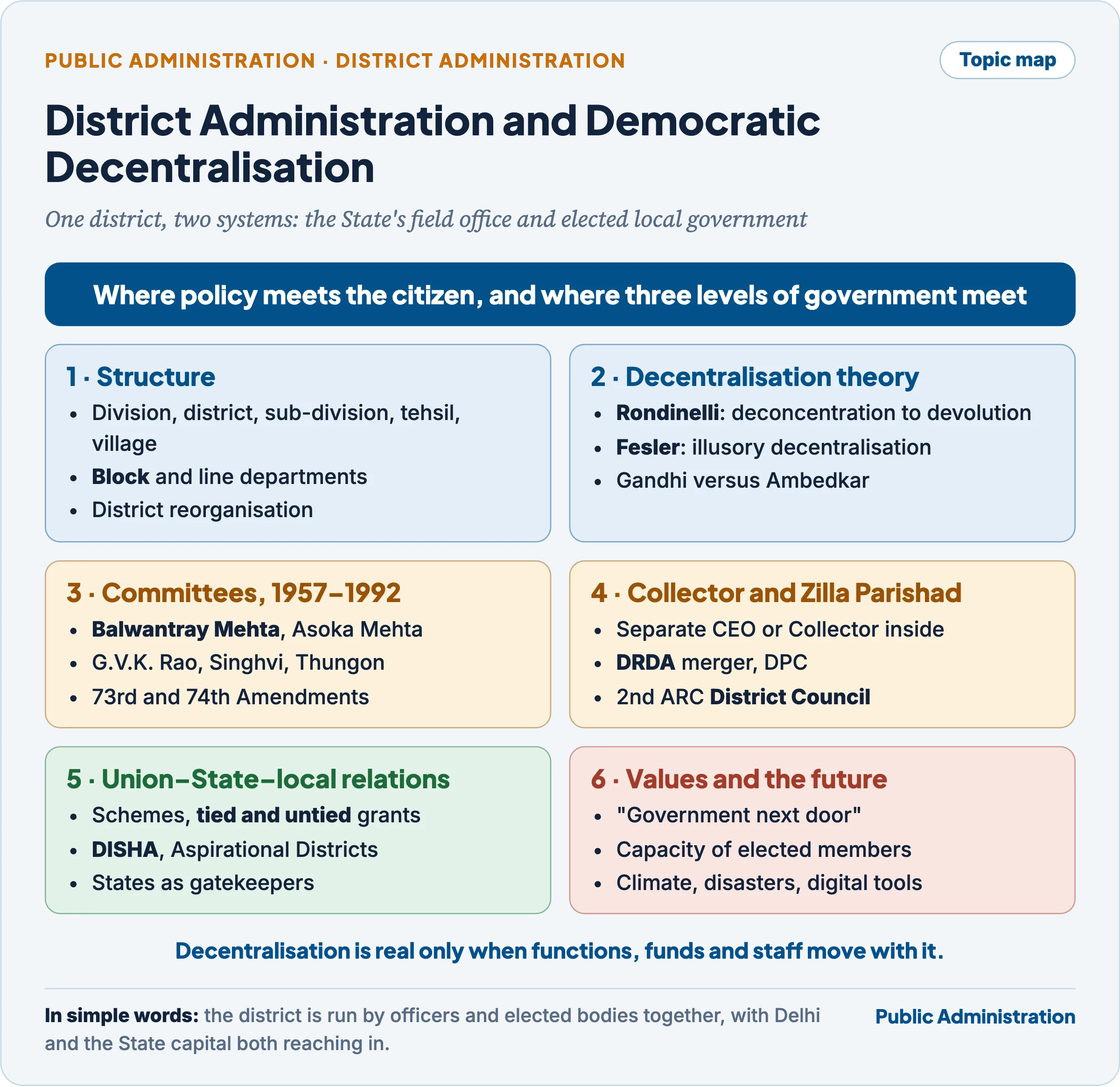
The district is where the Indian state stops being a set of ministries and becomes a face, an office and a service. A ration card, a land record, a flood-relief camp, a school building and a Gram Sabha meeting are all district events. Since 1947 the district has had to carry two systems at once: an inherited bureaucratic field administration headed by the Collector, and a new democratic structure of Panchayats and Municipalities that the Constitution, since 1992, calls institutions of self-government. How these two systems divide work, money and authority, and how the Union and the States reach into the district over the heads of both, is the subject of this article.
In simple words
Imagine a large apartment complex run by a manager appointed by the builder. Over time, residents elect a society committee. Now two bodies run the same complex: the manager knows the rules and has the keys; the committee has the residents’ mandate but little staff or money. The builder also keeps sending new projects with its own instructions. District administration in India is this situation on a vast scale: the Collector is the manager, the Panchayats and Municipalities are the elected committee, and the Union and State governments are the builder.
1. District Administration since Independence: Meaning and Change
In simple words
A district is a part of a State, usually with one to three million people, run from one headquarters town. District administration is everything the government does there: keeping order, keeping land records, delivering schemes and helping local bodies. After 1947 its main purpose changed from controlling people to developing them.
1.1 Meaning of district administration
- District. A territorial unit of a State for revenue, criminal, development and electoral administration, created and altered by the State government under its land revenue law. India has nearly 800 districts; the Local Government Directory lists 784, with wide variation in size (from under a lakh of people in parts of Arunachal Pradesh to more than a crore in Thane in 2011).
- District administration. S.S. Khera, a former Cabinet Secretary and author of District Administration in India, defined it as the total management of public affairs within a delimited area, the district. It is the sum of the work of the Collector’s office, the police, the line departments, the courts’ administrative support and the local bodies operating in that area.
- Field administration. The district is the most important layer of field administration: the offices that carry policy from the State capital (the headquarters) to the citizen. Paper I’s headquarters–field debate (how much discretion to give the man on the spot) is played out here every day.
- The cutting edge. The district is where policy meets the citizen. The efficiency of Indian administration, as an old saying goes, is the efficiency of district administration, because it is the level that comes into direct contact with the people.
1.2 Why the district matters
- Unit of delivery. Almost every Union and State scheme, from rural housing to nutrition, is implemented, monitored and audited at the district. The 2020 question that most schemes are “directed towards the district administration” reflects this.
- Unit of coordination. Departments are organised vertically (health, agriculture, police), but problems are territorial (a drought affects water, crops, cattle, migration and law and order together). Only an area-based authority can join them up.
- Unit of contact and communication. The district officer is the State’s chief agent in the area and the channel through which information flows both ways: orders and schemes go down; grievances, reports and early warnings come up. An old description calls the district officer the eyes, ears and tongue of the government.
- Unit of planning. Since the 1969 Planning Commission guidelines and the 74th Amendment’s District Planning Committee (Article 243ZD), the district is meant to be the level where rural and urban plans meet.
- Unit of crisis response. Under the Disaster Management Act, 2005, the district has its own authority and plan; floods, epidemics and riots are managed district by district.
- “India lives in districts.” Addressing District Collectors on 20 May 2005, Prime Minister Manmohan Singh said that if India lives in its States, it could equally be said that India lives in its districts, and that the “cutting edge” of government is at the district and lower levels.
1.3 Inherited patterns of district administration
The British did not build one uniform district; three broad patterns grew out of different land settlements. They still shape district machinery today.
| Pattern | Land settlement | District features | Where |
|---|---|---|---|
| Bengal (zamindari) pattern | Permanent Settlement, 1793: revenue fixed and collected through zamindars | Collector dealt with a few large proprietors, not with cultivators; no strong village revenue staff; large districts divided into sub-divisions rather than tehsils | Bengal, Bihar, Odisha (parts) |
| Ryotwari (Madras–Bombay) pattern | Settlement directly with each cultivator (ryot) | Dense revenue hierarchy: taluk, firka, village accountant and headman; Collector in close touch with villages | Madras, Bombay presidencies |
| Mahalwari and non-regulation pattern | Settlement with the village community (mahal) | Deputy Commissioner combining revenue, magisterial and judicial powers under executive orders | North-Western Provinces, Punjab, Central Provinces |
- Why the Bengal pattern was distinctive. Because the zamindar, not the state, collected rent from cultivators, the Collector’s revenue role was thin and the state had no record of the actual tiller. Village-level revenue machinery (patwari, kanungo) was weak or absent, and the district was run through sub-divisional officers for magisterial work.
- Consequences after 1947. When zamindari abolition laws (from the early 1950s) brought the state face to face with millions of cultivators, Bengal-pattern States had to build village revenue staff and land records almost from scratch. Even today Bihar and West Bengal have circles or blocks rather than tehsils as the unit below the sub-division, and their land records have been among the hardest to modernise.
- The prefectorial frame. Over all three patterns the British placed a prefect-like Collector-cum-District Magistrate who represented the whole government and supervised all departments, in the absence of elected rural government at the district level. The detailed history of the Cornwallis and Munro schools and of the prefectorial system is in the article on Legacy of British Rule.
1.4 What changed after Independence
- From order to development. The colonial district existed to collect revenue and keep order. The welfare state added development: the Community Development Programme (2 October 1952), the development block, Five Year Plans and, later, poverty programmes.
- From bureaucracy to democracy. Elected Panchayati Raj bodies (from 1959) and, after 1992, constitutional local governments created rival centres of legitimacy in the district.
- From generalist control to specialist departments. Agriculture, health, education, cooperation, irrigation and industries built their own district hierarchies answering to State directorates, weakening the Collector’s command and making him a coordinator rather than a commander.
- From separation of powers. Article 50 led to the separation of the judiciary from the executive; most judicial work passed from the District Magistrate to judicial magistrates under the High Court.
- From scarcity to rights and markets. Rights-based laws (information, food, employment), liberalisation after 1991, public–private partnerships and digital delivery made the district a facilitator and regulator more than a provider.
- From routine to risk. Disasters, climate change, terrorism and communal tension made crisis management a core district function.
James Fesler, the American scholar of field administration, called this the dual-role problem: field systems built to maintain the established order are asked to drive rapid social and economic change. The Indian district carries both roles at once, and much of this article is about how the two are reconciled.
1.5 The Collector in brief
The Collector (Deputy Commissioner in some States) remains the head of district administration: chief revenue officer, District Magistrate, coordinator of departments and chair of the District Disaster Management Authority. Since 1947 the office has moved from ruler to developer to coordinator and facilitator. Its roles and the development–law and order debate are covered in the article on The District Collector: Changing Role, Development Management and Law and Order; here the Collector appears only where the office meets democratic decentralisation and Union–State–local relations.
2. Structure of District Administration
In simple words
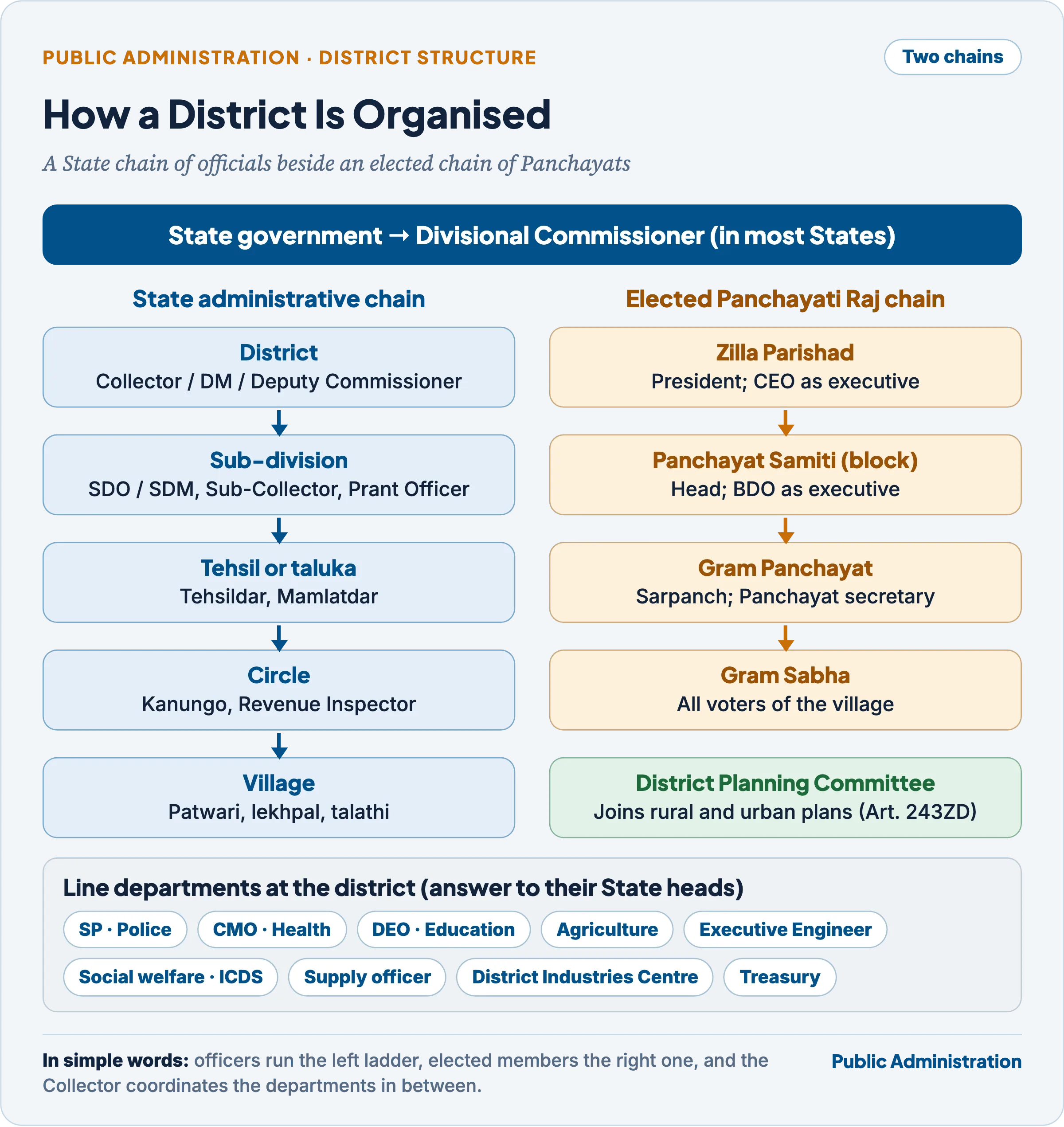
A district is run through a ladder of offices. The State is split into divisions, divisions into districts, districts into sub-divisions and tehsils, and tehsils into villages, with a revenue official at each step. Beside this ladder stand the block offices for development, the police stations and the offices of each department.
2.1 The territorial hierarchy
- Division. In most States (not all), several districts form a division under a Divisional Commissioner, a senior IAS officer who supervises Collectors, hears revenue appeals and reviews development. Supporters see the division as a useful supervisory tier over young Collectors; critics see a post office that delays files. Tamil Nadu’s T.A. Varghese Commission recommended abolishing such intermediate tiers as having outlived their use.
- District. Headed by the Collector/District Magistrate/Deputy Commissioner, assisted by an Additional Collector or Additional District Magistrate, and in some States a District Revenue Officer or Chief Development Officer.
- Sub-division. Created under the Land Revenue Code and the criminal procedure law for revenue and magisterial work. Its head is the Sub-Divisional Officer/Sub-Divisional Magistrate (Uttar Pradesh, Bihar), Revenue Divisional Officer or Sub-Collector (Tamil Nadu), or Prant Officer (Maharashtra). The SDO is either a young IAS officer in field training or a State civil service officer. Two types exist:
- office type: the SDO has a permanent office at the sub-division headquarters (most States);
- touring type: the SDO lives at the district headquarters and tours the sub-division (seen in parts of Uttar Pradesh), which reduces accessibility for citizens.
- Tehsil or taluka. The basic unit of revenue, treasury and magistracy, often called a “miniature district” because many departments have offices there. Its head is the Tehsildar (Mamlatdar in Maharashtra and Gujarat), assisted by a Naib Tehsildar, with revenue, magisterial and executive powers.
- Circle. Each tehsil is divided into circles for revenue supervision under a Kanungo (Uttar Pradesh), Revenue Inspector (Tamil Nadu, with the unit called a firka) or Circle Inspector (Maharashtra).
- Village. The lowest unit of revenue and administration. The village accountant keeps land records and accounts: patwari in Punjab, Haryana, Himachal and Madhya Pradesh, lekhpal in Uttar Pradesh, talathi in Maharashtra, karnam (now village administrative officer) in Tamil Nadu. The village headman (patil in Maharashtra) traditionally combined revenue, police and general duties. S.S. Khera called the patwari the kingpin of revenue administration.
| Level | Uttar Pradesh | Tamil Nadu | Maharashtra |
|---|---|---|---|
| Tehsil | Tehsildar | Tahsildar (taluk) | Mamlatdar/Tehsildar (taluka) |
| Circle | Kanungo | Revenue Inspector (firka) | Circle Inspector |
| Village | Lekhpal | Village Administrative Officer | Talathi |
The names differ, but the logic is the same: a single chain of territorial generalists runs from the Collector to the village, and this chain is the State’s most reliable instrument in a crisis.
2.2 The development hierarchy
- Block. The Community Development Programme (1952) created the development block (about 100 villages originally) under a Block Development Officer (BDO), with extension officers for agriculture, animal husbandry, cooperation, panchayats and education, and village level workers as multi-purpose field staff.
- Block and Panchayati Raj. After 1959 the block became the area of the Panchayat Samiti; the BDO usually serves as its executive officer. The 2nd ARC observed that integration of departments with Panchayats is better at the block level than at the district, because the BDO coordinates extension staff, though technical departments such as health, engineering and industry still work independently of PRIs.
- Today. India has about 7,300 development blocks, 6,768 intermediate Panchayats, 675 district Panchayats and about 2.55 lakh Gram Panchayats (Local Government Directory). Blocks are now also the unit of the Aspirational Blocks Programme (500 blocks, 2023).
2.3 Line departments and district officers
Every State department has a district counterpart, technically answerable to its own head of department, administratively coordinated by the Collector.
| Sector | District officer (common designations) | Reports technically to |
|---|---|---|
| Police | Superintendent of Police | Range DIG/IG, DGP |
| Health | Chief Medical Officer/District Health Officer | Director of Health Services |
| Education | District Education Officer/District Inspector of Schools | Director of Education |
| Agriculture | Deputy Director/District Agriculture Officer | Director of Agriculture |
| Public works, irrigation | Executive Engineer | Chief Engineer |
| Social welfare, ICDS | District Social Welfare Officer/District Programme Officer | Director, Social Welfare/WCD |
| Food and civil supplies | District Supply Officer | Commissioner, Food and Civil Supplies |
| Industries | General Manager, District Industries Centre | Director of Industries |
| Finance | District Treasury Officer | Director of Treasuries/Finance Department |
| Statistics, IT | District Statistical Officer, District Informatics Officer (NIC) | Directorate of Economics and Statistics, NIC |
- Area versus function. Fesler’s distinction between area-based authority (the Collector, responsible for everything in a territory) and function-based authority (each department, responsible for one subject everywhere) is the permanent tension of the district. India began with an integrated prefectorial system (the Collector commanded field officers) and has moved to a mixed system: prefectorial for revenue, law and order and disasters; functional for most development sectors.
- Dual control. A district officer serves two masters: the head of department (for technical matters, postings and discipline) and the Collector (for coordination, review and crisis). After 1992, many of these officers were also meant to serve a third: the Zilla Parishad, for subjects transferred to it.
- Urban side. Municipal corporations and councils, development authorities (often chaired by a minister or the Collector), water and transport boards, and in metropolitan areas the Police Commissionerate, which removes law and order from the District Magistrate. Urban governance is covered in the articles on urban local government.
2.4 District reorganisation and size
- Growth in numbers. India had about 593 districts at the 2001 Census, 640 at the 2011 Census and nearly 800 today. Recent waves include Telangana (10 districts at formation, 33 now), Andhra Pradesh (from 13 to 26 in 2022, more since) and Rajasthan (17 new districts in 2023, of which 9 were abolished in December 2024).
- Administrative case for smaller districts. Shorter distances to headquarters, a manageable span of control for the Collector and SP, closer supervision of schemes, better disaster response and more attention to remote and tribal areas. The 2013 question on reducing district size to relieve an overburdened Collector rests on this logic.
- Politico-populist drivers. New districts are often announced before elections, to satisfy local demands for a “headquarters town”, or to redraw political and caste geographies. The Rajasthan reversal of 2024, on the ground that several new districts were not viable, shows how politically driven reorganisation can be.
- Costs and limits. Each district needs a new collectorate, police headquarters, courts and dozens of district officers; staff are often shifted rather than added, so new districts start understaffed. Data series break, Census and planning boundaries diverge, and the Zilla Parishad and DPC must be reconstituted.
- Assessment. Smaller districts help only if they come with staff, buildings, delegated powers and stable boundaries. Reducing size does not reduce the Collector’s number of roles; that needs functional reform (realignment of duties, devolution to local bodies), not only new maps.
3. Democratic Decentralisation: Meaning and Theory
In simple words
Decentralisation means moving decisions away from the capital. If you move only officers, it is “deconcentration”: the State still decides, but closer to the people. If you move power to bodies the people elect, it is “devolution” or democratic decentralisation: local people decide for themselves. India has done a lot of the first and only part of the second.
3.1 What democratic decentralisation means
- Definition. Democratic decentralisation is the transfer of decision-making authority, functions and resources from higher levels of government to elected local institutions that are accountable to local citizens. It combines decentralisation (who decides) with democracy (to whom the decider answers).
- Origin of the term in India. The Balwantray Mehta Study Team (1957) used “democratic decentralisation” for its proposal of elected Panchayati Raj bodies to run development. The phrase became the name of the whole movement.
- Three components (the “3Fs”). Real decentralisation transfers functions (clear activities), funds (own revenue and untied transfers) and functionaries (staff under local control). Constitutional status without the 3Fs gives form without substance.
- Decentralisation versus delegation within bureaucracy. Shifting powers from the Secretariat to the Collector or BDO is administrative decentralisation; it brings decisions nearer but not under local democratic control.
3.2 Types of decentralisation: Rondinelli
Dennis Rondinelli, the American development administration scholar, with John Nellis and G. Shabbir Cheema, in Decentralization in Developing Countries (World Bank, 1983), classified decentralisation by how much authority is transferred and to whom.
| Type | What moves | To whom | Indian example |
|---|---|---|---|
| Deconcentration | Workload and some decisions | Field officers of the same government | Collector, SDO, BDO; Aspirational Districts monitoring |
| Delegation | Defined functions, with some autonomy | Semi-autonomous bodies outside the regular hierarchy | DRDAs (registered societies), development authorities, district health societies |
| Devolution | Authority, revenue powers and accountability | Elected, legally separate local governments | Panchayats and Municipalities under Parts IX and IXA |
| Privatisation/deregulation | Delivery of services | Private firms, NGOs, community groups | PPP projects, NGO-run services, user groups, SHGs |
- Reading the Indian district. Most of the post-1952 district is deconcentration and delegation: officials and societies closer to people but answerable upward. Devolution arrived constitutionally only in 1992, and in many States remains partial.
- Political, administrative and fiscal decentralisation. Later writers separate political (elected bodies), administrative (staff and procedures) and fiscal (taxes, transfers and spending powers) decentralisation. A Panchayat can be politically decentralised (elected) yet fiscally centralised (dependent on tied grants).
3.3 Fesler’s four approaches
James Fesler, in “Approaches to the Understanding of Decentralization” (1965), showed that decentralisation is never only technical.
- Doctrinal approach: decentralisation as an article of faith, an end in itself; the romantic idealisation of the village republic in Gandhian thought is an example.
- Political approach: whether power really moves depends on political will. Without it, devolution exists “more in law than in practice”, what Fesler called illusory decentralisation; much Indian Panchayati Raj before 1992 fitted this description.
- Administrative approach: decentralisation judged by efficiency; it multiplies functional departments in the field and creates the area–function duality of the district.
- Dual-role approach: the conflict in field administration between maintaining order and promoting change, sharp in post-colonial districts.
3.4 Why decentralise: justifications beyond efficiency
- Democratic: local institutions are schools of democracy. Alexis de Tocqueville, in Democracy in America (1835), saw the New England township as the seedbed of liberty; J.S. Mill, in Considerations on Representative Government (1861), valued local bodies as schools of public spirit.
- Efficiency and information: local governments know local needs and costs. Wallace Oates‘ decentralisation theorem (Fiscal Federalism, 1972) holds that a public good should be provided by the lowest level that covers its beneficiaries, unless there are economies of scale or spillovers.
- Choice and competition: Charles Tiebout (1956) argued that many local governments offering different tax–service packages let citizens “vote with their feet”, disciplining monopoly power. Centralisation inclines towards domination; decentralisation towards competition and self-determination.
- Subsidiarity: decisions should be taken at the lowest competent level, and higher levels should help, not replace, lower ones. The principle comes from Catholic social teaching (Pope Pius XI, Quadragesimo Anno, 1931) and was written into the European Union by the Maastricht Treaty (1992). The 2nd ARC built its local governance report on it.
- Equity and inclusion: reservations for SCs, STs and women (Article 243D) brought about 1.4 million women into elected office; decentralisation can be an instrument of social justice.
- Why it is “never just technical.” Because decentralisation redistributes power, it is resisted by those who lose it (State ministers, departments, legislators, local elites). Its effects depend on who captures the new institutions.
3.5 The Gandhi–Ambedkar debate
- Gandhi’s vision. Mahatma Gandhi imagined India as an oceanic circle of self-reliant village republics, with power flowing upward from the village. The Constituent Assembly honoured this only as a Directive Principle, Article 40: the State shall organise village panchayats as units of self-government.
- Ambedkar’s warning. B.R. Ambedkar (4 November 1948) called the Indian village “a sink of localism, a den of ignorance”, fearing that power to villages meant power to dominant castes over Dalits and the poor. He preferred a strong, rights-protecting centre.
- The lesson. Both were partly right. The Asoka Mehta Committee (1978) found that Panchayati Raj had been dominated by the economically and socially privileged, confirming Ambedkar’s fear; the 73rd Amendment’s reservations were the response, an attempt to decentralise without handing power to local elites. As the economist M.L. Dantwala put it, in an unequal society decentralised mechanisms do not by themselves ensure genuine participation.
Common confusion
Is creating more field offices the same as decentralisation? Only in the weak sense. Opening a sub-division office, posting a BDO or giving the Collector more financial powers is deconcentration: the State government still decides, through its own officers. Democratic decentralisation (devolution) means elected local bodies decide, with their own funds and staff, and answer to local voters. A district can be highly deconcentrated and still highly centralised in power. Many Indian reforms called “decentralisation” (for example, Collector-led district monitoring) are deconcentration.
4. Committees and Amendments: How Decentralisation Reached the District
In simple words
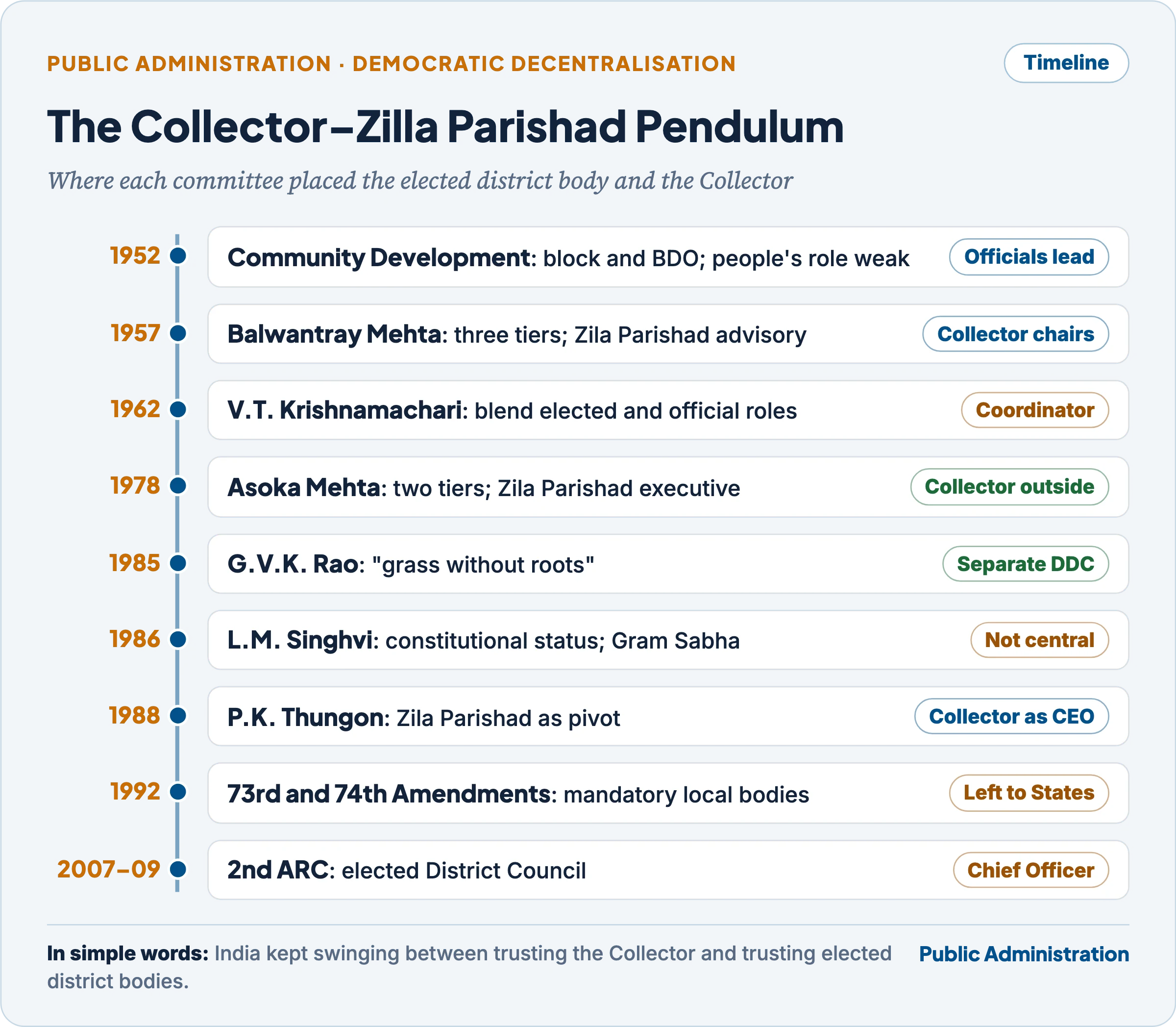
For thirty-five years India kept experimenting with how much power to give elected district bodies. Each committee moved the pendulum: towards the Collector, towards the elected Zilla Parishad, then back again. In 1992 the Constitution finally made local governments compulsory, but it left the key details to each State.
4.1 Community Development and its limits (1952–57)
- The Community Development Programme (2 October 1952) and the National Extension Service (1953) created the block and a cadre of extension staff, with advisory District Development Committees of officials and non-officials.
- Diagnosis: a programme meant to rouse “people’s initiative” became a government programme with targets from above; people saw it as the BDO’s scheme, not their own.
4.2 Balwantray Mehta Study Team (1957)
- Set up in January 1957 by the Committee on Plan Projects; chaired by Balwantray Mehta; report in November 1957.
- Core finding: Community Development had failed most at evoking popular participation; it needed statutory elected bodies with real functions and resources.
- Recommendations:
- Democratic decentralisation in three tiers: Gram Panchayat (village), Panchayat Samiti (block), Zila Parishad (district), with indirect election to the upper tiers.
- The Panchayat Samiti as the executive body, the real unit of development.
- The Zila Parishad as an advisory, coordinating and supervisory body, chaired by the Collector, with MLAs and MPs as members.
- Transfer of development functions, adequate resources and technical staff to these bodies.
- Outcome: endorsed by the National Development Council (January 1958). Rajasthan inaugurated Panchayati Raj at Nagaur on 2 October 1959; most States followed by the mid-1960s.
- States’ variations on the Collector’s place:
- Collector as chairman of the Zila Parishad in some States, in line with the report;
- Collector as member and chairman of key standing committees (Rajasthan, where he had no vote; Odisha; Himachal Pradesh);
- Collector excluded, with only supervisory powers (Maharashtra under the Maharashtra Zilla Parishads and Panchayat Samitis Act, 1961), where a strong, elected Zilla Parishad had its own Chief Executive Officer.
4.3 V.T. Krishnamachari (1962)
- V.T. Krishnamachari, former Deputy Chairman of the Planning Commission, reported in 1962 on the Indian and State Administrative Services and Problems of District Administration.
- He urged that village panchayats, panchayat samitis and zila parishads be built up as institutions carrying out plan policies, with the Zila Parishad setting priorities for the district, coordination of elective and administrative elements, a well-knit team of BDO and technical officers serving the Panchayat Samiti, and more use of local taxation.
- His report also recommended expanding the IAS for development needs and more rural development in officer training, reflecting the view that district development needed both strong officials and strong elected bodies.
4.4 Decline and bureaucratic revival (1965–77)
- Causes of decline: the plan holiday (1966–69), food crises, the Green Revolution’s reliance on departmental extension, and the Emergency (1975–77) all favoured official machinery. Elections to Panchayats were postponed and bodies superseded.
- The Bihar case. A study of Bihar by Edwin Eames and Parmatma Saran traced the pendulum:
- 1955: a circular made the Collector responsible for all development programmes;
- 1973: a Deputy Development Commissioner, equal in rank to the Collector, became chief executive of the Zila Parishad with planning, development and welfare duties;
- 1975: during the Emergency, the 1955 position was restored, and the Collector took charge of the 20-Point Programme.
- Lesson: whenever the political system wants speed and control, it turns to the Collector; whenever it wants participation, it turns to elected bodies. The district’s structure follows the political climate.
4.5 Asoka Mehta Committee (1978)
- Appointed in December 1977 by the Janata government; chaired by Asoka Mehta; reported in August 1978.
- Recommendations:
- Two tiers: Zila Parishad at the district and Mandal Panchayat for a cluster of villages.
- District as the first point of decentralisation below the State; the Zila Parishad as the executive body, responsible for district planning, with district-level development offices and staff placed under it.
- Direct elections with open participation of political parties; reservation for SCs and STs; compulsory taxation powers; Nyaya Panchayats as separate bodies.
- This implied a Collector confined largely to regulatory work; Jayaprakash Narayan even foresaw the Collector eventually fading into a mere representative of the State government.
- Critique: it assumed that strong elected bodies would serve the poorest, overlooking capture by village elites; it gave little thought to safeguards such as a protective governmental functionary. The Janata government fell in 1979 before national action.
- Impact: Karnataka’s 1985 Act (in force from 1987), with a directly elected Zilla Parishad served by a very senior officer styled its Chief Secretary (an experiment later wound up), and West Bengal’s party-based Panchayats from 1978 drew on these ideas.
4.6 The 1980s: return of the Collector and the G.V.K. Rao critique
- Return of the Collector (1980 onwards). The new government made the Collector responsible for the Integrated Rural Development Programme through the District Rural Development Agency (DRDA) and for most points of the 20-Point Programme. In Bihar the District Officer was responsible for 14 of the 20 points.
- Hanumantha Rao Working Group (1984): a District Planning Body with an executive committee chaired by the Collector, a technocratic, Collector-centred model of district planning (details in the article on Decentralised Planning after the 73rd and 74th Amendments).
- G.V.K. Rao Committee (CAARD, 1985): the Committee to Review Administrative Arrangements for Rural Development and Poverty Alleviation, chaired by G.V.K. Rao.
- Diagnosis: rural development had become bureaucratised and divorced from Panchayati Raj: “grass without roots“.
- Recommendations: the Zila Parishad as the principal body for managing all district development programmes; a District Development Commissioner (senior to the Collector) as its chief executive; the Collector’s development role transferred; the district as the basic unit of planning; regular elections.
4.7 Towards constitutional status
- L.M. Singhvi Committee (1986): concept paper on Revitalisation of Panchayati Raj Institutions for Democracy and Development. It found PRIs moribund and recommended that local self-government be constitutionally recognised, protected and preserved, with the Gram Sabha as the embodiment of direct democracy, regular elections and adequate finance.
- P.K. Thungon Committee (1988): a sub-committee of the Parliamentary Consultative Committee. It recommended constitutional recognition, the Zila Parishad as the pivot of planning and development, a five-year term, a State Finance Commission, and, notably, the Collector as the chief executive officer of the Zila Parishad: the pendulum swung back to using the Collector’s authority inside the elected body.
- V.N. Gadgil Committee (1988): constitutional status, five-year terms, direct elections, reservations, State Election and Finance Commissions.
- 64th Amendment Bill (1989): passed by the Lok Sabha, defeated in the Rajya Sabha in October 1989, partly because States saw it as the Union reaching past them to local bodies.
- 73rd and 74th Amendments (1992): passed in December 1992, in force on 24 April 1993 (73rd) and 1 June 1993 (74th). They made Panchayats and Municipalities mandatory, with fixed terms, reservations, State Election Commissions, State Finance Commissions and District Planning Committees, while leaving powers and functions to State law.
| Committee | Year | District-level model | Place of the Collector |
|---|---|---|---|
| Balwantray Mehta | 1957 | Three tiers; Samiti executive; Zila Parishad advisory | Chairs the Zila Parishad |
| V.T. Krishnamachari | 1962 | Zila Parishad sets district priorities | Coordinator of elected and official elements |
| Asoka Mehta | 1978 | Two tiers; Zila Parishad executive, plans for district | Regulatory functions; outside development |
| Hanumantha Rao | 1984 | District Planning Body | Chairs its executive committee |
| G.V.K. Rao | 1985 | Zila Parishad principal development body | Replaced by a District Development Commissioner |
| L.M. Singhvi | 1986 | Constitutional status; Gram Sabha | Not central |
| P.K. Thungon | 1988 | Zila Parishad as pivot | CEO of the Zila Parishad |
| 2nd ARC | 2007, 2009 | District Council as district government | Chief Officer of the Council, dually accountable |
The table shows the pendulum clearly: the Collector chairs, is excluded, is replaced, returns as CEO and is finally proposed as the elected council’s chief officer. The constant problem is the same: elected bodies need the authority and capacity that the Collector has, while the Collector’s presence threatens their autonomy.
4.8 The constitutional scheme in brief
The detailed working of Panchayats and Municipalities belongs to the articles on rural and urban local government; the provisions that shape district administration are listed below.
| Provision | What it says | District significance |
|---|---|---|
| Article 40 | DPSP: organise village panchayats as units of self-government | Pre-1992 basis; non-justiciable |
| Article 243B | Three tiers; intermediate tier optional below 20 lakh population | District Panchayat compulsory in Part IX States |
| Article 243D, 243T | Reservation for SCs, STs and at least one-third for women | Changes who sits in the Zilla Parishad and Municipalities |
| Article 243E, 243U | Five-year term; elections before expiry or within six months of dissolution | Ends indefinite supersession by officials |
| Article 243G, 243W | State may endow powers to function as institutions of self-government; plans and schemes, incl. Eleventh and Twelfth Schedule subjects | Devolution is discretionary (“may”), so it varies by State |
| Article 243H, 243X | State may authorise local taxes and grants | Fiscal autonomy depends on State law |
| Article 243-I, 243Y | State Finance Commission every five years | State–local fiscal relations |
| Article 243K, 243ZA | State Election Commission | Elections taken out of the hands of district officers’ discretion |
| Article 243ZD | District Planning Committee in every district; at least four-fifths elected by and from members of the district panchayat and municipalities, in proportion to rural and urban population | Consolidates rural and urban plans; links district to State plan |
| Article 243ZE | Metropolitan Planning Committee | Metropolitan districts |
| Article 280(3)(bb), (c) | Union Finance Commission to recommend measures to augment State funds for local bodies | Basis of FC local body grants |
| Seventh Schedule, State List entry 5 | Local government is a State subject | Union acts through money and schemes, not law |
| PESA Act, 1996 | Gram Sabha powers in Fifth Schedule areas | District administration must consult Gram Sabhas |
| Sixth Schedule | Autonomous District Councils in parts of the North-East | A different, older model of district self-government |
5. The Zilla Parishad and the Collector
In simple words
After 1992 every rural district has an elected Zilla Parishad and an appointed Collector. The big question is who runs development: if the Collector does, the elected body is a shell; if the Zilla Parishad does, it needs a strong officer of its own. States have answered differently, and the answer decides how real local democracy is in that State.
5.1 The problem: two heads in one district
- Before 1992, the Collector’s position in the Zilla Parishad depended on State choice and political mood.
- After 1992, Article 243G expects Panchayats to plan and implement development in Eleventh Schedule subjects; logically, development staff and funds should move to the Zilla Parishad, leaving the Collector with regulatory work. In practice, the Collector continues to chair or control many development bodies, schemes and committees.
- The ambiguity (2012 question). Since the 73rd Amendment did not define the Collector’s role at all, an emerging ambiguity surrounds his development function: he is no longer formally in charge of subjects transferred to PRIs, yet Union and State schemes, district committees, DISHA and the Aspirational Districts Programme still make him the nodal officer. The 2nd ARC noted that the Constitution’s architects of the third tier gave no thought to the Collector’s place in the new dispensation.
- The challenge (2000 question). Balancing the Collector with democratic bodies means preserving the neutral, coordinating and crisis capacity of the office without letting it overshadow elected leaders.
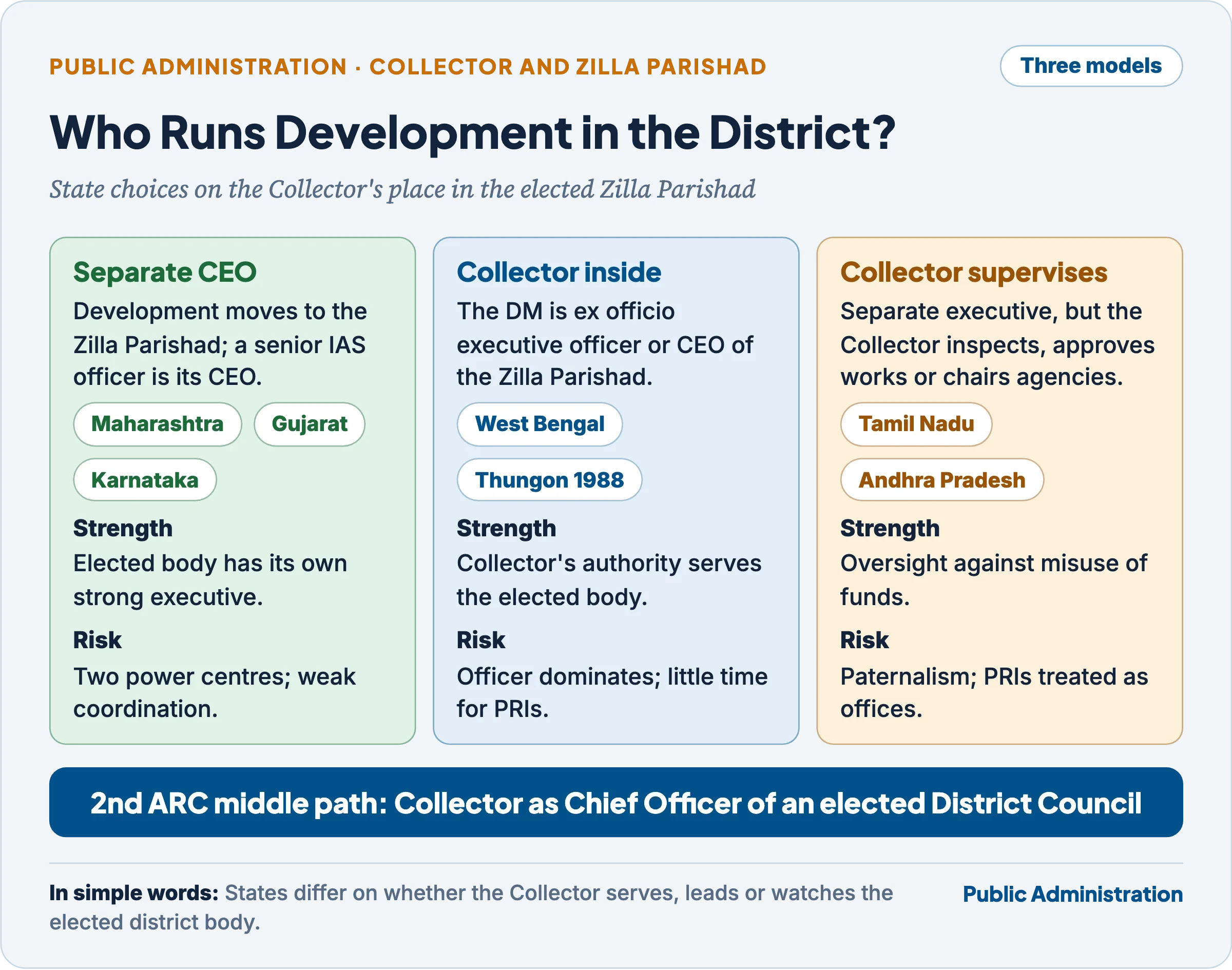
5.2 Three models of the relationship
| Model | How it works | Examples | Strength | Risk |
|---|---|---|---|---|
| Separate CEO model | Development transferred to the Zilla Parishad; a senior IAS officer (CEO, or District Development Officer in Gujarat) serves it; the Collector keeps revenue, magistracy and coordination | Maharashtra (since 1962), Gujarat, Karnataka; Kerala (with a Secretary) | Elected body has a strong executive of its own; Collector freed for regulatory work | Two power centres; coordination gaps; Collector bypassed in development, CEO captured by local politics |
| Collector inside the Zilla Parishad | The DM is ex officio Executive Officer or CEO of the Zilla Parishad | West Bengal (Panchayat Act, 1973); Odisha at the time of the 2nd ARC; proposed by Thungon (1988) | Uses the Collector’s authority and coordination for PRIs | Officer dominates elected body; little time for PRIs amid law and order and protocol |
| Collector as supervisor | A separate officer runs the Zilla Parishad, but the Collector is Inspector of Panchayats, approves works above limits, controls the district panchayat officer or chairs DRDA | Tamil Nadu (Panchayats Act, 1994), Andhra Pradesh, Rajasthan, Uttar Pradesh in practice | Oversight against misuse; continuity | Paternalism: elected bodies treated as subordinate offices |
- What the State studies found. Field studies of the Collector’s role in Panchayati Raj across States (cited in the base sources) found:
- Andhra Pradesh: elected representatives complained that most Eleventh Schedule subjects were still with the Collector, whose approval was needed for important works, and that the District Panchayat Officer answered to him; they wanted all development and DRDA moved to the Zilla Parishad under a CEO of Collector rank.
- Gujarat: the Collector had almost no role in Panchayati Raj after the separate DDO system; yet he still received funds for Scheduled Areas, MPLADS and MLALADS works.
- Karnataka: the Deputy Commissioner’s role in PRIs was limited to elections and recruitment; officials preferred a separate CEO, and noted that the DC interacted more with MLAs and MPs than with Panchayat leaders.
- Punjab: Zilla Parishad members felt no discernible change after 1992; the Collector remained in charge.
- West Bengal: few DMs had time to act as Executive Officers; most cited law and order, protocol and committee work.
- Conclusion of these studies: the Collector remained the ambience of district administration; his leverage in development comes from heading the implementing departments, whatever the formal model.
5.3 Should the Collector be inside or outside the Zilla Parishad?
Arguments for keeping the Collector out:
- The Zilla Parishad is an elected, non-official body; an official in charge contradicts self-government, and in a disagreement the elected chairperson can claim to know the people’s mind better.
- Involvement in development distracts from law and order; preoccupation with law and order makes him suspect to the elected body.
- Divided loyalty: if the Zilla Parishad and the State government disagree, the Collector is caught between them.
- It perpetuates a paternalistic culture in which elected leaders never learn to govern.
Arguments for closer links:
- The Collector can mediate among factions and ensure targets are met.
- Coordination of departments is possible only with his involvement; excluding him alienates him from the common man and weakens development.
- Psychology of trust: many citizens see the Collector as a neutral guardian against local predatory politics. The American political scientist Richard Park observed that local opinion often favoured strong collectorates as protection against local politicians rather than more local responsibility.
- Experience: in Bihar and elsewhere, attempts to remove the Collector from development were reversed whenever the government wanted results.
The middle path. Scholars such as Rai and Singh suggested “assistance, guidance and advice from within“, not “control and direction from without”: the Collector need not be a member, but the Zilla Parishad should consult him regularly. P.R. Dubhashi proposed that the CEO be the captain of the development team, and the Collector the government’s eyes and ears, and at least a corrector, inspector and ombudsman of PRIs. Rai and Singh also predicted that, through attrition, the CEO of the Zilla Parishad might become the most influential official in the district, a forecast borne out in Maharashtra and Karnataka.
5.4 The DRDA and its merger into the Zilla Parishad
- Origin. District Rural Development Agencies were set up across the country from about 1980 to run the IRDP and later most rural poverty programmes. Each was a society registered under the Societies Registration Act, usually chaired by the Collector, combining government authority with an autonomous body’s flexibility. In Rondinelli’s terms it was delegation, not devolution.
- Critique. DRDAs became the classic parallel body: they handled funds for Eleventh Schedule subjects (poverty alleviation, rural housing, employment) outside the elected Zilla Parishad. The G.V.K. Rao Committee and Panchayat leaders repeatedly demanded their transfer.
- State variations. By the time of the 2nd ARC (2009), Maharashtra and Himachal Pradesh had brought the DRDA under the Zilla Parishad, while in Andhra Pradesh it still functioned under the Collector’s chairmanship. Kerala, Karnataka and Maharashtra had placed field offices of many departments under the Zilla Parishad; elsewhere administration remained department-centric.
- Merger. By a letter of 1 November 2021, the Ministry of Rural Development discontinued the centrally sponsored DRDA Administration scheme from 1 April 2022 and advised States to merge DRDAs with Zilla Parishads (or with District Councils where there are no Zilla Parishads, as in parts of the North-East), absorbing their staff into line departments or scheme units and transferring unspent balances.
Common confusion
Did the 2022 decision abolish the DRDA everywhere and hand rural development fully to the Zilla Parishad? No. The Union stopped funding the DRDA administrative structure and advised merger. Because local government is a State subject, each State decided how to merge. In many States a “DRDA wing” or district rural development cell now sits inside the Zilla Parishad, but scheme implementation (housing, livelihoods, employment) still runs through scheme-specific district units and the Collector reviews them. The merger reduced one parallel body; it did not by itself transfer functions, funds and functionaries to elected control.
5.5 The District Planning Committee in brief
- Design. Under Article 243ZD, every district must have a DPC to consolidate the plans of Panchayats and Municipalities into a draft district development plan, considering spatial planning, water and natural resources, infrastructure and environment, and forward it to the State government. At least four-fifths of its members are elected from among elected members of the district panchayat and municipalities, in proportion to the rural and urban population.
- Chair. State laws differ: a Minister (for example, the district’s guardian minister in Maharashtra), the Zilla Parishad chairperson (for example, the District Panchayat President in Kerala), or in some States the Collector; the Collector or CEO is commonly member-secretary.
- Why rural–urban convergence fails (2019 question):
- DPCs exist on paper in most States but meet rarely and lack a permanent planning secretariat and data;
- urban plans are made by development authorities and parastatals outside the DPC;
- departmental budgets and Centrally Sponsored Schemes are fixed at the State and Union level before district plans are ready;
- Municipalities and Panchayats plan in separate portals and cycles (GPDP for villages, separate city plans);
- MLAs and ministers dominate where they chair, and the DPC becomes a scheme-approval meeting.
- Evidence. The Devolution Index 2024 found grassroots-to-district plan consolidation through DPCs undertaken nowhere in a meaningful way; a CAG compendium (2024) on the 74th Amendment found DPCs and MPCs largely non-functional. The detailed analysis is in the article on Decentralised Planning after the 73rd and 74th Amendments.
- Partial substitutes. The People’s Plan Campaign (from 2018), District Panchayat Development Plans uploaded on e-GramSwaraj, and PM Gati Shakti district master plans now do some of the consolidation the DPC was meant to do, but through portals and officials more than through the elected DPC.
5.6 The 2nd ARC proposals: a District Council and a re-designed Collector
The Second Administrative Reforms Commission, chaired by M. Veerappa Moily (from 2005 to 31 March 2009; V. Ramachandran was acting chairman when the last reports were finalised), addressed the district in two reports.
- Sixth Report, Local Governance: An Inspiring Journey into the Future (October 2007):
- built on subsidiarity, democratic decentralisation, clear activity mapping, financial devolution and citizen-centric convergence;
- recommended a single elected District Council with representatives of all rural and urban local bodies, functioning as a true local government for the entire district and responsible for all local functions in the Eleventh and Twelfth Schedules; the DPC would become redundant once the Council existed, since planning would be part of its work;
- said parastatals should not undermine PRIs: existing committees should be subsumed in or organically linked to Panchayats; Union and State governments should not normally set up special committees outside PRIs, and where technical bodies are needed they should work under the Panchayats’ supervision; community-level bodies should be created from below and be accountable to PRIs;
- proposed a local body ombudsman, audit reforms and a separate local government cadre.
- Fifteenth Report, State and District Administration (April 2009):
- noted the view that, with empowered PRIs and ULBs, the Collector’s office should gradually recede into a land revenue functionary responsible to local bodies, and the counter-view that an office tested in many national and local crises should not be weakened;
- chose a “golden mean”: empower the District Government while using the institutional strength of the Collector;
- recommended an integrated governing structure at the district, the District Council with rural and urban representation, acting as the District Government;
- the Collector to serve as the Chief Officer of the District Council, appointed in consultation with the Council, with dual accountability: to the elected District Government on all local matters, and to the State government on regulatory and other matters not delegated to the district;
- eventually, the District Council should have its own Chief Officer; the Collector arrangement is an interim mechanism;
- the Collector’s own job to consist of a well-defined set of core functions (land and revenue, law and order, disaster management, civil supplies, excise, elections, census, treasury, protocol) and coordination with departments, with no role in activities transferred to local bodies.
- Status. The District Council and the Collector-as-Chief-Officer proposals have not been implemented by any State; the DPC, Zilla Parishad and Collector continue as separate institutions.
Criticism — Why the Collector should give way to elected district government
- Constitutional logic: Articles 243G and 243W envisage local bodies as institutions of self-government; an unelected officer controlling development contradicts this.
- Colonial residue: the office was built for control of subjects; its paternalism stunts elected leadership (the “father-figure” culture).
- Overload: the Collector chairs scores of committees; development suffers from superficial review and crisis firefighting.
- Accountability gap: citizens cannot vote out a Collector; transfers make tenure short and responsibility diffuse.
- Evidence from leaders: Kerala, Karnataka and Maharashtra, where development moved to elected bodies with their own executives, perform best on the Devolution Index.
Defence — Why the Collector remains indispensable
- Neutral authority: in caste-divided districts an All India Service officer is a non-partisan arbiter and a protection against elite capture of local bodies.
- Coordination: only the Collector can direct line departments, police and revenue staff together; PRIs lack this horizontal clout.
- Crisis capacity: floods, epidemics and riots need single-point command; the COVID-19 response was district-led.
- Capacity gap: many Zilla Parishads lack engineers, planners and accountants; the Collector’s office supplies them.
- 2nd ARC’s middle path: use the Collector’s strength inside a democratic District Council rather than abolishing or bypassing it.
6. Union–State–Local Relations
In simple words
Local government is legally a State subject, so the Union cannot pass laws telling Panchayats what to do. But the Union has the money. Through its schemes, Finance Commission grants and monitoring dashboards, the Union reaches straight into every district. The States, in turn, control what powers and money local bodies actually get. Local bodies sit at the bottom of this triangle.
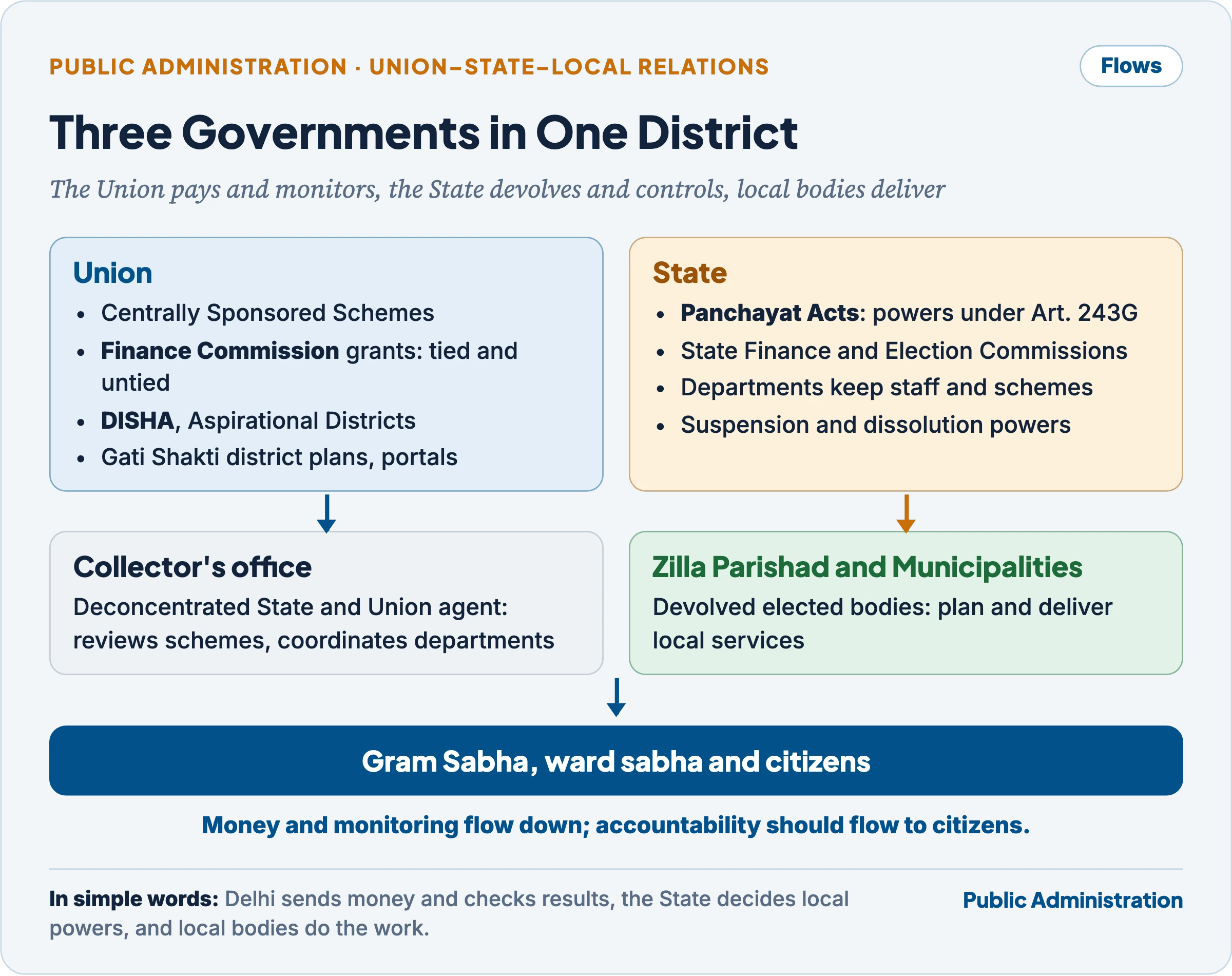
6.1 The constitutional triangle
- Union. Has no legislative power over local government (State List, entry 5), except through Parts IX and IXA themselves and laws on Union subjects. Its instruments are fiscal (grants under Article 282, Finance Commission grants under Article 275 read with Article 280), programmatic (Centrally Sponsored Schemes) and informational (portals, indices, monitoring).
- States. Decide powers and functions (Article 243G), taxes and grants (243H), SFC follow-up (243-I), staff, control powers and the shape of district machinery. They are the gatekeepers of devolution.
- Local bodies. Have constitutional existence, elections and reserved representation, but their functions, funds and functionaries are derived from State law and Union money.
- “Three-tier federalism”? (1992 question). Some scholars call Panchayats a third tier of federalism. Strictly, India is two-tier federal with constitutionally protected but not sovereign local government: local bodies have no list of their own powers comparable to the Seventh Schedule, no residuary power and no independent judiciary-protected sphere. The model is viable only if the third tier gets assured functions and finances, which the 1992 design left to State discretion.
6.2 The States’ role: devolution and control
- What States do well when they choose to: activity mapping (assigning each Eleventh Schedule activity to a tier), devolving staff, formula-based SFC transfers, untied funds, and planning campaigns (Kerala’s People’s Plan Campaign, 1996, which sent about 35–40 per cent of the State plan to local bodies).
- How States keep control:
- Discretionary devolution: “may” in Article 243G lets States transfer subjects on paper but keep schemes, staff and budgets in departments;
- Control powers in State Panchayat Acts: inspection, suspension of resolutions, removal or suspension of presidents, dissolution (subject to fresh elections within six months under Article 243E), and approval limits for works, often exercised by the Collector or Divisional Commissioner;
- Staff: Panchayat secretaries, engineers and teachers usually remain State employees, answerable to departments;
- Finance: SFC reports delayed or not acted upon; transfers made as ad hoc grants;
- Elections: delays in delimitation and reservation rotation postpone elections; the Supreme Court in Kishansing Tomar v. Municipal Corporation of Ahmedabad (2006) and Suresh Mahajan v. State of Madhya Pradesh (2022) held that elections cannot be postponed and the State Election Commission must ensure them on time.
- Autonomy is conditioned by two things (1994 question): State–local relations (how much the State devolves and how it uses its controls) and managerial capability of local bodies themselves (staff, accounts, planning and revenue effort). Weak capability is used by States to justify withholding powers, and withheld powers keep capability weak: a vicious circle.
Indian Connect — Devolution Index 2024
The Devolution Index 2024, prepared by the Indian Institute of Public Administration for the Ministry of Panchayati Raj and released on 14 February 2025, ranked States on six dimensions: framework, functions, finances, functionaries, capacity enhancement and accountability. Karnataka (72.23), Kerala (70.59) and Tamil Nadu (68.38) led; Maharashtra (61.44) and Uttar Pradesh (60.07) followed; the national average was 43.89. The index confirms that the same constitutional framework produces very different local governments, because the States, not the Constitution, decide how much is devolved.
6.3 The Union’s role: schemes that reach the district directly
- Centrally Sponsored Schemes (CSS). Most rural development, health, education, water and sanitation money flows through CSS with Union guidelines, State matching shares and district implementation. Historically, funds went to DRDAs and district societies (health, education, water), bypassing both State legislatures and local bodies.
- Why the Union bypasses local bodies: fear of leakage and weak capacity, the wish for visible national results, uniform targets, and the political value of direct credit for schemes.
- How the Union now administers local services (2021 question):
- Scheme-specific committees at village level (water and sanitation committees under Jal Jeevan Mission, school management committees, forest committees, health and sanitation committees), each with its own funds and rules;
- Direct Benefit Transfer and centrally run portals that deliver entitlements without local discretion;
- national dashboards and rankings (Aspirational Districts, Swachh Survekshan) that make the Collector answerable to Delhi’s indicators;
- tied Finance Commission grants earmarked for water and sanitation;
- uniform software for planning, accounts and asset tagging.
These raise transparency and speed, but they sideline local initiative and discretion: a Gram Sabha can choose among options within national formats, but rarely change the format.
- Many local programmes are Union-initiated (2009 question). Programmes from IRDP to rural employment, housing and drinking water were conceived and financed by the Union, implemented by States and local bodies. This reflects India’s centralised fiscal federalism: the Union has the elastic taxes, States and local bodies the spending responsibilities.
- Punchhi Commission (2010). The Commission on Centre–State Relations chaired by Justice M.M. Punchhi devoted its Volume IV to Local Self-Governments and Decentralised Governance. It found devolution of the 3Fs uneven across and within States, noted that Union Ministries had not reoriented their CSS to give local bodies a distinct role, welcomed the Backward Regions Grant Fund model of untied funds placed directly with Panchayats, and stressed district planning and capacity building. Its larger view of Indian federalism as passing through potential maturity (2011 question) applies here too: cooperative arrangements exist, but the third tier is the least mature.
6.4 Finance Commission grants: tied versus untied
Union Finance Commission grants have become the most reliable untied money local bodies receive, and the Union’s main lever on States’ treatment of local bodies.
| Commission (chair) | Period | Local body grants | Design |
|---|---|---|---|
| Fourteenth (Y.V. Reddy) | 2015–20 | ₹2,87,436 crore | Gram Panchayats only; 90% basic (untied), 10% performance |
| Fifteenth (N.K. Singh) | 2021–26 | ₹4,36,361 crore (incl. ₹70,051 crore for health) | All three rural tiers; 60% tied (water, sanitation), 40% untied; online accounts as entry condition |
| Sixteenth (Arvind Panagariya) | 2026–31 | ₹7,91,493 crore (rural ₹4,35,236 crore; urban ₹3,56,257 crore) | Basic 80% (half tied, half untied), performance 20% (untied); entry conditions on constituted bodies, published accounts and regular SFCs |
- Untied grants respect local choice (subsidiarity) and fund what the Gram Sabha prioritises; tied grants secure national priorities (clean water, open-defecation-free status) and reduce diversion.
- The trend since the Fifteenth Commission is towards more tying and more conditions. Conditions on elections, accounts and SFCs enforce the 1992 framework on reluctant States; tying to sectors narrows local discretion.
- Including the district tier. The Fourteenth Commission gave grants only to Gram Panchayats, which weakened Zilla Parishads; the Fifteenth restored funding for all three rural tiers, which matters for the district Panchayat’s planning role.
6.5 Union monitoring at the district level
- DISHA (2016). The District Development Coordination and Monitoring Committee, constituted by the Ministry of Rural Development in June 2016, replaced the District Vigilance and Monitoring Committee.
- Chair: the senior-most Lok Sabha MP elected from the district (other MPs, and one Rajya Sabha MP who opts in, as co-chairpersons);
- Member-secretary: the Collector;
- Members: MLAs, the Zilla Parishad chairperson, mayors and Panchayat representatives, and district officers;
- Work: quarterly review of several dozen Union schemes, with powers to seek information and demand follow-up; a State-level DISHA is chaired by the Chief Minister.
- Assessment: it brings all elected tiers into one room and gives MPs a formal voice in district development; but it makes an MP-chaired, Union-scheme review the main coordination forum, overlapping the DPC and placing the Collector’s accountability upward and outward rather than towards the Zilla Parishad.
- Aspirational Districts Programme (January 2018). Coordinated by NITI Aayog for 112 least-developed districts, ranked on 49 indicators in health and nutrition, education, agriculture and water, financial inclusion and skill development, and basic infrastructure. Its method is convergence, collaboration and competition, with Union “prabhari” officers of senior rank assigned to districts and Collectors judged by monthly improvement (“delta”) ranking. The Aspirational Blocks Programme (January 2023) extends it to 500 blocks.
- Strengths: data-driven, outcome-focused, targets the most deprived districts.
- Limits: it is Collector-led and NITI-monitored: in Rondinelli’s terms, deconcentration; indicators are national, and elected district bodies have no formal role.
- PM Gati Shakti District Master Plans. Building on the PM Gati Shakti National Master Plan (launched 13 October 2021), a District Master Plan portal for geospatial, area-based planning of schools, health centres, anganwadis, roads and pipelines was launched for 28 aspirational districts in 2024 and extended to all 112 Aspirational Districts on 13 October 2025. It gives the district an integrated GIS base for planning, but through Union-designed tools and officials.
- District Good Governance Index. The Department of Administrative Reforms and Public Grievances released India’s first District Good Governance Index for the 20 districts of Jammu and Kashmir on 22 January 2022, using 58 indicators in ten sectors; similar indices have been developed for some States.
6.6 MPLADS, MLALADS and the legislator in the district
- MPLADS. The Members of Parliament Local Area Development Scheme began on 23 December 1993; each MP may recommend works worth ₹5 crore a year (since 2011–12). The District Authority (the Collector) checks feasibility, sanctions works (within 45 days under the 2023 guidelines) and appoints implementing agencies; since 1 April 2023 funds flow through the e-SAKSHI portal.
- MLALADS. Most States run similar schemes for MLAs, with amounts and rules set by the State.
- Judicial view. In Bhim Singh v. Union of India (2010), a Constitution Bench upheld MPLADS, holding that it does not violate the separation of powers because MPs only recommend and the district authority sanctions and executes.
- Critique from the decentralisation angle:
- legislators become executive actors in local works, duplicating Panchayats’ and Municipalities’ role;
- works are chosen by patronage rather than plans; the DPC and Gram Sabha are bypassed;
- MLAs often see Panchayat leaders as rivals and resist devolution;
- the 2nd ARC (Report on Ethics in Governance, 2007) recommended that MPLADS and MLALADS be abolished.
- Defence: quick, flexible funds for felt local needs; legislators’ accountability to voters; now digitised and time-bound.
Common confusion
Is DISHA the District Planning Committee under a new name? No. The DPC is a constitutional body (Article 243ZD), mostly elected from local bodies, meant to consolidate local plans. DISHA is an executive committee created by Union guidelines (2016), chaired by an MP, meant to monitor Union schemes. They overlap in purpose (coordination of development in the district) but differ in legal basis, chair, membership and focus. The 2nd ARC’s ideal of a single District Council would have absorbed the planning role of both.
7. Bureaucracy and Elected Representatives at the District Level
In simple words
In a district, officers and politicians must work together every day. The Collector needs the MLA’s support; the Zilla Parishad president needs the Collector’s staff; the MP chairs DISHA. When they cooperate, schemes move; when they compete, files stall, transfers become weapons and local bodies are squeezed.
7.1 The actors
The district interface involves officials (Collector, Zilla Parishad CEO, SP, district officers, BDOs), elected local leaders (Zilla Parishad president, sarpanches, mayors), legislators and ministers (MPs chairing DISHA, MLAs, and in many States a guardian or prabhari minister for each district), and parties, interest groups and media.
7.2 Patterns of the interface
| Pattern | What happens | Example |
|---|---|---|
| Cooperative | Clear roles; officials provide technical and administrative support; elected leaders set priorities | Kerala and Maharashtra Zilla Parishads with competent CEOs |
| Bureaucratic dominance | Officers control files, funds and approvals; elected leaders reduced to ceremony | Collector approval needed for all important works (Andhra Pradesh study) |
| Political dominance | Legislators and ministers direct officers, transfers and works; local bodies and officers both sidelined | MLA control over local works through MLALADS and district committees |
| Collusive | Officials, contractors and local leaders share rents | Leakages in works programmes found in social audits |
| Conflictual | Disputes over authority, protocol and credit | Collector versus Zilla Parishad president over transfers or sanctions |
- Collector versus Zilla Parishad president. The president has a mandate but little administrative command; the Collector has command but no mandate. Conflicts arise over control of district officers, sanction of works, inspection and suspension powers, and protocol.
- MLAs and MPs versus PRIs. Legislators often resist devolution because strong Zilla Parishad presidents become political rivals. Their presence in Zilla Parishads, DPCs, DISHA and district committees, and their local area funds, crowd out local representatives.
- Transfers as control. Frequent transfers of Collectors and district officers (average tenures often well under two years) weaken institutional memory and make officers responsive to those who control transfers, not to local bodies.
- “Officer in attendance.” Protocol for VIP visits, review meetings and scheme events consume much of the Collector’s time, a complaint taken up in the article on the Collector.
7.3 Improving the interface
- Clarity of roles: activity mapping and rules of business for district bodies; a written division of work between Collector and CEO.
- Accountability of officials to local bodies: officers working on devolved subjects to report to the Zilla Parishad, with the Zilla Parishad writing part of their performance appraisal.
- Codes of conduct: for elected representatives and officials; a local body ombudsman (2nd ARC) for complaints against both.
- Stable tenure: minimum tenure for Collectors and CEOs, as the 2nd ARC and the Supreme Court’s T.S.R. Subramanian v. Union of India (2013) judgment urged for civil servants generally.
- Capacity and respect: training officials in working with elected leaders, and elected leaders in using officials, a theme of the next sections.
8. The “Government Next Door”: Values of Local Government
In simple words
The government you meet most is not in Delhi; it is the Panchayat office or the municipal ward office near your home. It fixes the street light, the drain and the water tap, issues birth certificates and runs the anganwadi. That is why local government matters most to ordinary people, even if national government gets more attention.
8.1 Why the government next door matters most
- Proximity: most everyday services (water, sanitation, streets, schools, health sub-centres, certificates, local roads) are local by nature.
- Visibility and accessibility: a citizen can meet a sarpanch or ward councillor; a minister is distant.
- Knowledge: local bodies know who is poor, which road floods, which well dries; this information is lost as decisions move up.
- Feedback speed: complaints can be raised in a Gram Sabha or ward meeting and acted upon quickly.
8.2 Values of local government
| Value | Meaning | Indian illustration |
|---|---|---|
| Democracy and participation | Citizens take part directly, not only through periodic votes | Gram Sabha, ward sabhas, special Gram Sabhas on 15 August and 2 October |
| Political education | Local office trains citizens and leaders (Mill’s “school of public spirit”) | Many MLAs began as sarpanches or Zilla Parishad members |
| Liberty through dispersal of power | Power spread across levels is harder to abuse (Tocqueville) | Constitutional protection against supersession (Article 243E) |
| Responsiveness and efficiency | Services match local preferences at lower cost (Oates) | GPDP priorities differ from village to village |
| Equity and inclusion | Representation of excluded groups | About 1.4 million women elected representatives; SC and ST reservation |
| Accountability | Short chain between voter and decision-maker; social audit | Social audits of rural works; public disclosure in Gram Sabha |
| Community and identity | Recognition of local culture and customary institutions | PESA Gram Sabhas; Sixth Schedule councils |
| Legitimacy and stability | Local self-rule channels conflict into institutions | District councils in the North-East |
| Innovation | Many units experiment and learn from each other | Kerala’s People’s Plan; model Gram Panchayats |
- Limits of the “next door” argument: elite capture (Ambedkar’s fear), proxy representation of women by male relatives, low capacity, petty corruption, and the fact that many problems (climate, rivers, epidemics) spill over village boundaries and need the district and State.
- What makes the values real: the 3Fs, a functioning Gram Sabha, transparent accounts, and a district administration that supports rather than supplants local bodies.
8.3 NGOs, civil society and decentralisation
- “New actors” in development. Since the 1980s, NGOs, community-based organisations, self-help groups and cooperatives have taken roles in district development: delivery (health, education, watershed), mobilisation, advocacy, social audit and capacity building of Panchayats.
- As instruments of decentralisation and debureaucratisation (2012 question):
- Effective where: they bring flexibility, local knowledge and trust; they organise the poor (the DAY-NRLM self-help group network of about ten crore women, Kerala’s Kudumbashree working with Panchayats); they run social audits (the MKSS campaign in Rajasthan led to the right to information movement); they train elected women representatives.
- Limits: dependence on donor or government funds, accountability to funders rather than citizens, uneven geographic spread, possible substitution for elected local bodies (parallel committees), and capture by elites or political parties. Tighter rules on foreign contributions (the FCRA amendment, 2020) have reduced the space for many NGOs.
- Assessment: NGOs debureaucratise delivery but do not themselves create democratic decentralisation; they work best as partners of Gram Sabhas and Panchayats, not substitutes.
- The district’s role: the 2nd ARC recommended a civil society and media forum at the district for regular interaction with the Collector’s office, and partnerships with civil society for public education.
9. Capacity Building of Elected Representatives
In simple words
Lakhs of people are elected to Panchayats every five years, many for the first time, many with little schooling and, because of rotation of reserved seats, often for just one term. Without training, staff and support, they cannot use their powers, and officials or male relatives end up running the Panchayat in their name.
9.1 Why capacity is the bottleneck (2017 question)
- Scale and turnover: about 3.1 million elected representatives in rural local bodies, nearly half of them women; rotation of reserved seats means most serve one term.
- Knowledge gaps: rules of procedure, budgeting, procurement, accounts, scheme guidelines, planning, digital portals.
- Weak support staff: one Panchayat secretary often serves several Gram Panchayats; few have engineers or accountants.
- Proxy representation: the “sarpanch pati” phenomenon, in which male relatives exercise the office of women representatives.
- Consequences: dependence on the BDO and Collector’s office, unspent funds, poor planning, and the State’s argument that local bodies are not ready for more powers.
- But capacity is not only training. Capacity also means staff, money, buildings, data and authority. Training elected members while withholding the 3Fs produces frustrated competence.
9.2 What is being done
- Rashtriya Gram Swaraj Abhiyan (RGSA). Introduced in 2018–19 and revamped from 2022–23, this Centrally Sponsored Scheme funds training of elected representatives and functionaries, Panchayat buildings and computers, Gram Sabha strengthening and e-governance. Orientation training is to be given within six months of election, and refresher training within two years. In 2025–26 more than 45 lakh participants were trained, and 632 Panchayat Learning Centres set up; about 1.66 crore participants were trained from 2022–23 to July 2026.
- Training institutions: the National Institute of Rural Development and Panchayati Raj (Hyderabad) and State Institutes of Rural Development, using cascading master trainers and vernacular, simplified modules.
- Women elected representatives. The Sashakt Panchayat-Netri Abhiyan (launched 4 March 2025) and a special game-based training module aim to build leadership and negotiation skills; about 7 lakh women representatives were trained in 2025–26 under RGSA.
- Proxy representation. An advisory committee chaired by former Mines Secretary Sushil Kumar (constituted September 2023, report early 2025) recommended exemplary penalties for proven proxy leadership, public swearing-in of women heads in the Gram Sabha, women’s ombudspersons, gender resource centres, women-only Panchayat subject committees, and digital tracking of heads’ participation in meetings.
- Digital aids: e-GramSwaraj (planning, accounting, payments, launched 24 April 2020), the Panchayat Nirnay portal for meeting decisions, and SabhaSaar (launched 14 August 2025), an AI tool that drafts Gram Sabha minutes from recordings in 13 languages.
9.3 Gaps and the way forward
- Training is episodic and supply-driven: large numbers trained once, little on-the-job mentoring or assessment of learning.
- Staffing: a dedicated local government cadre (2nd ARC) of secretaries, engineers and accountants answerable to Panchayats.
- Peer learning: exposure visits, networks of women representatives, model Panchayats.
- Link training to devolution: capacity building is credible only where States also devolve funds and functionaries.
10. The Future of District Administration
In simple words
The district of the future will be less a command post and more a hub: linking departments, local bodies, private firms, NGOs and citizens, using data and digital tools, and preparing for disasters and climate change before they strike rather than only after.
10.1 Challenges facing district administration (2020 question)
- Scheme overload: dozens of Union and State schemes, each with guidelines, portals, reviews and committees, consume official time and crowd out local planning.
- Coordination: vertical departments, parallel societies and multiple monitoring forums make convergence hard.
- Role overload of the Collector: the 2nd ARC found Collectors chairing scores of committees (a Deputy Commissioner in Assam chaired 43), many unaware of all the laws under which they hold powers.
- Weak local bodies: limited 3Fs, delayed elections in some States, and dependence on district officials.
- Human resources: vacancies at block and village level, short tenures, and weak technical capacity (engineering, planning, data).
- Data and accountability: many dashboards but low-quality, unverified data; accountability to indicators rather than to citizens.
- Law and order pressures: communal tension, protests, cyber crime and organised crime pull the district away from development.
- Urbanisation: census towns and peri-urban areas fall between Panchayats and Municipalities.
- Climate and disaster risk: more frequent floods, heatwaves and droughts.
- Politicisation: transfers, credit-claiming and pressure on officials.
10.2 The district as the unit of disaster and climate governance (2017 and 2018 questions)
- Legal frame. Under Section 25 of the Disaster Management Act, 2005, every district has a District Disaster Management Authority (DDMA), chaired by the Collector, with the elected head of the district local authority as co-chairperson, and the SP, CMO and other officers as members. It prepares the District Disaster Management Plan (Section 31) and coordinates prevention, preparedness, response and recovery.
- Disaster Management (Amendment) Act, 2025 (assent 29 March 2025, in force 9 April 2025):
- district plans to be reviewed at least once every two years (instead of annually) and updated as needed;
- States may set up Urban Disaster Management Authorities for State capitals and cities with municipal corporations, chaired by the Municipal Commissioner with the Collector as vice-chairperson;
- disaster databases at national and State levels; statutory backing for the National Crisis Management Committee; enabling provision for State Disaster Response Forces.
- Why climate makes the district central:
- climate impacts are local and compound (heat, water stress, crop loss, disease, migration), requiring cross-department action that only the district can coordinate;
- early warning, evacuation and relief are district operations (Odisha’s district-led cyclone evacuations have sharply reduced deaths since 1999);
- adaptation needs local plans: heat action plans (pioneered by Ahmedabad in 2013), district irrigation and drought plans, climate-resilient GPDPs, flood-plain zoning;
- mitigation choices (solar pumps, waste management, afforestation, groundwater recharge under rural works) are implemented through district and Panchayat machinery.
- From reactive to proactive: risk mapping, vulnerability data, community-based disaster preparedness with Panchayats, SHGs and volunteers (Aapda Mitra), climate budgeting at district level, and integration of disaster plans into district and Panchayat development plans. The district must move from relief after the event (the Famine Code tradition) to risk reduction before it.
10.3 Networked and citizen-centric district administration
- From hierarchy to network. Stephen Osborne’s New Public Governance (2006) describes a plural state in which outcomes come from networks of public, private and civil society actors. The district increasingly works this way: CSR foundations, NGOs, SHGs, banks, start-ups and volunteers join government in delivery.
- Digital public infrastructure at the district:
- e-District services and Common Service Centres for certificates and applications;
- e-GramSwaraj and the Panchayat Advancement Index for local planning and performance;
- SVAMITVA (launched 24 April 2020) drone surveys of village habitations: by August 2026 drone surveys were complete in 3.30 lakh villages, 3.24 crore property cards prepared and about 2.72 crore distributed, and more than 11,000 loans worth about ₹1,713 crore had been taken against them;
- land records under the Digital India Land Records Modernization Programme (DILRMP), PM Gati Shakti district plans and geospatial data.
- Citizen-centric design: single-window services, time-bound delivery under Right to Services laws in many States, grievance portals (CPGRAMS and State portals), Citizen’s Charters, and the 2nd ARC’s proposals for a district grievance cell, RTI cell, vigilance cell and MIS in the Collector’s office.
- Self-sustaining, customer-friendly institutions. Development management favours district institutions that run on their own revenue and user feedback (water user associations, municipal utilities, SHG federations, producer companies) rather than permanent dependence on grants; this is the managerial counterpart of democratic decentralisation.
Indian Connect — Land records: necessary but not sufficient
DILRMP (2008, a 100 per cent Union-funded Central Sector scheme since 2016, extended to 2030–31) had by 6 August 2026 computerised 99.90 per cent of Records of Rights, digitised 97.43 per cent of cadastral maps, geo-referenced 77.68 per cent, and given a Unique Land Parcel Identification Number (Bhu-Aadhaar) to 69.04 per cent of parcels; DILRMP 3.0 (September 2026) adds a GIS-based Land Stack and urban mapping. Yet digitisation copies existing records: where surveys are decades old, mutations pending and possession differs from the record, a digital error is still an error. Only about 14 per cent of villages have completed survey or resurvey. Transparency in district administration also needs fresh surveys, quick mutation, revenue court reform, conclusive titling (the 2nd ARC’s recommendation for a Torrens-type system), and an end to the patwari’s discretionary monopoly over records.
10.4 Reform directions
- Realign the Collector to core regulatory, crisis and coordination functions (see the article on the Collector).
- Empower elected district government: devolve the 3Fs, place development departments under the Zilla Parishad with a strong CEO, or adopt the 2nd ARC’s District Council.
- Make the DPC real: permanent planning secretariat, data centre and planning calendar; one integrated rural–urban district plan.
- Rationalise Union instruments: fewer, broader CSS with untied components routed through local bodies; one district review forum instead of many; common data standards.
- Stable, capable staff: minimum tenure, local government cadre, specialist planners and engineers at district and block.
- Accountability downward: social audit, Gram Sabha scrutiny, published district budgets and outcome reports, local ombudsman.
- Holistic, not marginal, reform (2011 question): district reforms have been diluted by constant tinkering at the margin (new committees, new portals, new schemes) without a holistic redesign of roles, finances and accountability across the Union, State and local levels.
Theory lens: why Indian decentralisation stays partial
- Rondinelli’s typology. Dennis Rondinelli (1983) distinguished deconcentration, delegation, devolution and privatisation. India’s district is rich in the first two (Collectors, BDOs, DRDAs, district societies, Aspirational District teams) and constitutionally committed to the third, but devolution remains thin because the 3Fs stay with State departments. See the article on Structure and Forms of Public Organisations.
- Fesler’s illusory decentralisation. James Fesler (1965) warned that without political will, devolution exists “in law” but not in practice. Discretionary Article 243G and State control powers make much Indian local government an example of this façade devolution.
- Subsidiarity. The principle that higher levels should do only what lower levels cannot underlies the 2nd ARC’s local governance report and its District Council. Indian practice often inverts it: national schemes decide even village-level choices. See the article on Administrative Reforms since Independence.
- Multi-level governance. Gary Marks and Liesbet Hooghe (1993; 2003) describe authority dispersed across levels and across public and private actors, with Type I (general-purpose, nested governments such as the Zilla Parishad) and Type II (task-specific, overlapping bodies such as DRDAs, water committees, DISHA). The Indian district shows a dense, unplanned growth of Type II bodies that weakens Type I local governments.
- New Public Service and participatory governance. Robert and Janet Denhardt (2000; 2003) argued that public servants should serve citizens, not steer them, and value citizenship over customers. The Gram Sabha, social audit and People’s Plan Campaign embody this; Collector-led dashboards and target ranking reflect the earlier NPM logic of performance management. See the article on New Public Management and After: New Public Service, New Public Governance and Digital-Era Governance.
- Riggs’ formalism. Fred Riggs (Administration in Developing Countries, 1964) described formalism: a gap between prescribed norms and actual behaviour. The 73rd Amendment’s “institutions of self-government”, DPCs that exist but do not plan, and transferred subjects whose staff remain with departments are classic prismatic formalism. See the article on Riggsian Models and their Critique.
- Principal–agent relations between tiers. In agency theory (Jensen and Meckling, 1976) a principal uses incentives and monitoring to control an agent with different goals and better information. The Union uses tied grants, conditions and dashboards to control States and districts; States use control powers over Panchayats. Excessive monitoring, however, makes local bodies accountable upward to principals rather than downward to citizens, the opposite of democratic decentralisation.
- Development administration and the dual role. The Indian district was asked, in Edward Weidner’s terms, to be goal-oriented and change-oriented while still maintaining order; Fesler’s dual-role problem explains why law and order crises repeatedly pull Collectors away from development. See the article on Development Administration: Concept, Changing Profile and the Anti-Development Thesis.
Key Terms
The terms below recur in district administration and decentralisation debates.
| Term | Meaning in simple words |
|---|---|
| District administration | Total management of public affairs in a district by State offices, police, departments and local bodies |
| Field administration | Government offices outside the headquarters that carry policy to citizens |
| Prefectorial system | A general representative (prefect, Collector) coordinates all departments in an area |
| Area–function duality | Tension between area-based authority (Collector) and subject-based departments |
| Democratic decentralisation | Transfer of power, functions and resources to elected local bodies accountable to local people |
| Deconcentration | Shifting work to field officers of the same government |
| Delegation | Transfer of defined functions to semi-autonomous bodies |
| Devolution | Transfer of authority and resources to legally separate, elected local governments |
| Subsidiarity | Decisions should be taken at the lowest level able to take them |
| 3Fs | Functions, funds and functionaries needed for real devolution |
| Activity mapping | Assigning each activity of a subject to a specific tier of government |
| Zilla Parishad | Elected district-level Panchayat |
| CEO of Zilla Parishad | Senior official serving as chief executive of the district Panchayat |
| DRDA | District Rural Development Agency: a registered society that ran rural development schemes; merged with Zilla Parishads from 2022 |
| District Planning Committee | Constitutional body (Art. 243ZD) to consolidate rural and urban plans for the district |
| District Council | 2nd ARC’s proposed single elected district government for rural and urban areas |
| DISHA | MP-chaired committee (2016) monitoring Union schemes in each district |
| Parallel bodies | Societies, committees or agencies that perform local functions outside elected local bodies |
| Tied grant | Transfer that must be spent on specified purposes |
| Untied grant | Transfer that the local body can spend on its own priorities |
| Illusory decentralisation | Decentralisation in law without real transfer of power (Fesler) |
| Elite capture | Domination of local institutions by locally powerful groups |
| Proxy representation | Male relatives exercising the office of women elected representatives |
| Multi-level governance | Authority shared across levels and across public and private actors |
Commissions, Committees and Judgments
The table lists the bodies, laws and judgments that shaped the district’s democratic structure.
| Body / case | Year | Key point |
|---|---|---|
| Community Development Programme | 1952 | Block and BDO; extension staff; advisory district committees |
| Balwantray Mehta Study Team (Balwantray Mehta) | 1957 | Democratic decentralisation; three tiers; Zila Parishad advisory, chaired by Collector |
| Maharashtra Zilla Parishads and Panchayat Samitis Act | 1961 | Strong elected Zilla Parishad with its own IAS CEO; Collector outside |
| V.T. Krishnamachari Report | 1962 | IAS and district administration; coordination of elected and official elements |
| Asoka Mehta Committee (Asoka Mehta) | 1978 | Two tiers; Zila Parishad executive and district planning body; party participation |
| Working Group on District Planning (C.H. Hanumantha Rao) | 1984 | District Planning Body; Collector-led executive committee |
| CAARD (G.V.K. Rao) | 1985 | “Grass without roots”; Zila Parishad principal agency; District Development Commissioner |
| L.M. Singhvi Committee | 1986 | Constitutional recognition of local self-government; Gram Sabha |
| P.K. Thungon Committee | 1988 | Constitutional status; Zila Parishad as pivot; Collector as its CEO |
| V.N. Gadgil Committee | 1988 | Constitutional status, direct elections, reservations, SFC and SEC |
| 73rd and 74th Constitutional Amendments | 1992 | Parts IX and IXA; Arts. 243B, 243D, 243E, 243G, 243-I, 243K, 243W, 243ZD |
| MPLADS | 1993 | MPs recommend works; Collector sanctions; ₹5 crore a year since 2011–12 |
| PESA Act | 1996 | Gram Sabha powers in Fifth Schedule areas |
| Disaster Management Act (s.25) | 2005 | DDMA chaired by Collector; local body head co-chair |
| Kishansing Tomar v. Municipal Corporation of Ahmedabad | 2006 | Local body elections must be held on time; SEC’s duty |
| 2nd ARC, 6th Report, Local Governance (M. Veerappa Moily) | 2007 | Subsidiarity, activity mapping, District Council, parastatals under PRIs |
| 2nd ARC, 15th Report, State and District Administration (V. Ramachandran, acting) | 2009 | Collector as Chief Officer of District Council with dual accountability; core functions |
| Punchhi Commission, Vol. IV (M.M. Punchhi) | 2010 | Uneven 3F devolution; CSS to give local bodies a role; district planning |
| Bhim Singh v. Union of India | 2010 | MPLADS upheld; MPs only recommend, district authority executes |
| T.S.R. Subramanian v. Union of India | 2013 | Fixed tenure, civil services boards, written orders for civil servants |
| DISHA (Ministry of Rural Development) | 2016 | MP-chaired district monitoring of Union schemes; Collector member-secretary |
| Aspirational Districts Programme (NITI Aayog) | 2018 | 112 districts, 49 indicators; convergence, collaboration, competition |
| DRDA Administration scheme discontinued | 2022 | DRDAs to merge with Zilla Parishads from 1 April 2022 |
| Suresh Mahajan v. State of Madhya Pradesh | 2022 | Local body elections cannot be postponed indefinitely |
| Advisory Committee on proxy representation (Sushil Kumar) | 2025 | Penalties for proxy leadership; women’s ombudspersons; public oath |
| Disaster Management (Amendment) Act | 2025 | Urban DMAs with Collector as vice-chair; DDMA plan review every two years |
| Sixteenth Finance Commission (Arvind Panagariya) | 2026 | ₹7,91,493 crore to local bodies; entry conditions on elections, accounts, SFCs |
Contemporary Developments
- 10 September 2026: the Union launched DILRMP 3.0, adding a GIS-based Land Stack, universal Bhu-Aadhaar, modernised registration offices and paperless revenue courts; by August 2026, 99.90 per cent of Records of Rights were computerised but only about 69 per cent of parcels had a ULPIN.
- 4 August 2026: the Ministry of Panchayati Raj told Parliament that under SVAMITVA drone surveys were complete in 3.30 lakh villages, 3.24 crore property cards prepared and about 2.72 crore distributed, with 11,147 loans worth ₹1,713 crore taken against them.
- April–May 2026: Panchayat Advancement Index 2.0 (2023–24) covered 2,59,867 Gram Panchayats on 112 indicators; no Panchayat reached “Achiever”, 3,635 were “Front Runners”, and Tripura, Kerala and Odisha led while Punjab, Uttar Pradesh, Bihar and Rajasthan lagged.
- 1 February 2026: the Sixteenth Finance Commission recommended ₹7,91,493 crore for local bodies for 2026–31, conditional on duly constituted bodies, online audited accounts and regular SFCs.
- 13 October 2025: PM Gati Shakti District Master Plans were extended to all 112 Aspirational Districts for geospatial planning of schools, health centres, anganwadis, roads and pipelines.
- 14 August 2025: SabhaSaar, an AI tool to generate Gram Sabha minutes in 13 languages, was launched; Tripura used it in all its Gram Panchayats on 15 August 2025.
- 29 March 2025: the Disaster Management (Amendment) Act, 2025 received assent (in force 9 April 2025), providing for Urban Disaster Management Authorities with the Collector as vice-chair, disaster databases and State Disaster Response Forces.
- February–March 2025: the Devolution Index 2024 (14 February) put the national average at 43.89 with Karnataka first; the Sushil Kumar committee’s report on proxy representation was submitted, and the Sashakt Panchayat-Netri Abhiyan for women representatives was launched on 4 March 2025.
Revision Grid
| Thinker / body | Work or report (year) | Key idea |
|---|---|---|
| S.S. Khera | District Administration in India | District administration as total management of public affairs in the district |
| James Fesler | “Approaches to the Understanding of Decentralization” (1965) | Doctrinal, political, administrative, dual-role approaches; illusory decentralisation |
| Dennis Rondinelli, Nellis, Cheema | Decentralization in Developing Countries (1983) | Deconcentration, delegation, devolution, privatisation |
| Alexis de Tocqueville | Democracy in America (1835) | Local institutions as schools of liberty |
| J.S. Mill | Considerations on Representative Government (1861) | Local bodies as schools of public spirit |
| Charles Tiebout | “A Pure Theory of Local Expenditures” (1956) | Voting with the feet; competition among local governments |
| Wallace Oates | Fiscal Federalism (1972) | Decentralisation theorem |
| Gary Marks, Liesbet Hooghe | Multi-level governance (1993; 2003) | Type I and Type II governance |
| Robert and Janet Denhardt | New Public Service (2000; 2003) | Serve citizens, not steer |
| Fred Riggs | Administration in Developing Countries (1964) | Formalism in prismatic societies |
| Mahatma Gandhi / B.R. Ambedkar | Village republic / Constituent Assembly (1948) | Village self-rule versus fear of local domination |
| Balwantray Mehta | Study Team (1957) | Democratic decentralisation; three tiers |
| Asoka Mehta | Committee (1978) | District as first point of decentralisation; two tiers |
| G.V.K. Rao | CAARD (1985) | Grass without roots; District Development Commissioner |
| P.K. Thungon | Committee (1988) | Zila Parishad pivot; Collector as CEO |
| 2nd ARC | 6th Report (2007), 15th Report (2009) | District Council; Collector as dually accountable Chief Officer |
| M.M. Punchhi | Commission on Centre–State Relations (2010) | Uneven devolution; reorient CSS to local bodies |
Previous Year Questions
- 2026Linkages between the district administration and local self governments have not evolved to the desired extent. Evaluate.
- 2025Experience of various States suggests that reorganization of districts was prompted more by politico-populist convenience rather than ease of administration. Discuss.
- 2021The Union government develops and practices strategies to administer increasing number of existing local government services by sidelining local initiatives and discretion. Examine.
- 2020District administration is the most important unit in governance. Most of the Central and State Government schemes and programmes are directed towards the district administration. In this context, discuss the challenges and problems posed to the district administration.
- 2019It is observed that non-functioning of District planning Committees is preventing the Convergence of rural and urban planning needs. Do you agree? Justify.
- 2018“A government next-door is the government that matters most for the people.” Discuss the statement with special reference to the values of local government.
- 2018Climate change issues pose new challenges for district administration to be proactive.” Elaborate
- 2017“Effectiveness of local self-government institutions is hampered due to the lack of capacity building of the elected representatives.” Elaborate
- 2017”Digitalization of land records is a necessary but not sufficient precondition for ensuring transparent district administration.” Explain.
- 2017“The Second Administrative Reforms Commission (ARC) makes a strong case for the principle of subsidiarity.” Elaborate.
- 2017“Disaster preparedness and management has become an important component of district administration in India.” Discuss with suitable illustrations.
- 2013“Reducing the size (geographical area) of the district will provide relief to the overburdened and overworked collector.” Comment.
- 2012NGOs demand greater autonomy from the State and are now ‘new actors’ in development. How effective are they as instruments of decentralisation and debureaucratisation? Critically evaluate.
- 2012Explain the emerging ambiguity in respect of the developmental role of the District Collector in the wake of the 73 rd Constitutional Amendment Act.
- 2011“Indian federalism is passing through a state of potential maturity.” Discuss this statement in the context of the views of the Commission on Centre-State Relations (Justice M.M. Punchi).
- 2011“Administrative reforms get diluted because of constant tinkering on the margin rather than a holistic transformation.” Discuss the statement in the context of reforming district administration in India.
- 2009“Many of the programmes of development being implemented at the State and the Local level have been initiated or financed by the nature of Indian federalism.” Critically examine this assessment.
- 2004“The district officer as a chief agent and representative of state serves as a channel of communication between the Government and the residents of the district.” Explain.
- 2003“It is at the district level that the common man comes into direct contact with the administration.” Elucidate.
- 2000“It is a major challenge to balance the role of District Collector with the powers of democratic bodies.” Comment.
- 1997“The District Rural Development Agency is presently serving as the nodal agency of rural development at the district level.” Explain.
- 1994“Autonomy of local bodies is conditioned by state-local relations and the managerial capability of the local bodies themselves.” Comment.
- 1994“The Bengal pattern of district administration was based on the Zamindari system of land tenure.” Explain.
- 1993“The British colonial administration superimposed the prefectorial system on the historically inherited district administration in India, in the absence of rural local governments at the district level.” Comment.
- 1992Examine some of the Challenges to Development Administration in the Panchayati democracy of rural India. Do you think that the Constitutionalisation of three-tier Federalism will be a viable model for future?
- 1997“Centralization inclines toward power and domination. Decentralization, on the other hand, inclines toward competition and self-determination.” Discuss.
- 1993“Decentralization is never just a technical exercise, with intentions and effects neatly confined to questions of economy and efficiency.” Comment.
- 1992‘Decentralization has a more important justification than more administrative efficiency.’ Comment.