

7 Culture, language and communication: Nature, origin and characteristics of language; verbal and non-verbal communication; social context of language use.
Official Syllabus: Paper I, Unit 7
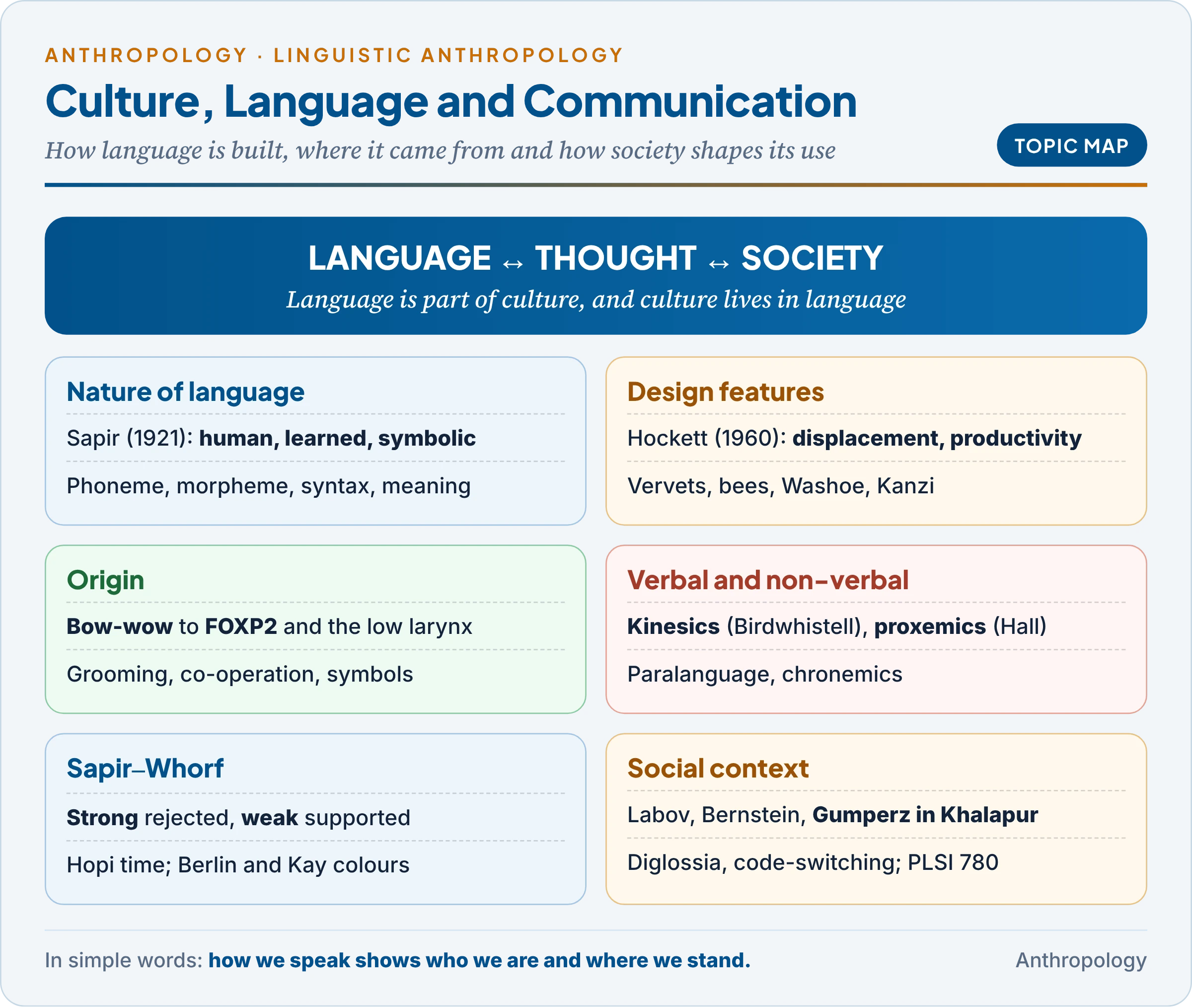
1. The Nature of Language
In simple words
Language is a shared system of sounds, words and rules that lets people say anything they want to one another. It is learned while growing up in a group, so every language carries the ideas, values and social ranks of the people who speak it.
Example first. A Hindi-speaking child learns two words for an uncle: chacha (father’s brother) and mama (mother’s brother). An English-speaking child has one, “uncle”. Without any lesson in kinship, the Hindi child learns through vocabulary that the father’s side and the mother’s side are different kinds of relatives, owed different duties. This is the core of the unit: language is part of culture, and culture lives in language.
1.1 Definitions
- Edward Sapir, the American linguist-anthropologist and student of Boas: language is “a purely human and non-instinctive method of communicating ideas, emotions and desires by means of a system of voluntarily produced symbols” (Language, 1921). It is human (no animal has it), learned (not instinctive) and symbolic (sounds stand for meanings by convention).
- Bernard Bloch and George Trager, American structural linguists: “a system of arbitrary vocal symbols by means of which a social group co-operates” (1942). This stresses the social function: language exists to coordinate group life.
- Linguistic anthropology studies language as a cultural resource and speaking as a cultural practice. Its branches (historical, descriptive, sociolinguistic, ethnosemantic, psycholinguistic, ethnography of communication) and the borrowing of structuralism from linguistics are covered in Unit 1.3 §5.
1.2 Language, speech and communication
The three words are often used loosely; the table separates them.
| Term | Meaning | Example |
|---|---|---|
| Communication | Any transfer of information between organisms, by any channel | A bee’s dance, a dog’s growl, a smile |
| Language | A rule-governed symbolic system shared by a community | Hindi, Santali, Indian Sign Language |
| Speech | The spoken use of language | A conversation in Kurukh |
A parrot produces speech sounds without language, while a deaf signer uses language without speech. Human uniqueness therefore lies in language, not in the vocal organs.
- Ferdinand de Saussure, the Swiss founder of structural linguistics (1916), separated langue (the shared system of rules) from parole (an individual act of speaking), and described each word as a sign joining a signifier (sound-image) to a signified (concept) by convention.
- Dell Hymes, an American linguistic anthropologist, added communicative competence (1972): knowing when, where, to whom and how to say something.
- Bronisław Malinowski, the Polish-British functionalist, noticed that Trobriand greetings and small talk carry little information but create bonds, which he called phatic communion (1923).
1.3 The structure of language
Every language is built in levels. The table runs from the smallest unit to the largest.
| Level | Unit | Example |
|---|---|---|
| Phonology | Phoneme: smallest sound that changes meaning | Hindi kal (tomorrow) vs khal (skin): /k/ and /kʰ/ are separate phonemes |
| Morphology | Morpheme: smallest unit of meaning | kind + ness; free boy, bound -s |
| Syntax | Sentence | Hindi is verb-final; English puts the verb in the middle |
| Semantics | Meaning | “Uncle” vs chacha, mama, phupha, mausa |
A phoneme has no meaning of its own but distinguishes meanings. Meaningless sounds combine into meaningful words, and a few dozen phonemes yield hundreds of thousands of words; Hockett called this duality of patterning (§2).
2. Characteristics of Language: Hockett’s Design Features
In simple words
Animals communicate, but only humans have language. Human language can talk about anything, including the past, the future and things that do not exist, and it can make endless new sentences from a small set of sounds. No animal system does both.
Example first. Vervet monkeys in Kenya give different alarm calls for a leopard, an eagle and a snake. When recorded calls were played with no predator present, the monkeys ran up a tree, into bushes or stood up to scan the ground, as appropriate (Robert Seyfarth, Dorothy Cheney and Peter Marler, American primatologists, 1980). The calls mean something. Yet a vervet cannot say “a leopard was here yesterday”: its system is closed and tied to the here and now. These two limits are what the design features capture.
2.1 Hockett’s list
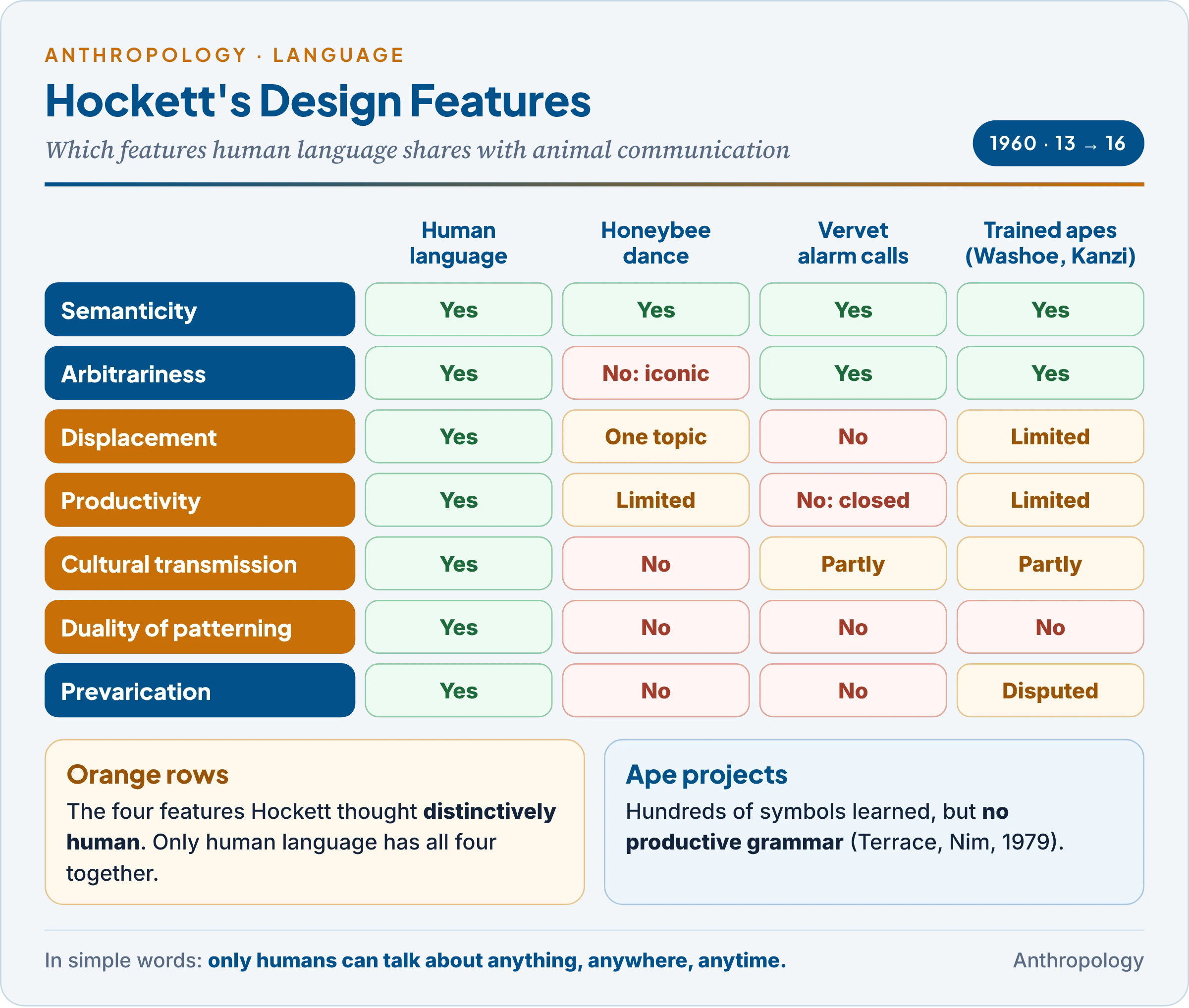
Charles Hockett, an American linguist, compared human language with animal systems in “The Origin of Speech” (Scientific American, 1960). He listed 13 design features; by 1963 he had added prevarication, reflexiveness and learnability, making 16. The table groups them.
| Group | Features | Meaning |
|---|---|---|
| Shared with many animals | Vocal-auditory channel; broadcast transmission; rapid fading; interchangeability; total feedback; specialisation | Sound spreads and vanishes at once; any speaker can be a hearer; speech serves only to signal |
| Shared with some | Semanticity; arbitrariness; discreteness | Fixed meanings; conventional link of sound to meaning; separate units |
| Distinctively human | Displacement | Talking about what is absent in time or space |
| Productivity (openness) | Making and understanding sentences never heard before | |
| Traditional (cultural) transmission | Each language is learned, not inherited | |
| Duality of patterning | Meaningless sounds combine into meaningful words | |
| Added in 1963 | Prevarication, reflexiveness, learnability | Lying and fiction; talking about language; learning other languages |
The early features explain why speech is efficient; the human ones explain why it is limitless. Arbitrariness is a strength: since pani, water and eau need not resemble water, a language can coin words for anything, including abstractions such as justice or karma. Productivity and displacement make myth, planning, law and history possible: language is the precondition of culture.
2.2 Further characteristics
Anthropologists add characteristics that show language as a social fact:
- Symbolic and arbitrary: “apple” is seb in Hindi and manzana in Spanish; the link is a convention handed down in a speech community.
- Variable: by region (dialect), by social group (sociolect: class, caste, occupation) and by individual (idiolect: each person’s unique voice and word choice).
- Universal and equal: every known group has a fully developed language, and no “primitive” language exists. Sapir wrote: “When it comes to linguistic form, Plato walks with the Macedonian swineherd, Confucius with the head-hunting savage of Assam” (1921). Technology may be simple, but language is always complex; languages differ in which distinctions they mark, not in expressive power.
2.3 Language in primates
Non-human primates signal through olfactory, visual, auditory and tactile channels, in rising order of strength, from scent marks to grooming and biting. These are call systems: a fixed, closed set of signs, each pointing to something present, rather than symbols that can stand for absent or abstract things. Since the 1940s, researchers have tried to teach apes human language.
| Ape | Researchers | Medium | Result |
|---|---|---|---|
| Viki (chimpanzee) | Keith and Catherine Hayes (1940s–50s) | Speech | About four words (mama, papa, cup, up): the ape vocal tract cannot produce speech |
| Washoe (chimpanzee) | Allen and Beatrix Gardner (from 1966) | American Sign Language | About 130 signs; some new combinations (“water bird” for a swan) |
| Koko (gorilla) | Francine Patterson (from 1972) | Modified sign language | Over 1,000 signs reported; claims hard to test |
| Nim Chimpsky (chimpanzee) | Herbert Terrace (1979) | Sign language | Video showed Nim copied trainers’ cues; no sentences |
| Kanzi (bonobo) | Sue Savage-Rumbaugh (1980s), after Duane Rumbaugh’s Lana (1970s) | Lexigram keyboard | Learned symbols by watching his mother’s lessons; understood many novel spoken sentences |
Apes can learn hundreds of symbols and use them to ask for things, which narrows the human–ape gap. But they rarely combine symbols by rules, seldom talk about absent things and almost never ask questions for their own sake. Terrace compared trained apes to Clever Hans, a German horse that seemed to count but was reading unconscious cues from its questioners. Apes have the building blocks of language, not productive grammar.
3. The Origin of Language
In simple words
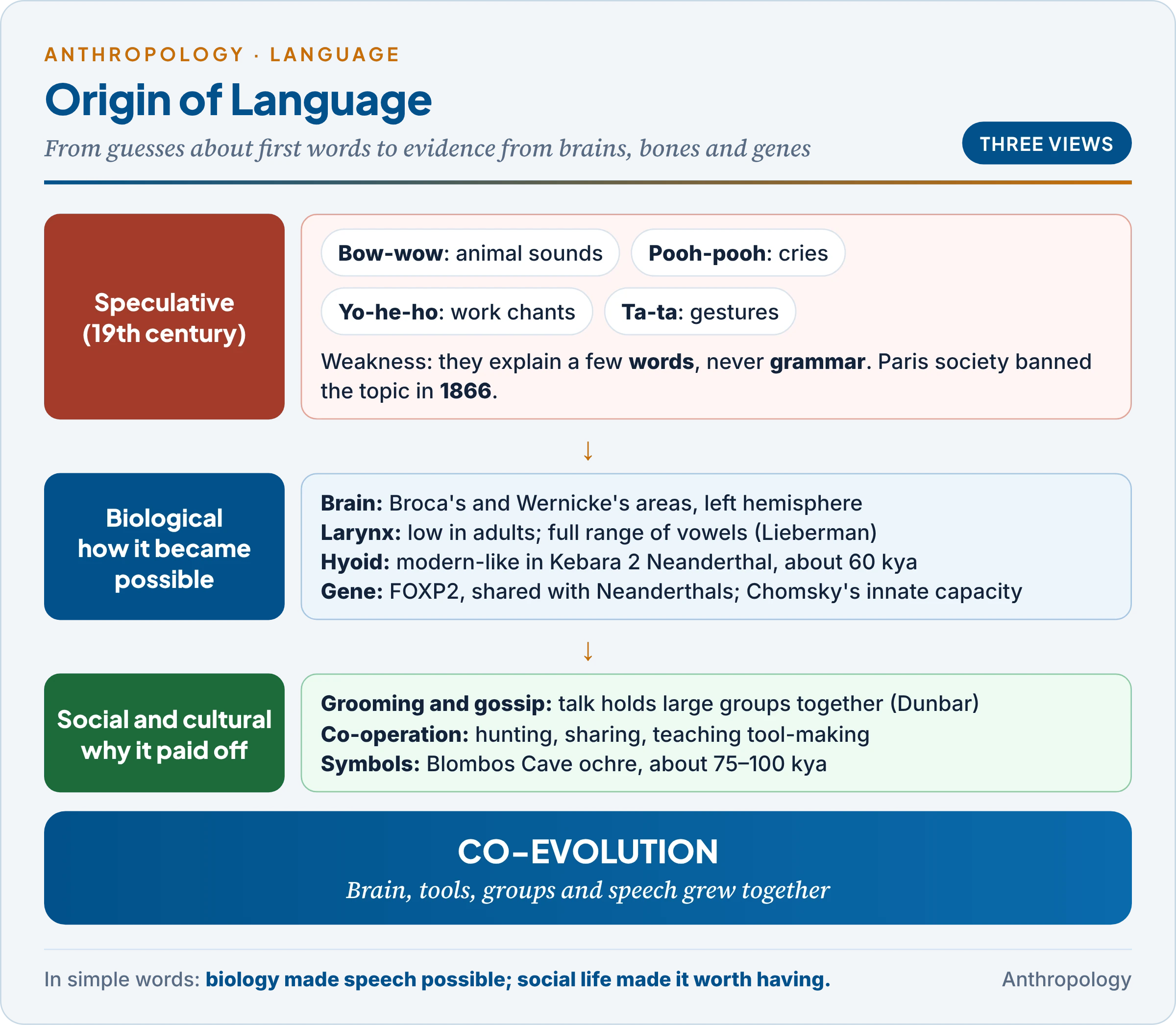
Speech leaves no fossils, so the origin of language must be pieced together from brains, skulls, genes, archaeology and living languages. Older theories guessed which sounds came first; modern research asks which biological and social changes made language possible and useful.
The question is so speculative that in 1866 the Linguistic Society of Paris wrote into its statutes that it would accept no papers on the origin of language. It returned in the 1990s, when genetics, neuroscience and archaeology supplied evidence.
3.1 Speculative theories
Some traditions treat language as a divine gift (Vak, speech, is a goddess in the Vedas). Monogenesis derives all languages from one original tongue, now linked to the Out of Africa dispersal; polygenesis has language arise in several places. Nineteenth-century scholars also proposed that the first words imitated something, and the German-born philologist Max Müller mocked such theories with nicknames (1861) that stuck.
| Theory | Claim | Main weakness |
|---|---|---|
| Bow-wow | First words imitated animal and natural sounds | Onomatopoeia is a tiny part of vocabulary and differs by language (dog: bow-wow, Japanese wan-wan) |
| Pooh-pooh | First words were involuntary cries of pain or surprise | Exclamations are few and also language-specific (ouch, oi) |
| Yo-he-ho (Ludwig Noiré) | Rhythmic chants of co-operative work | Explains song and rhythm, not names of things |
| Ta-ta (Richard Paget, 1930) | Tongue and lips copied hand gestures | Gestures also vary by culture |
| Warning and lying (E.H. Sturtevant) | First words were warnings, or invented to deceive | Untestable |
Each theory might explain a few words, but none explains grammar, the patterns with fixed functions but no fixed meaning (word order, tense) that no animal system has. That gap moved research to the biological and social conditions of language.
3.2 The biological perspective
- Brain: in most people two left-hemisphere areas control language: Broca’s area (production and grammar; Paul Broca, 1861) and Wernicke’s area (comprehension; Carl Wernicke, 1874), joined by the arcuate fasciculus. Some endocasts of early Homo (about 2 million years ago) show an enlarged Broca’s region.
- Vocal tract: the adult human larynx sits low, giving a two-part tube that produces the full range of vowels; chimpanzees and human infants have a high larynx (Philip Lieberman). A modern-looking hyoid bone from the Kebara 2 Neanderthal, Israel (about 60,000 years ago), suggests Neanderthals could speak.
- Genes: mutation of FOXP2 (chromosome 7) causes speech and grammar disorders in the London family known as KE (2001). Humans carry two changes in FOXP2 absent in chimpanzees, and Neanderthals share them (2007). FOXP2 is not “the language gene”, but speech clearly has a genetic foundation.
- Innate capacity: Noam Chomsky proposed an inborn Language Acquisition Device, because children master complex rules quickly from limited input; Steven Pinker and Paul Bloom (1990) argued that this capacity evolved by natural selection.
- Gesture first: Michael Corballis argued that language began as gesture, citing mirror neurons in a region matching Broca’s area.
3.3 The cultural and social perspective
- Grooming and gossip: Robin Dunbar, a British anthropologist, argued (1996) that as groups grew to about 150, grooming by hand took too long, so talk replaced grooming as the way to keep alliances.
- Co-operation: planning hunts, sharing food and teaching tool-making all need displacement and productivity.
- Symbolic culture: engraved ochre at Blombos Cave, South Africa (about 75,000–100,000 years ago), shell beads and later cave art show symbolic thought, which language both required and spread.
- Co-evolution: brain, tools, social complexity and speech evolved together, each creating pressure for the next.
The biological view explains how humans became able to speak; the cultural view explains why speaking paid off. A brain ready for grammar is useless without a community that shares one, hence the co-evolutionary view.
3.4 Language change and glottochronology
About 7,100–7,200 languages are spoken today. Languages descended from one ancestor form a family (Indo-European, Dravidian, Austroasiatic, Sino-Tibetan), and historical linguists reconstruct the ancestral proto-language from cognates (related words).
Glottochronology, developed by the American linguist Morris Swadesh in the 1950s, dates the split of two related languages. It assumes that:
- every language has a core vocabulary (body parts, low numbers, sun, water, eat) that is rarely borrowed: Swadesh’s 100- and 200-word lists;
- this core is replaced at a roughly constant rate, about 81 per cent surviving each 1,000 years;
- related languages lose words independently.
The formula is t = log C ÷ (2 log r), where t is time since separation in millennia, C the share of cognates and r the retention rate (0.805). Worked example: two languages share 70 per cent cognates, so t = log 0.70 ÷ (2 × log 0.805) = (−0.155) ÷ (−0.188) ≈ 0.82: they split about 820 years ago.
- Critique: rates are not constant (Icelandic has changed far more slowly than Norwegian); borrowing inflates cognates; judging cognates is subjective. Lexicostatistics (counting cognates without dating) survives, and computational phylogenetics now allows rates to vary.
4. Verbal and Non-verbal Communication
In simple words
People communicate not only with words but with faces, hands, posture, tone of voice, distance and timing. Much of this happens without our noticing, and its meaning changes from culture to culture, which is why visitors so often misread each other.
Example first. Most people have smiled into a telephone, though the listener cannot see it. In experiments where friendly sentences are spoken angrily, or hostile ones with a warm face, listeners respond mainly to the tone and the face, not the words; sarcasm works by exactly this contrast. In everyday talk, words and wordless signals are fused.
4.1 Verbal communication
- Verbal means “of words“, not “spoken”. Speech, writing and sign languages are all verbal; a grunt or wordless hum is oral but non-verbal.
- Sign languages are full languages with grammar: signs are built from hand shape, orientation, location and movement, plus facial expression. India has Indian Sign Language, served by a national research and training centre since 2015.
4.2 Non-verbal communication
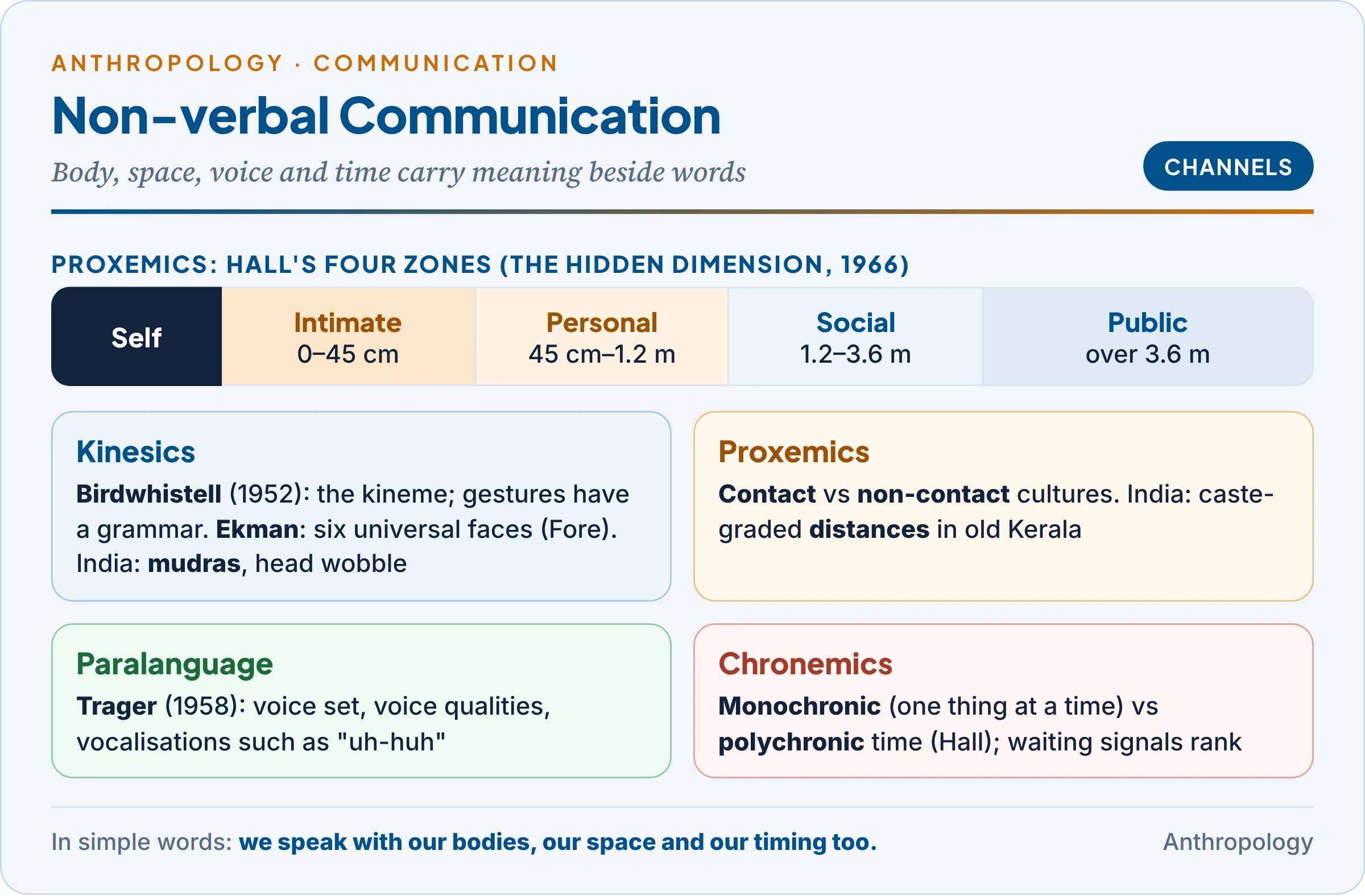
Non-verbal communication is the sending and receiving of wordless messages through any sense. Charles Darwin‘s The Expression of the Emotions in Man and Animals (1872) argued that emotional expressions are inherited and shared with other mammals. Paul Ekman, an American psychologist, tested this among the Fore of highland New Guinea in the late 1960s: they matched faces to emotions as Americans did, so six expressions are universal (happiness, sadness, anger, fear, disgust, surprise). What varies between cultures are the display rules, which decide when an emotion may be shown. The table lists the main channels.
| Channel | Studies | Key scholar | Indian example |
|---|---|---|---|
| Kinesics | Gesture, posture, facial expression | Ray Birdwhistell (1952) | The South Indian head wobble for “yes” or “I see” |
| Proxemics | Use of space and distance | Edward T. Hall (1963, 1966) | Caste-graded distances in old Kerala |
| Paralanguage | Voice qualities and sounds beside words | George Trager (1958) | A lowered voice before elders |
| Chronemics | Use of time | Fernando Poyatos (term, 1972); Hall | Waiting for a senior officer |
| Haptics | Touch | Touching an elder’s feet |
The channels show that culture shapes the body. Because these signals are given and read below awareness, they cause more misunderstanding between cultures than words do: in Bulgaria, a nod can mean “no”.
4.3 Kinesics
- Ray Birdwhistell, an American anthropologist, coined kinesics in Introduction to Kinesics (1952) and analysed films of conversations with Margaret Mead and Gregory Bateson.
- Method: modelled on descriptive linguistics. A kineme is a class of movements that can replace one another without changing social meaning, as allophones of a phoneme do; body movement, he argued, has a grammar.
- Claims: no more than 30–35 per cent of the social meaning of a conversation is carried by words, and there are no universal kinesic displays. Ekman disproved the second claim for facial emotion.
- Ekman and Wallace Friesen (1969) classified gestures as emblems (direct verbal translation: a wave, namaste), illustrators (depict speech), affect displays (show emotion), regulators (manage turn-taking) and adaptors (release tension).
- Indian case: the mudras of Bharatanatyam and of Hindu and Buddhist iconography form a codified gesture language.
4.4 Proxemics
Edward T. Hall, an American anthropologist who trained US diplomats, coined proxemics in 1963 and developed it in The Hidden Dimension (1966). Among middle-class Americans he found four zones.
| Zone | Distance | Used for |
|---|---|---|
| Intimate | 0–45 cm | Embracing, comforting, whispering |
| Personal | 45 cm–1.2 m | Talk among friends and family |
| Social | 1.2–3.6 m | Impersonal business, meetings |
| Public | Over 3.6 m | Lectures, speeches |
The distances are cultural, not natural. Hall contrasted contact cultures (Arab, Latin American, southern European), where people stand close and touch, with non-contact cultures (northern European, Japanese).
- Indian case: in pre-reform Kerala, caste rules fixed graded distances that lower castes had to keep from Nambudiri Brahmins, so that space itself expressed the hierarchy of purity. Proxemics shows how social structure is written into space.
4.5 Paralanguage and chronemics
- George Trager, an American linguist, classified paralanguage (1958) into the voice set (the speaker’s age, sex, mood, culture), voice qualities (pitch, tempo, rhythm, resonance) and vocalisations: characterisers (laughing or crying while speaking), qualifiers (whispering or yelling the same words) and segregates (“uh-huh”).
- Chronemics studies how time communicates. Hall contrasted monochronic time (one thing at a time, schedules first; northern Europe, North America) with polychronic time (many things at once, relationships first; Middle East, Latin America, much of South Asia). Arriving late or making someone wait signals status.
5. Language, Thought and Culture: The Sapir–Whorf Hypothesis
In simple words
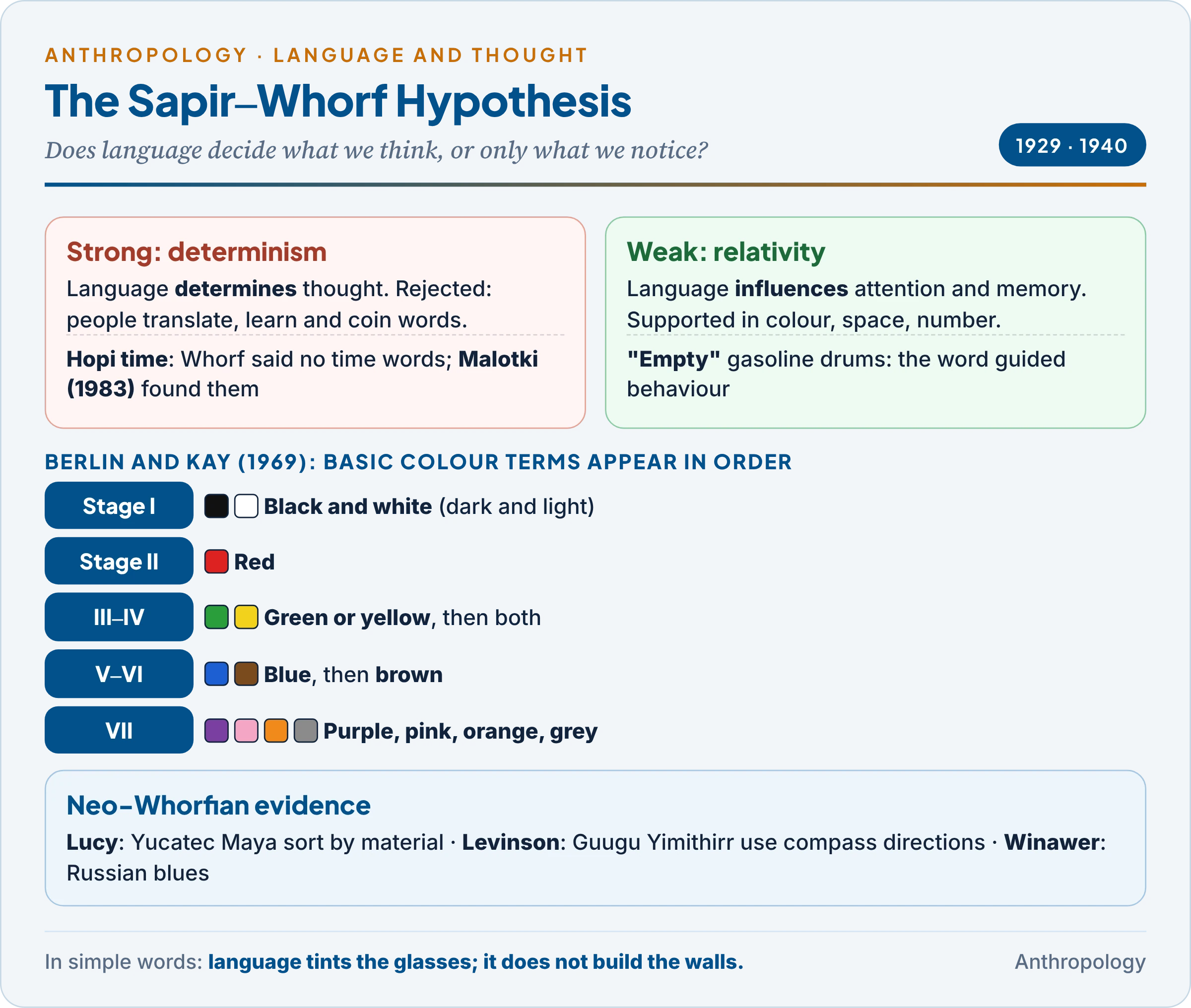
Does the language you speak shape how you see the world? The strong answer is that it decides what you can think; the weak answer is that it nudges what you notice and remember. Research supports the weak answer: language influences thought but does not imprison it.
Example first. Benjamin Lee Whorf worked as a fire-prevention inspector for an insurance company. He noticed that workers were careful near full gasoline drums but smoked near drums labelled “empty“, although empty drums are full of explosive vapour and more dangerous. The word “empty” suggested “harmless”, and behaviour followed the word, not the chemistry. Whorf concluded that the categories of a language guide habitual thought and behaviour.
5.1 From Boas to Whorf
- Franz Boas, the German-American founder of American anthropology, noted (Handbook of American Indian Languages, 1911) that the Inuit have separate roots for snow on the ground, falling snow and drifting snow: languages classify experience differently. For Boas, language reflected culture rather than determining it.
- Edward Sapir went further (1929): humans are “very much at the mercy of the particular language” of their society, and “the ‘real world’ is to a large extent unconsciously built up on the language habits of the group”.
- Whorf (1897–1941), Sapir’s student, gave the boldest form (1940): “We dissect nature along lines laid down by our native languages.” His essays were collected as Language, Thought, and Reality (1956). He called the idea the principle of linguistic relativity; the label “Sapir–Whorf hypothesis” came later (Harry Hoijer, 1954).
5.2 Strong and weak versions
| Basis | Strong version: linguistic determinism | Weak version: linguistic relativity |
|---|---|---|
| Claim | Language determines thought; what cannot be said cannot be thought | Language influences perception, attention and memory |
| Translation | Impossible between very different languages | Possible, though some ideas need many words |
| Thought without language | Impossible | Possible (infants, animals, visual thinking) |
| Status | Rejected | Supported in specific domains |
The strong version fails because people learn new concepts and languages, translate across very different languages and coin words when they need them, none of which would be possible if language set the limits of thought. The weak version survives because careful experiments find real but limited effects, especially in colour, space, number and time.
5.3 Hopi time
Whorf compared the Hopi of Arizona with what he called Standard Average European (SAE) languages (written 1939).
- SAE treats time as a countable thing (“ten days”, “save time”), so speakers see it as a line of equal units.
- Hopi, Whorf claimed, has no words or grammatical forms for time as a countable thing; its verbs distinguish the manifested (what has become objective) from the manifesting (what is still in preparation or in the mind), so Hopi life stresses preparation and repetition rather than measured duration.
- Refutation: Ekkehart Malotki, a German linguist, showed in Hopi Time (1983) that Hopi has words for days, months and seasons, tense-like marking and a calendar. Whorf had relied largely on one Hopi speaker in New York. Hopi time is now the standard example of how the strong version overreached.
5.4 Evidence and critique
| Study | Domain | Finding | Verdict |
|---|---|---|---|
| Brent Berlin and Paul Kay, Basic Color Terms (1969) | Colour | Speakers of 20 languages tested, 78 more reviewed: 11 basic colour terms appear in a fixed order | Against strong relativity |
| Eleanor Rosch Heider (1972) | Colour memory | The Dani of New Guinea, with two colour terms, remembered focal colours best, like English speakers | Against |
| John Lucy (1992) | Classification | Yucatec Maya speakers, whose nouns name substances, sorted objects by material; English speakers by shape | For weak relativity |
| Stephen Levinson (1990s–2003) | Space | Guugu Yimithirr speakers (Australia) use compass directions instead of left and right, and always know where north is | For weak relativity |
| Jonathan Winawer and colleagues (2007) | Colour perception | Russian speakers, with separate words for light and dark blue, told those blues apart faster | For weak relativity |
Berlin and Kay’s sequence has seven stages: every language names black and white; a third term is always red; then green or yellow, then both; then blue; then brown; finally purple, pink, orange and grey. Colour naming seemed to follow human vision, and universalism dominated the 1970s. The neo-Whorfian studies of the 1990s–2000s then showed real effects of language on habitual attention, reviving the weak version.
- Critics: Steven Pinker (The Language Instinct, 1994) argued that people think in a language-independent “mentalese“. The “hundreds of Inuit words for snow” grew by retelling from Boas’s few roots (Laura Martin, 1986; Geoffrey Pullum, 1991).
- Indian illustration: Hindi grammar forces a choice of tū, tum or āp in every address, and kin terms force a choice of father’s or mother’s side. Speakers attend constantly to rank and lineage: a weak-relativity effect.
5.5 Ethnolinguistics and perspectives on language, culture and thought
Ethnolinguistics studies how a people’s language encodes its culture and worldview: kin terms, colour terms, plant names, illness categories, words for time and space. It grew out of the Boas–Sapir–Whorf tradition. The table sets out the main perspectives on how language, culture and thought relate.
| Perspective | Key scholars | Position |
|---|---|---|
| Boasian descriptive | Boas (1911) | Language reflects culture; record it in its own terms |
| Linguistic relativity | Sapir, Whorf | Language shapes habitual thought |
| Ethnoscience | Goodenough, Conklin, Frake | A people’s own classifications reveal their cognitive categories (Unit 6j) |
| Structuralism | Lévi-Strauss | Culture, like language, rests on unconscious binary structures (Unit 6f) |
| Universalism | Chomsky; Berlin and Kay | A shared human mind limits all languages |
| Ethnography of communication | Hymes, Gumperz (1964) | Study speech in use: who speaks, how, when, why |
| Language and power | Bourdieu | Speech carries symbolic capital (§6.6) |
The perspectives move from what words mean to what speakers do and then to whom language favours. Most anthropologists now combine relativity and universalism: the capacity for language is universal, while each language channels attention in its own way.
Common confusion
Are ethnolinguistics and sociolinguistics the same? No. Ethnolinguistics studies how language relates to culture and thought: how it classifies colours, plants or kin, and whether that shapes perception. Sociolinguistics studies how language relates to social structure: how speech varies by class, caste, gender and situation. The first asks how a people see; the second, how they rank and relate.
6. The Social Context of Language Use
In simple words
The same language is spoken differently by rich and poor, men and women, high and low castes, and by one person in different situations. These differences are not random: they mark who we are, whom we respect and where we stand, and they can keep people in their place.
Example first. One Hindi speaker calls a younger sibling tū, a friend tum and a teacher āp; writes office emails in English; and speaks Bhojpuri at home. Each choice signals intimacy, respect or identity. Sociolinguistics maps such choices.
6.1 Basic concepts
- Speech community: a group sharing a language variety and the norms for using it (John Gumperz, American linguistic anthropologist). Its linguistic repertoire may include a village dialect, a regional dialect, standard Hindi and English.
- Dialect, sociolect, register: variation by region, by social group and by situation (legal, ritual, casual).
- Prestige: some forms are valued and the value passes to the speaker. Overt prestige attaches to the standard; covert prestige to vernacular forms that signal toughness or local loyalty (Peter Trudgill, Norwich, 1972).
6.2 Class and language
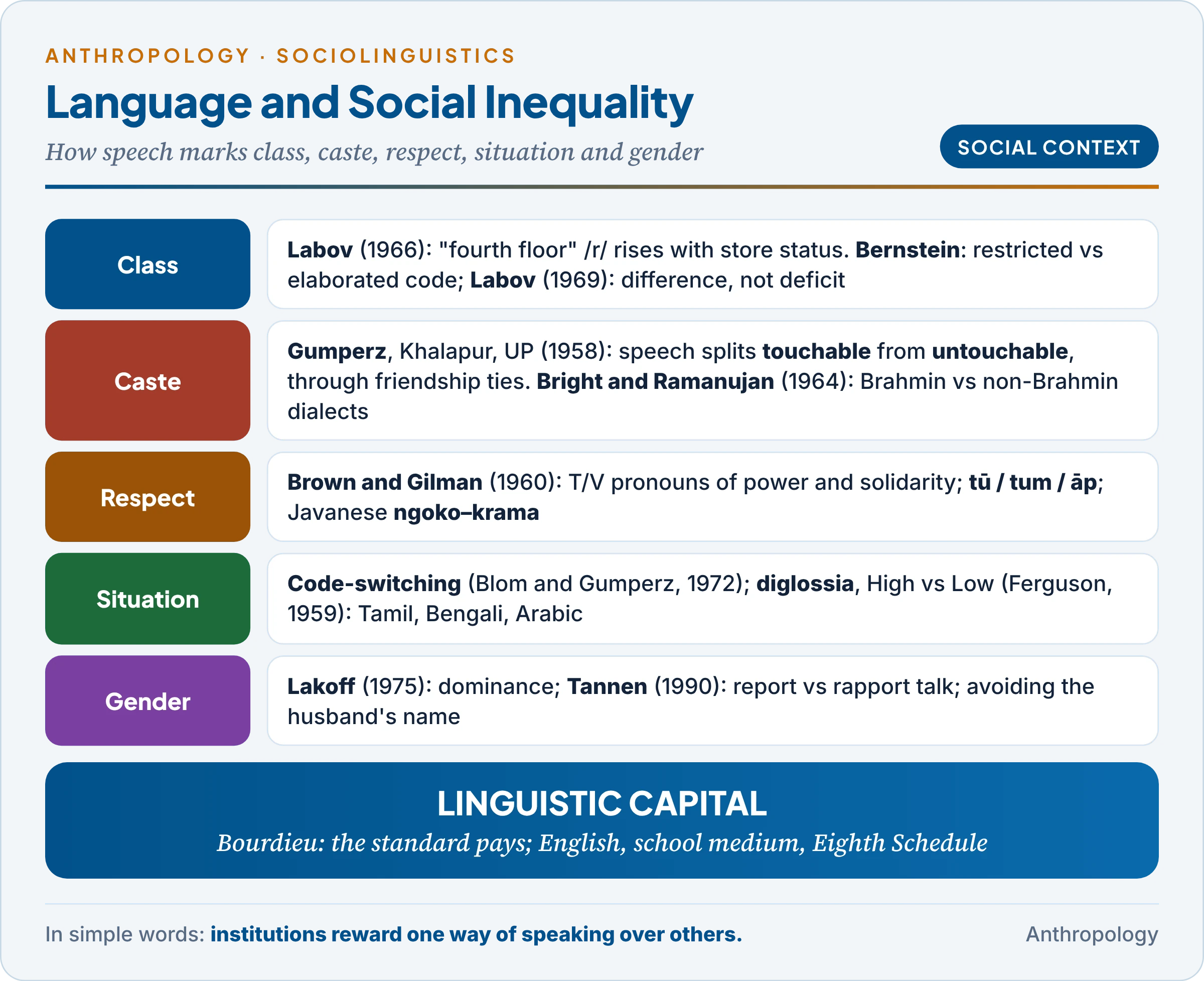
- William Labov, an American linguist, founded the study of variation with The Social Stratification of English in New York City (1966). He asked shop assistants in Saks (expensive), Macy’s (middle) and S. Klein (cheap) for an item on the “fourth floor“: pronunciation of /r/ rose with the store’s status and again in careful repetition. Speech variation is systematic, not sloppy; lower-middle-class speakers even hypercorrected, overshooting the prestige norm out of class aspiration.
- Basil Bernstein, a British sociologist, contrasted a restricted code (condensed, context-bound, relying on shared assumptions) with an elaborated code (explicit, context-free) (1964; Class, Codes and Control, 1971). Working-class children raised mainly in the restricted code, he argued, were disadvantaged in schools run on the elaborated code.
- Labov’s reply, “The Logic of Nonstandard English” (1969), showed that African American Vernacular English is fully rule-governed and logical. The disadvantage lies in how schools value speech, not in the children’s language: the shift from a deficit to a difference model.
6.3 Caste and dialect in India
John Gumperz studied Khalapur, a village of about 5,000 people in Saharanpur district, Uttar Pradesh, with 31 ranked castes dominated by Rajputs (“Dialect Differences and Social Stratification in a North Indian Village”, American Anthropologist, 1958).
- Speech followed caste, not neighbourhood: members of a caste spoke alike wherever they lived.
- The sharpest line separated touchable from untouchable castes (Chamars, Jatia Chamars, Sweepers), and each untouchable group from the others.
- The cause was friendship, not work: touchables of different castes met informally over the shared clay pipe (chilam), so new forms spread among them; untouchables lived in walled quarters with no informal ties across the line. Speech boundaries traced the boundaries of social intercourse.
William Bright and A.K. Ramanujan compared Brahmin and non-Brahmin dialects of Tamil, Kannada and Tulu (1964). Brahmin speech innovated consciously (borrowing Sanskrit and English words), non-Brahmin speech unconsciously (changes in sounds and grammar); literacy, concentrated among Brahmins, seemed to brake sound change.
6.4 Honorifics, code-switching and diglossia
- Honorifics: Roger Brown and Albert Gilman, American psychologists, showed that European T/V pronouns (French tu/vous) encode power when used non-reciprocally (superior says T, inferior V) and solidarity when reciprocal (“The Pronouns of Power and Solidarity”, 1960). Hindi tū/tum/āp works the same way. Javanese has distinct speech levels, ngoko (familiar), madya and krama (high), each with partly different vocabulary (Clifford Geertz, The Religion of Java, 1960).
- Code-switching is moving between languages or varieties within one conversation. Jan-Petter Blom and Gumperz (1972), in Hemnesberget, Norway, separated situational switching (the setting changes, from home to office) from metaphorical switching (the topic or tone changes in one setting). Code-mixing inserts words of one language into the grammar of another, as in Hinglish (“meeting cancel ho gayi”). People switch to signal identity or to include or exclude listeners.
- Diglossia: Charles Ferguson, an American linguist, used the term (1959) for a community using two varieties of one language for different functions: a High (H) variety learned in school for religion, literature and speeches, and a Low (L) variety learned at home for daily talk. His cases were Arabic, Greek, Swiss German and Haitian French/Creole. Indian cases: Tamil (literary centamil vs spoken Tamil), Bengali (sadhu bhasha vs cholit bhasha) and historically Sanskrit and the Prakrits.
Common confusion
How does diglossia differ from bilingualism and code-switching? Bilingualism is an individual’s ability to use two languages. Diglossia is a social arrangement in which a whole community assigns two varieties to fixed domains, H for formal and L for informal. Code-switching is the moment-to-moment act of moving between varieties in talk. A diglossic community can include monolinguals, and bilinguals can switch without any diglossia.
6.5 Language and gender
- Robin Lakoff, an American linguist (Language and Woman’s Place, 1975), argued that women are taught a powerless style: hedges (“sort of”), tag questions (“isn’t it?”) and extra politeness. In this dominance view, women’s speech reflects male power; Don Zimmerman and Candace West (1975) found that men made almost all interruptions in mixed conversations.
- Deborah Tannen (You Just Don’t Understand, 1990) offered a difference view: boys and girls grow up in different “cultures” of talk, men favouring report talk (information, status) and women rapport talk (connection).
- Indian cases: in many north Indian households a wife avoids uttering her husband’s name and those of senior affines, using teknonyms (“Munna’s father”); in many families she addresses him as āp while he uses tum, a grammatical record of gender hierarchy.
6.6 Language and social inequality
Variation becomes inequality when one variety is made the standard and others are judged against it. Pierre Bourdieu, the French sociologist, described a linguistic market in which the legitimate language carries linguistic capital: speakers of other varieties are paid less for the same words in jobs, courts and classrooms (Language and Symbolic Power, 1991). The table shows the mechanisms in India.
| Mechanism | How it creates inequality | Indian example |
|---|---|---|
| Standard language ideology | The standard is “correct”, others “broken” | Village dialects mocked as rustic |
| Elite language | Jobs and power require one language | English in higher education, courts and corporate jobs |
| Medium of schooling | Children taught in an unfamiliar language fall behind | Santal or Gond children in Hindi- or Odia-medium schools |
| Caste and dialect | Speech reveals caste and attracts prejudice | Gumperz’s touchable–untouchable line in Khalapur |
| Official recognition | Unlisted languages lose schools, media, funds | Eighth Schedule demands by Ho, Bhili and Gondi speakers |
Inequality comes less from language difference itself than from institutions that reward one variety. That is the logic of mother-tongue education: Article 350A asks states to provide primary education in the mother tongue, and the National Education Policy 2020 prefers the home language as the medium until at least Grade 5.
7. The Indian Language Situation
In simple words
India is one of the most multilingual countries on earth: hundreds of languages from several families live side by side, and most Indians use more than one. Many small tribal languages are losing speakers, and with them go stories, plant knowledge and ways of seeing the world.
7.1 Families and numbers
| Family | Share of speakers (approx.) | Examples |
|---|---|---|
| Indo-Aryan (Indo-European) | About three-quarters | Hindi, Bengali, Marathi, Bhili |
| Dravidian | About one-fifth | Tamil, Telugu, Gondi, Kurukh, Toda |
| Austroasiatic (Munda, Khasi) | About 1 per cent | Santali, Mundari, Ho, Kharia, Khasi |
| Tibeto-Burman | About 1 per cent | Bodo, Meitei (Manipuri), Garo, Mizo |
| Andamanese and isolates | Very small | Great Andamanese, Onge, Jarawa; Nihali |
Tribal communities speak languages of every family, so tribal identity in India cannot be tied to one language group.
- Census 2011: 19,569 raw mother-tongue returns were rationalised to 1,369 mother tongues, grouped into 121 languages of 10,000 or more speakers: 22 scheduled and 99 non-scheduled. Hindi is the mother tongue of about 44 per cent.
7.2 Constitutional framework
- Eighth Schedule: 14 languages originally, 22 now: Sindhi (1967, 21st Amendment); Konkani, Manipuri and Nepali (1992, 71st); Bodo, Dogri, Maithili and Santali (2003, 92nd).
- Article 29 protects a distinct language, script and culture; Articles 343–351 govern the official language; Article 350A provides for mother-tongue primary education and 350B for a Special Officer for Linguistic Minorities.
- Linguistic states: Andhra State (1953) and the States Reorganisation Act (1956) redrew the map along language lines.
- Classical languages: Tamil (2004), Sanskrit (2005), Telugu and Kannada (2008), Malayalam (2013), Odia (2014); Marathi, Pali, Prakrit, Assamese and Bengali added in October 2024, making 11.
7.3 Endangered languages
- People’s Linguistic Survey of India (PLSI): led by G.N. Devy from 2010, it recorded about 780 languages, about 480 of them spoken by tribal and nomadic communities, and estimated that 220–250 languages had disappeared in the previous fifty years.
- UNESCO‘s Atlas of the World’s Languages in Danger (2009) listed 197 Indian languages, the most for any country.
- Last speakers: Boa Sr, last speaker of Bo (Great Andamanese), died on 26 January 2010, recorded by the linguist Anvita Abbi. Madhika, home language of Kerala’s Chakaliya community, had two fluent speakers in 2025.
- Why languages die: loss of land and forest livelihood, migration, schooling in dominant languages, the stigma of “tribal” or low-caste speech, and the lack of scripts, media and jobs.
- Responses: the Scheme for Protection and Preservation of Endangered Languages (SPPEL, Central Institute of Indian Languages, 2013) has identified 117 endangered languages and publishes dictionaries, grammars and online archives; states run multilingual education in tribal mother tongues (Odisha, Jharkhand); scripts such as Ol Chiki (Santali) and Warang Citi (Ho) carry literacy movements.
Key Terms
| Term | Meaning in simple words |
|---|---|
| Phoneme | The smallest sound that changes meaning |
| Langue / parole | The shared system of a language / one person’s act of speaking |
| Phatic communion | Talk whose purpose is bonding, not information |
| Displacement | Talking about things absent in time or space |
| Duality of patterning | Meaningless sounds combining into meaningful words |
| Glottochronology | Dating the split of related languages from the loss of basic words |
| Kinesics | Body movement and gesture as communication |
| Proxemics | How people use space and distance |
| Paralanguage | Voice features that accompany words: pitch, tone, pauses |
| Linguistic relativity | The idea that language influences thought and perception |
| Ethnolinguistics | How language encodes a people’s culture and worldview |
| Sociolinguistics | How language varies with social groups and situations |
| Code-switching | Moving between languages within one conversation |
| Diglossia | Two varieties of a language for formal and informal purposes |
| Linguistic capital | The social value of speaking the prestigious variety |
Contemporary Developments
- Adi Vaani (2025): the Ministry of Tribal Affairs announced an AI translation tool for tribal languages, built by IIT Delhi, BITS Pilani, IIIT Hyderabad and IIIT Naya Raipur with Tribal Research Institutes, starting with Santali, Bhili, Mundari and Gondi.
- Sanchika portal (July 2025): the Central Institute of Indian Languages put its SPPEL documentation online, with audio of endangered languages; a Toda primer in Tamil script was prepared for children.
- Ethics of documentation (2025): the two remaining speakers of Madhika in Kannur complained of intrusion by social-media vloggers after a video of them went viral.
- Eighth Schedule demands: speakers of Ho, Bhili and Gondi continue to press for inclusion, and Ho scholars are training AI models on text in the Warang Citi script.
Diagrams to Master
- Topic map of the article.
- Hockett’s design features (§2): displacement, productivity, cultural transmission and duality for humans, bees, vervets and trained apes.
- Origin of language (§3): speculative theories and their weakness; brain, larynx, hyoid, FOXP2; grooming, co-operation, symbolic culture.
- Non-verbal channels (§4): kinesics, Hall’s four zones with distances, paralanguage, monochronic and polychronic time.
- Sapir–Whorf (§5): strong vs weak; Hopi time; Berlin and Kay’s seven stages; Lucy, Levinson, Winawer.
- Language and inequality (§6): Labov, Bernstein, Gumperz in Khalapur, T/V pronouns, diglossia, Bourdieu.
Revision Grid
| Scholar | Work (year) | Key idea |
|---|---|---|
| Franz Boas | Handbook of American Indian Languages (1911) | Languages classify experience differently |
| Edward Sapir | Language (1921); “Status of Linguistics as a Science” (1929) | Language as symbols; “at the mercy” of language |
| Benjamin Lee Whorf | “Science and Linguistics” (1940) | Linguistic relativity; Hopi time |
| Ray Birdwhistell | Introduction to Kinesics (1952) | Kinesics; kineme |
| John Gumperz | “Dialect Differences … North Indian Village” (1958) | Caste dialects in Khalapur |
| Charles Ferguson | “Diglossia” (1959) | High and low varieties |
| Charles Hockett | “The Origin of Speech” (1960) | 13, later 16, design features |
| Brown and Gilman | “Pronouns of Power and Solidarity” (1960) | T/V pronouns |
| Edward T. Hall | The Hidden Dimension (1966) | Proxemics; four zones |
| William Labov | Social Stratification of English in New York City (1966) | Class variation |
| Berlin and Kay | Basic Color Terms (1969) | Universal colour sequence |
| Pierre Bourdieu | Language and Symbolic Power (1991) | Linguistic capital |
| John Lucy | Language Diversity and Thought (1992) | Yucatec Maya classification |
Previous Year Questions
Unit 7: Nature, origin and characteristics of language; verbal and non-verbal communication; social context of language use
- 2025Describe briefly the theoretical perspectives in linguistic anthropology to explain the relationship of culture, language and thought.
- 2023Write notes on: Glottochronology.
- 2020Write notes on Sapir-Whorf hypothesis in about 150 words.
- 2020Explain how variations in language usage is related to social inequality.
- 2018Critically examine that the structure and content of language are influenced by culture.
- 2017Write a note in 150 words on Nonverbal communication.
- 2010State the theories regarding the origin of spoken languages in human societies both from biological and cultural points of view.
- 1993Write a note on Language and culture.
Related questions from other units
- 2021Unit 1.3: Mention the major branches of linguistic anthropology and discuss language use in social and cultural settings.
- 2019Unit 1.3: Write a note in 150 words on the relationship between Linguistics and Social-Cultural Anthropology.
- 2015Unit 8: Explain the difference between emic and etic, and how does the difference derive from the study of language?
- 2013Unit 1.3: Write a note in 150 words on Linguistic Anthropology.
- 1996Unit 1.3: What is cognitive approach ? Critically examine its implications in Sociocultural Anthropology.
- 1990Unit 1.3: Write a note on Linguistic anthropology.
- 1989Unit 1.3: Write a note on Theme of Linguistic Anthropology.
- 1985Unit 1.3: What are the common aspects of structural anthropology and linguistics?
- 1984Unit 6: Discuss how structuralism derived from modern linguistics ?
- 1983Unit 1.3: Does structuralism in social anthropology coincide with that in linguistics ? Critically assess their analogy.