

6 Anthropological theories: (g) Cultural materialism (Harris).
Official Syllabus: Paper I, Unit 6 (cultural materialism)
1. What Cultural Materialism Is
In simple words
Cultural materialism explains customs by the practical problems of staying alive: getting food and energy, and keeping population in balance with resources. A custom that looks irrational, such as refusing to eat cattle in a land of hunger, may turn out to be a sensible way of making a living in a particular environment.
Example first. In the 1950s and 1960s, Western agricultural experts looked at India’s tens of millions of cattle wandering through fields and city streets and saw waste: a hungry country, they argued, was feeding useless animals because religion forbade killing them. The American anthropologist Marvin Harris reversed the argument. In “The Cultural Ecology of India’s Sacred Cattle” (Current Anthropology, 1966) he showed that the living cow gave Indian peasants oxen for ploughing, dung for fuel and manure, milk, and leather, at almost no cost. The ban on cow slaughter, he concluded, is not a religious mistake but an adaptation to India’s ecology and economy. This way of explaining culture by its material conditions is cultural materialism.
1.1 Harris in brief
- Marvin Harris (1927–2001), an American anthropologist born in Brooklyn, taught at Columbia University (1953–80) and the University of Florida (1980–2000). His fieldwork in Brazil, Mozambique, Ecuador and Kerala (India) dealt with race, colonialism, poverty and cattle.
- He coined “cultural materialism” in The Rise of Anthropological Theory (1968), a history of theories of culture, and set out the full programme in Cultural Materialism: The Struggle for a Science of Culture (1979).
- He spread the approach to a wide public through Cows, Pigs, Wars and Witches: The Riddles of Culture (1974), Cannibals and Kings (1977) and Good to Eat (1985).
1.2 Where it came from
Harris described cultural materialism as a research strategy (a set of rules for choosing questions and explanations), built from four sources:
- Marx and Engels: the idea that the material base of society shapes its organisation and ideas.
- Thomas Malthus: the pressure of population on resources, so that reproduction counts as much as production.
- The neo-evolutionists (Unit 6h): Leslie White‘s priority of technology and energy, and Julian Steward‘s cultural ecology and culture core, the features of a culture most closely tied to getting a living. Harris added demography, stricter causal priority and a general theory.
- Neo-materialism: the wider materialist anthropology of the 1960s–80s, which studied how populations keep a balance with the productive capacity of their environment, is sometimes called neo-materialism; cultural materialism is its best-known form.
- Science: Harris insisted on observable, measurable, testable explanations and on general laws (a nomothetic approach), against anthropologists who saw cultures as unique or explained them only by ideas.
1.3 Against idealism
Harris wrote at a time when much anthropology located the causes of culture in the mind: in values, symbols and mental structures. He grouped these approaches as idealist and opposed them:
- Boasian relativism (Unit 6b) treated each culture as the product of its own history, which ruled out general laws.
- Durkheimian sociology and structuralism (Lévi-Strauss, Unit 6f) explained customs by collective representations and universal structures of thought.
- Symbolic and interpretive anthropology (Unit 6j) read culture as meaning to be interpreted, not caused.
For Harris these approaches removed culture from its material base. His alternative was to explain ideas by the conditions of earthly existence: “human social life is a response to the practical problems of earthly existence”.
2. Infrastructure, Structure and Superstructure
In simple words
Harris divided every society into three layers. At the bottom are the ways people get food and energy and control their numbers; in the middle, the family and political-economic arrangements; at the top, religion, art and ideas. Changes usually begin at the bottom and work their way up.
2.1 The universal pattern
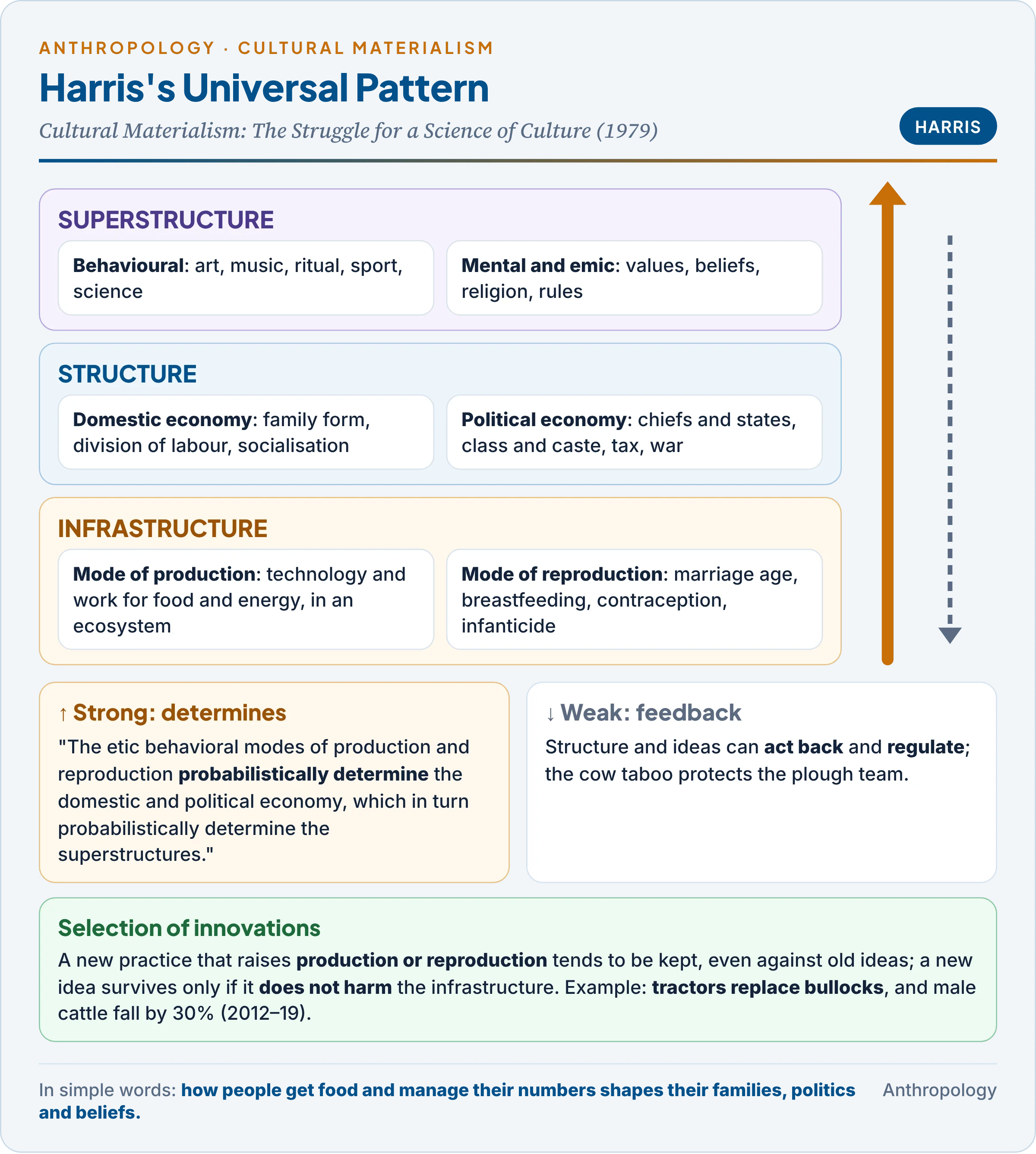
Harris argued that every sociocultural system has the same three parts, which he called the universal pattern. The table sets out what each contains; note that the bottom layer includes population as well as technology.
| Layer | Components | Examples |
|---|---|---|
| Infrastructure | Mode of production: technology and work for producing food and energy, in relation to the ecosystem | Ploughing with oxen, shifting cultivation, fishing, factory work |
| Mode of reproduction: practices that expand, limit or maintain population | Marriage age, breastfeeding, contraception, abortion, infanticide, migration | |
| Structure | Domestic economy: organisation of production and reproduction in the household | Family form, domestic division of labour, socialisation, age and sex roles |
| Political economy: organisation of production and exchange among groups | Chiefs and states, class and caste, taxation, police, warfare | |
| Superstructure | Behavioural: art, music, dance, ritual, sport, science | Temple festivals, folk songs, cricket |
| Mental and emic: values, beliefs, rules, philosophies, religion, ideology | Sanctity of the cow, ideas of purity, moral codes |
The universal pattern is a checklist for analysis. Its key feature is the mode of reproduction: Harris thought earlier materialists, including Marx, had neglected the fact that every society must keep its numbers in balance with its food supply, and that many customs (late marriage, long breastfeeding, female infanticide, warfare) do just that.
2.2 The principle of infrastructural determinism
The three layers are linked by the principle of infrastructural determinism (Cultural Materialism, 1979): “The etic behavioral modes of production and reproduction probabilistically determine the etic behavioral domestic and political economy, which in turn probabilistically determine the behavioral and mental emic superstructures.“
How it works. Every new practice, whether a new crop, a new marriage rule or a new god, is tried out in a society. Innovations in the infrastructure that raise the efficiency of production and reproduction are likely to be selected (kept and spread), even if they clash with existing structure or ideas. Innovations in structure or superstructure survive only if they do not damage the infrastructure. Over time, therefore, the infrastructure sets the direction, and structure and ideas adjust to it.
Why the infrastructure comes first. Harris gave three reasons:
- Survival: humans must eat, find energy and manage numbers before anything else; the infrastructure is the point where culture meets nature’s limits.
- Constraint: the laws of physics, chemistry and biology limit what the infrastructure can do, whereas ideas can vary freely; so the infrastructure is the most stable base for explanation.
- Research priority: as a matter of strategy, a researcher should look first at infrastructural causes, and turn to structure or ideas only when they fail.
An Indian illustration. Between 2012 and 2019, India’s male cattle fell by about 30 per cent while female cattle rose by 18 per cent (Livestock Census 2019). Tractors had replaced bullocks: a change in the mode of production made male calves less useful, and households responded by keeping cows for milk and letting go of bulls, whatever their stated beliefs about cattle.
Common confusion
Does Harris say that ideas and religion do not matter? No. The determinism is probabilistic, not absolute: infrastructure determines structure and superstructure most of the time and in the long run. Structure and superstructure can act back on the infrastructure, and they regulate it (the cow taboo protects the plough team). What Harris denied is that ideas are usually the prime movers of long-term change.
3. Emic and Etic
In simple words
“Emic” means describing a culture in the people’s own terms, as they themselves see it. “Etic” means describing it in the observer’s scientific terms, such as calories, rainfall or death rates, whether or not the people think that way. Harris argued that the etic view usually explains why things happen.
3.1 Origin and meaning
The terms were coined by the American linguist Kenneth Pike (Language in Relation to a Unified Theory of the Structure of Human Behavior, 1954) from phonemic and phonetic. Phonetics describes speech sounds by objective, universal criteria; phonemics describes which sound differences matter to speakers of a language. Harris carried the pair from language into the whole of culture.
- Emic description makes the native informant the judge: it is adequate if people accept it as real, meaningful and appropriate. Learning why the BaThonga call the mother’s sister “mother” is an emic task.
- Etic description makes the observer the judge: it is adequate if it yields scientific theories that explain differences and similarities between cultures. Measuring kilograms of grain per household or deaths per thousand is etic.
Harris also distinguished mental events (thoughts) from behavioural events (actions). Crossing the two pairs gives four kinds of knowledge.
3.2 The Kerala calves
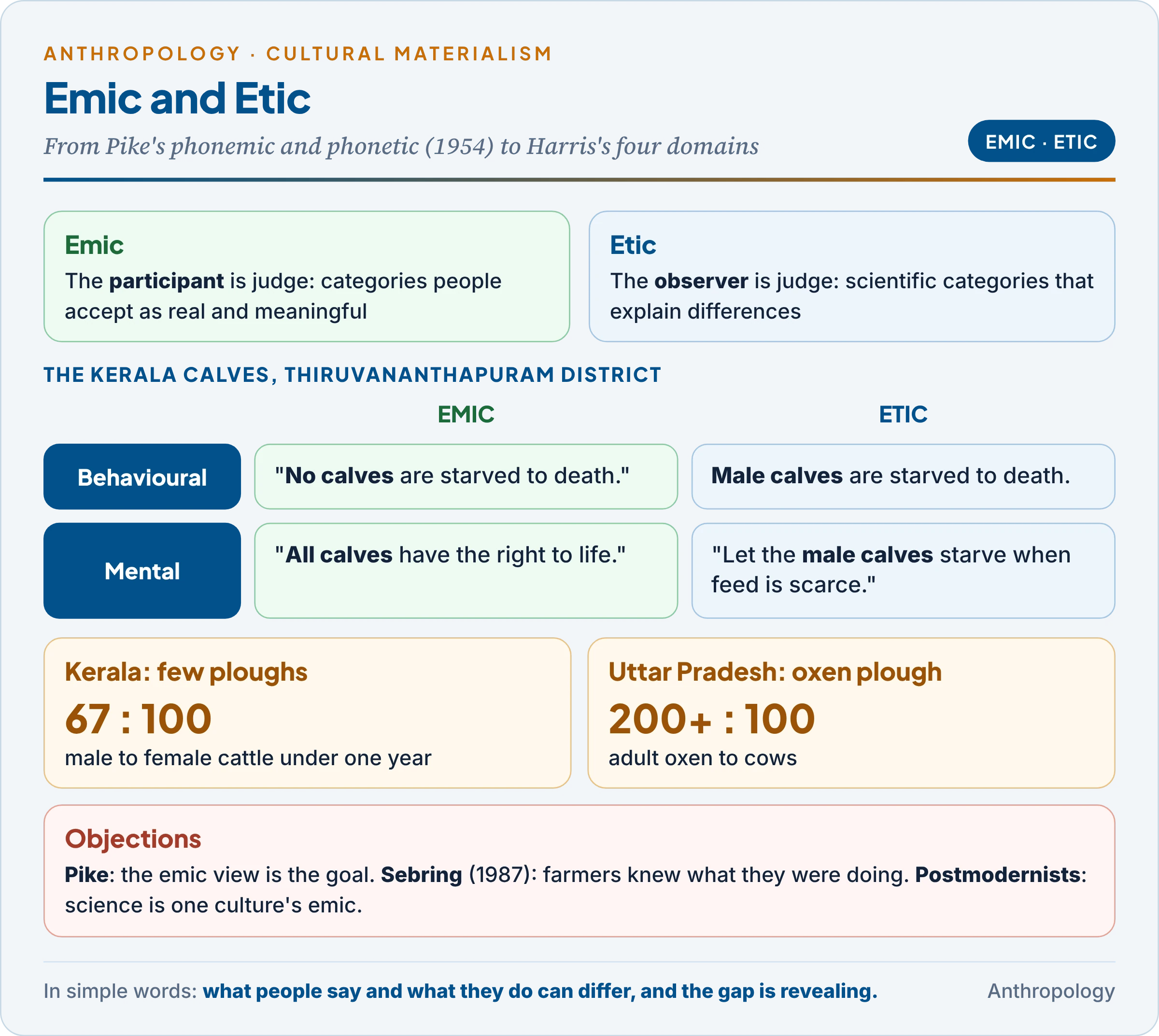
Harris’s own example came from his fieldwork in Thiruvananthapuram (Trivandrum) district, Kerala. Farmers told him that they would never kill or starve a calf. Yet his records showed that male calves died at almost twice the rate of female calves: among cattle under one year old there were only 67 males for every 100 females. Male calves were not killed; they were allowed to suckle only briefly and slowly weakened. Kerala had little need for draught animals, so males were culled. In Uttar Pradesh, where oxen pull the plough, the opposite happened: adult cattle numbered over 200 oxen for every 100 cows. The table places the case in Harris’s four domains.
| Emic (the farmer’s view) | Etic (the observer’s view) | |
|---|---|---|
| Behavioural | “No calves are starved to death.” | Male calves are starved to death. |
| Mental | “All calves have the right to life.“ | “Let the male calves starve when feed is scarce.” |
The contrast shows why the distinction matters: the farmers’ sincere statements and their actual behaviour point in different directions, and only the etic data reveal that cattle sex ratios are adjusted to the local economy. For Harris, the size of the gap between emic and etic versions measures how far people are mystified about their own society.
Common confusion
Is emic the same as “subjective” and etic the same as “objective”? No. An emic account can be recorded objectively (a careful, testable report of what people believe), and an etic account can be careless or biased. The distinction is about whose categories are used, the participants’ or the observer’s, not about how scientific the work is. Harris held that good research needs both, but that causal explanation rests mainly on etic data.
3.3 Objections to the distinction
- Pike disagreed. Pike saw emic understanding as the goal and the etic grid only as a starting point; the two debated in Emics and Etics: The Insider/Outsider Debate (1990).
- Misreading the people. James Sebring (“Bovidicy”, 1987) argued that Harris’s claim that Hindu farmers starve calves “unknowingly” came from a theory applied too deductively and a field method shaped by that theory: the farmers understood very well what they were doing.
- Whose science? Postmodernists replied that “etic” science is itself one culture’s emic view (Unit 6k).
4. The Riddles of Culture
In simple words
Harris chose customs that seem to make no sense, such as sacred cows, banned pork, wasteful feasts and endless tribal wars, and tried to show that each one helps people survive in their environment. These cases are called the riddles of culture.
4.1 India’s sacred cow
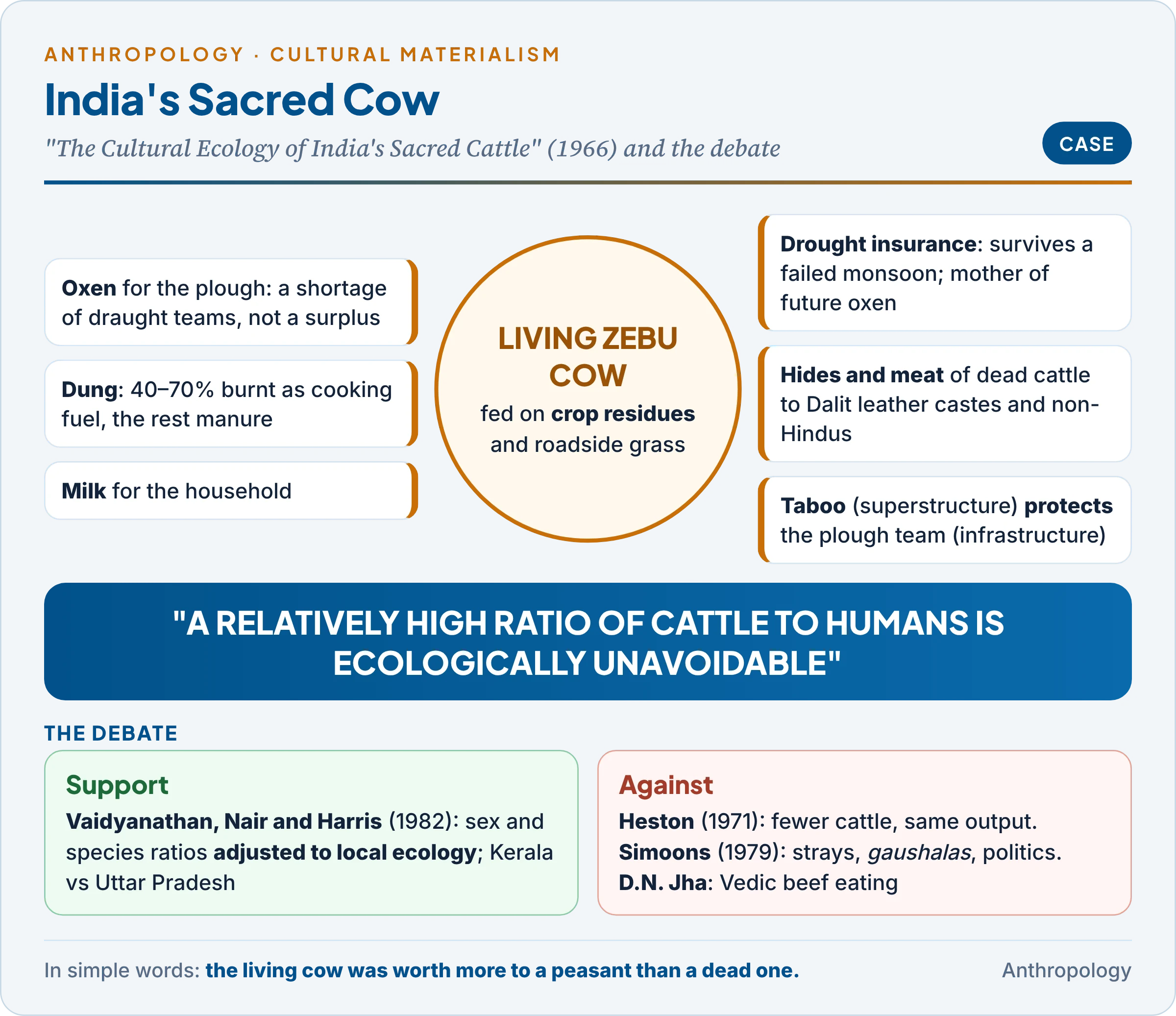
Harris’s 1966 paper argued against the view that India’s cattle complex was “an important example of resource mismanagement under the influence of religious doctrine“. He showed the positive functions of the living zebu cow in its techno-environmental setting (the combination of technology and environment):
- Traction. Indian farming depends on oxen. Harris (1978) reckoned that some 70 million farms needed about 140 million draught animals but had only about 80 million oxen and male buffaloes, a shortage of draught teams, not a surplus of cattle. A cow is valued above all as the mother of oxen.
- Drought insurance. The monsoon is erratic. Zebu cows can survive weeks of little food and recover when the rains return; a family that sells or eats its cow in a famine has nothing with which to farm afterwards. The taboo is “disaster insurance“.
- Dung. Of an estimated 800 million tonnes of manure a year, 40–70 per cent was burnt as cooking fuel (equal to about 43 million tonnes of coal) and the rest returned to the fields as fertiliser.
- Cheap feed. A study in West Bengal by Stewart Odend’hal (1971) found that cattle ate mostly crop residues (rice straw, husks, sugar-cane tops) and roadside grass, which humans cannot eat; the cattle did not compete with people for food.
- Milk, meat and leather. Milk fed many; and when a cow died, Dalit leather-working castes, Muslims and Christians used its hide and often ate its meat, so the taboo on beef for higher castes distributed protein to the poorest.
Conclusion. Under India’s existing technology and environment, “a relatively high ratio of cattle to humans is ecologically unavoidable“. The superstructure (the sanctity of the cow) protects the infrastructure (the plough team and the dung supply), which is exactly what infrastructural determinism predicts.
Why the cow became sacred. Harris also offered a historical hypothesis: in the Vedic period cattle were sacrificed and eaten, but as population grew and forests were cleared after about 1000 BCE, cattle became too valuable as draught animals to kill. Buddhism and Jainism, with their ethic of ahimsa (non-injury), and later Brahmanical Hinduism turned this economic necessity into a religious rule.
4.2 The sacred cow debate
The paper started one of anthropology’s longest controversies, carried on mostly in Current Anthropology. The table sets out the main positions; read it as a contest between ecological, economic, religious-historical and political explanations.
| Scholar (year) | Position | Main point |
|---|---|---|
| First commentators (1966), among them Nirmal Kumar Bose and Joan Mencher | Comment and reply | The paper appeared with comments by Indian and Indianist scholars and Harris’s reply |
| V.M. Dandekar (1964) and other economists | Surplus cattle | The conventional view: India had more cattle than its feed could support |
| W. Norman Brown (1964) | Religious history | The cow’s sanctity grew from ahimsa and Hindu doctrine |
| Alan Heston (1971) | Economic | The same output of traction, milk, dung and hides could come from fewer cattle; religion leads to unusually many female cattle, so religion is a causal variable |
| Frederick Simoons (1979) | Religious and political | Harris’s origin hypothesis is unlikely; stray cattle damage crops; cow homes (gaushalas) divert resources; cow protection is a political force |
| A. Vaidyanathan, K.N. Nair and Harris (1982) | Ecological, with data | Bovine age, sex and species ratios in India and Kerala are systematically adjusted to local conditions; religion cannot explain the regional variation |
| Historians, e.g. D.N. Jha (The Myth of the Holy Cow, 2002) | Historical | Vedic texts record beef eating (the Shatapatha Brahmana has the sage Yajnavalkya eat it if tender); sanctity is a later historical development |
Both sides were partly right. The ecological side showed that Indian cattle management is far more rational than the “waste” view assumed, and that sex ratios respond to economic need (as in Kerala and Uttar Pradesh). The critics showed that religion and politics have independent effects: they explain why there are unusually many old cows, gaushalas and, today, large numbers of stray cattle. The debate is the best example in anthropology of a materialist and a cultural explanation tested against the same evidence.
4.3 Pigs and protein
- The riddle. Why do Judaism and Islam forbid pork, while the Maring (Tsembaga) of New Guinea love pigs so much that they hold huge pig feasts (Rappaport, Pigs for the Ancestors, 1968; Unit 6h)?
- Harris’s answer (“Pig Lover and Pig Hater”, 1974). The pig is a forest animal that needs shade, water and grain; it cannot digest grass, gives no milk and cannot pull a plough. As the hot, dry Middle East lost its forests, pigs became a costly competitor with humans for food and water, while cattle, sheep and goats could live on grass. Because pork remained tempting, a divine prohibition was the most effective way to stop people raising pigs. In the forests of New Guinea, by contrast, pigs are efficient converters of garden waste into protein.
- The rival explanation. The British anthropologist Mary Douglas (Purity and Danger, 1966) explained the pig taboo of Leviticus by classification: the clean animals of the herd are cloven-hoofed and chew the cud; the pig is cloven-hoofed but does not chew the cud, so it is an anomaly that breaks the categories, and what breaks categories is unclean. The taboo protects the order of the world, not the ecosystem.
4.4 The potlatch
The potlatch of the Kwakiutl (Kwakwaka’wakw) of the north-west coast of North America was a feast at which chiefs gave away, and sometimes destroyed, great quantities of blankets, oil and copper plates (Unit 3b). It looked like pure status competition and waste. Harris, following Wayne Suttles (1960) and Stuart Piddocke (1965), argued that salmon runs and harvests varied sharply between villages; feasting moved food from lucky to unlucky villages and stored “credit” as prestige, so the potlatch worked as redistribution and insurance. The destructive “rivalry” potlatch of the late nineteenth century he explained, as Helen Codere (1950) had, by colonial conditions: sudden trade wealth and a population collapsed by disease.
4.5 Warfare
- Primitive war (1974). Harris rejected explanations of tribal war by instinct or by the love of glory. War among village farmers, he argued, keeps population spread out in relation to resources such as game, and it is linked to female infanticide, which limits the number of future mothers.
- The male supremacist complex. With William Divale (“Population, Warfare and the Male Supremacist Complex”, 1976), Harris argued that warfare, preferential female infanticide and male dominance form one system that regulates population in pre-state societies, part of the mode of reproduction.
- The Yanomamö test. For the Yanomamö of Venezuela and Brazil, Harris argued that war arose from scarce animal protein in the Amazon forest. Napoleon Chagnon and Raymond Hames (“Protein Deficiency and Tribal Warfare in Amazonia”, Science, 1979) found protein intake adequate and argued that men fought over women and revenge. The case became a classic test of materialist explanation.
4.6 Cannibals and witches
- Aztec sacrifice. In Cannibals and Kings (1977), following Michael Harner (1977), Harris argued that the mass sacrifice and eating of captives in Aztec Mexico met a shortage of animal protein in a region without large domestic herbivores. Critics, including Bernard Ortiz de Montellano (1978), showed that the Aztec diet was adequate and the amount of meat from sacrifice nutritionally trivial.
- The European witch craze (15th–17th centuries). Harris argued that witch-hunts diverted blame for poverty and crisis away from the Church and the ruling classes onto poor, powerless women: a political-economic function served by the superstructure.
- Intensification and depletion. Cannibals and Kings also proposed a general theory: population pressure leads to intensification of production, intensification depletes the environment, and depletion forces a new mode of production, a cycle that runs from hunting to farming to the state.
5. Cultural Materialism Compared
In simple words
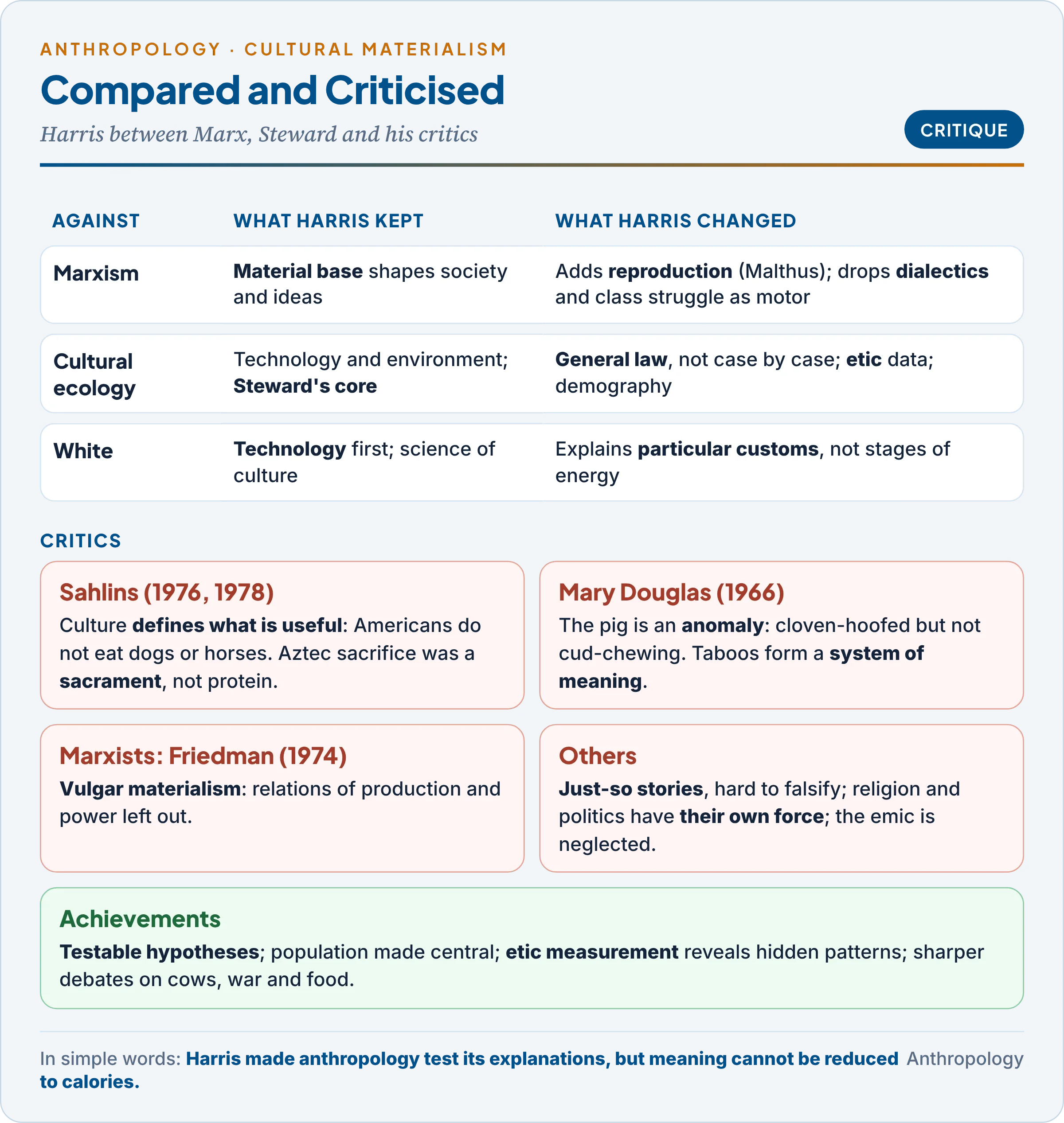
Cultural materialism borrowed its layers from Marx and its interest in environment from Steward, but it changed both. Compared with Marx, it drops the idea of class struggle as the motor of history and adds population. Compared with Steward, it turns case studies into a general theory.
5.1 Cultural materialism and Marxism
The table compares Harris with Marx on the points where their materialisms differ.
| Basis | Marxism (historical materialism) | Cultural materialism (Harris) |
|---|---|---|
| Base | Forces and relations of production | Modes of production and reproduction (adds demography) |
| Engine of change | Class struggle; contradiction between forces and relations | Cost-benefit selection of innovations by their effect on survival |
| Method | Dialectics (from Hegel): change through contradiction | Positivist science: operational definitions, testable hypotheses; dialectics rejected as untestable |
| Determination | Base and superstructure interact; structure (relations of production) can drive change | Probabilistic priority of the infrastructure; structure has little influence on it |
| Purpose | Theory joined to revolutionary practice | A research strategy for explaining culture |
| Scope | Mainly class societies | All societies, from foragers to industrial states |
The most important differences are the mode of reproduction and the rejection of dialectics. Marx had dismissed Malthus; Harris made population pressure central. Marxist anthropologists such as Jonathan Friedman (“Marxism, Structuralism and Vulgar Materialism”, 1974) answered that Harris had produced a “vulgar materialism“: by treating social relations as mere responses to technology and environment, he lost Marx’s insight that relations of production (who owns and who works) shape how technology is used.
5.2 Cultural materialism and cultural ecology
Harris built on Steward’s cultural ecology (Unit 6h), the study of how a society adapts to its environment through its technology and work. The table shows what he kept and what he changed.
| Basis | Cultural ecology (Steward) | Cultural materialism (Harris) |
|---|---|---|
| Core | Culture core: subsistence technology and work, plus closely linked institutions | Infrastructure: production and reproduction |
| Causation | Decided case by case; the core’s influence is an empirical question | A general principle of infrastructural determinism |
| Aim | Limited parallels in similar environments (multilinear evolution) | Nomothetic laws for all cultures |
| Data | Ethnographic and archaeological description | Insistence on etic, measurable data |
| Ideas | Secondary features left to history and diffusion | Superstructure explained, in the long run, by infrastructure |
Harris praised Steward for showing that similar technology in similar environments regularly produces similar social forms, but criticised his eclecticism: Steward never turned his case studies into a general theory. Cultural materialism is therefore cultural ecology made more general, more demographic and more deterministic. Its neighbour, Roy Rappaport‘s ecosystem approach, shared Harris’s materialism but treated ritual as a regulator within a self-balancing system.
6. Critique
In simple words
Critics said that Harris reduced culture to calories and convenience. They argued that people decide what is useful through their culture’s meanings, that his explanations were clever stories told after the fact, and that religion, history and politics have effects of their own.
6.1 Marshall Sahlins: culture defines utility
Marshall Sahlins, once a neo-evolutionist (Unit 6h), became Harris’s strongest critic.
- Culture and Practical Reason (1976). Material needs do not dictate culture, because culture decides what counts as useful. Americans could eat dogs and horses, which are nutritious and plentiful, but do not, because dogs and horses are like kin or companions, while cattle and pigs are objects; and steak ranks above tongue for symbolic, not nutritional, reasons. Practical reason works inside a symbolic order.
- “Culture as Protein and Profit” (New York Review of Books, 1978). Reviewing Cannibals and Kings, Sahlins argued that the Aztecs ate captives as a sacrament, not to fill a protein gap: Harris had turned a religion into a butcher’s shop.
6.2 Mary Douglas: classification and meaning
Mary Douglas showed that food rules form a system of meaning. In Purity and Danger (1966) the pig is unclean because it is a classificatory anomaly; in “Deciphering a Meal” (1972) she showed that the structure of meals encodes social relations. For Douglas, explaining one taboo by ecology misses the pattern: Leviticus bans many animals (camel, hare, rock badger, shellfish) for which no ecological reason exists, but all of which break the categories. Harris replied that classification itself needs explaining, and that his account explained why the pig in particular was singled out.
6.3 Other criticisms
- Just-so stories. Explanations found after the fact, by showing that a custom has some useful effect, are hard to falsify; some useful effect can be found for almost anything. This is the old weakness of functionalism (Units 6d, 6e) in materialist dress.
- Religion and politics have independent force. Heston and Simoons showed that Hindu belief raises cattle numbers beyond economic need, and that cow protection is a political movement; the 21st-century stray-cattle problem shows ideas shaping the infrastructure.
- Neglect of the emic. By treating natives’ views as “mystification”, Harris risked ignoring what people know and intend (Sebring); idealists argued that the emic is more significant than he allowed.
- Vulgar materialism (Friedman and other Marxists): social relations of production and power are reduced to responses to environment.
- Postmodern objections. Science is itself a cultural product, so the etic standpoint is not neutral (Unit 6k).
6.4 What it achieved
- A science of culture. Harris forced anthropology to state its explanations as testable hypotheses and to measure.
- Reproduction and demography. He made population a central variable in social theory.
- Etic data matter. Measurement of calories, sex ratios and land use revealed facts, such as the Kerala calves, that interviews alone would miss.
- Debate. The sacred cow, Yanomamö and Aztec controversies produced better data on all sides.
Key Concepts
| Concept | Meaning in Harris |
|---|---|
| Cultural materialism | Research strategy explaining culture by material conditions |
| Universal pattern | Infrastructure, structure and superstructure in every society |
| Mode of production | Technology and work for producing food and energy |
| Mode of reproduction | Practices that regulate population |
| Domestic and political economy | Organisation within households and among groups |
| Infrastructural determinism | Infrastructure probabilistically determines structure and superstructure |
| Emic | Description in the participants’ own categories |
| Etic | Description in the observer’s scientific categories |
| Riddles of culture | Apparently irrational customs explained materially |
Major Works
| Work | Year | Significance |
|---|---|---|
| The Nature of Cultural Things | 1964 | Emic and etic introduced into anthropology |
| “The Cultural Ecology of India’s Sacred Cattle” | 1966 | The sacred cow argument |
| The Rise of Anthropological Theory | 1968 | History of theory; “cultural materialism” coined |
| Cows, Pigs, Wars and Witches | 1974 | Riddles of culture |
| Cannibals and Kings | 1977 | Intensification, depletion, Aztec sacrifice |
| Cultural Materialism: The Struggle for a Science of Culture | 1979 | Full statement of the strategy |
| Good to Eat | 1985 | Food preferences and taboos |
| Theories of Culture in Postmodern Times | 1999 | Defence against postmodernism |
Key Terms
| Term | Meaning in simple words |
|---|---|
| Materialism | Explaining society by physical and economic conditions |
| Idealism | Explaining society by ideas, values and symbols |
| Research strategy | Rules for choosing questions and explanations |
| Nomothetic | Seeking general laws |
| Infrastructure | How a society gets food and energy and controls its numbers |
| Structure | Family and political-economic organisation |
| Superstructure | Art, ritual, religion and ideas |
| Probabilistic | True most of the time, not always |
| Techno-environmental | Technology and environment taken together |
| Draught animal | An animal used to pull ploughs or carts |
| Bovicide | Killing cattle, here by neglect |
| Ahimsa | Non-injury to living beings |
| Anomaly | Something that does not fit a category |
| Vulgar materialism | A crude materialism that ignores social relations |
Contemporary Developments
- Livestock Census 2019 (20th): 192.5 million cattle; female cattle up 18 per cent and male cattle down about 30 per cent since 2012; about 50 lakh stray cattle. Mechanisation has removed the bullock’s role, and the sex ratio has shifted as Harris’s theory predicts. The 21st Livestock Census was launched on 25 October 2024.
- Stray cattle. Stray cattle damaging crops have become a major rural and political issue in north India since cow-slaughter laws were tightened in several states after 2015, a case of the superstructure and politics acting on the infrastructure, as Simoons argued.
- Dung as energy. The GOBARdhan scheme (2018) promotes biogas from cattle dung and farm waste, a modern form of the dung economy Harris described.
- Anthropology of infrastructure. Younger anthropologists studying roads, pipes and power grids have returned to Harris’s question of how material systems shape social life.
- Revival of materialist explanation. Evolutionary and behavioural ecologists test food taboos with quantitative data, for example Joseph and Natalie Henrich (2010), who showed that Fijian taboos on certain reef fish for pregnant and nursing women reduce exposure to ciguatera poisoning, continuing the “riddles of culture” programme with stronger methods.
Diagrams to Master
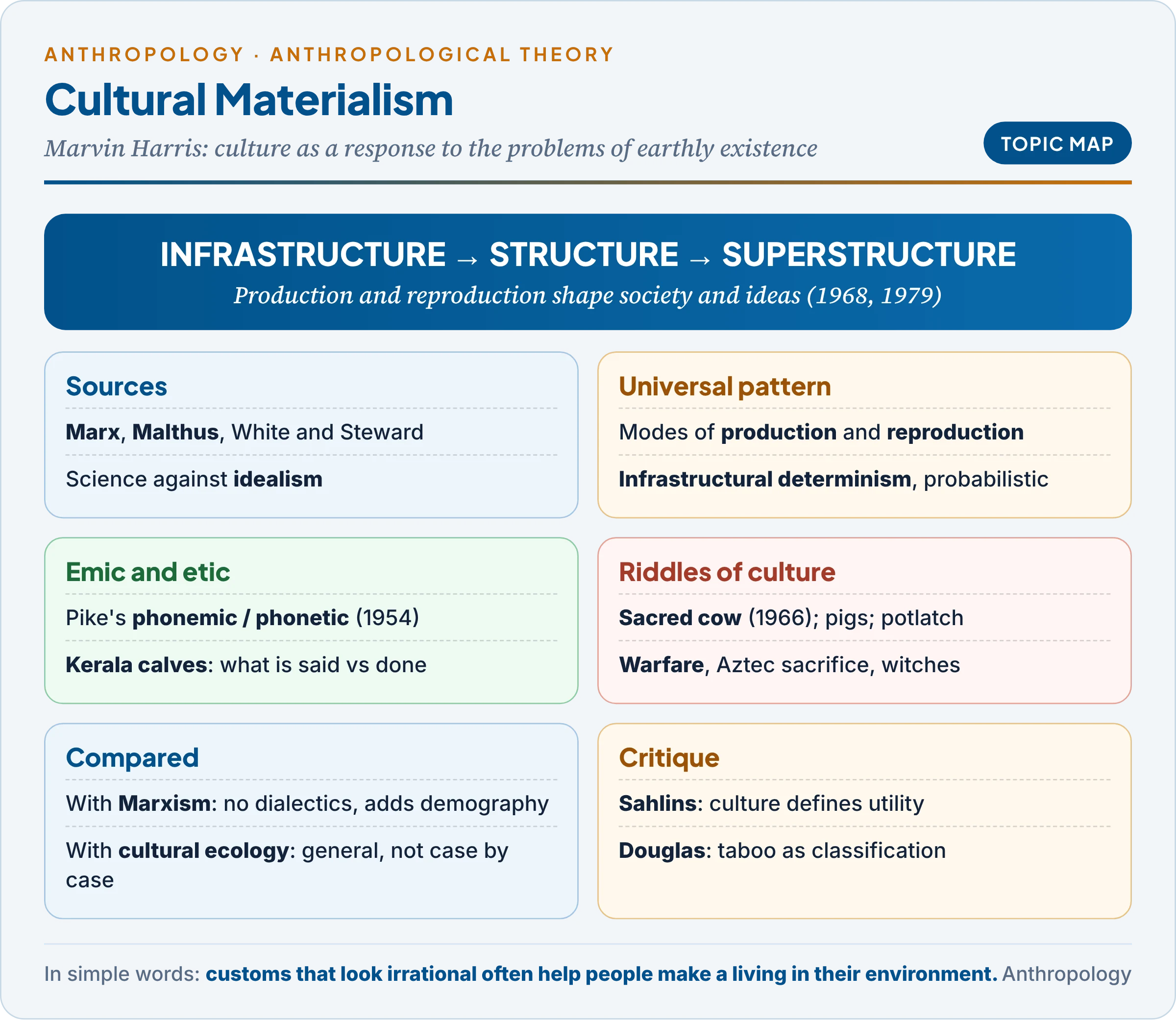
- Topic map of the article.
- Universal pattern (§2): three layers with their components; strong arrows up, weak arrows down; selection of innovations.
- Emic and etic (§3): the four domains with the Kerala calves; 67:100 in Kerala, 200:100 in Uttar Pradesh.
- The sacred cow (§4): oxen, dung, milk, hides, crop residues, drought insurance; the critics.
- Compared and criticised (§5–6): against Marxism and cultural ecology; Sahlins, Douglas, Marxists.
Revision Grid
| Scholar | Work (year) | Key idea |
|---|---|---|
| Kenneth Pike | Language in Relation to a Unified Theory (1954) | Emic and etic |
| Marvin Harris | “The Cultural Ecology of India’s Sacred Cattle” (1966) | The taboo protects the plough team |
| Harris | Cultural Materialism (1979) | Infrastructural determinism |
| Mary Douglas | Purity and Danger (1966) | Pig as classificatory anomaly |
| Roy Rappaport | Pigs for the Ancestors (1968) | Ritual regulates pigs and war |
| Alan Heston | “An Approach to the Sacred Cow of India” (1971) | Surplus cattle; religion matters |
| Jonathan Friedman | “Marxism, Structuralism and Vulgar Materialism” (1974) | Harris as vulgar materialist |
| Divale and Harris | “Population, Warfare and the Male Supremacist Complex” (1976) | War and infanticide regulate population |
| Marshall Sahlins | Culture and Practical Reason (1976) | Culture defines utility |
| Chagnon and Hames | “Protein Deficiency and Tribal Warfare” (1979) | Yanomamö protein adequate |
| Frederick Simoons | “Questions in the Sacred-Cow Controversy” (1979) | Religion and politics |
| Vaidyanathan, Nair and Harris | “Bovine Sex and Species Ratios in India” (1982) | Ratios adjusted to ecology |
Previous Year Questions
Unit 6: Cultural materialism (Harris)
- 2019Write a note in 150 words on Cultural Materialism.
- 2011Write a note in 150 words on Cultural materialism.
- 2003Unit 2.1: Write a note on Cultural Materialism.
Related questions from other units
- 2025Unit 9.7: How political economy is integrated with ecological and adaptability perspectives in bio-cultural anthropology?
- 2022Unit 6: Discuss the approaches of Leslie White, Julian Steward and Marshall Sahlins in the light of cultural evolution.
- 2017Unit 6: Critically examine the Stewardian view of neo-evolutionism.
- 2015Unit 8: Explain the difference between emic and etic, and how does the difference derive from the study of language?
- 2014Unit 9.7: Write a note in 150 words on Ecological Anthropology.
- 2013Unit 5: How does taboo serve as a means of social control ? (250 words).
- 2000Unit 8: Write a note on Etic and Emic approach.
- 1995Unit 9.7: What is cultural ecology ? Discuss how man adapts himself to different environments, giving suitable examples.
- 1992Unit 5: What is Taboo. Discuss the Significance of Taboo in primitive societies.
- 1989Unit 6: Write an essay on neo-evolutionism and cultural ecology.