

Schools of Buddhism: Pratītyasamutpāda; Kṣaṇikavāda, Nairātmyavāda
Official Syllabus: Paper I, Section B, Unit 14
Buddhism keeps two beliefs that other Indian schools tie to an eternal soul — karma and rebirth — while denying the soul. And it sets as its goal nirvāṇa, the end of suffering, while teaching that there is no permanent self to be freed and that everything is momentary. Critics asked: if nothing passes from one life to the next, what is reborn? If no one lasts, who attains nirvāṇa? And if everything is momentary, how can nirvāṇa be unconditioned and lasting? This article explains the Buddhist theory of karma, rebirth without transmigration, the nature and kinds of nirvāṇa, the Three Jewels (Triratna), and the much-asked question whether nirvāṇa is consistent with no-self and momentariness.
In simple words
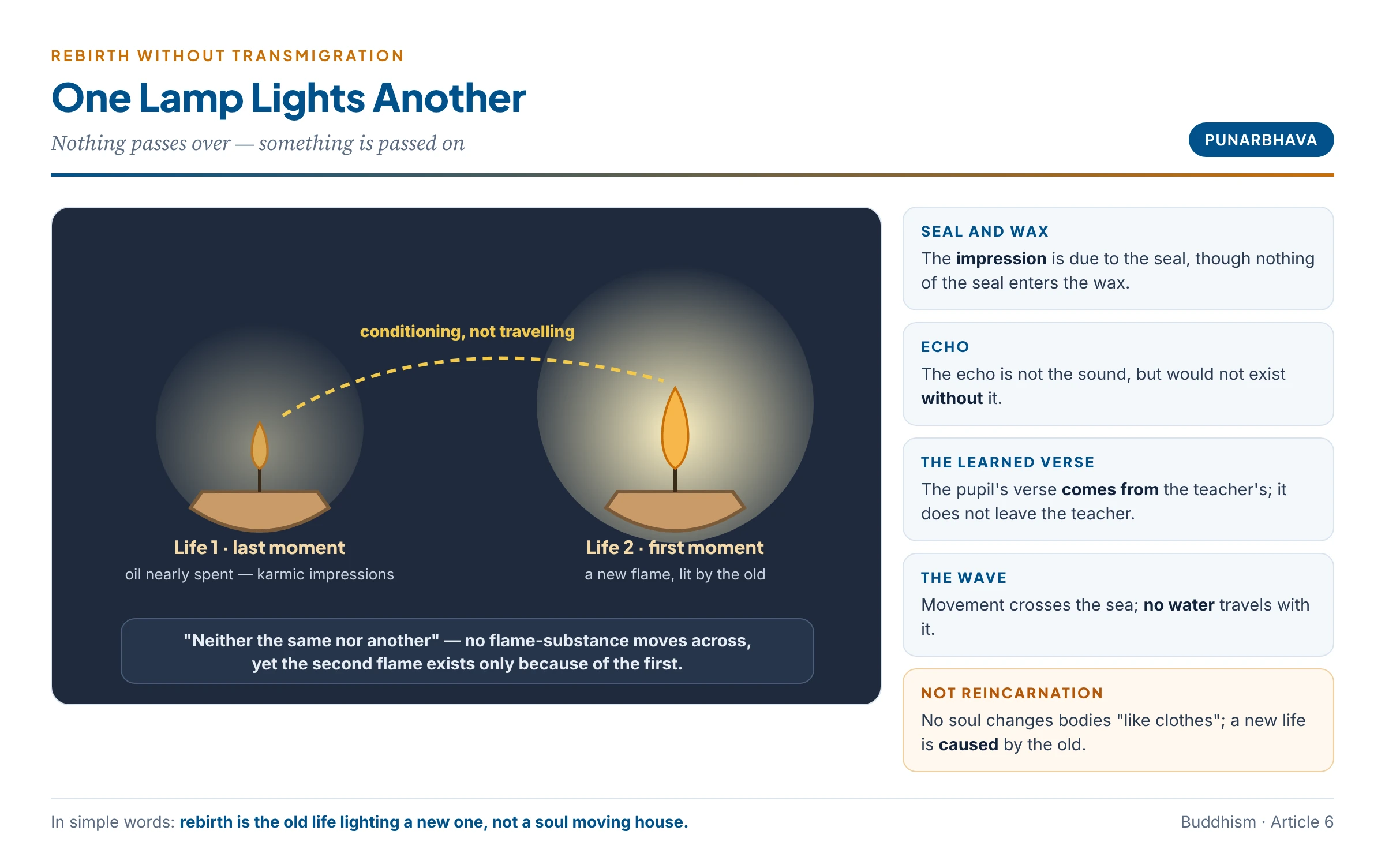
Light a second candle from the first, then blow out the first. Did the flame move from one candle to the other? No thing travelled across — yet the second flame would not exist without the first. The Buddha said rebirth is like this: the end of one life lights the beginning of the next. Nothing passes over; something is passed on. And nirvāṇa is like the moment when there is no more wick and oil — the flame simply goes out, and there is nothing left to light another.
Context & Problem
Karma and Rebirth in Indian Thought
- The shared belief. Almost every Indian school (except the Cārvāka) accepts the law of karma — every intentional action has a fitting result — and rebirth (punarjanma) as the way karma bears fruit beyond one lifetime.
- The usual carrier: the soul. For the Upaniṣads, Sāṃkhya, Nyāya, Mīmāṃsā and Jainism, karma and rebirth belong to an eternal soul that passes from body to body. The Bhagavad Gītā: “As a man casts off worn-out clothes and puts on new ones, so the embodied self casts off worn-out bodies and enters new ones.“
- The Buddhist difficulty. The Buddha accepted karma and rebirth but denied the soul. He therefore had to explain rebirth without transmigration and karma without an owner.
Nirvāṇa and the Problem of the Subject
- The goal. Nirvāṇa is the summum bonum of Buddhism, the content of the third noble truth.
- The puzzle. Liberation seems to need a liberated one. If there is no self (Nairātmyavāda) and nothing lasts (Kṣaṇikavāda), whose liberation is it, and how can a momentary series reach a state described as permanent and unconditioned?
Core Doctrine
1. The Buddhist Theory of Karma
- Karma is intention. “Intention (cetanā), monks, is what I call karma; having intended, one acts by body, speech and mind.” It is not the outward act alone but the will behind it that counts. “Mind is the forerunner of all states” (Dhammapada).
- Example. The same act of cutting with a knife is surgery when done to heal and assault when done to harm; its karma follows the intention.
- Three doors of karma.
- Bodily karma (kāya-karma) — killing, stealing, acts of kindness.
- Verbal karma (vāk-karma) — lying, gossip, compassionate speech.
- Mental karma (mano-karma) — thoughts of greed, hatred, love, generosity; the most important, since they precede the other two.
- Ripening (vipāka). Every intentional action bears a corresponding fruit:
- Wholesome (kuśala) actions, rooted in non-greed, non-hatred and wisdom, lead to happiness and favourable rebirth.
- Unwholesome (akuśala) actions, rooted in greed, hatred and delusion, lead to suffering and unfavourable rebirth (animal, ghost, hell realms).
- Neutral actions have little karmic weight.
- An impersonal law. “Karma is an impersonal law which works by itself.” Unlike the orthodox Hindu view, it “does not depend on any divine power“; unlike the Jaina view, it “is not subtle matter pulling down the soul”. It is causation applied to moral life — “only a special form of the more general law of causation“.
- Not fatalism. Past karma shapes present circumstances, but present choices are new karma. The Buddha rejected the view that everything we experience is due to past deeds — that would make effort pointless. Through mindful, wise action one can break harmful patterns.
- Karma and ethics. The theory gives a strong basis for personal responsibility: everyone inherits the results of their own deeds. The five precepts (no killing, stealing, sexual misconduct, lying, intoxication) cultivate wholesome karma.
- Beyond karma. The aim is not good karma for ever but freedom from karma: action done without greed, hatred and delusion “does not create karma producing rebirth” — like fried seeds, which cannot sprout.
2. Rebirth Without Transmigration
- “Born again”, not “soul migrating”. Buddhism speaks of rebirth (punarbhava, “becoming again”), not transmigration of a soul. “Rebirth is not transmigration, i.e. the migration of the same soul into another body; it is the causation of the next life by the present.”
- How it works.
- At death, the last moment of consciousness, charged with the karmic impressions (saṃskāra) of the whole life, does not simply stop.
- As craving is still present, it conditions the arising of the first moment of consciousness in a new womb — the third link of dependent origination (vijñāna).
- “The past and present lives bear no resemblance except that the new birth is according to the karmas of the old one.” It is the “character” that continues, not a soul.
- “Neither the same nor another.” Asked whether the reborn one is the same as the one who died, Nāgasena answers: “Neither the same nor another.“
The Classical Analogies
- One lamp lit from another. “As from one flame another may be lighted, and though the two are different, they are connected causally, similarly the end-state of this life may cause the beginning of the next.”
- The seal and the wax. A seal leaves its impression on wax; nothing of the seal passes into the wax, yet the impression is exactly due to the seal.
- The echo. A sound produces an echo; the echo is not the sound, but would not exist without it.
- The verse learned from a teacher. A pupil learns a verse from his teacher. The verse does not leave the teacher and enter the pupil, yet the pupil’s verse comes from the teacher’s.
- Waves on the ocean. A wave travels across the sea, but no water travels with it; only the movement is passed on from particle to particle.
- Milk, curd, butter, ghee. Each stage is neither the same as nor wholly different from the one before (Article 4).
- The question of evil deeds. Milinda: “If nothing passes over, will not the new being be freed from the evil deeds of the old?” Nāgasena: “Yes — if there were no rebirth. But since there is rebirth, he is not freed” — as the mango thief is not freed by pleading that the stolen mangoes were not the ones planted.
Common confusion
Does Buddhism teach reincarnation of the soul? No. “Reincarnation” means a soul taking on a new body — the Gītā’s image of changing clothes. Buddhism rejects this, because there is no soul to change bodies. It teaches rebirth: a new life-process caused by the old one, with no unchanging entity passing between them. The common Hindi phrase “ātmā ek śarīr chhoḍkar dūsrā dhāraṇ karti hai” describes the Hindu, not the Buddhist, view.
3. Is Immortality of the Soul a Necessary Postulate for Rebirth?
- The traditional view: yes. For the Upaniṣads, Nyāya, Jainism and Sāṃkhya, rebirth means the same soul in a new body. Without an enduring soul, there would be no one who is reborn; rebirth would just be a new birth.
- Nyāya’s argument. A new-born baby sucks at the breast, shows fear and joy — signs of memory of past experience; since it has had none in this life, it must have had a past life and an enduring self that carries the memory.
- Moral argument. Only if the same person reaps the fruit is the law of karma just.
- The Buddhist view: no.
- Rebirth needs only causal continuity, not identity: the new life is conditioned by the old, and inherits its impressions.
- The Nyāya evidence (instincts, inborn tendencies) is equally explained by transmitted impressions in the series.
- Justice is preserved by the same-series principle: the fruit ripens only where the deed was done (Article 4).
- An eternal, unchanging soul could not be reborn at all, since rebirth is a change of state.
- Assessment. Buddhism shows that immortality of a soul is not logically required for rebirth; it is required only if rebirth is defined as transmigration. The real price Buddhism pays is to make personal identity across lives a matter of degree and convention.
4. The Significance of Rebirth in Non-Theistic Religions
- Buddhism and Jainism — the two great anti-theistic Indian religions — both make karma and rebirth do the work that God does elsewhere:
- Moral order without a judge. Rewards and punishments follow automatically from deeds; no divine judge is needed.
- An answer to the problem of evil. Unequal fortunes are explained by past deeds, not by divine favour or injustice.
- Room for self-effort. Liberation is earned by one’s own conduct and insight.
- The difference. Jainism keeps an eternal soul (jīva) as the bearer of karma (karma as subtle matter clinging to it); Buddhism keeps only the causal series. Buddhism therefore shows the more radical possibility: a moral universe with neither God nor soul.
5. Nirvāṇa: Meaning and Nature
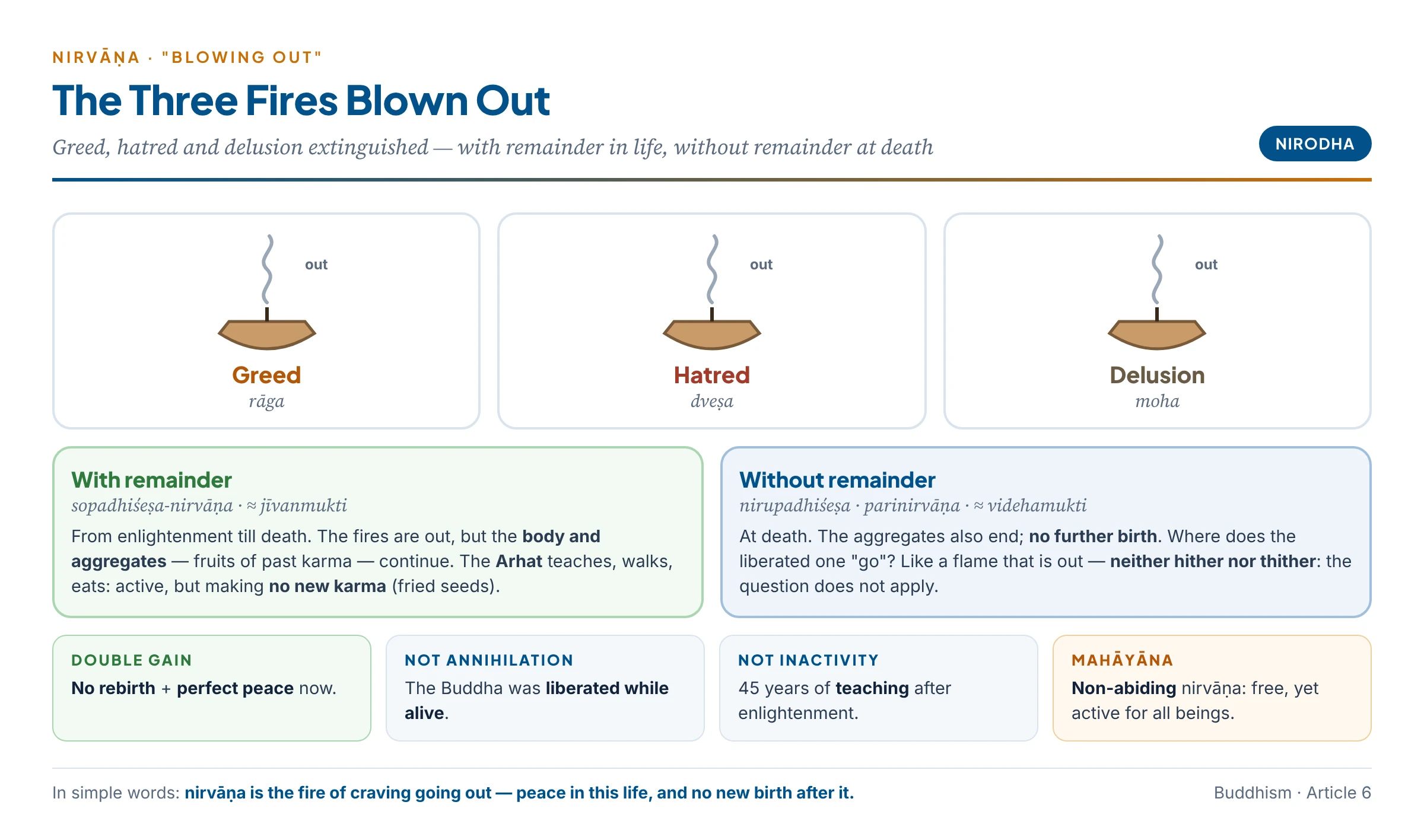
- Etymology. Nir-vāṇa — “blowing out“, “extinguishing”, “cooling”. What is blown out is the “three fires” (or “three poisons”) of greed (rāga), hatred (dveṣa) and delusion (moha).
- The third noble truth. Nirvāṇa is dukkha-nirodha, the cessation of suffering, reached by removing its conditions.
- Attainable here and now. Liberation “is a state attainable herein this very life“. One who reaches it is an Arhat; “he has broken the fetters that bound him to the world”. When King Ajātaśatru asked what visible fruit the homeless life brings here and now, the Buddha described a rising series of fruits — calm, joy, insight — ending in this freedom.
- Not inactivity. The Buddha lived “forty-five years” of active teaching after enlightenment. There are two kinds of action — that done under greed, hatred and delusion, which binds, and that done without them, which does not; the second is like sowing fried seeds. The Buddha “thought it proper that the raft which he constructed with toil and with which he got across the flood of misery should be left for others”.
- Not annihilation.
- If nirvāṇa were extinction of existence, the Buddha would not have been liberated till he died — but he declared himself free while alive; the Pāli word for “liberated” (parinibbuto) is used of living persons.
- What becomes of the liberated one after death is one of the ten unanswered questions: the Buddha did not say he ceases to exist.
- The flame “goes neither hither nor thither” — neither to the earth nor to the sky; asking where it goes is asking the wrong question.
- In the Pāli canon, “to mistake nirvāṇa as annihilation” is called “a wicked heresy“.
- Double gain. “The gain is double, negative and positive.” Negatively, nirvāṇa guarantees no rebirth; positively, it is perfect peace in this life — “a state of serenity, equanimity and passionless self-possession“.
- Positive descriptions. Nirvāṇa is called “the highest bliss“, “the deathless“, “the unconditioned“, “the fearless goal“, the island, the shelter, the cool, the further shore. It “gives happiness here and hereafter”.
- Indescribable. “It cannot be described in terms of ordinary experience.” Nāgasena compares it to an ocean (profound), a mountain peak (lofty), honey (sweet) — but “reasoning and metaphor are of little avail for convincing a blind man what colour is like”.
- Foretaste. “The advantages of nirvāṇa can be enjoyed in part even before it has been obtained”: every bit of ignorance removed brings “purity, good-will, self-possession, courage, unperplexed mind, unruffled temper“.
In simple words
Think of the relief when a long fever finally breaks. Nothing new has been added to you; something painful has stopped — and what remains is a clear, light, peaceful feeling you could hardly describe. The Buddha used just such images — freedom from disease, debt, slavery and prison — to hint at nirvāṇa: not a new possession, but the end of a burning, and a peace that follows.
6. Kinds of Nirvāṇa
| Kind | Meaning | When | Indian parallel |
|---|---|---|---|
| Sopadhiśeṣa-nirvāṇa (Pāli saupādisesa) | Nirvāṇa “with a remainder” — the fires are out, but the body and the five aggregates (the “remainder” produced by past karma) continue | During life, from enlightenment till death — the state of the living Arhat or Buddha | Jīvanmukti (liberation while alive); Jaina sayogī kevalin |
| Nirupadhiśeṣa-nirvāṇa (anupādisesa), Parinirvāṇa | Nirvāṇa “without remainder” — the aggregates too come to an end; no further birth | At the death of the liberated one | Videhamukti (liberation after the body falls); Jaina ayogī kevalin |
| Apratiṣṭhita-nirvāṇa (Mahāyāna) | “Non-abiding” nirvāṇa — the Bodhisattva rests neither in saṃsāra nor in a separate nirvāṇa, free yet active for all beings | The Mahāyāna ideal | — |
- Hīnayāna and Mahāyāna. “Hīnayāna schools favour mostly the negative description of nirvāṇa as the cessation of suffering. Later Buddhists define it in the positive sense as a state of positive bliss.” In the Hīnayāna, nirvāṇa can be consciously attained; in the Mahāyāna it is “a concept that cannot be defined; it has to be realised“.
- In the schools.
- Vaibhāṣika — nirvāṇa is a real, unconditioned dharma (asaṃskṛta), “cessation through wisdom” (pratisaṅkhyā-nirodha).
- Sautrāntika — nirvāṇa is mere absence of the defilements and of future rebirth, not a positive entity — like the going out of a flame.
- Yogācāra — liberation is the transformation of the basis (āśraya-parāvṛtti): the storehouse-consciousness is purified into “mirror-like wisdom“.
- Mādhyamika — “There is not the slightest difference between saṃsāra and nirvāṇa”; nirvāṇa is the world seen without the distortions of own-nature — the realisation of emptiness.
7. Is Nirvāṇa a Logical Necessity for the Buddhists?
- Arguments that it is.
- From dependent origination. “If this is not, that does not arise.” Whatever arises from conditions must cease when they cease. Suffering arises from conditions; therefore its cessation is possible — the third truth follows from the second.
- From the structure of the teaching. Without nirvāṇa, the third and fourth truths and the path would have no point; Buddhism would be a diagnosis without a cure.
- From the unconditioned. “There is an unborn, unbecome, unmade, unconditioned. If there were not, no escape from the born, become, made and conditioned would be possible.”
- From experience. The Buddha and the Arhats claim to have realised it; it is not a hope but a report.
- Doubts.
- Dependent origination shows that cessation is possible, not that it is necessary or ever actually happens.
- Saṃsāra is beginningless; a beginningless process need not have an end.
- If nirvāṇa is unconditioned, it cannot be produced by the path; if it is produced, it is conditioned and therefore impermanent.
- Buddhist reply to the last doubt. The path does not produce nirvāṇa; it removes the obstacles to it, as clearing clouds does not produce the sun.
- Balanced view. Nirvāṇa is a logical requirement of the system (the cure that dependent origination makes possible and the Four Truths promise), and an existential claim grounded in the Buddha’s experience; it is not a purely logical deduction.
8. Is Nirvāṇa Consistent with Momentariness and No-Self?
The Objections
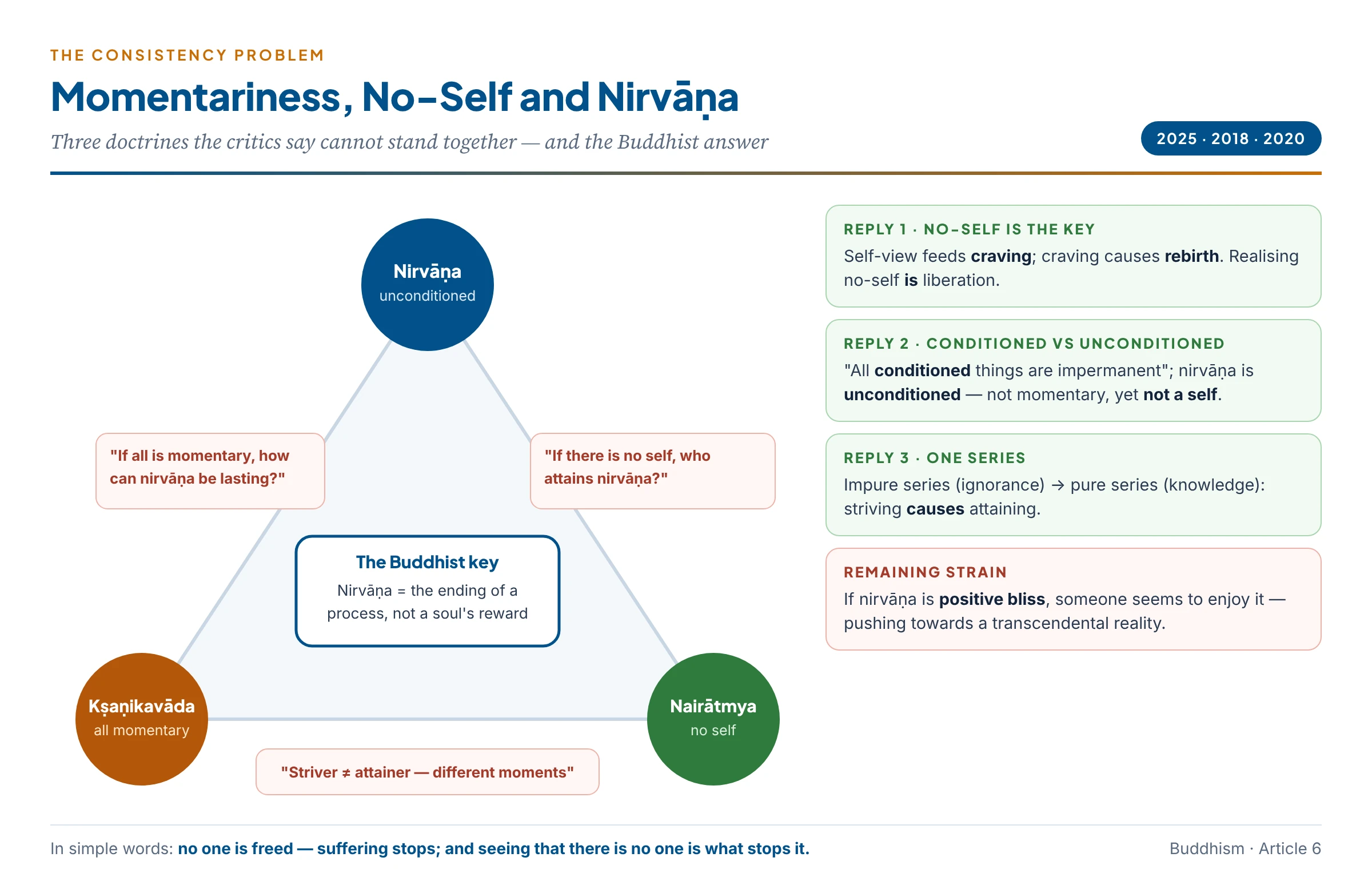
- No subject. If there is no self, who attains nirvāṇa and who enjoys its peace? Liberation of no one seems empty.
- Different attainers. If everything is momentary, the one who strives is not the one who attains; “one momentary idea is bound and another is liberated”.
- Momentary nirvāṇa? If everything is momentary, nirvāṇa too must be momentary — but it is described as lasting, deathless, unconditioned.
- Uninspiring. “It becomes uninspiring for individuals to strive for nirvāṇa if it is not defined positively as a state of eternal bliss. For this it becomes inevitable to accept an immortal self as the substratum of bliss.”
- Annihilation in disguise. If nirvāṇa is the ending of the five aggregates with no self left over, it seems to be simple extinction — the annihilationism the Buddha rejected.
The Buddhist Replies
- Nirvāṇa is the cessation of a process, not the reward of a self. Suffering is a process of craving and clinging; nirvāṇa is that process ceasing. As Buddhaghosa put it: “Nirvāṇa is, but no one who enters it; the path is, but no traveller on it is seen.” What needs liberating is not a soul but a stream of suffering.
- No-self is not an obstacle but the key. Belief in a self (satkāya-dṛṣṭi) is a root of craving; craving is the cause of rebirth. So realising no-self is liberation — nirvāṇa and nairātmya are not merely compatible, they require each other. A permanent self, by contrast, could never be freed (Article 4).
- Momentariness covers the conditioned only. “All conditioned things (saṅkhārā) are impermanent” — but nirvāṇa is unconditioned (asaṃskṛta). The verse that follows says “all dharmas are not-self” — nirvāṇa included: it is not impermanent, yet it is not a self. So there is no contradiction in an unconditioned nirvāṇa that is no one’s soul.
- The series is transformed. “Bondage means the flow of an impure series beginning with ignorance; liberation means the transformation of this flow into that of a pure series beginning with knowledge.” The striver and the attainer belong to one series; the striving causes the attaining.
- Not annihilation. What ends is craving and its suffering, not “a person” — for there never was a person-substance to be annihilated. The question “does the liberated one exist after death?” remains unanswered, because both “yes” and “no” assume a self.
- Mahāyāna deepening. For Nāgārjuna, nirvāṇa is the realisation that saṃsāra and nirvāṇa are both empty — no self is bound and no self is freed; for the Yogācāra, it is the purified storehouse-consciousness. Both avoid needing an eternal subject.
In simple words
When a traffic jam clears, what has been “liberated”? Not some “jam-soul” that now lives on in freedom. The jam itself — a pattern of cars blocking cars — has simply ended, and the road flows. Nirvāṇa, on the Buddhist view, is like this: the knot of craving that kept suffering going comes undone. No eternal someone is needed for the ending to be real — and very welcome.
Assessment
- Consistent — if nirvāṇa is understood as the cessation of a causal process (Hīnayāna) or the realisation of emptiness (Mahāyāna), and if momentariness is restricted to the conditioned.
- Strained — if nirvāṇa is described as positive bliss that someone enjoys: then “the theory of momentariness would be relegated to the sphere of the empirical alone”, and many interpreters see the need for a transcendental reality (Bodhi, Prajñā, the Mahāyāna “great self”).
- The verdict. The doctrines are consistent within the Buddhist framework of conventional and ultimate truth; the tension appears when nirvāṇa is pictured in soul-language (“I will enjoy eternal bliss”) — which is exactly the picture Buddhism asks us to give up.
9. The Three Jewels (Triratna) and Their Internal Relation
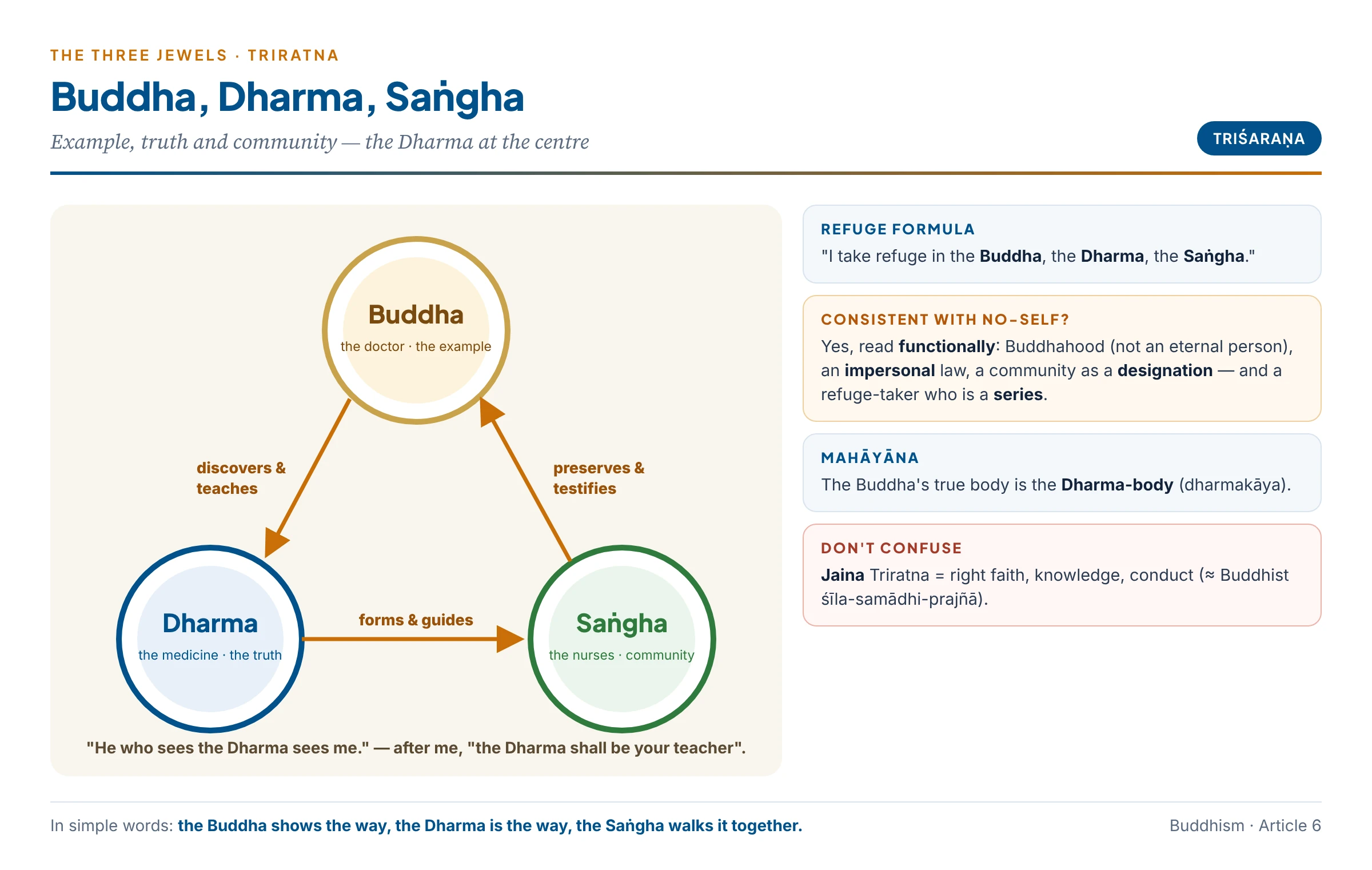
- The Three Jewels (triratna) — the threefold refuge (triśaraṇa): “I take refuge in the Buddha, the Dharma, the Saṅgha.”
- Buddha — the teacher and example: proof that a human being can wake up.
- Dharma — the teaching (the Four Truths, dependent origination, the path) and the law it describes; also the truth realised in nirvāṇa.
- Saṅgha — the community of practitioners, especially the noble ones who have entered the path; it preserves and lives the Dharma.
- Their internal relation.
- Buddha → Dharma. The Buddha discovered and taught the Dharma; he did not create it — “whether Buddhas arise or not, this law stands”.
- Dharma → Buddha. “He who sees the Dharma sees me; he who sees me sees the Dharma.” The Buddha is the Dharma embodied.
- Dharma → Saṅgha. The Saṅgha is formed by the Dharma and exists for it.
- Saṅgha → Buddha and Dharma. The Saṅgha transmits the teaching and testifies that the path works.
- The physician analogy. The Buddha is the doctor, the Dharma the medicine, the Saṅgha the nurses and fellow-patients who help one take it.
- The centre. Before passing away the Buddha said: “The Dharma and the discipline I have taught shall be your teacher after I am gone.” The Dharma is the jewel that unites the other two.
- Do not confuse with the Jaina Triratna — right faith, right knowledge, right conduct — which corresponds more closely to the Buddhist threefold training (śīla, samādhi, prajñā).
Is the Triratna Consistent with No-Self?
- The objection. Refuge seems to need persons: a Buddha who is a lasting saviour, a Saṅgha of real members, and a refuge-taker. If no one is a self — and if the Buddha after parinirvāṇa cannot be said to exist — what is one taking refuge in, and who takes it?
- The replies.
- The Buddha as awakening, not as a soul. Refuge is in Buddhahood — the qualities of wisdom and compassion — and in the example of the historical Buddha, not in an eternal individual. The Mahāyāna made this explicit in the doctrine of the Dharma-body (dharmakāya): the Buddha’s true “body” is the Dharma itself.
- The Dharma is impersonal. The law of dependent origination and the path need no owner; refuge in the Dharma is perfectly consistent with no-self.
- The Saṅgha as a functional community. Like a chariot or a team, the Saṅgha is a real designation for practitioners in relation — conventionally real, without a group-soul.
- The refuge-taker is a series — a stream that turns towards the path and is transformed by it.
- Refuge is itself a remedy for self-view. Taking refuge replaces trust in “I and mine” with trust in awakening, truth and community.
- Assessment. The Triratna is consistent with no-self if understood functionally (example, teaching, community) rather than personally; the later devotional forms of Buddhism (the Buddha as a saviour-god, Amitābha) show the pull of the personal reading — and the strain it creates.
Critical Evaluation
A. Rival Critiques
- Nyāya and Mīmāṃsā: karma needs an owner. Merit and demerit (dharma, adharma / adṛṣṭa) are qualities, and qualities need a substance — the soul — to inhere in.
- Śaṅkara: liberation of whom? “If the soul is momentary, whose is the bondage and whose is the liberation?” And if ignorance perishes of itself (causeless destruction), the path is pointless.
- Jainism: rebirth without a jīva is incoherent. Karma is subtle matter that binds a soul; without the soul there is nothing to bind or release.
- The annihilation charge. Nirvāṇa without a self looks like extinction; Western interpreters such as Schopenhauer read it as “nothingness”, attractive as a release from the will to live.
- The positive-bliss objection. If nirvāṇa is bliss, there must be someone blissful; if not, why strive?
B. Buddhist Replies (Summary)
- Causal continuity carries karma and rebirth (lamp, seal, echo, verse, wave).
- Nirvāṇa is the cessation of suffering-process, not of a person; the liberated one after death is indescribable, not non-existent.
- No-self is not the enemy of liberation but its content.
Critics and Defenders
Criticism — Critics
- Nyāya, Mīmāṃsā: merit and demerit need a substance to inhere in.
- Śaṅkara: whose bondage, whose liberation? causeless destruction makes the path idle.
- Jaina: karma binds a jīva; without it rebirth is incoherent.
- Interpreters: nirvāṇa without a self is annihilation; positive bliss needs a subject.
- Devotional pressure: refuge in a Buddha who no longer exists is empty.
Defence — Defenders and strengths
- Lamp to lamp: rebirth needs causation, not transmigration.
- Same-series principle keeps karma just without a soul.
- Nirvāṇa is real peace, attainable in this life, neither annihilation nor eternal ego.
- No-self is liberation: removing self-view removes craving and rebirth.
- Functional Triratna: example, teaching and community need no souls.
Cross-Tradition Comparison
| Theme | Buddhism | Other view | Point of comparison |
|---|---|---|---|
| What is reborn | A causal series (“character”) | Bhagavad Gītā, Nyāya, Jaina: the same soul in a new body | Rebirth with and without a carrier |
| Immortality and morality | Not needed; karma works through the series | Kant: immortality is a postulate of practical reason — needed for endless moral progress towards the highest good | Kant needs an immortal soul for morality; Buddhism does not |
| The soul and the afterlife | Liberated one after death: unanswered | Plato: proofs of the soul’s immortality (recollection, affinity, opposites) | Opposite ends of the spectrum |
| Liberation | Nirvāṇa — extinction of craving, peace beyond description | Advaita mokṣa — realisation of the eternal Self (Brahman) as bliss (ānanda) | Both: liberation in life (jīvanmukti); they differ on whether a Self is realised |
| Liberation | Cessation of the series of suffering | Sāṃkhya/Yoga kaivalya — isolation of the pure puruṣa from Prakṛti | Sāṃkhya frees a witness; Buddhism frees a process |
| Liberation | Nirvāṇa with and without remainder | Jainism — the soul rises to the summit of the universe (siddha-śilā) in infinite knowledge and bliss | Both reject God; Jainism keeps a perfected soul |
| Will and its denial | Craving extinguished | Schopenhauer — denial of the will to live | Schopenhauer reads the result as near-nothingness; Buddhism as peace |
Indian Connect — Key takeaways
- Jīvanmukti/videhamukti in Vedānta and sayogī/ayogī kevalin in Jainism are close parallels to nirvāṇa with and without remainder.
- All Indian schools except the Cārvāka keep karma and rebirth; Buddhism alone keeps them without a soul.
- Śaṅkara’s “liberation is realising what one already is” and Nāgārjuna’s “saṃsāra and nirvāṇa are not different” both deny that liberation is a journey to another place.
Synthesis (Siddhānta)
- Karma is intention and its fruit, an impersonal causal law — neither divine judgment nor subtle matter.
- Rebirth is the causation of a new life by the old — lamp lit from lamp — not the migration of a soul; immortality is not a necessary postulate for it.
- Nirvāṇa is the blowing out of greed, hatred and delusion, attainable in this life (with remainder) and complete at death (without remainder); neither annihilation nor eternal ego, best described as peace, and ultimately beyond description.
- Consistency. Nirvāṇa, no-self and momentariness fit together if nirvāṇa is the cessation of a conditioned process and momentariness covers only the conditioned — indeed realising no-self is liberation. The tension returns only when nirvāṇa is pictured as someone’s eternal bliss.
- The Triratna — Buddha, Dharma, Saṅgha — understood as example, truth and community, is consistent with no-self; the Dharma is its centre.
- Contemporary relevance.
- Ethics of intention. Modern law and ethics, like Buddhist karma, weigh intention (mens rea) over the bare act.
- Well-being research. Studies of craving, rumination and attachment support the claim that reducing craving reduces suffering; “nirvāṇa-like” equanimity is a goal of many contemplative therapies.
- Social engagement. The Bodhisattva ideal of non-abiding nirvāṇa inspires engaged Buddhism — liberation expressed as service.
- Facing death. Seeing death as the end of a process, not the destruction of a thing, informs palliative and hospice care practices.
“Nirvāṇa is the highest bliss.” — Dhammapada
Previous Year Questions
- 2025Is Buddhist notion of Nirvana in consonance with their conception of Kṣanikavāda (momentariness) and Nairātmyavāda (no-soul theory)? Critically discuss.
- 2023“Ignorance of dependent origination is suffering, while its knowledge is cessation of suffering.” Present an account of Buddhist soteriology in the light of above statement.
- 2022Explain Buddhist concept of Triratna and their internal relation. Critically examine the consistency of Triratnas with the Buddhist concept of No-soul (Nairätmyaväda).
- 2022“Immortality of Soul is a necessary postulate for rebirth.” Critically examine with reference to Buddhism.
- 2020How does Buddhism explain Self in terms of Pancaskandhas? What is Liberation for Buddhism if there is no Soul?
- 2018Is it consistent for the Buddhists to admit the theory of Nairátmyavāda and the doctrine of Nirvana simultaneously? Give reasons in favour of your answer.
- 2018How far is it plausible to argue that the anti-theistic religions’ stand on the concept of rebirth is philosophically significant?
- 2016Buddhism disbelieves in the immortality of soul, but accepts the phenomenon of rebirth. Examine.
- 2014How do you justify rebirth with or without the soul?
- 2011Is the concept of Nirvana a logical necessity for the Buddhists? Give reasons for your answer.
- 2011Is a belief in rebirth and reincarnation possible without a belief in the immortality of the soul? Discuss.
- 2010How does the Buddhist accept the possibility of rebirth in the absence of an eternal soul? Discuss.
- 2004Nature and kinds of Nirvana. Short Notes.