

Religion and Morality: Religion and Morality.
Official Syllabus: Paper II, Section B, Unit 8
For most of history, people learned right and wrong from religion. Immanuel Kant (1724–1804) carried out a revolution: morality, he argued, does not come from God’s command, from scripture or from hope of heaven — it comes from reason giving law to itself. This is the autonomy of morality. A person who refrains from murder only because God forbids it, or only for fear of hell, has done nothing morally worthy at all. Yet Kant did not throw religion away. He argued that morality, followed to its end, leads to religion: it requires us to postulate God and the immortality of the soul. After Kant, the autonomy of morals became “an accepted creed” of philosophers, and thinkers such as Matthew Arnold, R.B. Braithwaite, John Dewey and Freud reinterpreted religion in moral terms. This article explains Kant’s doctrine, its critics, the post-Kantian views, and the question asked in the 2026 paper: how does moral autonomy conflict with the conception of religion as a source of morality — and can the conflict be resolved?
In simple words
Two students do not copy in an exam. The first does not copy because the invigilator is watching and he fears being caught. The second does not copy because she knows cheating is unfair to others and would make her marks a lie — she would not copy even in an empty room. Both behave the same way, but only the second acts morally in Kant’s sense. If we put God in the invigilator’s chair, Kant’s point becomes clear: obeying God only out of fear is still the first student’s honesty.
Context & Problem
From Obedience to Self-Government
- In the medieval and early modern world, morality was widely understood as obedience — to God, to the Church, to the king. Knowing right and wrong meant knowing who commands.
- The Enlightenment changed this picture. Morality came to be seen as self-government: rational adults can know and give themselves the moral law. (Interestingly, this change was led largely by religious philosophers, who took for granted that God was essential to morality but wanted morality to be rational.)
- Kant is the high point of this change. His motto for the Enlightenment was “Have the courage to use your own understanding” — in morality as in everything else.
The Problem Kant Faced
- If morality rests on God’s command, then it is heteronomous — imposed from outside — and is exposed to the Euthyphro dilemma (Article 3).
- If morality rests on happiness or self-interest, it becomes a matter of prudence, not duty.
- Kant sought a foundation that was neither theological nor empirical: the pure practical reason present in every rational being.
Core Doctrine
1. The Good Will
- Kant’s ethics opens with a famous claim: nothing in the world — indeed nothing even beyond the world — can be called good without qualification except a good will.
- Everything else can be misused. Health, wealth, honour, learning, intelligence, courage — all can serve evil ends. A clever thief or a brave tyrant is all the worse for his cleverness or courage.
- Good in itself. The good will is good not because of its results. Even if, by the “niggardly provision of a step-motherly nature“, it achieved nothing at all, it would still “shine like a jewel by its own light“, as something having its full value in itself.
- What makes a will good? That it acts from duty — out of respect for the moral law — and not merely in accordance with duty.
2. Duty for Duty’s Sake
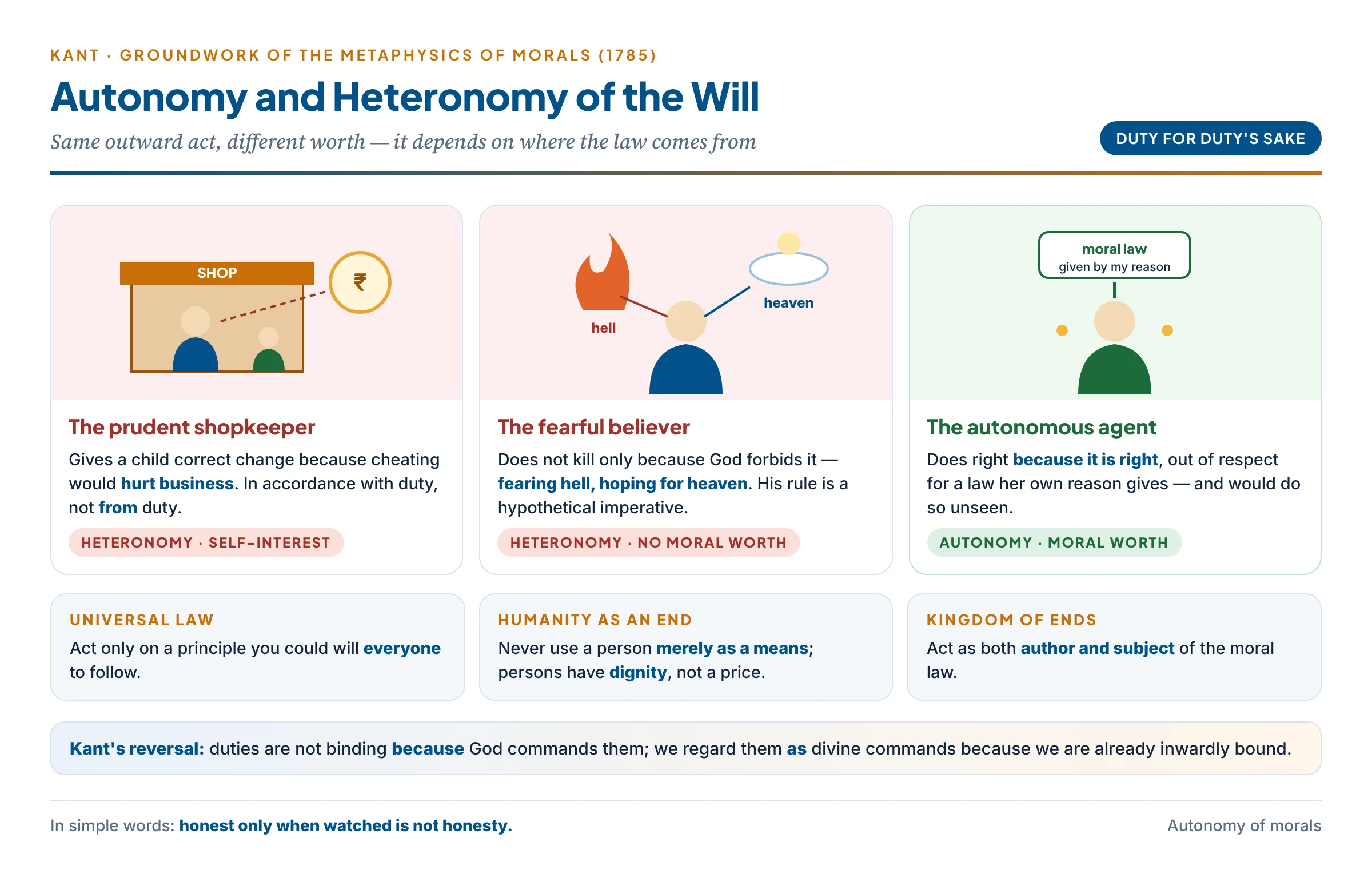
- In accordance with duty vs from duty. A shopkeeper who gives correct change to a child because cheating would hurt his business acts in accordance with duty, but not from duty; his action is prudent, not moral. Only the honesty that is done because it is right has moral worth.
- “Duty for duty’s sake” (Pflicht, duty) is the true rule of life: we must do our duty because it is our duty and not out of any other consideration. An act done as a means to some further end — pleasure, reputation, heaven — does not conform to this principle.
- Hypothetical and categorical imperatives.
- A hypothetical imperative commands conditionally: “If you want X, do Y” — “if you want to pass, study”; “if you want heaven, obey God”. It binds only those who want X.
- The categorical imperative commands unconditionally: “Do Y” — whatever you want. Morality speaks only in categorical imperatives.
- The categorical imperative in its main forms:
- Universal law — act only on a principle that you could will to become a universal law for everyone (a lie cannot be universalised: if everyone lied, no one would be believed).
- Humanity as an end — treat humanity, in yourself and in others, always as an end, never merely as a means. Rational beings have dignity (Würde), not a price.
- Kingdom of ends — act as a legislating member of a community of rational beings, each of whom is both subject and author of the moral law.
3. Autonomy and Heteronomy of the Will
- Autonomy (autos, self; nomos, law): the will gives the moral law to itself through reason. A rational being obeys only laws of which it is also the author. This, for Kant, is the supreme principle of morality and the ground of human dignity.
- Heteronomy (heteros, other): the will is governed by something outside reason — inclination, the desire for happiness, fear, or the will of another, including God.
- Why religion-based motives are heteronomous. If a person refrains from murder only because God said “Thou shalt not kill”, fearing the fires of hell or coveting the pleasures of heaven, the action has no moral worth (moralischer Wert). He acts from prudence, fear and selfish inclination; his “morality” is a set of hypothetical imperatives (“if you want to escape hell, do not kill”).
- Kant’s reversal. Kant states the relation precisely: as far as practical reason has the right to lead us, “we shall not regard actions as obligatory because they are the commands of God, but shall regard them as divine commands because we have an inward obligation to them“.
In simple words
A cricket team that plays fair only because the umpire is watching would cheat the moment he looked away. A team that plays fair because it has made the spirit of cricket its own would play fair in an empty ground. Heteronomy is the first team — the rule lives outside them, in the umpire. Autonomy is the second — the rule lives inside them, as their own law. Kant wants morality to be like the second team, even when the “umpire” is God.
Common confusion
Did Kant say that religion is bad for morality, or that believers cannot be moral? No. Kant objected only to making religion the ground or motive of duty. A believer who does her duty because it is right — and also sees it as God’s will — is fully moral. Kant himself defined religion as “the recognition of all our duties as divine commands“: first we know our duties by reason, then religion lets us see them as God’s commands. Morality is not derived from religion; religion is morality viewed in a certain light.
4. Morality Leads to Religion: The Highest Good
Kant rejected all theoretical proofs of God (ontological, cosmological, design) in the Critique of Pure Reason. But in the Critique of Practical Reason (1788) he argued that practical reason must make certain postulates.
The argument step by step:
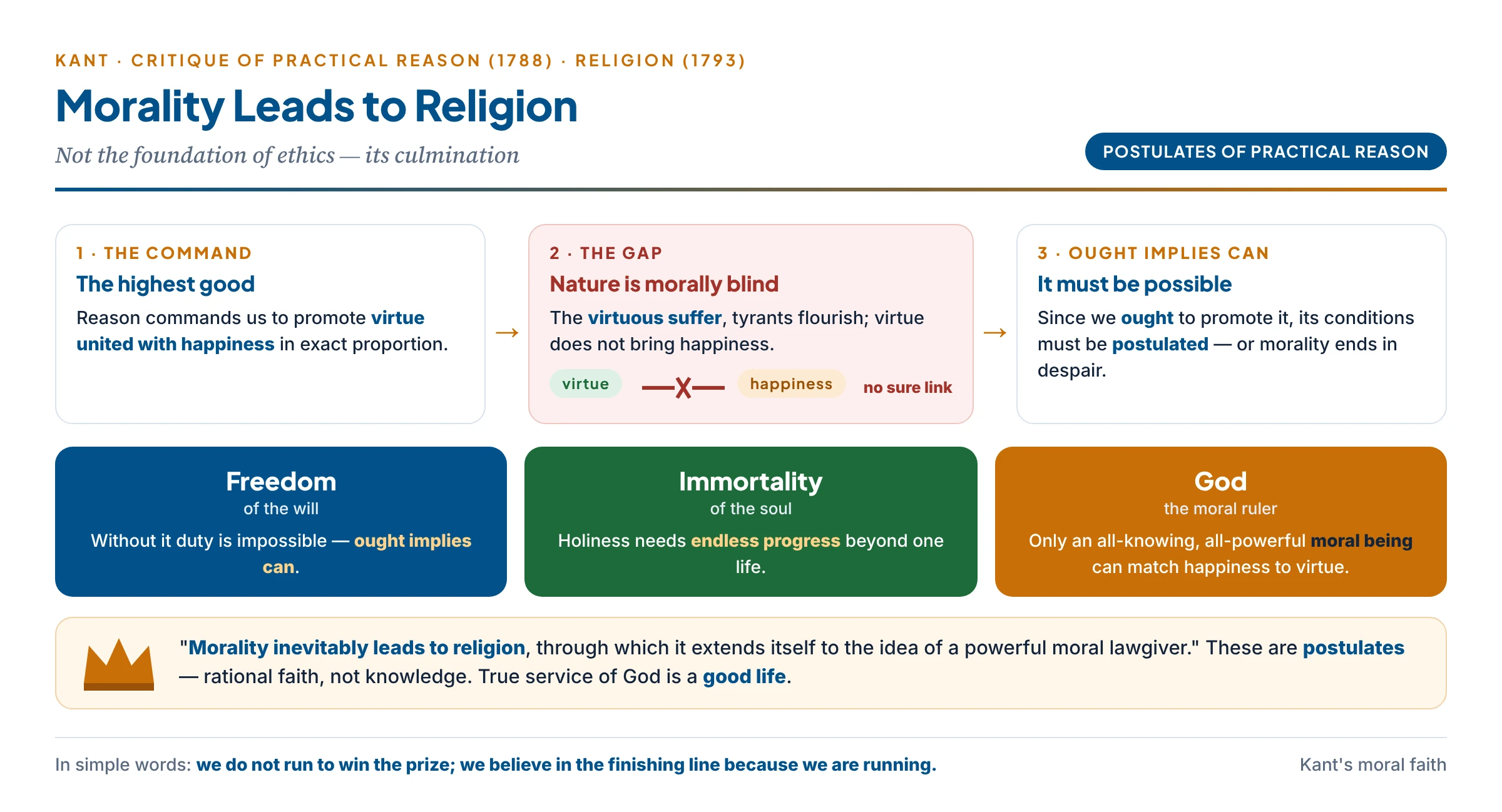
- The highest good (summum bonum). Reason demands that the final goal of moral striving is the highest good: supreme virtue (being worthy of happiness) united with complete happiness in exact proportion to virtue. “To be in need of happiness and also worthy of it and yet not to partake of it” could not be willed by a perfectly rational being.
- The tragic gap (the antinomy of practical reason). In the empirical world, nature is morally blind: the virtuous often suffer poverty and persecution, while corrupt tyrants flourish in luxury. Experience shows that virtue does not necessarily lead to happiness, nor vice to pain.
- The threat. If virtue and happiness are permanently disconnected, the moral law commands us to promote a goal (the highest good) that is impossible — and moral striving seems to collapse into absurdity and despair. What then will inspire people to virtue?
- Ought implies can. Since we ought to promote the highest good, it must be possible. Therefore practical reason must postulate the conditions of its possibility:
- Freedom of the will — without freedom, duty is impossible: “ought implies can“.
- Immortality of the soul — perfect virtue (holiness) cannot be reached in a finite life, so there must be an endless progress towards it.
- The existence of God — a supreme, omniscient, omnipotent and moral ruler of the world, who alone can ensure that happiness is distributed in exact proportion to virtue, if not in this life then in a future one.
- Conclusion: “Morality thus inevitably leads to religion, through which it extends itself to the idea of a powerful moral lawgiver” (Religion within the Bounds of Bare Reason, 1793). Religion is not the foundation of ethics but its culmination.
Postulates, not proofs. A postulate is not knowledge; it is a practically necessary belief — what Kant calls rational faith (Vernunftglaube). We do not know that God exists; we must assume it if we are to take the moral life seriously. Kant’s religion is thus a moral faith, “religion within the boundaries of bare reason”, whose true service of God is a good life; whatever is done to please God beyond good conduct is “religious illusion”.
Common confusion
Did Kant prove the existence of God through morality? No. Kant held that God’s existence can never be proved — neither by theoretical reason nor by moral argument. The moral argument yields a postulate: a belief that practical reason must assume in order to make sense of the duty to promote the highest good. It is “rational faith”, not knowledge. Many notes present Kant’s moral argument as one more “proof” alongside the ontological and cosmological ones — but Kant himself rejected all proofs and offered this only as a practical necessity.
In simple words
A runner trains hard for a race whose finishing line he cannot see. If someone told him “there is no finishing line — the track goes nowhere”, his training would seem pointless. Kant says the moral person is like this runner: the moral law tells him to run towards a world where goodness and happiness meet. To keep running sensibly, he must believe there is a finishing line and someone who guarantees it — immortality and God. He does not run in order to win a prize; he believes in the finishing line because he is already running.
5. Kant’s “Psychological Booster”
- Kant knew that the performance of duty is difficult for weak human beings. So, while making morality wholly autonomous, he recommended that duties be regarded as divine commands — this gives the will strength and seriousness.
- Thus even the father of the autonomy of morals did not discard religion; he kept it as a support to the moral will. For this reason some argue that “morality without religion remains a hoax” — even Kant needed religion to sustain it.
- Kant’s position therefore has three layers:
- Foundation: morality is autonomous — known and binding through reason.
- Goal: morality leads to religion — the highest good requires God.
- Motivation: religion helps — regarding duties as divine commands strengthens the will.
6. Criticisms of Kant’s Moral Route to Religion
- Theology through the back door. Schopenhauer and Nietzsche accused Kant of throwing Christian theology out of the front door (in the Critique of Pure Reason) only to smuggle it in again through the back door (in the Critique of Practical Reason).
- Why must virtue be rewarded? The Stoics held that virtue is its own reward; the Buddhists that the wise seek the end of craving, not happiness as payment. If virtue need not be crowned with happiness, God is not needed to guarantee it.
- “Ought implies can” does not hold here. We may sensibly be told to aim at what we cannot achieve. A dull child may be told she ought to try to learn French, though she never will. So from “we ought to aim at the highest good” it does not follow that the highest good can be realised, nor that God exists.
- Circularity. The argument seems to run: “If God does not exist, we need not aim at the highest good; but we must aim at it, so God exists.” Why not simply conclude that the highest good is not something to aim at?
- Why omnipotence? Even if some powerful being were needed to match virtue and happiness, why must it be omnipotent and omniscient? A being less than God — “a pantheon of very clever, Kantian-minded angels” — could do the job. Kant assumes that what is sufficient to guarantee the highest good is also necessary.
- Kant creates the problem he solves. Ancient and medieval thinkers did not separate virtue and happiness so sharply. Kant first tears them apart and then calls in God to join them again.
- The absurd. Atheist existentialists such as Camus accept the premise that, without God, the demand for justice is thwarted — and conclude not that God exists but that life is absurd. Camus placed at the head of The Myth of Sisyphus Pindar’s line: “O my soul, do not aspire to immortal life, but exhaust the field of the possible.”
7. After Kant: Morality as the Substance of Religion
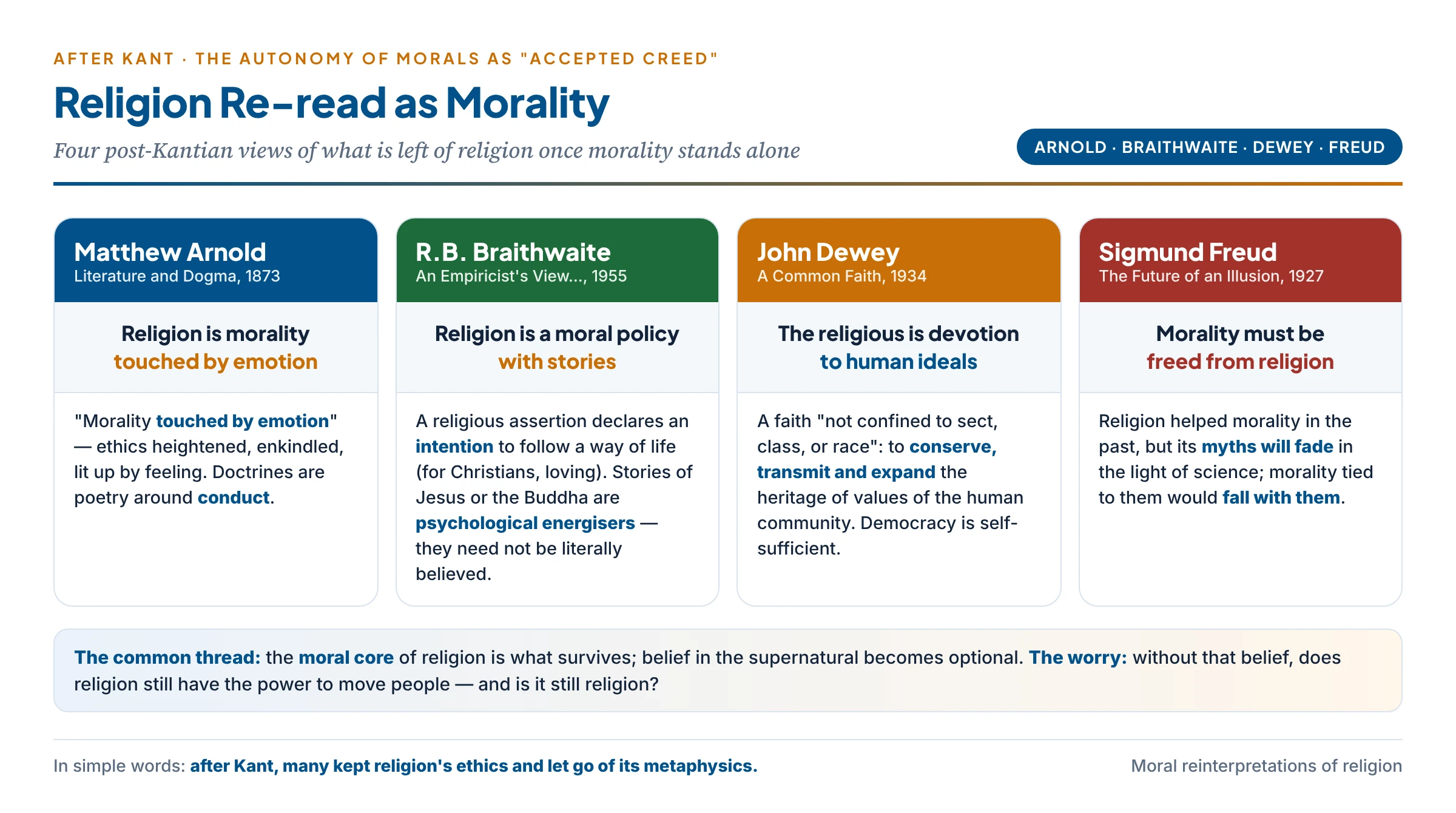
“Since the time of Kant the autonomy of morals has become an accepted creed for the philosophers.” Many then reinterpreted religion in moral terms.
(a) Matthew Arnold
- In Literature and Dogma (1873), the English poet-critic Matthew Arnold defined religion as “morality touched by emotion” — “ethics heightened, enkindled, lit up by feeling”.
- On this view the essence of religion is conduct; doctrines and miracles are poetry that clothes it.
(b) R.B. Braithwaite
- In An Empiricist’s View of the Nature of Religious Belief (1955), Braithwaite argued that a religious assertion is chiefly a declaration of intention to follow a certain policy of behaviour — for a Christian, an agapeistic (loving) way of life — which is general enough to count as a moral policy.
- What distinguishes religions is the stories associated with these policies — the life of Jesus, the life of the Buddha. The stories act as psychological energisers; the believer need not even believe them to be literally true.
- Religion thus becomes morality plus stories.
(c) John Dewey
- Dewey denounced supernatural religion and taught the self-sufficiency of democracy and human co-operation. In A Common Faith (1934) he wrote:
“The things in civilization we most prize are not of ourselves. They exist by grace of the doings and sufferings of the continuous human community in which we are a link. Ours is the responsibility of conserving, transmitting, rectifying and expanding the heritage of values we have received… Here are all the elements for a religious faith that shall not be confined to sect, class, or race.” — John Dewey
- For Dewey the “religious” is an attitude of devotion to ideal ends, not belief in the supernatural.
(d) Freud — morality must be freed from religion
- Freud admitted that religion had done much good for morality in the past. But morality must now be made independent of religion. Why? Because religion is largely mythological, and myths are bound to disappear “in the white light of science”. If religion and morality are kept together, then when religion disappears, morality will be endangered too.
(e) The wider climate
- There is hardly any analytic philosopher today who studies morality with reference to religion.
- Ideologies such as communism denounced religion outright, and liberal democrats such as Dewey treated democracy itself as a sufficient moral faith.
8. Moral Autonomy versus Religion as a Source of Morality
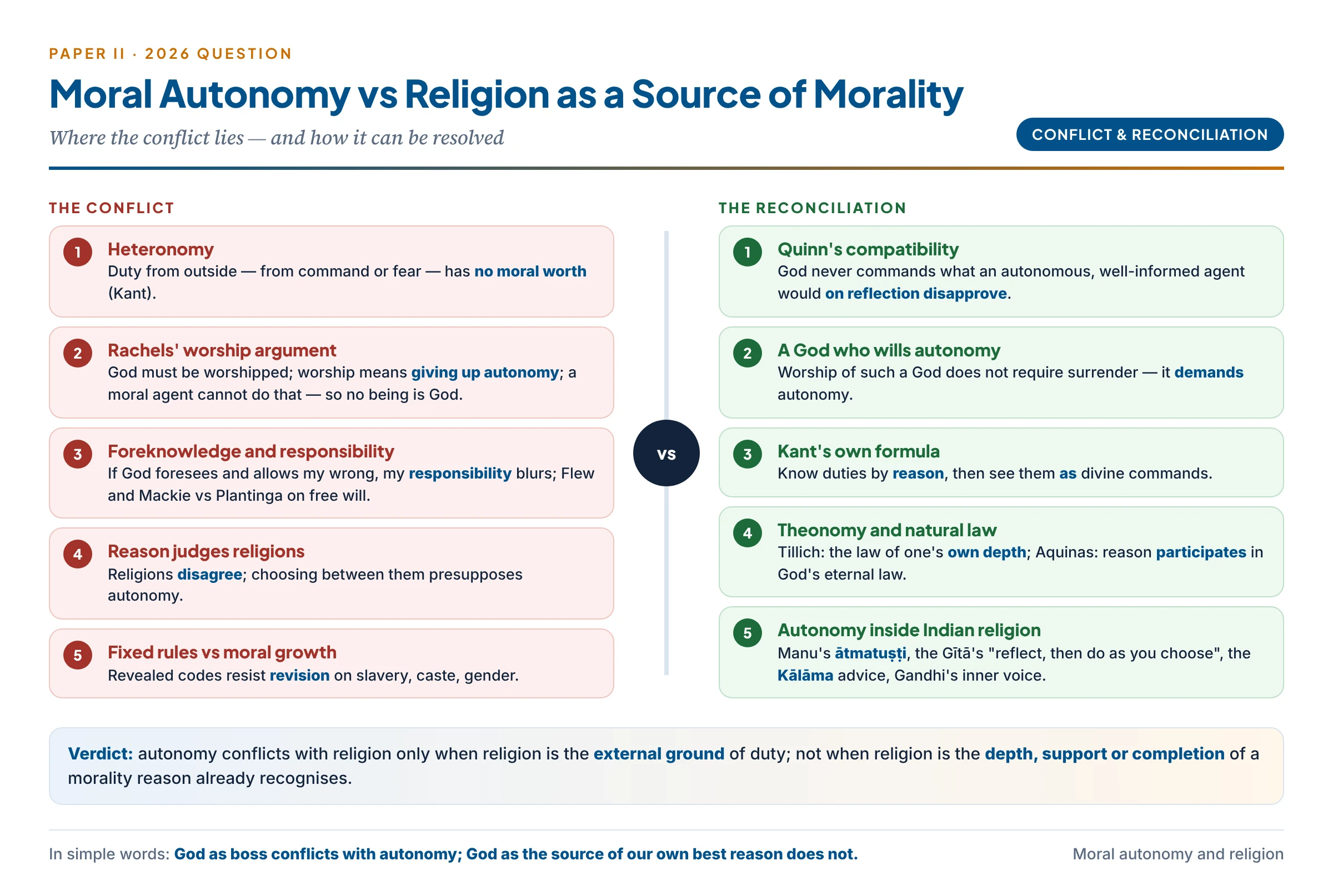
The 2026 paper asks how the issue of moral autonomy conflicts with the conception of religion as a source of morality. The conflict can be stated in several forms.
(a) The heteronomy objection (Kant)
- If religion is the source of morality, the believer’s duties come from outside reason — from God, scripture or church. Acting on them because they are commanded is heteronomy, which has no moral worth.
(b) Rachels’ argument: worship and autonomy
- James Rachels argued that belief in God involves a total, unqualified commitment to obey God’s commands, while “to be a moral agent is to be an autonomous or self-directed agent” — one who acts on precepts he can, on reflection, conscientiously approve in his own heart. Hence:
- If any being is God, he must be a fitting object of worship.
- No being could be a fitting object of worship, since worship requires abandoning one’s role as an autonomous moral agent.
- Therefore there cannot be any being who is God.
(c) Responsibility and divine power
- If God already knows what I will choose and is all-powerful, He could prevent my wrongdoing. If He does not, He seems responsible for its consequences — “aiding and abetting through divine negligence” — and my own moral responsibility seems to dissolve.
- Free will is an essential postulate of morality. Some analytic philosophers, such as Antony Flew and J.L. Mackie, argued that God could have created human beings free and yet so arranged things that they always freely chose the right. Alvin Plantinga replied that this is incoherent: a free act cannot be wholly determined by another; so God could not both grant real freedom and guarantee that no one would ever fall.
(d) Reason as the judge
- Religions and sects disagree on moral questions. To choose between them, one must use reason as the final arbiter — so autonomy is presupposed even by the believer who claims to follow religion.
(e) Fixed rules vs moral growth
- Revealed codes tend to be fixed; autonomous reason can revise moral judgements as understanding grows (on slavery, caste, gender). Autonomy thus seems necessary for moral progress.
Can the conflict be resolved?
- Quinn’s compatibility. An autonomous agent can admit God’s existence if he denies that any supposed divine command that conflicts with his firm, reflective moral judgements really is a divine command. These propositions are consistent: “God exists”; “God sometimes commands agents to do certain things”; “God never commands anything an autonomous and well-informed human moral agent would, on reflection, disapprove.“
- God may will our autonomy. A being worthy of worship may be one who wants us to be autonomous moral agents. Worshipping such a being does not mean abandoning autonomy; it may even require it. Rachels’ argument then collapses.
- Kant’s own solution. Know your duties by reason, then see them as divine commands. Religion becomes the completion of autonomy, not its enemy.
- Theonomy. For Paul Tillich, the true alternative to an alien heteronomy and an empty autonomy is theonomy: the moral law is the law of our own deepest being, which is grounded in the divine. Obeying it is self-fulfilment.
- Natural law. For Aquinas, the natural law is the rational creature’s participation in God’s eternal law: in following reason we follow God.
- Religious autonomy in Indian thought. Indian traditions themselves contain autonomy within religion (see the Indian Connect box below).
In simple words
A good teacher wants her students to understand why an answer is right, not just copy it because she said so. A student who understands may still trust the teacher and follow her advice — but now as someone who sees the reason, not as a slave to her word. Many religious thinkers say God is like such a teacher: He wants obedience that comes from understanding, which is autonomy, not blind submission.
Indian Connect — Autonomy inside Indian religion
- Manu lists four sources of dharma: the Veda, the smṛti, the conduct of the good (sadācāra), and what is pleasing to one’s own self (ātmanaḥ priyam, ātmatuṣṭi) — an inner moral sense alongside scripture.
- At the end of the Gītā, after all his teaching, Kṛṣṇa tells Arjuna: “Reflect on this fully, and then do as you choose” — the decision is left to Arjuna’s own understanding.
- The Buddha’s advice to the Kālāmas: do not accept a teaching merely because of tradition, scripture or a teacher’s authority; accept it when you yourselves know it to be wholesome and conducive to welfare.
- Gandhi made the inner voice of conscience the final court of Truth (Article 9). Indian religion thus often treats moral insight as one’s own, not merely as an external command.
9. Do Moral Principles Function Better Independent of Religion?
Arguments that they do:
- Universality. Principles grounded in reason, sympathy and human need can be shared by people of all faiths and none — essential in plural societies.
- Openness to argument. Secular principles can be debated and revised; religious ones often rest on authority that cannot be questioned.
- Moral progress. Independent morality has been the engine of reform against religiously defended practices (slavery, sati, untouchability).
- Avoiding sectarian conflict. Tying morality to one religion invites conflict with others.
- Survival. As Freud warned, morality tied to religion falls when belief falls.
- Constitutional morality. Modern constitutions (such as India’s) rest public morality on justice, liberty, equality and fraternity, not on any one faith.
Arguments that they do not — or not entirely:
- Motivation. Abstract principles may lack force without the hope, love and community religion supplies; “thin” secular concepts motivate less than “thick” religious ones.
- Depth. Religion interiorises morality and adds love beyond duty and forgiveness.
- Exemplars. Religions offer living models — saints, arahants, tīrthaṅkaras, gurus — which secular ethics largely lacks.
- Kant himself kept religion as a booster.
Verdict. Moral principles function better when they are independent in their foundation and justification — open to all and revisable by reason — but they may function best when religious people are also free to support them from their own traditions.
10. Grounds of Morality for an Atheist
The 2003 question asks, following Kant, what grounds of morality remain for one who rejects God. Kant’s own answer is that the moral law needs no God to be known or binding; only the highest good needs God. Beyond Kant, an atheist may ground morality in:
- Reason — Kant’s categorical imperative, or the demand for consistency: I cannot claim for myself what I deny to others.
- Human welfare — the utilitarian aim of reducing suffering and promoting happiness (Bentham, Mill).
- Human nature and flourishing — Aristotle’s virtues as the qualities a human being needs to live well.
- Sympathy and social life — Hume’s fellow-feeling; morality as a social necessity (as the Indian atheist Gora put it, “moral conduct is not a passport to heaven; it is social necessity”).
- Social contract — fair rules that free and equal persons would agree to (Hobbes, Rawls).
- Evolution — empathy, fairness and reciprocity as traits that developed in social animals.
These are developed in Article 5.
Critical Evaluation
Strengths of the Autonomy Thesis
- It explains why fear and reward cannot be the basis of genuine morality.
- It grounds human dignity in rational self-legislation — the basis of modern human rights.
- It allows a common morality across religions.
- It escapes the Euthyphro dilemma.
Weaknesses
- Formalism. Kant’s categorical imperative is criticised (by Hegel and others) as empty — it tests principles but does not supply concrete content.
- Neglect of feeling and community. Morality is not only reason; sympathy, tradition and community matter (Hume, communitarians, care ethics).
- Kant’s own need for religion — the postulates and the booster — suggests that autonomy alone may not be self-sufficient.
Critics and Defenders
Criticism — Critics of strict moral autonomy
- Divine command theorists: autonomy makes the self a rival to God.
- Anscombe: “moral obligation” without a lawgiver is a survival without sense.
- Schopenhauer, Nietzsche: Kant’s autonomy is theology in disguise.
- Hegel: Kant’s moral law is empty formalism.
- Religious thinkers: autonomous reason cannot supply love, grace and hope.
Defence — Defenders of moral autonomy
- Kant: only action from duty has moral worth; religion completes, not grounds, morality.
- Rachels: autonomy is the essence of moral agency.
- Arnold, Braithwaite, Dewey: religion’s real content is moral.
- Freud: morality must survive the decline of myth.
- Quinn, Tillich, Aquinas: autonomy and religion can be reconciled — through compatibility, theonomy or natural law.
Cross-Tradition Comparison
| Point | Kant | Pūrva Mīmāṃsā | Bhagavad Gītā | Buddhism |
|---|---|---|---|---|
| Source of duty | Reason’s own law | Vedic injunction (codanā) | Svadharma, revealed by Kṛṣṇa | Insight into suffering and its cause |
| Role of God | Postulate for the highest good | None; results through apūrva | Lord who upholds dharma; gives freedom to choose | None |
| Duty without desire | Duty for duty’s sake | Duty because enjoined | Niṣkāma karma — act without desire for fruit | Act without craving |
| Reward | God matches virtue and happiness | Apūrva brings fruit automatically | Liberation; equanimity in success and failure | Nirvāṇa, the end of craving |
Indian Connect — Takeaways
- Kant and the Gītā meet in the ideal of disinterested duty: “your right is to the action alone, never to its fruits.” Both reject acting for reward — though the Gītā grounds duty in a theistic and cosmic order, Kant in reason.
- Kant and Mīmāṃsā both hold a deontological ethics of unconditional command; but Kant locates the command in reason, Mīmāṃsā in the authorless Veda — and Mīmāṃsā, unlike Kant, needs no God even to guarantee results, since apūrva does that automatically.
Synthesis (Siddhānta)
- Kant’s achievement is to show that morality is autonomous in its foundation: duties are known and binding through reason, and action from fear or reward is not genuinely moral. This is now the common starting point of moral philosophy.
- But Kant himself shows the limits of pure autonomy: the moral life points beyond itself to a highest good, and human weakness needs support. His formula — know duties by reason, then see them as divine commands — turns the conflict between autonomy and religion into a partnership.
- The 2026 question is answered thus: moral autonomy conflicts with religion only when religion is taken as the external ground of morality (heteronomy, Rachels). It does not conflict with religion understood as theonomy, natural law or a moral faith that God wills our autonomy — as Indian traditions also suggest with ātmatuṣṭi, the Kālāma advice and Gandhi’s inner voice.
- Contemporary relevance. Modern constitutional democracies rest on autonomous public morality — dignity, equality, liberty — which citizens of every faith can share, while remaining free to draw strength from their religions. This is Kant’s settlement translated into political life.
“We shall not regard actions as obligatory because they are the commands of God, but shall regard them as divine commands because we have an inward obligation to them.” — Immanuel Kant
Previous Year Questions
- 2026How does the issue of moral autonomy conflict with conception of religion as a source of morality? Critically discuss.
- 2025Is it necessary for the normative principles to bear reference to God in order to produce a feeling of obligation in a moral agent? Critically discuss.
- 2016“Moral principles function better when they remain independent and unconnected with religion.” Discuss.
- 2003Are God and religion necessary presuppositions of morality? Elucidate your answer following Kant and consider critically in this context the possible grounds of morality for an atheist.