

12 Applications of Anthropology: Anthropology of sports, Nutritional anthropology, Anthropology in designing of defence and other equipments, Forensic Anthropology, Methods and principles of personal identification and reconstruction, Applied human genetics – Paternity diagnosis, genetic counseling and eugenics, DNA technology diseases and medicine, serogenetics and cytogenetics in reproductive biology, Application of statistical methods
Official Syllabus: Paper I, Unit 12
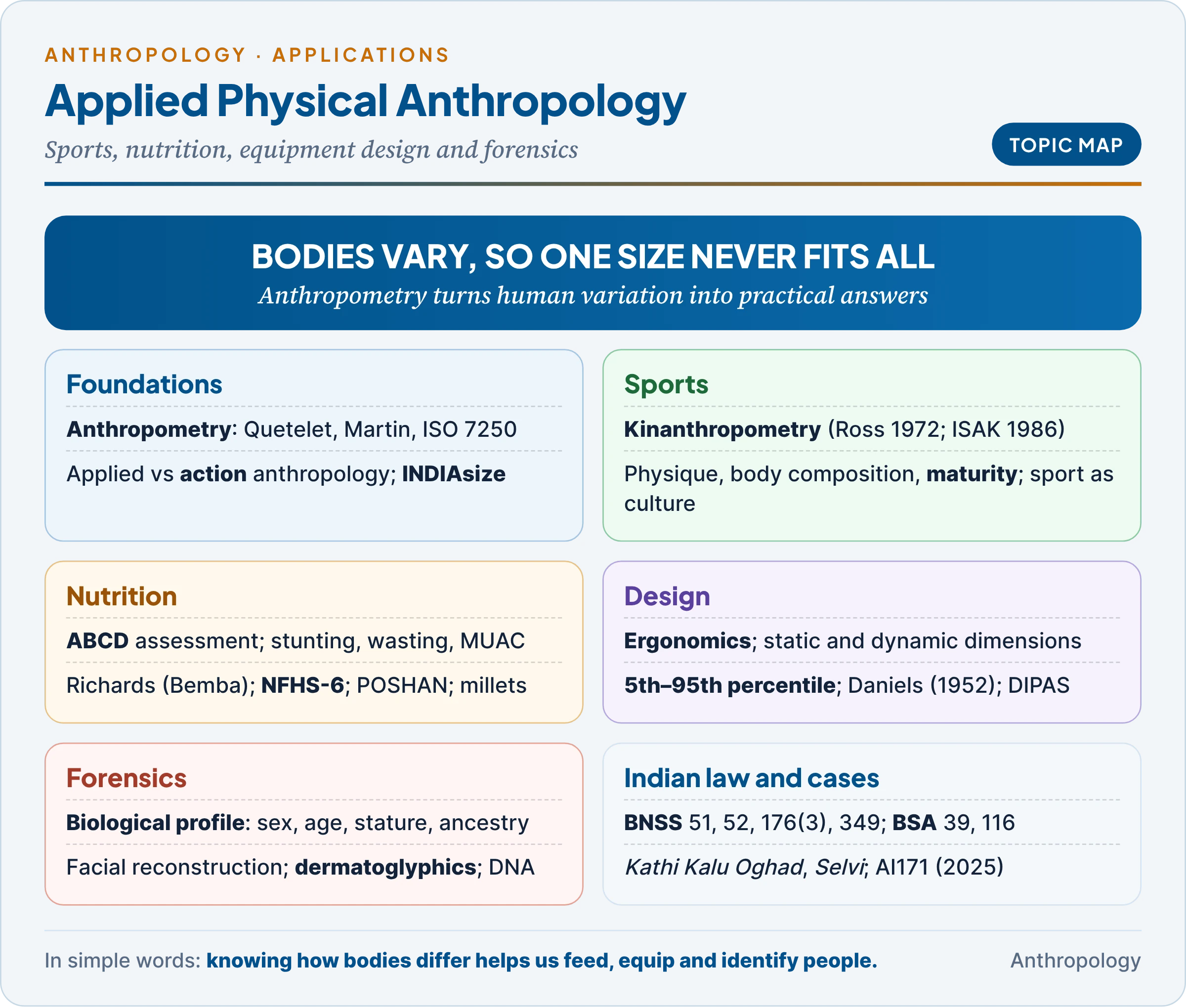
Physical anthropology spent a century measuring human bodies and describing how they vary by age, sex, population and environment. This article shows that knowledge put to work: choosing and training athletes, judging whether children are well fed, designing cockpits, uniforms and chairs that fit, and naming the dead from bones. This is part 1 of the syllabus line; applied human genetics (paternity, counselling, eugenics, DNA in medicine, serogenetics, cytogenetics) and statistical methods are treated in 12b.
1. Applied Physical Anthropology
In simple words
Applied physical anthropology uses what we know about the human body and its variation to solve practical problems. Its main tool is anthropometry, the careful measurement of the body, and its main lesson is that bodies differ, so one size never fits all.
1.1 Meaning and tools
- Applied anthropology is the use of anthropological knowledge, methods and theory to solve practical problems. Action anthropology, associated with the American anthropologist Sol Tax and his Fox Project (1948–59) among the Meskwaki of Iowa, goes further: the anthropologist works with a community, at its request, towards goals the community sets.
- Applied physical anthropology applies knowledge of human biological variation: growth, physique, body composition, nutrition, genetics and the skeleton.
- Anthropometry (measurement of the human body) is the common tool. The Belgian statistician Adolphe Quetelet published Anthropométrie (1870), and the German anthropologist Rudolf Martin‘s Lehrbuch der Anthropologie (1914) standardised the landmarks and instruments (anthropometer, calipers, skinfold calipers) that are still used, now codified in ISO 7250.
| Applied anthropology | Action anthropology | |
|---|---|---|
| Who sets the goal | Usually an agency (state, firm, army) | The community itself |
| Role of anthropologist | Expert adviser | Partner and learner |
| Example | Anthropometric sizing of army uniforms | Fox Project, Iowa (Sol Tax) |
The contrast is one of control: applied work answers someone else’s question, action work helps a community answer its own. Most of this article is applied work.
1.2 Indian anthropometric surveys
- The Anthropological Survey of India‘s All India Anthropometric Survey, conceived by N. K. Bose and carried out under D. K. Sen, measured thousands of people across castes and tribes zone by zone; its analytical volumes (1980s–1990s) used Mahalanobis D² (a statistical distance between groups) instead of racial typing.
- INDIAsize, India’s first National Sizing Survey, led by the National Institute of Fashion Technology for the Ministry of Textiles, scanned 26,324 people aged 15 and above with 3D whole-body scanners in six cities (2021–22) and produced 27 body-size charts (14 for men, 13 for women), released in full in January 2026.
2. Anthropology of Sports
In simple words
The anthropology of sports studies both the athlete’s body and the culture of games. Measuring physique helps match people to the sports that suit them and train them safely; studying play and ritual shows what sport means to a society.
The small district of Simdega in Jharkhand, home mainly to Munda, Oraon and Kharia communities, has produced a remarkable number of India’s hockey players, among them Salima Tete, who played at the Tokyo Olympics (2021). The explanation is bio-cultural: a lean, agile physique built by active rural childhoods, a long village tradition of hockey and community pride in the game. Physique alone does not make a sportsperson, and neither does culture alone.
2.1 Kinanthropometry
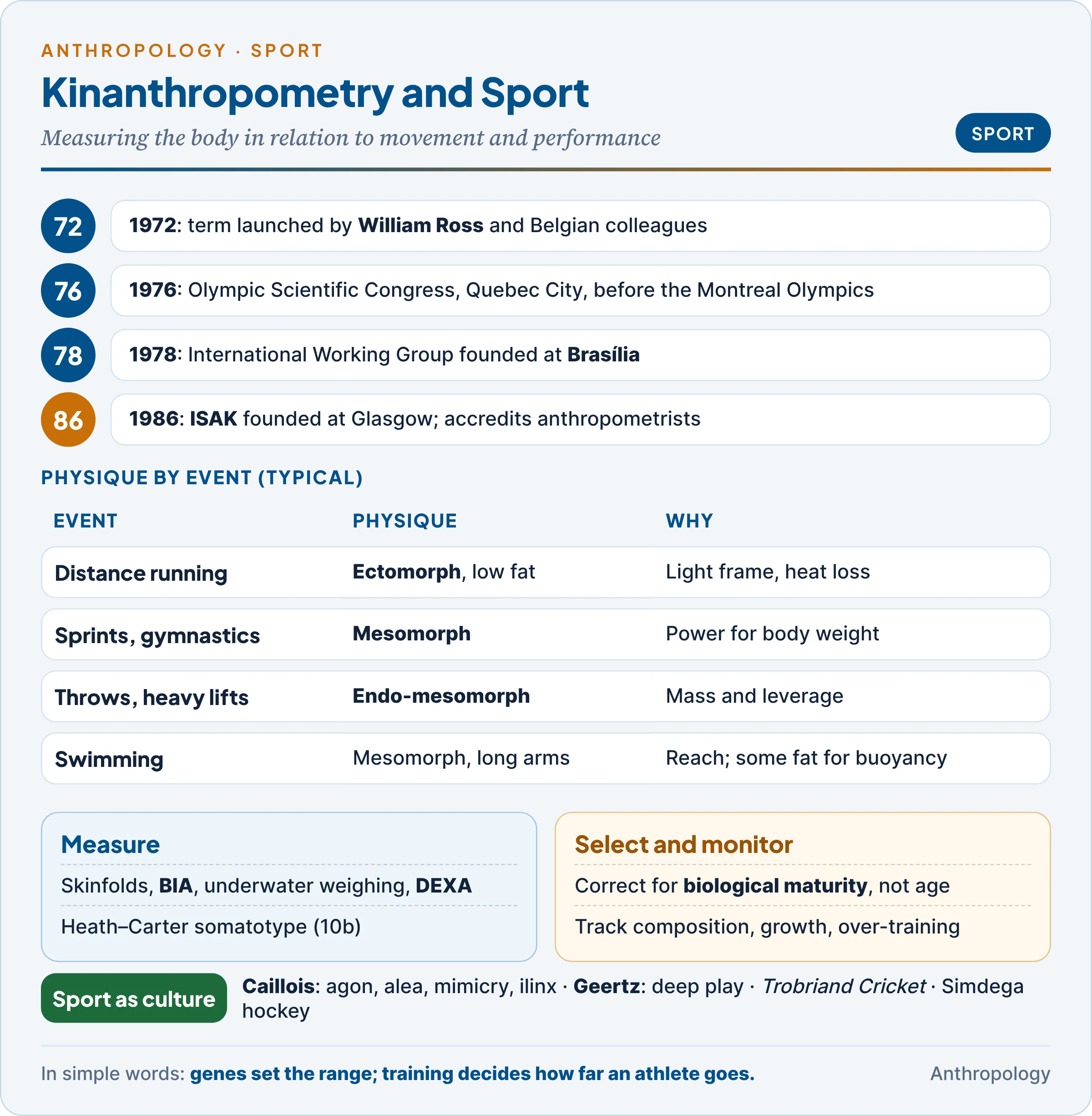
- Kinanthropometry (Greek kinein, to move; anthropos, human; metrein, to measure) is the study of human size, shape, proportion, composition, maturation and gross motor function in relation to movement and performance.
- The term was launched in 1972 by the Canadian William Ross with the Belgians Marcel Hebbelinck and colleagues. It was first featured at the Olympic Scientific Congress at Quebec City (1976), held before the Montreal Olympics of 1976.
- The International Working Group on Kinanthropometry was founded at Brasília on 11 September 1978 under UNESCO’s International Council of Sport Science and Physical Education; it became the International Society for the Advancement of Kinanthropometry (ISAK) at Glasgow in 1986, which today accredits anthropometrists worldwide.
2.2 Physique, body composition and sport
Early classifications linked body type to event:
| Scholar | Type | Best suited to |
|---|---|---|
| Kohlrausch (1929) | Slender | Running, jumping, hurdling |
| Medium | Boxing, ball games, swimming | |
| Massive | Weightlifting, throwing, wrestling | |
| Arnold (1931) | Gymnast, wrestler, pentathlon types | Matching trunk, breadth and leg length to event |
- J. M. Tanner (British auxologist) measured Olympic athletes in The Physique of the Olympic Athlete (1964), showing that each event selects a narrow band of physiques.
- Somatotype (a three-number rating of physique: endomorphy or relative fatness, mesomorphy or muscle and bone, ectomorphy or relative linearity) is the main summary. The Heath–Carter method (1967) rates it from ten anthropometric measurements, so it can be applied to anyone; its method and the somatochart are treated in 10b.
- Typical patterns: distance runners are ectomorphic and low in fat; sprinters and gymnasts mesomorphic; throwers and heavyweight lifters endo-mesomorphic; swimmers are mesomorphs with long trunks and arms, and some fat aids buoyancy and heat retention.
- Body composition (the proportions of fat, muscle and bone) matters as much as shape: excess fat is “inert weight” in running and jumping. It is measured by skinfold thickness, bioelectrical impedance (resistance of the body to a weak current), underwater weighing and DEXA (dual-energy X-ray absorptiometry).
- Physiology and genes: fast-twitch (type II) and slow-twitch (type I) muscle fibres, VO₂max (maximal oxygen uptake) and genetic variants such as ACTN3 R577X (the RR form is more common in sprinters; Yang and colleagues, 2003). Genes set the range; training, nutrition and motivation decide where in it an athlete reaches.
2.3 Selection and monitoring of sportspersons
- Talent identification: batteries of anthropometric, physiological and skill tests (as in the Sports Authority of India‘s talent schemes and Khelo India fitness assessments) identify children with physiques suited to particular sports.
- Maturity, not age: children of the same age differ by years in biological maturity (skeletal age, peak height velocity). Early maturers look more talented at 12 and are over-selected (the relative age effect); anthropologists correct for maturity so that late developers are not lost.
- Monitoring: repeated measurement tracks body composition, growth and over-training; it guides weight categories, nutrition and injury prevention.
- Equipment: anthropometric data shape shoes, cycles and protective gear (§4).
2.4 Sport as culture
- Play: the Dutch historian Johan Huizinga (Homo Ludens, 1938) treated play as older than culture; the French sociologist Roger Caillois (Man, Play and Games, 1958) classified games as agon (competition), alea (chance), mimicry (make-believe) and ilinx (vertigo).
- Deep play: Clifford Geertz‘s essay on the Balinese cockfight (1972) read betting and status in the cockpit as a story the Balinese tell themselves about their own social hierarchy.
- Appropriation: the film Trobriand Cricket (1976, Jerry Leach and Gary Kildea) showed islanders turning a missionary game into a ritual of chiefly rivalry, with dances and unlimited players.
- Sport and social complexity: Kendall Blanchard and Alyce Cheska (The Anthropology of Sport, 1985) found sport growing more organised with society: wrestling and ball games among the Arunta band, Choctaw stickball (ancestor of lacrosse) and Tikopia dart matches (studied by Raymond Firth) in chiefdoms, professional spectator sport in states. Mihaly Csikszentmihalyi‘s flow (total absorption in a challenging activity) explains its appeal.
- War and ritual: Richard Sipes (1973) found that societies with frequent warfare also had more combative sports; George Gmelch described baseball magic, players’ rituals that manage uncertainty, as Malinowski’s theory of magic predicts.
- Indian cases: Jallikattu (bull-embracing in Tamil Nadu), upheld by the Supreme Court in May 2023 as cultural heritage; mallakhamb and kabaddi.
- Sex categories: the sprinter Dutee Chand challenged hyperandrogenism rules and won at the Court of Arbitration for Sport (2015); in September 2025 World Athletics made a one-time SRY gene test a condition for the female category. Who counts as a woman in sport is a question where biology and culture meet.
Common confusion
Is kinanthropometry the same as somatotyping? No. Somatotyping rates physique on three components. Kinanthropometry is the wider field: it measures size, proportion, composition and maturation and relates all of them to movement and performance. Somatotyping is one of its tools.
3. Nutritional Anthropology
In simple words
Nutritional anthropology studies what people eat, why they eat it and what it does to their bodies. It combines measuring bodies to judge nutrition with studying the beliefs, customs and inequalities that decide who gets which food.
The British social anthropologist Audrey Richards lived among the Bemba of Northern Rhodesia (now Zambia) and wrote Hunger and Work in a Savage Tribe (1932) and Land, Labour and Diet in Northern Rhodesia (1939). She showed that the Bemba went hungry every year before the millet harvest not because they were ignorant of food but because labour migration, kinship obligations and the rhythm of shifting cultivation shaped what could be grown and shared. Diet, she argued, can only be understood as part of the whole social system.
3.1 Meaning and scope
- Nutritional anthropology studies the food intake and nutritional status of individuals and communities, and the ecological, genetic, social and cultural factors behind them. It overlaps with nutrition science, epidemiology and public health.
- Research directions: food intake and health; genetic and physiological adaptation to diet (lactase persistence, the thrifty genotype in 9.8); socio-cultural processes (food habits, taboos, distribution); the social epidemiology of malnutrition; and beliefs about food and the body.
- Food as culture: Claude Lévi-Strauss‘s culinary triangle (raw, cooked, rotted) read cooking as the passage from nature to culture; Mary Douglas (“Deciphering a Meal”, 1972) showed that meals encode social boundaries; Marvin Harris (Good to Eat, 1985) explained food preferences by their material costs and benefits.
- Indian food cultures: the hot–cold classification of foods in pregnancy and illness; “eating down” (eating less in late pregnancy to have a small baby and easier delivery); women eating last and least in many households; caste rules of commensality; and the high nutritional value of tribal and millet diets.
- Nutrition transition: as incomes rise, diets shift from millets, pulses and vegetables to refined cereals, sugar, fats and processed food, producing the double burden of undernutrition and obesity (9.8).
- Energy basics: carbohydrate and protein give 4 kcal per gram, fat 9 kcal; the basal metabolic rate is the energy used at complete rest; deficiency can be primary (too little food) or secondary (illness preventing absorption).
3.2 Assessing nutritional status
Assessment uses four kinds of evidence, often remembered as ABCD.
- Anthropometric: body measurements compared with a reference (below).
- Biochemical: blood haemoglobin (anaemia), serum albumin, ferritin, vitamin levels, urinary iodine.
- Clinical: signs graded by the WHO Expert Committee (1963) into those of value, those needing further study and those unrelated to nutrition: Bitot’s spots (vitamin A), angular stomatitis (B-complex), bleeding gums (vitamin C), goitre (iodine), oedema and the flag sign in hair (protein).
- Dietary: 24-hour recall, food frequency questionnaires and weighed intake, compared with the ICMR–NIN recommended dietary allowances.
Anthropometric indices for children:
| Index | Deficit called | What it shows |
|---|---|---|
| Height-for-age | Stunting | Chronic, long-term undernutrition |
| Weight-for-height | Wasting | Acute, recent undernutrition |
| Weight-for-age | Underweight | A composite of both |
| MUAC (mid-upper-arm circumference) | Under 115 mm = severe acute malnutrition (6–59 months) | Quick field screening |
The key distinction is time: stunting records years of deprivation and wasting records a recent crisis, so a famine raises wasting first, while a lifetime of poor diet and infection shows as stunting. Weight-for-age cannot tell the two apart, which is why the Waterlow classification (1972) separated wasting from stunting.
- Classifications: Gómez (1956) graded weight-for-age as a percentage of the reference median (I: 75–90%, II: 60–75%, III: under 60%); the Wellcome classification (1970) added oedema (60–80% with oedema is kwashiorkor, under 60% with oedema marasmic kwashiorkor, under 60% without oedema marasmus); today the WHO Child Growth Standards (2006) use z-scores, with below −2 moderate and below −3 severe.
- Field tools: the QUAC stick (Arnhold, 1969; arm circumference against height), colour-coded MUAC tapes, the bangle test, skinfolds at the triceps and subscapular sites, and the chest–head ratio (in a well-fed child the chest overtakes the head after about six months).
- Adults: body mass index (BMI) = weight (kg) ÷ height (m)². WHO cut-offs are under 18.5 (underweight), 25 (overweight) and 30 (obese); lower cut-offs (23 and 25) are used for Asian Indians, who carry more fat at the same BMI.
Worked examples.
- BMI: a woman weighing 50 kg and 1.60 m tall has BMI = 50 ÷ (1.60 × 1.60) = 50 ÷ 2.56 = 19.5, within the normal range.
- Gómez grade: a child weighing 8.1 kg whose reference median weight-for-age is 12.0 kg is at 8.1 ÷ 12.0 × 100 = 67.5%, so Grade II malnutrition.
- z-score: z = (observed − reference median) ÷ reference SD. With illustrative values of 81.0 cm observed, 87.0 cm median and 3.0 cm SD, z = −6.0 ÷ 3.0 = −2.0, the threshold of stunting.

3.3 India: data and programmes
- NFHS-6 (2023–24): stunting among under-fives fell from 35.5 to 29.3 per cent, severe wasting from 7.7 to 5.2 per cent, and underweight barely moved (32.1 to 31.8 per cent). In NFHS-5, 67.1 per cent of children aged 6–59 months and 57 per cent of women were anaemic.
- Programmes: POSHAN Abhiyaan (launched 8 March 2018), merged into Saksham Anganwadi and Poshan 2.0 (2021), with the Poshan Tracker for growth monitoring; PM POSHAN school meals (2021, formerly the Mid-Day Meal); Anaemia Mukt Bharat (2018); and fortified rice in the public distribution system.
- Millets: at India’s proposal the UN declared 2023 the International Year of Millets, and India renamed millets Shree Anna. Millets such as ragi (rich in calcium) and jowar are drought-tolerant and central to many tribal diets, so their revival joins nutrition, ecology and cultural heritage.
- The anthropological point: programmes work when they respect local food cultures, reach women and girls within the household, and address sanitation and infection, which waste nutrients even when food is available.
4. Anthropology in Designing Defence and Other Equipment
In simple words
Equipment works best when it fits the people who use it. Anthropologists measure many people, describe how much they vary, and tell designers which sizes and adjustments are needed so that almost everyone can use a seat, a helmet or a control safely.
In the late 1940s the US Air Force was losing aircraft to pilot error. A young researcher, Gilbert Daniels, measured 4,063 pilots on ten body dimensions used in cockpit design and found that not one was within the middle range on all ten. A cockpit built for the “average pilot” fitted nobody. His report, The “Average Man”? (1952), led to adjustable seats, pedals and harnesses, and established the central rule of ergonomic design: design for variation, not for the average.
4.1 Ergonomics and anthropometry
- Ergonomics (Greek ergon, work; nomos, law), named by the British psychologist K. F. H. Murrell in 1949, is the design of tools, tasks and environments to fit human capabilities and limits. In the United States it is called human factors engineering.
- A man–machine system works well when it is efficient, safe and comfortable; designs that ignore human variation cause poor performance, accidents, fatigue and musculoskeletal injury.
- Design involves three parties: users, anthropologists (who supply data on variation in a simple, usable form) and manufacturers.
- Static (structural) anthropometry measures the body in fixed standard postures: stature, sitting height, eye height, shoulder breadth, popliteal height (floor to the back of the knee), buttock–knee length, head and hand dimensions. Dynamic (functional) anthropometry measures the body in motion: reach envelopes, clearance during movement, strength and range of joint movement.
4.2 Percentiles and design principles
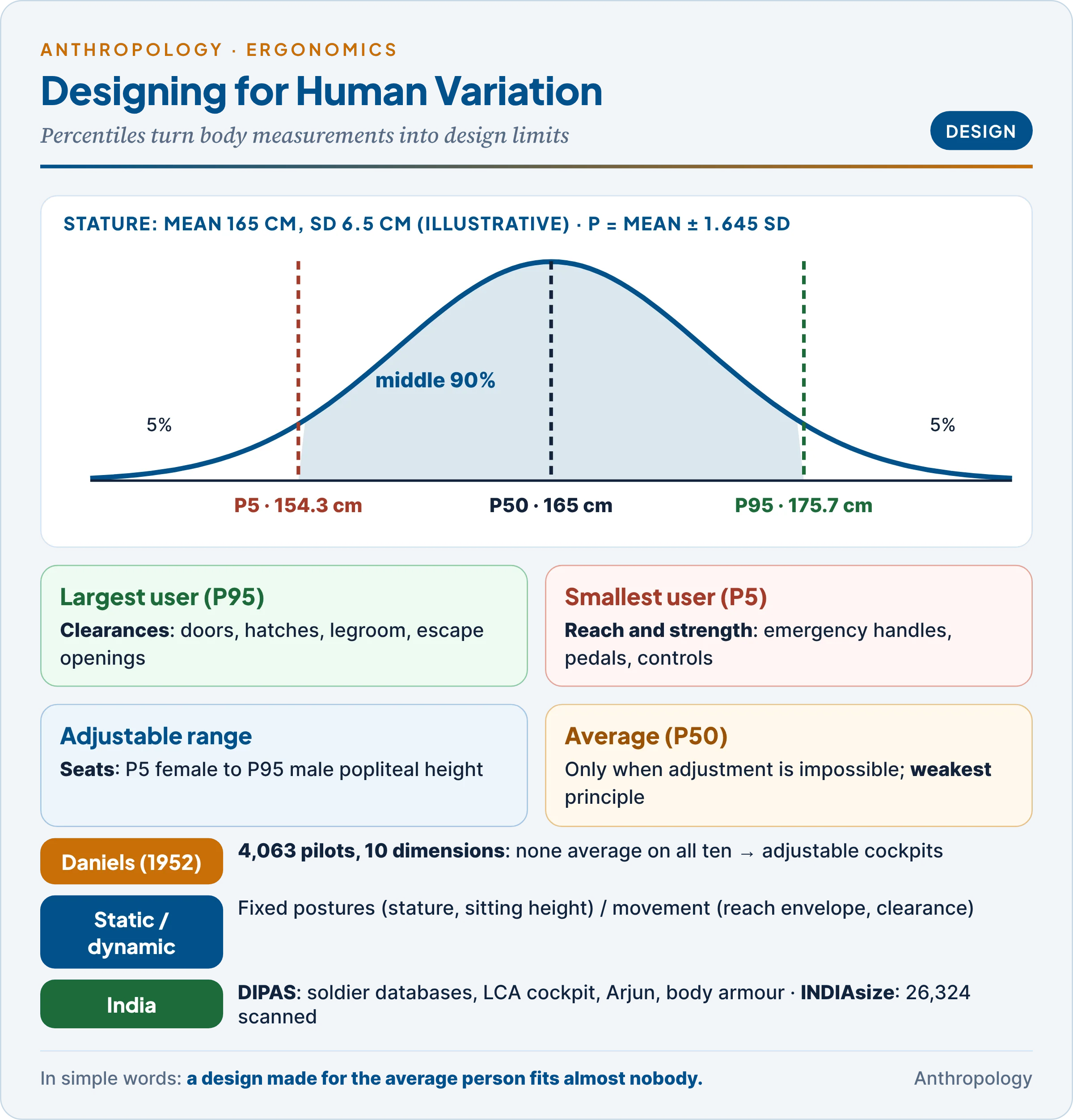
A percentile is the value below which a given percentage of a population falls: the 5th percentile stature is the height that only 5 per cent are shorter than. Designers usually aim to accommodate the middle 90 per cent (5th to 95th percentile).
| Principle | Use | Example |
|---|---|---|
| Design for the largest (95th percentile) | Clearances | Door and hatch height, legroom, escape openings |
| Design for the smallest (5th percentile) | Reach and strength | Emergency handles, pedals, overhead controls |
| Design for a range (adjustable) | Items people adjust | Seats from 5th-percentile female to 95th-percentile male popliteal height |
| Design for the average | Only where adjustment is impossible and fit is not critical | Shop counters, park benches |
The table shows why “average” is the weakest principle: a door built for average height injures the tall half of users, and a lever placed for average reach is out of reach for the short half. Because body dimensions are only partly correlated, a design that fits 90 per cent on each of several dimensions fits far fewer people on all of them together, which is exactly Daniels’s finding.
Worked example. If adult male stature in a population has a mean of 165 cm and a standard deviation of 6.5 cm (illustrative figures), and is normally distributed:
- 5th percentile = mean − 1.645 SD = 165 − 1.645 × 6.5 = 165 − 10.7 = 154.3 cm
- 95th percentile = mean + 1.645 SD = 165 + 10.7 = 175.7 cm
- A bunk or hatch must therefore clear at least 176 cm plus allowances for boots, helmet and movement, while a control must be reachable by the shortest users.
Population specificity: data from one population mislead in another. Korean soldiers had difficulty handling the American M-1 rifle (grasping the stock, reaching the trigger, sighting), and Korean crews could not reach valve handles in a ship’s engine room designed elsewhere. India’s diverse population needs its own data, which is why surveys such as INDIAsize matter.
4.3 Defence applications
- Second World War: anthropologists sized gun turrets (cramped, movable enclosures for a gunner with machine guns, which had to allow full movement while adding little air resistance), cockpits and seats, and flight clothing.
- Helmets and masks: sculpted wooden head forms in four statistically derived sizes, and seven face forms for oxygen masks, were supplied to manufacturers as standards.
- Pressure suits: at altitudes above about 50,000 feet the body swells as pressure falls; the physiologist J. P. Henry devised the partial-pressure suit, which had to fit like skin, so sizing data were essential. Every garment is checked by a fit test on a sample covering the full size range; stature and weight correlate best with other dimensions and serve as sizing keys.
- Ejection seats (first used by Germany in the Second World War) require the centre of gravity of the body and its limbs, measured in living subjects, so the seat does not tumble; the same data improved car seats and crash safety.
- Modern surveys: the US Army’s ANSUR (1988) and ANSUR II (2012) databases guide the design of body armour, vehicles and uniforms, now including women.
- India: the Defence Institute of Physiology and Allied Sciences (DIPAS) of DRDO has built anthropometric databases of Indian service personnel (one study measured 76 body dimensions) for uniform sizing and personal protective equipment, and developed digital human models of Indian soldiers and pilots to evaluate the LCA Tejas cockpit, the Arjun tank, bullet-proof jackets and load-carrying backpacks.
- Ethics: anthropology’s link with the military is contested. The US Army’s Human Terrain System (2007–2014) embedded social scientists with combat units; an American Anthropological Association commission (2009) judged it incompatible with the discipline’s ethics of informed consent and doing no harm.
4.4 Civilian design
- Workspace design: school furniture (often too high or deep for Indian pupils), factory workstations, bus and tractor cabins, and kitchens for older and disabled users.
- Personal equipment: garments, footwear, gloves, helmets and spectacles; INDIAsize charts now replace sizes borrowed from Western data.
- Components: knobs, levers, switches, handholds and hand tools, including agricultural tools designed for the smaller hands of women farmers.
- Health and safety: car seats and belts, hospital beds, wheelchairs and personal protective equipment.
5. Forensic Anthropology: Personal Identification and Reconstruction
In simple words
Forensic anthropology applies knowledge of the human skeleton to legal cases. From bones, teeth and traces left on objects, anthropologists work out the sex, age, height and individual features of an unknown person, and help name the dead and reconstruct what happened.
On 12 June 2025 an Air India Boeing 787 (flight AI171) crashed into a medical college hostel just after take-off from Ahmedabad, killing 260 people. Fire left most remains unrecognisable. Forensic teams collected 318 bodies and body parts and DNA samples from about 250 relatives; within about two weeks, 254 victims were identified by DNA matching and six by facial recognition. The case shows modern disaster victim identification: recovery, biological profiling, comparison with antemortem (before-death) records and DNA, and return of remains to families.
5.1 Meaning and development
- Forensic comes from the Latin forensis, “of the forum”, the place of public courts. Forensic anthropology applies physical anthropology to questions of law.
- The American anthropologist T. Dale Stewart (Essentials of Forensic Anthropology, 1979) defined it as “that branch of physical anthropology which, for forensic purposes, deals with the identification of more or less skeletonized remains known to be, or suspected of being, human”.
- Development: Wilton Krogman‘s guide to identifying skeletal material for the FBI (1939); Mildred Trotter‘s work on war dead; the Physical Anthropology section of the American Academy of Forensic Sciences (1972); and Clyde Snow‘s work with the Argentine Forensic Anthropology Team (from 1984) on the “disappeared”, which made the field central to human rights investigation.
- Scope: recently dead, decomposed or mutilated bodies, skeletal and fragmentary remains, mass disasters and mass graves, and bioarchaeology. In 2014 skeletons found in a well at Ajnala, Punjab, were studied with mitochondrial DNA and oxygen isotopes (2022); the results placed the dead men’s origins in the Gangetic plain, consistent with the Bengal Native Infantry soldiers killed in 1857.
5.2 Principles of personal identification
- Locard’s exchange principle: the French criminologist Edmond Locard held that every contact leaves a trace; the criminal leaves something at the scene and carries something away.
- Individuality: no two persons share the same combination of features (fingerprints, DNA, dental work, healed fractures).
- Comparison: identification means matching postmortem findings with antemortem records: medical X-rays, dental charts, fingerprints, DNA from relatives.
- Primary and secondary identifiers: Interpol‘s disaster victim identification guidelines treat fingerprints, dental records and DNA as primary (enough on their own), and medical features, tattoos and personal effects as secondary.
- Recovery protocol: document the scene, map the position of remains, recover and preserve all material, keep a chain of custody, and only then analyse.
5.3 The biological profile from the skeleton
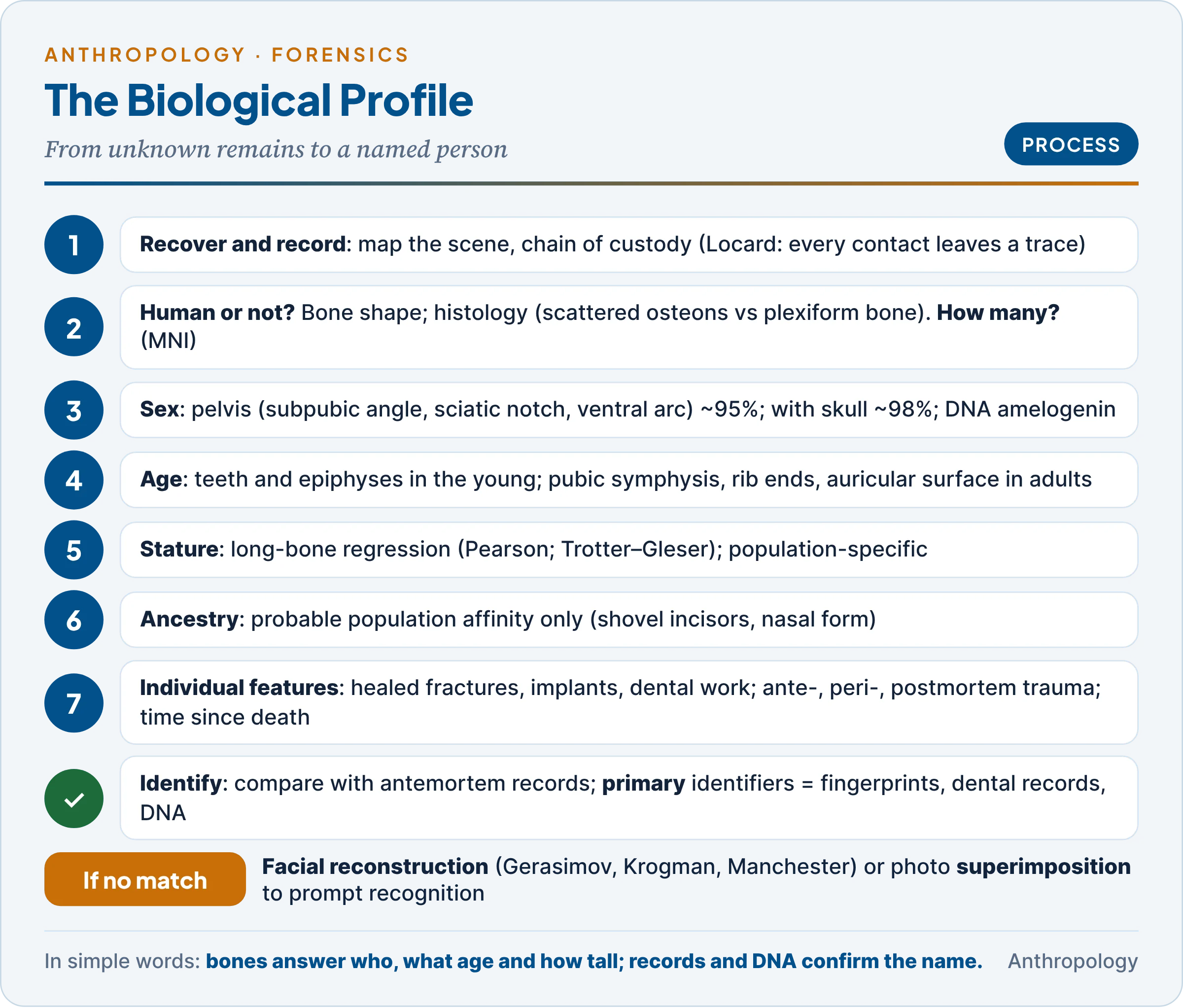
The examination answers a fixed sequence of questions: Are the bones human? How many individuals (minimum number of individuals)? What were their sex, age, stature and ancestry? What individual features, trauma and time since death can be read?
(a) Human or not: shape and size of bones, and, for fragments, bone histology (human bone has scattered osteons, the cylindrical units of compact bone; many animals have regular plexiform bone).
(b) Sex. The pelvis is the best indicator, because natural selection for childbirth has given the female pelvis a wider birth canal.
| Trait | Male | Female |
|---|---|---|
| Subpubic angle | Narrow, V-shaped (about 50–70°) | Wide, U-shaped (about 90° or more) |
| Greater sciatic notch | Narrow, deep | Wide, shallow |
| Pelvic inlet | Heart-shaped | Round or oval |
| Preauricular sulcus | Rare | Often present |
| Sacrum | Long, narrow, evenly curved | Short, broad, less curved |
| Ventral arc of pubis (Phenice, 1969) | Absent | Present |
| Skull | Large mastoids, heavy supra-orbital ridges, rounded orbit margins, square chin | Small mastoids, smooth brow, sharp orbit margins, pointed chin |
The pelvis alone gives about 95 per cent accuracy and pelvis with skull about 98 per cent in adults; the skull alone is less reliable, and long bones (head diameters of the humerus and femur) give population-specific cut-offs. Sex cannot be read reliably from the skeletons of children; for fragments, the amelogenin gene in DNA settles it.
(c) Age at death.
- Children: dental eruption (deciduous teeth from about 6 months to 2½ years; first permanent molar about 6 years; third molar variable, about 17–21) and the appearance and fusion of ossification centres. Fusion follows a sequence: elbow (about 14–16 years), hip and ankle, then knee and wrist (about 18–20), iliac crest, and last the medial end of the clavicle (mid-twenties). Females mature one to two years earlier.
- Adults: the pubic symphysis face changes from ridged and furrowed in youth to smooth and rimmed, then eroded (Todd, 1920, ten phases; McKern and Stewart, 1957; Suchey–Brooks, 1990, six phases); the sternal ends of the ribs (İşcan and colleagues, 1984); the auricular surface of the ilium (Lovejoy and colleagues, 1985); cranial suture closure (Meindl and Lovejoy, 1985); and degenerative changes. Accuracy falls with age, to a range of a decade or more after 50.
- In the living: Indian courts often rely on radiological ossification tests to estimate age; under the Juvenile Justice Act, 2015 (section 94), such tests are used only when birth or school records are not available.
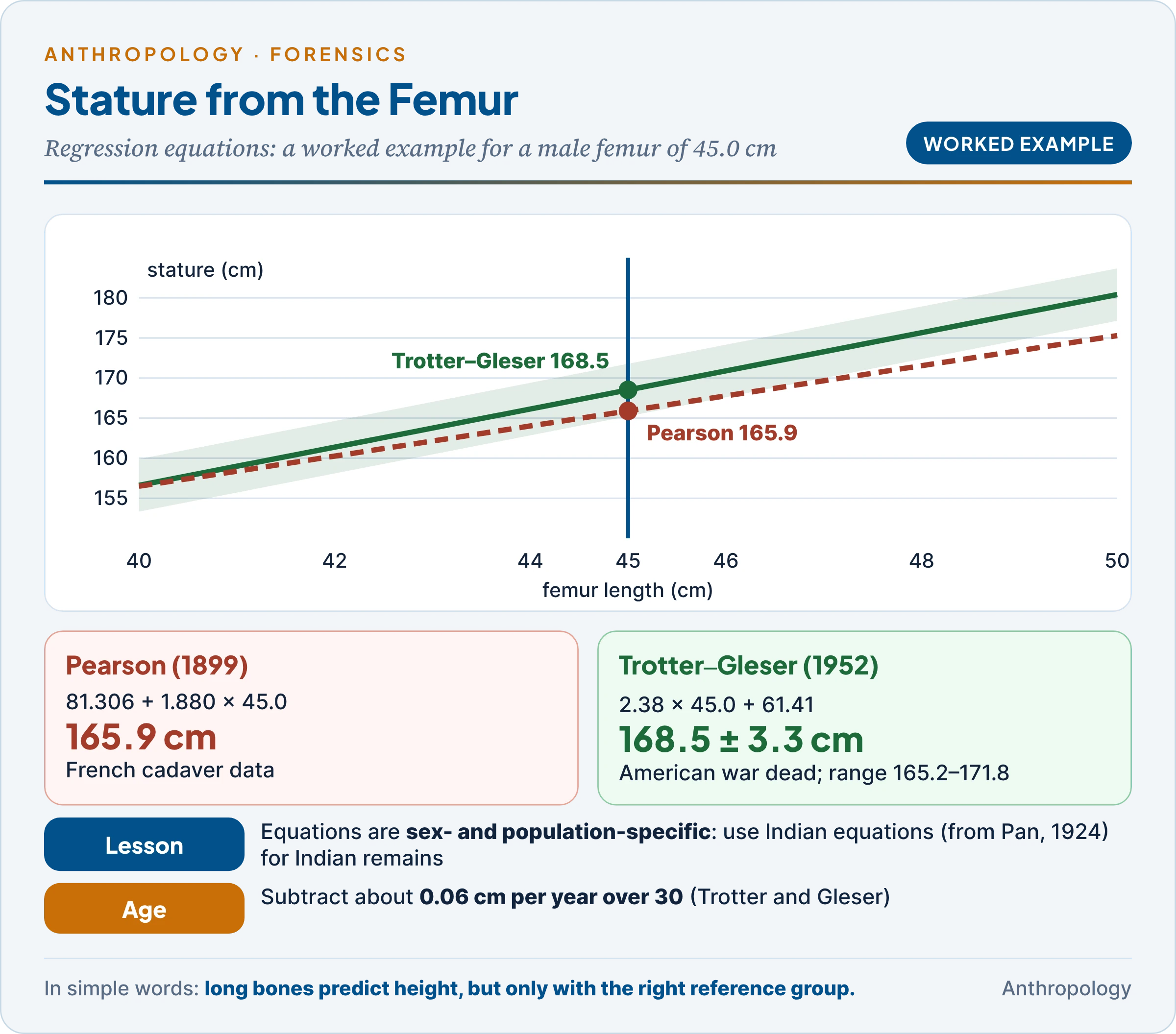
(d) Stature. The anatomical method (Fully, 1956) adds the heights of all skeletal elements with a correction for soft tissue. The mathematical method uses regression equations linking long-bone length to stature: Karl Pearson (1899) from French data, and Mildred Trotter and Goldine Gleser (1952, 1958) from American war dead. Equations are sex- and population-specific, so Indian work uses Indian equations, beginning with Pan (1924).
Worked example: a male femur of maximum length 45.0 cm
| Equation | Formula | Stature |
|---|---|---|
| Pearson (1899), male | 81.306 + 1.880 × 45.0 = 81.306 + 84.600 | 165.9 cm |
| Trotter–Gleser (1952), white male | 2.38 × 45.0 + 61.41 = 107.10 + 61.41 | 168.5 ± 3.3 cm (165.2–171.8) |
The two answers differ by about 2.6 cm because the equations were built on different populations (nineteenth-century French cadavers and twentieth-century American soldiers). This is why the right reference population matters more than the arithmetic. Trotter and Gleser also advised subtracting about 0.06 cm for each year over 30, because people shrink with age.
(e) Ancestry: traits such as shovel-shaped incisors, nasal aperture and facial projection give a probable population affinity. Because human variation is clinal (9.5), modern practice speaks of affinity, not race, and treats such estimates with caution.
(f) Individualising features, trauma and time since death: healed fractures, surgical implants (often with serial numbers), dental restorations, disease and occupational markers individualise a skeleton. Antemortem injuries show healing; perimortem injuries (around the time of death) show fractures in fresh, elastic bone; postmortem damage shows dry, brittle breaks. Time since death and taphonomy (what happens to remains after death) are read from decomposition, insects (forensic entomology), soil and plant growth.
5.4 Reconstruction of the face
- Facial reconstruction (or facial approximation) rebuilds a likely face on a skull when other methods fail. The German anatomist Wilhelm His modelled a face on the skull believed to be J. S. Bach‘s (1895); Kollmann and Büchly (1898) tabulated soft-tissue depths at standard points.
- Methods: the anatomical (Russian) method of Mikhail Gerasimov, who built up muscles one by one; the tissue-depth (American) method associated with Krogman, which glues markers of average tissue thickness to the skull and joins them with clay strips; and the Manchester method (Richard Neave), which combines the two. Today 3D computer reconstruction from CT scans is common.
- Limits: bone does not record eye or hair colour, hairstyle, lip shape or fat, so the result is a likeness, used to prompt recognition, not proof of identity.
- Superimposition: when a likely identity exists, the skull is superimposed on photographs of the missing person; if landmarks align, identity is supported. The method was first used in the Ruxton case (Britain, 1935–37).
5.5 Dermatoglyphics
- Dermatoglyphics (the study of skin ridge patterns on fingers, palms and soles; term coined by Harold Cummins, 1926) rests on two facts: ridges form between about the 10th and 16th week of fetal life and are complete by about the 24th, and they do not change through life.
- Patterns: loops (about two-thirds of fingerprints), whorls (about one-third) and arches (a few per cent), with triradii (deltas) and cores; minutiae (ridge endings, bifurcations, dots, enclosures) individualise a print.
- History: Francis Galton (Finger Prints, 1892) showed permanence and individuality; the Henry system of classification was developed in Bengal (1897) by Edward Henry with Azizul Haque and Hem Chandra Bose, and the Calcutta bureau was the world’s first fingerprint bureau. Fingerprints replaced Bertillonage (identification by body measurements).
- Crime-scene prints are visible (in blood or ink), plastic (impressed in wax, soap or putty) or latent (invisible sweat deposits), developed by powders, iodine fumes, ninhydrin, silver nitrate or cyanoacrylate fuming.
- Beyond identification: ridge counts are highly heritable and some patterns are associated with chromosomal syndromes (a single palmar crease in Down syndrome; 9.4).
5.6 DNA profiling
- The British geneticist Alec Jeffreys discovered DNA fingerprinting (1984); its first criminal conviction came in 1988 (the Pitchfork case). Modern profiling compares short tandem repeats (STRs), short sequences repeated a variable number of times; the US CODIS system uses 20 core loci, making a chance match between unrelated people vanishingly rare.
- Special systems: mitochondrial DNA (inherited from the mother; survives in old bones and teeth, as at Ajnala), Y-STRs (male line; useful in sexual-assault mixtures) and SNPs for degraded samples.
- India: the technique was adapted at the Centre for Cellular and Molecular Biology, Hyderabad, under Lalji Singh, and the Centre for DNA Fingerprinting and Diagnostics was set up in Hyderabad. In the Tandoor murder case (Delhi, 1995), DNA from the charred body matched the parents of the victim, Naina Sahni, and helped convict her husband Sushil Sharma. (Paternity testing and the genetics of DNA technology are treated in 12b.)
5.7 Indian legal context
| Provision | Content |
|---|---|
| Article 20(3) | No person accused of an offence shall be compelled to be a witness against himself |
| BNSS s. 51 (old CrPC s. 53) | Medical examination of an arrested accused at police request; “examination” includes blood, semen, swabs, hair, nail clippings and DNA profiling |
| BNSS s. 52 (old s. 53A) | Examination of a person accused of rape, including material for DNA profiling |
| BNSS s. 176(3) (new) | Forensic experts must visit the crime scene for offences punishable with seven years or more |
| BNSS s. 184 (old s. 164A) | Medical examination of a rape victim, with consent; report within seven days |
| BNSS s. 329 (old s. 293) | Reports of government scientific experts usable as evidence |
| BNSS s. 349 (old s. 311A) | Magistrate may order specimen signatures, handwriting, finger impressions and voice samples, even from persons not arrested |
| BSA s. 39 (old Evidence Act s. 45) | Opinions of experts in science, art, handwriting and finger impressions are relevant facts |
| BSA s. 116 (old s. 112) | Birth during a valid marriage is conclusive proof of legitimacy unless non-access is shown |
| Criminal Procedure (Identification) Act, 2022 | Replaced the 1920 Act; allows collection of finger and palm prints, iris and retina scans, photographs and biological samples, stored for 75 years |
The BNSS and BSA replaced the CrPC and the Indian Evidence Act from 1 July 2024. India still has no DNA-specific law: the DNA Technology (Use and Application) Regulation Bill, 2019, which would have set up DNA data banks, was withdrawn in 2023.
Key judgments:
- State of Bombay v. Kathi Kalu Oghad (1961): giving fingerprints, handwriting or specimen samples is not “testimonial compulsion”, so it does not violate Article 20(3).
- Selvi v. State of Karnataka (2010): narco-analysis, polygraph and brain-mapping tests without consent violate Articles 20(3) and 21; results of voluntary tests are not admissible as such.
- Nandlal Wasudeo Badwaik v. Lata Nandlal Badwaik (2014): where a reliable DNA test contradicts the presumption of legitimacy, the scientific truth prevails.
- Ritesh Sinha v. State of Uttar Pradesh (2019): a magistrate may order a voice sample, a power now written into BNSS s. 349.
- Rajendra Pralhadrao Wasnik v. State of Maharashtra (2019): failure to produce available DNA evidence in a rape case may justify an adverse inference against the prosecution.
Cases: the Aarushi Talwar case (Noida, 2008) showed the cost of poor crime-scene management: the Allahabad High Court acquitted her parents in 2017, citing gaps in the evidence. In the Sister Abhaya case (Kottayam, death in 1992), a CBI court convicted a priest and a nun in 2020, after decades in which scientific tests had been contested.
Common confusion
Are narco-analysis and brain-mapping “forensic anthropology”? No. They are psychological interrogation techniques, and in Selvi (2010) the Supreme Court held them involuntary and unconstitutional without consent. Forensic anthropology works on physical evidence: bones, teeth, prints and DNA, which courts treat as non-testimonial (Kathi Kalu Oghad, 1961).
Key Terms
| Term | Meaning in simple words |
|---|---|
| Anthropometry | Standardised measurement of the human body |
| Action anthropology | Anthropologists working with a community towards goals it sets |
| Kinanthropometry | Measuring body size, shape and composition in relation to movement and sport |
| Somatotype | A three-number rating of physique: fatness, muscularity, linearity |
| Body composition | The proportions of fat, muscle and bone in the body |
| Stunting / wasting | Low height-for-age (long-term) / low weight-for-height (recent) |
| MUAC | Mid-upper-arm circumference, a quick test for severe malnutrition |
| z-score | How many standard deviations a measurement lies from the reference median |
| Ergonomics | Designing tools and workplaces to fit human bodies and abilities |
| Static / dynamic anthropometry | Body measured still / body measured in movement |
| Percentile | The value below which a given percentage of people fall |
| Biological profile | Sex, age, stature and ancestry estimated from remains |
| Antemortem / perimortem / postmortem | Before / around / after the time of death |
| Facial reconstruction | Rebuilding a likely face on a skull from tissue-depth data |
| Dermatoglyphics | The study of ridge patterns on fingers, palms and soles |
| STR | Short tandem repeat, the DNA marker used in profiling |
Contemporary Developments
- NFHS-6 (2023–24), released 29 May 2026: under-five stunting fell to 29.3 per cent and severe wasting to 5.2 per cent.
- INDIAsize: the full set of 27 Indian body-size charts from the National Sizing Survey became available on 2 January 2026, for apparel, furniture, defence clothing and ergonomic design.
- AI171, Ahmedabad (June 2025): one of India’s largest DNA identification exercises identified 254 of 260 victims within about two weeks.
- BNSS s. 176(3): compulsory forensic examination of crime scenes for serious offences has been in force since 1 July 2024.
- World Athletics (September 2025): a one-time SRY gene test now governs eligibility for the female category.
Diagrams to Master
- Topic map: applied physical anthropology → sports → nutrition → design → forensics → Indian law.
- Kinanthropometry: Ross 1972 → ISAK 1986; physique by event; body composition methods; maturity in talent identification; sport as culture.
- Nutritional assessment: ABCD methods; stunting, wasting, underweight; Gómez, Wellcome, Waterlow, WHO z-scores; MUAC cut-off.
- Percentiles in design: normal curve with P5, P50, P95; the four design principles; Daniels (1952).
- Biological profile: human? → MNI → sex (pelvis, skull) → age (teeth, epiphyses, symphysis) → stature → ancestry → individual features → identification.
- Stature worked example: Pearson and Trotter–Gleser for a 45 cm femur, with the error band.
Revision Grid
| Scholar | Work (year) | Key idea |
|---|---|---|
| Adolphe Quetelet | Anthropométrie (1870) | Statistical measurement of the body |
| Rudolf Martin | Lehrbuch der Anthropologie (1914) | Standard landmarks and techniques |
| Karl Pearson | Reconstruction of stature (1899) | Regression formulae from long bones |
| Harold Cummins | Dermatoglyphics (1926) | Named and systematised ridge studies |
| Audrey Richards | Hunger and Work in a Savage Tribe (1932) | Diet as part of the social system (Bemba) |
| K. F. H. Murrell | Ergonomics (1949) | Fitting work to people |
| Gilbert Daniels | The “Average Man”? (1952) | No pilot was average on ten dimensions |
| Trotter and Gleser | Stature from long bones (1952, 1958) | Population-specific regression |
| J. M. Tanner | The Physique of the Olympic Athlete (1964) | Each event selects a physique |
| Heath and Carter | Anthropometric somatotype (1967) | Somatotype from ten measurements |
| William Ross and colleagues | Kinanthropometry (1972) | Measurement linked to movement |
| Clifford Geertz | “Deep Play” (1972) | Balinese cockfight as social commentary |
| T. Dale Stewart | Essentials of Forensic Anthropology (1979) | Classic definition of the field |
| Clyde Snow | Argentine team (from 1984) | Forensic anthropology for human rights |
| Alec Jeffreys | DNA fingerprinting (1984) | Individual identification by DNA |
Previous Year Questions
Unit 12 (part 1): Anthropology of sports; nutritional anthropology; designing defence and other equipment; forensic anthropology; personal identification and reconstruction; applied physical anthropology
- 2026What is meant by a somatotype? Discuss the Heath-Carter anthropometric method, giving its advantages over that of Sheldon’s method. How can somatotyping be applied in sports sciences?
- 2026Write notes on: Anthropometry in ergonomics.
- 2025Examine the utility of human remains in forensic analysis. Discuss the facial reconstruction technique.
- 2024Discuss the applications of forensic anthropology with suitable examples.
- 2023Discuss various methods of personal identification based on skeletal remains.
- 2022Discuss how anthropological knowledge of the human body may be used in designing equipments and articles of human use.
- 2021What is Anthropometry ? Discuss its role in assessing the nutritional status and sports capability of a person.
- 2019Write a note in 150 words on Anthropological inputs in facial reconstruction.
- 2017Write a note in 150 words on Anthropology and designing of equipments.
- 2017What are the methods of personal identification? Critically examine how personal identification helps in criminal investigations.
- 2016Describe the role of Anthropology in designing defence and other equipments.
- 2016Write a note in 150 words on Forensic Anthropology.
- 2015Elucidate the role of Anthropology in selection and monitoring of sports persons.
- 2015Forensic Science can help in criminal investigations. Discuss.
- 2012Write a note in 150 words on Applications of Anthropometry in designing.
- 2012Briefly discuss the applications of the knowledge of human osteology in forensic investigations.
- 2011Write a note in 150 words on Personal identification.
- 2011Discuss the application of anthropological knowledge in designing equipment.
- 2011Explain the application of anthropological knowledge in genetic counseling, forensic science, sports and nutrition.
- 2010Write a note in 150 words on Role of forensic anthropology in the field of personal identification.
- 2009Analyse the various applications of anthropological knowledge to solve medico-legal problems and in the reconstruction of evidence.
- 2008Write a note on Nutritional anthropology.
- 2008Discuss the role of anthropology in designing defence and other equipments.
- 2007Write a note on Forensic Anthropology.
- 2007Briefly Describe various applications of physical Anthropology.
- 2006Write a note on Personal Identification.
- 2005Write a note on Nutritional : Anthropology.
- 2004Write a note on Anthropology of Sports.
- 2003Write a note on Forensic Anthropology.
- 2003What do you understand by applied Physical Anthropology ? Discuss the applications of anthropometry in designing defence and other equipments.
- 1997Write a note on Anthropology of Sports.
- 1997Critically examine the anthropological approaches to planning and socioeconomic development among the weaker sections of the Indian society, highlighting the issues of macroplanning in anthropology.
- 1996Write a note on Forensic Anthropology.
- 1996Write a note on Nutritional ecology.
- 1990Write a note on Applied anthropology.
- 1989What is meant by Applied Anthropology? Explain its methods and scope in Indian context.
- 1988Write a note on Applied physical anthropology.
- 1984Distinguish between: Applied and action anthropology.
Questions on applied human genetics, serogenetics and cytogenetics, eugenics and statistical methods from this syllabus line are listed in 12b.
Related questions from other units
- 2025Unit 9.8: How anthropologists assess the nutritional status of a community? Discuss the significance of intersectionality of ecology, culture, and social inequality in the study of nutritional anthropology.
- 2025Unit 9.1: What are genetic markers? Discuss their applications in understanding population variation, disease association and forensics.
- 2023Unit 9.8: Elucidate the different forms of malnutrition. Describe protein-calorie malnutrition with suitable examples.
- 2022Unit 10: Why Heath and Carter used anthropometric measurements instead of photographs of an individual to assess the somatotype? Elaborate their method.
- 2021Unit 12: How are the cases of disputed paternity solved ? Discuss the recent techniques.
- 2015Unit 10: What is an anthropometric somatotype? Describe Heath and Carter’s method of somatotyping.
- 2011Unit 10: Define somatotype. Describe the salient features of different components of somatotype.
- 1999Unit 12: Discuss the application of the human genetics in the field of forensic science and diagnosis and treatment of genetic disorders.
- 1983Unit 9.7: Stature is susceptible to environmental influences. Substantiate.
- 1981Unit 9.8: “Nutrition affects several physical features. ” Exemplify. (200 words).