

Mīmāṃsā: Theory of Knowledge.
Official Syllabus: Paper I, Section B, Unit 18
How do you know that there is no jar on the table? You look, and the table is bare. It seems obvious — yet it hides a deep puzzle. Perception works through contact between a sense and an object; but an absence is not an object that light can bounce off or a hand can touch. Kumārila Bhaṭṭa answers that absence (abhāva) is a real feature of the world, and that it is known by a separate pramāṇa — non-cognition (anupalabdhi): the jar is known to be absent because it is not perceived where it would have been perceived. Prabhākara, his rival within the same school, denies that absence is a separate reality at all: “no jar” is just the bare table. Nyāya agrees with Kumārila that absence is real, but says we simply perceive it. UPSC has set this three-cornered debate six times, most recently in 2025.
In simple words
You come home and say at once, “Someone has taken my bicycle!” The bicycle is not there — and you know its absence as vividly as you would have seen its presence. You did not reason it out; you did not touch the “missing bicycle”. You simply failed to see what would surely have been seen if it were there. For Kumārila, that meaningful not-seeing is a source of knowledge in its own right.
Context & Problem
- Two questions, not one.
- Ontological: Is absence (abhāva) a real feature of the world — a category of its own — or only a way of speaking about what is there?
- Epistemological: If absence is real, how is it known — by perception, by inference, or by a pramāṇa of its own?
- The positions in brief.
| School | Is abhāva real? | How is it known? |
|---|---|---|
| Bhāṭṭa Mīmāṃsā (Kumārila) | Yes — a real category | By a separate pramāṇa: anupalabdhi |
| Advaita Vedānta | Yes, at the empirical level | By anupalabdhi (follows Kumārila) |
| Nyāya–Vaiśeṣika | Yes — the seventh category | By perception (or inference); non-cognition only helps |
| Prābhākara Mīmāṃsā | No — only the bare locus | By perception of the locus |
| Buddhists | No — a mental construction | By inference from non-perception |
- Why it matters to Mīmāṃsā. The Veda is full of prohibitions (“one should not…”) and the ritual world is full of absences (a rite not performed, an impurity absent). A theory of knowledge that could not account for negative facts would be incomplete.
Core Doctrine
1. What Anupalabdhi Is
- Definition. Anupalabdhi (“non-apprehension”, “non-cognition”, “non-perception”) is the source of our immediate cognition of the non-existence of an object.
- The core rule. If a thing should have been perceived under certain circumstances, then its non-perception under those circumstances gives knowledge of its non-existence.
- What it is not. Such knowledge can be obtained neither from perception nor from inference, but only from an appropriate non-perception.
- Who accepts it. Kumārila and the Advaita Vedāntins. Prabhākara, Nyāya, the Buddhists and the Cārvākas reject it as a separate pramāṇa.
2. Appropriate Non-Perception (Yogyānupalabdhi)
- Not every non-perception. All non-perception does not mean non-existence.
- We do not see a table in the dark — yet we do not judge that it does not exist.
- We do not perceive atoms, ether, merit and demerit (virtue, vice) — yet we do not deny them; they are simply not perceptible.
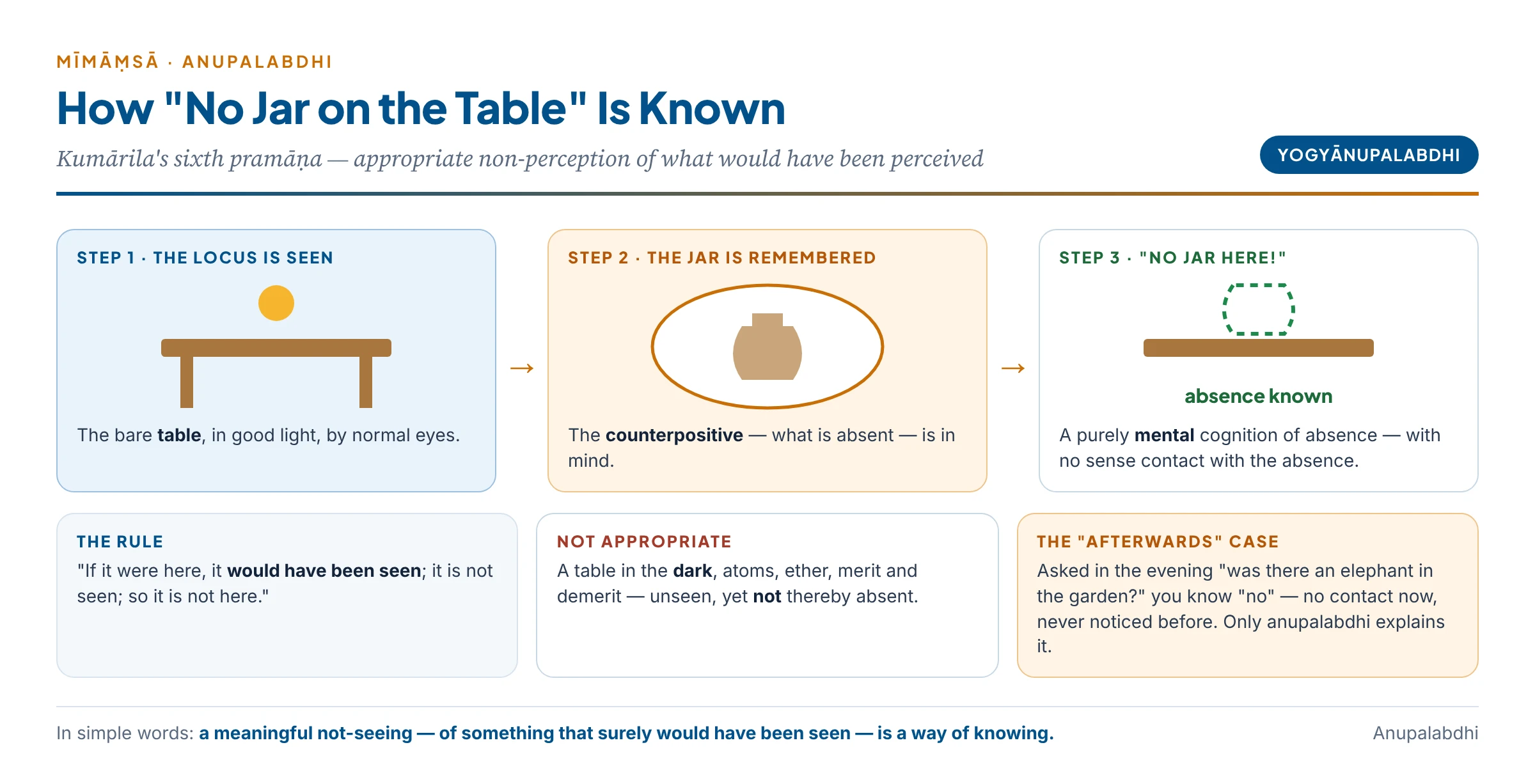
- The condition. Only appropriate non-perception — yogyānupalabdhi — gives knowledge of absence: the non-perception of a thing that is capable of being perceived, under conditions in which it would have been perceived had it been there:
- sufficient light;
- normal sense-organs;
- attention directed to the place;
- the thing is of a perceptible kind and size, and nothing obstructs the view.
- A test in one line. “If it were here, it would have been seen; it is not seen; so it is not here.“
3. How Absence Is Known: The Process
- Step 1. The locus of the absence — the floor, the table — is perceived.
- Step 2. The counterpositive (pratiyogin) — the jar whose absence it is — is remembered (we must know what a jar is to notice its absence).
- Step 3. Then there arises a purely mental cognition of the absence of the jar, independent of any sense–object contact with that absence.
In simple words
You open the fridge looking for milk. You see the shelf (step 1). You have the idea of the milk bottle in mind (step 2). Then the thought hits you: “No milk!” (step 3). Your eyes saw the shelf; but the “no milk” came from the combination of seeing the shelf and not seeing what you were ready to see.
4. Absence Is Real: The Four Kinds
- A real category. For Kumārila, non-existence is real and is an object (prameya) of a pramāṇa. His five categories are substance, quality, action, universal and absence (Article 1).
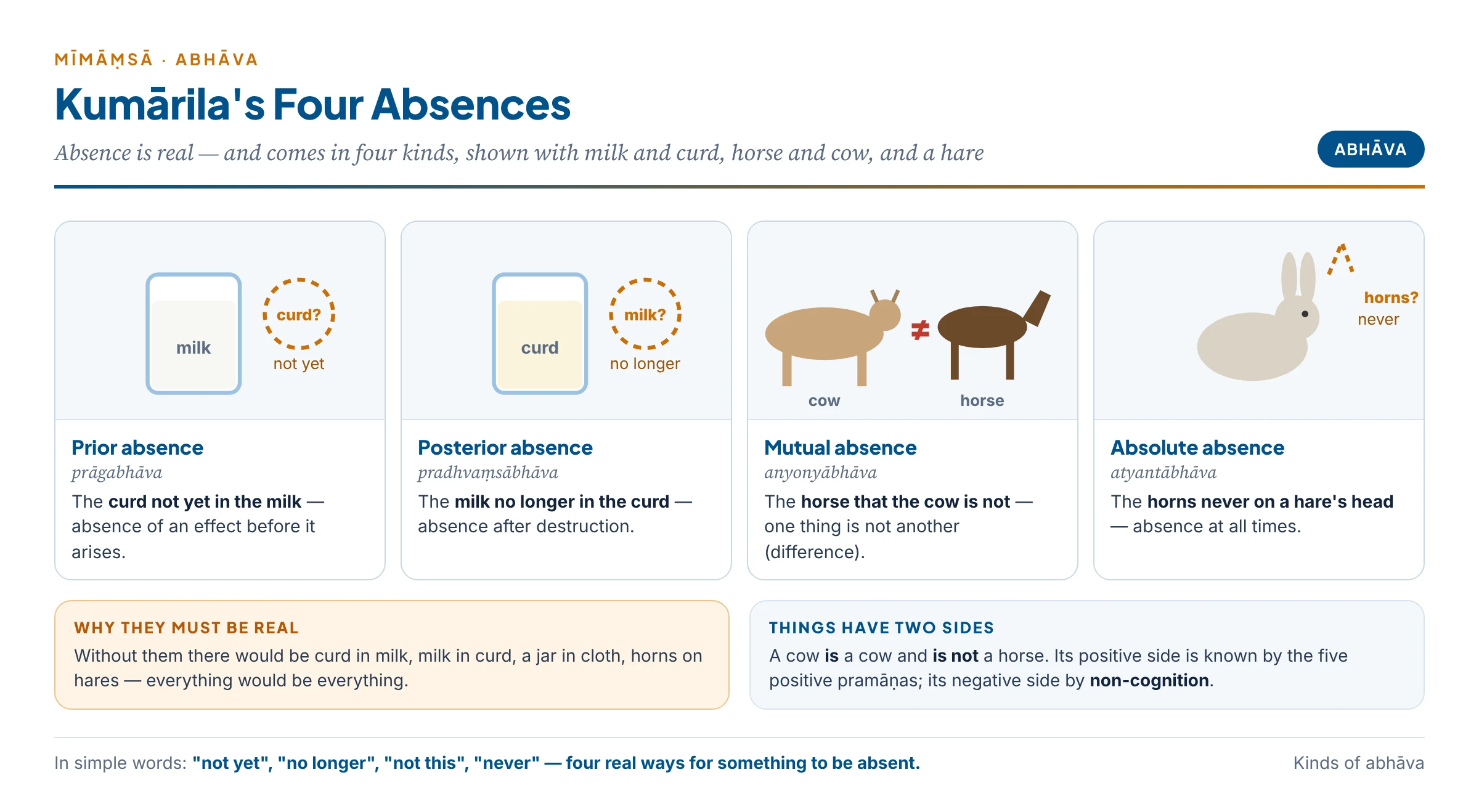
- Things have two sides. Every real thing is both existent (as itself) and non-existent (as other things): the cow is a cow and is not a horse. Its positive side is known by the five positive pramāṇas; its negative side by non-cognition. “Where the five pramāṇas do not arise with regard to the existence of a thing, there non-cognition is the pramāṇa for its non-existence.”
- The four kinds of absence. Kumārila illustrates them with milk and curd:
| Kind | Sanskrit | Kumārila’s example | Meaning |
|---|---|---|---|
| Prior absence | prāgabhāva | The curd that is not yet in the milk | Absence of an effect before it is produced |
| Posterior absence | pradhvaṃsābhāva | The milk that is no longer in the curd | Absence of a thing after it is destroyed |
| Mutual absence | anyonyābhāva | The horse that is not in the cow | One thing is not another (difference) |
| Absolute absence | atyantābhāva | The horns that are not on a hare’s head (where the head is low, without growth and hardness) | Absence that holds at all times |
- Why we need them. If these absences were not real and known, Kumārila argues, there would be curd in milk, milk in curd, a jar in a piece of cloth and horns on a hare — every thing would be everything, and the world would collapse into confusion.
5. Kumārila’s Justification: Why Absence Needs Its Own Pramāṇa
- Like is known by like. Non-existence is negative in character, so it is known by a means similar to itself — a negative pramāṇa. Perception, inference, comparison, testimony and postulation are positive in character; they reveal what exists, not what does not.
- Not perception.
- Perception needs contact between a sense and its object. Absence has no colour, shape or parts; nothing in it can stimulate a sense the way the table does.
- Nor can absence be first grasped by indeterminate perception and later recalled in a determinate one: indeterminate perception is non-relational, so it could not grasp an absence, which is always the absence of something in something.
- Not inference.
- To infer absence from non-perception we would need a universal rule — “whatever is not perceived does not exist“. But that rule is false (atoms, the table in the dark) and, in its correct form (“whatever is not perceived where it would be perceived does not exist”), it already assumes that non-perception gives knowledge of absence. The inference would be begging the question.
- And what would be the mark (liṅga)? The non-perception itself — which is again an absence (of perception). Knowing that absence would need another inference, and so on.
- Not testimony — no words are involved. Not comparison — no similarity is known. Not postulation — there are not two conflicting facts to reconcile.
- The afterwards argument. Suppose you visited a garden in the morning without giving any thought to elephants. In the evening someone asks, “Was there an elephant in the garden?” and you know at once: “No, there was not.” Your eyes are no longer in contact with the garden, so this is not perception; and you never cognised the elephant’s absence in the morning, so it is not memory. The knowledge arises now, from remembering the garden and the non-perception of an elephant there. Only anupalabdhi explains it.
- Conclusion. The absence of an object is known by appropriate non-apprehension, a distinct means of valid knowledge.
6. Prabhākara: There Is No Absence over and above Existence
- Rejection of both the category and the pramāṇa. Prabhākara does not recognise non-existence as an ontological reality, and so has no need for a special pramāṇa to know it.
- Absence is the bare locus. “There is no non-existence over and above existence.” When a jar is on the ground, we perceive the ground as related to the jar; when the jar is absent, we perceive the bare ground only (kevala-bhūtala). The so-called “non-existence of the jar on the ground” is nothing but the apprehension of the bare ground, which is a positive cognition produced by ordinary sense contact with the ground.
- The other absences reduced.
- The prior absence of a jar before it is made is nothing but the clay.
- Its posterior absence after it breaks is nothing but the potsherds.
- “The horse is not the cow” is nothing but the cow’s own nature.
- So perception is enough. Since “absence” is the locus itself, the eye that sees the floor already knows all there is to know. Non-perception is at most a form of perception, not a separate pramāṇa.
In simple words
Prabhākara’s view is like an empty parking slot. Is there a “no-car” sitting in the slot? Of course not — there is just tarmac with white lines. Seeing “no car” is simply seeing the tarmac alone. Nothing extra — no “absence” — needs to be added to the world.
7. Kumārila’s Reply to Prabhākara
- We see the floor even when the jar is there. If seeing the bare floor were seeing the jar’s absence, then whenever we saw the floor — even with a jar standing on it — we would see the absence of the jar. But we do not.
- “Bare” is itself a negation. Prabhākara says we see the floor alone (kevala). But what does “alone” or “bare” mean? Only “without the jar” — that is, the floor as qualified by the jar’s absence. The absence he tried to remove has come back in the word “bare”.
- Our judgments differ. “There is a floor” and “There is no jar on the floor” are different cognitions, with different contents and different uses; one cannot be reduced to the other. We clearly distinguish “a floor with a jar” from “a floor without a jar”.
- Non-existence is not nothing. Negation is not mere nothing: it is a real feature of the floor-situation. When we perceive the bare ground we perceive neither the jar nor its absence; the absence is grasped by another route — non-cognition.
8. Nyāya: Absence Is Real but Perceived
- Agreement with Kumārila on the category. Nyāya–Vaiśeṣika, like Kumārila, admits absence as an independent category (the seventh padārtha).
- Disagreement on the pramāṇa. Nyāya rejects anupalabdhi as a separate pramāṇa. Absence is known either by perception or by inference, according as its counterpositive is perceptible or not:
- By perception. “The same sense-organ which perceives an object perceives its non-existence also.” When one sees an empty floor, the eye itself reveals the absence of the pot. The contact is a special one — the relation of qualifier and qualified (viśeṣaṇatā): the absence is perceived as a qualifier of the floor seen (“the floor is jar-less”).
- By inference. “If the pot were on the floor, it would be perceived; it is not perceived; therefore it is absent.” And where the counterpositive is supersensible, its absence is inferred.
- Non-cognition only helps. Non-perception of the counterpositive is only an auxiliary condition (sahakārin) of the perception of absence — like light is an auxiliary of seeing — not a separate pramāṇa.
In simple words
Run your tongue over your teeth after a tooth has been pulled: you seem to feel the gap directly. Nyāya says absence is like that — perceived by the same sense that would have perceived the thing. Kumārila replies: what the tongue actually touches is the gum; the “gap” is known because the tooth that should be felt is not felt.
- Kumārila’s reply to Nyāya.
- The “qualifier relation” presupposes that the absence is already known: a thing can qualify the floor in perception only if it is somehow grasped — and there is no sense contact with an absence to grasp it.
- If non-perception is the condition without which the absence is never known, and with which it is always known, then it is the real cause; calling it a mere “auxiliary” of the eye is a verbal trick. The eye’s job ends with seeing the floor.
- The afterwards argument (section 5) shows that the knowledge of absence can arise when the eye is not in contact at all.
9. The Bhāṭṭa–Prābhākara Debate in One Table
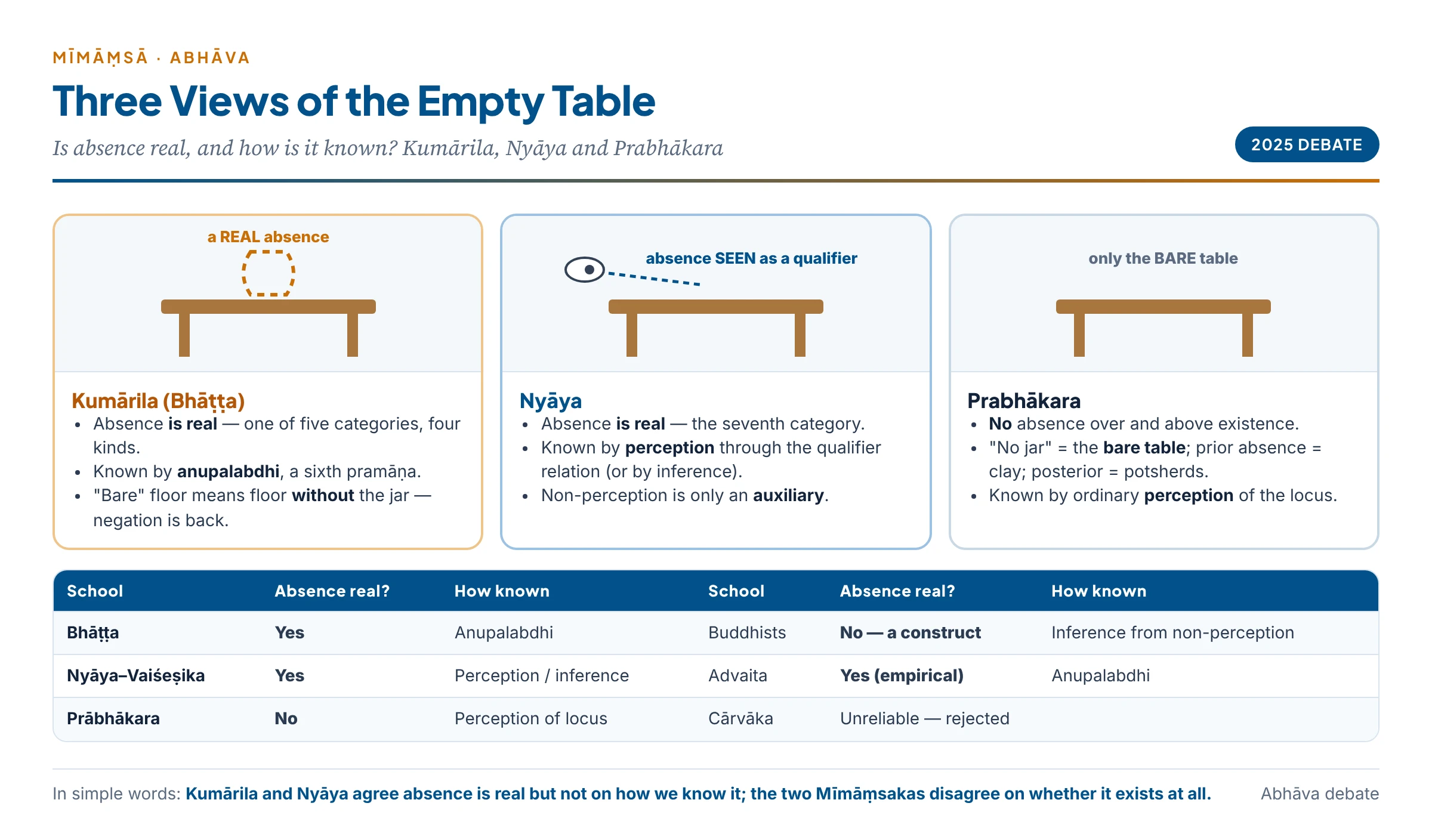
The 2025 paper asked for the debate between the two Mīmāṃsā schools on the nature of absence and its knowledge.
| Point | Bhāṭṭa (Kumārila) | Prābhākara |
|---|---|---|
| Is absence a category? | Yes — one of five; real, of four kinds | No — no absence over and above existence |
| What is “no jar on the floor”? | The floor qualified by a real absence of jar | The bare floor — a positive thing |
| Prior absence | Real absence of the effect before production | The material cause (clay) |
| Posterior absence | Real absence after destruction | The remains (potsherds) |
| How absence is known | Anupalabdhi — a sixth pramāṇa | Perception of the locus |
| Number of pramāṇas | Six | Five |
| Main argument | Negative facts need a negative means; perception and inference fail | Economy — nothing negative needs to exist |
| Main objection to the rival | “Bare” means “without the jar” — negation sneaks back | Positing absences multiplies entities; absence as a “thing” is self-contradictory |
10. Other Criticisms of Anupalabdhi
- Buddhists. Non-existence is not an independent reality but a conceptual construction (prajñapti). “There is no pot on the floor” is just the conceptual interpretation of what we perceive, or an inference from non-perception: “There is no pot here, because, though all conditions for perceiving it are present, it is not perceived.” A new pramāṇa for absence is metaphysically unnecessary.
- Cārvāka. Absence cannot be directly known; it is only an assumption based on failed perception, and since the Cārvāka distrusts inference, he treats knowledge of absence as unreliable. He dismisses anupalabdhi completely.
- The general charge of redundancy. Most critics accuse anupalabdhi of epistemic redundancy: since absence can be explained through perception (seeing the empty locus) or inference (from non-perception), introducing a new pramāṇa is methodologically extravagant.
Common confusion
Did Kumārila classify anupalabdhi into four kinds — non-perception of the cause, of the effect, of the thing itself, and of its opposite? No. Some notes give a table of “Kumārila’s classification of anupalabdhi” — kāraṇa-, kārya-, svabhāva- and viruddha-anupalabdhi, with examples like “no smoke because no fire” and “no darkness because there is light”. This classification belongs to the Buddhist logician Dharmakīrti, for whom non-perception is a mark (hetu) in an inference, not a separate pramāṇa; he listed up to eleven such forms. Kumārila’s own classification is of absence itself — prior, posterior, mutual and absolute — illustrated with curd and milk, horse and cow, and the hare’s horns.
- The Buddhist forms, for comparison. Dharmakīrti’s main types of “non-perception as a mark” include:
- Non-perception of the thing itself — “There is no pot here, because none is perceived though it would be.”
- Non-perception of the cause — “There is no smoke here, because there is no fire.”
- Perception of something incompatible — “There is no cold here, because there is fire.”
- Perception of an effect of something incompatible — “There is no cold here, because there is smoke” (which shows fire).
For the Buddhist all of these are inferences; for Kumārila none of them shows that absence is known by inference, because each still needs a prior grasp of absence.
Critical Evaluation
Objections to Kumārila
- Redundancy (Nyāya, Buddhists). The eye that sees the empty floor, aided by the memory of the jar, gives all we need.
- A negative pramāṇa is odd. A pramāṇa is a cause of knowledge. How can an absence of cognition cause anything? (Nyāya presses this.)
- Absence as a “thing” is paradoxical. Calling absence a real entity seems to give being to non-being — the old puzzle of Parmenides.
- Prabhākara’s economy. Why add absences to the furniture of the world when the bare locus explains our experience?
Kumārila’s Replies
- Non-cognition is not a mere nothing. It is the definite non-occurrence of a cognition that would have occurred — a determinate condition, like a silent alarm that tells you no one has entered.
- Reality of absence. Things are both existent and non-existent in different respects; to deny their negative side is to deny that the cow differs from the horse.
- The afterwards argument defeats both perception (no contact) and memory (never cognised before).
- Against economy. “Bare floor” smuggles absence back in; economy that relies on a hidden negation is not economy.
Critics and Defenders
Criticism — Critics
- Nyāya: absence is perceived by the eye through the qualifier relation; non-cognition is only an auxiliary.
- Prabhākara: there is no absence over and above the bare locus.
- Buddhists: absence is a mental construct; its knowledge is inference from non-perception.
- Cārvāka: absence-knowledge is guesswork.
- General critics: a sixth pramāṇa is methodologically extravagant.
Defence — Defenders and strengths
- Absence has no form or colour — no sense contact with it is possible.
- Inference from non-perception begs the question: it presupposes knowledge of absence.
- “Bare” means “without” — Prabhākara’s reduction hides a negation.
- The afterwards case shows knowledge of absence without present contact or memory.
- Yogyānupalabdhi carefully separates genuine absence from mere unseen presence.
- Advaita finds the theory strong enough to adopt it whole.
Cross-Tradition Comparison
Absence East and West
| Point | Indian view | Western parallel |
|---|---|---|
| Absence is real | Kumārila, Nyāya | Russell: there are irreducible negative facts (“Socrates is not alive”; there is no hippopotamus in this room) |
| Absence is not real | Prabhākara, Buddhists | Wittgenstein (Tractatus) and Ayer: the world is the totality of positive facts; “not” is a logical operator, not a thing |
| Absence experienced directly | Kumārila’s anupalabdhi | Sartre: looking for Pierre in the café, I experience his absence — “Pierre is not here” is given, not inferred |
| Idea of nothing is a pseudo-idea | Prabhākara’s bare locus | Bergson: “nothing” is only the presence of something other than what we expected |
| Difference as non-being | Mutual absence (horse not cow) | Plato’s Sophist: “not-being” as otherness |
| Non-being cannot be known | Cārvāka scepticism | Parmenides: what is not cannot be thought |
Knowledge of Absence across Indian Schools (the 2009 question)
| School | Status of abhāva | Pramāṇa for it | Kinds |
|---|---|---|---|
| Nyāya | Real, seventh category | Perception (qualifier relation); inference for the supersensible | Prior, posterior, absolute, mutual |
| Vaiśeṣika | Real (added to the six positive categories) | Perception and inference (the only two pramāṇas) | Same four |
| Bhāṭṭa Mīmāṃsā | Real | Anupalabdhi | Same four (curd and milk) |
| Prābhākara Mīmāṃsā | Not real — the bare locus | Perception of the locus | Reduced to clay, potsherds, own nature |
| Buddhism | Not real — a construct | Inference from non-perception (Dharmakīrti) | Types of non-perception as marks |
| Advaita Vedānta | Empirically real | Anupalabdhi (as Kumārila) | As Kumārila |
Indian Connect — Key takeaways
- Kumārila and Nyāya agree that absence is real; they disagree on how it is known.
- Kumārila and Prabhākara belong to one school yet disagree on whether absence exists at all.
- The debate anticipates the twentieth-century quarrel between Russell (negative facts) and Wittgenstein (only positive facts).
Synthesis (Siddhānta)
- For Kumārila, absence is a real category of four kinds — prior, posterior, mutual and absolute — and is known by a separate pramāṇa, anupalabdhi: the appropriate non-perception of a perceptible thing in conditions where it would have been perceived.
- Absence cannot be perceived (no sense contact), inferred (the rule would beg the question), or known by testimony, comparison or postulation; the “afterwards” case shows it arises without present contact and without memory.
- Prabhākara denies both the category and the pramāṇa: “no jar” is the bare floor, prior absence is the clay, posterior absence the potsherds — all known by perception. Kumārila replies that “bare” already means “without”, and that seeing the floor is not seeing the absence.
- Nyāya accepts real absence but holds it is seen by the eye through the qualifier relation, with non-perception only an auxiliary; Buddhists treat absence as a construct known by inference from non-perception.
- Contemporary relevance.
- Detection: Sherlock Holmes’s “curious incident of the dog in the night-time” — the dog did nothing, and that absence solved the case.
- Medicine and science: the absence of a symptom or of a predicted effect is evidence — but only when the test was capable of detecting it (yogyānupalabdhi).
- Data and AI: “missing data” must be distinguished from “data showing absence” — the same caution as the dark-room table.
“Where the five pramāṇas do not arise with regard to the existence of a thing, there non-cognition is the pramāṇa for its non-existence.” — Kumārila Bhaṭṭa
Previous Year Questions
- 2025Discuss the debate between the Bhāṭṭa and the Prābhākara Mīmāṃsakas with reference to the nature of Non-existence (Abhāva) and its knowledge.
- 2023Present Bhāṭṭa’s view of anupalabdhi (non-cognition) as a valid means of knowledge.
- 2021What, according to Mīmāṃsakas, is the ontological status of abhāva (absence) and how does one know it? Explain and examine.
- 2014How is an absence of an object known according to Naiyāyikas and Mīmāṃsakas? Discuss.
- 2009Compare the viewpoints of Nyāya, Vaiśeṣika, Mīmāṃsā and Buddhism on the issue of knowledge of abhāva.
- 2008Anupalabdhi as a pramāṇa. Short note.