

Moore, Russell and Early Wittgenstein: Defence of Commonsense; Refutation of Idealism; Logical Atomism; Logical Constructions; Incomplete Symbols; Picture Theory of Meaning; Saying and Showing.
Official Syllabus: Paper I, Section A, Unit 6
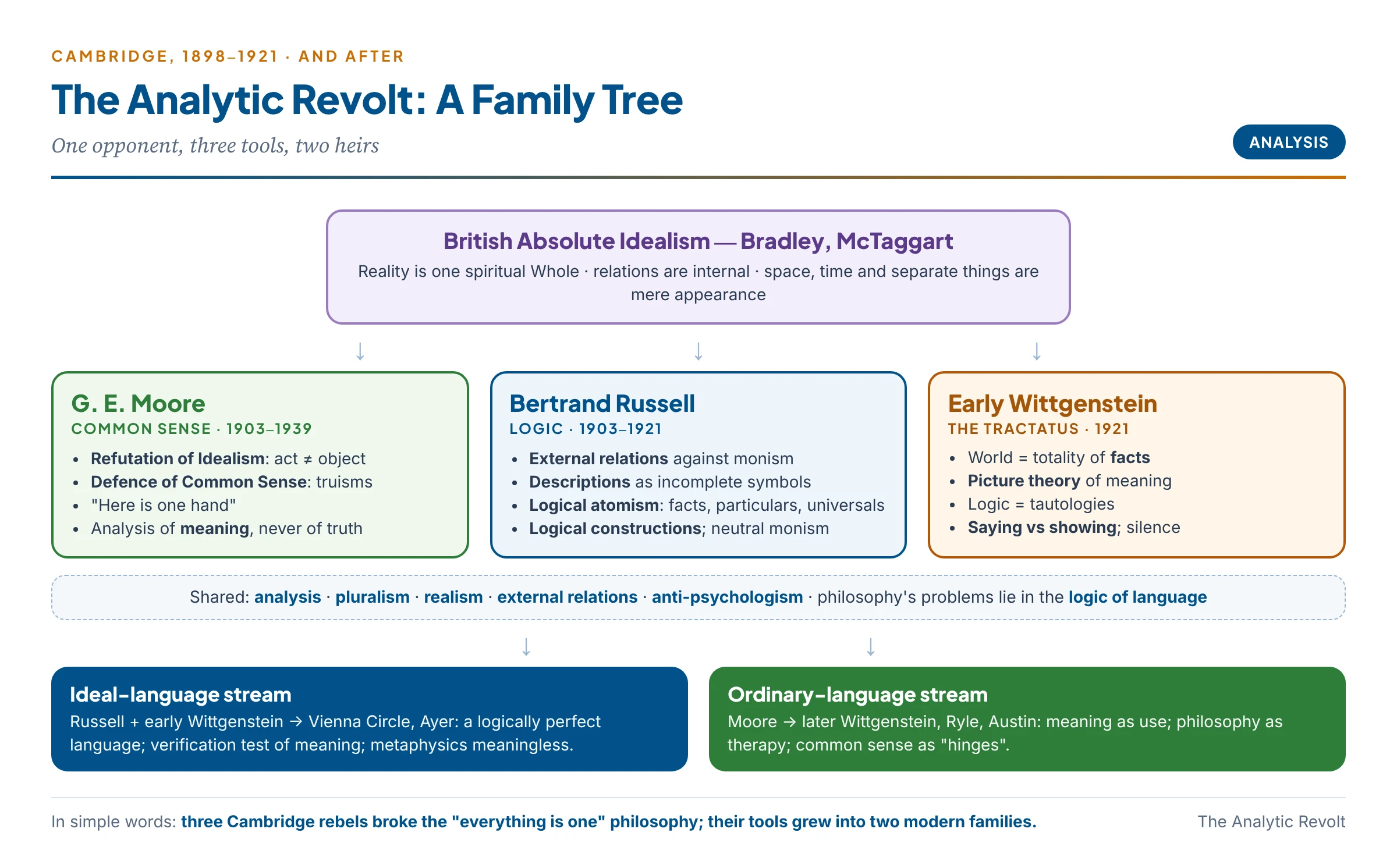
The analytic revolt was the turn-of-the-century rebellion at Cambridge against the Absolute Idealism of Bradley and McTaggart, who taught that the world of separate things, space, time and relations is mere appearance and that reality is one timeless spiritual Whole. G. E. Moore led the way with a defence of common sense and an analysis of the act and object of awareness; Bertrand Russell followed with the new logic of relations, the theory of descriptions, logical atomism and logical constructions; and the young Ludwig Wittgenstein pushed the programme to its limit in the Tractatus, with the picture theory of meaning and the distinction between saying and showing. The three share a method — analysis — and a picture of the world as many independent things and facts, but they differ sharply on what analysis is for: Moore clarifies what we already know, Russell reconstructs knowledge on a logical basis, and Wittgenstein draws the limits of what can be said at all. Together they made the linguistic turn, out of which grew both the ideal-language philosophy of the logical positivists and the ordinary-language philosophy of the later Wittgenstein.
In simple words
Imagine a city where the old rulers said: “Your houses, streets and neighbours are not really separate — everything is one great palace, and only the palace is real.” Three young engineers refused to accept this. The first (Moore) said: “I can see my own house and my neighbour’s house. I am more sure of that than of any argument for the palace.” The second (Russell) took out a measuring kit and showed, house by house, how the city is built from small separate bricks. The third (Wittgenstein) drew the map of the city so exactly that he also showed where the map must stop — what no map can ever contain. Same rebellion, three different tools.
Context & Problem
The Idealist Background
- British Idealism. By the 1890s the leading philosophers in Britain were idealists inspired by Kant and Hegel: F. H. Bradley (Appearance and Reality, 1893), Bernard Bosanquet and, at Cambridge, J. M. E. McTaggart.
- The core claims.
- Monism. Reality is a single, all-inclusive, harmonious Absolute; finite things are only partial aspects of it.
- Appearance and reality. Space, time, matter, change and the separate self are appearances — contradictory when thought through, and therefore not ultimately real.
- Internal relations. Every relation a thing has is part of its nature; if anything were different, everything would be different. So nothing can be fully understood apart from the whole.
- Reality is spiritual. Whatever is real is in some sense experience or mind.
- McTaggart’s paradoxes. McTaggart argued that time is unreal (“The Unreality of Time”, 1908) and that space is unreal too. The young Moore, hearing such claims, asked how they could be squared with the plain facts that the wall is nearer than the library, or that the lecture will end at noon.
- Bradley’s regress. Bradley argued that relations cannot be real: if a relation R relates A and B, we need a further relation to connect R with A and with B, and so on without end. So relations, and with them a world of many separate things, are mere appearance.
The Rebellion
- Moore leads. Moore came up to Trinity College, Cambridge, to read classics, was drawn into philosophy, and began as an idealist. In “The Nature of Judgment” (1899) and “The Refutation of Idealism” (1903) he turned against idealism; in the same year Principia Ethica defended good as a simple, indefinable, non-natural quality.
- Russell follows. Russell later described the break: “He took the lead in rebellion, and I followed, with a sense of emancipation. Bradley argued that everything common sense believes in is mere appearance; we reverted to the opposite extreme, and thought that everything is real that common sense, uninfluenced by philosophy or theology, supposes real. With a sense of escaping from prison, we allowed ourselves to think that grass is green, that the sun and stars would exist if no one was aware of them …“
- Russell’s debt to Moore. In the Preface to The Principles of Mathematics (1903) Russell wrote: “On fundamental questions of philosophy, my position, in all its chief features, is derived from Mr G. E. Moore.“
- Analysis as the new method. Russell summed up his whole career: “Ever since I abandoned the philosophy of Kant and Hegel, I have sought solutions of philosophical problems by means of analysis; and I remain firmly persuaded … that only by analysing is progress possible.“
- Wittgenstein arrives. In 1911 Wittgenstein came to Cambridge to study with Russell. Within two years Russell regarded him as his successor in logic. The Tractatus (1921; English 1922) carried an Introduction by Russell, and Russell’s 1918 lectures on logical atomism opened by saying they were “very largely concerned with explaining certain ideas which I learnt from my friend and former pupil Ludwig Wittgenstein“.
- The “Cambridge trinity”. Moore, Russell and Wittgenstein — all at Trinity College — are often treated together as the founders of analytic philosophy.
The Problem for This Note
- One rebellion or three? The three thinkers attacked the same opponent, but did they share one philosophy? Where exactly do Moore and Russell part company, and why did Wittgenstein disagree with Russell’s own atomism?
- What did the revolt achieve? Did it refute idealism, or only replace one set of assumptions with another?
- Where did it lead? How did the turn to language — the “linguistic turn” — grow out of this revolt, and how does it look beside Indian debates on realism, relations, negation and meaning?
Core Doctrine
1. Three Weapons against Idealism
| Thinker | Main weapon | What it attacks |
|---|---|---|
| Moore | Common sense and the act–object analysis of awareness | The premise esse est percipi; the idealist’s denial of matter, space, time and other minds |
| Russell | Modern logic: relations, descriptions, atomism, constructions | Monism and internal relations; the idea that reality is one undivided whole; confused metaphysics hidden in grammar |
| Early Wittgenstein | The picture theory and the logic of the Tractatus | Metaphysics as such — idealist and realist alike — as an attempt to say what can only be shown |
- Moore’s weapon.
- Common sense. Truisms such as “Here is one hand“, “the earth has existed for many years” and “other people exist” are more certain than any premise an idealist or sceptic can offer against them. If an argument concludes that time is unreal, it is the argument that must go.
- Act and object. In every sensation there are two elements: the consciousness (which is the same in the sensation of blue and of green) and the object (blue, green). The object is not part of the consciousness. So the idealist’s step from “it is experienced” to “it exists only in experience” is invalid.
- Russell’s weapon.
- Logic of relations. Relations such as “taller than” or “to the left of” are real and external: they cannot be reduced to properties of their terms. This destroys the logical basis of monism.
- Descriptions. Phrases like “the present King of France” are incomplete symbols; analysed correctly, they commit us to no strange entities. Grammar misleads, logic corrects.
- Atomism and constructions. The world is a plurality of facts made of particulars and universals; tables, persons and numbers are logical constructions out of simpler items.
- Wittgenstein’s weapon.
- The world as facts. “The world is the totality of facts, not of things“, and atomic facts are independent of one another. There are no internal relations binding everything to everything.
- Limits of language. Metaphysical theses — “reality is spiritual”, “the world is matter” — try to say what lies outside the sayable. They are not false but nonsensical.
- Solipsism collapses into realism. “Solipsism strictly carried out coincides with pure realism. The I in solipsism shrinks to an extensionless point and there remains the reality co-ordinated with it.” The subject is the limit of the world, not its maker.
2. The Common Front: What the Three Shared
- Analysis. Philosophical progress comes from breaking down complex propositions or concepts into simpler ones, not from building grand systems.
- Pluralism. Reality is many, not one: separate things, facts or states of affairs.
- Realism. Objects of knowledge are independent of the mind that knows them (Wittgenstein’s realism is “shown” rather than stated).
- External relations and independence. A thing is not constituted by all its relations; atomic facts or propositions are independent of each other.
- Anti-psychologism. Logic and meaning concern what is true and what follows, not the mental processes of judging. Moore, against Kant, separated the psychological act from what is known; Russell separated logical analysis from psychological analysis of the kind Hume practised; Wittgenstein called psychology “no nearer related to philosophy than is any other natural science”.
- Language as the key. All three treated philosophical puzzles as arising, at least in part, from the form of our sentences. This is the beginning of the linguistic turn.
- Clarity as a virtue. In contrast with the dense prose of Hegel and Bradley, all three valued clarity, precision and step-by-step argument.
In simple words
Think of three doctors treating the same disease. All agree on the diagnosis: the patient (philosophy) is sick from confused language and from believing that “everything is one”. But one prescribes rest and common sense, the second prescribes surgery with precise logical tools, and the third says the cure is to know the limits of the body and stop trying to do the impossible. Same diagnosis, different treatments.
3. External Relations: The Logical Heart of the Revolt
- The idealist “axiom of internal relations”. Every relation is grounded in the natures of its terms; so if A is related to B, both A and B would be different without the relation, and ultimately everything is internally connected with everything — which supports monism.
- Russell’s reply (asymmetrical relations).
- Take “A is greater than B“. This cannot be reduced to a property of A alone, or of B alone, or of the whole (A + B): the whole is the same whether A is greater than B or B is greater than A.
- So relations are real and irreducible, and a world of many related things is logically coherent.
- Since modern mathematics depends on ordered series (greater, before, between), denying real relations would make mathematics impossible.
- Moore’s reply (“External and Internal Relations”, 1919–20).
- The idealist claim that a thing “would have been different” without a relation trades on an ambiguity.
- It is trivially true that a thing with a relation is not the same in all respects as a thing without it; but it does not follow that its identity or nature depends on the relation.
- The idealist misuses Leibniz’s law (whatever differs in a property is a different thing) to conclude that all relations are internal.
- Wittgenstein’s version. The Tractatus keeps a place for “internal” properties — but only as formal properties that show themselves (for example, the form of an object), never as factual connections that bind all facts together. “From the existence or non-existence of one state of affairs it is impossible to infer the existence or non-existence of another.“
- Result. Once relations are real and external, pluralism is possible — and with it the analytic programme of breaking the world into independent pieces.
Common confusion
“Moore and Russell refuted idealism once and for all.” Not quite. Moore’s 1903 paper attacks only arguments that depend on esse est percipi. Idealism of the Platonic kind, and the Absolute idealism of Hegel and Bradley, do not rest on that premise. What hurt Absolute Idealism was Russell’s logic of relations and the success of analysis — and even here the idealist could reply that the new logic simply assumed a pluralist world. The revolt changed the agenda of philosophy more than it conclusively refuted its opponents.
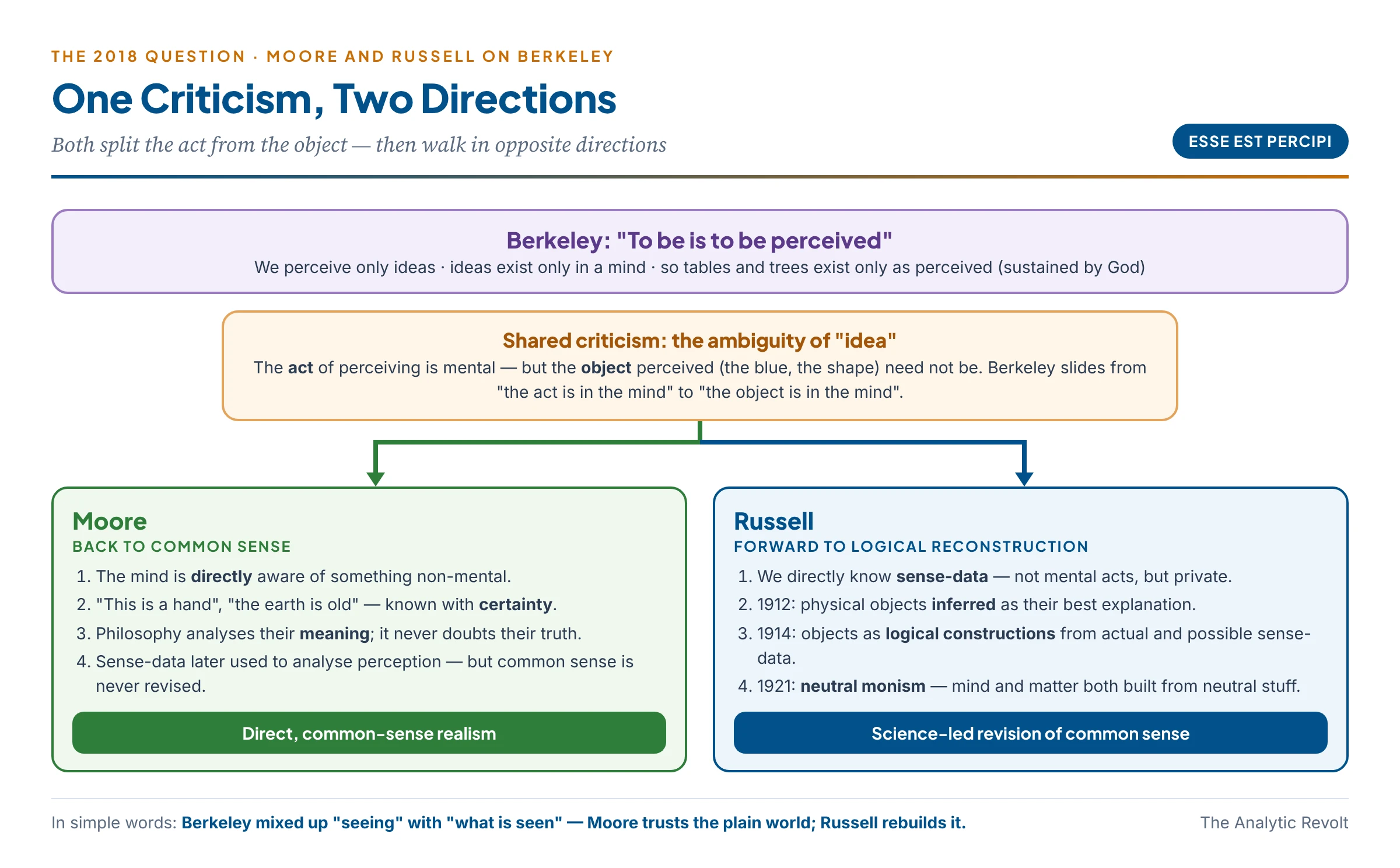
4. Moore and Russell on Berkeley: One Criticism, Two Directions
The 2018 question asks how Moore and Russell reacted to Berkeley and how their reactions differ.
- Berkeley’s thesis. We perceive only ideas; ideas exist only in a mind; so the things we perceive — tables, trees, mountains — exist only as perceived (“esse est percipi“), and their continued existence depends on God’s perceiving them.
- The shared criticism. Both Moore and Russell argue that Berkeley trades on an ambiguity in the word “idea”:
- the act of perceiving or apprehending, which is admittedly mental;
- the object perceived — the colour, the shape — which need not be mental at all.
- From “the act is in the mind” Berkeley slides to “the object is in the mind“. Russell put it in The Problems of Philosophy: the act of apprehension is undoubtedly in the mind, but there is no reason to suppose that the thing apprehended is.
- Moore’s direction: back to common sense.
- Having separated act and object, Moore holds that in perception the mind is directly aware of something non-mental.
- He then defends common-sense propositions — “this is a hand“, “the earth existed long before I was born” — as known with certainty.
- His later work tried to analyse the meaning of such propositions (with sense-data as the direct objects), but he never doubted their truth. Analysis must save common sense, not revise it.
- Russell’s direction: logical reconstruction.
- Russell accepted that what we directly know are sense-data — colours, sounds, hardnesses — which are not mental acts but are private and fleeting.
- Physical objects are not directly known. At first (1912) he held that we infer them as the best explanation of our sense-data; later (1914) he treated them as logical constructions — classes of actual and possible sense-data (sensibilia) from all perspectives.
- Finally, in neutral monism (1921), he held that both mind and matter are constructed from neutral elements that are neither mental nor physical.
- He was willing to revise common sense in the light of science: “Naive realism leads to physics, and physics, if true, shows that naive realism is false. Therefore naive realism, if true, is false; therefore it is false.“
| Point | Berkeley | Moore | Russell |
|---|---|---|---|
| Direct object of perception | Ideas (mental) | A non-mental object (later analysed via sense-data) | Sense-data (not mental acts, but private) |
| Status of physical objects | Collections of ideas in finite minds and in God | Exist independently; known with certainty | Inferred (1912), then logical constructions (1914) |
| Main argument against Berkeley | — | Act–object distinction; common-sense certainty | Same act–object point; logical analysis |
| Attitude to common sense | Claims to defend it while denying matter | Defends it; philosophy must not overturn it | Revises it where science requires |
| Mind and matter | Only minds and ideas | Two kinds of reality | Both constructed from neutral stuff (1921) |
Is Russell’s reaction to Berkeley the same as Moore’s?
- Same starting point. Both reject esse est percipi by separating the act from the object.
- Different destination. Moore goes back to the plain man’s world and defends its certainty. Russell goes forward to a scientific, logically reconstructed world in which the plain man’s “table” turns out to be a construction.
- An irony. Russell’s sense-data are private and momentary; his constructions use only items that are, in principle, perceivable. In this respect his final view sits closer to Berkeley’s phenomenalism than Moore’s does — though without Berkeley’s God and without making anything mental.
5. Two Kinds of Analysis: Moore and Russell Compared
- Moore: analysis of meaning, not of truth.
- Moore distinguished understanding the meaning of a proposition from knowing its correct analysis. We all understand “this is a hand” and know it to be true; what we do not know is its analysis.
- The philosopher’s job is to give the analysis, never to cast doubt on the truth.
- Moore said that the world and the sciences never suggested philosophical problems to him: “What has suggested philosophical problems to me is things which other philosophers have said about the world or the sciences.“
- His method was piecemeal: take a philosopher’s claim, distinguish its possible meanings, test each.
- Russell: analysis as logical reconstruction.
- The aim is to reveal the logical form hidden under the grammatical form — “the present King of France is bald” looks like subject–predicate but is really a complex existential claim.
- Analysis is guided by Occam’s razor, in Russell’s words “Wherever possible, logical constructions are to be substituted for inferred entities“.
- The goal is an ideal language whose structure mirrors the structure of facts; ordinary language is vague and misleading.
- Analysis may revise what we ordinarily believe.
- The contrast in one line. Moore analyses to understand common sense; Russell analyses to rebuild knowledge on secure logical foundations.
- The paradox of analysis. If an analysis is correct, the analysing expression means the same as the analysed one — so the analysis seems trivial; if it does not mean the same, the analysis seems incorrect. Moore admitted he had no fully satisfactory answer. Russell avoided the problem by treating analysis as replacement of a misleading form by a clearer one rather than as synonymy.
| Point | Moore | Russell |
|---|---|---|
| Starting point | Common-sense truths, known with certainty | Logic and mathematics as the model of knowledge |
| What is analysed | Concepts and propositions as ordinarily understood | Propositions, to reveal their logical form |
| Purpose | Clarify meaning; protect truth | Reveal structure of reality; eliminate pseudo-entities |
| Attitude to ordinary language | Respect: ordinary words are generally in order | Suspicion: grammar misleads; an ideal language is needed |
| Attitude to science | Neutral; philosophy is not science | Close alliance: philosophy as scientific in method |
| Metaphysics | No grand system; defends the world of common sense | Logical atomism; neutral monism |
| Ethics | Central: Principia Ethica, good as non-natural quality | Ethics largely outside philosophy proper; deep public engagement |
| Influence | Ordinary-language philosophy (Wittgenstein, Ryle, Austin) | Logical positivism; formal logic; philosophy of science |
In simple words
Moore is like a tailor who measures an old, well-loved coat very carefully to understand exactly how it is stitched — he would never throw the coat away. Russell is like an architect who studies the old house in order to design a better, stronger one, even if the new house looks quite different from the old.
6. Russell and Early Wittgenstein on Atomism
Russell’s logical atomism and the Tractatus grew up together, but the 2014 question asks why Wittgenstein disagreed with Russell’s version.
- Shared ground.
- The world has a logical structure that analysis can reveal.
- Language, properly analysed, consists of atomic propositions combined truth-functionally into molecular ones.
- Atomic propositions are independent of each other; ordinary language disguises logical form.
- Where they part company.
- Epistemology versus logic. Russell’s atoms are reached through knowledge by acquaintance — sense-data and universals we directly experience; his logically proper names are “this” and “that“. Wittgenstein’s objects are required by logic alone: “Objects make up the substance of the world“, and he gave no examples, treating their identification as no business of logic.
- Things or facts first. Russell’s inventory starts with particulars, qualities and relations that combine into facts. Wittgenstein begins with facts: “The world is the totality of facts, not of things.” Objects occur only in states of affairs.
- Universals. Russell treats universals (qualities and relations) as constituents of atomic facts. In the Tractatus, relations are not extra objects: in “Delhi is north of Agra“, it is the arrangement of the names “Delhi” and “Agra” in the sentence that says how Delhi and Agra are related. The arrangement of names shows the relation.
- Negative and general facts. Russell admitted negative facts and general facts (“I think you must admit general facts“) because a list of atomic facts cannot by itself say it is complete. Wittgenstein admitted no negative or general facts: negation and generality belong to the logic of propositions, not to the furniture of the world.
- Logical constants. For Russell, logic is “concerned with the real world just as truly as zoology, though with its more abstract and general features“. For Wittgenstein, “my fundamental thought is that the ‘logical constants’ do not represent“: “not”, “or”, “all” name nothing.
- Logical truths. For Russell, the propositions of logic are the most general truths about the world. For Wittgenstein, they are tautologies that say nothing — they show the formal properties of language and the world.
- Theory of types. Russell needed a theory of types to avoid the paradoxes. Wittgenstein held that it is unnecessary and misconceived: “Russell’s error is shown by the fact that in drawing up his symbolic rules he has to speak about the things his signs mean“; correct notation shows what types try to say.
- Saying and showing. Russell thought logical form could be described; Wittgenstein held it can only be shown. Russell’s suggestion of a hierarchy of languages was his answer to this.
- Belief propositions. Russell treated “Ram believes that it is raining” as a special kind of fact relating a subject to a proposition. Wittgenstein analysed it as “the sentence ‘it is raining’ says that it is raining” — a correlation of a sign with a fact, with no simple soul standing in a relation.
- Ethics and metaphysics. Russell thought some metaphysics (atomism itself, neutral monism) is legitimate and that ethics can be discussed. Wittgenstein declared metaphysics nonsensical and ethics unsayable — shown, not said.
- Russell’s own position. Russell acknowledged a large debt to Wittgenstein in logic, but he remained an empiricist at heart, more concerned with how we know than with what logic alone requires.
| Point | Russell | Early Wittgenstein |
|---|---|---|
| Aim | Logical analysis yielding a scientific metaphysics | Clarify the logic of language; mark its limits |
| Reality | Particulars and universals forming facts | “The totality of facts, not of things” |
| Basic units | Sense-data, qualities, relations (known by acquaintance) | Simple objects required by logic, never exemplified |
| Meaning | Reference: names stand for objects of acquaintance | Picture: a proposition models a possible state of affairs |
| Language and world | Ideal language describes the structure of facts | Proposition pictures a fact through shared logical form |
| Logical form | Can be stated | Can only be shown |
| Logic | Most general science of the world | Tautologies; says nothing |
| Negative/general facts | Admitted | Rejected |
| Metaphysics | Partly legitimate | Nonsensical attempt to say the unsayable |
| Ethics | Discussable | Transcendental; shown, not said |
| Philosophy’s task | Construct theories by analysis | An activity of clarification; throw away the ladder |
Common confusion
“The early Wittgenstein was a logical positivist.” No. The Vienna Circle read the Tractatus as a verificationist charter: meaningful propositions are those of natural science, and metaphysics is nonsense. But Wittgenstein never joined the Circle, and for him what cannot be said — ethics, the mystical, the sense of the world — is the most important part of life, not mere emotional noise. The positivists kept his logic and dropped his silence. A friend of Wittgenstein’s put the contrast this way: positivism holds that what we can speak about is all that matters in life, whereas Wittgenstein believed that all that really matters in human life is precisely what we must be silent about.
7. Russell’s Hierarchy versus Wittgenstein’s Showing
- The difficulty. For Wittgenstein, the structure of a language — its logical form — cannot be stated within that language; it shows itself.
- Russell’s suggestion (Introduction to the Tractatus). “Every language has … a structure concerning which, in the language, nothing can be said, but … there may be another language dealing with the structure of the first language, and having itself a new structure, and … to this hierarchy of languages there may be no limit.” On this view nothing is absolutely unsayable; there is no “totality” of languages and so no room for the mystical.
- Its development. The idea was made precise in metalogic: Tarski defined truth for a language in a stronger metalanguage; Carnap described the logical syntax of languages; Gödel showed how a formal system can encode statements about its own syntax.
- Wittgenstein’s side. Each new level has a form it cannot state, so the difficulty moves up rather than disappears; a metalanguage describes signs (syntax), not the relation of picturing between language and world; and value is not a matter of linguistic structure at all.
- Comparative verdict. The hierarchy meets the difficulty for formal syntax — here modern logic has proved Russell right — but it does not dissolve what is shown in its deepest sense: the language–world relation as a whole, the metaphysical subject, and the realm of ethics. This is the clearest single point at which the empiricist logician (Russell) and the logician of limits (Wittgenstein) diverge.
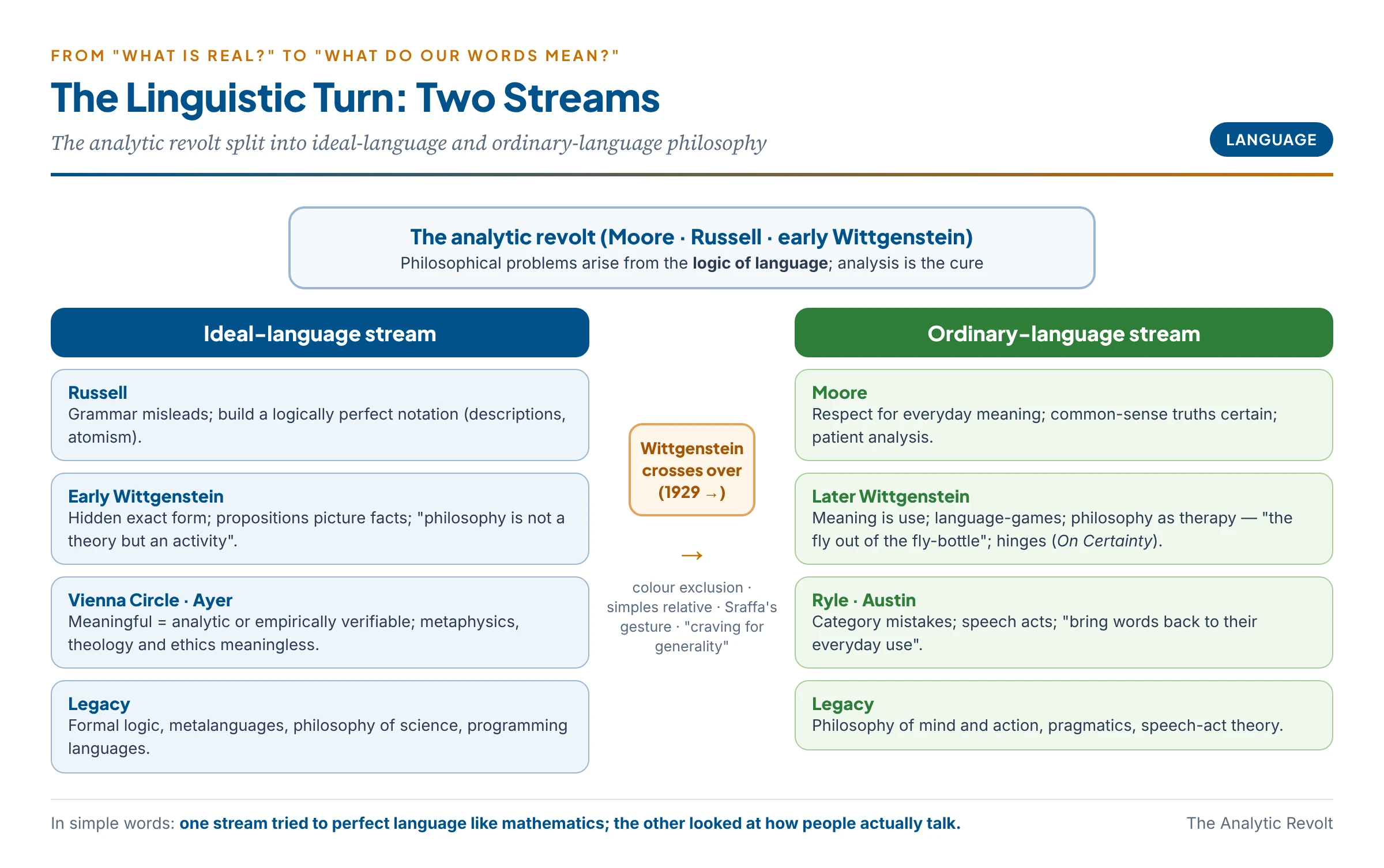
8. The Linguistic Turn and Its Two Streams
- The turn itself. The revolt shifted philosophy’s central question from “What is real?” and “How do we know?” to “What do our words and sentences mean?” Philosophical problems came to be seen as problems about language and its logic.
- Stream one: ideal-language philosophy.
- Russell and the early Wittgenstein sought a logically perfect language whose structure mirrors reality.
- The Vienna Circle (Schlick, Carnap, Neurath) and, in Britain, A. J. Ayer (Language, Truth and Logic, 1936) built logical positivism on this: a statement is meaningful only if it is either analytic (true by logic or definition) or empirically verifiable; metaphysics, theology and ethics are literally meaningless.
- The Tractatus idea that “philosophy is not a theory but an activity” of clarification became a slogan of the movement.
- Stream two: ordinary-language philosophy.
- Moore’s respect for ordinary meaning and his patient analysis of everyday propositions inspired a different path.
- The later Wittgenstein (Philosophical Investigations, 1953) rejected the ideal of a perfect language: “the meaning of a word is its use in the language“; there are countless language-games; “Philosophy is a battle against the bewitchment of our intelligence by means of language.“
- Gilbert Ryle (category mistakes) and J. L. Austin (speech acts) at Oxford developed ordinary-language philosophy.
- Why the early Wittgenstein changed. In 1929 Wittgenstein returned to Cambridge and soon found the Tractatus mistaken:
- Colour exclusion. “This is red” and “this is green” (of the same spot at the same time) exclude each other, yet atomic propositions were supposed to be independent.
- Simplicity is relative. “Simple” and “complex” have no absolute sense; they depend on context and purpose.
- Conversations with Ramsey and Sraffa. The economist Piero Sraffa, so the story goes, made a Neapolitan gesture of contempt (brushing the chin with his fingertips) and asked: what is the logical form of that? Wittgenstein came to see the Tractatus as driven by a “craving for generality“.
- What he kept. Philosophy as activity, not doctrine; the idea that grammar shows itself in use; suspicion of metaphysical theories.
- Wittgenstein and Moore again. In his last notes (On Certainty, written 1949–51) Wittgenstein returned to Moore’s “Here is one hand“. He agreed with Moore’s conclusion — such propositions are not open to doubt — but criticised his method: Moore’s propositions are not items of knowledge proved by evidence, but “hinges” on which our doubts and enquiries turn. “I know” is out of place where doubt makes no sense.
9. The Grand Comparison: Moore, Russell, Early and Later Wittgenstein
| Parameter | Moore | Russell | Early Wittgenstein | Later Wittgenstein |
|---|---|---|---|---|
| Key works | “Refutation of Idealism” (1903); Principia Ethica (1903); “A Defence of Common Sense” (1925); “Proof of an External World” (1939) | “On Denoting” (1905); Principia Mathematica (with Whitehead, 1910–13); Our Knowledge of the External World (1914); “The Philosophy of Logical Atomism” (1918) | Tractatus Logico-Philosophicus (1921/22) | Philosophical Investigations (1953); On Certainty (1969) |
| Philosophical focus | Common-sense realism | Logical atomism; logic and mathematics | Logical structure of language and world | Ordinary language in its use |
| Nature of meaning | Concepts and propositions grasped in understanding | Reference; descriptions analysed by logic | Picture: shared logical form | Use in language-games |
| View of language | A tool to be carefully analysed | Imperfect; needs an ideal logical notation | Has a hidden, exact truth-functional structure | Many-sided, open-ended, part of forms of life |
| Basic units | Common-sense objects; sense-data in perception | Sense-data, particulars, universals | Simple objects; atomic facts | No absolute simples |
| Common sense | Certain; to be defended | To be revised by science | Everyday propositions are “in perfect logical order” just as they are; analysis only reveals their hidden form | “Hinge” certainties; not known, but not doubted |
| Task of philosophy | Clarify meanings; refute paradoxical theories | Construct a scientific philosophy by analysis | Clarify thoughts; mark the limits of the sayable | Therapy: “to shew the fly the way out of the fly-bottle” |
| Status of metaphysics | Rejects idealist metaphysics; no system of his own | Replaces old metaphysics with logical atomism | Nonsense: tries to say what shows itself | Language “on holiday”; confusions to be dissolved |
| Ethics | Central; good is non-natural | Outside strict philosophy; active public engagement | Transcendental; shown in life | Grammar of ethical language-games |
10. The Legacy of the Revolt
- Analytic philosophy. The dominant style of English-language philosophy for a century traces back to these three: clear argument, attention to language, piecemeal problem-solving.
- Logic and computing. Russell’s and Whitehead’s Principia, the theory of types and the idea of formal languages fed directly into modern logic, the theory of computation and programming languages.
- Ethics. Moore’s Principia Ethica opened twentieth-century metaethics with the open-question argument and the charge of the naturalistic fallacy.
- Philosophy of science. Russell’s constructions and the Tractatus shaped logical positivism and later debates about theory and observation.
- Public philosophy. Russell’s pacifism, campaigns against nuclear weapons and popular writing (Nobel Prize for Literature, 1950) showed philosophy engaged with public life.
- A turn inward. Wittgenstein’s later work questioned the whole ideal of analysis into simples and opened the way to philosophy as the study of forms of life.
In simple words
A good way to remember the three: Moore says, “I know this is a hand — don’t argue me out of it.” Russell says, “Let me analyse what ‘this hand’ really is — a construction from sense-data.” Early Wittgenstein says, “Whatever you can say about the hand, you can say clearly — but what makes saying possible you cannot say at all.”
Critical Evaluation
Objections to the Analytic Revolt
- Idealism not refuted, only bypassed. Moore’s argument hits Berkeley’s premise, not the Absolute Idealism of Hegel and Bradley, which never relied on esse est percipi. W. T. Stace turned Moore’s method around in “The Refutation of Realism” (1934): realists cannot prove that anything exists unperceived, since every example they give is perceived.
- Question-begging common sense. Moore’s appeal to certainty simply assumes what the idealist denies; a long history of common beliefs (the sun “rising”, a flat earth) shows that common sense can be wrong.
- The return of private ideas. Russell’s sense-data are private and momentary — uncomfortably close to Berkeley’s ideas. Moore himself struggled for decades to say how sense-data relate to the surfaces of objects.
- Atomism abandoned by its founders. Russell moved to neutral monism; Wittgenstein gave up independent atomic propositions after the colour-exclusion problem. No one ever produced a single example of a Tractarian simple object or a complete analysis.
- The ideal-language programme failed. The verification principle of the positivists is itself neither analytic nor verifiable, and so by its own test meaningless; Quine attacked the analytic–synthetic distinction on which it rested.
- Narrowing of philosophy. Critics charge that analysis turned philosophy into a technical discipline cut off from history, culture, ethics and the great questions of life — the very questions the idealists had tried to answer.
- Hidden metaphysics. The revolt claimed to be free of metaphysics, yet atomism, external relations and realism are themselves metaphysical theses.
Replies and Strengths
- Burden of proof shifted. After Moore, a philosophical theory that denies the reality of time, space or other minds must show why its premises are more certain than the plain truths it denies — a lasting gain.
- Logic transformed philosophy. Russell’s analysis of descriptions and relations is a permanent achievement; even critics of atomism use his logic.
- Self-correction is a virtue. That the founders revised their own views is evidence of the method’s honesty: claims were stated clearly enough to be refuted.
- Clarity has value in itself. By demanding precision, the revolt made it possible to see exactly where arguments go wrong.
- The limits of language. Wittgenstein’s insight that some things can be shown but not said kept room for ethics and the mystical within a rigorous logical framework, and his later work recovered the richness of ordinary life that critics said analysis had lost.
Critics and Defenders
Criticism — Critics
- Absolute idealists (Bradley’s school): pluralism and external relations simply assumed, not proved.
- W. T. Stace: realism is as unproved as Moore said idealism was.
- Later Wittgenstein: atomism and the ideal language are a myth; meaning is use.
- Quine: no sharp analytic–synthetic distinction; analysis cannot be completed.
- Continental and pragmatist critics: analysis narrows philosophy and ignores history and lived experience.
- Strawson: Russell’s theory of descriptions confuses sentences with their uses.
Defence — Defenders and strengths
- Moore: common-sense truths are more certain than any philosophical premise against them.
- Russell: only by analysing is progress possible; logic exposes pseudo-entities.
- Early Wittgenstein: clarity about the sayable protects what matters most.
- Logical positivists: philosophy as clarification of science.
- Ordinary-language philosophers: Moore’s respect for everyday meaning vindicated.
- Modern logicians: Russell’s hierarchy realised in metalanguages and formal semantics.
Cross-Tradition Comparison
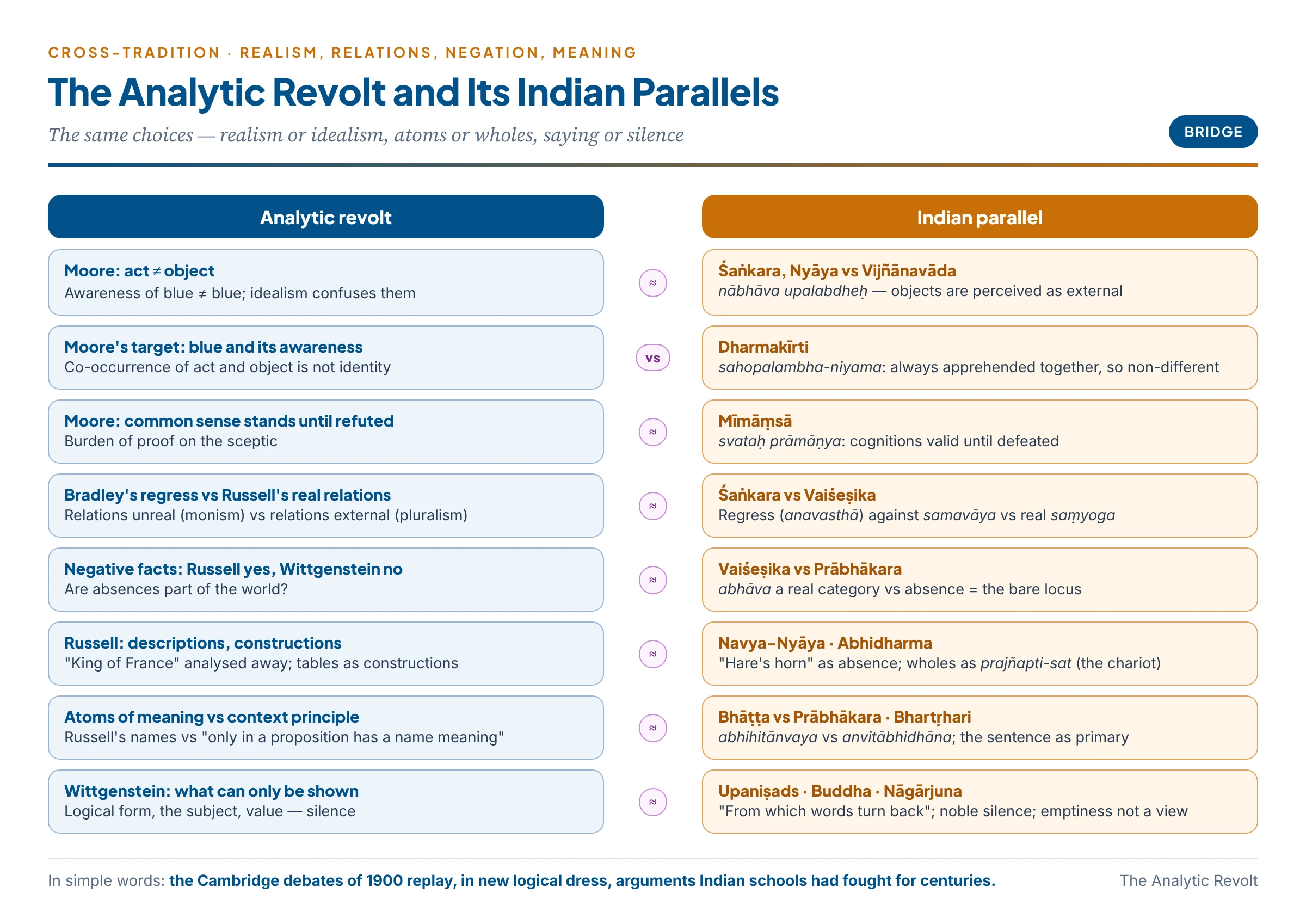
Indian Parallels to the Analytic Revolt
| Analytic theme | Western position | Indian parallel |
|---|---|---|
| Realism against idealism | Moore: the object of awareness is distinct from the act; common sense is certain | Nyāya, Mīmāṃsā and Śaṅkara against Vijñānavāda: “non-existence of external objects cannot be held, because they are perceived” (nābhāva upalabdheḥ) |
| Blue and the awareness of blue | Moore: awareness of blue and of green share the same consciousness; the difference lies in the objects | Dharmakīrti’s sahopalambha-niyama (blue and the cognition of blue are always apprehended together, so are not different) — the very inference Moore attacks |
| Burden of proof | Moore: common sense stands until refuted | Mīmāṃsā svataḥ prāmāṇya: a cognition is valid by itself until defeated |
| External relations | Russell: relations are real and irreducible | Vaiśeṣika saṃyoga (conjunction): a real, separable relation between independent substances |
| The regress against relations | Bradley: relations need further relations without end, so they are unreal | Śaṅkara: if samavāya (inherence) connects substance and quality, another relation is needed to connect samavāya itself — infinite regress (anavasthā); hence relations are not ultimately real |
| Pluralist inventory | Russell’s atomism: particulars, qualities, relations, facts | Vaiśeṣika padārthas: substance, quality, action, universal, particularity, inherence, absence |
| Negative facts | Russell admits them; Wittgenstein rejects them | Vaiśeṣika treats absence (abhāva) as a real category; Prābhākara Mīmāṃsā reduces absence to the bare locus |
| Empty terms | Russell: “the present King of France” analysed away | Navya-Nyāya on the “hare’s horn” (śaśa-śṛṅga): analysed as the absence of a horn in a hare, not as an unreal object |
| Logical constructions | Physical objects and persons as constructions | Abhidharma: wholes are prajñapti-sat (conventionally real), only dharmas are dravya-sat; the chariot of the Milindapañha |
| Inferred external world | Russell (1912): physical objects inferred from sense-data | Sautrāntika: external objects are inferred from the forms in cognition |
| Word and sentence meaning | Russell builds meaning from names of objects of acquaintance; the Tractatus says “only in the context of a proposition has a name meaning” | Bhāṭṭa abhihitānvaya-vāda (words first express meanings, then combine) versus Prābhākara anvitābhidhāna-vāda (words mean only as connected in a sentence); Bhartṛhari: the sentence is the primary unit |
| The unsayable | Wittgenstein: what can be shown cannot be said | Kena and Taittirīya Upaniṣads; the Buddha’s silence; Nāgārjuna’s emptiness that is not a view |
Indian Connect — Key takeaways
- Moore’s argument has a long Indian history. When the Yogācāra (Vijñānavāda) Buddhist argued that objects are nothing but forms of consciousness, Śaṅkara replied that the object is perceived as external: the idealist’s own phrase “appears as if external” makes sense only if there is an external — no one says that something “appears like the son of a barren woman”. Like Moore, he holds that the act of cognition and its object are distinct and that perception, not theory, has the first word.
- Dharmakīrti and Moore’s blue. Dharmakīrti’s principle that blue and the awareness of blue are always apprehended together (sahopalambha-niyama) is a sophisticated version of the idealist step Moore attacks; the Nyāya and Mīmāṃsā reply, like Moore’s, is that invariable co-occurrence does not prove identity.
- Śaṅkara and Bradley on relations. Both use an infinite-regress argument against relations to support monism — Bradley for the Absolute, Śaṅkara for Brahman. The Vaiśeṣika defence of real relations (saṃyoga, samavāya) plays the role that Russell’s logic of relations plays against Bradley.
- Absence and negative facts. The Vaiśeṣika–Nyāya acceptance of absence (abhāva) as real resembles Russell’s admission of negative facts; the Prābhākara reduction of absence to the bare locus resembles Wittgenstein’s refusal to admit them.
- Atomism and context. Russell’s atomism of meaning echoes the Bhāṭṭa view that word-meanings come first; the Tractatus‘ context principle and the later Wittgenstein’s holism echo the Prābhākara and Bhartṛhari view that the sentence is primary.
- A difference. The analytic revolt aimed at clarity and scientific knowledge; the Indian debates were part of systems aimed at liberation (mokṣa, nirvāṇa), so realism and idealism were tied to questions of bondage and release.
Common confusion
“Moore was an ordinary-language philosopher.” Only indirectly. Moore analysed concepts and propositions, not the use of words; he spoke of what a proposition means, and he took common-sense beliefs to be true knowledge. Ordinary-language philosophy (the later Wittgenstein, Ryle, Austin) learnt from Moore’s respect for everyday meaning, but it treated meaning as use — and the later Wittgenstein explicitly criticised Moore for claiming to know what lies beyond doubt.
Synthesis (Siddhānta)
The analytic revolt was one rebellion fought with three different tools. Against the Absolute Idealism of Bradley and McTaggart, Moore defended the certainty of common sense and separated the act of awareness from its object; Russell made relations real and external, analysed away misleading descriptions and built a pluralist world of logical atoms and logical constructions; and the early Wittgenstein pictured the world as a totality of independent facts and showed that metaphysics, idealist or realist, tries to say what can only be shown. All three shared a faith in analysis, a pluralist and broadly realist view of the world, and a conviction that philosophical errors are often errors about the logic of language.
Their differences are as instructive as their agreement. Moore analyses to preserve common sense; Russell analyses to reconstruct it in the light of science, ending closer to Berkeley’s phenomenalism than Moore ever did; Wittgenstein analyses to fix the limits of the sayable and leaves logic, the self and value to show themselves. The hierarchy of languages marks the sharpest divide between the empiricist logician and the logician of limits. The programme did not so much refute idealism as change the questions of philosophy; its atomism was abandoned by its founders, but its logic, its demand for clarity, and its two heirs — ideal-language and ordinary-language philosophy — shaped the century. Indian debates — Nyāya and Śaṅkara against Vijñānavāda, Vaiśeṣika on relations and absence, Mīmāṃsā on sentence meaning, and the Upaniṣadic unsayable — show that the same choices between realism and idealism, atoms and wholes, saying and silence arise wherever philosophy takes language and knowledge seriously.
- Logic and computer science rest on the formal languages, type theories and metalanguages that grew from Russell’s work.
- Artificial intelligence and linguistics still debate whether meaning is built from atoms (formal semantics) or emerges from use in context (large-scale statistical models of language).
- Public reasoning benefits from Moore’s lesson that a clever argument against plain facts is more likely to contain an error than the facts are.
The idealists said the world is one; the analysts answered with a hand, a logical formula and a picture — and then discovered that the hardest question was what language itself can say.
Previous Year Questions
- 2026“Wittgenstein’s difficulty about not being able to say anything within a given language about the structure of that language can be met by the idea of a hierarchy of languages.” Do you agree with this statement? Give reasons and justifications for your answer.
- 2018How does Berkeley establish that Mind and its ideas alone are real? How do Moore and Russell react to Berkeley’s view in this regard? Do you find any difference between Moore’s reaction and Russell’s one? Discuss.
- 2014Why does Wittgenstein disagree with Bertrand Russell’s interpretation of atomism in the philosophy of Tractatus? Discuss.