

Social and Political Ideals: Equality, Justice, Liberty.
Official Syllabus: Paper II, Section A, Unit 1
Amartya Sen (born 1933), economist and philosopher, dedicated The Idea of Justice (2009) to the memory of John Rawls — and then questioned the whole direction Rawls had given to the subject. Rawls, like Hobbes, Locke, Rousseau and Kant before him, tried to identify the perfectly just institutions of an ideal society. Sen calls this transcendental institutionalism, and argues that it is neither necessary nor sufficient for what really matters: removing the clear injustices around us — famine, avoidable illness, illiteracy, the subjugation of women, torture. Borrowing two old Sanskrit words, he distinguishes nīti (right rules and institutions) from nyāya (justice as actually realised in people’s lives), and asks political philosophy to focus on nyāya. His alternative is a realisation-focused, comparative approach, judged by people’s capabilities — their real freedom to live lives they have reason to value. This article explains Sen’s critique of Rawls, his own approach, the famous three children and a flute, his ideas of open impartiality and public reasoning, the criticisms of Sen, and finally how Marx, Gandhi and Sen agree and differ on justice in Indian democracy.
In simple words
To know that Mount Everest is the tallest mountain in the world does not help you decide whether Kangchenjunga is taller than Mont Blanc — and you do not need to know the tallest mountain to compare those two. In the same way, says Sen, we do not need a picture of the perfectly just society to know that a society with famine is less just than one without it — and to act to remove the famine.
Context & Problem
Two Traditions of Thinking about Justice
- Transcendental institutionalism — the dominant tradition from Hobbes, Locke, Rousseau and Kant to Rawls and Nozick:
- It concentrates on identifying perfect justice, not on comparing more and less just arrangements.
- It concentrates on getting the institutions right, not on the actual societies that would emerge from them — it assumes people will behave as the institutions require.
- It typically uses a social contract.
- Realisation-focused comparison — a second tradition in Adam Smith, Condorcet, Bentham, Mary Wollstonecraft, Marx and J. S. Mill, and the modern theory of social choice:
- It compares actual or possible societies and asks which is more or less just.
- It looks at actual behaviour, lives and outcomes, not only institutions.
- It aims at removing manifest injustice rather than describing a perfect order.
- Sen places himself in the second tradition. He does not reject institutions; he says institutions matter because of what they do to people’s lives.
Core Doctrine
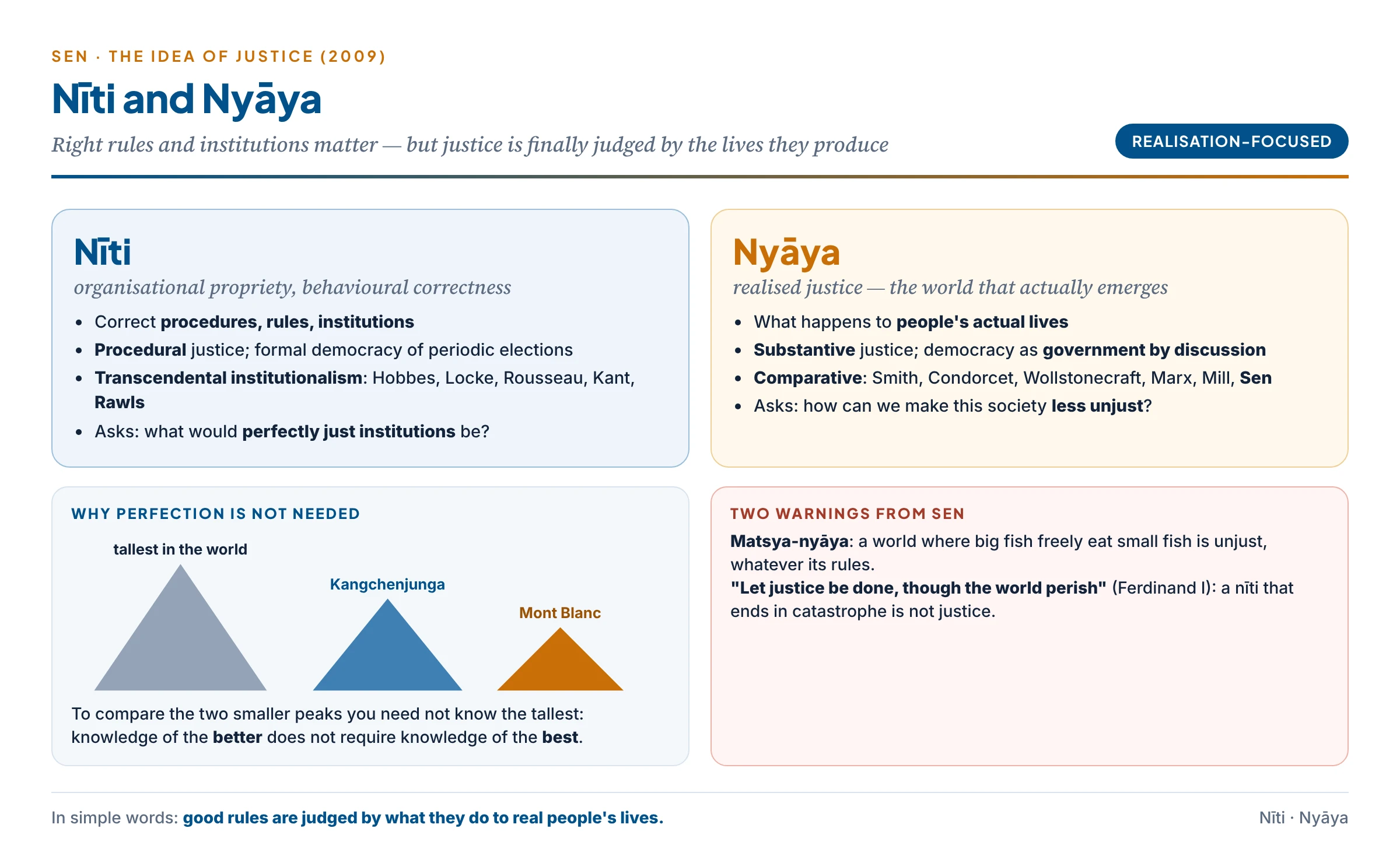
Nīti and Nyāya
- Nīti means organisational propriety and behavioural correctness — the rightness of rules, laws and institutions.
- Nyāya means a comprehensive concept of realised justice — what actually happens to people’s lives, the kind of world that emerges.
- Matsya-nyāya. Early Indian legal theorists spoke disparagingly of matsya-nyāya — “justice in the world of fish”, where a big fish can freely devour a small fish. Preventing matsya-nyāya is an essential part of justice: whatever rules and institutions we have, a world in which the strong freely swallow the weak is not a just world.
- “Let justice be done, though the world perish.” The sixteenth-century Holy Roman Emperor Ferdinand I declared: Fiat justitia, et pereat mundus. Sen replies: if the world perishes, there is nothing to celebrate — a strict nīti that ends in catastrophe cannot count as justice in the sense of nyāya.
- Sen’s point. Rules and institutions (nīti) matter, but they cannot be the whole of justice; their worth must be judged by the lives they actually produce (nyāya).
Common confusion
Is Rawls’s approach “nyāya” and Sen’s “nīti”? No — it is the other way round, though some notes swap them. Nīti is the rightness of rules and institutions — the focus of Rawls’s search for perfectly just institutions. Nyāya is realised justice in people’s actual lives — Sen’s focus. So Sen uses the idea of nyāya to criticise a nīti-centred approach. A question framed as Sen’s “principle of nīti as critique of nyāya” still turns on this distinction: Sen does not reject nīti, but he insists that nīti must be judged by nyāya.
Sen’s Critique of Transcendental Institutionalism
The two problems:
- Feasibility — there may be no agreement on the nature of the perfectly just society, even among impartial and reasonable people, because there are plural, competing reasons of justice (see the flute example below).
- Redundancy — even if a perfect society could be identified, it is not needed for comparative judgements. “Knowledge of the better does not require knowledge of the best.”
- Mountains: we can know which of two mountains is taller without knowing which is the tallest in the world.
- Paintings: if someone thinks the Mona Lisa is the best painting in the world, that tells us nothing about how to rank a Picasso against a Dalí.
Further criticisms of Rawls:
- Hypothetical vs actual. The original position is a hypothetical device; justice should not be indifferent to the lives people actually live.
- Institutions vs behaviour. Rawls assumes that once just institutions are chosen, people will comply with them. Real societies depend on actual behaviour; just institutions do not guarantee just outcomes.
- Primary goods vs capabilities. Primary goods are means; people differ in their ability to convert them into well-being (see below).
- Priority of liberty. Sen accepts that liberty is especially important but questions its absolute priority: why should a minor liberty always outweigh, say, freedom from famine?
- Closed impartiality. Rawls’s original position includes only members of one society. It ignores the views and interests of people outside — a risk of parochialism.
- One set of principles. Rawls assumes the original position would yield one unique set of principles. Sen doubts this, given plural reasons.
- The global question. A theory that needs a sovereign state to set up just institutions has little to say about global injustice — where there is no world state.
The Three Children and a Flute
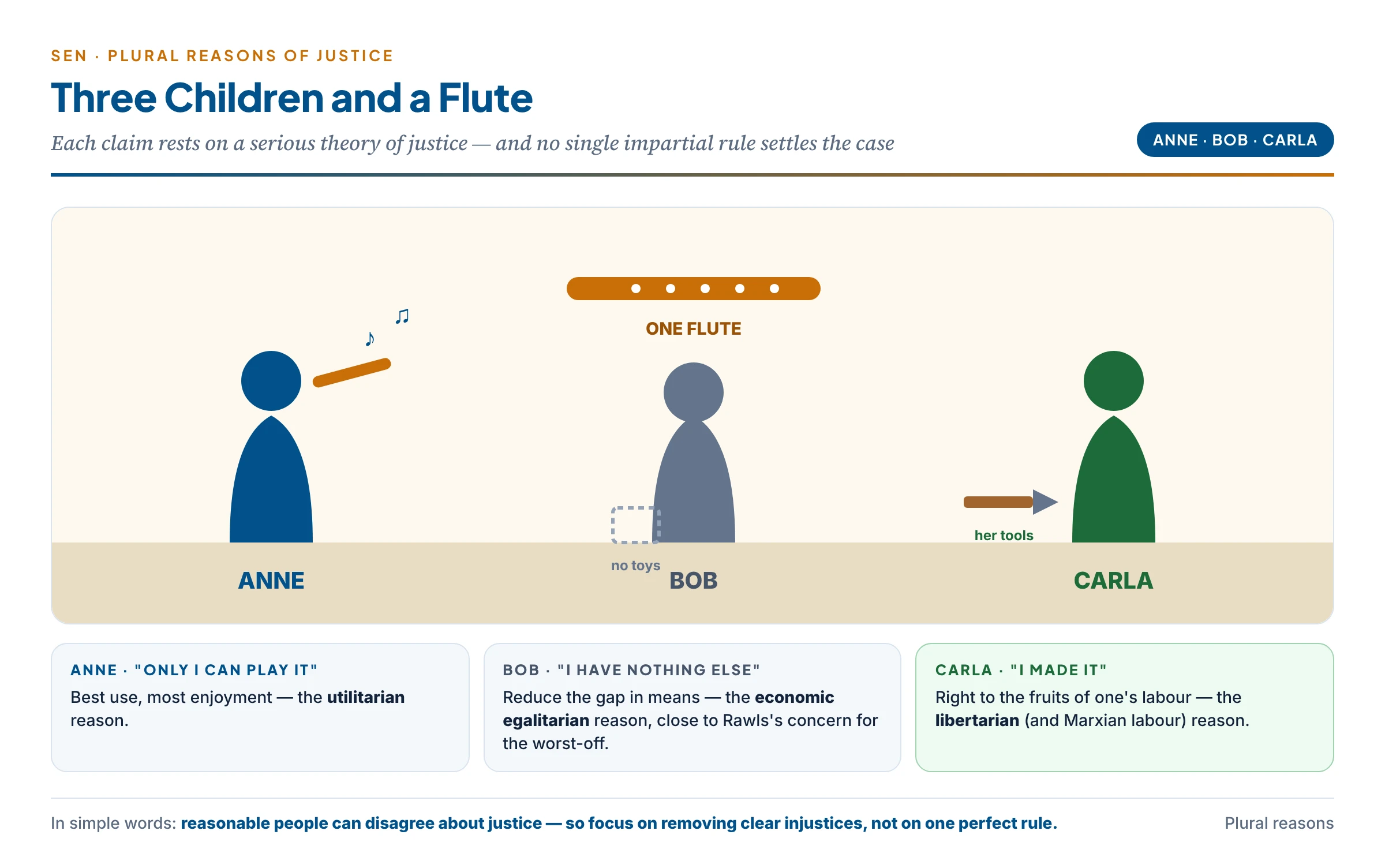
Three children quarrel over a flute:
- Anne says it should be hers because she is the only one who can play it; the others would waste it.
- Bob says it should be his because he is so poor that he has no other toys; the flute would give him something to play with.
- Carla says it should be hers because she made it with her own labour; it would be wrong to take away what she made.
Each claim is backed by a serious theory:
- Anne — a utilitarian (or one who looks to fulfilment and use): the flute produces most happiness or the best use in her hands.
- Bob — an economic egalitarian (close to Rawls’s concern for the worst-off): reduce the gap in means.
- Carla — a libertarian (and also the Marxist idea of the right to the fruits of one’s labour): a person is entitled to what she produces.
Sen’s lesson. There may be no single impartial principle that settles the case: plural and competing reasons of justice can each survive critical scrutiny. So the search for one perfectly just arrangement may fail — yet we can still reason, rank and agree on removing the worst injustices.
In simple words
Your family must decide who gets the only scooter. Your sister drives best; your brother has the longest walk to college; your father paid for it. Each has a fair point. A family that waits to find “the one perfect rule” will never decide. A wiser family talks it over, compares the options, and at least avoids the worst outcome — say, leaving the scooter unused while everyone walks. That is Sen’s comparative approach.
The Comparative, Realisation-Focused Approach
- Rank, do not idealise. Rank alternative social arrangements as more or less just, rather than focusing only on identifying a fully just society.
- A continuum, not a dichotomy. Justice and injustice lie along a continuum; societies are not simply “just” or “unjust”.
- Policy against policy. Instead of judging a proposal against an ideal vision, it is more practical to compare one possible policy with another.
- Social choice theory. From Condorcet to Kenneth Arrow and Sen’s own work, social choice theory shows how to reach partial rankings from plural values — we may not rank everything, but we can agree that some states are clearly worse.
- Manifest injustice. Most people can agree that slavery, famine, the subjugation of women, and lack of medical care are unjust — without first agreeing on a complete theory. Mary Wollstonecraft and the abolitionists did not need a perfect theory of justice to see that slavery and women’s subjection had to end.
Capabilities: What Should Be Equalised?
- Primary goods and income are means, not ends. People differ in their ability to convert resources into good lives:
- A pregnant woman needs more food than others to be equally well-nourished.
- A disabled person needs more income (a wheelchair, help) to achieve the same mobility.
- People living in different climates, environments or social conditions need different resources for the same results.
- Functionings — the “beings and doings” a person values: being well-fed, healthy, literate, mobile, taking part in community life.
- Capabilities — the real freedom or opportunity to achieve these functionings. Justice should be judged by capabilities, not by resources or by happiness.
- Freedom matters, not just outcomes. A person who fasts for religious reasons and a person who starves for lack of food have the same functioning (both are undernourished), but very different capabilities — the faster could eat; the starving person cannot.
In simple words
Two people each have a bicycle. One is a healthy young man in a town with good roads; the other is an elderly woman with weak knees in a hilly village with no roads. They have the same resource, but very different freedom to move. Sen says justice must look at what people can actually do and be with what they have — their capabilities.
- Development as freedom. In Development as Freedom (1999) Sen treats freedom as both the primary end and the principal means of development; it is advanced through five instrumental freedoms: political freedoms, economic facilities, social opportunities, transparency guarantees and protective security. These freedoms reinforce each other — for example, economic and political freedom.
- The Human Development Index (from 1990, with Mahbub ul Haq) applied this thinking: development measured by health, education and income, not by income alone.
Open Impartiality and the Impartial Spectator
- Closed impartiality (Rawls): only members of the society take part in the original position.
- Open impartiality (Sen): we must also hear the views of those outside — “views from a distance” — to avoid parochial prejudice. Sen uses Adam Smith’s impartial spectator: judge your society’s practices as an informed and fair outsider would.
- Example. Practices once accepted in one society — such as stoning for adultery or child marriage — look very different when examined from the standpoint of an impartial spectator anywhere in the world.
- Sen proposes to replace the original position with Smith’s impartial spectator, and to extend the exercise to the global context.
Democracy as Public Reasoning
- Government by discussion. Democracy is not only elections and majority rule; it is public reasoning — open discussion in which people can argue and learn.
- Famines and free press. Sen’s famous finding: no substantial famine has ever occurred in a functioning democracy with a free press, because governments that face elections and criticism cannot ignore mass starvation. (His Poverty and Famines, 1981, studied the 1943 Bengal famine, which killed millions under colonial rule.)
In simple words
In a village where the newspaper reports that people are going hungry and the opposition raises it in the assembly, the government cannot pretend all is well — it must open relief kitchens before the next election. Where the press is silenced and no one can complain, hunger can quietly turn into famine. That is why Sen ties justice to public reasoning.
- Formal vs substantive democracy. Formal democracy is based on periodic elections; substantive democracy is decision-making by discussion — closer to nyāya.
| Basis | Nīti | Nyāya |
|---|---|---|
| Meaning | Correct procedures, rules and institutions | The kind of world produced by them; justice in actual lives |
| Type of justice | Procedural | Substantive |
| Democracy | Formal democracy: periodic elections | Democracy as decision-making by discussion |
| Typical thinkers | Hobbes, Kant, Rawls (transcendental) | Smith, Condorcet, Wollstonecraft, Marx, Mill (comparative) |
| Question asked | What would a perfectly just institution be? | How can we make this society less unjust? |
Indian Connect — Arjuna, Krishna and the consequences of duty
Sen uses the Bhagavad Gītā to illustrate nīti and nyāya. On the battlefield of Kurukṣetra, Arjuna hesitates: fighting his own kin will bring terrible slaughter. Krishna urges him to do his duty as a warrior without attachment to consequences. Krishna’s argument is a powerful defence of duty-based nīti; but Sen argues that Arjuna’s concern for what will actually happen — the deaths, the grief — is not simply mistaken. A full idea of justice must take consequences in the world (nyāya) seriously, alongside duty.
Critical Evaluation
Criticisms of Sen
- Comparison may need an ideal. Some argue that to rank two arrangements as “more just”, we need some idea of what justice is — a transcendental standard. Sen replies that partial agreement on reasons is enough; but critics say his capabilities approach itself works as a standard.
- Hard cases. Many injustices are complex and subtle, harder to identify than famine or slavery — for example, everyday gender inequality in the family. A focus on “manifest injustice” may miss them.
- Indeterminacy of capabilities. Sen refused to give a definite list of capabilities. Martha Nussbaum gave a list of ten central capabilities; critics say without such a list the approach cannot guide policy, and with one it becomes paternalist.
- Measurement. Capabilities are hard to measure and compare across cultures; in practice the approach often falls back on economic indicators — some critics say Sen confines the measure of freedom too much to economic criteria.
- Too much faith in public reasoning. Public discussion can be dominated by the powerful; free press does not prevent chronic hunger or malnutrition, as Sen himself admits.
- Rawls already compares. Defenders of Rawls say A Theory of Justice already gives guidance for non-ideal cases and that Sen exaggerates the contrast.
Is Sen’s Idea of Justice an Improvement upon Rawls?
Ways in which it improves:
- Focus on real lives — from ideal institutions to actual outcomes and the removal of injustice.
- Capabilities over primary goods — attends to human diversity in converting resources (disability, gender, region).
- Open impartiality — guards against parochialism; makes global justice thinkable.
- Plural reasons — honest about reasonable disagreement (the flute).
- Practical guidance — policy-against-policy comparison is directly useful for governments.
Ways in which it does not replace Rawls:
- Sen builds on Rawls’s ideas of fairness, impartiality and public reason; his book is dedicated to Rawls.
- Rawls gives a systematic structure — priority of liberty, fair opportunity, difference principle; Sen deliberately gives no complete theory.
- Without some general principles, comparisons may become arbitrary.
- Verdict. Sen’s Idea of Justice is best seen as completing and moving forward Rawls’s concept of justice — fulfilling its aims in the real world — rather than as a wholly alternative view. It is an improvement in practical relevance and attention to diversity; Rawls remains stronger in systematic principle.
Marx, Gandhi and Sen on Justice in Indian Democracy
Marx on Justice
- Justice and the mode of production. For Marx, ideas of justice are part of the superstructure: each mode of production has its own idea of what is “just”. Under capitalism, the wage contract is “just” by bourgeois standards — the worker is paid the value of his labour-power — yet the capitalist takes the surplus value the worker produces. Exploitation is built into the system, not a breach of its rules.
- Bourgeois right. Equal rights in a class society are formal; they hide real inequality of property and power.
- Two phases of communism (Critique of the Gotha Programme, 1875):
- First phase (socialism): “to each according to his work” — still an equal standard applied to unequal people, and so, Marx says, “a right of inequality, in its content, like every right”.
- Higher phase (communism): “From each according to his ability, to each according to his needs!” — when labour has become life’s first need and goods flow abundantly.
- Beyond justice. In a classless society of plenty, the circumstances of justice disappear; disputes over shares, and so “justice” in the bourgeois sense, become unnecessary.
- Method. Justice requires changing the relations of production — abolishing private ownership of the means of production — through class struggle.
Gandhi on Justice
- Sarvodaya — the welfare of all, not of the greatest number; inspired by Ruskin’s Unto This Last: the labour of a lawyer and a barber has equal value.
- Antyodaya — the rise of the last person; the talisman asks every policy to be judged by its effect on the poorest.
- Trusteeship — the rich hold surplus wealth in trust for society; change of heart, not expropriation by force.
- Bread labour and limited wants — everyone should do some manual labour; needs should be limited; greed, not scarcity, is the root of poverty.
- Swarāj and decentralisation — self-reliant village republics; power close to the people.
- Means and ends — justice cannot be achieved by violence; satyagraha (non-violent resistance) is the method of fighting injustice.
- Duty before rights, and justice rooted in truth and non-violence.
Sen on Justice (summary)
- Capabilities, comparative removal of injustice, public reasoning and democracy, open impartiality.
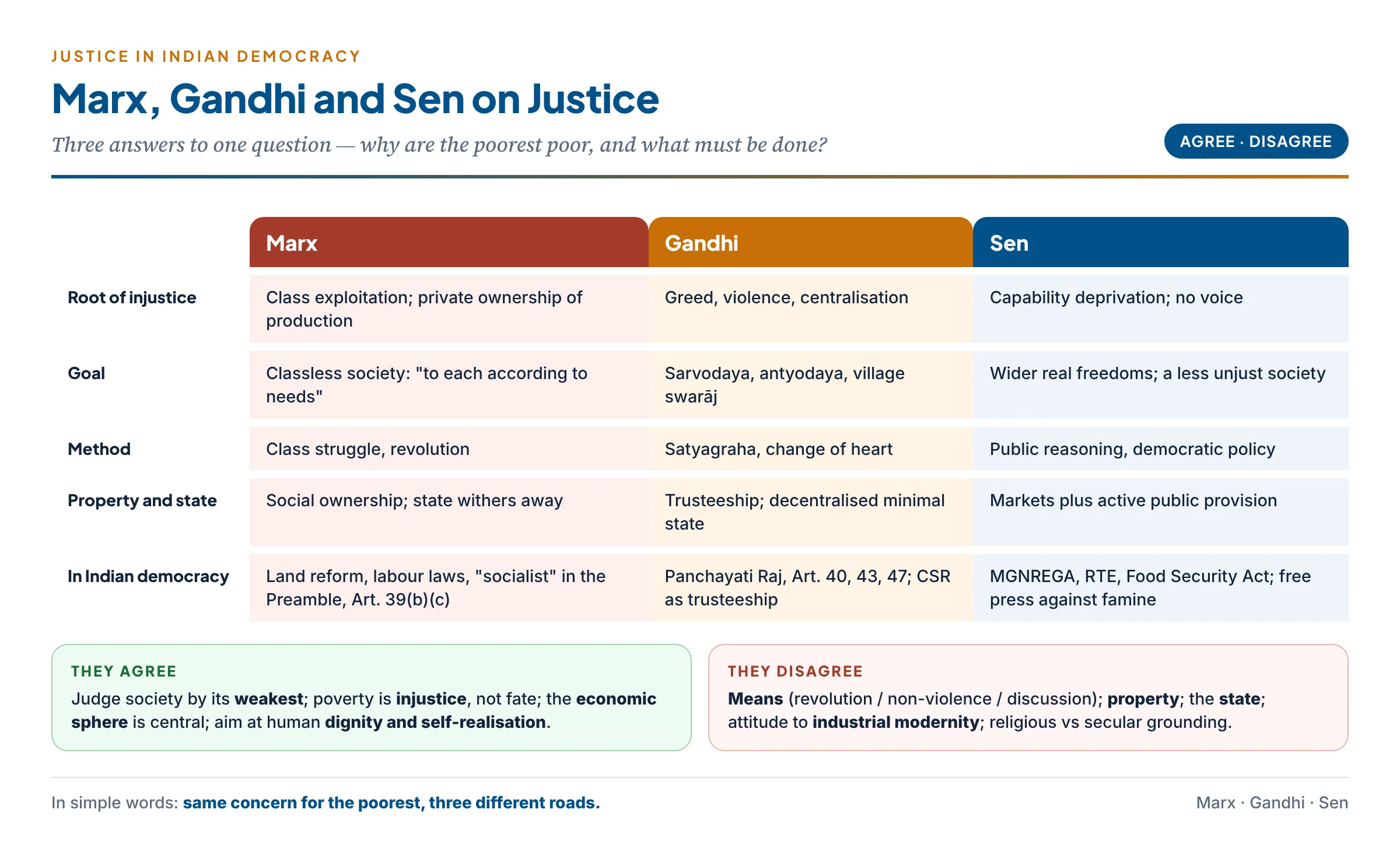
| Theme | Marx | Gandhi | Sen |
|---|---|---|---|
| Root of injustice | Class exploitation; private ownership of means of production | Greed, violence, centralisation, untruth | Capability deprivation; lack of voice and public reasoning |
| Goal | Classless society; “to each according to needs” | Sarvodaya, Rāmarājya, village swarāj | Expansion of real freedoms; less unjust society |
| Method | Class struggle, revolution | Satyagraha, change of heart, constructive work | Public reasoning, democratic policy, comparison |
| State | Withers away after transition | Minimal, decentralised | Active democratic state, free press |
| Property | Social ownership | Trusteeship | Pragmatic; markets plus public provision |
| Individual | Freed through social emancipation | Moral individual with duties | Agent with capabilities and voice |
Where they agree:
- All three reject utilitarian aggregation and formal equality that ignores the poor; all three judge society by the condition of its weakest members.
- All see poverty and deprivation as injustice, not misfortune.
- All treat the economic sphere as central to justice — not only legal and political rights.
- All value human dignity and self-realisation — Marx’s free development of each, Gandhi’s swarāj, Sen’s capabilities.
Where they disagree:
- Means: Marx accepts revolutionary class struggle; Gandhi insists on non-violence and purity of means; Sen relies on democratic public reasoning.
- Property: Marx — abolish private ownership of the means of production; Gandhi — trusteeship; Sen — no single doctrine, judged by results.
- State: Marx expects it to wither away; Gandhi wants it decentralised and minimal; Sen wants an active democratic state.
- Modernity: Marx and Sen welcome industry and technology; Gandhi was deeply critical of industrial civilisation.
- Values: Gandhi’s justice is rooted in religion and truth; Marx’s in historical materialism; Sen’s in secular public reason.
In Indian democracy:
- Marxian strands: land reforms and abolition of zamindari, labour laws, the word “socialist” in the Preamble (42nd Amendment, 1976), Article 39(b) and (c) against concentration of wealth.
- Gandhian strands: Panchayati Raj (73rd Amendment, 1992), Article 40 (village panchayats), Article 48 and cottage industries (Article 43), prohibition (Article 47), the antyodaya approach in welfare, and trusteeship echoed in mandatory Corporate Social Responsibility under the Companies Act, 2013.
- Senian strands: rights-based welfare laws — MGNREGA (2005), the Right to Education Act (2009), the National Food Security Act (2013) — the emphasis on health, education and women’s agency, and on democracy and free press as protection against famine.
- Synthesis. Indian democracy blends the three: Marx’s insistence that economic structure matters, Gandhi’s moral and decentralised vision, and Sen’s capability and public-reasoning approach — all within a constitutional framework that also protects individual liberty.
Critics and Defenders
Criticism — Critics of Sen
- Needs an ideal to rank “more just”.
- Subtle injustices (gender in the family) missed.
- No list of capabilities; hard to measure.
- Public reasoning can be captured by the powerful.
- Overstates the gap with Rawls.
Defence — Strengths of Sen’s approach
- Real lives, not ideal institutions.
- Human diversity in converting resources.
- Open impartiality; global justice.
- Plural reasons honestly faced (the flute).
- Policy-ready: compare, improve, remove injustice.
Cross-Tradition Comparison
| Theme | Western theory | Indian thought |
|---|---|---|
| Rules vs realised justice | Transcendental institutionalism (Rawls) vs comparison (Smith) | Nīti vs nyāya (classical Sanskrit jurisprudence, revived by Sen) |
| Law of the strong | Thrasymachus; Hobbes’s state of nature | Matsya-nyāya |
| Duty vs consequences | Kant vs utilitarians | Krishna vs Arjuna in the Gītā |
| The worst-off first | Rawls’s difference principle | Gandhi’s antyodaya and talisman |
| To each according to need | Marx’s higher phase of communism | Sarvodaya; the Jaina and Buddhist ethic of non-possession (aparigraha) |
Indian Connect — Sen’s Indian sources
Sen draws on Indian traditions of public reasoning — the Buddhist councils, Aśoka’s edicts urging respect for other sects, and Akbar’s debates among faiths at Fatehpur Sikri — to argue that democracy as government by discussion is not a purely Western gift. In The Argumentative Indian (2005) he presents India’s long habit of argument and heterodoxy as a resource for justice and tolerance today.
Synthesis (Siddhānta)
- Sen’s shift: from nīti to nyāya, from ideal institutions to real lives, from primary goods to capabilities, from closed to open impartiality.
- His insight: we can and must act against manifest injustice now, without waiting for agreement on a perfect society; and reasonable people may hold plural reasons of justice.
- His limits: comparisons need some guiding principles; subtle and structural injustices are harder to see; capabilities resist measurement.
- With Marx and Gandhi, Sen shares a concern for the poorest and a view of justice as economic and social, not only legal; they differ on means, property and the state.
- Contemporary relevance. India’s welfare architecture — rights to work, food and education, the Human Development and Multidimensional Poverty indices, and the defence of a free press — is a practical expression of realisation-focused justice.
Knowledge of the better does not require knowledge of the best — the heart of Sen’s comparative idea of justice.
Previous Year Questions
- 2021Discuss whether Amartya Sen’s idea of justice is an improvement upon Rawls’ theory of justice.
- 2017How far do Marx, Gandhi and Amartya Sen agree and disagree on the concept of justice in the Indian democracy? Discuss.
- 2014Discuss Amartya Sen’s principle of Niti as critique of Nyaya.
- 2013How Amartya Sen’s approach to justice is different from that of Rawls?