

Official syllabusPaper II · Unit 6 · Community Psychology
Effective strategies for social change – resistance to change and the community psychologist’s role.
Definition
“[Resistance is] any conduct that serves to maintain the status quo in the face of pressure to alter the status quo.”
Zaltman and Duncan (1977)
Every planned change in a community meets forces that hold the old pattern in place, and many programmes that are technically sound fail at that point. Community psychology treats resistance as information about the setting, not as a defect of the people, and works with the community to change the setting itself.
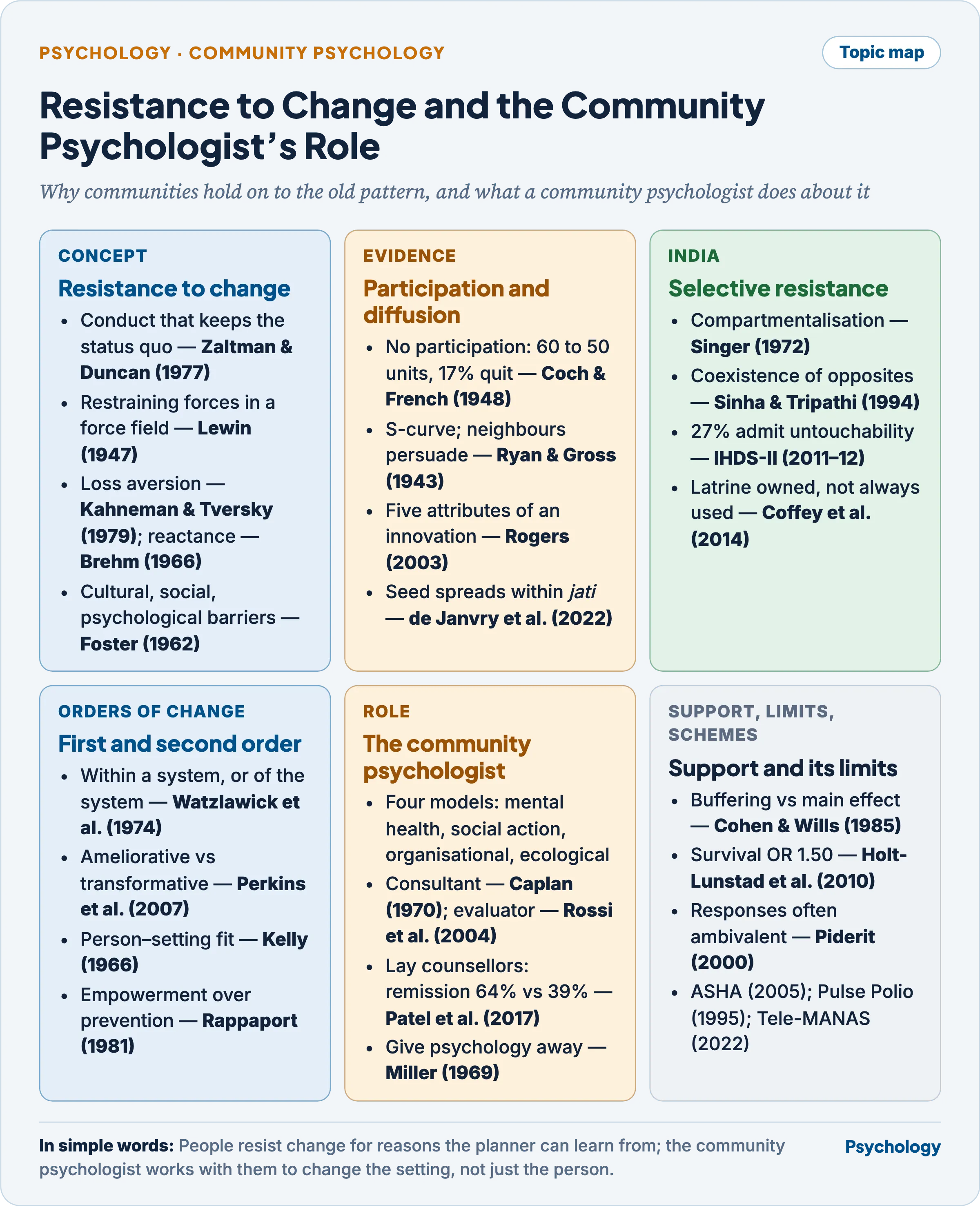
The top row explains why communities hold on to the old pattern; the bottom row is what a community psychologist does about it.
Resistance to change: the phenomenon
- Force-field analysis (Lewin, 1947): a level of behaviour is a quasi-stationary equilibrium between driving forces and restraining forces, and resistance is the restraining side.
- A change brought about by adding force raises tension, so removing a restraint moves the level with less strain (Lewin, 1947); the organisational version is in Sensitivity Training and Organisational Development (Unit 4).
- Its sources sit at three levels, and each level needs its own remedy.
Individual sources
- Habit — a familiar routine costs no effort, and the new one has to be learnt while the old one still runs.
- Fear of the unknown — uncertainty about whether one will cope, and about who will be blamed if the change fails.
- Loss — of income, status, skill or identity. Kahneman and Tversky (1979) showed that losses weigh more than equal gains (loss aversion), and Samuelson and Zeckhauser (1988) found a status quo bias in real decisions.
- Selective perception — information that threatens a settled belief is discounted, so a campaign reaches mainly those already persuaded.
- Reactance (Brehm, 1966) — pressure read as a threat to freedom of choice drives people away from the advocated position; set out in Persuasion and Attitude Change through Communication (Paper I).
Group and cultural sources
- Group standards: Lewin (1947) found that “it is usually easier to change individuals formed into a group than to change any one of them separately”, because each member is held to the group’s norm.
- Foster (1962), writing for those who run technical-aid programmes, sorted the obstacles to technical change into three groups.
- Cultural barriers: values and attitudes such as tradition and ethnocentrism.
- Social barriers: obligations to kin and group, factions, authority patterns, caste and class.
- Psychological barriers: how the innovation is perceived and communicated.
- Vested interests and distrust — those who gain from the present arrangement resist openly; groups with a history of neglect read an outsider’s programme as a threat.
Structural sources
- Power, land, credit and markets: a change that needs money, irrigation or insurance is out of reach for those without them.
- Schultz (1964) argued that peasant farmers are poor but efficient within their constraints, so non-adoption is often a rational answer to risk, not ignorance.
Coch and French (1948): overcoming resistance through participation
- Coch and French (1948), at the Harwood pyjama factory in Virginia, introduced the same kind of job change to matched groups under three conditions: no participation (control), participation through representatives, and total participation.
- Control output fell from about 60 to about 50 units an hour and stayed there for 32 days; 17 per cent quit within 40 days (Coch and French, 1948).
- The total-participation groups recovered fast and ended about 14 per cent above the old level (Coch and French, 1948).
- Interpretation: resistance came from how the change was introduced, not from the workers’ personalities.
- Limitation: an atypical plant run by a psychologist-president.
- Bartlem and Locke (1981) argue that differences in how the change was explained, how the time studies were run and extra training, not participation as such, may explain the result; they point to the perceived fairness of the new piece rates.
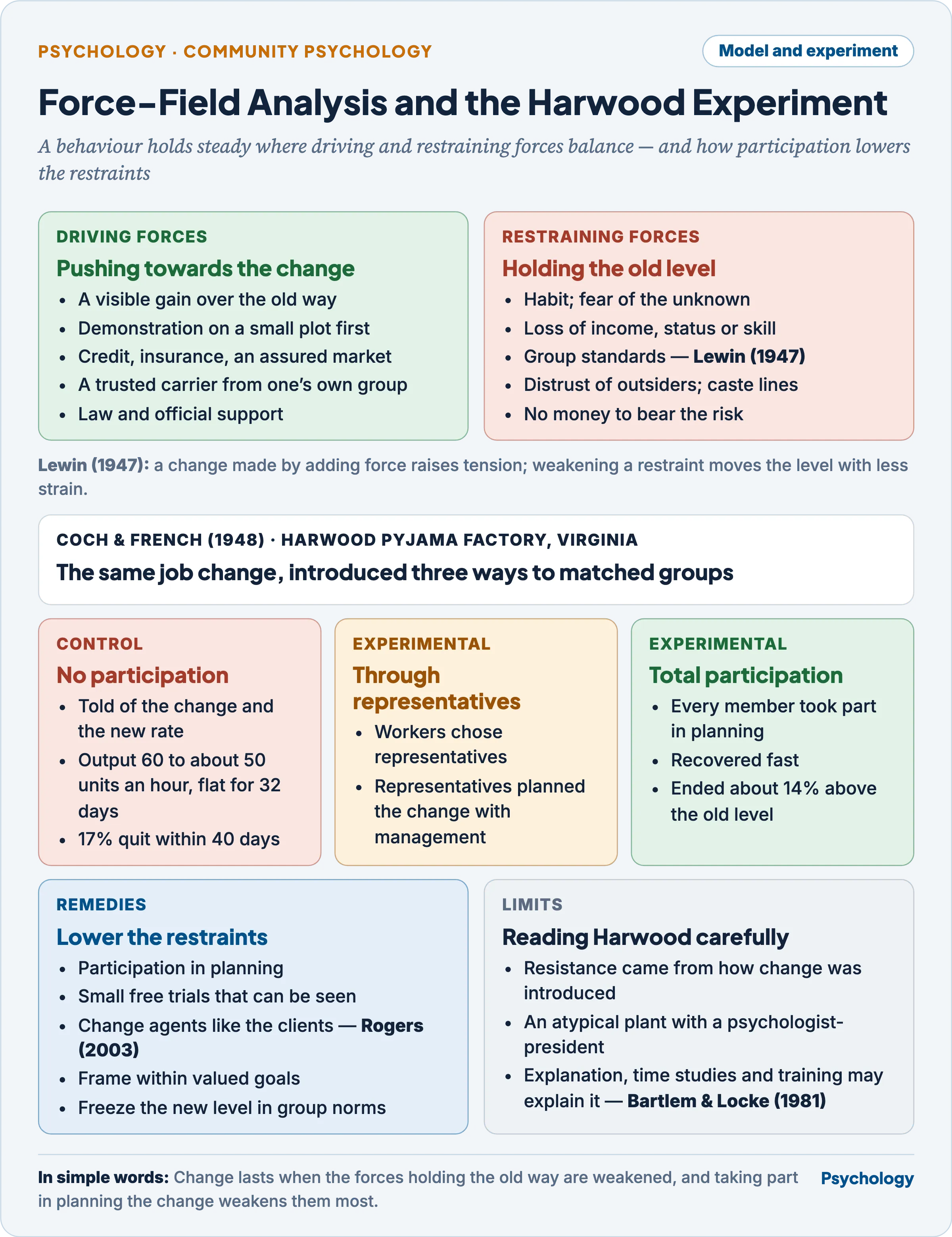
The same job change, introduced three ways: the groups that planned it themselves recovered fastest and ended above their old output.
Factors affecting social change in relation to the productive processes of a community
- Attributes of the innovation (Rogers, 2003): relative advantage, compatibility with existing values and practice, complexity, trialability on a small scale, and observability of results. A seed that can be tried on one plot and seen by neighbours spreads faster.
- Ryan and Gross (1943) traced hybrid seed corn in two Iowa communities: adoption followed an S-shaped curve, and farmers first heard of the seed from salesmen but were persuaded to plant it by neighbours.
- Social structure: Frankel (1971), studying five Green Revolution districts from Ludhiana to Thanjavur, found that rapid growth widened rural disparities and heightened social tensions, since the new inputs favoured those who already had land, water and credit.
- Old patron–client ties between landowners and labourers began to give way to class polarisation (Frankel, 1971).
- De Janvry, Rao and Sadoulet (2022) followed a flood-tolerant paddy, Swarna-Sub1, across 126 villages in Odisha after seed minikits went to about five randomly chosen farmers in each treated village.
- The seed spread to farmers of the recipients’ own jati, and less to lower-status jatis.
- Villages with fewer distinct jatis showed 8–9 percentage points higher adoption than comparable control villages (de Janvry and colleagues, 2022).
- Limitation: a working paper on one crop in one state.
- Motivation: McClelland and Winter (1969) gave achievement-motivation courses to businessmen in Kakinada in 1964, and the trained men were more active as entrepreneurs over the next two years; the economic-development side belongs to Unit 11.
Remedies: effective strategies for overcoming resistance
- Participation in planning — the Harwood lesson; the group-decision procedure is in Group Decision Making for Social Change.
- Demonstration and trial — small free trials, as in the Odisha minikits, so the result can be seen before the risk is taken.
- Homophilous change agents — Rogers (2003) found change agents most effective when similar to their clients; seed and messages need carriers from every caste and gender group.
- Compatibility — frame the change within valued goals (children’s health, family income) rather than against tradition.
- Removing structural restraints — credit, insurance, assured markets and compensation for losses.
- Freezing — anchor the new practice in group norms and institutions, since isolated adopters drift back (Lewin, 1947).
Is Indian society resistant to change?
- The defensible position is selective resistance. Change is fast where it brings visible gains and fits existing structures, and slow where it threatens caste, gender hierarchy or purity norms.
- Rapid change: rural sanitation coverage was 38.7 per cent when Swachh Bharat Mission (Grameen) began on 2 October 2014, and every state’s rural areas declared themselves open-defecation-free on 2 October 2019 (PIB, 2020).
- Resistance where hierarchy is at stake:
- About 27 per cent of households admitted practising untouchability when asked directly or about letting a Scheduled Caste person use their kitchen or utensils, and 5.4 per cent of married women aged 15–49 reported an inter-caste marriage (IHDS-II, 2011–12).
- Coffey and colleagues (2014) found that in over 40 per cent of households with a working latrine at least one member defecated in the open, across 22,787 people in five north Indian states.
- Coffey and colleagues (2017) traced this to beliefs about purity, pollution and untouchability that make people reject affordable pit latrines, which must one day be emptied.
- Traditional and modern coexist. Singer (1972), interviewing Madras industrial leaders in 1964, called it compartmentalisation: business and religion kept as “distinct and separate spheres” with different norms.
- Sinha and Tripathi (1994) described Indian individualism and collectivism as a coexistence of opposites.
- Sinha, Sinha, Verma and Sinha (2001) gave 292 respondents eighteen situations: family concerns evoked purely collectivist behaviour, while urgent personal needs produced a mix of individualist and collectivist intentions.
- Factors responsible: caste and purity norms; hierarchical, elder-centred families; gender norms; poverty, which makes risk costly; low trust in the state among marginalised groups; and programmes designed without the people they target.
- Measures to combat it:
- participation from the planning stage, and change agents drawn from the community;
- framing within valued goals; law joined to norm change, since law alone yields compliance without acceptance;
- removal of structural barriers, and evaluation that counts use, not only coverage.
First-order and second-order change
- Watzlawick, Weakland and Fisch (1974): “There are two different types of change: One which occurs within a given system which itself remains unchanged, and one whose occurrence changes the system itself.”
- Their example: a dreamer can run, hide or scream inside a nightmare, and none of it ends the dream; only waking does. Second-order change is “change of change”.
- Their warning: “more of the same” solutions can keep a problem going.
- Perkins, Bess, Cooper, Jones, Armstead and Speer (2007) gave the community version.
- First-order change is incremental or ameliorative and leaves the structure, values and purpose of a system intact.
- Second-order change is transformative, altering relationships among its parts or its basic goals and processes.
| Dimension | First-order change | Second-order change |
|---|---|---|
| Target | Individuals inside a setting | Roles, relationships, rules and power of the setting |
| View of the problem | A deficit in the person | A mismatch between persons and settings |
| Typical tool | Treatment, training, counselling | Policy, new settings, shared control of resources |
| Indian example | Counselling students who fail entrance tests | Changing school rules that rank and segregate students by marks |
| Risk | Problem recurs in the next cohort | Slow, contested, hard to evaluate |
- Why second-order change is the focus of community psychology:
- Ecology — Kelly (1966) located problems in person–setting fit, so the setting is what has to change.
- Empowerment — Rappaport (1981) argued for a social policy of empowerment over prevention: people in trouble have rights as well as needs, and programmes should build on competences they already have.
- Prevention at scale — treating cases one at a time leaves incidence untouched, the public-health argument behind Caplan (1964).
- Values — Perkins and colleagues (2007) hold that changing the conditions behind problems is better than spending society’s resources on maintaining the status quo through inadequate services.
- Limitation: second-order change is difficult, often disappointing and rarely funded (Perkins and colleagues, 2007), and people in crisis still need first-order help.
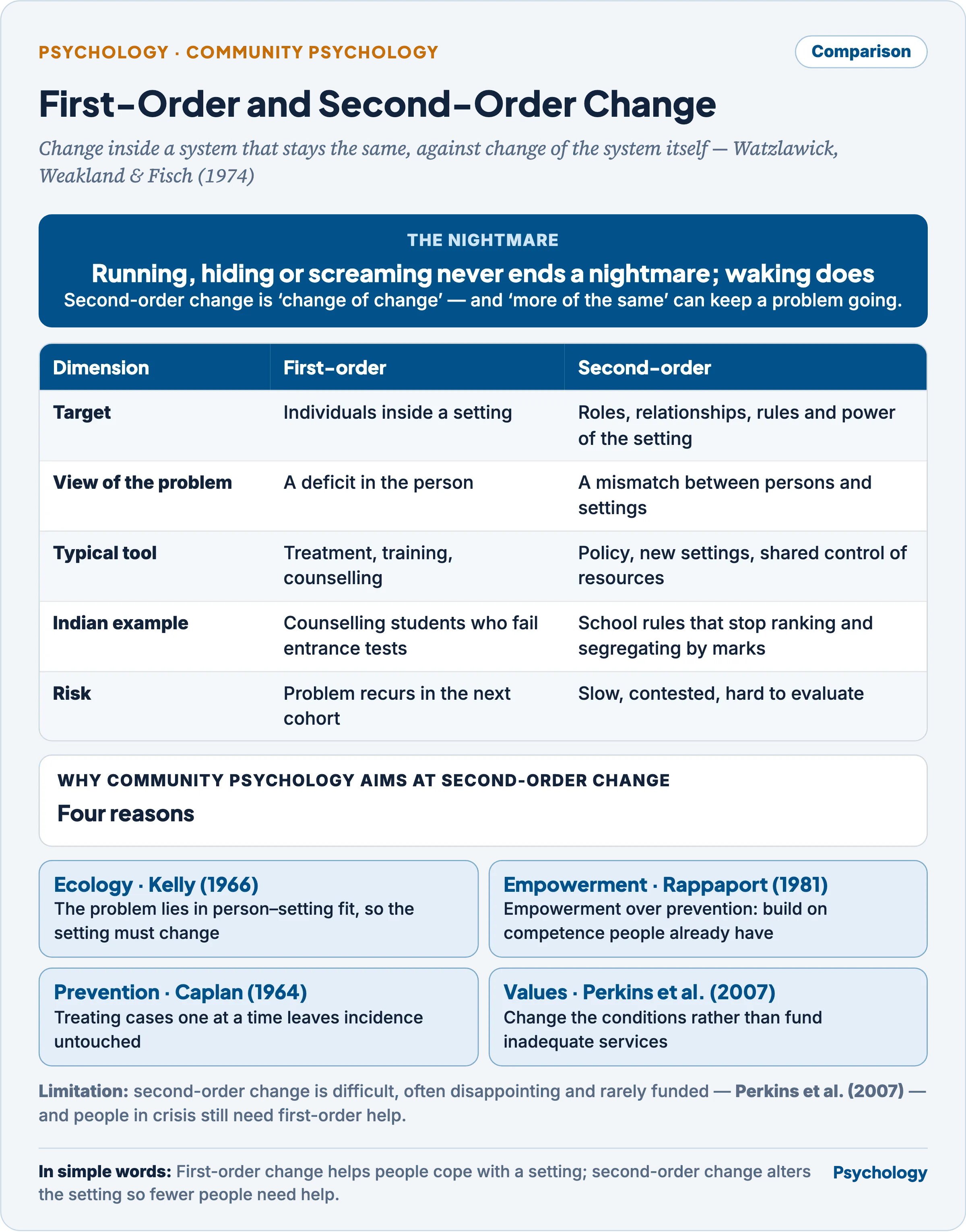
Moving from the left column to the right redefines the problem as well as the response.
The role of the community psychologist in social change
Models of intervention and the roles they imply
- Mental health model — Caplan (1964) carried primary, secondary and tertiary prevention into mental health; the role is preventer and consultant. Weakness: it treats “community” as a catchment area and neglects how the community shapes health.
- Social action model — born of the 1960s War on Poverty; it locates problems in social structure and works through organised residents and trained non-professionals. The role is advocate and organiser; the risk is co-option by parties or media.
- Organisational model — Lewin’s laboratory training and survey feedback (Mann, 1957); the role is organisational consultant. Open confrontation in mixed groups transfers poorly to many Indian settings.
- Ecological model — Kelly (1966): interdependence, cycling of resources, adaptation and succession; Barker (1968): behaviour settings. The role is ecologist and designer of settings; the weakness is underplaying power and the macro level.
Roles
- Needs assessor and researcher — participatory action research (Lewin, 1946): plan, act, gather facts on the result, re-plan, with the community defining the questions.
- Consultant — Caplan (1970) distinguished client-centred case, consultee-centred case, programme-centred administrative and consultee-centred administrative consultation; strengthening teachers, health workers and clergy reaches far more people than direct therapy.
- Programme developer and trainer of non-professionals — task-sharing with lay workers.
- Patel and colleagues (2017) randomised 495 adults with moderately severe to severe depression in ten primary health centres in Goa to enhanced usual care with or without the Healthy Activity Program from lay counsellors.
- Remission at three months: 64 per cent against 39 per cent (Patel and colleagues, 2017).
- Limitation: a three-month primary outcome in one state’s primary care.
- Evaluator — Rossi, Lipsey and Freeman (2004) ask, in order, whether the need is real, the programme theory sound, implementation faithful, outcomes attributable and costs justified; formative evaluation improves a programme, summative judges it (Scriven, 1967).
- Advocate and coalition builder — carrying evidence to policy and joining NGOs, panchayats and departments around one problem.
- Giving psychology away — Miller (1969) saw nothing more relevant to human welfare than discovering “how best to give psychology away”.
- Ethics — respect for persons and autonomy, justice in who bears the burdens, beneficence and non-maleficence, integrity, respect for diversity, and disclosure of conflicts of interest.
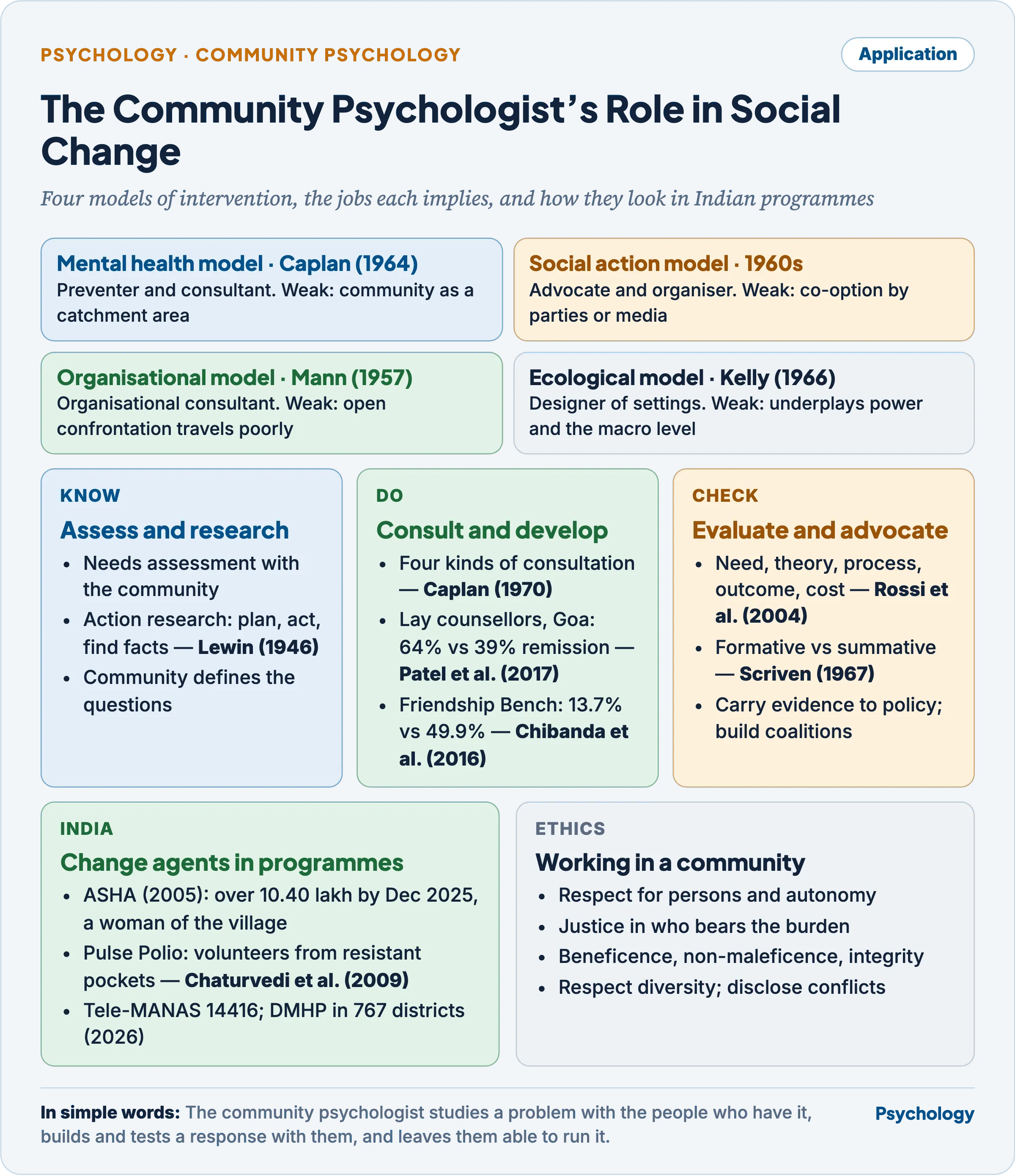
Each model of intervention hands the psychologist a different job, and real programmes combine them.
The significance of social support programmes
- Cohen and Wills (1985) identified four functions: esteem support, informational support, social companionship and instrumental support.
- The buffering hypothesis: support protects mainly people under stress. Cohen and Wills (1985) found buffering when support was measured as perceived availability of resources responsive to stress, and a main effect when it was measured as integration in a large social network.
- Holt-Lunstad, Smith and Layton (2010) pooled 148 studies of 308,849 people: stronger social relationships meant a 50 per cent greater likelihood of survival, comparable with well-established mortality risks.
- Brown and Harris (1978), studying women in Camberwell, found that lacking a close confiding relationship raised the risk of depression mainly when a severe life event struck, a buffering pattern in a community sample.
- Why programmes matter: support is unequally distributed, and those most exposed to stress (migrants, caregivers, the bereaved, the poor) often have the thinnest networks. Programmes create it where it is missing: support groups, mutual-help and self-help groups, peer volunteers, helplines.
- Limits: support helps when it matches the need (the optimal matching model of Cutrona and Russell, 1990), and mismatched or intrusive help can raise distress; long-term caregiving is itself a chronic stressor.
How community psychologists bring positive change for mental health and well-being
- Through task-sharing: lay counsellors in Goa (Patel and colleagues, 2017), and the Friendship Bench in Harare.
- Chibanda and colleagues (2016) randomised 24 Harare clinics with 573 attenders; after problem-solving therapy from lay health workers, 13.7 per cent still had depressive symptoms at six months, against 49.9 per cent of controls.
- Through community volunteers and groups: Atmiyata’s village Champions in Mehsana and women’s groups in Jharkhand and Odisha (Tripathy and colleagues, 2010), both set out in Fostering Mental Health (Unit 3).
- Through changing settings: school and campus rules that remove ranking and segregation, and workplace policies, alongside counselling for those who break down.
- Through reducing barriers to help-seeking: stigma campaigns, helplines and screening linked to services.
- Through policy and advocacy: evidence for the District Mental Health Programme and the Mental Healthcare Act’s promotion duties; prevention and rehabilitation are in Prevention and Rehabilitation of the Mentally Ill (Unit 3).
Criticisms and limitations
- The label blames the resistor. Dent and Goldberg (1999) traced how Lewin’s systems concept became a contest of employees against managers, and urged letting go of the term.
- Ford, Ford and D’Amelio (2008) showed that change agents help create resistance and that it can be useful feedback.
- Responses are often ambivalent. Piderit (2000) separated emotional, cognitive and intentional dimensions; a person can doubt a change, fear it and still intend to comply.
- Blaming the victim: Ryan (1971) warned that calling the poor “traditional” or “fatalistic” relocates a structural problem inside them; Schultz (1964) shows the rational constraints behind much non-adoption.
- Participation can be manipulation when the outcome is fixed in advance; Arnstein’s ladder is in Fostering Mental Health.
- Second-order change is rare and contested. One group’s gain in control can be another’s loss, and social action can be captured by parties or media.
- The evidence is short and local. The best task-sharing trials report three- to six-month outcomes.
Indian context
- Accredited Social Health Activist (ASHA) (Ministry of Health and Family Welfare, National Rural Health Mission, 2005) — a woman resident of the village, about one per 1,000 people; over 10.40 lakh were serving by 31 December 2025 (PIB, 2026).
- It operationalises the homophilous change agent: advice from a neighbour of the same village meets less distrust than advice from an outsider.
- Pulse Polio Immunisation Programme (Ministry of Health and Family Welfare, 1995) — India’s last wild poliovirus case was on 13 January 2011 in Howrah, and India was certified polio-free on 27 March 2014 (PIB, 2024).
- Chaturvedi and colleagues (2009) studied resistance in Moradabad and JP Nagar through 76 interviews, 12 focus groups and 156 informal interactions: rumours clustered in some marginalised minority pockets while most parents supported the campaign.
- They recommended volunteers from within those pockets, the principle of in-group credibility.
- Swachh Bharat Mission (Grameen) (now Ministry of Jal Shakti, 2 October 2014; Phase II from 2020–21) — Swachhagrahis are village motivators for sanitation behaviour change (PIB, 2026). It shows the gap between access and use; the environmental side is in Unit 12.
- Tele-MANAS (Ministry of Health and Family Welfare, 10 October 2022) — toll-free 14416; 53 cells handled 47,75,644 calls by October 2026, and the District Mental Health Programme was sanctioned for 767 districts (PIB, 9 October 2026). It operationalises low-threshold access to support.
Previous Year Questions
- 2022How can community psychologists bring positive social change in order to address mental health and well-being in society? Explain with suitable examples.
- 2018In the context of positive social change differentiate between first-order and second-order change. Why is the second-order change often the focus of community psychology?
- 2007Write a short note on: Role of community psychologist in social change.
- 2006Write a short note on: Role of Community Psychology in social change.
- 2001Discuss the significance of social support programs. Mention the role of community psychologist in social change.
- 1997It is said that Indian society is resistant to change. Is it true? If so discuss the factors responsible for this and suggest measures to combat the same.
- 1995Examine the phenomenon of resistance of change. Explain the factors involved therein affecting social change in relation to productive processes of a community and suggest possible remedies.
