

Official syllabusPaper II · Unit 6 · Community Psychology
Effective strategies for social change.
Definition
“planned change: a conscious, deliberate, and collaborative effort to improve the operations of a system, whether it be self-system, social system, or cultural system, through the utilization of scientific knowledge.”
Bennis, Benne and Chin (1961)
A strategy of social change is a theory about people put into practice: that they change when informed, when their group changes, or when they are made to. Each theory has a typical success and a typical failure, and Indian programmes from family planning to Swachh Bharat show both.
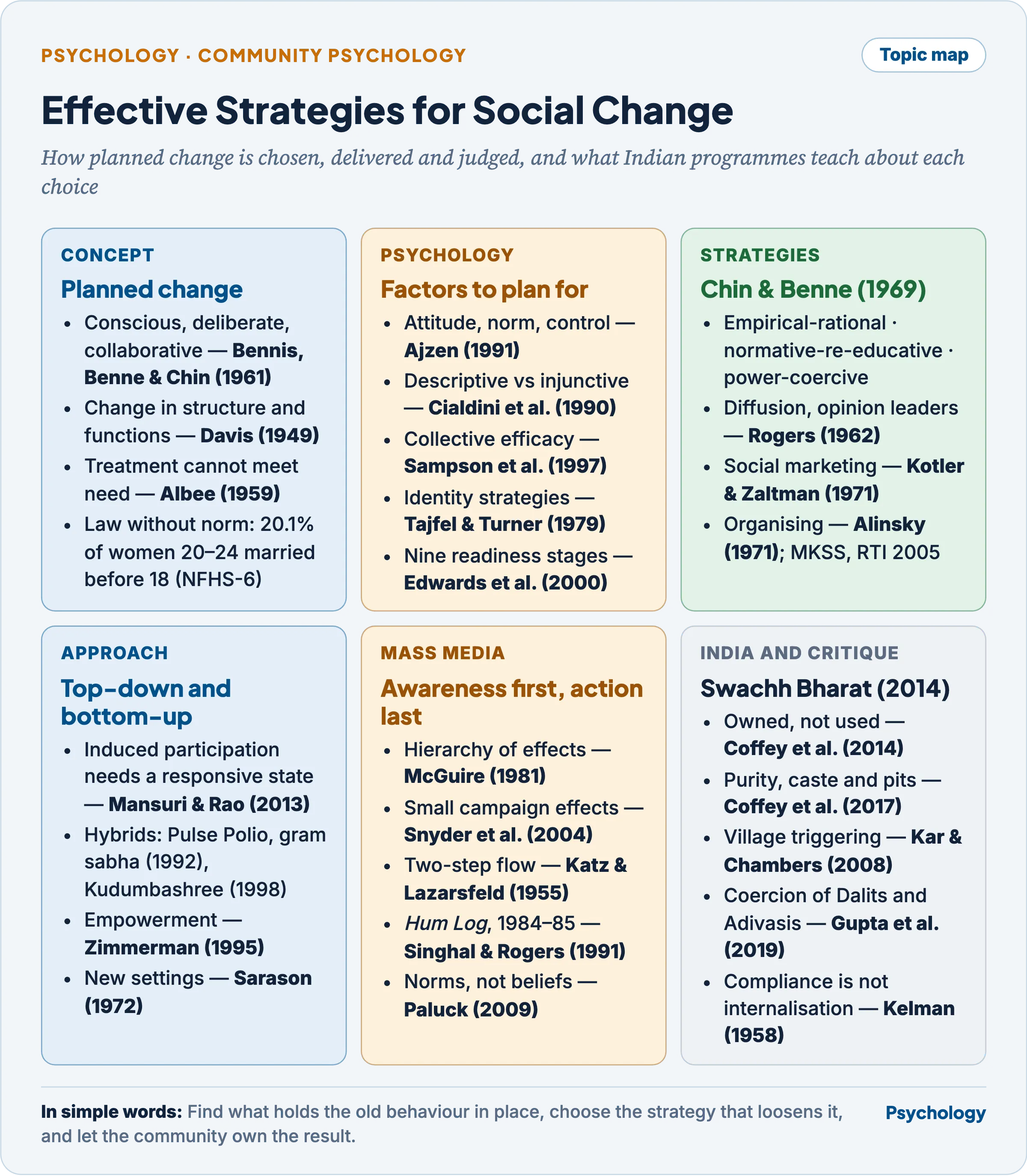
The upper row chooses a strategy; the lower row delivers it, through participation, media and the Swachh Bharat record.
Social change: what it is and why it is necessary
- Davis (1949): “By ‘social change’ is meant only such alterations as occur in social organization — that is, the structure and functions of society.” A new art form is cultural change; it becomes social change when roles, relationships and institutions alter.
- Planned change is deliberate and knowledge-based (Bennis, Benne and Chin, 1961); unplanned change follows technology, markets, migration or disaster.
- Change inside a system that leaves its structure intact is first-order; change of the system itself is second-order (Watzlawick, Weakland and Fisch, 1974; see Resistance to Change and the Community Psychologist’s Role).
- Why social change is necessary:
- Treatment cannot meet need. Albee (1959) showed that the United States could never train enough clinicians to meet need, so the conditions producing distress had to change.
- Law does not change norms by itself. The Prohibition of Child Marriage Act, 2006 stands, yet 20.1 per cent of women aged 20–24 had married before 18 (NFHS-6, 2023–24).
- Justice: marginalised groups lack the resources and voice to change the settings that harm them, the value base of Community Psychology: Definition, Concept and Values.
Psychological factors to consider while planning social change
- Attitudes and beliefs. The theory of planned behaviour (Ajzen, 1991) predicts intention from attitude, subjective norm and perceived behavioural control; a plan must find which one blocks (see Attitudes and Behaviour, Paper I).
- Norms. Cialdini, Reno and Kallgren (1990) separated descriptive norms (what others do) from injunctive norms (what others approve); publicising a bad descriptive norm backfires (see Changing Others’ Behaviour, Paper I, also for nudges).
- Perceived benefit and efficacy. The health belief model (Rosenstock, 1974) weighs susceptibility, severity, benefits and barriers. Bandura (1997) added collective efficacy, a group’s shared belief that it can act together.
- Sampson, Raudenbush and Earls (1997), surveying 8,782 residents of 343 Chicago neighbourhoods, found collective efficacy linked to lower violence, largely mediating the effect of concentrated disadvantage.
- Identity. Tajfel and Turner (1979) described three responses of a low-status group: individual mobility, social creativity (revaluing the group) and social competition (challenging the hierarchy). Only the third seeks structural change.
- Van Zomeren, Postmes and Spears (2008), meta-analysing 182 effects, found that injustice, efficacy and identity each predicted collective action, identity bridging the other two.
- Trust. Source credibility (Hovland, Janis and Kelley, 1953) decides whether a message is heard; where the state has coerced before, its messages are distrusted.
- Readiness. The transtheoretical model (Prochaska and DiClemente, 1983) runs from precontemplation to maintenance.
- The Community Readiness Model (Edwards, Jumper-Thurman, Plested, Oetting and Swanson, 2000) applies stages to whole communities: nine, from no awareness to high level of community ownership; a community in denial needs consciousness-raising before any action plan.
Effective strategies for social change: Chin and Benne’s classification
Chin and Benne (1969) grouped strategies for changing any human system into three families, each resting on an assumption about people.
| Strategy | View of people | Lever of change | Typical tools | Indian instance |
|---|---|---|---|---|
| Empirical-rational | Rational, self-interested | Information and incentives | Research, education, demonstration, subsidy | Nirodh condoms at a nominal price (1968) |
| Normative-re-educative | Social, norm-bound | Group norms changed through participation | Group discussion, action research, village triggering | Community-led sanitation; women’s collectives |
| Power-coercive | Compliant to power | Law, sanctions, political pressure | Legislation, enforcement, protest, boycott | Child marriage law; the 1976 sterilisation drive |
- Empirical-rational strategies work where the barrier is ignorance or cost, and fail where behaviour is held by norm or identity.
- Normative-re-educative strategies descend from Lewin (1947): attitudes anchored in groups change when the group changes, as set out in Group Decision Making for Social Change.
- Power-coercive strategies win compliance quickly. Kelman (1958) showed why that is fragile: compliance lasts only under surveillance, while identification and internalisation persist.
- India recorded 81.32 lakh sterilisations in 1976–77 against 26.42 lakh in 1975–76, many under pressure (PIB, 2025). Coates and colleagues (2013) reported that some Uttar Pradesh communities read polio drives as a continuation of that coercion.
- Power is also used from below, through protest and boycott; Gandhian satyagraha is the Indian archetype.
- Effective programmes combine all three: information makes the case, groups shift norms, law signals what society now expects.
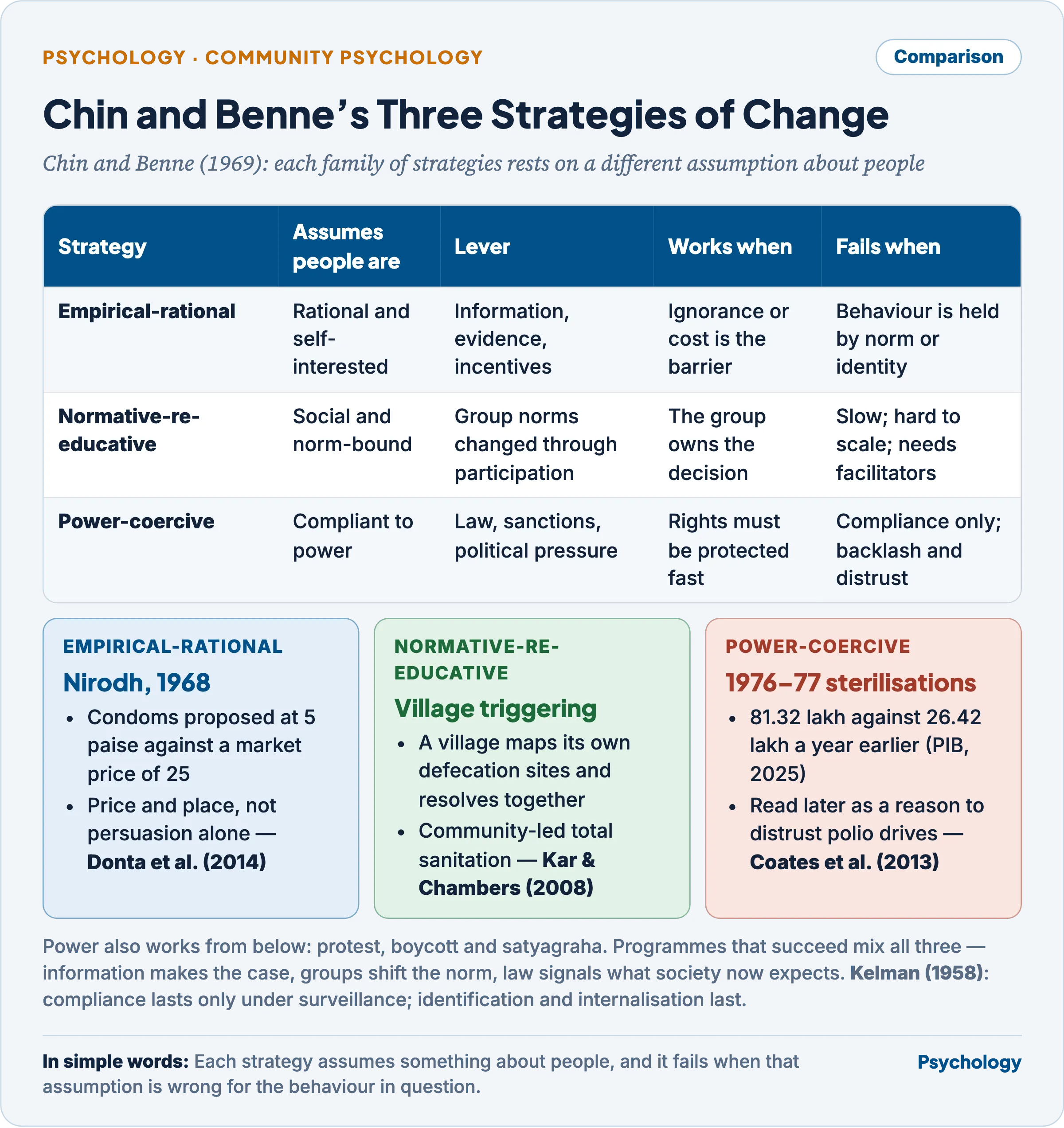
Each strategy assumes something different about people, and fails when that assumption is wrong for the behaviour in hand.
Diffusion of innovations, social marketing and community organising
- Rogers (1962) described diffusion as the spread of an innovation through communication channels, over time, among the members of a social system; adoption traces an S-curve.
- Adopter categories, cut at standard deviations from the mean adoption time: innovators (2.5 per cent), early adopters (13.5), early majority (34), late majority (34), laggards (16) (Rogers, 2003).
- Opinion leaders, mostly early adopters, carry an innovation into their networks; innovation attributes and the Iowa hybrid-corn study are in Resistance to Change and the Community Psychologist’s Role.
- Social marketing: Kotler and Zaltman (1971) applied marketing’s planning, pricing, communication, distribution and research to the acceptability of social ideas.
- Product is the behaviour and its benefit; price, its money, time and social cost; place, access; promotion, the message.
- India’s Nirodh programme (1968) proposed condoms at 5 paise when they sold at 25, working on price and place (Donta, Begum and Naik, 2014).
- Limitation: it suits discrete products better than deep norms.
- Community organising: Alinsky (1971), building on Chicago’s Back of the Yards Neighborhood Council (1939), held that the poor win change by organising around self-interest and using conflict to shift power.
- A social movement is a large, complex set of collective events oriented to a general social-change goal (Oliver, 1989).
- The Mazdoor Kisan Shakti Sangathan (Rajasthan, 1990) read public-works records aloud in village jan sunwais (public hearings); the campaign ended in the Right to Information Act, 2005.
- Limitation: conflict can harden opponents, and gains last only while mobilisation does.
Top-down and bottom-up approaches to social change
- A top-down approach is designed by the state or experts and delivered to communities; a bottom-up one starts from a community’s own definition of its problem and its own organisation.
| Dimension | Top-down | Bottom-up |
|---|---|---|
| Initiator | State, expert agency, donor | Community, movement, local organisation |
| View of people | Beneficiaries to be reached | Agents with knowledge and rights |
| Usual strategy | Empirical-rational, power-coercive | Normative-re-educative, organising |
| Strength | Speed, scale, resources, uniform standards | Ownership, cultural fit, sustainability |
| Typical failure | Coverage without use; coercion; distrust | Slow, small, captured by local elites |
| Indian example | Swachh Bharat’s latrine targets (2014–19) | Chipko (1973); the RTI campaign |
- Mansuri and Rao (2013), reviewing almost 500 studies for the World Bank, found that induced participation works best when a responsive state backs it: a “sandwich” of bottom-up civic action and top-down support.
- India’s successful programmes are hybrids:
- Pulse Polio (1995) reached its last resistant pockets through locally recruited mobilisers (see Indian context).
- The 73rd Constitutional Amendment (1992) gave the gram sabha constitutional standing, institutionalising bottom-up deliberation from above; who speaks there is in Group Decision Making for Social Change.
- Kudumbashree (Kerala, launched 17 May 1998) is state-created but runs through federated neighbourhood groups of poor women, an empowering setting.
- Swachh Bharat’s target-driven first phase drew reports of coercion (Gupta and colleagues, 2019); its second phase stresses sustained use.
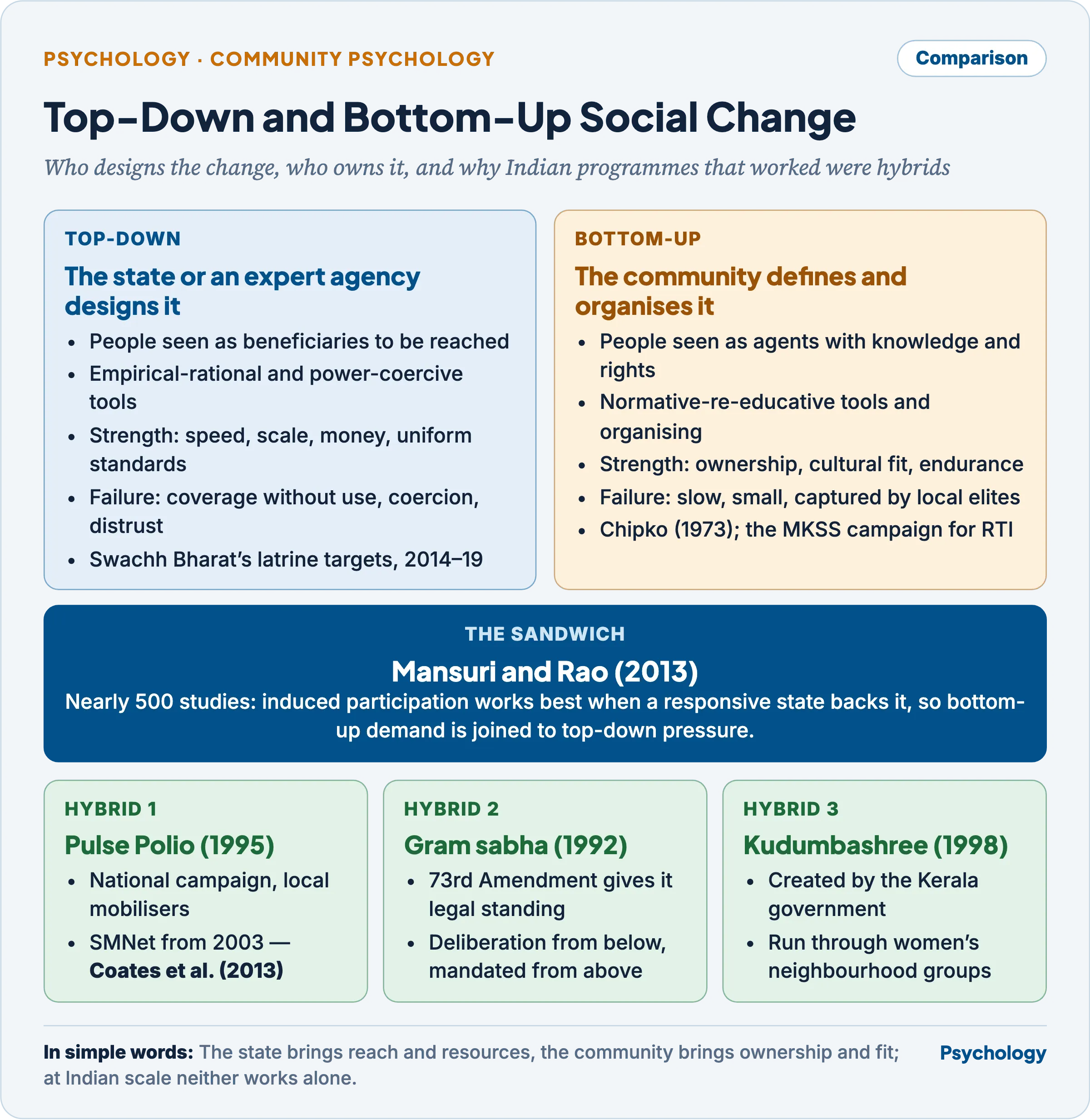
At Indian scale neither direction works alone: the state brings reach, the community ownership.
Key elements of effective social change in a marginalised community
- Participation from problem definition onwards. Wexler and Gone (2012) argued that professional suicide prevention clashes with Native North American understandings, which place prevention with community members, not outside clinicians.
- Empowerment: Rappaport (1987) described people gaining mastery over their lives, and Zimmerman (1995) gave its intrapersonal, interactional and behavioural components.
- Critical consciousness of the causes of disadvantage, after Freire (1970), treated in Arousing Community Consciousness.
- Trusted insiders as change agents: messengers of the same caste, faith and gender meet less suspicion, as polio mobilisers in Uttar Pradesh showed (Coates and colleagues, 2013).
- Collective efficacy and organisation, so that private grievance becomes group capacity (Sampson and colleagues, 1997).
- Structural resources (credit, land, services, legal protection), without which changed attitudes have nothing to act on, and protection from backlash against the first to change.
- New settings that outlast the programme. Sarason (1972) defined a setting as two or more people in new and sustained relationships pursuing shared goals: groups and federations that keep the change going.
Effective strategies for community development and steps to plan social change in India
- Define the problem with the community, from local data (NFHS-6, census, panchayat records) and its own account.
- Diagnose driving and restraining forces (Lewin, 1947; see Sensitivity Training and Organisational Development), readiness (Edwards and colleagues, 2000) and local meanings.
- Map stakeholders and opinion leaders: gram sabha, self-help groups, ASHAs, religious leaders, and those who gain from the status quo.
- Choose a strategy mix (Chin and Benne, 1969) matched to readiness: information and incentives, norm change through groups, law where rights are at stake.
- Pilot in a few villages for compatibility and trialability before scaling.
- Communicate in two steps: mass media for awareness, interpersonal channels for adoption.
- Implement with fidelity and dosage. Durlak and DuPre (2008), reviewing over 500 studies, found mean effects at least two to three times higher in carefully implemented programmes, and at least 23 contextual factors shaping implementation.
- Derzon, Sale, Springer and Brounstein (2005) found a mean effect of .02 across 46 youth substance-abuse prevention sites, projected at .24 once comparison-group exposure, intensity and coherent implementation were adjusted for.
- Evaluate outcomes such as latrine use, verified independently; construction counts are outputs.
- Institutionalise the change in norms, budgets and local settings, so that it holds when the programme ends.
Mass media in creating social awareness and social change: relative effectiveness
- Media effects run along a hierarchy of effects (McGuire, 1981), condensed as exposure, awareness, knowledge, persuasion, intention, behaviour and maintenance. Media are strongest at the start and weakest at the end, the knowledge–behaviour gap.
- Snyder and colleagues (2004) meta-analysed US mediated health campaigns: short-term effects were small, from r = .04 (screening, sexual behaviour) to r = .15 (seat-belt use), and larger with enforcement.
- The two-step flow: Katz and Lazarsfeld (1955), studying women in Decatur, Illinois, found that influence passes from media through opinion leaders.
- Entertainment-education embeds the message in drama, after Miguel Sabido’s Mexican telenovelas from 1975. Hum Log (Doordarshan) was India’s first such serial (Singhal and Rogers, 1991).
- It ran from 7 July 1984 to 17 December 1985 in 156 episodes, each closed by Ashok Kumar’s epilogue; after 13 episodes family planning was diluted in favour of women’s status and family harmony.
- Ratings reached 65–90 per cent in north India and viewers sent about 4,00,000 letters (Singhal and Rogers, 1991). Exposure went with more behaviour indicating women’s freedom of choice, though effects were small.
- Limitation: correlational survey data, so sympathetic viewers may simply have watched more.
- Paluck (2009) ran a yearlong field experiment in Rwanda: against a health-soap control, a reconciliation radio soap changed listeners’ perceived norms and behaviour on intermarriage, dissent and trust, but not their personal beliefs.
- Jensen and Oster (2009) found that Indian villages acquiring cable television reported lower acceptance of wife-beating, weaker son preference and more female autonomy, with no such trend before cable arrived.
- Main Kuch Bhi Kar Sakti Hoon (Population Foundation of India, from 2014) added phone-in participation to drama; Wang and Singhal (2017) logged 1.7 million calls from over 390,000 numbers in two seasons.
- Media mostly reinforce rather than convert, since audiences select confirming messages (Klapper, 1960).
- Verdict: strong for awareness, moderate for norms when drama is discussed in groups, weak alone for behaviour.
Cultural factors in the success of Swachh Bharat Abhiyan
- Swachh Bharat Mission (Grameen) (now the Department of Drinking Water and Sanitation, Ministry of Jal Shakti) began on 2 October 2014 at 38.7 per cent rural sanitation coverage (PIB, 2020).
- After over 10 crore household toilets, every state’s rural areas declared themselves open-defecation-free (ODF) on 2 October 2019.
- Phase II (approved in 2020 for 2020–21 to 2024–25 at ₹1,40,881 crore, since extended) targets ODF Plus, sustained use and waste management; 4.89 lakh villages were declared ODF Plus (Model) by 16 December 2025 (PIB, 2026).
- It operationalises norm change sustained by visible collective commitment.
- Coffey and colleagues (2014), the SQUAT survey, asked why latrine owners do not use them.
- December 2013 to April 2014: over 3,200 households in 13 districts of Bihar, Haryana, Madhya Pradesh, Rajasthan and Uttar Pradesh, covering 22,787 people.
- Over 40 per cent of households with a working latrine had a member defecating in the open; in the four largest states, more than half of people in households owning a government latrine did so (Coffey and colleagues, 2014).
- Limitation: behaviour rests on what respondents said, in north India only.
- Coffey and colleagues (2017) traced this to purity and pollution: a latrine near the home pollutes it, open defecation is wholesome, and emptying a pit is associated with manual scavenging, work long forced on Dalits, who increasingly reject it.
- Cultural factors that can be used, and how:
- Purity reframed: in a twin-pit latrine one pit rests while the other fills, so contents decompose before handling; yet villagers told this still asked who would empty it (Coffey and colleagues, 2017).
- Honour and women’s dignity: the Darwaza Band campaign (2017, with Amitabh Bachchan) addressed men who owned toilets but did not use them.
- Marriage: Stopnitzky (2017) found that Haryana’s “No Toilet, No Bride” campaign (2005) raised latrine ownership mainly where women were scarce in the marriage market.
- Collective commitment: community-led total sanitation, developed by Kamal Kar in Bangladesh in 1999–2000 (Kar and Chambers, 2008), has a village map its own defecation sites and resolve together to stop.
- Gandhian idiom: the mission was timed to Gandhi’s 150th birth anniversary, and its Swachhata Hi Seva campaign drew over 18 crore participants in 2025 (PIB, 2026).
- Shaming and coercion: Bartram and colleagues (2012) described CLTS practices that infringe human rights. Among latrine owners, Dalits were over twice and Adivasis almost three times as likely as others to report coercion (Gupta and colleagues, 2019).
- The ODF verification debate: villages largely declared themselves ODF, and surveys of access and use came out lower.
- Rural latrine access was 71.3 per cent in the NSO’s 76th round (July–December 2018); NFHS-5 (2019–21) found 26 per cent of rural households using no facility.
- The department’s Swachh Survekshan Grameen 2023–24 found 95.1 per cent of surveyed households with toilet access (PIB, 2025).
- In four north Indian states about 44 per cent of people over two defecated in the open in late 2018, against about 70 per cent in 2014; latrine owners doing so stayed near 23 per cent (Gupta and colleagues, 2019).
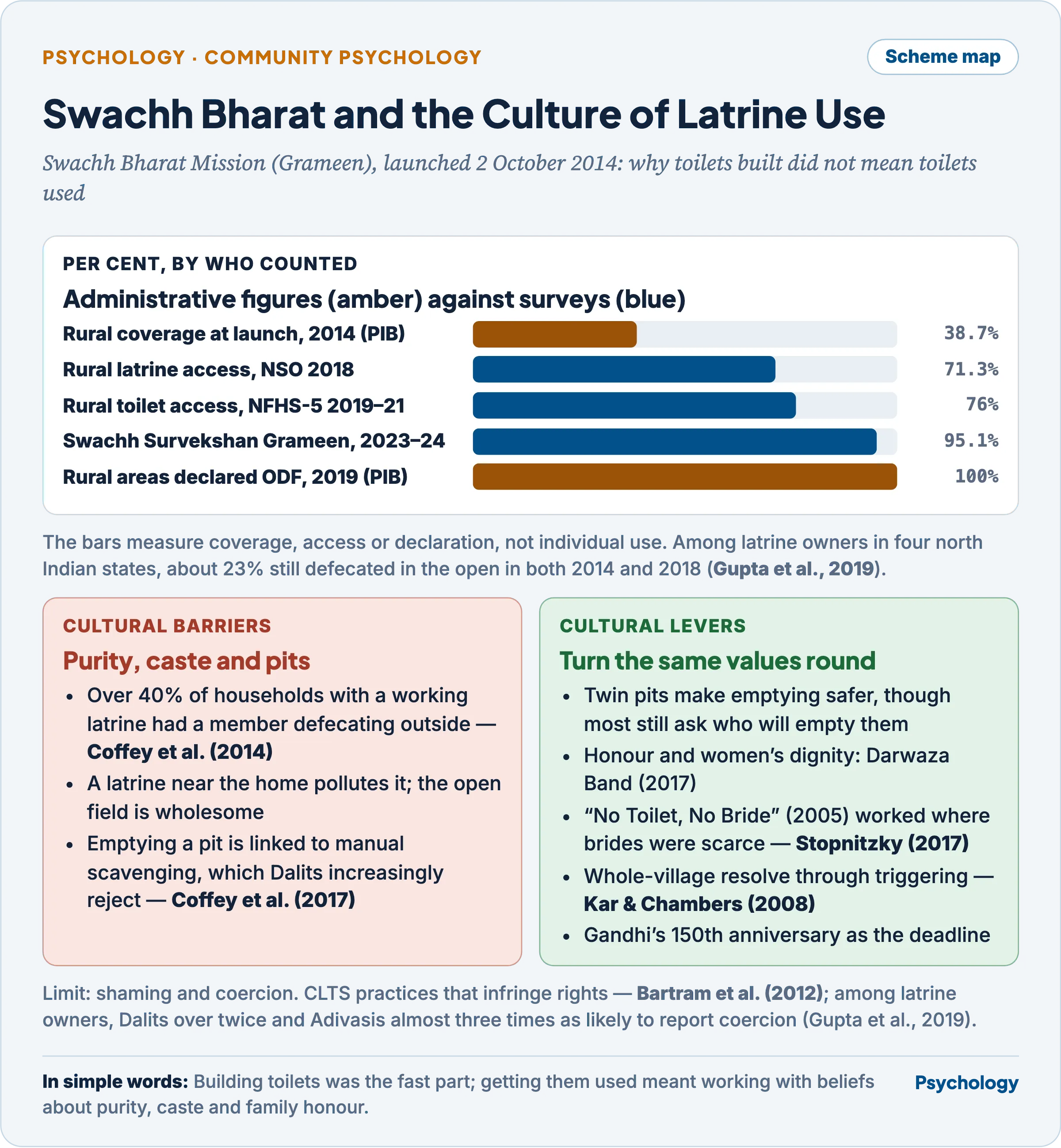
Declared coverage ran ahead of every survey of access, and access is not use.
Social change and organisational change
- Social change travels through organisations (ministries, panchayats, self-help-group federations), and organisational change is how a reform becomes routine.
- Both apply one theory of planned change, defined for any “self-system, social system, or cultural system” (Bennis, Benne and Chin, 1961); Lewin’s (1947) unfreezing, moving and freezing fits a village norm as well as a firm.
- Swachh Bharat’s Phase II judges waste management by output-outcome indicators (PIB, 2020), so its bureaucracy had to change what it measured and rewarded.
- An organisation has a legitimate centre and bounded membership; society is polycentric, so social change is slower and seldom managed.
Criticisms and limitations
- Planned change lets experts set the goal, and experts and states have imposed goals on the poor; the 1976 sterilisation drive is the Indian warning.
- Diffusion research has a pro-innovation bias and an individual-blame bias, blaming non-adopters when the innovation or the system may be at fault (Rogers, 2003).
- Effects are small and fragile: campaigns move behaviour by a few points (Snyder and colleagues, 2004), and loosely implemented programmes fail (Derzon and colleagues, 2005).
- Coercion and shaming produce compliance without internalisation (Kelman, 1958), and fall hardest on Dalit and Adivasi households (Gupta and colleagues, 2019).
- Induced participation without a responsive state often fails, and local elites can speak for the community (Mansuri and Rao, 2013).
- Outputs stand in for outcomes, and “culture” can hide structure: in Coffey and colleagues (2017), purity beliefs and caste hierarchy are one problem.
Indian context
- Pulse Polio Immunisation Programme (Government of India, 1995) — national immunisation days for every child under five.
- The Social Mobilization Network (SMNet), formed in Uttar Pradesh in August 2003 by UNICEF, Rotary and the CORE Group Polio Project, recruited community mobilisation coordinators, mostly women from high-risk communities, each tracking 400–500 households (Coates and colleagues, 2013).
- It worked through religious leaders, and from 2004 through an Underserved Strategy for Muslim communities; refusals fell below 1 per cent (Deutsch and colleagues, 2017).
- India’s last case was on 13 January 2011, and the WHO South-East Asia Region was certified polio-free on 27 March 2014. It operationalises the trusted insider as change agent inside a top-down campaign.
- POSHAN Abhiyaan (Ministry of Women and Child Development; launched 8 March 2018 at Jhunjhunu, Rajasthan) runs nutrition as a Jan Andolan, a people’s movement, through Poshan Maah each September and Poshan Pakhwada each March–April.
- Ten campaigns recorded over 60 crore activities by September 2023 (PIB, 2023). It operationalises normative mobilisation, making nutrition a visible community concern.
Previous Year Questions
- 2025Compare the ‘top-down’ and ‘bottom-up’ approaches to social change with specific reference to handling social problems in the Indian context.
- 2020Identify and discuss the key elements contributing to effective social change in a marginalized community.
- 2019Why is social change necessary? Discuss the effective strategies to bring about social change for community development.
- 2015It has been found that cultural factors can be used to facilitate social change. What cultural factors can be made use of, and how, in making a success of the governmental programme called ‘Swacch Bharat Abhiyan’?
- 2000Show conceptual relationship between social change and organizational change.
- 1999What is social change? Describe the relevant psychological factors that need to be considered while planning for social change.
- 1999Discuss the relative effectiveness of mass media in creating social awareness and social change.
- 1996Why is social change necessary? Keeping the present state of affairs in India, what steps would you take to plan social change?
