

Official syllabusPaper II · Unit 5 · Application of Psychology to Educational Field
Educational, vocational guidance and career counseling; Effective strategies in guidance programmes.
Definition
“Guidance involves personal help given by someone; it is designed to assist a person in deciding where he wants to go, what he wants to do, or how he can best accomplish his purpose; it assists him in solving problems that arise in his life. It does not solve problems for the individual but helps him to solve them.”
Jones (1951)
Guidance exists because choices about schooling, work and personal life have to be made before a young person has the information or self-knowledge to make them well. In India organised guidance dates from 1938, yet trained counsellors are still scarce in schools, colleges and employment offices.
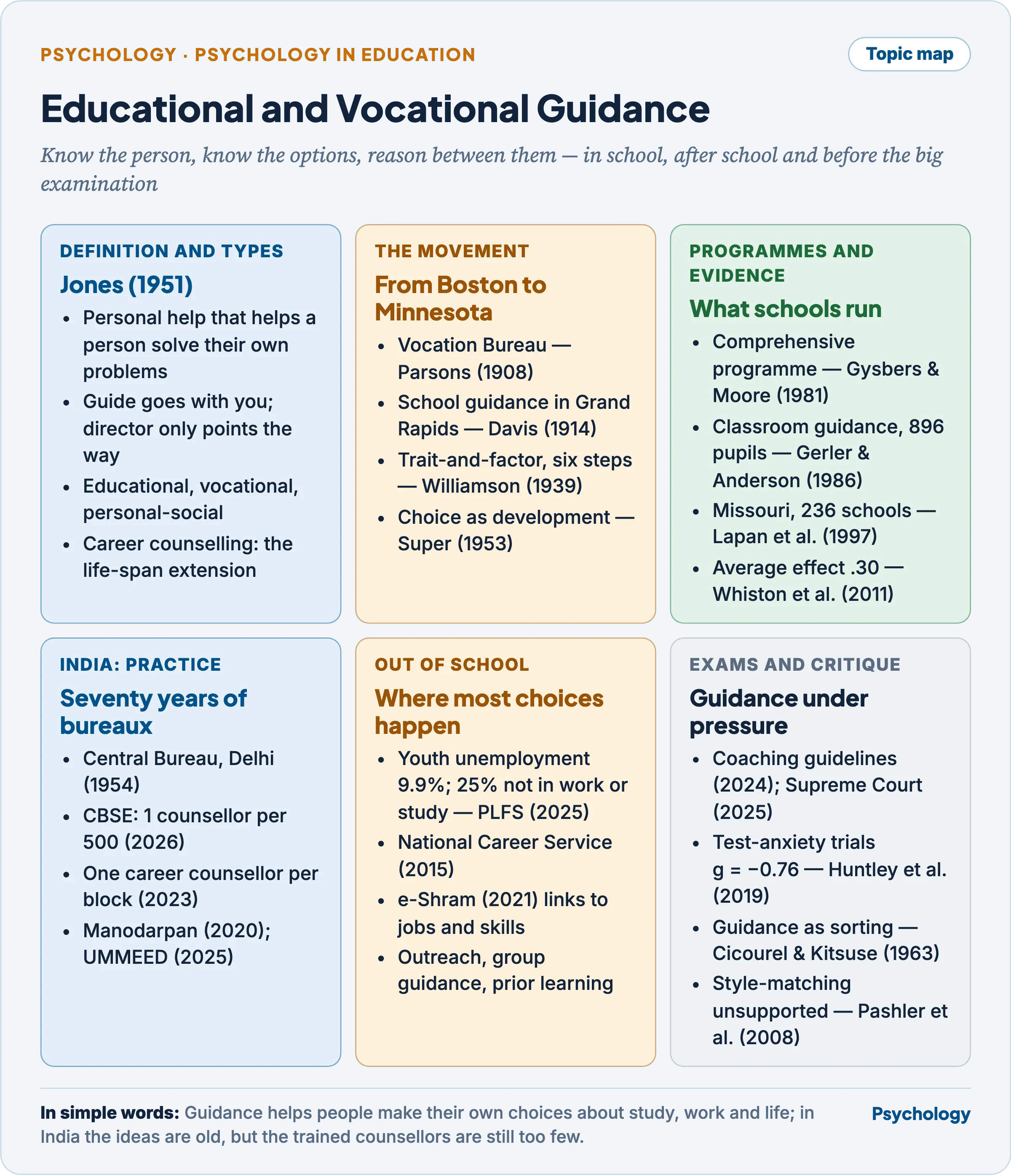
Every part of the field turns on the same three steps, knowing the person, knowing the options and reasoning between them, delivered at different points of life.
Educational, vocational guidance and career counseling: meaning and types
- Guidance is the wider service, covering information, appraisal, placement and follow-up. Counselling is its central technique: a confidential relationship in which the student reaches a decision of their own. Rogers (1942) shifted school counselling away from expert advice towards that relationship.
- Jones (1951) separates guiding from directing: “We may direct a person to the railway station by telling him how to go, but we guide him only when we go with him.”
- He listed eight kinds of guidance, from health and family to school and vocation, yet insisted on its unitary character, because a student’s problems seldom fit one category.
- Schools work with three types.
- Educational guidance: help with choices and adjustments relating to schools, courses, curricula and school life (Jones, 1951), such as stream choice after Class 10, study habits and transitions.
- Vocational guidance: help in choosing an occupation, preparing for it, entering it and building a career in it, the aims Parsons (1908) gave the Boston Vocation Bureau.
- Personal-social guidance: adjustment, relationships, emotional difficulties and conduct, where school counselling meets mental-health promotion.
- Career counselling carries vocational guidance across the life span; its theories and process are set out in Career Counselling.
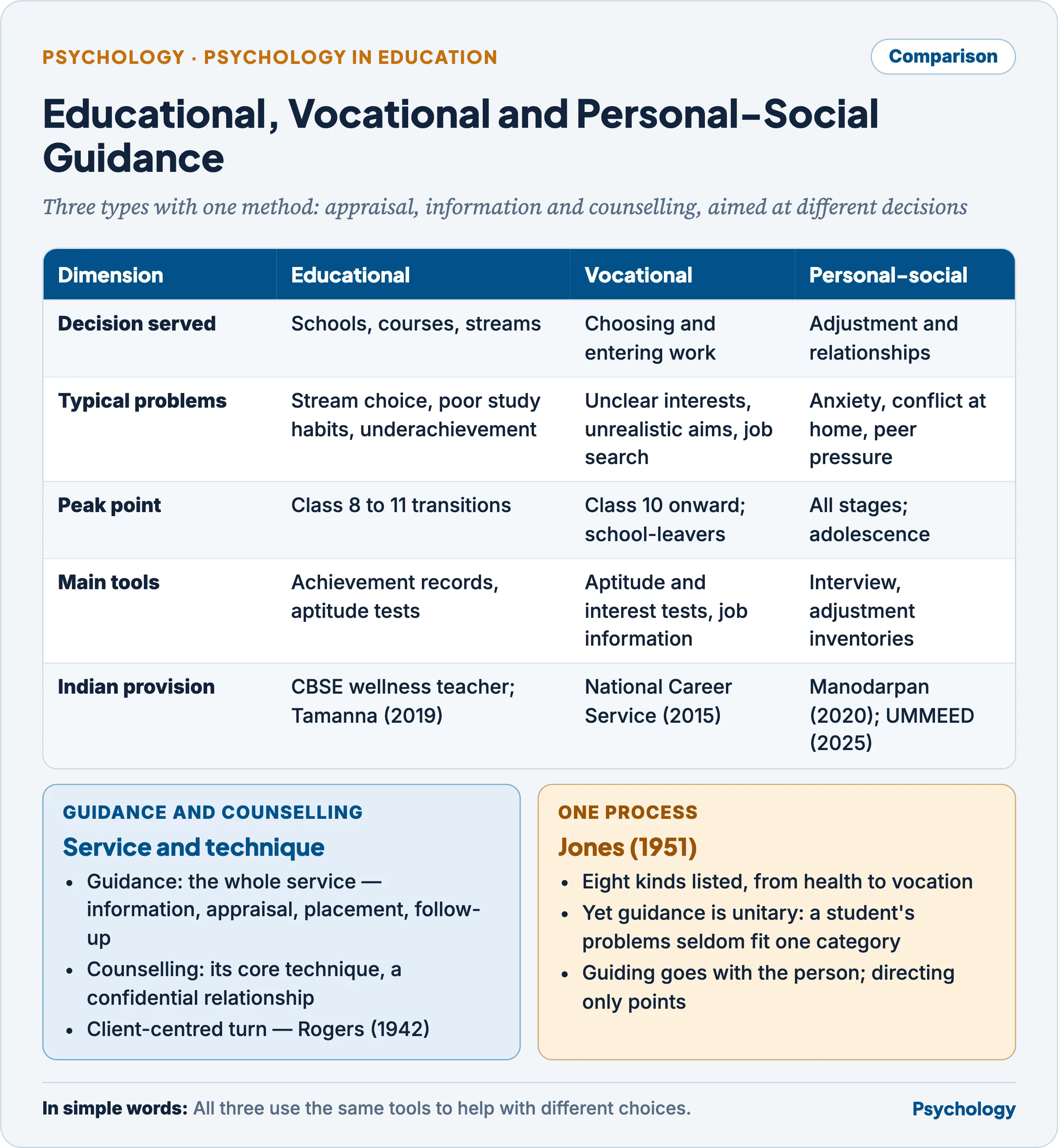
The three types share their methods and differ in the decision each one serves.
The guidance movement: Parsons, Davis and trait-and-factor
- Parsons opened the Boston Vocation Bureau in 1908 and used the term “vocational guidance” in its first report. Choosing a Vocation (1909), published after his death, set out three steps: understand yourself, know the world of work, and reason between the two.
- Jesse B. Davis, principal of Central High School, Grand Rapids, from 1907, taught vocational and moral guidance through English composition (Davis, 1914), often called the first systematic school programme.
- The National Vocational Guidance Association was founded at Grand Rapids in 1913 (Jones, 1951). Brewer (1932), in Education as Guidance, treated all of education as guidance for living.
- Williamson (1939) turned Parsons’ steps into trait-and-factor counselling: analysis, synthesis, diagnosis, prognosis, counselling and follow-up, with tests making the first step measurable.
- Super (1953) recast vocational choice as development across the life span, and the US National Defense Education Act (1958) funded school counsellors nationally.
- The American School Counselor Association has recommended one counsellor per 250 students since 1965; the US ratio was 372:1 in 2024–25 (ASCA, 2026).
Individual differences and their importance for vocational guidance
- The concept emerged when Galton (1869, 1884) treated human variation as measurable. Cattell (1890) coined “mental test”, Binet and Simon (1905) built the first practical intelligence scale, and Army Alpha (1917) made group testing routine. The full history is in The Nature of Individual Differences.
- Jones (1951) dates the recognition of guidance to “the increasing realization of the fact of individual differences in abilities, interests, and capacities”.
- Why the differences matter for vocational guidance:
- Inter-individual differences: people differ stably and occupations differ in their demands, so the two can be matched. Holland’s (1959) types are set out in Interests: Nature, Structure and Measurement (Paper I).
- Intra-individual differences: a profile of aptitudes, such as high spatial but low verbal ability, guides stream choice better than one overall score.
- Developmental differences: readiness varies, so guidance has to be timed and repeated (Super, 1953).
- Group differences in gender and income constrain choice and warn against stereotyped advice.
- Matching helps, but modestly: the mean congruence–satisfaction correlation was around .20 (Assouline and Meir, 1987).
Guidance services and programmes in schools
- The classical guidance services are orientation, appraisal (cumulative record and tests), information, counselling, placement, follow-up and evaluation.
- Gysbers and Moore (1981), at Missouri, proposed a comprehensive guidance programme in place of scattered services. Its developed form has four components: a guidance curriculum for all, individual planning, responsive services and system support, which the ASCA National Model (2003) adopted as its delivery system.
- Gerler and Anderson (1986): a classroom guidance experiment.
- 896 children in grades 4 and 5 across 18 North Carolina schools; volunteer counsellors ran guidance units for 453 against 443 controls.
- The treatment group improved, and controls declined, on classroom behaviour and attitude to school (p < .001); language and mathematics grades did not differ significantly.
- Limitation: volunteer counsellors, and no follow-up.
- Lapan, Gysbers and Sun (1997) studied 22,964 students in 236 Missouri high schools. Fuller implementation went with reports of higher grades, better preparation, more career information and a better climate, net of size and income. Limitation: correlational self-report data.
- Whiston, Tai, Rahardja and Eder (2011) found an average weighted effect of .30 across treatment–control studies of school counselling, with wide variation between interventions.
- Carey and Dimmitt (2012) summarised six statewide studies: better-implemented programmes went with better attendance and fewer disciplinary incidents, though every design was correlational.
- Tests used for appraisal, and their ethics, are covered in Use of Psychological Tests in Educational Institutions.
Learning styles in educational guidance and counselling
- The style models, including Kolb’s (1984) experiential cycle, are described in Learning Styles.
- Guidance uses them in study-skills counselling, in diagnosing underachievement where teaching mode and preference clash, as one input beside aptitude and interest in stream choice, and in advising teachers to vary presentation.
- Pashler, McDaniel, Rohrer and Bjork (2008) found no adequate evidence that matching instruction to style improves learning, so styles can prompt self-reflection but should never label or sort students.
Indian context: present practices of educational guidance and counselling in Indian schools and colleges
How the guidance movement grew in India
- Calcutta (1938) and Patna (1945) universities began research on mental tests and practical vocational guidance, and in 1947 the Parsi Panchayat in Bombay opened a guidance division to all communities (International Labour Office, 1958).
- Following the Mudaliar Commission (1953), the Ministry of Education set up the Central Bureau of Educational and Vocational Guidance in Delhi in 1954. By 1957 seven of 14 states had bureaux, yet programmes reached “only a minority of schools” (International Labour Office, 1958).
- The bureau merged into NCERT on its founding in 1961. Its psychology department has offered a diploma in guidance and counselling since 1958, now on a teacher-as-counsellor model in Delhi and five Regional Institutes (NCERT, DEPFE).
Present practices in schools
- National Education Policy, 2020 (Ministry of Education) — links counsellors or trained social workers to schools and school complexes, and ends hard separation between streams. Principle: guidance as part of holistic development.
- CBSE Affiliation Bye-Laws, 2018, clause 2.4.12 — required a full-time counsellor and wellness teacher in secondary schools, part-time below 300 students in Classes 9–12.
- Circular 02/2026 (19 January 2026) set one per 500 students, added a career counsellor at 1:500 for Classes 9–12, and allowed hub-and-spoke sharing between schools.
- CBSE psycho-social counselling (since 1998) — pre-examination and post-result support through a toll-free line and tele-counselling by principals, counsellors and psychologists (CBSE, 2026).
- Samagra Shiksha career counselling (Ministry of Education, 2023) — one Academic Resource Person per block across 7,116 blocks, holding sessions for Classes 9–12 and using Tamanna. Principle: assessment-based choice in place of choice by default.
- Tamanna (NCERT and CBSE, 2019) — a voluntary seven-aptitude test for Classes 9 and 10 that operationalises Parsons’ first step, self-knowledge.
- Manodarpan (Ministry of Education, July 2020) — a national tele-counselling helpline and advisories. Its 2022 survey of 3.79 lakh students in Classes 6–12 found anxiety about studies, examinations and results rising from middle to secondary stage (NCERT, 2022).
- UMMEED guidelines (NCERT; draft 2023, final May 2025) — a School Wellness Team under the principal, a list of warning signs and a response plan. Principle: whole-school gatekeeping instead of one counsellor.
- School Health and Wellness Programme (Ayushman Bharat, 2020) — two teachers per school trained as Health and Wellness Ambassadors, 3,23,575 of them by 2022–23 (Lok Sabha reply, 8 December 2023).
- State career portals built with UNICEF began with Rajasthan’s in February 2019, covering courses, scholarships and jobs for Classes 9–12.
Practices in colleges
- NEP 2020 (para 12.5) promises professional academic and career counselling to every student in higher education.
- A National Task Force survey cited by the Supreme Court found about 65 per cent of higher-education institutions offering no access to any mental-health professional and 73 per cent with none full-time (Amit Kumar v. Union of India, 2026). Untrained faculty were being labelled “counsellors”.
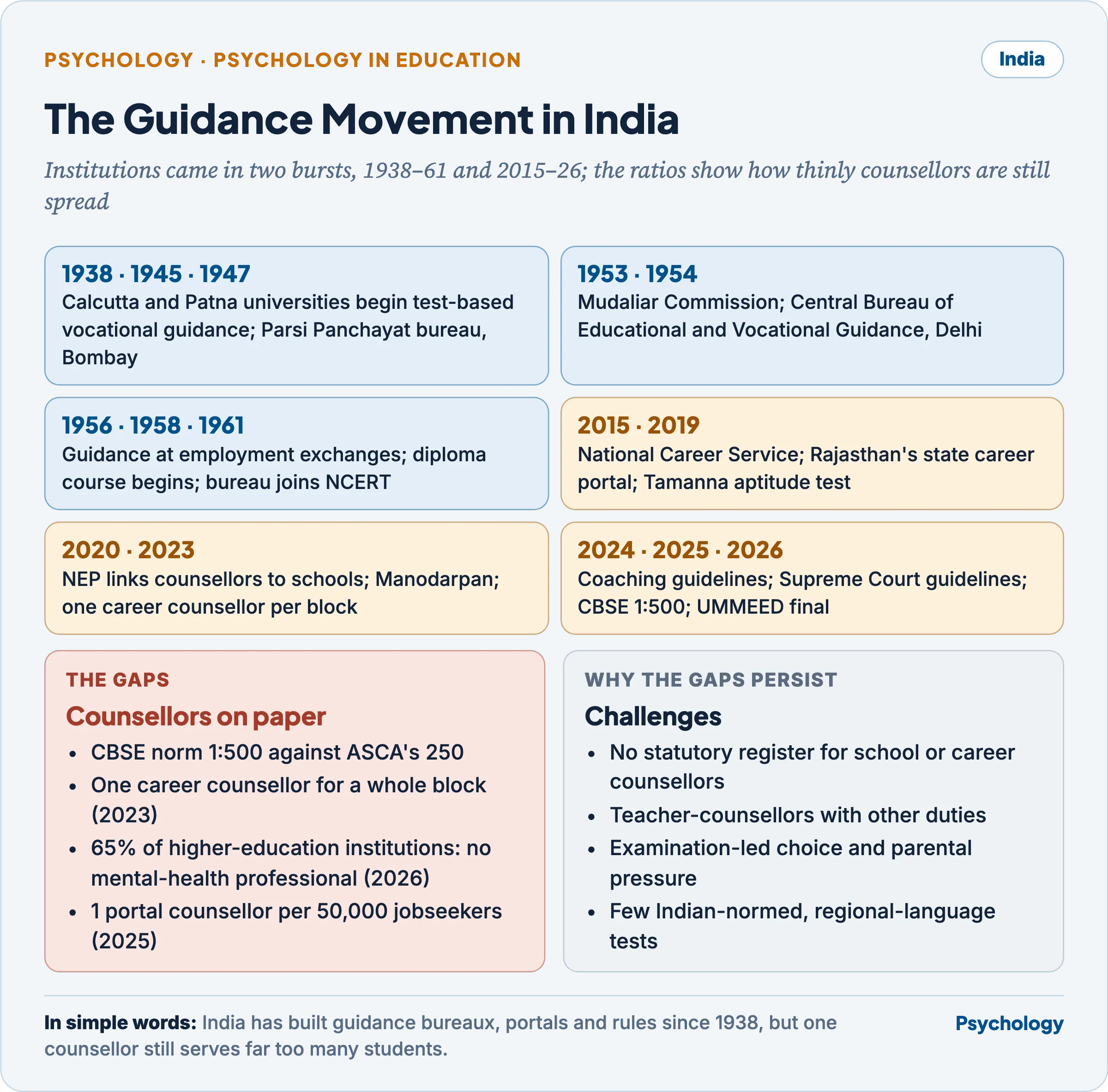
Each policy adds counsellors on paper, and the ratios show how many students each one would still have to serve.
Problems in implementing guidance programmes and the challenges faced by the guidance movement in India
- Too few counsellors. The CBSE norm of 1:500 is double ASCA’s 250, and under Samagra Shiksha one career counsellor has to cover every secondary school in a block.
- Teacher-counsellors and role confusion. Guidance falls to teachers who also teach; CBSE lets schools nominate a teacher where no career counsellor exists (CBSE, 2026). Counsellors get pulled into discipline and paperwork, which ASCA rules out, and the Task Force warned against calling untrained faculty counsellors.
- No professional standards. The Rehabilitation Council of India registers clinical psychologists, and the National Commission for Allied and Healthcare Professions Act, 2021 lists psychologists and specific counsellor roles, but no statutory register covers school or career counsellors.
- Low priority. Guidance rarely has a timetable period or assessment weight, so it gives way to examination preparation.
- Examinations and parents. Marks decide streams, families often decide careers, and science sits above commerce and humanities in prestige; anxiety about examinations and results rises through secondary school (NCERT, 2022).
- Socio-economic and cultural barriers. Arulmani, Van Laar and Easton (2003) found lower-income Indian high-school students holding more negative career beliefs. Stigma and fears about confidentiality keep students away (Amit Kumar v. Union of India, 2026).
- Tools and language. Indian-normed tests in regional languages are few, and occupational information dates quickly. India’s many languages already made one national test battery impracticable in 1958 (International Labour Office, 1958).
- No evaluation of outcomes. Programmes report calls, sessions and posts; few measure the decisions made or the distress prevented.
- Strengthening needs a trained counsellor cadre with fixed ratios, a weekly guidance period, regional-language tests, parent programmes and the annual reporting the Supreme Court now requires (Sukdeb Saha v. State of Andhra Pradesh, 2025).
Out-of-school vocational guidance
Its significance in the Indian scenario
- Most young Indians make work decisions after or outside school: the secondary dropout rate was 7.0 per cent and secondary retention only 51.9 per cent (UDISE+, 2025–26).
- Youth unemployment was 9.9 per cent (13.6 per cent urban), 25.0 per cent of those aged 15–29 were not in employment, education or training, and only 5.0 per cent had formal vocational training (PLFS, 2025).
- Self-employment (56.2 per cent) and casual labour (20.2 per cent) make up three-quarters of the workforce (PLFS, 2025), so guidance must cover informal livelihoods and upskilling as well as salaried jobs.
- A 1950s agreement gave guidance for pupils to the Ministry of Education and for school-leavers to the Ministry of Labour, which began vocational guidance at employment exchanges in 1956 (International Labour Office, 1958).
- Career development continues past school (Super, 1953), and dropping out or failing lowers self-efficacy and outcome expectations, the drivers of choice in social cognitive career theory (Lent, Brown and Hackett, 1994).
Special strategies for out-of-school vocational guidance
- National Career Service (Ministry of Labour and Employment, 2015) — turned employment exchanges into a portal and career centres: 6.02 crore jobseekers, 54.27 lakh employers, 8.17 crore vacancies and 407 approved Model Career Centres by November 2025 (PIB, 2025).
- More than 1,182 career counsellors on the portal had given over 41 lakh guidance sessions by August 2025, about one counsellor per 50,000 registered jobseekers (PIB, 2025).
- Principle: Parsons’ knowledge of the world of work, delivered at scale.
- e-Shram (Ministry of Labour and Employment, 2021) — 31.89 crore registrations of unorganised workers by August 2026, linked to the National Career Service and the Skill India Digital Hub (PIB, 2026).
- Special groups. Twenty-four National Career Service Centres for the Differently Abled assess residual capacities (the first two opened in 1968); women returning to work need re-entry counselling.
- Community and mobile outreach. Camps through panchayats and self-help groups, career vans, melas, community radio and local-language sessions reach people who never visit an office.
- Group guidance and local role models, which use observational learning where pamphlets fail; group talks at employment offices date to the 1950s (International Labour Office, 1958).
- Recognition of prior learning under the Pradhan Mantri Kaushal Vikas Yojana (2015) certifies existing skills, so appraisal rests on experience rather than marks.
- Bridges back to education through open schooling, and job-search training.
Effective strategies in guidance programmes for adolescents preparing for competitive examinations
- In 2025, 22.09 lakh candidates sat NEET-UG (NTA, 2025) for about 1.29 lakh MBBS seats (NMC, 2025), so most will not get one.
- There were 14,488 student suicides in 2024, 8.5 per cent of all suicides (NCRB, 2024). Test anxiety is negatively related to performance (von der Embse, Jester, Roy and Post, 2018), and ranked batches add constant comparison.
- Guidelines for Registration and Regulation of Coaching Centres (Ministry of Education, January 2024) — no enrolment below 16, a counselling system as a condition of registration, no more than five hours of classes a day, a weekly off, and no guarantees of rank.
- Sukdeb Saha v. State of Andhra Pradesh (Supreme Court, 25 July 2025) — held mental health part of the right to life under Article 21 and issued fifteen binding guidelines.
- A qualified counsellor in every institution of 100 or more students; referral links for smaller ones.
- No batch segregation by performance, public shaming or disproportionate targets; structured career counselling for students and parents; staff training twice a year.
- Heightened measures in coaching hubs such as Kota and Sikar. Principle: the institution changes its environment while the student learns to cope.
- The Rajasthan Coaching Centres (Control and Regulation) Act, 2025 makes registration conditional on a counselling system.
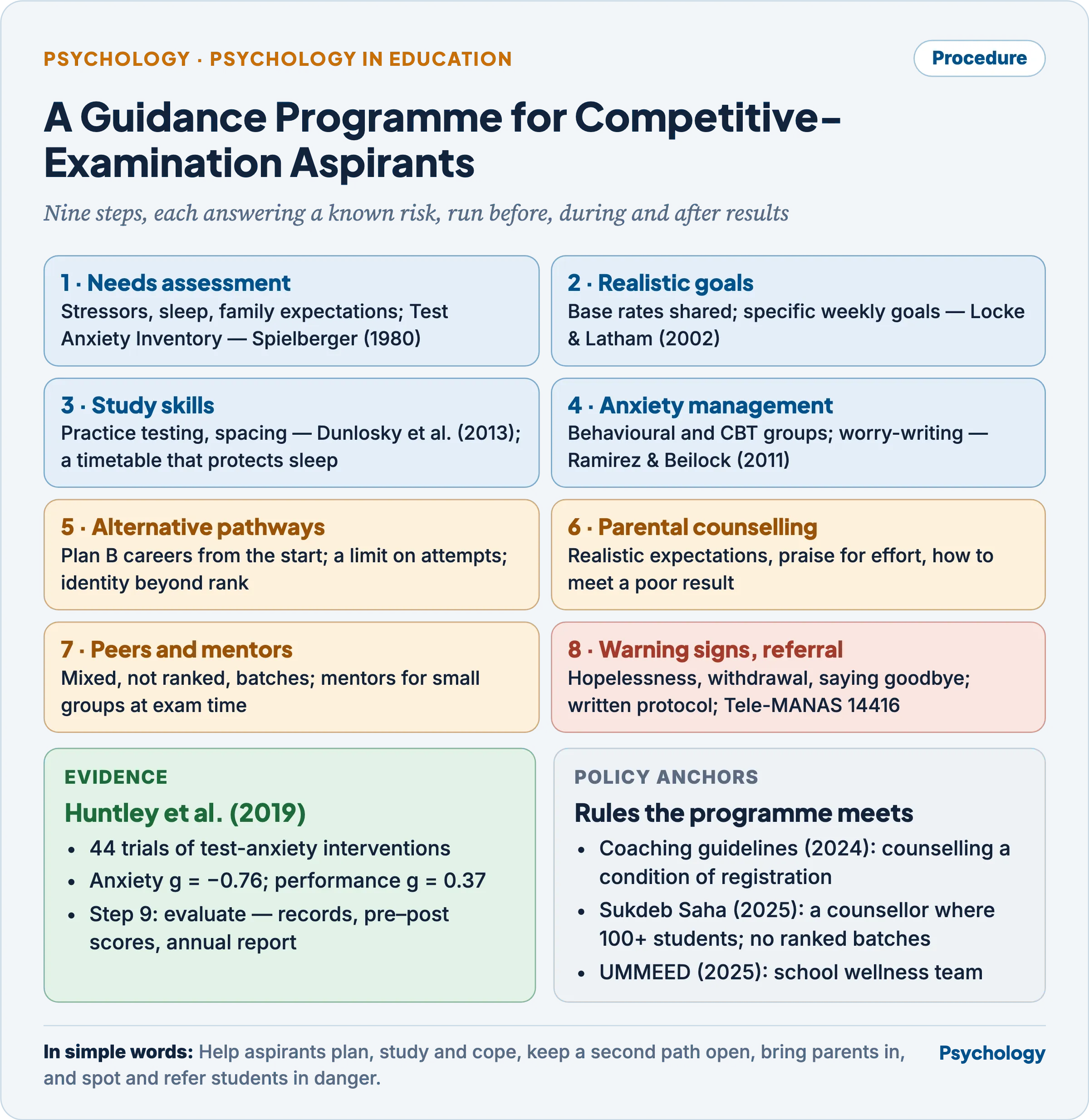
Each step answers a known risk, and the programme runs before, during and after the results.
A guidance programme, step by step
- Needs assessment. Survey stressors, sleep, study habits and family expectations; screen with the Test Anxiety Inventory (Spielberger, 1980); flag first-time migrants, repeaters and students with past self-harm.
- Orientation and realistic goal setting. Share base rates openly and set specific weekly goals with feedback (Locke and Latham, 2002), so small successes build self-efficacy (Bandura, 1997).
- Study skills and time management. Teach practice testing and spaced practice, the techniques rated highest in utility (Dunlosky and colleagues, 2013), within a timetable that protects sleep. Time management relates moderately to achievement and well-being (Aeon, Faber and Panaccio, 2021).
- Stress and test-anxiety management. Run behavioural and cognitive-behavioural groups: across 44 trials with test-anxious university students, interventions cut test anxiety (g = −0.76) and raised performance (g = 0.37) (Huntley and colleagues, 2019).
- Ten minutes of writing about worries before an examination lifted highly anxious ninth-graders from B− to B+ (Ramirez and Beilock, 2011).
- Reading arousal as helpful improved GRE mathematics scores (Jamieson and colleagues, 2010).
- Alternative pathways from the start. Plan related careers in allied health, pharmacy, research or engineering, set a limit on attempts, and support an identity resting on more than rank; decision models are in Career Counselling.
- Parental counselling. Cover realistic expectations, praising effort over rank, warning signs, and how to respond to a poor result.
- Peer support and mentors. Keep batches mixed rather than ranked, give small groups a mentor during examination periods, and train peers to notice distress.
- Early warning signs and referral. UMMEED lists hopelessness, worthlessness, withdrawal, changed sleep or appetite, falling performance, returning gifts or saying goodbye, and talk of ending life (NCERT, 2025). Refer by written protocol to the counsellor, psychiatrist or Tele-MANAS (14416), and reach out after results.
- Evaluation. Keep anonymised records, measure anxiety and help-seeking before and after, and report annually to the regulator.
Criticisms and limitations
- Trait-and-factor guidance is static. It makes choice a one-time match by testing, while Super (1953) showed choice develops, and matching predicts satisfaction only modestly (Assouline and Meir, 1987).
- Guidance can become sorting. Cicourel and Kitsuse (1963) found high-school counsellors’ judgements of college potential tracking students’ social class; stream allocation by marks in India risks the same gatekeeping.
- Western, individualist models fit poorly where careers are family decisions and beliefs vary with income (Arulmani, Van Laar and Easton, 2003).
- The evidence is thin. Most studies are correlational (Carey and Dimmitt, 2012) with non-standardised outcome measures (Whiston and colleagues, 2011), and almost no Indian school programme has been evaluated for outcomes.
- Schemes count outputs. The National Career Service does not require hiring figures (PIB, 2025), and a post on paper is not a trained counsellor.
- Medicalisation and stigma. A handful of institutions sent every student for psychiatric evaluation regardless of need, which the Court called an overreaching approach (Amit Kumar v. Union of India, 2026).
- The structure produces the distress. Seat scarcity and ranked coaching cause much of what guidance then treats, so the 2025 guidelines target institutions too.
Previous Year Questions
- 2025Describe the various effective strategies which can be incorporated in designing guidance programme for adolescents preparing for competitive examinations.
- 2022With reference to the general scenario of our country, elaborate the significance of ‘out of school’ vocational guidance. Which special strategies should be used for it?
- 2017Explain how the concept of individual differences emerged and state its importance for vocational guidance.
- 2012Comment on the present practices related to educational guidance and counseling programs in Indian schools and colleges. Highlight the problems in implementing and strengthening these programs in Indian context.
- 2010Discuss the challenges encountered by the guidance and counselling movement in India.
- 2004Describe the various learning styles. How are/can they be used in educational guidance and counselling?
