

Official syllabusPaper II · Unit 5 · Application of Psychology to Educational Field
Personality development and value education.
Definition
“I define character as an individual’s set of psychological characteristics that affect that person’s ability and inclination to function morally.”
Berkowitz (2002)
Personality is what a child is like; character is that same personality judged against moral standards; value education is the school’s deliberate attempt to shape the second through the first. Schools move moral reasoning, social skills and conduct modestly, and most of the effect comes from how the school treats the child; moral lessons on their own add little.
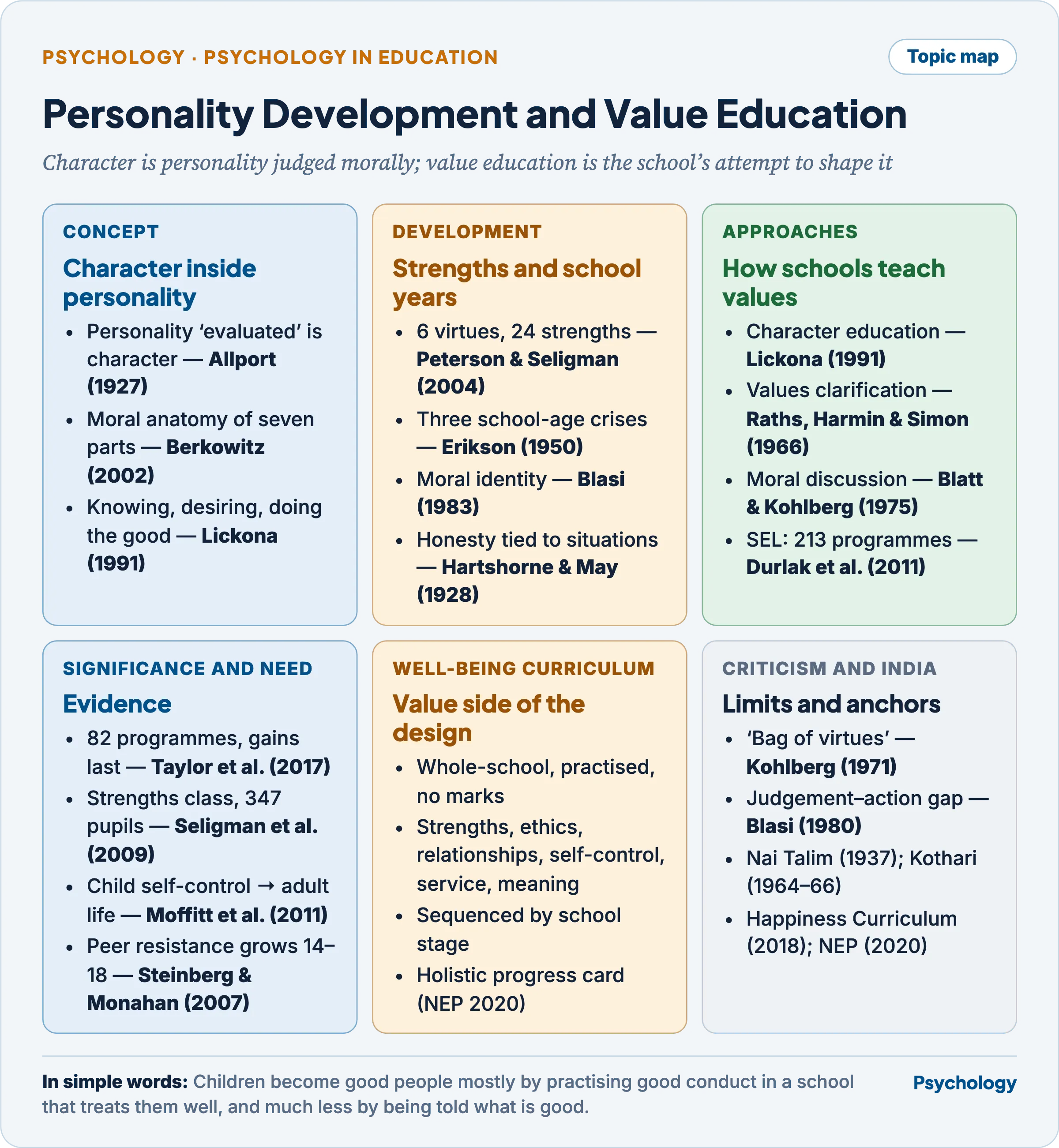
Character sits inside personality, so every route to it in school runs through relationships, practice and the school’s own conduct.
The concept of personality and character development
- Personality is the characteristic organisation of a person’s traits, motives and self-concept; its definitions and determinants are in Definition, Concept and Determinants of Personality (Paper I).
- Character is the part of personality that carries moral weight. Allport (1927) put the line between “personality devaluated and personality evaluated, that is, between personality and character”: one trait, read with or without a moral judgement.
- Allport wanted such judgements kept out of psychology. Value education does the opposite: it evaluates traits and sets out to change them.
- Berkowitz (2002) splits character into a moral anatomy of seven parts: moral behaviour, moral values, moral personality, moral emotion, moral reasoning, moral identity and foundational characteristics. Each part develops on its own timetable.
- Lickona (1991) divides character into three interrelated parts, moral knowing, moral feeling and moral action, which he glosses as “knowing the good, desiring the good, and doing the good”.
- Personality development in school is the formation of traits, self-concept and identity under family, peers and teachers, set out in Socialisation and the Agents of Socialisation (Paper I). Character development is the moral strand of that same process.
Character strengths and virtues
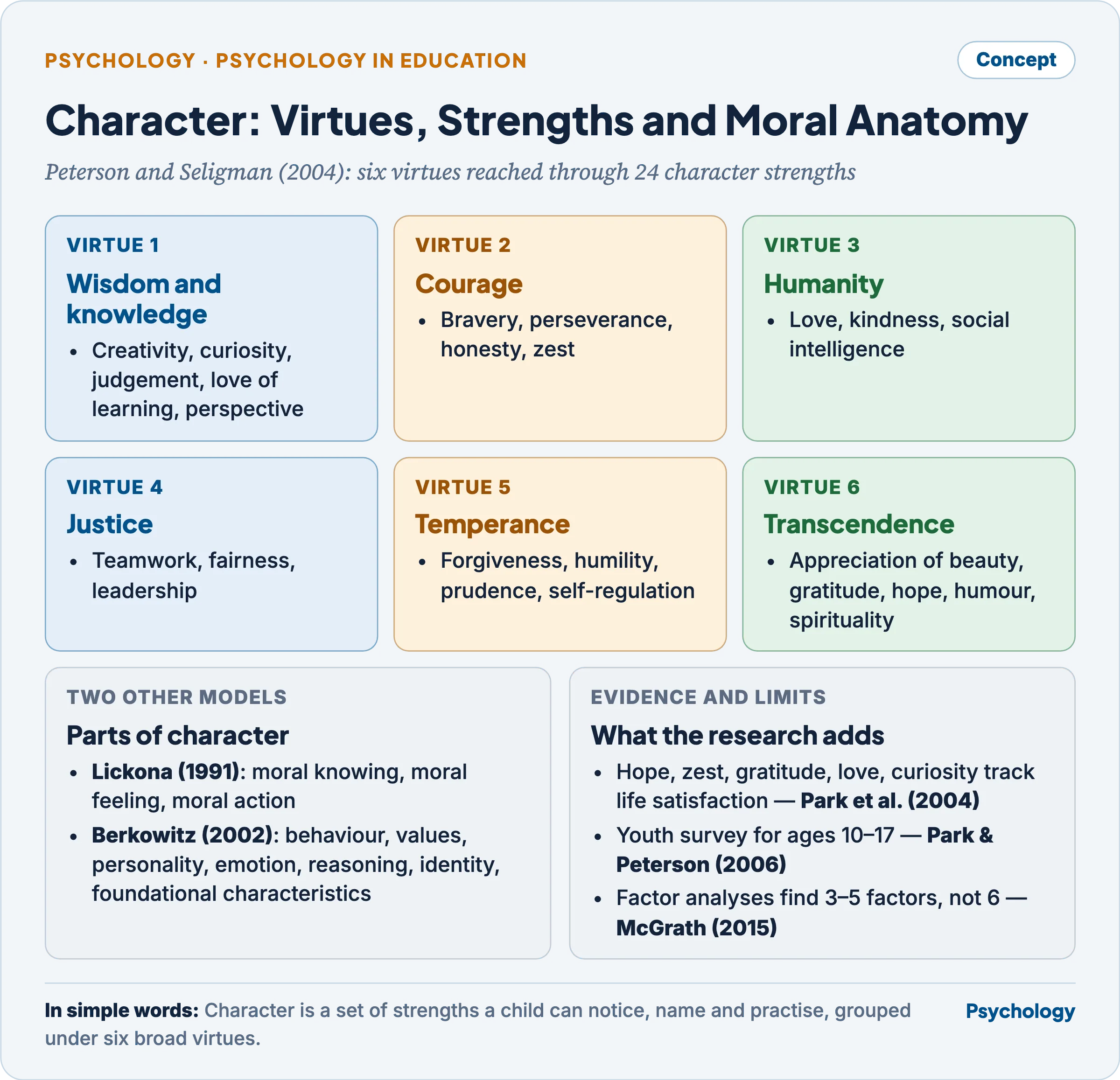
Virtues are abstract; strengths are the observable, teachable routes to them, which is why schools work at the second level.
- Peterson and Seligman (2004) built a classification of strengths to set beside the diagnostic manuals. Six virtues (wisdom, courage, humanity, justice, temperance, transcendence) are each reached through three to five of 24 character strengths, which show up through situational themes: habits tied to particular settings.
- Strengths are trait-like but developable, so they can be named, noticed and practised in class.
- Park, Peterson and Seligman (2004) surveyed 5,299 adults online: hope, zest, gratitude, love and curiosity were the strengths most consistently tied to life satisfaction.
- Park and Peterson (2006) built the VIA Inventory of Strengths for Youth for ages 10 to 17, validated on about 1,300 students in seven US states.
Character development across the school years
- Berkowitz (2002) times the components: self-control makes its greatest headway at five to seven; perspective-taking advances most between three or four and twelve; moral reasoning becomes mainly prosocial at about eleven or twelve; moral identity forms in adolescence.
- Erikson (1950) places three crises inside the school years, set out in Freud and Erikson – The Psychosexual and Psychosocial Stages (Paper I).
- Initiative against guilt (purpose): the child needs room to plan and attempt.
- Industry against inferiority (competence): standards that are realistic and achievement that is recognised.
- Identity against role confusion (fidelity): commitment to values the adolescent has explored, which Marcia (1966) included in his identity statuses through ideological commitment.
- Kohlberg’s (1958) stages, with Gilligan’s (1982) care critique and Turiel’s (1983) domains, are in Adolescent Development – Physical, Cognitive, Moral and Social (Paper I).
- Through adolescence reasoning shifts from self-oriented consequences to the impact of one’s acts on others (Berkowitz, 2002), and discussion pitched one stage above the child’s own moves it on.
- Moral identity is the centrality of being good to one’s self-concept. Blasi (1983) proposed that judgement turns into action when morality is central to the self, so that failing to act would be a failure of self-consistency.
- Hart and Fegley (1995) compared urban adolescents nominated by community leaders for exceptional care with matched peers. The exemplars described themselves in more moral traits and goals, with no difference in stage of moral judgement. Limitation: a small, cross-sectional sample.
- Hartshorne and May (1928), the Character Education Inquiry, gave 10,865 pupils about four hours of tests offering chances to cheat, lie and steal in classroom, home, party and athletic settings.
- Honesty in one setting predicted honesty in another only weakly, so the trait looked specific to the situation.
- Children in organisations that taught honesty deceived about as much as others, and moral knowledge did not predict an individual’s conduct; a group’s code predicted the group’s conduct.
- Limitation: Burton (1963) re-analysed the data and found a general honesty factor, about 35–40 per cent of the common variance, though much variance stayed specific to each test. Schools still have to build character in particular settings and through group norms.
Value education: meaning, aims and approaches
- Value education is the school’s deliberate effort to develop students’ understanding of, commitment to and practice of values; the Education Commission (1966, para 1.75) asked for “the inculcation of right values in the students, at all stages of education”.
- It runs through lessons and, unplanned, through the hidden curriculum (Jackson, 1968): what the school’s routines teach.
- Kohlberg (1971) asked his second-grade son who the bad boys were: “The ones who don’t put their books back where they belong and get yelled at.” His teacher, Kohlberg noted, had no idea that her classroom management was defining morality for the children.
- Its aims follow Lickona’s three parts: moral knowing (reasoning about right and wrong), moral feeling (empathy, conscience, self-respect) and moral action (habits and self-control). The Indian statements of aim are under Indian context.
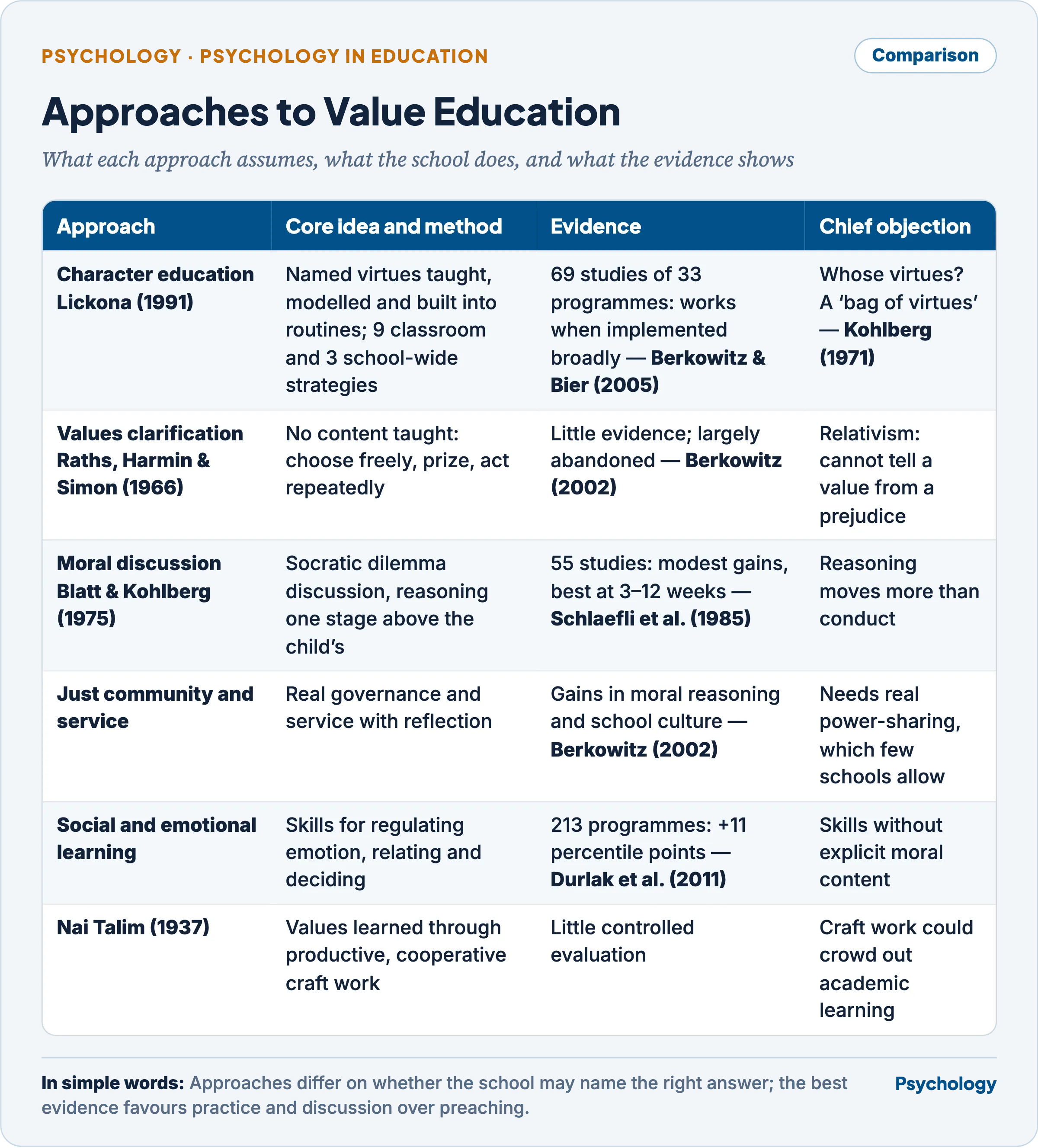
The approaches differ most on whether the school may name the right answer, and their evidence differs on whether conduct, or only reasoning, moves.
- Character education teaches named virtues directly, models them and builds them into routines.
- Lickona’s (1991) comprehensive approach has nine classroom strategies (teacher as caregiver, model and mentor; moral community; moral discipline; democratic classroom; values through the curriculum; cooperative learning; conscience of craft; moral reflection; conflict resolution) and three school-wide ones.
- Berkowitz and Bier (2005) found 69 rigorous studies of 33 programmes and concluded that character education works when implemented broadly and faithfully.
- Objection: Kohlberg (1971) called virtue lists a bag of virtues, noting that “everyone has his own bag”.
- Values clarification (Raths, Harmin and Simon, 1966) teaches no content: a value counts only if chosen freely after weighing alternatives, prized and publicly affirmed, and acted on repeatedly.
- Objection: it cannot tell a value from a prejudice. Kohlberg (1971) called it a cop-out from the relativity problem, and Berkowitz (2002) notes it has largely disappeared, partly because its evidence was weak. The reviews are in Strategies for Fostering Values (Paper I).
- Cognitive-developmental moral discussion: Blatt and Kohlberg (1975) ran teacher-led Socratic discussion of dilemmas, exposing students to reasoning one stage above their own, and students advanced in stage relative to controls.
- Colby and colleagues (1977) found gains only in some classrooms: those with more discussions, a wider spread of stages and teachers skilled at eliciting reasoning.
- Schlaefli, Rest and Thoma (1985) pooled 55 intervention studies: dilemma discussion had modest effects, best at three to twelve weeks. Objection: reasoning moves more readily than conduct.
- The just community and service learning extend discussion into governance and service; both are in Strategies for Fostering Values (Paper I).
- Social and emotional learning teaches the skills values need. Durlak and colleagues (2011) pooled 213 universal programmes with 270,034 students and found better skills, attitudes and behaviour, and an 11-percentile-point gain in achievement.
Methods of value education in schools
- Solomon, Watson and Battistich (2001) found four practices with strong support: student autonomy and influence; participation, discussion and collaboration; social-skills training; helping and service. Berkowitz (2002) adds the mediator, a caring moral atmosphere.
- Stories and the curriculum, with moral questions placed inside literature, history and science.
- Dilemma discussion and role play to practise perspective-taking.
- Cooperative learning in jigsaw groups, where each child holds a piece the others need (Aronson and Patnoe, 1997).
- Responsibility roles, class councils and service, followed by structured reflection or journals.
- Modelling. Berkowitz (2002) puts first how adults treat the child, then how they treat each other in the child’s sight; schools that lean on posters, announcements and assembly lectures “miss the boat”.
- A class that runs its own monitor rota and settles disputes in a weekly circle practises responsibility and fairness every week.
- Partnership with parents, who remain the primary influence.
The significance of value education for personality development
- Value education acts on personality through four mechanisms.
- Habit: dispositions form by repeated acts, as Aristotle held.
- Internalisation: standards become the child’s own, set out in Strategies for Fostering Values (Paper I).
- Identity: values become part of who the adolescent is (Blasi, 1983).
- Self-regulation: impulse control is practised until it becomes routine.
- Berkowitz (2002) lists what schools can shape: self-concept and self-esteem, social skills, values, moral reasoning, and prosocial inclination and behaviour.
- Taylor, Oberle, Durlak and Weissberg (2017) followed 82 programmes with 97,406 students for six months to eighteen years: participants stayed ahead, with a 13-percentile-point achievement advantage (eight studies), and skill gains after the programme best predicted later well-being.
- Battistich and colleagues (2000) evaluated the Child Development Project, which makes elementary schools caring communities, against comparison schools in six US districts. Where it was implemented widely, drug use and problem behaviour fell.
- Seligman, Ernst, Gillham, Reivich and Linkins (2009) randomly assigned 347 ninth-graders to language-arts classes with or without a strengths curriculum of 20–25 sessions.
- Students identified signature strengths and used them in new ways.
- Enjoyment of school, teacher-rated learning strengths and social skills (empathy, cooperation, assertiveness, self-control) rose; teachers rating them were blind to condition.
- Limitation: self-reported strengths, depression and anxiety did not change, and it was one school.
- Srikala and Kishore (2010) evaluated the NIMHANS life-skills model, with ordinary teachers as life-skills educators, in Karnataka.
- After one year, 605 adolescents in two schools had better self-esteem and coping than 423 matched peers, with no difference in psychopathology.
- Limitation: matched rather than randomised controls.
- Personality can be the explicit target: Delhi’s Happiness Curriculum lists “a confident and pleasant personality” among its four outcomes (Khanna and Peterson, 2023).
The need for value education during schooling
- The components of character mature during the school years (Berkowitz, 2002), so the school meets each one while it is forming.
- Steinberg and Monahan (2007) pooled over 3,600 people aged 10 to 30: resistance to peer influence grows steadily between 14 and 18, little before. Values have to be in place by early adolescence.
- Moffitt and colleagues (2011) followed 1,000 Dunedin children to age 32: childhood self-control predicted health, substance dependence, finances and offending along a gradient, independent of IQ and social class.
- Hartshorne and May (1928) showed that conduct follows the group’s code. Every school has one, so a school either shapes its value climate deliberately or leaves it to chance.
- Two Indian figures set the scale.
- The NCRB’s Accidental Deaths and Suicides in India 2024 (May 2026) recorded 14,488 student suicides, 8.5 per cent of all suicides.
- The National Mental Health Survey (2015–16) put disorder prevalence at ages 13–17 at about 7.3 per cent, from a limited adolescent sample.
- The Education Commission (1966, para 1.74) warned that knowledge “with a lack of essential values may be dangerous”.
- A plural society needs a shared civic floor, the constitutional values of justice, liberty, equality and fraternity, taught without religious instruction.
A well-being curriculum for children
The well-being science, the resilience and mindfulness trials and the core skills are in Factors Influencing Positive Health, Well-Being, Lifestyle and Quality of Life (Unit 2); what follows is the value-education and personality side of the design.
- Positive education is “education for both traditional skills and for happiness” (Seligman and colleagues, 2009), argued for on three grounds: an antidote to youth depression, a route to life satisfaction, and an aid to learning and creative thinking.
- Focus: flourishing together with good character; universal and whole-school; built on strengths; learned through daily practice; non-sectarian and constitutional; assessed without marks.
- Essential components:
- Self-awareness and emotion regulation: a daily mindful check-in and naming feelings.
- Knowing one’s strengths: VIA-Youth profiles, strength-spotting in peers, using a strength in a new way.
- Ethical reasoning: dilemmas from children’s lives, such as cheating, plagiarism, littering and exclusion, discussed one stage up.
- Relationships: empathy, cooperation and conflict resolution through jigsaw groups and anti-bullying norms.
- Self-control: goal-setting, planning and delay strategies.
- Service and citizenship: class duties, community service with reflection, the Fundamental Duties.
- Meaning and gratitude: stories from the Indian tradition, gratitude practice, purpose projects.
- Sequence by stage:
- Foundational: stories, play and circle time.
- Preparatory: classroom jobs, kindness projects, strength-spotting.
- Middle: dilemma discussion, cooperative projects, service and peer-pressure role play, all before the peer-influence years.
- Secondary: identity and purpose projects, debates on constitutional values, peer mentoring.
- Pedagogy: one regular period plus infusion across subjects; a story–activity–reflection cycle; general teachers who model what they teach, trained first.
- Assessment: a holistic progress card of self, peer and teacher observation of behaviour, never a mark on a child’s worth. The programme is evaluated against comparison schools, with behavioural measures and follow-up beyond a year.
- Supports: parents as partners; a counsellor; referral to Manodarpan (Ministry of Human Resource Development, now Education, 21 July 2020), a psychosocial-support initiative with a national tele-counselling helpline for students.
Criticisms and limitations
- Situational specificity. Hartshorne and May (1928) found honesty tied to settings. Even Burton’s (1963) general factor left much of the variance specific to each test, so virtue taught in one context need not transfer.
- The judgement–action gap. Blasi (1980) found the link between moral reasoning and action positive but moderate, and uneven across kinds of conduct. Hart and Fegley’s (1995) exemplars differed from peers in self-concept, not moral judgement, so programmes that move reasoning may not move conduct.
- Indoctrination against relativity. Kohlberg (1971): “What is one man’s ‘integrity’ is another man’s ‘stubbornness'”. Character education risks imposing one list; values clarification cannot condemn anything.
- The classification. McGrath (2015) noted that factor analyses of strengths measures usually find four or five factors, and across four samples of over a million cases found three (caring, inquisitiveness, self-control), not six virtues.
- The evidence. Berkowitz and Bier (2005) counted social-emotional and youth-development programmes as character education. Developers often evaluate their own programmes, and outcomes are mostly self-reported where children know the approved answer.
- Indian programmes are thinly evaluated. The Happiness Curriculum’s evidence is mostly surveys: 87 per cent of teachers in a 2020 survey reported a tangible impact on students (Khanna and Peterson, 2023).
- Carney and Moorthy (2026), a randomised trial of the Tripura version in 100 schools, is still an unpublished working paper; its abstract reports maths up 0.29 SD after two years, driven by daily mindfulness, with little effect on anxiety or depression.
- Contested content and continuity. Who chooses the values is political: both Delhi curricula were replaced after the 2025 change of government.
Indian context
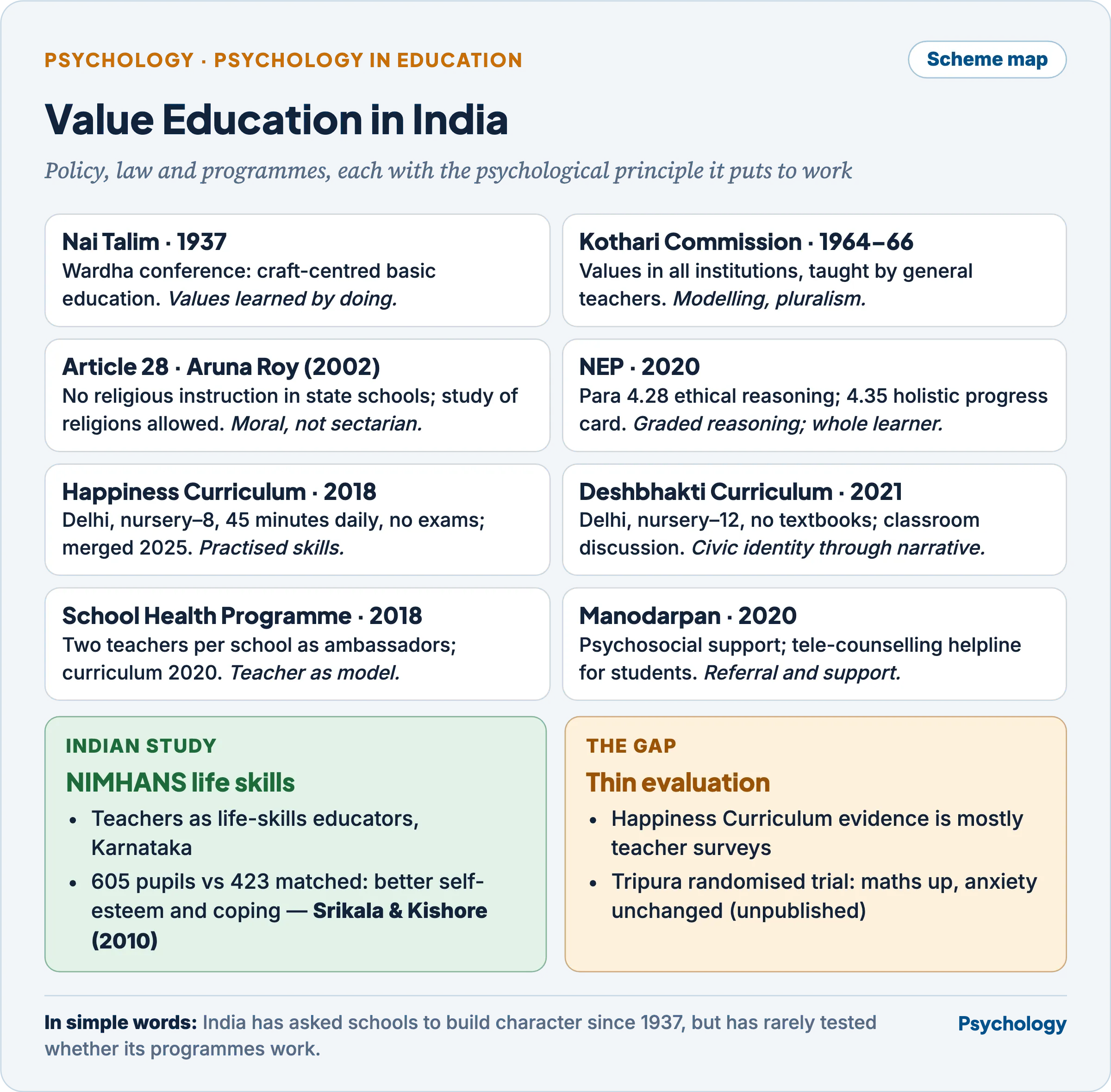
Indian policy has asked schools for value education since 1937, but few of its programmes have been tested against comparison schools.
- Nai Talim, the Wardha scheme (1937): the Wardha conference of 22–23 October 1937 endorsed Gandhi’s basic education, seven years free and compulsory in the mother tongue, centred on a productive craft.
- A committee under Zakir Husain drew up the syllabus. Principle: values such as cooperation and dignity of labour are learned by doing.
- Education Commission (Kothari Commission, 1964–66): it declined to “enumerate a list of values” (para 1.75) and asked for education in moral, social and spiritual values in all government institutions, with private ones to follow suit.
- Periods were to be taken by general teachers, preferably from different communities. Principle: modelling by ordinary teachers, and pluralism.
- Article 28(1) of the Constitution bars religious instruction in institutions wholly maintained from state funds.
- In Aruna Roy v. Union of India (2002) the Supreme Court held that studying religious philosophy and culture, as value education, is not barred. Principle: value education must be moral and civic, not sectarian.
- National Education Policy 2020 (Ministry of Education) states its purpose as good human beings “with sound ethical moorings and values”.
- Paragraph 4.28 starts with “doing what’s right” and widens to cheating, violence, plagiarism and empathy; paragraph 4.35 requires a 360-degree holistic progress card with self- and peer-assessment.
- Principle: graded ethical reasoning, and assessment of the whole learner.
- Delhi Happiness Curriculum (Department of Education, Government of NCT of Delhi, 2 July 2018): a 45-minute daily period, nursery to class 8, in 1,024 schools reaching 800,000 students (Khanna and Peterson, 2023).
- It rests on A. Nagraj’s philosophy of coexistence and uses mindfulness, stories, activities and expression, with no examinations.
- Uttarakhand adapted it as Anandam Pathyacharya in 15,000 schools; Tripura took it up in 2021 and rolled out its Saharsh version statewide in 2023.
- In March 2025 Delhi merged it, with yoga sessions and village tours, into a Science of Living programme on moral values, elder care and meditation. Principle: universal primary prevention through practised skills.
- Deshbhakti Curriculum (Government of NCT of Delhi, 28 September 2021): nursery to class 12, no textbooks, built on classroom discussion of patriotic figures and a reflective diary. Principle: civic identity through narrative and discussion.
- School Health Programme under Ayushman Bharat (Ministries of Health and Family Welfare and Human Resource Development, launched 14 April 2018; curriculum released 12 February 2020): two teachers per school act as Health and Wellness Ambassadors, one hour a week for 24 weeks.
- Its eleven themes include emotional well-being, interpersonal relationships, values and responsible citizenship, and gender equality. Principle: the teacher as model and mentor.
Previous Year Questions
- 2019There is a strong need for a wellbeing curriculum for children in schools. You are asked to develop such a curriculum. What would be the focus and essential components of such a curriculum?
- 2016Illustrate the significance of value education in schools and comment on its relevance for personality development of children.
- 2011Bring out the need of value education in personality development of students during schooling.
- 2001Explain the concept of personality and character development. Discuss the role of value education for personality and character development.
