

Official syllabusPaper II · Unit 2 · Psychological Well Being and Mental Disorders
Causal factors in mental disorders (Anxiety disorders).
Definition
“Anxiety is a future-oriented mood state in which one is ready or prepared to attempt to cope with upcoming negative events.”
Barlow (2000)
Anxiety becomes a disorder when the alarm that prepares for danger fires out of proportion to the threat, persists, and is kept alive by avoidance. No single cause accounts for it: inherited temperament, an evolved fear-learning system, threat-biased thinking and dangerous life events combine, so the causal accounts are layers of one model rather than rivals.
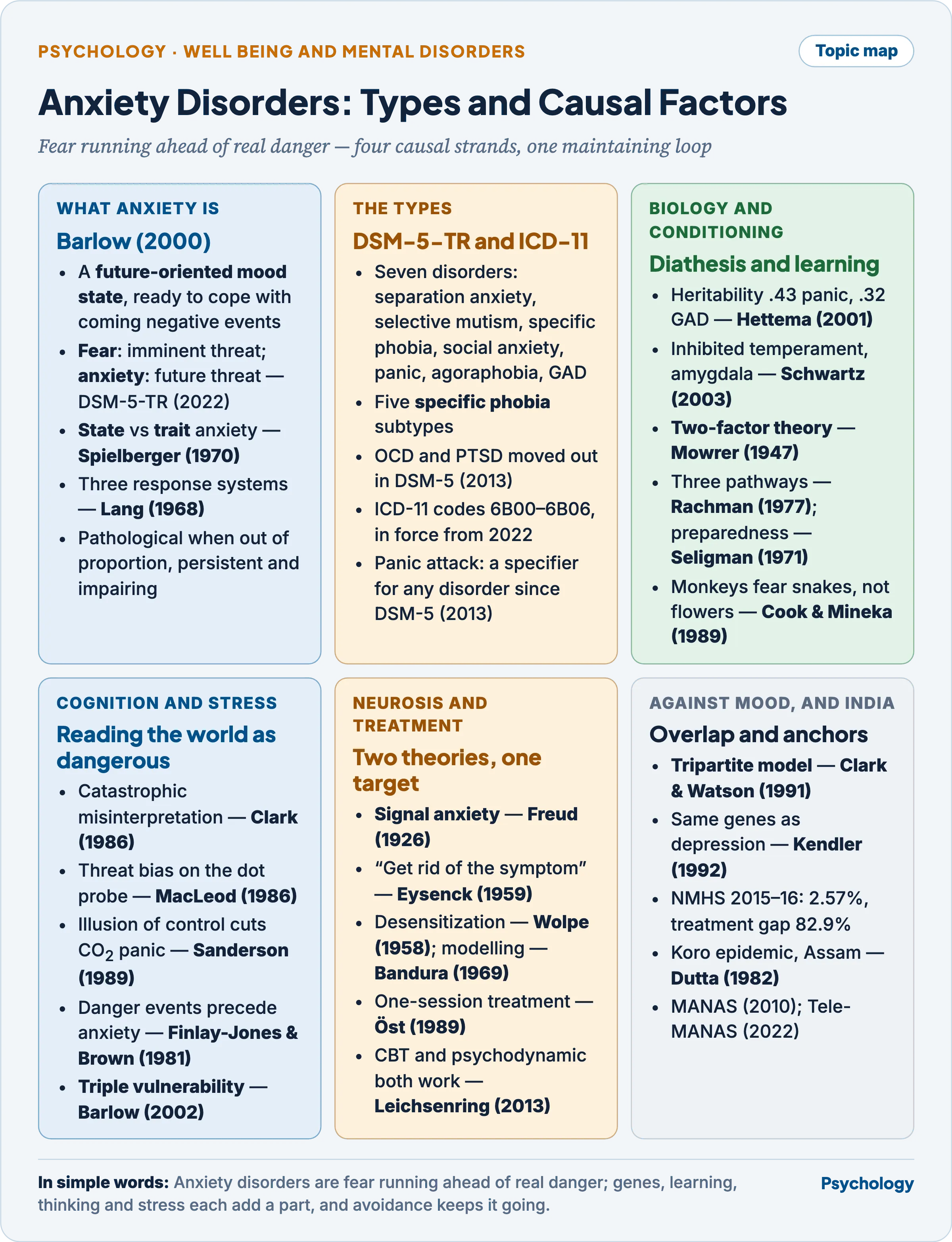
Every causal strand on the map converges on avoidance, which is exactly what the behavioural treatments set out to break.
Anxiety, fear and the anxiety disorders
- Fear and anxiety differ in time. DSM-5-TR (American Psychiatric Association, 2022): “Fear is the emotional response to real or perceived imminent threat, whereas anxiety is anticipation of future threat.” Fear surges and drives escape; anxiety brings tension, vigilance and avoidance.
- Spielberger and colleagues (1970) separated transient state anxiety from trait anxiety, a stable proneness to read situations as threatening; generalized anxiety is chiefly a disorder of trait, a phobia state anxiety tied to one cue.
- Lang (1968) described anxiety in three response systems — verbal (reported fear, worry), overt-motor (avoidance) and somatic (arousal) — which need not move together, so each is assessed separately.
- Anxiety is pathological when out of proportion to the danger, persistent (usually six months or more) and impairing. The older label neurosis covered anxiety, phobic, obsessional and hysterical states; its history is in Abnormality, Classification and the Causal Factors of Mental Disorders.
Types of anxiety disorders
- DSM-5-TR (2022) has seven principal anxiety disorders, ordered by typical age of onset; ICD-11, in effect from 1 January 2022, groups the same seven as anxiety or fear-related disorders. They differ in the focus of apprehension, the cue that triggers fear.
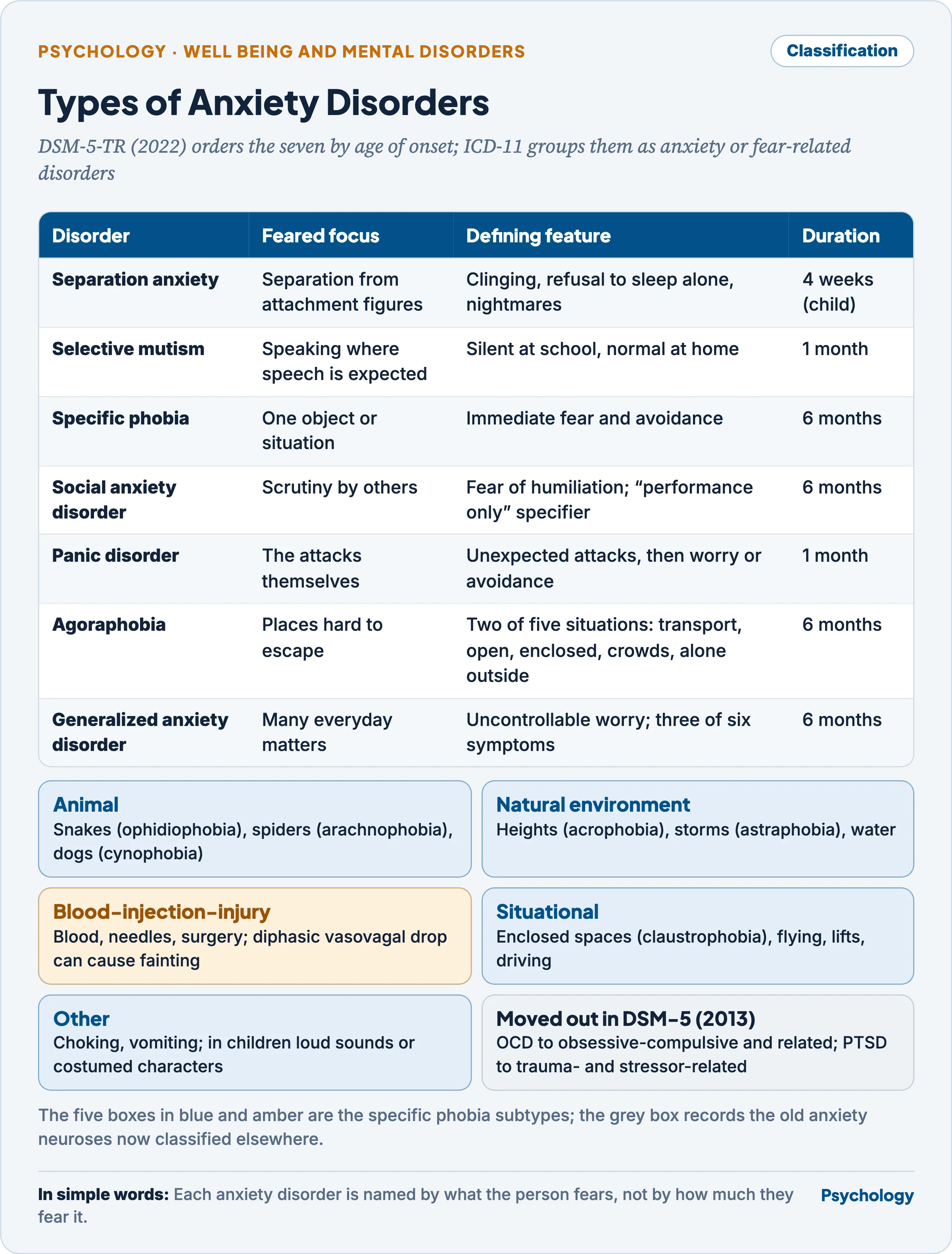
The seven differ less in how anxious the person is than in what the anxiety is about.
| Disorder | Feared focus | Defining features (DSM-5-TR) |
|---|---|---|
| Separation anxiety disorder | Separation from attachment figures | Clinging, refusal to sleep or go out alone, nightmares; four weeks in children |
| Selective mutism | Speaking where expected | Silent at school or with strangers, normal at home; one month |
| Specific phobia | One object or situation | Immediate fear and avoidance; five subtypes |
| Social anxiety disorder | Scrutiny by others | Fear of humiliating oneself; “performance only” specifier |
| Panic disorder | The attacks themselves | Unexpected attacks, then a month of worry or avoidance |
| Agoraphobia | Places hard to escape | Two of five: transport, open spaces, enclosed places, crowds, outside home alone |
| Generalized anxiety disorder | Many everyday matters | Uncontrollable worry for six months, with three of six symptoms |
- A panic attack is an abrupt surge of fear peaking within minutes, with four or more of 13 symptoms such as palpitations, breathlessness and fear of dying. DSM-5 (2013) made it a specifier for any disorder and unlinked agoraphobia from panic disorder.
Types of phobias encountered in clinical practice
- A phobia is a marked, persistent fear of a specific object or situation, out of proportion to its danger, avoided or endured with intense distress. ICD-10 (1992) grouped specific phobias, social phobia and agoraphobia as phobic anxiety disorders.
- DSM-5-TR’s five specific phobia subtypes:
- Animal — snakes (ophidiophobia), spiders (arachnophobia), dogs (cynophobia).
- Natural environment — heights (acrophobia), storms (astraphobia), water.
- Blood-injection-injury — blood, needles (trypanophobia), surgery; a diphasic vasovagal response, a brief rise then a sharp fall in heart rate and blood pressure, can cause fainting.
- Situational — enclosed spaces (claustrophobia), flying, lifts, driving.
- Other — choking, vomiting; in children, loud sounds or costumed characters.
- Social phobia may be generalised or performance only; agoraphobia often follows panic and at worst confines the person to home.
Disorders once grouped as anxiety neuroses
- DSM-5 (2013) moved obsessive-compulsive disorder and post-traumatic stress disorder into chapters of their own, and ICD-11 followed; Stein and colleagues (2014) justified the split by evidence on diagnostic validity, neurobiology and treatment.
- In OCD, compulsions are negatively reinforced by the relief they bring, on the two-factor logic set out below; Salkovskis (1985) added that normal intrusions turn obsessional when appraised as responsibility for harm; Baxter and colleagues (1987) found raised orbitofrontal and caudate metabolism by PET.
Causal factors in mental disorders: anxiety
The general models are set out in Abnormality, Classification and the Causal Factors of Mental Disorders.
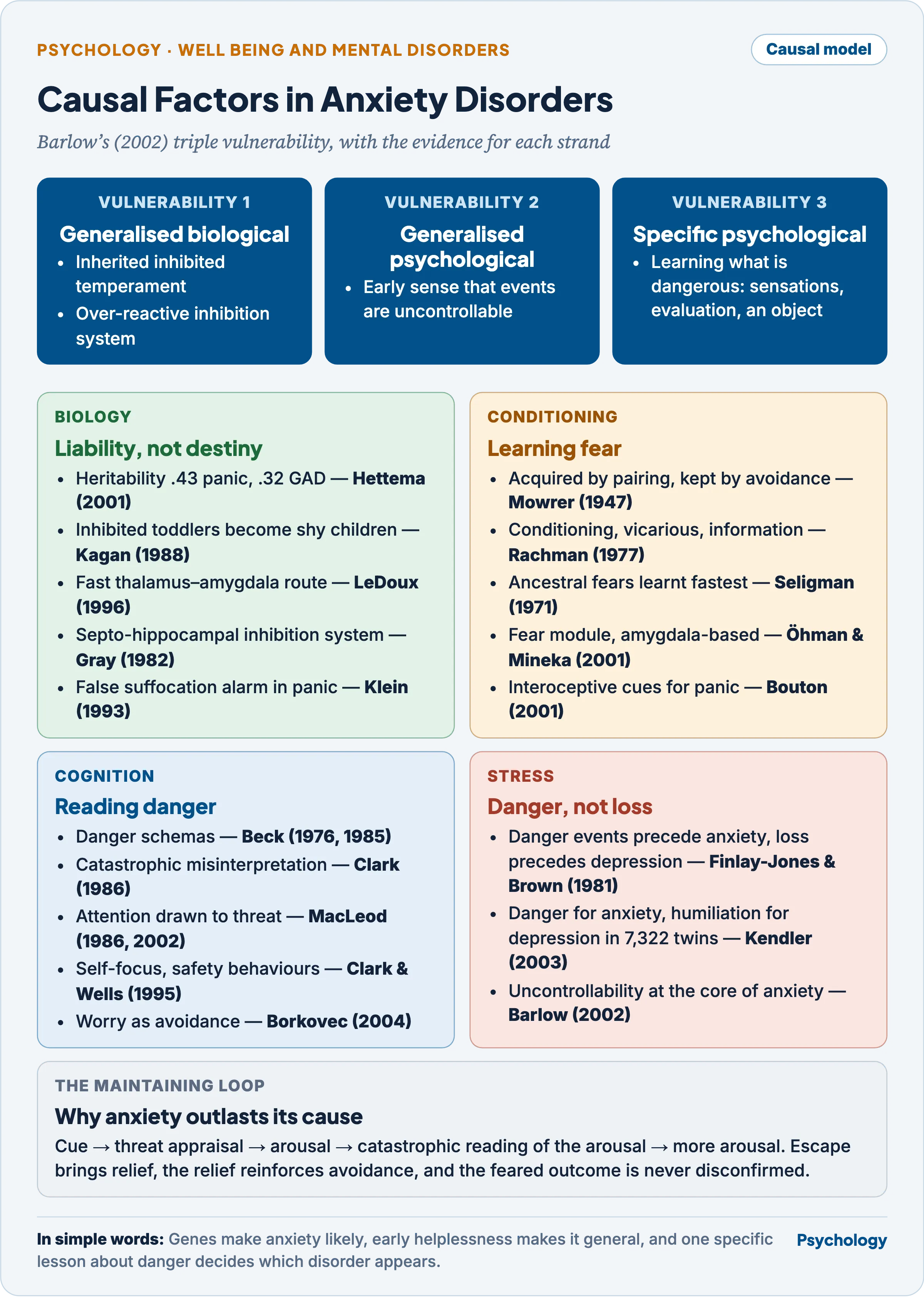
The vulnerabilities stack: temperament makes anxiety likely, uncontrollability makes it general, and one specific lesson decides which disorder appears.
Biological factors
- Hettema, Neale and Kendler (2001) meta-analysed family and twin studies: first-degree relatives have four to six times the odds; heritability is 0.43 for panic disorder, 0.32 for generalized anxiety and 0.20–0.37 for phobias. Most remaining variance is non-shared environment.
- The inherited core is a temperament, behavioural inhibition — withdrawal from the unfamiliar — followed from age two by Kagan and colleagues (1988), whose restrained toddlers were mostly shy and avoidant at seven.
- Schwartz and colleagues (2003) scanned 22 adults classified in infancy: the 13 once inhibited showed greater amygdala response to novel faces than the 9 uninhibited.
- Limitation: a tiny sample, and the difference may mark a diathesis rather than a disorder.
- LeDoux (1996) traced a fast thalamus-to-amygdala route that fires fear before the cortex identifies the stimulus; Etkin and Wager (2007) meta-analytically confirmed amygdala and insula hyperactivity in social anxiety disorder, specific phobia and PTSD.
- Gray (1982) located anxiety in a septo-hippocampal behavioural inhibition system that halts behaviour and heightens vigilance to signals of punishment and novelty.
- Neurochemistry: benzodiazepines act by enhancing GABA inhibition; serotonin reuptake inhibitors are first-line drugs, implicating serotonin; the HPA axis sustains arousal under chronic threat.
- Klein (1993) proposed a false suffocation alarm: an oversensitive carbon-dioxide monitor, which is why CO2 inhalation provokes attacks in panic patients.
- Limitation: heritability is modest and the genes non-specific, shared with depression; cross-sectional imaging cannot separate cause from consequence.
Conditioning
- Watson and Rayner (1920) supplied the model, set out in Classical Conditioning (Paper I).
- Mowrer (1947) explained persistence by two-factor theory: fear acquired by classical conditioning is maintained by operant avoidance, each escape reinforced by relief and preventing extinction — see Escape, Avoidance and Learned Helplessness (Paper I).
- Rachman (1977) showed direct conditioning is insufficient, since many phobics recall no trauma, and proposed three pathways: conditioning, vicarious observation and information. Seligman (1971) added preparedness: phobias cluster on ancestral dangers, form quickly and resist extinction.
- Cook and Mineka (1989) tested both ideas.
- Laboratory-reared rhesus monkeys watched spliced videotapes in which a model reacted fearfully to toy snakes and a crocodile, or to flowers and a toy rabbit.
- Observers acquired fear of the snakes and crocodile only: vicarious learning, restricted to fear-relevant objects.
- Limitation: an animal analogue with toy stimuli.
- Öhman and Mineka (2001) proposed an evolved fear module — selective for fear-relevant stimuli, automatic, impenetrable to reasoning, amygdala-based — which is why a phobic fears a spider known to be harmless.
- Mineka and Zinbarg (2006) argued that temperament, early learning history and post-event context decide whether conditioning yields a disorder; Bouton and colleagues (2001) added interoceptive conditioning, early arousal sensations becoming cues for panic.
Cognition
- Beck (1976) proposed content-specificity: anxiety follows thoughts of future danger, depression of past loss. Beck, Emery and Greenberg (1985) described danger schemas that overestimate harm and underestimate coping.
- Clark (1986): panic is the catastrophic misinterpretation of bodily sensations — palpitations read as a heart attack raise apprehension, which intensifies the sensations, in a vicious circle.
- Sanderson, Rapee and Barlow (1989) showed cognition moderating a biological trigger.
- 20 panic patients inhaled carbon-dioxide-enriched air, told a dial would reduce it while a light shone; it shone for half, and the dial did nothing.
- Patients without perceived control had more symptoms, catastrophic thoughts and panic attacks. Limitation: a small sample and laboratory panic.
- MacLeod, Mathews and Tata (1986) devised the dot-probe task: anxious patients, but not depressed ones, detected dots faster where threat words had been.
- Bar-Haim and colleagues (2007), across 172 studies, confirmed the bias in every anxious group, at a modest d = 0.45, and none in non-anxious people.
- MacLeod and colleagues (2002) made it causal: training attention away from threat reduced reactions to a later stressor.
- Clark and Wells (1995): social anxiety is maintained by self-focused attention, an observer’s-eye image of oneself, and safety behaviours that prevent disconfirmation.
- Borkovec and colleagues (2004): generalized worry is cognitive avoidance, damping the arousal of threatening imagery, negatively reinforced, and blocking the emotional processing extinction needs.
- Limitation: cognitions recorded during anxiety may be its products; the experimental inductions are the exception.
Stress and life events
- Finlay-Jones and Brown (1981) interviewed 164 young women at a London general practice, rating severe life events for loss and danger, with symptoms rated blind to the events.
- Severe danger came before anxiety onsets, severe loss before depression, both before mixed cases. Limitation: few cases and retrospective dating.
- Kendler and colleagues (2003) confirmed this in 7,322 twins: generalized anxiety followed danger and loss, depression loss and humiliation.
- Uncontrollability is the common thread: Barlow (2002) placed a learned sense of uncontrollability at the core of anxious apprehension, and the same event triggers disorder only in the vulnerable.
Psychodynamic factors
- Freud (1895) first saw anxiety neurosis as undischarged sexual tension transformed into anxiety.
- Freud (1926) reversed this: anxiety is the ego’s signal of a danger situation — object loss, loss of love, castration — that mobilises defence. “It was anxiety which produced repression and not, as I formerly believed, repression which produced anxiety.”
- Freud (1933) distinguished realistic, neurotic (fear of id impulses) and moral (fear of the superego) anxiety.
- A phobia displaces internal danger onto an avoidable object: Freud (1909) read Little Hans’s fear of horses as displaced fear of his father. Obsessions use reaction formation, undoing and isolation.
- Horney (1945) moved the source of neurosis into relationships: basic anxiety, “the feeling a child has of being isolated and helpless in a potentially hostile world”, defended against by compulsively moving towards, against or away from people.
- Limitation: the constructs are hard to test, and the evidence long rested on single cases.
An integrative account: triple vulnerability
- Barlow’s (2002) triple vulnerability theory: a generalised biological vulnerability (inhibited temperament), a generalised psychological vulnerability (an early sense that events are uncontrollable) and a specific psychological vulnerability (learning what is dangerous — sensations, evaluation, an object).
- The first two suffice for generalized anxiety; a focal disorder needs the third.
Psychological and behaviouristic theories of neurosis compared
| Dimension | Psychodynamic (Freud, 1926) | Behaviouristic (Wolpe, 1958; Eysenck, 1959) |
|---|---|---|
| Symptom | Defence against unconscious conflict | Learned maladaptive habit |
| Anxiety | Signal driving defence | Conditioned response driving avoidance |
| Origin | Childhood conflict | Conditioning, observation, information |
| Therapy target | Insight, working through | The symptom itself |
| Symptom removed alone | Substitution expected | Lasting cure |
| Early evidence | Case studies | Experiments, controlled trials |
- Eysenck (1959): “there is no neurosis underlying the symptom, but merely the symptom itself. Get rid of the symptom and you have eliminated the neurosis.”
- Wolpe and Rachman (1960) reread Little Hans: the phobia followed his seeing a horse fall, an episode Freud recorded, and the data came from a father committed to Freud’s theory.
- Kazdin (1982) recast symptom substitution, hard to define and test, as response covariation; reviews find little evidence of substitution (Tryon, 2008).
- The behaviourist account has its own gaps: conditioning cannot explain phobias without trauma or the selectivity of fears (Rachman, 1977; Seligman, 1971), which pushed behaviour therapy towards cognition.
- Dollard and Miller (1950) translated neurosis into learning terms: fear as a learned drive, conflict as approach–avoidance, repression as a learned habit of not thinking, reinforced by fear reduction.
Are the therapies inclusive of each other?
- Both target avoidance — of feelings and memories, or of objects and situations. Stampfl and Levis (1967) wrote psychodynamic themes into the imagery of implosive therapy; Wachtel (1977) joined the two in cyclical psychodynamics, where avoidance keeps evoking reactions that confirm early conflicts.
- Milrod and colleagues (2007), in a trial of 49 panic patients, found response in 73 per cent with panic-focused psychodynamic psychotherapy against 39 per cent with applied relaxation.
- Leichsenring and colleagues (2013), randomising 495 social anxiety patients, found remission of 36 per cent with CBT, 26 per cent with psychodynamic therapy and 9 per cent on a waiting list.
- The theories conflict over what a symptom is, but the therapies are partly complementary, exposure being the better-evidenced first line; see Psychotherapy: Effectiveness, Common Factors and Eclecticism (Unit 3).
Behavioural treatment of anxiety and phobic disorders
- All rest on exposure without escape, so the feared outcome fails to occur. Craske and colleagues (2014) recast it as inhibitory learning: a new safety association competing with the old fear, strengthened by violating expectancies, varying contexts and dropping safety behaviours.
- Systematic desensitization (Wolpe, 1958): progressive muscle relaxation (Jacobson, 1938), an anxiety hierarchy graded in subjective units of distress, and imagined exposure step by step while relaxed — reciprocal inhibition; see Systematic Desensitization and Exposure Therapies (Unit 3).
- A hierarchy for a dog phobia, in subjective units of distress: reading the word “dog” (10); a photograph (25); a dog across the road (45); a leashed dog a metre away (65); stroking it (90). Each step is repeated until calm.
- Paul (1966): 86 per cent of the desensitization group were much improved against 20 per cent with insight therapy, also outperforming attention-placebo.
- Design: 96 speech-anxious students, the most anxious of 710, assigned to desensitization, insight therapy, attention-placebo or control groups, with behavioural, physiological and self-report measures. Limitation: an analogue sample and brief insight therapy.
- In vivo exposure grades the real object upward; flooding starts at the top and holds the person there; implosion floods in exaggerated imagery.
- Bandura, Blanchard and Ritter (1969): among 48 snake-phobic people, live modelling with guided participation outperformed symbolic modelling and desensitization.
- Öst (1989): one-session treatment, exposure with modelling averaging 2.1 hours, left 90 per cent of 20 patients much improved or recovered at four years — an uncontrolled series.
- Applied tension (Öst and Sterner, 1987) counters the blood-pressure drop of blood-injection-injury phobia, preventing fainting.
- By disorder: social anxiety — exposure while dropping safety behaviours (Wells and colleagues, 1995); panic — interoceptive exposure to feared sensations; agoraphobia — graded in vivo exposure to avoided places, first accompanied, then alone.
- Generalized anxiety — worry exposure and applied relaxation; OCD — exposure and response prevention; children — graded exposure with modelling and parental reinforcement.
- Limitation: fear can return by renewal in a new context or spontaneous recovery (Craske and colleagues, 2014).
Distinguishing anxiety from mood disorders
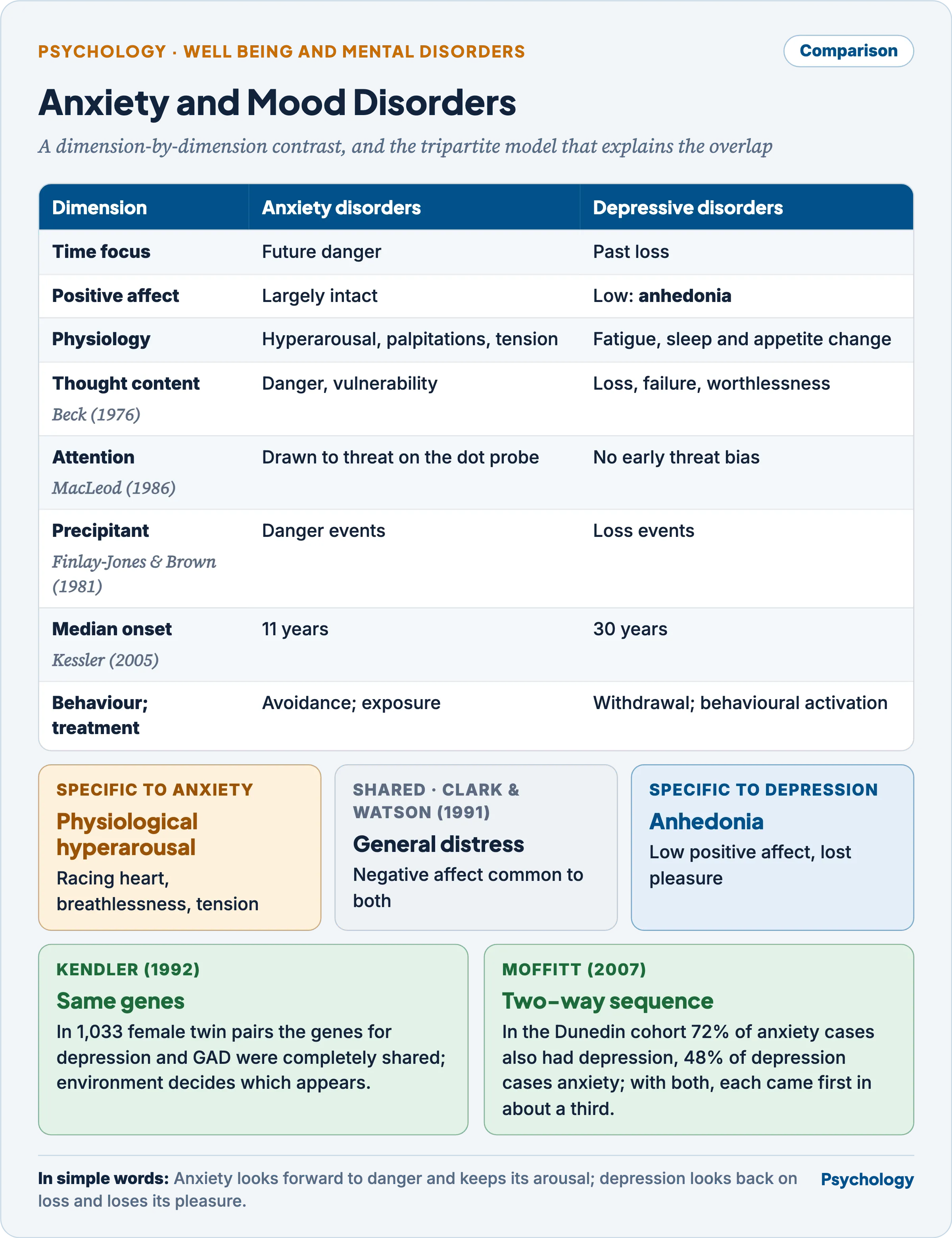
The two share a core of distress; arousal marks one side and lost pleasure the other.
| Dimension | Anxiety disorders | Depressive disorders |
|---|---|---|
| Time focus | Future danger | Past loss |
| Positive affect | Intact | Low (anhedonia) |
| Physiology | Hyperarousal | Fatigue, sleep and appetite change |
| Thought content (Beck, 1976) | Danger | Loss, failure |
| Attention (MacLeod and colleagues, 1986) | Vigilance to threat | No dot-probe bias |
| Precipitant (Finlay-Jones and Brown, 1981) | Danger events | Loss events |
| Median onset (Kessler and colleagues, 2005) | 11 years | 30 years |
| Behaviour; treatment | Avoidance; exposure | Withdrawal; behavioural activation |
- Clark and Watson (1991) proposed the tripartite model: both share general distress; physiological hyperarousal is specific to anxiety, anhedonia to depression.
- Kendler and colleagues (1992), in 1,033 female twin pairs, found the genes for major depression and generalized anxiety completely shared; environment decides which appears.
- Moffitt and colleagues (2007), following the Dunedin cohort to 32, found 72 per cent of lifetime anxiety (GAD) cases also had depression, 48 per cent of depression cases anxiety; in adult comorbidity each came first in about a third.
- ICD-11 has mixed depressive and anxiety disorder, DSM-5-TR an anxious distress specifier; depression itself is in Mood Disorders: Depression and Bipolar Disorder.
Criticisms and limitations
- Porous categories: shared genes and two-way sequencing suggest one distress dimension cut into categories; the DSM-5 regrouping of OCD and PTSD remains contested.
- Partial causal accounts: heritability leaves most variance environmental (Hettema and colleagues, 2001); conditioning misses phobias without trauma (Rachman, 1977); catastrophic thoughts are recorded during the anxiety they supposedly cause; psychodynamic constructs resist test (Eysenck, 1959).
- Analogue evidence: monkeys (Cook and Mineka, 1989), students (Paul, 1966) and small laboratory samples carry much of the case.
- Cultural validity: anxiety is often voiced somatically and in local idioms that Western criteria miss; the koro epidemic (Dutta and colleagues, 1982) is the Indian case.
Indian context
- National Mental Health Survey 2015–16 (NIMHANS; 34,802 adults, 12 states): Manjunatha and colleagues (2022) report current anxiety-disorder prevalence of 2.57 per cent — 3.01 in women, 1.8 in men — and a treatment gap of 82.9 per cent.
- Agoraphobia was commonest (1.6 per cent); risk peaked at ages 40–59 and in urban metros. Specific phobia was not assessed, so the figure is an underestimate (Manjunatha and colleagues, 2022).
- NMHS-2, fielded from October 2024 among adults and adolescents in all 36 states and union territories, will update it (Rao and colleagues, 2026).
- Dutta, Phookan and Das (1982) documented a koro epidemic — acute panic about genital retraction — across four districts of lower Assam, June to September 1982.
- Of 83 cases, 72 per cent had heard of or seen a case in the preceding three days; anxiety came first, genital symptoms after (Dutta and colleagues, 1982).
- It ended after mass reassurance: Rachman’s information pathway and Clark’s catastrophic misinterpretation at population scale. Chakraborty (1983) tied its West Bengal phase to tension over land and migration. Limitation: an uncontrolled series.
- Patel and colleagues (2010), in the MANAS trial, randomised 24 Goa primary care facilities to lay counsellor-led stepped care or enhanced usual care for 2,796 adults screening positive for depressive and anxiety disorders.
- Public health centres: 65.9 per cent recovered at six months against 42.5 per cent; private clinics, no difference (Patel and colleagues, 2010). The principle is task-sharing.
- District Mental Health Programme (Ministry of Health and Family Welfare, 1996; 767 districts) — general physicians trained to detect and treat common mental disorders; operationalises decentralised primary care.
- Tele-MANAS (Ministry of Health and Family Welfare, 10 October 2022; helpline 14416; over 47 lakh calls by October 2026) — operationalises low-threshold help-seeking: an anonymous call lowers the evaluative cost that keeps anxious people from clinics.
Previous Year Questions
- 2026How do psychologists explain the causes of anxiety disorder?
- 2022Describe the instrumental role of biology, conditioning, cognition and stress in developing anxiety disorder.
- 2021Describe the different types of anxiety disorders. What are the behavioural approaches to treat such patients?
- 2014How will you distinguish between anxiety and mood disorders?
- 2010Enumerate the different types of phobias encountered in clinical practice. Explain the application of behaviour therapy in handling these phobic disorders.
- 1995Evaluate the psychological and behaviouristic theories of neurosis. Do you think the therapies suggested by both the groups are inclusive of each other?