

Official syllabusPaper II · Unit 2 · Psychological Well Being and Mental Disorders
Causal factors in mental disorders – abnormality, classification and causal models.
Definition
“A disorder is a harmful dysfunction, wherein harmful is a value term based on social norms, and dysfunction is a scientific term referring to the failure of a mental mechanism to perform a natural function for which it was designed by evolution.”
Wakefield (1992)
Calling behaviour abnormal is a judgement before it is a diagnosis: it joins a factual claim that something in the person has failed to a value claim that the failure does harm. Classification turns that judgement into categories clinicians can agree on, and the causal models explain why the failure arises.
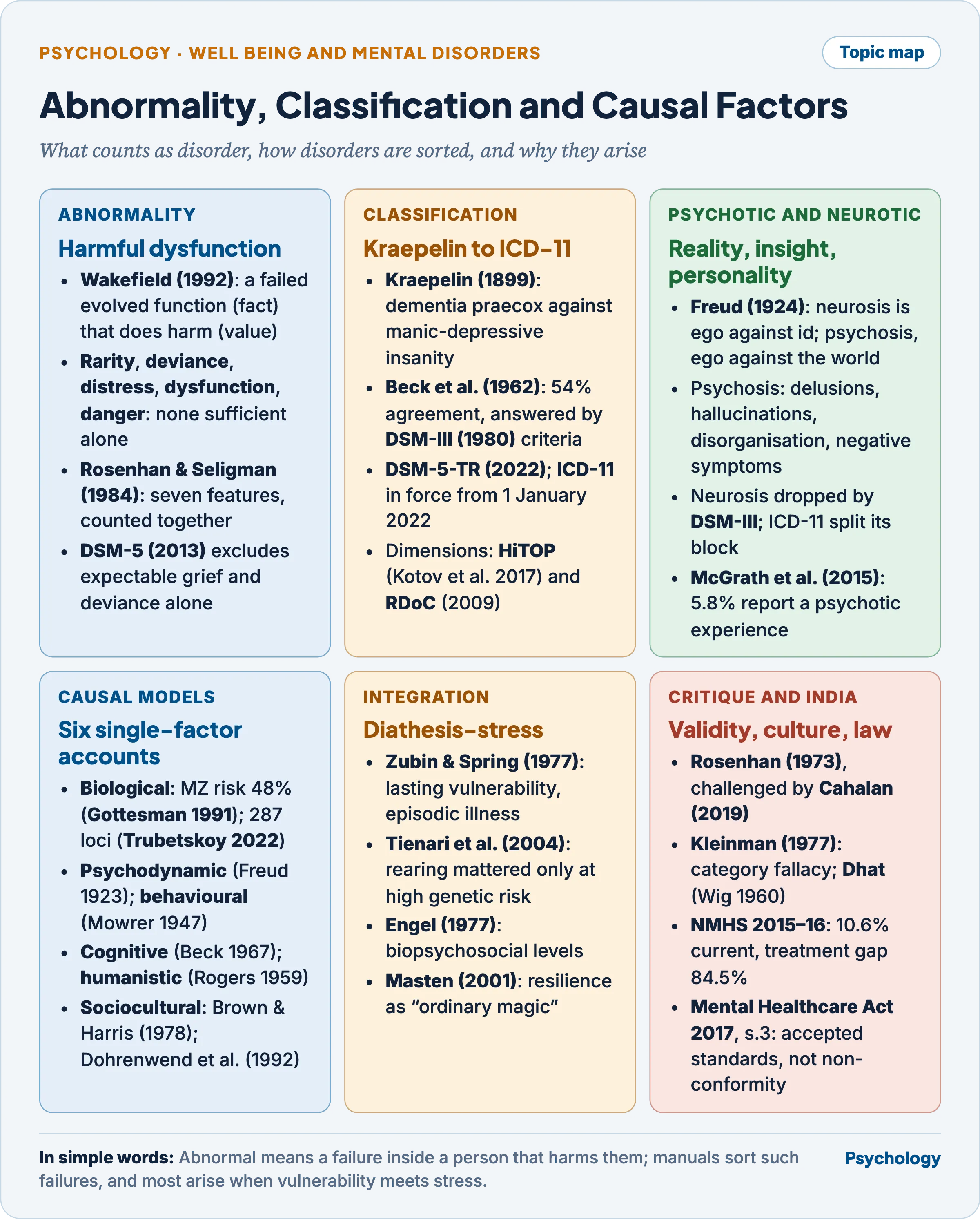
Each stage inherits the weakness of the one before: who is counted decides what is classified, and that decides what the models must explain.
Abnormality: criteria for labelling behaviour abnormal
- Statistical rarity — far from the population mean. Objection: exceptional intelligence is rare and desirable, and a common condition is not normal for being common.
- Social deviance — breaking a society’s rules. Objection: norms vary and change; the American Psychiatric Association removed homosexuality as a diagnosis only in 1973, and Cartwright (1851) coined “drapetomania” for enslaved people who ran away.
- Personal distress. Objection: antisocial personality disorder and mania carry little distress, while bereavement brings distress that is normal.
- Maladaptiveness or dysfunction — impaired work, relationships or self-care. Objection: the standard of adequate functioning is itself social.
- Danger to self or others. Objection: Teplin and colleagues (2005) found over a quarter of 936 Chicago patients with severe mental illness had been victims of violent crime in a year, over eleven times the general-population rate.
- Rosenhan and Seligman (1984) listed seven features: suffering, maladaptiveness, vividness and unconventionality, unpredictability and loss of control, irrationality and incomprehensibility, observer discomfort, and violation of moral and ideal standards. The more present, the firmer the judgement.
- Jahoda (1958) defined positive mental health instead — see Health, Ill-Health, Positive Health and Well-Being.
- The four Ds (deviance, distress, dysfunction, danger) inherit these objections.
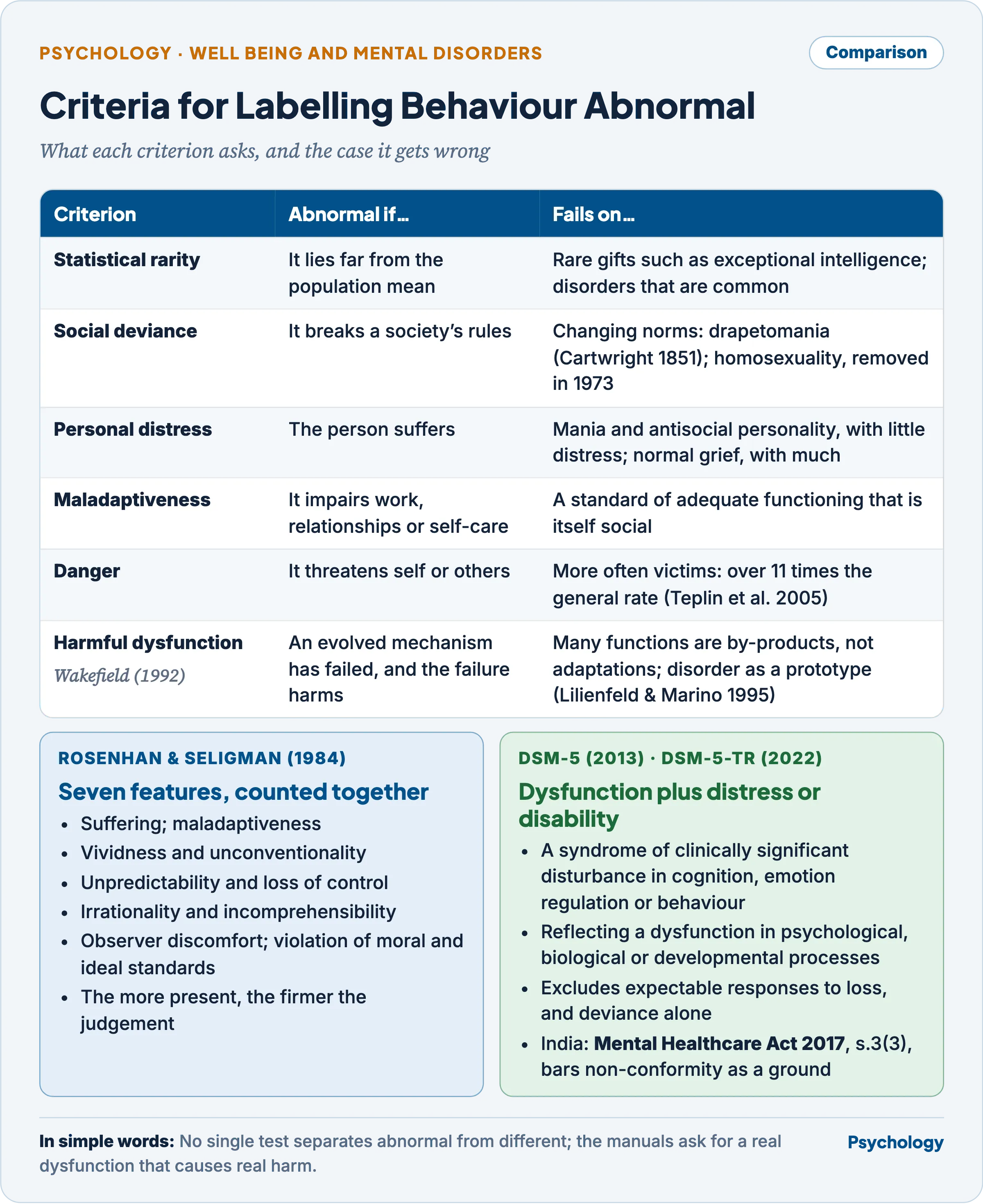
Every criterion fails on a case another one catches, which is why no manual relies on any one of them.
Harmful dysfunction and the DSM-5 definition
- Wakefield’s dysfunction is a mechanism failing to do what natural selection designed it to do, a fact; harm is judged by social standards, a value; both are required.
- Grief is not a disorder because nothing has failed; drapetomania was a misdiagnosis because it named harm without dysfunction.
- Objection: Lilienfeld and Marino (1995) argued that many mental functions are by-products rather than adaptations, many disorders are adaptive reactions to danger or loss, and “disorder” is a prototype concept with fuzzy boundaries.
- DSM-5 (2013), kept in DSM-5-TR (2022), defines a mental disorder as a syndrome of clinically significant disturbance in cognition, emotion regulation or behaviour reflecting a dysfunction in psychological, biological or developmental processes, usually with distress or disability.
- It excludes expectable responses to loss, and socially deviant behaviour unless it results from a dysfunction — Wakefield’s logic in the manual.
Classification and nosological systems
From Kraepelin to DSM-5-TR and ICD-11
- Classification serves communication, prognosis, treatment choice and research. It needs reliability (clinicians agree) before it can have validity (the category marks a real entity).
- Early systems sorted by cause: the Charaka Saṃhitā divides unmāda into four endogenous (nija) types from the doṣas and one exogenous (āgantu) type.
- Kraepelin (1899), in his textbook’s sixth edition, split the endogenous psychoses by course and outcome into dementia praecox (chronic, deteriorating) and manic-depressive insanity (episodic, remitting). Bleuler (1911) renamed the first schizophrenia.
- The International Classification of Diseases (World Health Organization): ICD-10 (1992) placed mental disorders in Chapter V; ICD-11 was adopted on 25 May 2019 and took effect on 1 January 2022; its clinical guidelines followed in 2024.
- The Diagnostic and Statistical Manual (American Psychiatric Association):
- DSM-I (1952) and DSM-II (1968) gave brief psychoanalytic descriptions; DSM-III (1980), led by Spitzer (1980), brought explicit criteria, an atheoretical stance, five axes and field trials, refined in DSM-III-R (1987), DSM-IV (1994) and DSM-IV-TR (2000).
- DSM-5 (2013) dropped the axes; DSM-5-TR (2022) revised the text and added prolonged grief disorder.
- DSM-5-TR orders its 20 disorder chapters along the lifespan, from neurodevelopmental and schizophrenia spectrum disorders to neurocognitive and personality disorders; ICD-11 has 21 groupings.
Reliability as the driver of DSM-III
- Beck and colleagues (1962): paired psychiatrists diagnosing 153 patients agreed on the specific diagnosis in only 54 per cent.
- The US–UK Diagnostic Project (Cooper and colleagues, 1972) found New York psychiatrists diagnosed schizophrenia about twice as readily as London ones: the concept differed, not the patients.
- DSM-III’s operational criteria descended from the Feighner criteria (1972) and Research Diagnostic Criteria (1978).
- Reliability remains uneven: in the DSM-5 field trials (Regier and colleagues, 2013) kappa was 0.67 for PTSD, 0.46 for schizophrenia, 0.28 for major depressive disorder and 0.20 for generalized anxiety disorder.
Categorical and dimensional models
- A categorical model asks whether a disorder is present or absent. It suits clinical decisions but yields comorbidity, heterogeneity within categories and arbitrary thresholds.
- A dimensional model places everyone on continua shared with normality.
- ICD-11 replaced ICD-10’s eight specific personality disorder types with one disorder graded mild, moderate or severe, plus five trait domains (negative affectivity, detachment, dissociality, disinhibition, anankastia) and an optional borderline pattern qualifier.
- HiTOP (Kotov and colleagues, 2017) builds a hierarchy from how symptoms co-vary: syndromes form six spectra — internalizing, thought disorder, disinhibited externalizing, antagonistic externalizing, detachment and somatoform — under a general p factor. Comorbidity becomes data.
- RDoC (US NIMH, 2009) is a research framework: functional domains such as negative and positive valence, cognitive systems and social processes, studied from genes and circuits to behaviour.
- Insel (2013), NIMH’s director, granted DSM its reliability: “The weakness is its lack of validity.”
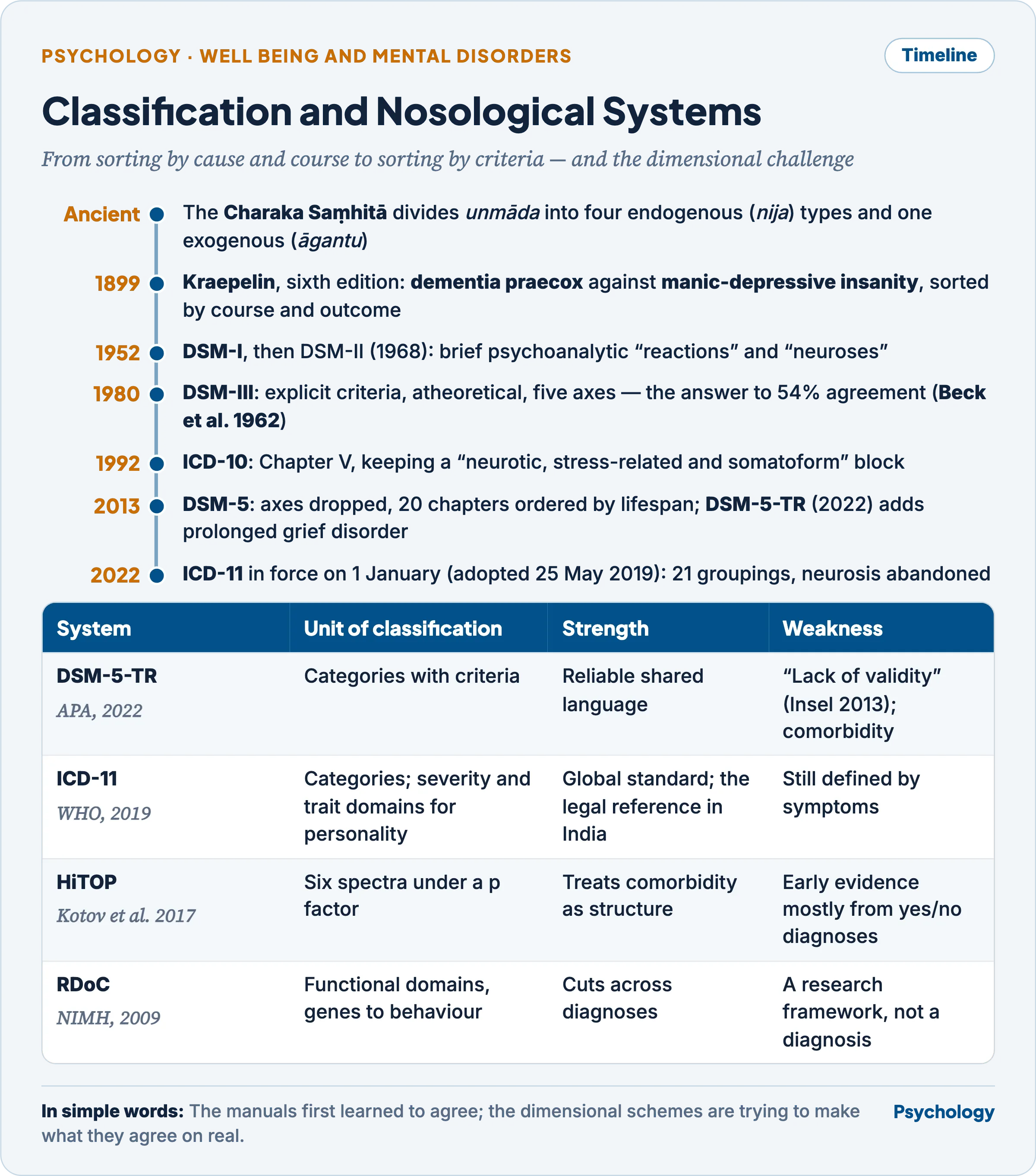
Each system answers its predecessor’s failure: DSM-III repaired reliability, and the dimensional systems are attempts to repair validity.
Critique of classification: labelling, Rosenhan and cultural validity
- Rosenhan (1973), “On being sane in insane places”:
- Eight sane people, reporting a voice saying “empty”, “hollow”, “thud”, were admitted to 12 US hospitals, then behaved normally.
- Eleven of twelve admissions were diagnosed schizophrenia; stays averaged 19 days, ending in “schizophrenia in remission”. Warned of impostors, a hospital flagged 41 of 193 genuine patients.
- Limitation: Spitzer (1975) replied that admitting someone who convincingly fakes a symptom is sound practice, not misdiagnosis. Cahalan (2019) found Rosenhan’s own record described a graver presentation and traced only two other pseudopatients; Scull (2023) called it scientific fraud.
- Labelling: Scheff (1966) argued that a label creates the role it names; Szasz (1961) called mental illness a myth that medicalises “problems in living”. Yet labels also open treatment and legal rights.
- Medicalisation: Cacciatore and Frances (2022) argued that prolonged grief disorder turns normal grief into illness on thin evidence.
- Cultural validity: Kleinman (1977) named the category fallacy — applying a category where the culture gives it no coherence.
- Dhat syndrome, named by Wig (1960): weakness, anxiety and sexual complaints attributed to loss of semen, the most precious dhātu; ICD-10 coded it F48.8, DSM-5 lists it among cultural concepts of distress.
- Sumathipala, Siribaddana and Bhugra (2004) traced the same anxiety in nineteenth-century Western writing: culture-shaped rather than culture-bound.
- ICD-11’s possession trance disorder excludes accepted religious practice, and DSM-5 added a Cultural Formulation Interview.
Psychotic and neurotic reactions
Prominent symptoms of psychosis
- Psychosis is loss of contact with reality. DSM-5 defines its domains as delusions, hallucinations, disorganized thinking, grossly disorganized or abnormal motor behaviour (including catatonia) and negative symptoms such as avolition.
- Typical forms: persecutory, referential and grandiose delusions; voices commenting on the person; derailment and neologisms; stupor and waxy flexibility; flat affect and alogia.
- With them go absent insight, failed reality testing and social breakdown.
- The classical grouping: organic psychoses with a brain cause (delirium, dementia, toxic states) and functional psychoses without one — Kraepelin’s two.
The classical distinction
- Cullen (1769) coined “neurosis” for nervous disease without a lesion; Feuchtersleben (1845) popularised “psychosis”.
- Freud (1924): “neurosis is the result of a conflict between the ego and its id, whereas psychosis is the analogous outcome of a similar disturbance in the relations between the ego and the external world.”
| Dimension | Neurotic reactions | Psychotic reactions |
|---|---|---|
| Contact with reality | Retained; reality testing intact | Lost; delusions, hallucinations |
| Insight | Present; help is sought | Usually absent |
| Personality | Integrated; efficiency reduced | Disorganised thought and conduct |
| Social functioning | Strained but sustained | Often breaks down; admission likely |
| Freud’s (1924) locus | Ego against id | Ego against external world |
| Old examples | Anxiety, phobic, obsessional, hysterical, depressive neuroses | Schizophrenia, manic-depressive and paranoid psychoses |
| Current home | Anxiety, obsessive-compulsive, dissociative, bodily distress, persistent depressive disorders | Schizophrenia spectrum and other psychotic disorders; bipolar I with psychotic features |
Why both terms left the manuals
- DSM-III (1980) dropped neurosis as a class because it implied an unproven psychoanalytic cause, keeping old labels in parentheses (“Dysthymic Disorder (or Depressive Neurosis)”); they survived DSM-III-R (1987) and went in DSM-IV (1994).
- ICD-11 split ICD-10’s “neurotic, stress-related and somatoform disorders” into five groupings, abandoning the concept.
- “Psychotic” survives as a description, not a class: “schizophrenia spectrum and other psychotic disorders” and “with psychotic features”. Manic-depressive psychosis is now bipolar I disorder.
- Objections to the dichotomy:
- Insight is graded; DSM-5 obsessive-compulsive disorder can be specified “with absent insight/delusional beliefs”.
- McGrath and colleagues (2015) found 5.8 per cent of 31,261 adults in 18 countries had had a psychotic experience without a psychotic disorder: psychosis is continuous with normality.
- Severity does not follow the line; neuroticism survives as a trait (Trait and Type Approaches to Personality, Paper I).
Causal factors in mental disorders: the causal models
- Causes are necessary, sufficient or contributory; mental disorders mostly have contributory causes acting as predisposing, precipitating or perpetuating factors. In delirium, a frail elderly brain (predisposing) becomes confused after an infection or drug (precipitating).
- Cicchetti and Rogosch (1996): equifinality (many routes to one disorder) and multifinality (one risk, many outcomes).
Biological factors
- Genetic factors.
- Gottesman (1991) put lifetime schizophrenia risk at 1 per cent generally, 9 in siblings, 17 in dizygotic co-twins, 46 in children of two affected parents and 48 per cent in monozygotic co-twins.
- Heritability: schizophrenia 81 per cent (Sullivan, Kendler and Neale, 2003), bipolar disorder 85 per cent (McGuffin and colleagues, 2003), major depression 37 per cent (Sullivan, Neale and Kendler, 2000).
- Kety and colleagues (1968) found schizophrenia-related illness raised in the biological, not adoptive, relatives of Danish adoptees with schizophrenia.
- Trubetskoy and colleagues (2022) found 287 loci in 76,755 people with schizophrenia and 243,649 controls, each of tiny effect: the disorder is polygenic.
- Endophenotypes (Gottesman and Gould, 2003): measurable traits between gene and diagnosis — heritable, present when the person is well, commoner in unaffected relatives — such as eye-tracking dysfunction in schizophrenia.
- Neurochemical factors.
- Antipsychotic potency tracks dopamine D2 blockade (Creese, Burt and Snyder, 1976), and dopamine-releasing amphetamine mimics paranoid psychosis (Connell, 1958); Kapur (2003) recast excess dopamine as aberrant salience, in which trivial events feel significant.
- The catecholamine hypothesis of depression (Schildkraut, 1965) and the GABA account of anxiety were inferred mainly from drug action.
- Watson and colleagues (2004) found an exaggerated cortisol response to the dexamethasone/CRH test in 53 bipolar patients, remitted or not — HPA-axis dysregulation as a possible trait; the design was cross-sectional.
- Brain structure and neurodevelopment.
- Johnstone and colleagues (1976) showed by CT enlarged ventricles in 17 chronic schizophrenic inpatients, tied to cognitive impairment.
- Second-trimester exposure to the 1957 Helsinki influenza epidemic raised later schizophrenia risk (Mednick and colleagues, 1988), as did early gestation in the Dutch Hunger Winter (Susser and colleagues, 1996).
- Organic causes: Noguchi and Moore (1913) found the syphilis organism in the brains of patients with general paresis, the model of a psychosis with a known cause.
Psychodynamic model
- Freud (1923): conflict among id, ego and superego produces anxiety; defences such as repression contain it; symptoms are compromise formations, and fixation predisposes to regression under stress.
- Freud (1909) traced Little Hans’s horse phobia to displaced fear of his father; Freud (1917) read melancholia as loss turned inward as self-reproach.
- Objection: retrospective case material resists falsification, and Wolpe and Rachman (1960) reread Little Hans as conditioned fear after he saw a horse fall — see Psychodynamic Therapies (Unit 3).
Behavioural model
- Disorder is learned by the laws governing normal behaviour.
- Mowrer (1947): fear acquired by classical conditioning is maintained by operant avoidance, which blocks extinction.
- Seligman (1971): preparedness — snake and height fears condition far more readily than fears of sockets.
- Mineka and colleagues (1984): laboratory-reared rhesus monkeys acquired lasting snake fear merely by watching wild-reared monkeys react.
- Lewinsohn (1974): depression follows a low rate of response-contingent positive reinforcement.
- Objection: many phobic people recall no conditioning event, so Rachman (1977) added vicarious and informational pathways — see Classical Conditioning and Escape, Avoidance and Learned Helplessness (Paper I).
Cognitive model
- Disorder follows from how events are interpreted.
- Ellis (1962): an activating event produces an emotional consequence through an irrational belief.
- Beck (1967): the cognitive triad (negative views of self, world and future), negative schemas, and errors such as overgeneralisation.
- Abramson, Seligman and Teasdale (1978): explaining bad events by internal, stable, global causes predisposes to depression.
- Alloy and colleagues (2006) followed 347 non-depressed students for 2.5 years; those with negative cognitive styles had 3.5 to 6.8 times the odds of depression.
- Objection: negative cognition may be a “scar” of depression rather than its cause — see Cognitive Therapies: Beck and Cognitive-Behavioural Therapy (Unit 3).
Humanistic-existential model
- Rogers (1959): conditions of worth create incongruence between self-concept and experience, and denied experience produces anxiety.
- Maslow (1954) saw disorder in blocked growth; Yalom (1980) in failed confrontation with death, freedom, isolation and meaninglessness.
- Objection: the concepts resist measurement and fit problems in living better than psychosis — see Client-Centred Therapy (Unit 3).
Sociocultural model
- Hollingshead and Redlich (1958) found schizophrenia concentrated in New Haven’s lowest social class.
- Dohrenwend and colleagues (1992), studying 4,914 young Israelis, found social selection (downward drift) better explained schizophrenia, and social causation (adversity) depression in women and antisocial and substance disorders in men.
- Brown and Harris (1978): severe life events (provoking agents) caused depression in Camberwell women mainly with vulnerability factors — no confiding relationship, three or more children under 14 at home, no outside job, mother lost before 11.
- Family expressed emotion — criticism, hostility, over-involvement — predicts schizophrenic relapse (Brown, Birley and Wing, 1972).
- Objection: illness also lowers income, and social factors cannot say who among the equally deprived falls ill.
Integrative models: diathesis-stress, biopsychosocial and vulnerability–resilience
- Diathesis-stress: a predisposition (diathesis) produces disorder only when stress exceeds the person’s threshold. Meehl (1962) proposed an inherited schizotaxia that becomes schizophrenia only under adverse learning.
- Zubin and Spring (1977) made vulnerability an enduring trait and episodes time-limited: “each of us is endowed with a degree of vulnerability that, under suitable circumstances, will express itself in an episode of schizophrenic illness.”
- Tienari and colleagues (2004) followed 303 Finnish adoptees for 21 years; dysfunctional adoptive rearing predicted schizophrenia-spectrum disorder only in the 145 at high genetic risk (odds ratio 10.0, against 1.11 at low risk).
- Limitation: rearing was rated once, years into the adoption.
- Caspi and colleagues (2003) reported that the serotonin-transporter short allele magnified the effect of stress on depression; Border and colleagues (2019), with samples up to 443,264, found no such interaction.
- Biopsychosocial: Engel (1977) argued that the biomedical model “leaves no room within its framework for the social, psychological, and behavioral dimensions of illness”.
- Vulnerability–resilience: secure attachment, problem-solving and social support buffer risk; Masten (2001) called resilience “ordinary magic” — see Prevention and Rehabilitation of the Mentally Ill (Unit 3).
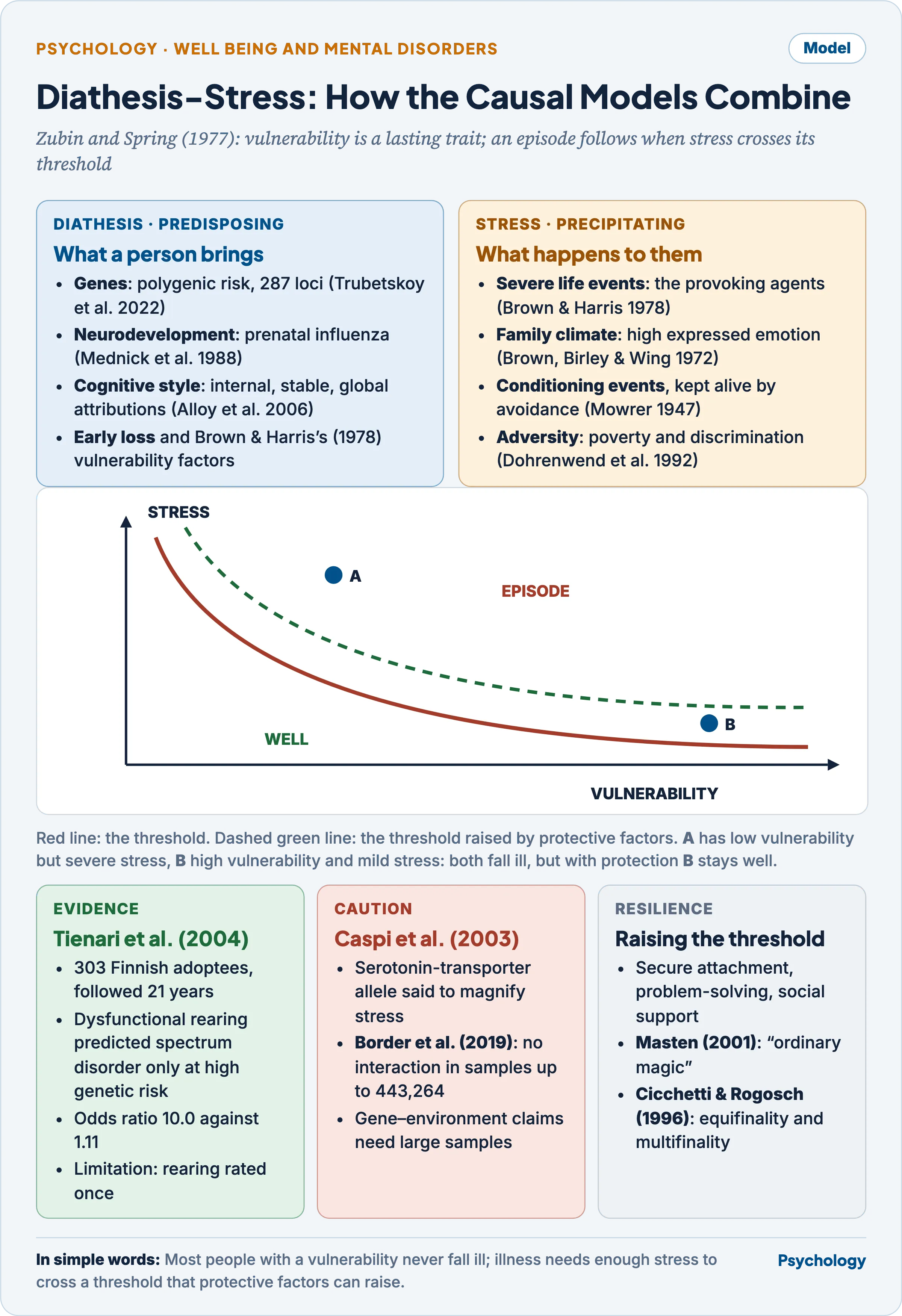
Every single-factor model reappears inside the diathesis-stress frame, as either a diathesis or a stressor.
Criticisms and limitations
- Biological explanation:
- Reasoning from drug action runs backwards; Moncrieff and colleagues (2022), in an umbrella review, found no consistent evidence that low serotonin causes depression.
- Counted pairwise, monozygotic concordance for schizophrenia in post-1963 studies is about 21 per cent (Joseph and Leo, 2006), and heritability describes populations, not individuals.
- Brain differences may follow illness or medication rather than cause it.
- The psychological models each fit one disorder family and strain on others, mostly from Western clinical samples.
- Integration: Ghaemi (2009) argued that the biopsychosocial model, with no rule for weighting its levels, “has devolved into mere eclecticism”.
Indian context
- National Mental Health Survey 2015–16 (NIMHANS, Ministry of Health and Family Welfare): 34,802 adults in 12 states, assessed against ICD-10; current prevalence 10.6 per cent, lifetime 13.7, treatment gap 84.5 (Gautham and colleagues, 2020).
- NMHS-2 (2024–26; over 2.5 lakh people, all 36 states and union territories) had not reported by its due date, 10 October 2026.
- Mental Healthcare Act, 2017 (Ministry of Health and Family Welfare) — Section 3 requires mental illness to be determined by accepted medical standards including the latest ICD, never by “non-conformity with moral, social, cultural, work or political values or religious beliefs”.
- Principle: the social-deviance criterion is rejected in law, and reliable classification gates every right and restriction under the Act.
- Section 2(1)(s) defines mental illness as a substantial disorder of thinking, mood, perception, orientation or memory grossly impairing judgement, behaviour or grasp of reality — dysfunction plus harm.
- District Mental Health Programme (1996, under the National Mental Health Programme of 1982; 767 districts) and Tele-MANAS (10 October 2022; helpline 14416; over 47 lakh calls by October 2026), Ministry of Health and Family Welfare. Principle: closing the treatment gap the survey measured.
- Culture and psychopathology:
- Wig and colleagues (1987), in the WHO Determinants of Outcome study, found Chandigarh relatives less critical and less over-involved than Danish relatives, villagers least critical of all.
- Leff and colleagues (1987) credited Chandigarh’s better outcome to fewer hostile, high-EE families; Cohen, Patel, Thara and Gureje (2008), reviewing 23 studies in 11 poorer countries, found outcomes too variable to sustain that axiom.
- Kakar (1982) studied healing at Rajasthan’s Balaji temple, where illness is read as possession and ritual removes shame, gives suffering meaning and draws in the family.
Previous Year Questions
- 2026How do biological, psychological and social factors influence mental disorders? Critically examine the concept of mental health and well-being.
- 2022What are different criteria for labelling abnormal behaviour?
- 2016What biological factors explain mental disorders? Discuss.
- 2000Comment on: Briefly describe the classification of psychological disorders.
- 2000Give your idea about nosological systems of mental disorders.
- 1997Describe the prominent symptoms of psychosis and discuss the main points of difference between psychotic and neurotic reactions.