

Official syllabusPaper II · Unit 2 · Psychological Well Being and Mental Disorders
Concept of health-ill health; Positive health, well being.
Definition
“Positive health describes a state beyond the mere absence of disease and is definable and measurable. Positive health can be operationalised by a combination of excellent status on biological, subjective, and functional measures.”
Seligman (2008)
For most of the twentieth century health meant the absence of diagnosable disease. Two arguments changed that: that illness is never only biological, and that well-being is a measurable state of its own rather than the zero point of illness. Both now shape policy, and both are contested.
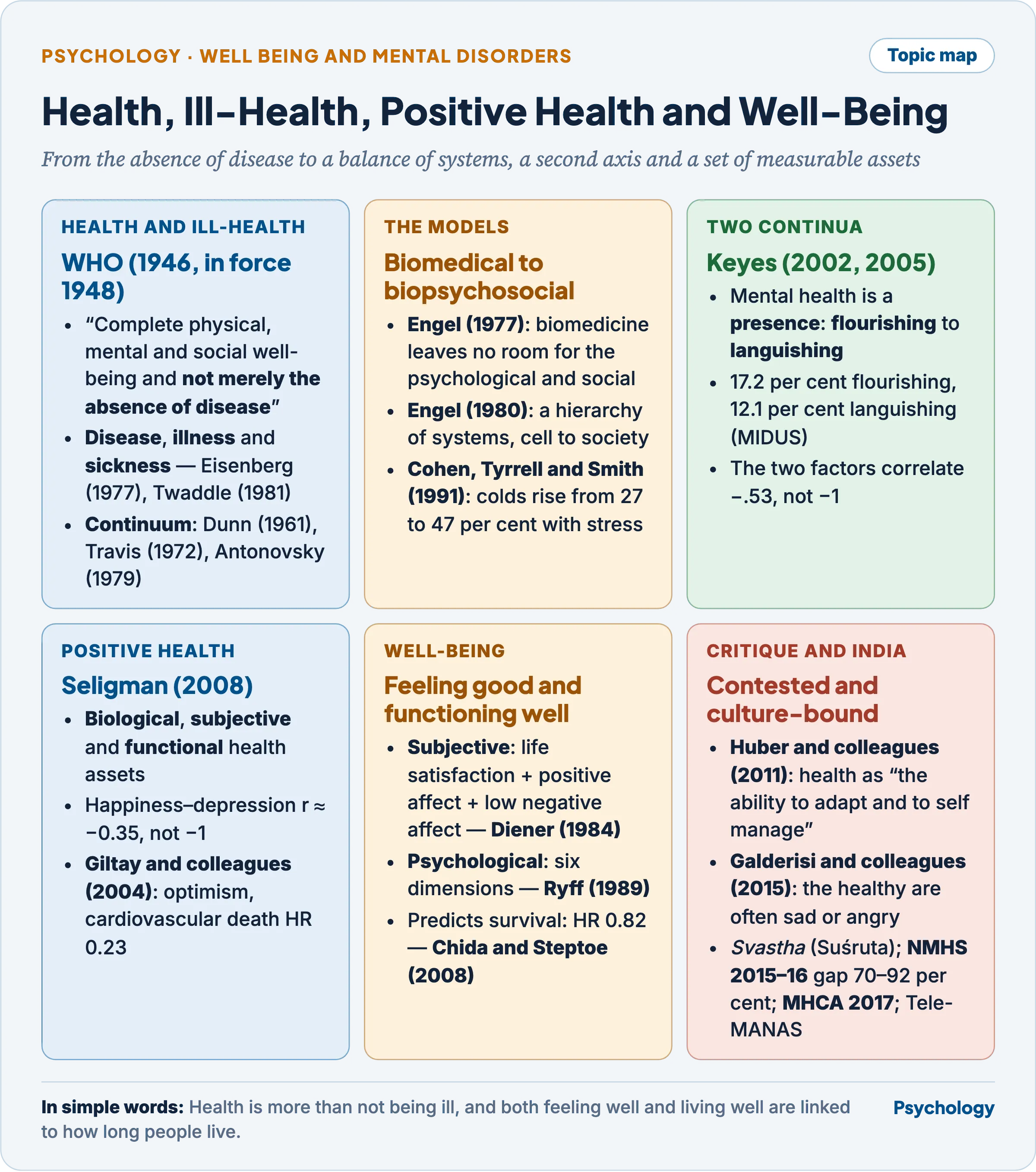
Each box moves health one step further from “no disease”: to a balance of systems, a second axis, and a set of measurable assets.
Concept of health-ill health
Health
- The WHO definition: “Health is a state of complete physical, mental and social well-being and not merely the absence of disease or infirmity.” It opens the WHO Constitution (adopted 22 July 1946, in force 7 April 1948) and has never been amended.
- It made health positive (a presence, not an absence), multidimensional, and a property of the person rather than of organs.
- WHO’s current definition of mental health (WHO, 2022): “a state of mental well-being that enables people to cope with the stresses of life, realize their abilities, learn well and work well, and contribute to their community.”
- Jahoda (1958), in Current Concepts of Positive Mental Health, had listed six criteria — positive attitudes towards the self, growth and self-actualisation, integration, autonomy, accurate perception of reality and environmental mastery.
- Dunn (1961) named the positive pole high-level wellness: “an integrated method of functioning which is oriented toward maximizing the potential of which the individual is capable”.
Ill-health: disease, illness and sickness
- Eisenberg (1977): “patients suffer ‘illnesses’; physicians diagnose and treat ‘diseases’.” Disease is abnormal structure or function of organs; illness is the person’s experience of disvalued change in being and social functioning.
- They dissociate: hypertension is disease without illness; much chronic pain is illness without demonstrable disease.
- Sickness is the social dimension — the status others confer when they accept a person’s failure to meet obligations as due to ill-health (Twaddle, 1981).
The health–illness continuum
- Travis (1972, published 1975) drew health as one line from premature death through a neutral point of no discernible illness to high-level wellness. Treatment returns a person to neutral; only awareness, education and growth carry them beyond it.
- Antonovsky (1979), in Health, Stress and Coping, replaced the healthy–sick dichotomy with a health ease/dis-ease continuum and asked the salutogenic question — what moves people towards health? His answer was the sense of coherence: life experienced as comprehensible, manageable and (from 1987) meaningful.
- Limitation: a single line implies that removing illness produces wellness; the dual-continua evidence below refutes this.
The medical model and the biopsychosocial model
- The biomedical model, in Engel’s (1977) words, “assumes disease to be fully accounted for by deviations from the norm of measurable biological (somatic) variables.” It rests on reductionism and mind–body dualism, and defines health as the absence of disease.
- Engel named its blind spot: “some people with positive laboratory findings are told that they are in need of treatment when in fact they are feeling quite well, while others feeling sick are assured that they are well”.
- His remedy, in Science: a medical model “must also take into account the patient, the social context in which he lives”, the physician’s role and the health-care system. “This requires a biopsychosocial model.”
- Engel (1980) grounded it in general systems theory: a hierarchy of natural systems from molecule, cell and organ through person and family to community, culture and biosphere, each level acting on those above and below.
- His case: a heart-attack patient whose arrhythmia followed repeated failed attempts at arterial puncture — a single anecdote.
- Cohen, Tyrrell and Smith (1991) gave controlled evidence that the psychological level acts on the biological.
- 394 healthy volunteers rated their stress, then received nasal drops of one of five respiratory viruses in quarantine; a further 26 received saline.
- As stress rose, infection rose from about 74 to 90 per cent and clinical colds from 27 to 47 per cent (Cohen and colleagues, 1991), with smoking, sleep, diet and personality controlled.
- Limitation: stress was measured, not manipulated, so a third variable cannot be excluded.
Biopsychosocial influences on mental disorder
- Each level contributes:
- Biological — inherited vulnerability, neurotransmitter and endocrine regulation, brain injury, physical illness.
- Psychological — learned fears, ruminative or hopeless thinking, weak coping, low self-esteem.
- Social — poverty, violence, discrimination, family conflict, isolation. The National Mental Health Survey (2015–16) found mental morbidity higher in lower income quintiles and urban metros.
- The integrating statement is diathesis–stress: a vulnerability becomes a disorder when stress meets it. Causal models: see Abnormality, Classification and the Causal Factors of Mental Disorders.
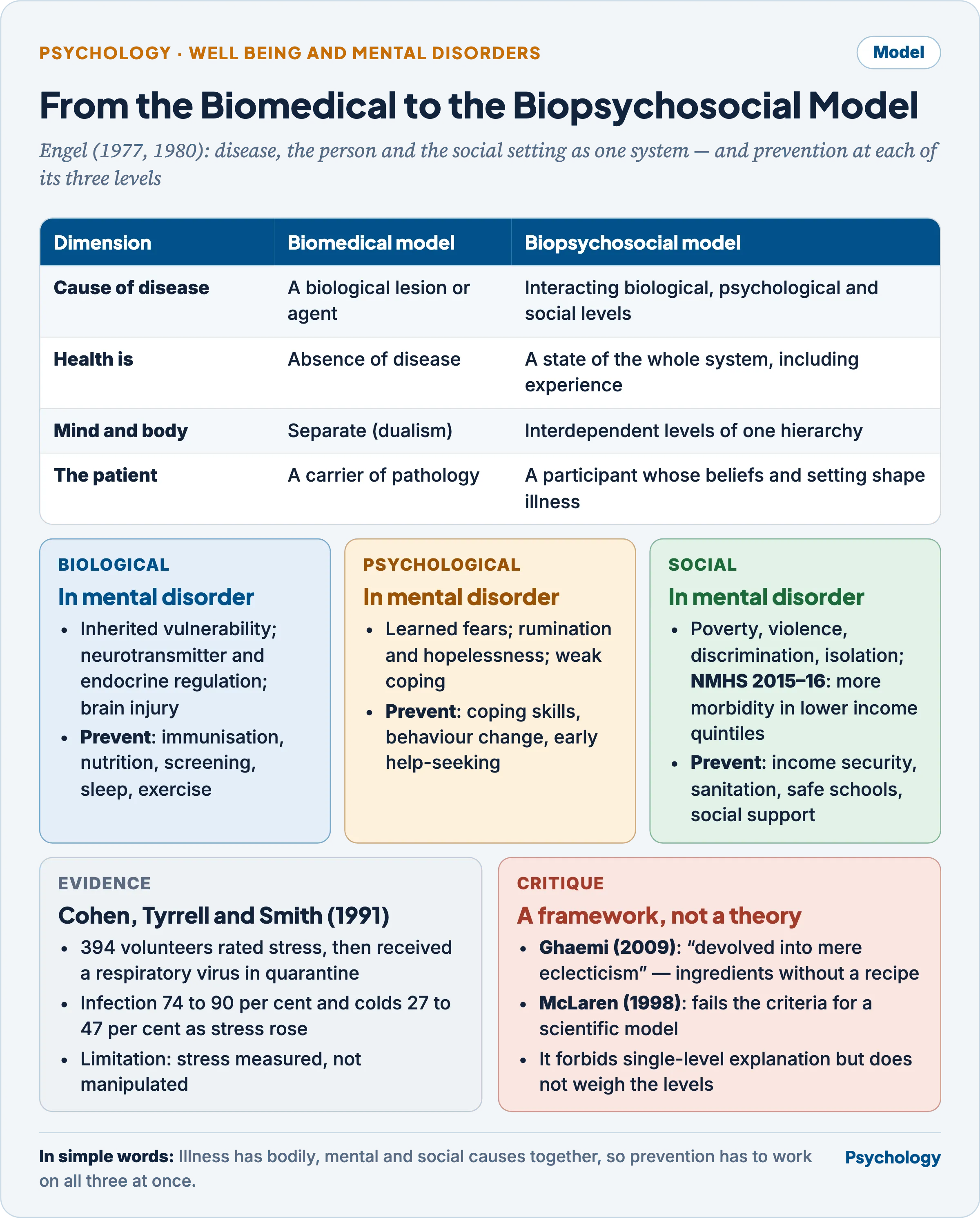
The biomedical model sees one level; the biopsychosocial model sees three, and every level that can cause a disorder is also a level at which it can be prevented.
Preventing illness from a biopsychosocial standpoint
- Biological action — immunisation, nutrition, screening, sleep and exercise. Psychological action — coping skills, health-behaviour change, early help-seeking. Social action — income security, sanitation, safe schools and workplaces, social support.
- India’s Ayushman Arogya Mandirs add mental-health services to comprehensive primary care, putting all three levels in one clinic; over 1.8 lakh centres had been upgraded (Ministry of Health and Family Welfare, 2026).
- Levels of prevention and the health belief model: see Factors Influencing Positive Health, Well-Being, Lifestyle and Quality of Life.
Evaluation of the biopsychosocial model
- Ghaemi (2009): it combated psychiatric dogmatism but “has devolved into mere eclecticism” — ingredients without a recipe, so each clinician stresses bio, psycho or social as preferred.
- McLaren (1998) argued it fails the criteria for a scientific model; Borrell-Carrió and colleagues (2004) defended its principles as a guide to clinical reasoning.
- It works best as a framework that forbids single-level explanation, not as a theory of how much each level weighs.
The dual-continua model of mental health and mental illness
- Keyes (2002) operationalised mental health “as a syndrome of symptoms of positive feelings and positive functioning in life” — emotional, psychological and social well-being — diagnosing its presence as flourishing and its absence as languishing.
- Sample: 3,032 adults aged 25–74 in the 1995 Midlife in the United States (MIDUS) survey.
- 17.2 per cent flourished, 56.6 per cent were moderately healthy and 12.1 per cent languished (Keyes, 2002); languishing adults were nearly six times as likely as the flourishing to have had a major depressive episode.
- Limitation: cross-sectional, self-report, and the cut-offs are conventions.
- Keyes (2005): confirmatory factor analysis of the same sample fitted two correlated factors far better than one bipolar factor; the latent correlation was −.53, about 28 per cent shared variance.
- Keyes, Dhingra and Simoes (2010) followed 1,723 MIDUS adults from 1995 to 2005: those staying languishing were 6.6 times, and those declining to languishing 8.2 times, as likely as the stably flourishing to have a mental disorder in 2005.
- So removing symptoms does not by itself produce flourishing: promotion and treatment are separate tasks.
- Singh and colleagues (2015) gave the Mental Health Continuum–Short Form to 539 Delhi private-school students aged 13–18.
- 46.4 per cent flourished, 51.2 per cent were moderately healthy and 2.4 per cent languished (Singh and colleagues, 2015); flourishing students reported less depression and more prosocial behaviour.
- Limitation: urban private-school students answering in English.
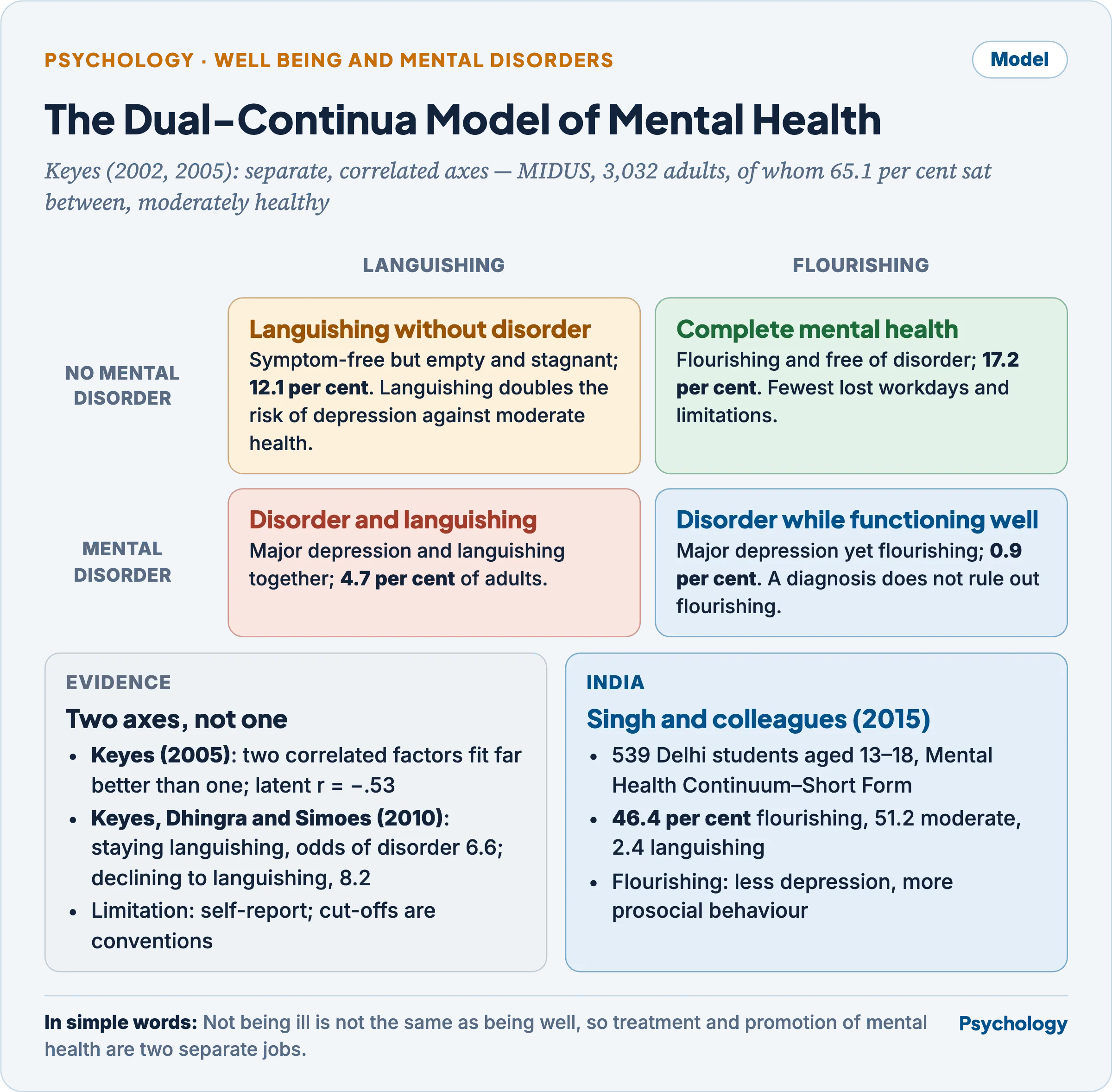
The two axes cross: a person can be free of disorder and still languish, or carry a diagnosis and still function well.
Positive health
- Seligman (2008) proposed positive health on the model of positive psychology. The correlation between happiness and depression, he noted, “is closer to minus 0.35”, not minus 1, so disorders “somewhat impede, but do not remotely preclude” positive functioning.
- He divided it into three classes of measures, later called health assets, predicted to bring longer life, lower health costs, better mental health in ageing and better prognosis:
- Biological — the favourable ends of physiological distributions: blood pressure, body mass, cholesterol, exercise tolerance.
- Subjective — vitality, optimism, an internal health locus of control, life satisfaction, positive emotion, meaning.
- Functional — gait speed, grip strength and fitness for one’s chosen work, love and play.
- Giltay and colleagues (2004) followed 999 Dutch adults aged 65–85 for 9.1 years: the most optimistic quartile had a hazard ratio of 0.23 for cardiovascular death against the least optimistic, after adjusting for age, sex, chronic disease and smoking.
- Limitation: the assets are correlational candidates, and optimism shares confounds such as income and prior illness with health. Its determinants: see Factors Influencing Positive Health, Well-Being, Lifestyle and Quality of Life.
Well-being: subjective and psychological
- Seligman and Csikszentmihalyi (2000) launched the positive psychology movement in the American Psychologist: “Psychology has, since World War II, become a science largely about healing.” They proposed three levels — positive subjective experience, positive individual traits and positive institutions.
Subjective well-being
- Diener, Lucas and Oishi (2002): “Subjective well-being is defined as a person’s cognitive and affective evaluations of his or her life.”
- Diener (1984) gave it three components: life satisfaction (cognitive), positive affect and negative affect (affective).
- Its three hallmarks (Diener, 1984): it is subjective, no objective condition such as health or wealth being part of it; it uses positive measures, not the absence of negative ones; and it is a global judgement of life as a whole.
- Lucas and colleagues (1996) found the three components separable: high positive affect does not entail low negative affect.
- Measurement:
- Satisfaction With Life Scale (Diener and colleagues, 1985) — five items rated 1–7 (“In most ways my life is close to my ideal”), alpha .87, two-month test–retest .82.
- PANAS (Watson, Clark and Tellegen, 1988) — ten positive and ten negative mood adjectives.
- The Day Reconstruction Method (Kahneman and colleagues, 2004) had 909 employed women reconstruct the previous day episode by episode, capturing experienced rather than remembered well-being.
- Correlates: Wilson (1967) pictured the happy person as “young, healthy, well-educated, well-paid, extroverted, optimistic, worry-free, religious, married”; Diener and colleagues (1999) found demographic factors have surprisingly small effects beside dispositions, goals, coping and adaptation.
- Consequences: Lyubomirsky and colleagues (2005), pooling 225 papers (over 275,000 participants), found happiness precedes success in work, relationships and health.
- Theories (Diener, 1984): bottom-up — the sum of satisfactions in life’s domains; top-down — a disposition to see life positively that colours every domain. Telic, activity (including flow, Csikszentmihalyi, 1975) and judgement theories sit within these. Adaptation and the set-point: see Happiness Disposition.
Psychological well-being
- The eudaimonic tradition, from Aristotle’s eudaimonia, defines well-being “in terms of the degree to which a person is fully functioning”; the hedonic, “in terms of pleasure attainment and pain avoidance” (Ryan and Deci, 2001).
- Ryff (1989), holding that existing measures had “little theoretical grounding”, derived six dimensions from Maslow, Rogers, Jung, Allport, Erikson and Jahoda, among others: self-acceptance, positive relations with others, autonomy, environmental mastery, purpose in life and personal growth.
- In 321 adults, positive relations, autonomy, purpose and growth were “not strongly tied” to existing indices of life satisfaction and affect balance. Age profiles are in Adulthood, Midlife and Psychological Well-Being (Paper I).
- Ryff and Keyes (1995) confirmed the six-factor structure in a national sample of 1,108 adults; Keyes, Shmotkin and Ryff (2002), with 3,032 MIDUS adults, found subjective and psychological well-being related but distinct.
- Self-determination theory (Ryan and Deci, 2000) locates well-being in satisfying three basic needs — autonomy, competence and relatedness — so a pleasant life that frustrates them is not a healthy one.
- Keyes (1998) added social well-being: social acceptance, actualisation, contribution, coherence and integration.
- PERMA (Seligman, 2011): positive emotion, engagement, relationships, meaning and accomplishment. Goodman and colleagues (2017), with 517 adults, found PERMA and subjective well-being correlated at a latent r = 0.98.
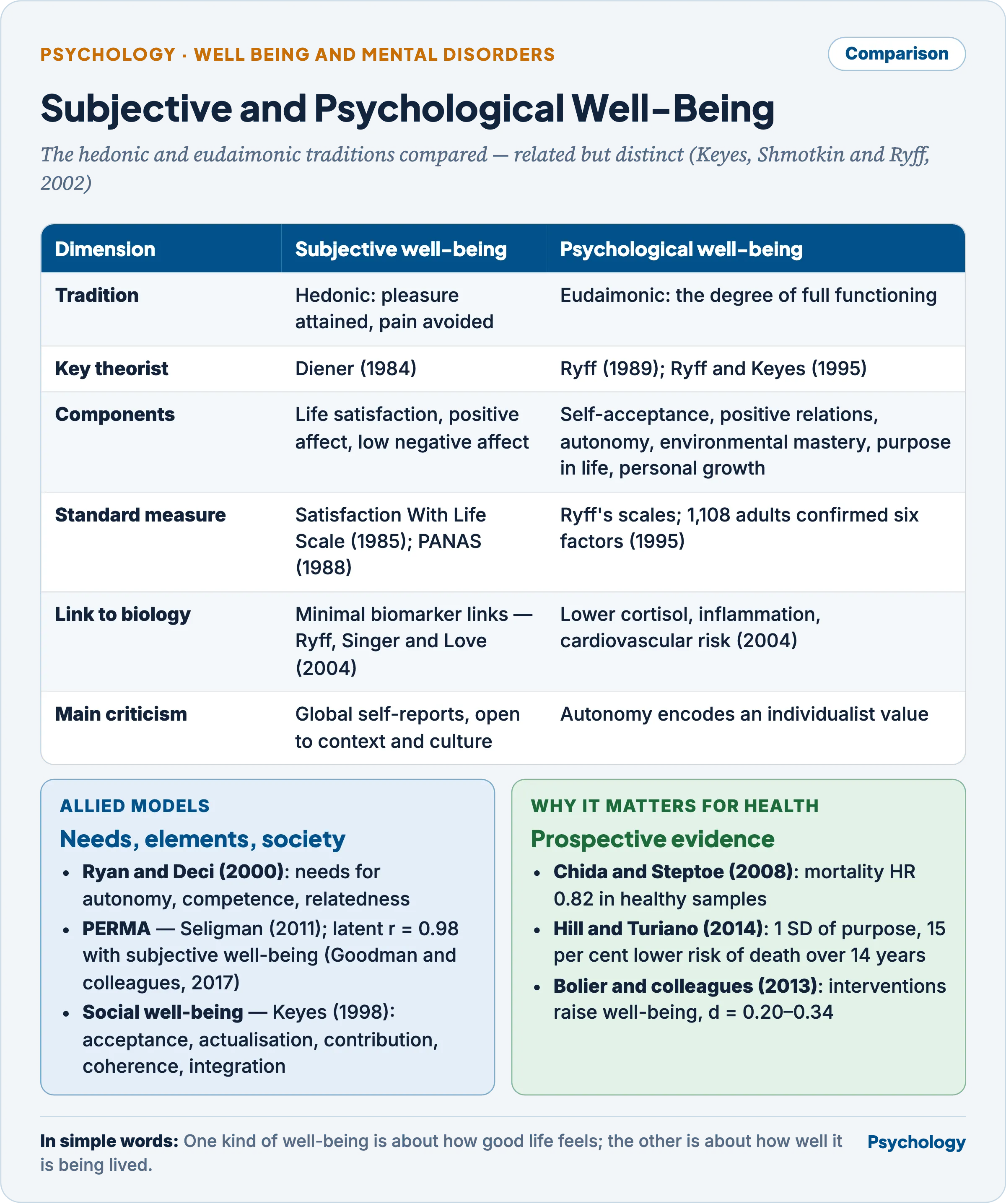
Subjective well-being asks how life feels; psychological well-being asks how well it is lived — and the second tracks biology more closely.
Why psychological well-being is an essential component of health
- Chida and Steptoe (2008) meta-analysed 35 studies of initially healthy and 35 of diseased populations: positive well-being predicted lower mortality — hazard ratio 0.82 in healthy and 0.98 in diseased samples — independently of negative affect.
- Hill and Turiano (2014) followed MIDUS adults for 14 years: each standard deviation of purpose in life lowered the risk of death by 15 per cent, net of positive and negative affect.
- Ryff, Singer and Love (2004) found older women high in eudaimonic well-being had lower daily cortisol, lower inflammatory markers, lower cardiovascular risk and longer REM sleep; hedonic well-being showed minimal links. Limitation: a small, cross-sectional sample.
- Limitation: the evidence is mostly observational, so reverse causation and confounding by income and education remain, and Chida and Steptoe (2008) found signs of publication bias.
- Enhancement: Bolier and colleagues (2013), pooling 39 randomised trials (6,139 participants), found positive psychology interventions such as gratitude letters, “three good things” and signature-strength use raised subjective well-being (d = 0.34) and psychological well-being (d = 0.20) and reduced depression (d = 0.23).
- Well-being therapy (Fava and colleagues, 1998), built on Ryff’s dimensions, and positive psychotherapy (Seligman and colleagues, 2006) apply this clinically against residual symptoms and depression. Wider methods are in Fostering Mental Health (Unit 3).
Issues and contradictions in understanding well-being
- Feeling good or functioning well. Hedonic and eudaimonic measures diverge and no agreed index combines them, so whether well-being has “risen” depends on which tradition is measured.
- Cultural relativity. Uchida and Kitayama (2009) found Americans tied happiness to personal achievement and Japanese to social harmony. Joshanloo and Weijers (2014) documented aversion to happiness — beliefs that happiness invites misfortune or makes people selfish.
- Indian conceptions. Salagame (2015) distinguishes sukha, happiness conditioned by circumstance, from ānanda, bliss independent of external objects; the Kaṭha Upaniṣad sets preyas, the pleasant, against śreyas, the good. Satisfaction scales register only the first of each pair.
- Materialism. Dittmar and colleagues (2014), across 259 samples, found materialist values correlated r = −.19 with well-being, largely through frustrated psychological needs: consumerism erodes what it sells.
- Social media. Kross and colleagues (2013) texted 82 young adults five times a day for two weeks; more Facebook use predicted worse mood at the next prompt and falling life satisfaction.
- Orben and Przybylski (2019), across 355,358 adolescents, found digital use explained at most 0.4 per cent of variation in well-being: the trend is real, its size disputed.
- The pursuit itself. Mauss and colleagues (2011): women induced to value happiness reacted less positively to a happy film, through disappointment at their own feelings — happiness made a duty becomes harder to reach.
- Measurement. Schwarz and Clore (1983) found life satisfaction higher on sunny than rainy days unless attention was drawn to the weather; Lucas and Lawless (2013), with over a million Americans, found weather effects negligible. Mood biases global judgements, but modestly.
- Economic growth and well-being: see Happiness Disposition.
Criticisms of the concept of mental health and well-being
- “Complete” well-being is unattainable. Huber and colleagues (2011) argued the WHO wording medicalises society, leaves almost everyone unhealthy, declares the chronically ill permanently ill and cannot be measured. They proposed health as “the ability to adapt and to self manage”.
- Mental health is not constant happiness. Galderisi and colleagues (2015) objected that tying mental health to positive feeling and productivity excludes shy adolescents, people fighting injustice, migrants and those unable to work: “People in good mental health are often sad, unwell, angry or unhappy”.
- Their alternative: “a dynamic state of internal equilibrium which enables individuals to use their abilities in harmony with universal values of society.”
- Value-laden criteria. Ryff’s autonomy prizes independence from social pressure, an individualist value that can score interdependence as deficit; Galderisi’s “universal values” raise the same problem.
- The positive psychology critique. Lazarus (2003) objected to splitting emotions into positive and negative and to reliance on cross-sectional data; Brown and colleagues (2013) showed the “critical positivity ratio” of 2.9013 (Fredrickson and Losada, 2005) rested on misapplied fluid-dynamics equations.
- Measurement and causality. The evidence is mostly self-report and correlational, and the continua correlate −.53 (Keyes, 2005): distinct, not independent.
- What survives. Health is better defined as a capacity than a state; mental health is a positive presence partly independent of illness; well-being modestly predicts survival (Chida and Steptoe, 2008); and its definitions carry cultural values.
Indian context
- Svastha. The Suśruta Saṃhitā (Sūtrasthāna 15): samadoṣaḥ samāgniś ca samadhātumalakriyaḥ, prasannātmendriyamanāḥ svastha ity abhidhīyate — healthy is one whose doṣas, digestive fire, tissues and excretions are balanced and whose self, senses and mind are prasanna, clear and content.
- National Mental Health Survey 2015–16 (NIMHANS, for the Ministry of Health and Family Welfare, MoHFW) — 34,802 adults in 12 states: current mental morbidity 10.6 per cent, lifetime 13.7 per cent (Gautham and colleagues, 2020).
- Treatment gap 70–92 per cent across disorders (NIMHANS, 2016), 84.5 per cent overall (Gautham and colleagues, 2020). It measured illness only — the single-continuum view; NMHS-2 (2024–26) covers adolescents and adults in all 36 states and union territories (MoHFW, 2026).
- Mental Healthcare Act, 2017 (MoHFW) — section 2(1)(s) defines mental illness as “a substantial disorder of thinking, mood, perception, orientation or memory that grossly impairs judgment, behaviour, capacity to recognise reality or ability to meet the ordinary demands of life”.
- Section 3(3) bars basing it on non-conformity with moral, social, cultural, work or political values or religious beliefs: ill-health is judged by dysfunction, never by social deviance.
- National Mental Health Policy, 2014 (MoHFW, New Pathways, New Hope, 10 October 2014) — its vision puts promoting mental health beside preventing illness and enabling recovery, making promotion a distinct task.
- Tele-MANAS (MoHFW, launched 10 October 2022) — toll-free 14416, the digital arm of the District Mental Health Programme. It lowers the cost of help-seeking, which drives the treatment gap.
- By 27 July 2026 it ran 53 cells in 36 states and union territories, in 20 languages, and had handled over 42 lakh calls (MoHFW, 2026).
Previous Year Questions
- 2026How do biological, psychological and social factors influence mental disorders? Critically examine the concept of mental health and well-being.
- 2023Discuss the biopsychosocial model of health. Suggest relevant actions to prevent illness.
- 2019Why is psychological wellbeing considered as an essential factor of health? What are the different ways it can be enhanced?
- 2013Reflect on the major issues and contradictions related to the understanding of well-being. Discuss with reference to current social trends.
- 2011Discuss the various aspects subjective well-being as propounded by positive psychology movement.
- 2005What do you mean by positive health? Suggest some of the important factors responsible for positive health, well being, life style and quality of life.