

Study of consciousness – dreams.
Official Syllabus: Paper I · Unit 14 Issues and Perspectives in Modern Contemporary Psychology
“When the work of interpretation has been completed, the dream may be recognised as the fulfilment of a wish.”
— Freud (1900), The Interpretation of Dreams
A dream is consciousness continuing while the sensory and motor channels that normally anchor it are shut. That single fact sets the agenda: a dream has to be explained as an experience with content and meaning, and simultaneously as the product of a brain in a particular physiological state. The three standing accounts — psychoanalytic, physiological and cognitive — divide precisely on which of those two descriptions is the explanation and which is the by-product.
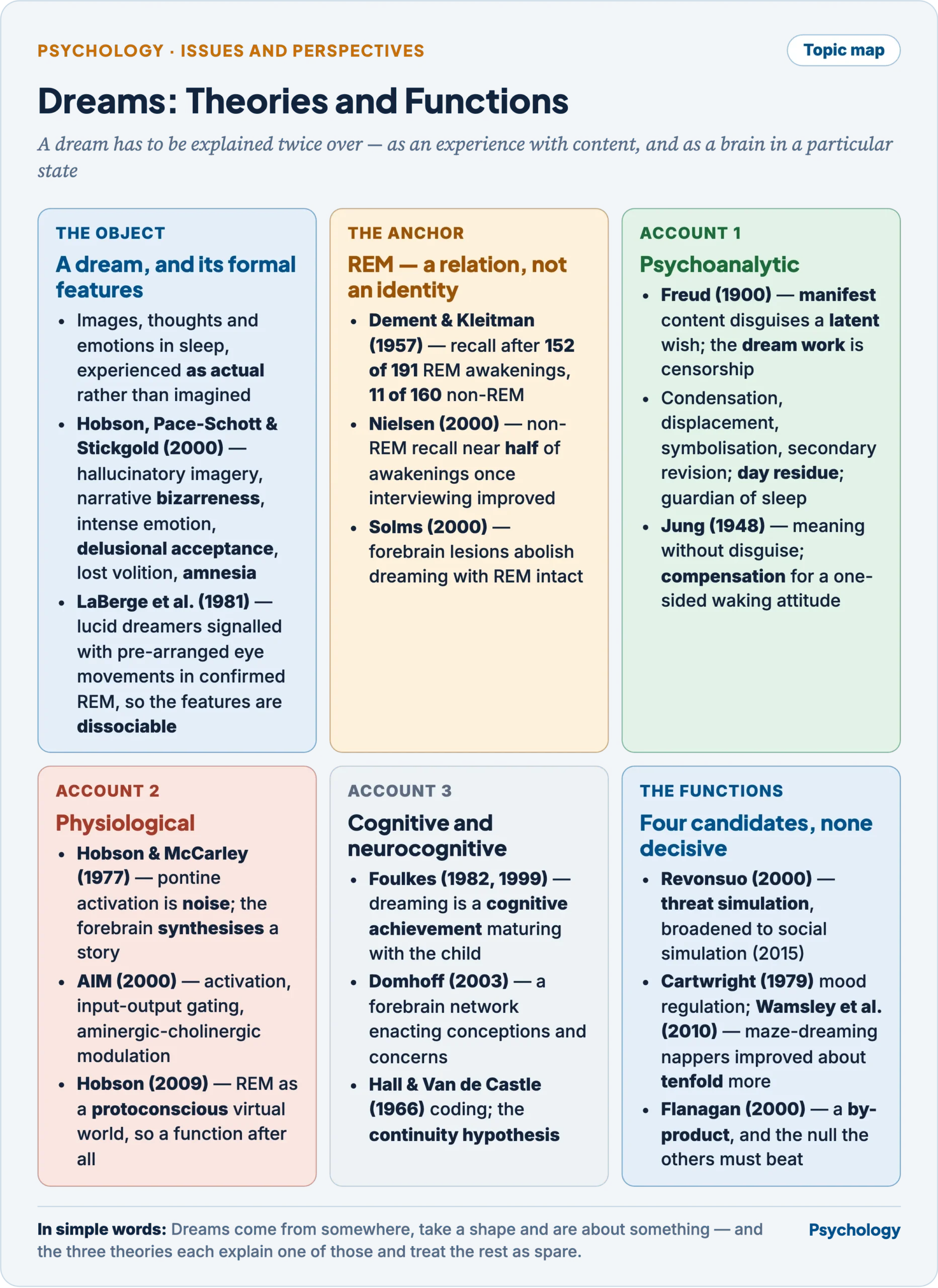
The three accounts are not three answers to one question; they explain the source, the form and the content respectively, which is why evidence against one rarely settles the others.
The study of dreaming as a state of consciousness
- A dream is a sequence of images, thoughts and emotions occurring during sleep and experienced, while it lasts, as actual rather than imagined. The last clause is what separates dreaming from waking imagery, which is monitored as self-generated.
- Hobson, Pace-Schott and Stickgold (2000) set out the formal features that any account must explain, and they are features of form rather than of content.
- Hallucinatory imagery, overwhelmingly visual and motoric, with sound common and taste, smell and pain rare.
- Narrative organisation combined with bizarreness — the story holds, while scenes, persons and places transform without the dreamer objecting.
- Intense emotion, with anxiety, fear and surprise disproportionately represented.
- Delusional acceptance — the impossible is believed, and loss of self-reflective awareness removes the capacity to test it.
- Loss of volitional control over both the dream’s course and the dreamer’s body.
- Amnesia — the great majority of dream content is lost unless the sleeper wakes directly from it.
- Lucid dreaming is the informative exception, in which self-reflective awareness returns inside the dream.
- LaBerge, Nagel, Dement and Zarcone (1981) demonstrated it objectively: trained lucid dreamers produced pre-arranged patterns of voluntary eye movements on the electro-oculogram while polysomnography confirmed unambiguous REM sleep.
- Volitional signalling from inside a dream makes the formal features above dissociable rather than a single package.
- Recall is a separate variable from dreaming. People who report never dreaming do report dreams when woken from REM sleep, so the individual differences are largely differences in retrieval, not in the occurrence of the experience.
Dreams and REM sleep: a relation, not an identity
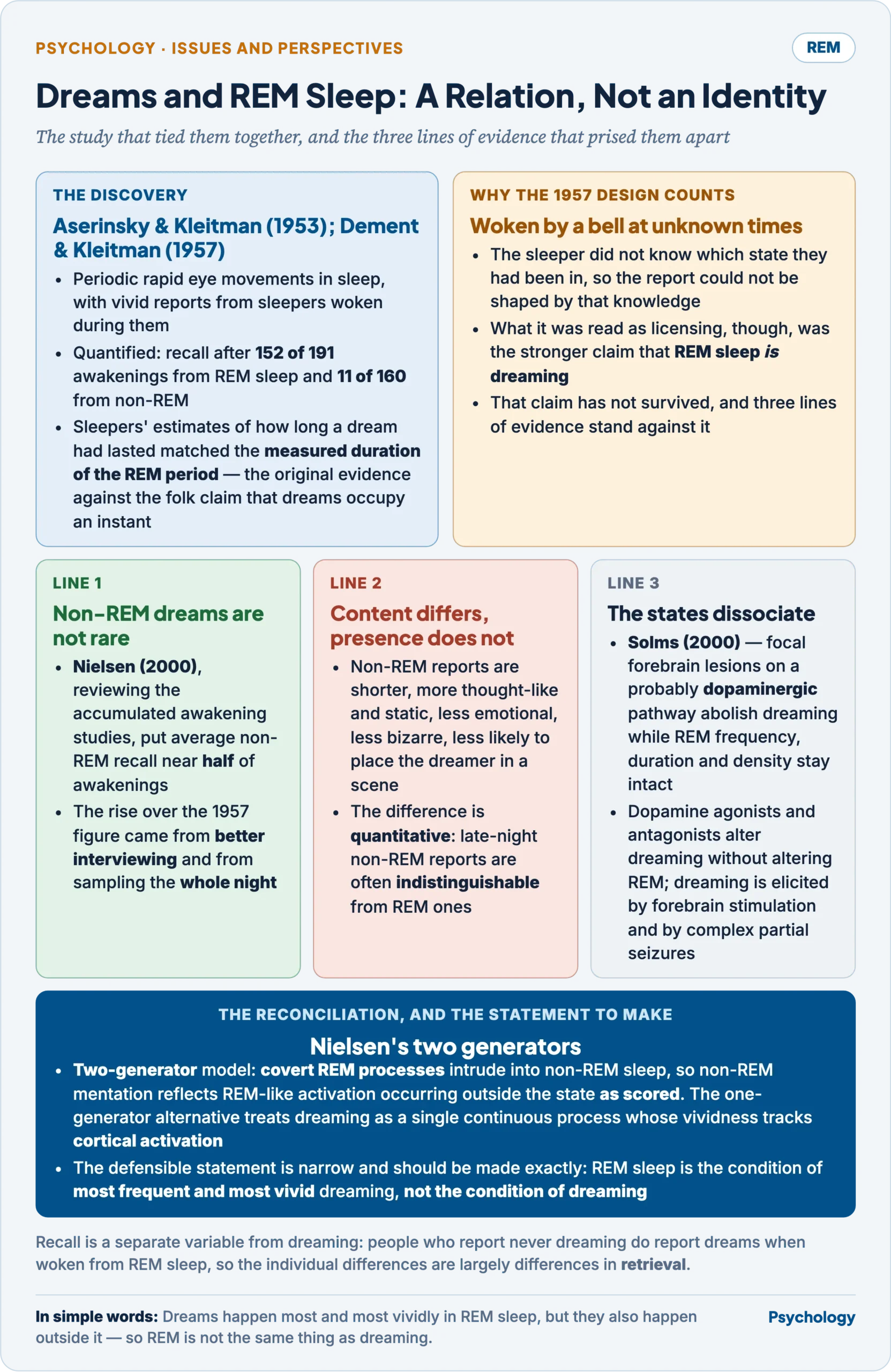
The two distributions overlap heavily and do not coincide. Equating them was the field’s most consequential simplification.
- Aserinsky and Kleitman (1953) discovered periodic rapid eye movements during sleep and observed that sleepers woken from them reported vivid dreaming. The physiology of the state itself is set out in Sleep: Stages, Physiology and Functions.
- Dement and Kleitman (1957) established the association quantitatively, waking sleepers from both states. Dreams were recalled after 152 of 191 awakenings from REM sleep and after only 11 of 160 awakenings from non-REM sleep.
- Dement and Kleitman (1957) also found that sleepers’ estimates of how long a dream had lasted matched the measured duration of the REM period — the original evidence against the folk claim that dreams occupy an instant.
- Its design matters: the sleeper was woken by a bell at times unknown to them, so the report could not be shaped by knowing which state they had been in.
- The strong conclusion drawn from this — that REM sleep is dreaming — has not survived, and three lines of evidence stand against it.
- Non-REM dreams occur, and are not rare. Nielsen (2000), reviewing the accumulated awakening studies, put the average recall rate from non-REM sleep in the region of half of awakenings — far above the 1957 figure, the rise coming from better interviewing and from sampling the whole night.
- Content, not presence, is what differs (Nielsen, 2000). Non-REM reports are shorter, more thought-like and static, less emotional and less bizarre, and less likely to place the dreamer in a scene.
- REM reports are longer, perceptually vivid and narratively progressive, but the difference is quantitative: late-night non-REM reports are often indistinguishable from REM ones (Nielsen, 2000).
- The two states dissociate neurologically. Solms (2000) reported that focal forebrain lesions along a probably dopaminergic pathway abolish dreaming while leaving REM frequency, duration and density intact.
- On the same evidence, dopamine agonists and antagonists alter dreaming without altering REM, and dreaming can be elicited outside REM by forebrain stimulation and by complex partial seizures (Solms, 2000).
- Nielsen’s (2000) reconciliation is a two-generator model with covert REM processes intruding into non-REM sleep, so that non-REM mentation reflects REM-like activation occurring outside the state as scored. The alternative one-generator view treats dreaming as a single continuous process whose vividness varies with cortical activation.
- The defensible statement is therefore narrow and should be made exactly: REM sleep is the condition of most frequent and most vivid dreaming, not the condition of dreaming.
The psychoanalytic account
Freud’s wish-fulfilment theory
- Freud (1900) treated the dream as a meaningful mental product, not a disturbance of sleep, and built the account on a distinction that remains its core.
- Manifest content is the dream as remembered and narrated. Latent content is the unconscious wish it expresses.
- The transformation of the second into the first is the dream work, whose function is censorship — disguising a wish unacceptable to the conscious mind so that it can be expressed without waking the sleeper.
- Four mechanisms of the dream work are specified, and each is a claim about how disguise is achieved.
- Condensation — several latent elements fuse into one manifest image, so a single figure carries features of many people.
- Displacement — affect is detached from its real object and attached to something trivial, so the dream’s emphasis misleads.
- Symbolisation — a latent content is represented by an image conventionally or privately standing for it.
- Secondary revision — the fragments are smoothed into a coherent narrative on waking, which adds a further layer of disguise.
- Two further elements complete the account. Day residue supplies the raw material from recent waking experience, and the dream is the guardian of sleep, discharging drive pressure that would otherwise wake the sleeper.
- The method is free association from each manifest element, on the argument that the latent content cannot be read off the image directly, since symbols are over-determined.
- Freud himself recorded the decisive exception. The traumatic dreams of war neurosis repeat the trauma rather than disguising a wish, and in 1920 he conceded that these lie “beyond” the pleasure principle — that is, outside the wish-fulfilment theory.
Jung’s compensatory account
- Jung (1948) kept the premise that dreams are meaningful and rejected the disguise. For him the dream states the unconscious situation directly, in symbolic form, and needs no censor.
- The function is compensation: the dream supplies what the conscious attitude has excluded, so a one-sided waking stance is balanced from the other side of the psyche.
- He added a prospective function, the dream rehearsing a possible future course, and treated recurring motifs as archetypes drawn from a collective unconscious.
- The method is amplification — enriching the image with cultural and mythological parallels — rather than association away from it.
- The cost of dispensing with the censor is falsifiability: a theory that reads the image as it stands has fewer constraints on what counts as a correct reading, and the archetypal apparatus is not independently testable.
The physiological account
- Hobson and McCarley (1977) proposed activation-synthesis, and the inversion is the point: the dream’s source is physiological noise, and its meaning is added afterwards.
- Brainstem activation during REM sleep, generated by pontine mechanisms, bombards the forebrain with signals carrying no message.
- The forebrain synthesises a narrative by matching this activation against stored memory, doing the best job it can with inconsistent input.
- Bizarreness therefore needs no censor to explain it. Scene shifts and impossible transformations are what synthesis of a disorderly input looks like.
- Dream content is not meaningless on this account, but its meaning is the dreamer’s own interpretive style, not a disguised wish.
- Hobson, Pace-Schott and Stickgold (2000) generalised it into the AIM model, which places conscious states in a three-dimensional space.
- A is activation level; I is input-output gating, the degree to which the brain is closed to external input and to motor output; M is modulation, the balance between aminergic and cholinergic neurotransmission.
- Waking is high on all three; REM sleep is high in activation, closed in gating and cholinergically dominant; non-REM sleep sits between them on every dimension.
- The aminergic withdrawal of REM sleep is offered as the mechanism of dream amnesia and of the loss of critical self-reflection, since the same neuromodulators support both in waking.
- Hobson (2009) revised the position substantially, proposing that REM sleep is a protoconscious state — a virtual model of a world, with a body in it, that prepares and maintains waking consciousness rather than merely reacting to it. Dreaming is thereby given a function the original account denied it.
The cognitive and neurocognitive accounts
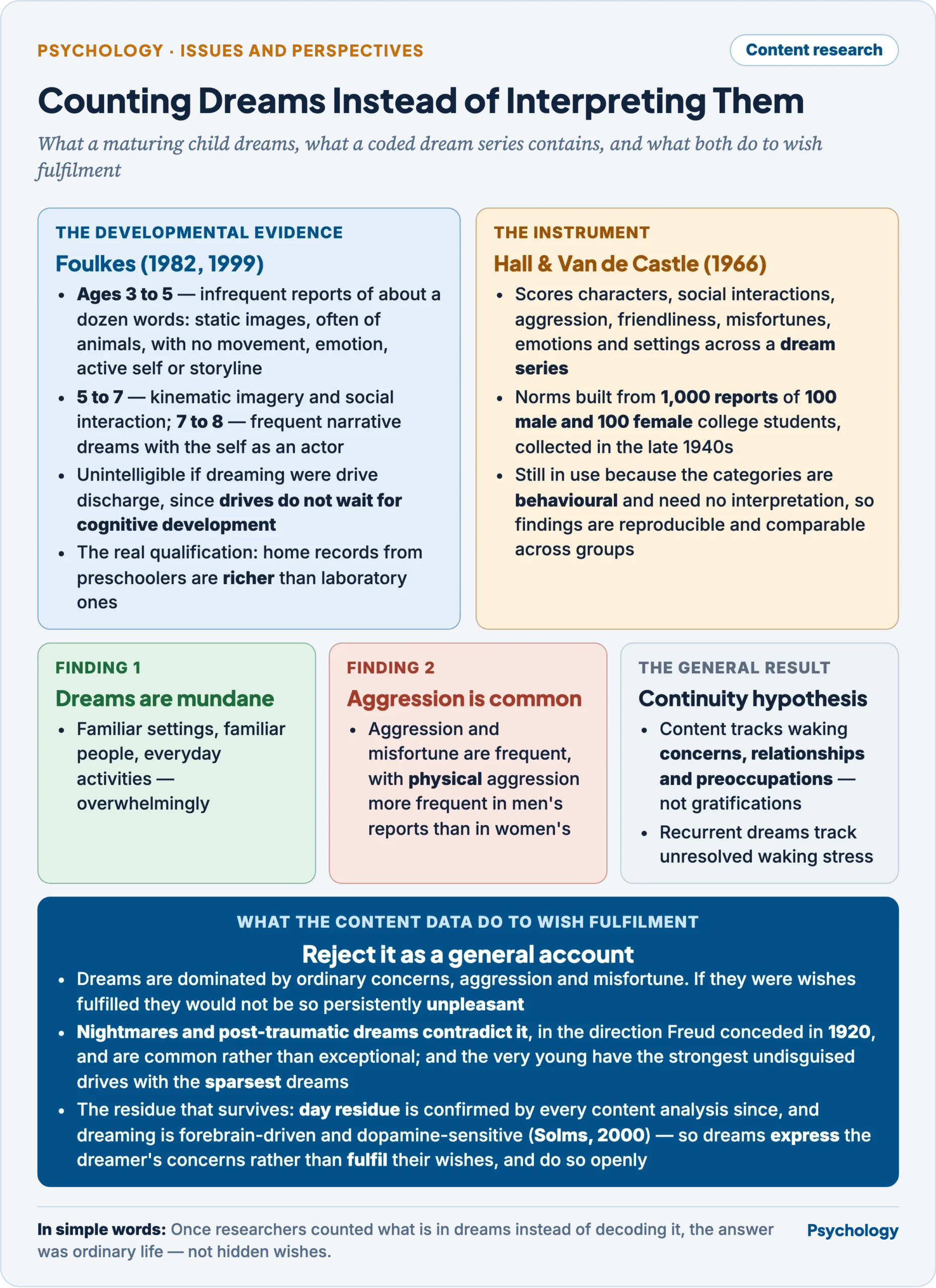
Content analysis replaced interpretation with counting, and the finding was continuity: dreams are mostly about the dreamer’s ordinary waking concerns.
- Foulkes (1982, 1999) reframed dreaming as a cognitive achievement rather than a drive phenomenon, and supported it with laboratory awakenings of children followed longitudinally.
- Children aged 3 to 5 gave infrequent, very brief reports — of the order of a dozen words — typically static images, often of animals, with no movement, emotion, active self or storyline (Foulkes, 1999).
- Kinematic imagery and social interaction appeared between 5 and 7; frequent, narratively organised dreams with the self as an actor appeared around 7 to 8.
- The inference is that dreaming depends on the same visuospatial and narrative capacities as waking cognition, and matures with them — which is unintelligible if dreaming were drive discharge, since drives do not wait for cognitive development.
- One qualification is real: dream records collected at home from preschoolers are richer than laboratory ones, so the laboratory awakening procedure may understate young children’s dreaming.
- Domhoff’s (2003) neurocognitive theory treats dreaming as the output of a specific forebrain network, enacting conceptions and concerns rather than processing drives, and its empirical base is quantitative content analysis rather than interpretation.
- The instrument is the coding system of Hall and Van de Castle (1966), which scores characters, social interactions, aggression, friendliness, misfortunes, emotions and settings in a dream series so that findings are reproducible and comparable across groups.
- The Hall and Van de Castle (1966) norms were built from 1,000 reports of 100 male and 100 female college students collected in the late 1940s, and the system remains in use because its categories are behavioural and need no interpretation.
- Two robust findings follow. Dream content is overwhelmingly mundane — familiar settings, familiar people, everyday activities — and aggression and misfortune are common, with physical aggression more frequent in men’s dream reports than in women’s (Hall and Van de Castle, 1966).
- The continuity hypothesis states the general result: dream content corresponds to the dreamer’s waking concerns, relationships and preoccupations, not to their gratifications. On this view the dream is continuous with waking thought rather than its opposite, and recurrent dreams track unresolved waking stress.
Comparing the psychoanalytic, physiological and cognitive accounts
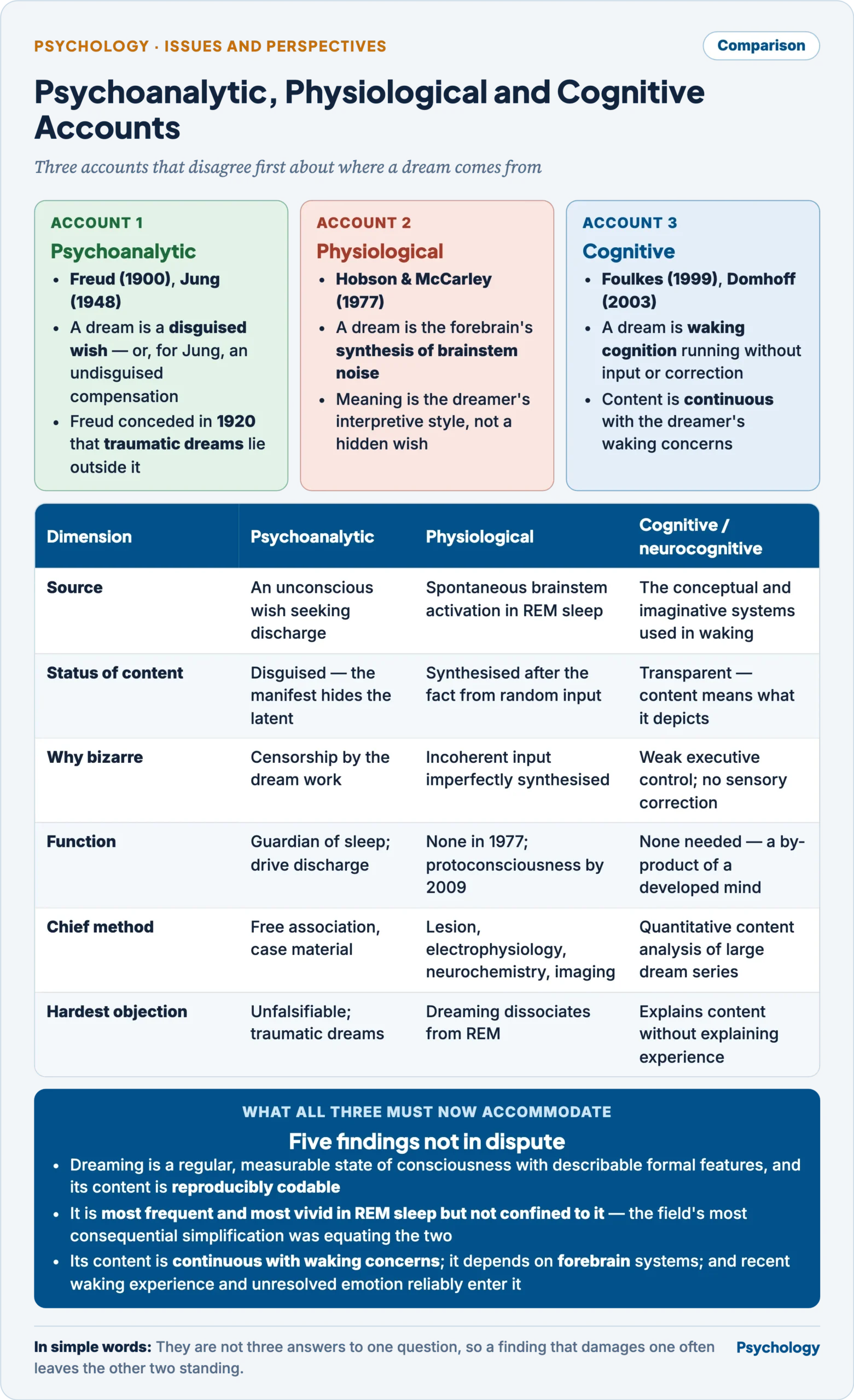
The three accounts disagree first about where a dream comes from; every other disagreement between them follows from that one.
| Dimension | Psychoanalytic | Physiological | Cognitive / neurocognitive |
|---|---|---|---|
| Source of the dream | An unconscious wish seeking discharge | Spontaneous brainstem activation in REM sleep | The same conceptual and imaginative systems used in waking |
| Status of the content | Disguised; the manifest hides the latent | Synthesised after the fact from random input | Transparent; content means what it depicts |
| Why dreams are bizarre | Censorship by the dream work | Incoherent input imperfectly synthesised | Reduced executive control and absent sensory correction |
| Function | Guardian of sleep; drive discharge | None in the 1977 form; protoconsciousness in the later form | None necessary; dreaming is a by-product of a developed cognitive system |
| Chief method | Free association, case material | Lesion, electrophysiology, neurochemistry, imaging | Quantitative content analysis of large dream series |
| Hardest objection | Unfalsifiable; traumatic dreams | Dreaming dissociates from REM | Explains content without explaining experience |
The functions of dreaming
- Threat simulation. Revonsuo (2000) proposed that dreaming is a biological adaptation that simulates threatening events and rehearses threat perception and avoidance, selected in an ancestral environment where any advantage in dealing with danger raised reproductive success.
- The supporting evidence is the predominance of threat and misfortune in normative dream content, in children’s dreams, in recurrent dreams and nightmares, and in the dreams of people exposed to real danger.
- The objections are serious. Much threat content is unrealistic and of little rehearsal value, approach and social dreams are at least as common as avoidance dreams, and no study has shown that threat-rehearsing dreamers fare better — which the adaptive claim requires.
- Revonsuo, Tuominen and Valli (2015) have since broadened the account into a social simulation theory of rehearsing social bonds.
- Emotional processing and mood regulation. Cartwright (1979) proposed that repetitive dreams index an unresolved emotional problem which dreaming works on across the night. Her later studies of people undergoing divorce associated dreaming about the former spouse with better subsequent adjustment.
- Memory consolidation. Wamsley, Tucker, Payne, Benavides and Stickgold (2010) trained 99 participants on a virtual maze, then retested them after a nap or an equivalent waking interval.
- Nappers reporting maze-related dream content improved roughly tenfold more than nappers who did not, and those dreamers had been the weaker performers at training (Wamsley and colleagues, 2010).
- The reports were fragments and thematic associates rather than replays, so dreaming is better read as a marker of consolidation than as its mechanism (Wamsley and colleagues, 2010). The consolidation evidence proper is taken up in Sleep: Stages, Physiology and Functions.
- No function at all. Flanagan (2000) argued that dreaming is most plausibly a by-product of a sleeping brain built for other purposes, and that the experience may matter to the dreamer while serving no biological end. This is the null hypothesis the functional accounts must beat, and it remains live.
Wish fulfilment assessed
- The wish-fulfilment theory should be rejected as a general account of dreaming, and the reasons are specific rather than a matter of taste.
- Content tells against it. Decades of content analysis find dreams dominated by ordinary concerns, aggression and misfortune, not by gratification. If dreams were wishes fulfilled, they would not be so persistently unpleasant.
- Nightmares and post-traumatic dreams contradict it in the direction Freud himself conceded in 1920, and they are common rather than exceptional.
- The censorship mechanism is unfalsifiable. Any manifest content can be reconciled with any latent wish by invoking enough disguise, so the theory predicts nothing in advance.
- Children’s dreams do not fit. The very young have the strongest undisguised drives and the sparsest dreams (Foulkes, 1999), which reverses the predicted relation.
- A restricted and defensible residue survives, and it is worth stating because it is what the evidence supports.
- Dreams do draw on recent waking experience, including material the dreamer has not consciously resolved — Freud’s day residue, confirmed by every content analysis since.
- Dreams are emotionally charged and often concern the dreamer’s own unacknowledged preoccupations, which is continuity rather than wish fulfilment but is not far from what Freud observed.
- Dreaming is forebrain-driven and sensitive to dopaminergic manipulation (Solms, 2000), so the claim that dreams arise from motivational systems rather than from brainstem noise has more support now than it had in 1977.
- The accurate formulation is that dreams express the dreamer’s concerns rather than fulfil their wishes, and that they do so openly rather than in disguise.
Criticisms and evaluation
- The psychoanalytic account is unfalsifiable in its central mechanism and rests on self-selected clinical case material with no control series; latent content is recovered by a method whose output cannot be independently checked.
- Activation-synthesis understated the input. Brainstem activation is not random with respect to content, dreaming survives REM-abolishing brainstem damage and fails after forebrain damage, and the account cannot explain why dream content is so consistently about the dreamer’s own life.
- AIM describes states rather than explaining experience. Placing REM sleep in a three-dimensional space says what is physiologically distinctive about it, not why that state is accompanied by a world.
- The neurocognitive account buys reliability with reach. Content analysis is reproducible, but counting characters and aggressions says nothing about the felt quality of dreaming, and the continuity hypothesis is near-unfalsifiable in the other direction, since almost any content matches some waking concern.
- Function claims outrun their evidence. Threat simulation, social simulation, mood regulation and consolidation are all compatible with the content data and none has a decisive test; the by-product hypothesis has not been excluded.
- Method constrains everything. Dream science depends on retrospective verbal reports of a state the reporter has left, filtered through recall, secondary revision and the demand characteristics of the laboratory; home and laboratory collection yield systematically different content.
- What survives is substantial. Five findings are not in dispute, and all three accounts must now accommodate them.
- Dreaming is a regular, measurable state of consciousness with describable formal features.
- It is most frequent and most vivid in REM sleep but is not confined to it.
- Its content is continuous with waking concerns and is reproducibly codable.
- It depends on forebrain systems and matures with cognitive development.
- Recent waking experience and unresolved emotion reliably enter it.
Previous Year Questions
- 2026Do our dreams represent unconscious wish fulfillment? Discuss the meaning and functions of dreams.
- 2024Discuss the functions of REM sleep and major theories of dreaming.
- 2013How the psychoanalytic view differs from physiological or cognitive view of dream?
- 2010What is REM sleep and how is it related to dreaming?