

Study of consciousness – sleep-wake schedules.
Official Syllabus: Paper I · Unit 14 Issues and Perspectives in Modern Contemporary Psychology
Circadian rhythms are endogenous, self-sustaining oscillations with a period of about — but not exactly — twenty-four hours, which persist in constant conditions and are reset by environmental time cues.
— the standard definition, after Halberg (1959), who coined the term circadian from the Latin circa (about) and dies (a day)
Sleep is not simply what happens when waking stops. It is scheduled, by a clock that runs whether or not the environment supplies a day, and the schedule is a separate problem from the architecture of the night. The topic settles why consciousness is withdrawn at particular hours, why that timing resists being changed by will, and what happens when work, travel or schooling force a schedule the clock does not share.
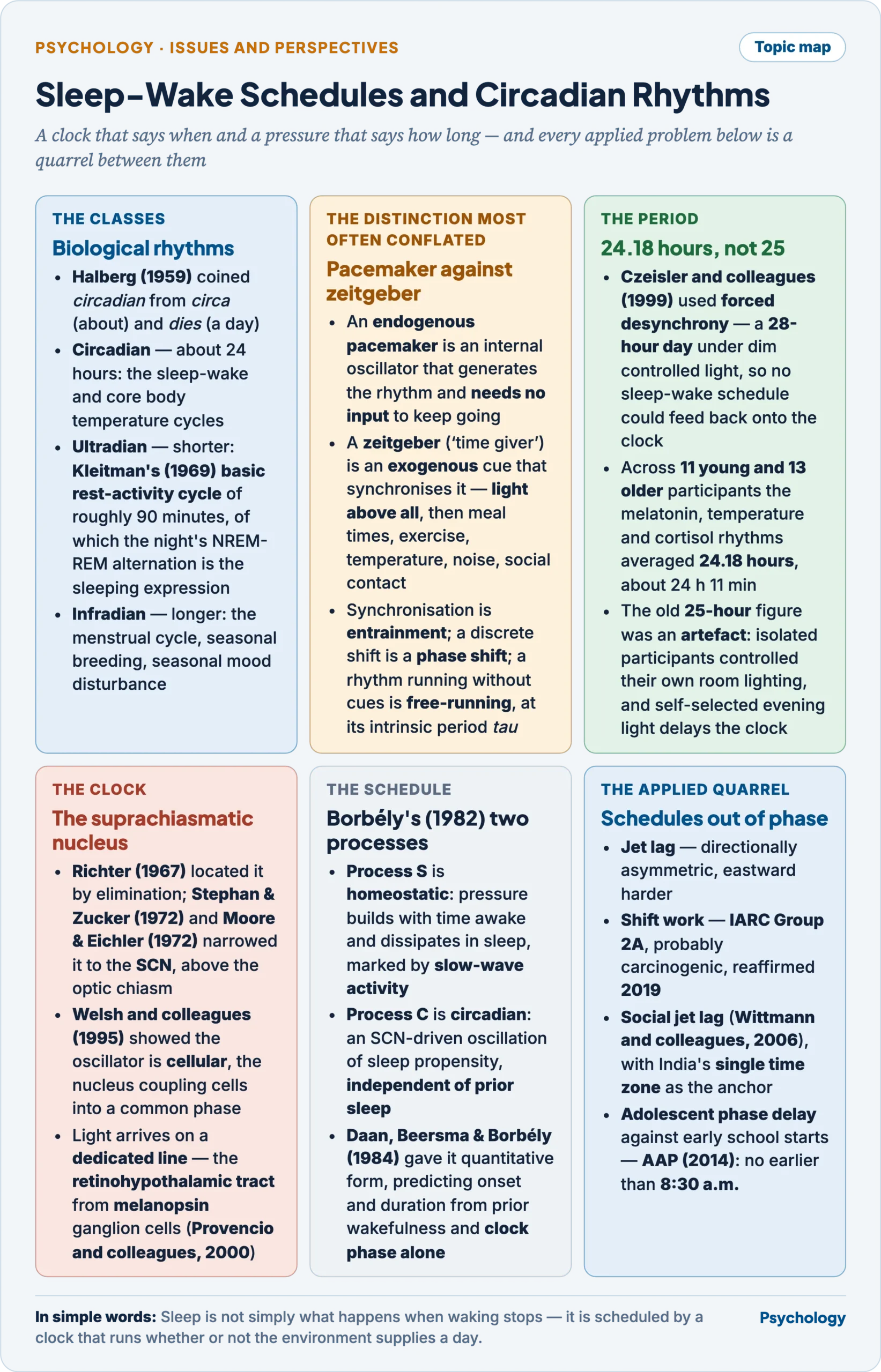
Two causes, not one: a clock that says when and a pressure that says how long. Every applied problem below is a quarrel between them.
The study of consciousness in time: biological rhythms
- A biological rhythm is a cyclic change in a biological process. Rhythms are classified by period length, and all three classes run in humans at once.
- Circadian rhythms have a period of about 24 hours. The sleep-wake cycle and the core body temperature cycle are the best characterised.
- Ultradian rhythms run shorter than a day. Kleitman proposed a basic rest-activity cycle of roughly 90 minutes across the whole 24 hours, of which the night’s non-REM-REM alternation is the sleeping expression.
- Infradian rhythms run longer than a day — the menstrual cycle, and the seasonal rhythms of animal breeding and of seasonal mood disturbance.
- Two kinds of cause are kept strictly apart, and conflating them is the commonest error here.
- An endogenous pacemaker is an internal oscillator that generates the rhythm and needs no input to keep going.
- A zeitgeber (“time giver”) is an exogenous cue used to synchronise that rhythm to the environment — light above all, then meal times, exercise, temperature, noise and social contact.
- Synchronisation is entrainment; a discrete shift produced by a cue is a phase shift. A rhythm running without cues is free-running, and its period is the clock’s intrinsic period, written tau.
Free-running rhythms and the intrinsic period of the clock
- Aschoff and Wever (1962) gave the first controlled demonstration that the human rhythm is endogenous, placing volunteers in an underground chamber with no clocks, daylight or social time cues.
- Activity, temperature and urinary excretion went on cycling but drifted away from 24 hours, so the rhythm is generated internally and merely corrected by the environment.
- Michel Siffre, a French geologist, supplied the vivid single case: in 1962 he spent about two months alone in a glacier cave without time cues, and on emerging was weeks behind in his count of the days.
- The 25-hour period reported from this generation of isolation studies is an artefact, and the correction matters because the figure is still widely quoted. Isolated participants controlled their own room lighting, and self-selected evening light systematically delays the clock (Czeisler and colleagues, 1999).
- Czeisler and colleagues (1999) removed that confound with a forced desynchrony protocol, imposing a 28-hour day under dim controlled light so no sleep-wake schedule could feed back onto the clock.
- Across 11 young and 13 older participants, the intrinsic period of the melatonin, temperature and cortisol rhythms averaged 24.18 hours — about 24 hours and 11 minutes.
- Period was near-identical in the two age groups, which removes age-related period change as the reason older people wake early.
- The near-24-hour value explains why entrainment is easy and why the clock drifts later without cues: it needs advancing by only a few minutes a day, and delay is the direction of least resistance.
The suprachiasmatic nucleus as the master clock
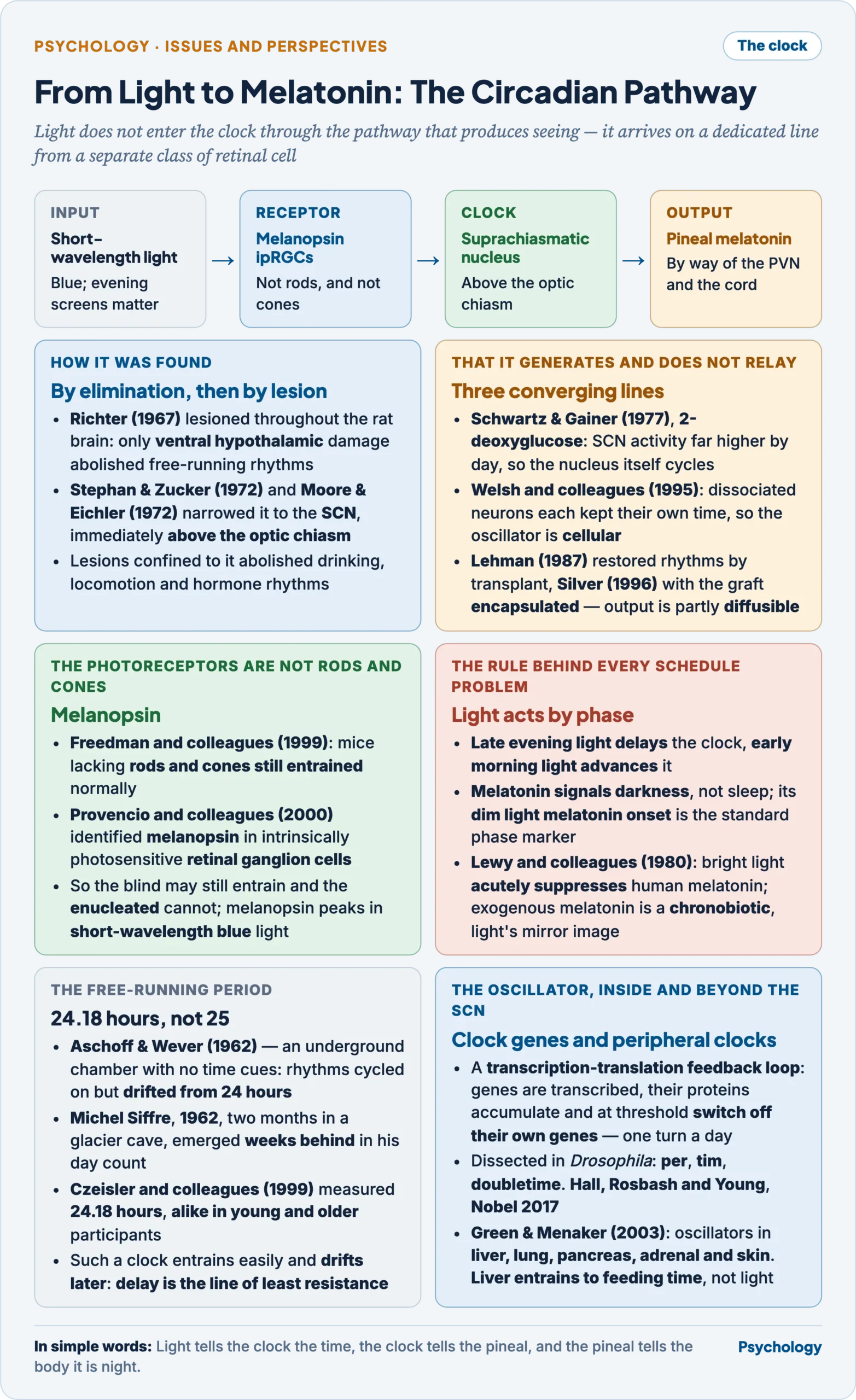
Light does not enter the clock through the visual pathway that produces seeing; it arrives on a dedicated line from a separate class of retinal cell.
- Richter (1967) located the clock by elimination, lesioning structures throughout the rat brain and finding that only ventral hypothalamic damage abolished free-running rhythms of activity, feeding and drinking. The region was too small for him to resolve further.
- Stephan and Zucker (1972) and Moore and Eichler (1972) narrowed it to the suprachiasmatic nucleus (SCN), a paired cluster of small, densely packed neurons immediately above the optic chiasm.
- Lesions confined to the SCN abolished circadian rhythms of drinking, locomotion and hormone secretion while leaving the animal otherwise intact.
- Four converging lines establish that the SCN generates a rhythm rather than relaying one.
- Schwartz and Gainer (1977), using radioactive 2-deoxyglucose in rats, found SCN metabolic activity far higher by day than by night, so the nucleus itself cycles.
- SCN tissue explanted and kept alive continues to cycle in phase with the light-dark cycle the animal had experienced.
- Welsh and colleagues (1995) dissociated SCN neurons and recorded them on a microelectrode array. Each kept circadian time independently, with its own peak — so the oscillator is cellular, and the nucleus couples cells into a common phase.
- Lehman and colleagues (1987) restored rhythms in SCN-lesioned hamsters by transplanting donor tissue; Silver and colleagues (1996) repeated this with the graft sealed in a capsule where no axons could grow out. Rhythms returned, so the output is partly diffusible rather than purely synaptic.
Light as the entraining signal
- Light reaches the SCN by the retinohypothalamic tract, a direct retinal projection anatomically separate from the pathway serving vision, with a secondary geniculohypothalamic input from the thalamus.
- The photoreceptors are not the rods and cones. Freedman and colleagues (1999) found mice genetically lacking rods and cones still entrained normally to light.
- Provencio and colleagues (2000) identified the pigment responsible, melanopsin, in a small population of intrinsically photosensitive retinal ganglion cells.
- People with no conscious light perception may therefore still entrain, while those whose eyes have been removed cannot.
- Melanopsin is most sensitive to short-wavelength (blue) light, so evening screen and LED exposure affects the clock disproportionately to its brightness.
- The response to light is phase-dependent, not simply dose-dependent, and this is the most useful fact in managing every schedule problem below.
- Light in the late evening and early night delays the clock; light in the late night and early morning advances it; light in the middle of the subjective day does very little.
Melatonin, the pineal gland and the clock’s hormonal output
- The SCN’s chief hormonal output runs a long circuit: to the hypothalamic paraventricular nucleus, down the cord to sympathetic preganglionic neurons, through the superior cervical ganglion, and on to the pineal gland, which synthesises melatonin from serotonin.
- Melatonin secretion is high at night and low by day in nocturnal and diurnal species alike, so it signals darkness rather than sleep. Its rise under dim light, the dim light melatonin onset, is the standard marker of circadian phase.
- Lewy and colleagues (1980) showed that bright light acutely suppresses human melatonin, establishing that the human clock is light-responsive in the way animal clocks are — a point that had been doubted.
- Exogenous melatonin therefore acts as a chronobiotic, advancing the clock when given in the late afternoon or evening and delaying it in the morning — the mirror image of light. Its hypnotic effect at ordinary doses is modest; the phase shift is the useful part.
- The pineal also mediates seasonal rhythms by signalling night length: Rusak and Morin (1976) found SCN lesions abolished the annual testosterone and breeding rhythm in male hamsters.
Clock genes and peripheral oscillators
- The cellular oscillator is a transcription-translation feedback loop: clock genes are transcribed, their proteins accumulate, and on reaching a threshold those proteins switch off their own genes; as they degrade, transcription resumes. One turn takes about a day.
- The loop was dissected in Drosophila, where period (per) and timeless (tim) were the first components identified and doubletime regulates how fast the protein accumulates. Hall, Rosbash and Young received the 2017 Nobel Prize in Physiology or Medicine for the work.
- Ralph and Menaker (1988) found a single-gene mutation in the golden hamster, tau, that shortened the free-running period — the first demonstration that mammalian circadian period is under simple genetic control.
- Clock genes are not confined to the SCN. Green and Menaker (2003) set out the standard picture of peripheral oscillators in liver, lung, pancreas, adrenal and skin, each able to cycle autonomously and normally held in phase by SCN signals.
- Liver oscillators entrain substantially to feeding time rather than light, which is why eating at biological night desynchronises metabolism from behaviour.
Why consciousness is withdrawn at some hours and not others: the two-process model
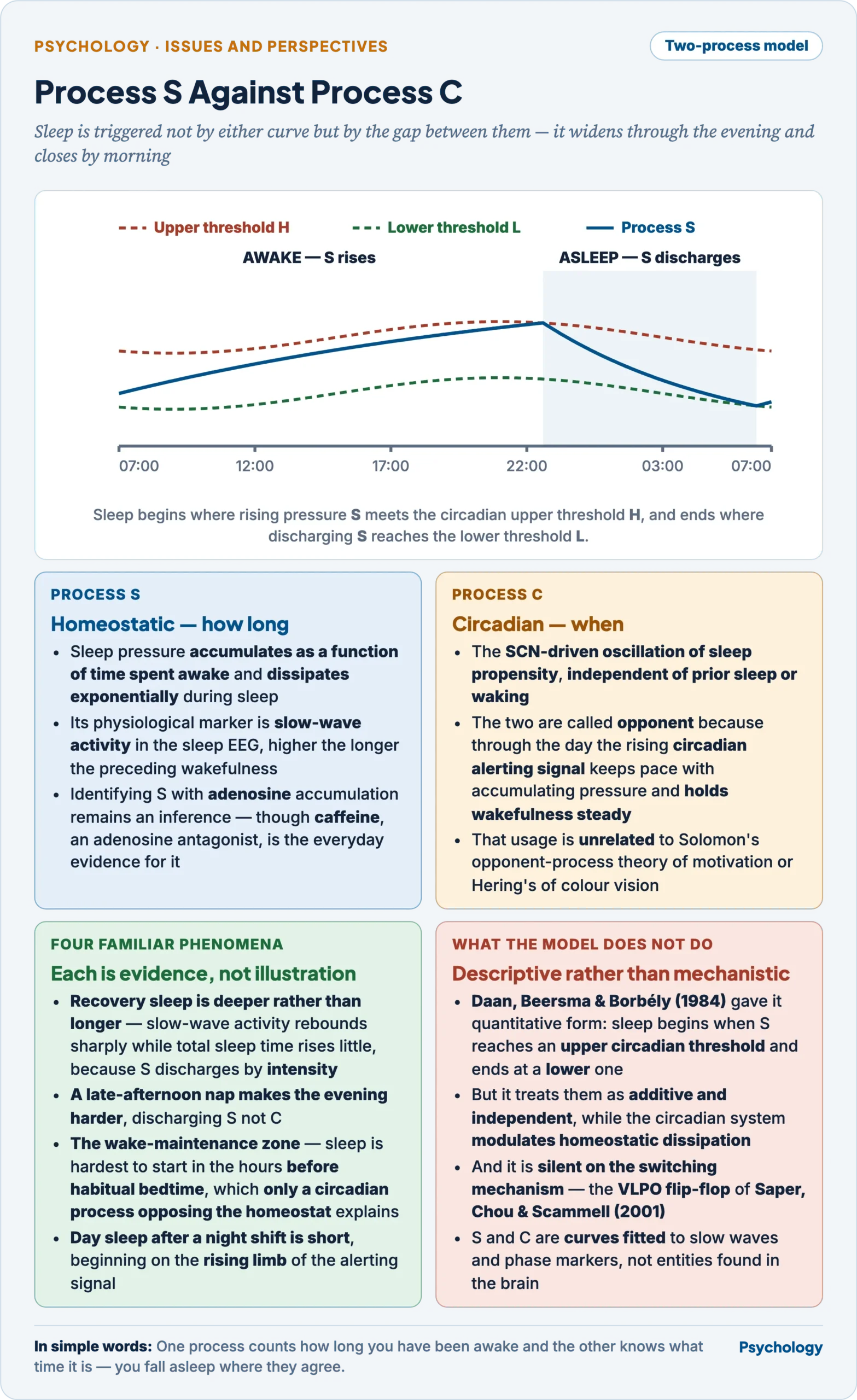
Sleep is triggered not by either curve but by the gap between them: it widens through the evening and closes by morning.
- Borbély (1982) proposed that sleep-wake timing is the joint product of two independent processes, and this remains the field’s organising framework.
- Process S is homeostatic. Sleep pressure accumulates as a function of time spent awake and dissipates exponentially during sleep. Its physiological marker is slow-wave activity in the sleep electroencephalogram, which is higher the longer the preceding wakefulness.
- Process C is circadian. It is the SCN-driven oscillation of sleep propensity, independent of prior sleep or waking, and it continues to cycle whether the person has slept or not.
- The two are often called opponent, because through the waking day the circadian alerting signal rises in step with accumulating sleep pressure and so holds wakefulness steady.
- That usage is unrelated to Solomon’s opponent-process theory of acquired motivation or Hering’s opponent-process theory of colour vision, which share the phrase and nothing else.
- Daan, Beersma and Borbély (1984) gave the model quantitative form, with sleep beginning when Process S reaches an upper circadian threshold and ending when it falls to a lower one. The formulation predicts sleep onset and duration from prior wakefulness and clock phase alone.
- Four familiar phenomena follow, and each is evidence for the two-process account rather than illustration of it.
- Recovery sleep is deeper rather than proportionally longer. After deprivation slow-wave activity rebounds sharply while total sleep time rises far less, because Process S is discharged by intensity.
- A late-afternoon nap makes the evening harder, discharging Process S without touching Process C.
- The wake-maintenance zone. Sleep is hardest to initiate in the two or three hours before habitual bedtime, when the circadian alerting signal peaks although sleep pressure is at its highest. Only a circadian process opposing the homeostat produces this.
- Day sleep after a night shift is short. It begins with high Process S but on the rising limb of the alerting signal, and ends with sleep pressure only partly discharged.
- One limitation belongs with the model: it treats the two processes as additive and independent, whereas the circadian system modulates homeostatic dissipation itself, and it is silent on the switching mechanism that makes state transitions abrupt rather than graded.
Sleep-wake schedules out of phase with the clock
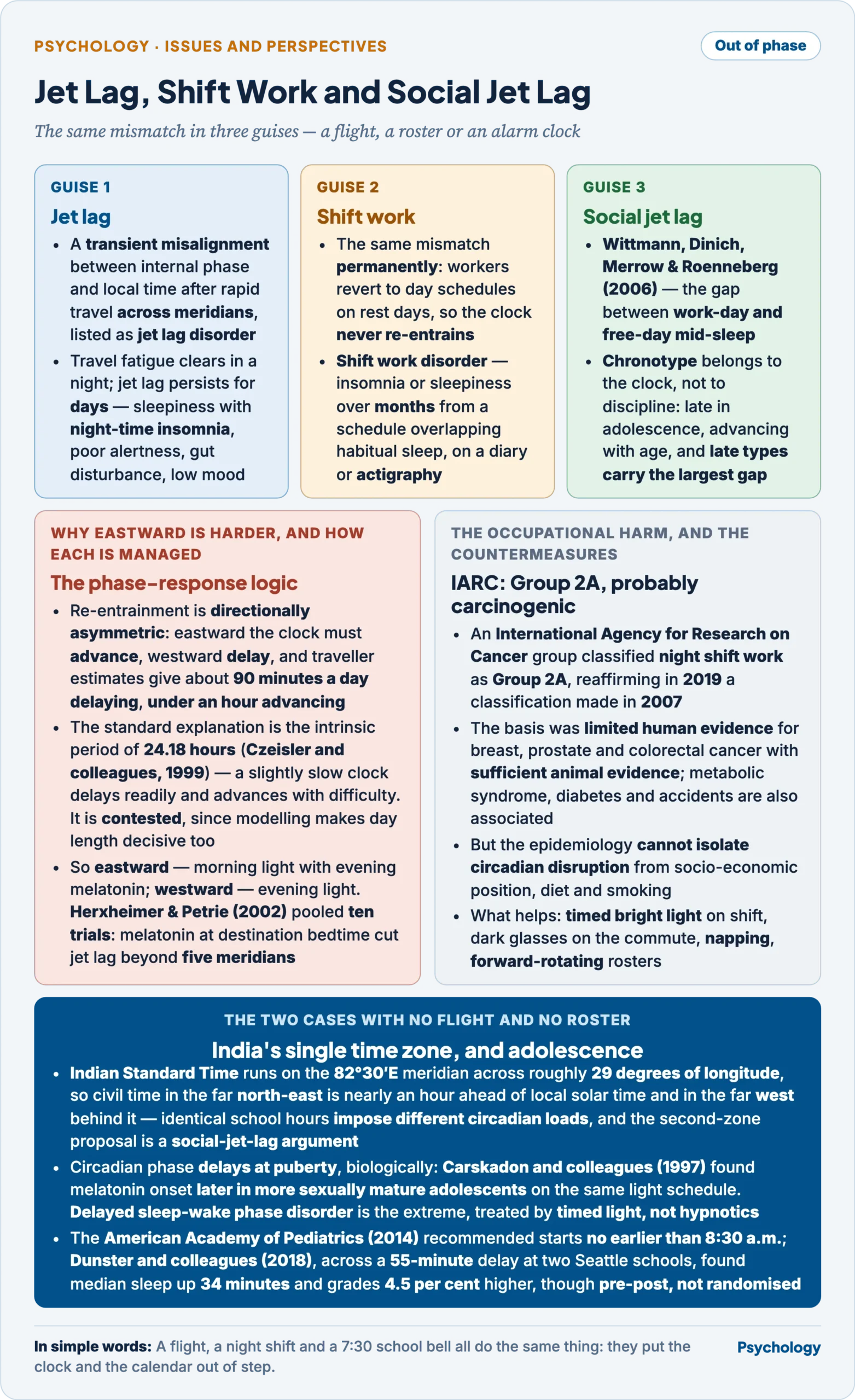
The same mismatch in three guises. Only the cause of the misalignment differs — a flight, a roster, or an alarm clock.
Jet lag
- Jet lag is a transient misalignment between internal circadian phase and local time after rapid travel across meridians, and it is a genuine condition rather than travel fatigue — listed as jet lag disorder among the circadian rhythm sleep-wake disorders.
- Fatigue from a long flight resolves after one night’s rest, while jet lag persists for days with the signature of phase mismatch: daytime sleepiness with night-time insomnia, impaired alertness, gastrointestinal disturbance and low mood.
- Travel across meridians produces it; a flight of the same duration along a meridian does not — the cleanest demonstration that the cause is phase shift and not travel.
- Re-entrainment is slow and directionally asymmetric: eastward travel requires the clock to advance, westward travel to delay. Early estimates from travellers put the achievable shift at roughly 90 minutes a day delaying and under an hour advancing.
- The standard explanation is the intrinsic period of 24.18 hours (Czeisler and colleagues, 1999): a clock running slightly slow delays readily and advances with difficulty.
- That explanation is contested, since modelling work makes day length and therefore season also decisive; the direction effect is empirically robust while its mechanism is unsettled.
- Management follows the phase-response logic: for eastward travel, morning light at destination and evening melatonin advance the clock; for westward travel, evening light delays it.
- Herxheimer and Petrie (2002), pooling ten randomised trials, found melatonin near destination bedtime reduced jet lag after crossing five or more meridians, with 0.5 to 5 mg similarly effective and higher doses no better.
Shift work
- Night work imposes the same mismatch permanently, and because workers revert to daytime schedules on rest days the clock never completes re-entrainment.
- Shift work disorder is diagnosed where a recurring schedule overlapping the habitual sleep period produces insomnia or excessive sleepiness over months, with the misalignment shown on a sleep diary or actigraphy.
- An International Agency for Research on Cancer working group classified night shift work as Group 2A, probably carcinogenic to humans, reaffirming in 2019 a classification first made in 2007.
- The basis was limited human evidence for breast, prostate and colorectal cancer with sufficient animal evidence. Metabolic syndrome, type 2 diabetes, cardiovascular disease and raised accident rates are also associated.
- Countermeasures with support are timed bright light during the shift with dark glasses on the morning commute, scheduled napping, forward- rather than backward-rotating rosters, and limiting consecutive nights.
Social jet lag and chronotype
- Chronotype is habitual phase preference — the morning and evening types — a property of the circadian system rather than of discipline, late in adolescence and advancing steadily with age.
- Wittmann, Dinich, Merrow and Roenneberg (2006) named social jet lag: the discrepancy between sleep timing on work days and free days, measured as the difference in mid-sleep.
- Late chronotypes accumulate the largest discrepancy, and the authors argued that the poorer sleep and wellbeing accompanying it follow from the misalignment rather than from being an evening type.
- The arrangement is structurally invisible, because the alarm clock rather than the body ends sleep on five days and the clock-driven schedule returns on two — a weekly phase shift without travel.
- India’s timekeeping supplies the anchor. A single time zone — Indian Standard Time, on the 82°30′E meridian — spans roughly 29 degrees of longitude.
- Civil time in the far north-east therefore runs close to an hour ahead of local solar time and in the far west behind it, so identical school and office hours impose different circadian loads.
- The standing proposal for a second zone is in substance a social-jet-lag argument.
Delayed sleep phase in adolescence and school start times
- Circadian phase delays at puberty, and the delay is biological rather than only social.
- Carskadon and colleagues (1997) found melatonin onset later in more sexually mature adolescents than in less mature ones on the same sleep and light schedule, so maturation and not autonomy alone shifts the clock.
- A delayed clock meeting an early school start truncates sleep on school days and displaces recovery sleep to weekends — adolescence as the clearest case of institutionally enforced social jet lag.
- Delayed sleep-wake phase disorder is the pathological extreme: habitual sleep onset and waking several hours later than conventional, with normal sleep quality once the person keeps their own schedule. Treatment is timed morning light and evening melatonin, not hypnotics.
- The policy evidence is unusually direct. The American Academy of Pediatrics (2014), in a policy statement on school start times, recommended that middle and high schools begin no earlier than 8:30 a.m., on the explicit ground of adolescent circadian biology.
- Dunster and colleagues (2018) used wrist actigraphy at two Seattle high schools before and after the district delayed the start by 55 minutes.
- Median sleep duration rose by 34 minutes and median grades were 4.5 per cent higher (Dunster and colleagues, 2018), with better attendance at the more economically disadvantaged school.
- The design is pre-post rather than randomised and the grade change is an association, so the sleep result is the firmer of the two.
Criticisms and evaluation
- The clock’s output is not one thing. Body temperature, melatonin, cortisol and alertness rhythms dissociate under forced desynchrony and under shift work, so a single phase marker can misrepresent the organism’s state.
- Period estimates were wrong for three decades because the isolation studies let participants control their own light — a standing caution against inferring an endogenous property from a protocol that permits feedback onto the measure.
- Zeitgebers other than light are weakly specified. Meal timing, exercise and social contact are routinely listed, but their phase-shifting power in humans is small and inconsistent beside light’s, and claims that temperature and noise reset the human clock lack comparable support.
- The animal evidence does not transfer cleanly. Lesion, transplant and knockout work is overwhelmingly in nocturnal rodents, whose SCN output drives activity at the opposite phase; the architecture generalises, the phase relations do not.
- The two-process model is descriptive rather than mechanistic. Processes S and C are curves fitted to slow-wave activity and phase markers; identifying Process S with adenosine accumulation remains an inference.
- Shift-work epidemiology cannot isolate circadian disruption. Night workers differ in socio-economic position, diet, smoking and sleep duration, and the exposure label bundles very different rosters — which is why the cancer classification rests on limited rather than sufficient human evidence.
- The applied literature is largely observational. Later school starts, social jet lag and health outcomes are studied without randomisation, and the firmest interventional evidence concerns sleep duration rather than the outcomes that justify the policy.
- What survives is substantial. Six findings are not in dispute.
- The rhythm is endogenous; the SCN is the master pacemaker; the oscillator is cell-autonomous and conserved from flies to humans.
- Light is the dominant zeitgeber and acts through melanopsin ganglion cells; the intrinsic period is near but not equal to 24 hours; and the response to light depends on phase.
- Together they account for every misalignment above. The architecture of the night that these schedules govern is set out in Sleep: Stages, Physiology and Functions.
Previous Year Questions
- 2025Is jet-lag a genuine phenomena? Explain it in the light of Circadian rhythms.
- 2015Why are we awake at certain times and asleep at others? Explain this with help of opponent process model.
- 2001Contemporary research has done much to inform us about the dark kingdom of sleep-wakefulness. Comment.