

Official syllabusPaper I · Unit 13 · Language and Communication
Language acquisition – predisposition, critical period hypothesis.
Definition
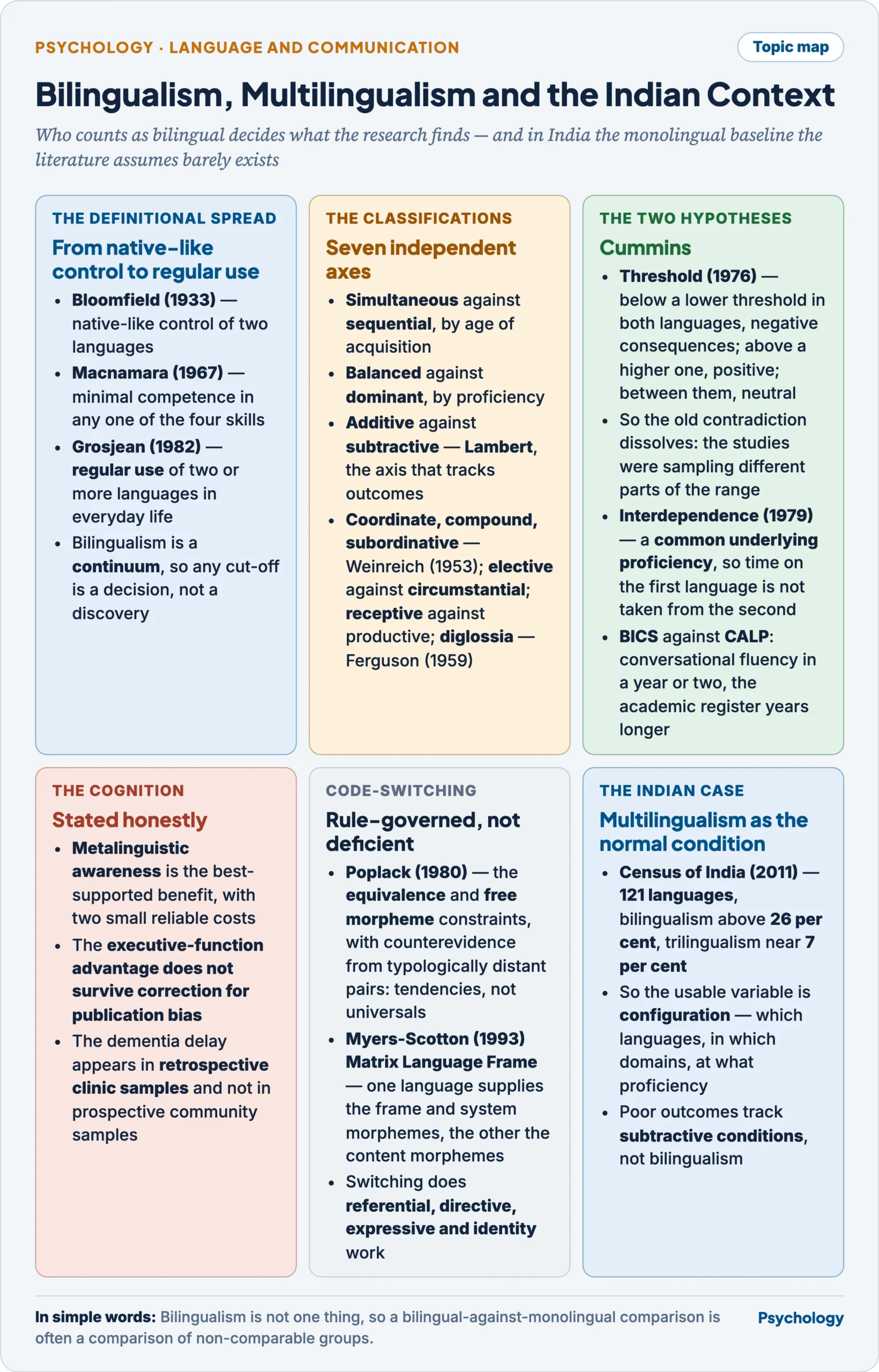
“Bilingualism is the native-like control of two languages.”
Bloomfield (1933)
Macnamara (1967) set the opposite bound — minimal competence in any one of the four skills in a second language — and Grosjean (1982) supplied the working definition between them: what matters is the regular use of two or more languages in everyday life, not mastery of either.
The spread between those definitions is the subject’s central problem. Who counts as bilingual decides what the research finds, and in India, where using several languages daily is unremarkable, the monolingual baseline the Western literature assumes barely exists.
What bilingualism is, and how it is classified
- Bilingualism is a continuum, not a category. Competence varies by language, skill and domain, so any cut-off is a decision rather than a discovery — and the cut-off chosen determines the result.
- Multilingualism is the same phenomenon with more than two languages, and is the commoner condition worldwide.
- By order and age of acquisition.
- Simultaneous bilingualism — both languages from infancy, conventionally before about age three, with no first-language baseline to build on.
- Sequential or successive bilingualism — a second language added after the first is established, which is the commoner route.
- By relative proficiency: balanced bilingualism, roughly equal competence in both, against dominant bilingualism, which is the ordinary case.
- By social consequence — the classification that tracks outcomes.
- Lambert distinguished additive bilingualism, where a second language is added while the first retains status and is maintained, from subtractive bilingualism, where the second displaces the first under social pressure, with loss of competence in it.
- By cognitive organisation, following Weinreich (1953): coordinate bilinguals hold two separate meaning systems, compound bilinguals one meaning system with two labels, and subordinative bilinguals access the second language through the first.
- By circumstance: elective bilingualism, chosen through instruction, against circumstantial bilingualism, forced by migration or by the language of school and market.
- By modality: receptive bilingualism, understanding without producing — very common in Indian settings — against productive bilingualism.
- By functional distribution: diglossia, from Ferguson (1959), is the stable allocation of a high variety to formal domains and a low variety to intimate ones — the normal Indian arrangement, not an anomaly.
Acquisition: simultaneous and sequential bilingualism
- Volterra and Taeschner (1978) proposed a unitary language system account of simultaneous acquisition, on which the child begins with one undifferentiated lexicon and separates the two systems in stages.
- The evidence since favours early differentiation: infants discriminate their two languages’ rhythms in the first months, and syntactic development proceeds largely separately, with cross-linguistic influence rather than fusion.
- Milestones arrive on the monolingual schedule when both languages are counted together. Babbling, first words and first combinations come at comparable ages, and apparent delay is usually an artefact of measuring one language only.
- Vocabulary is the standing asymmetry: fewer words in each language, an equal or greater number of concepts overall, so total conceptual vocabulary is the valid measure.
- Sequential acquisition adds stages absent from the simultaneous case: a receptive or silent period, rapid acquisition of conversational competence, and much slower acquisition of the academic register.
- Cummins marks that gap as BICS against CALP — basic interpersonal communicative skills, contextualised conversational fluency acquired within a year or two, against cognitive academic language proficiency, the decontextualised register of schooling, which takes several years longer.
- The consequence is a costly diagnostic error: a child who converses fluently is judged ready for instruction in that language, is not, and the academic failure that follows is attributed to ability.
- Whether a critical period constrains second-language attainment, and the evidence on age of arrival, is treated in the predisposition and the critical period hypothesis article.
Code-switching and code-mixing
- Code-switching is alternation across utterances or clause boundaries; code-mixing is insertion of one language’s elements inside an utterance framed by another. Everyday Indian speech does both continuously.
- The deficit reading is wrong, and the evidence is grammatical: switching is constrained rather than random, so it requires command of both grammars and of the interface between them.
- Poplack (1980), on Spanish-English switching among New York Puerto Ricans, proposed two constraints.
- The equivalence constraint: switches fall where the two languages’ surface orders correspond. The free morpheme constraint: no switch between a bound morpheme and a lexical form of the other language.
- Both have substantial counterevidence from pairs with very different morphology — Turkish-English, Japanese-English and Arabic-English data all contain violations — so they are tendencies in typologically similar pairs, not universals.
- Myers-Scotton (1993) replaced them with the Matrix Language Frame model: one language supplies the grammatical frame and the system morphemes, the other contributes content morphemes, and the frame may change across a discourse.
- Poplack (1980), on Spanish-English switching among New York Puerto Ricans, proposed two constraints.
- Switching does social work, which is the psychological content of the phenomenon.
- Referential — filling a lexical gap, or using the term the domain is conducted in.
- Directive — including or excluding a hearer.
- Expressive and phatic — marking affect, intimacy, humour or a change of footing.
- Identity marking — signalling membership of a community, generation or class, and accommodating towards or diverging from an interlocutor.
- Costs exist but are small and situational. Laboratory tasks that cue a switch produce a measurable switch cost; voluntary switching in conversation is far cheaper, which is why fluent speakers do it constantly without disruption.
Interference, transfer and the two hypotheses
- Transfer is the use of knowledge of one language in the other: positive where structures align — cognates, shared orthographic principles, transferable literacy skills — and negative, or interference, where they do not.
- Interference appears at every level: phonological (accent), lexical (false friends), syntactic (word order, article use) and pragmatic (politeness conventions carried across). It is evidence of a single interacting system, not of confusion.
- The threshold hypothesis — Cummins (1976) — holds that the cognitive effects of bilingualism depend on the level of competence reached.
- Below a lower threshold in both languages, the child has neither as a full instrument of thought, and negative consequences follow.
- Above a higher threshold in both, positive consequences become available.
- Between them, bilingualism is cognitively neutral. This dissolves the old contradiction between studies finding deficits and studies finding advantages: they were sampling different parts of the range.
- The developmental interdependence hypothesis — Cummins (1979) — holds that competence in the second language is partly a function of competence in the first at the time second-language exposure begins, because both draw on a common underlying proficiency.
- The policy implication is counter-intuitive and well attested: time spent developing the first language is not time taken from the second.
- Poor outcomes track subtractive conditions, not bilingualism. Where the home language is devalued and displaced before it is consolidated the child crosses neither threshold, and the interdependence account explains why the second language also suffers.
- Criticism. MacSwan and Rolstad argue that the threshold and the BICS-CALP distinction are not precisely operationalised, that no independent measure fixes where a threshold lies, and that both have been used to label minority-language children deficient.
Cognitive consequences, stated honestly
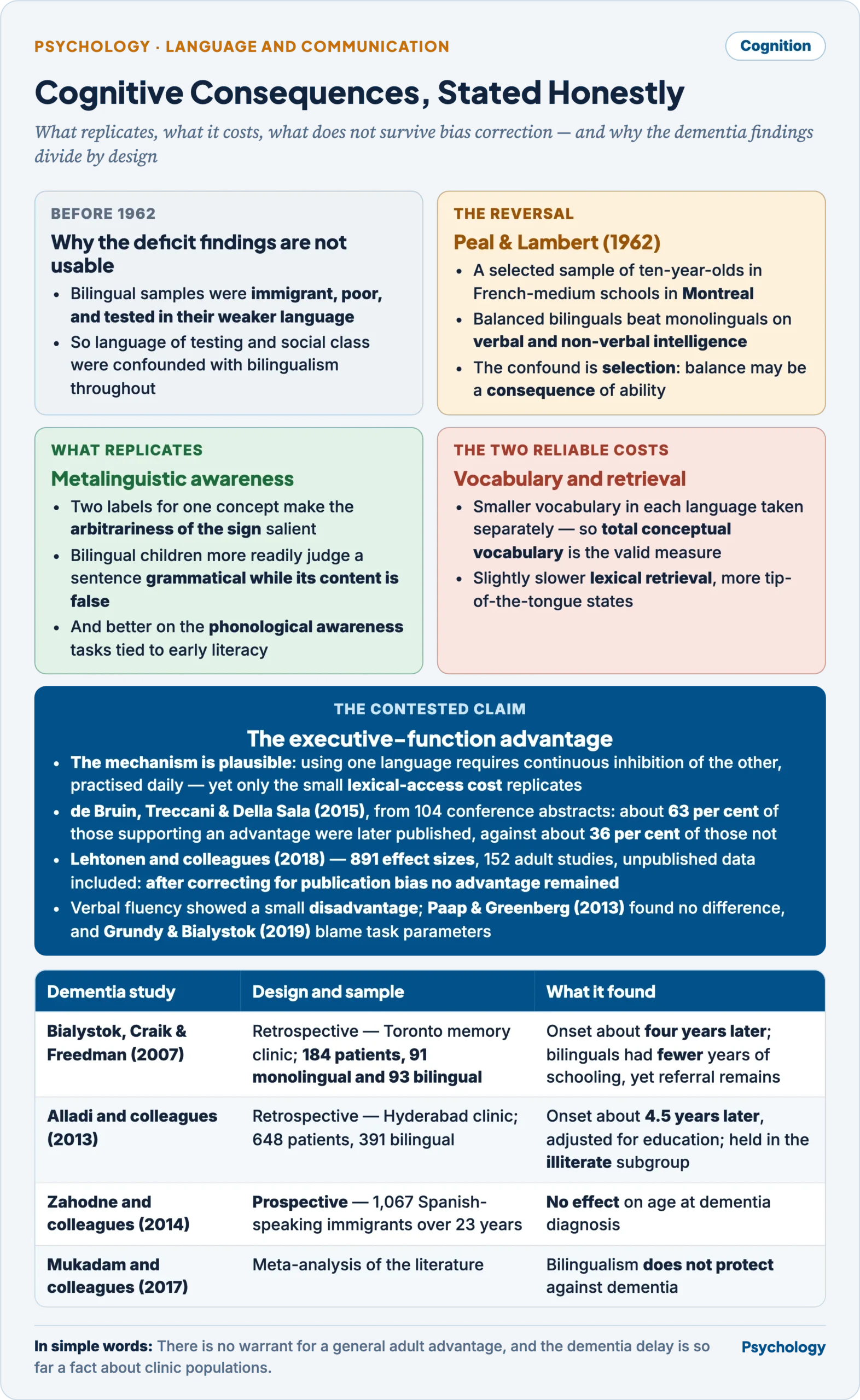
- The early literature’s deficit findings are not usable: bilingual samples were immigrant, poor and tested in their weaker language, so language of testing and social class were confounded with bilingualism throughout.
- Peal and Lambert (1962) reversed the picture with a carefully selected sample of ten-year-olds in French-medium schools in Montreal.
- Balanced bilinguals outperformed monolinguals on non-verbal measures and on verbal intelligence measures, and the authors proposed greater concept formation and symbolic flexibility.
- The confound is selection: balanced bilingualism may be a consequence of ability rather than a cause, since the brighter child is likelier to reach balance.
- Metalinguistic awareness is the best-supported benefit. Having two labels for one concept makes the arbitrariness of the sign salient, so bilingual children treat language as an object of thought earlier.
- Bilingual children judge a sentence grammatical while its content is false more readily — which requires attending to form independently of meaning — and do better on the phonological awareness tasks associated with early literacy.
- Two small reliable costs accompany it: a smaller vocabulary in each language taken separately, and slightly slower lexical retrieval with more tip-of-the-tongue states, both attributable to divided exposure and to competition between labels.
- The executive-function advantage is the contested claim, and has to be treated as contested.
- The proposed mechanism is plausible: using one language requires continuous inhibition of the other, so bilinguals practise inhibition, switching and monitoring daily, and that practice should transfer to non-linguistic control tasks.
- de Bruin, Treccani and Della Sala (2015) examined 104 conference abstracts on bilingualism and executive control. Roughly 63 per cent of those supporting an advantage were later published, against roughly 36 per cent of those not — a gap unexplained by task or sample size.
- Lehtonen and colleagues (2018) meta-analysed 891 effect sizes from 152 adult studies across six executive domains, unpublished data included. Before correction: a very small advantage for inhibition, shifting and working memory, none for monitoring or attention.
- After correcting for publication bias no advantage remained, and verbal fluency showed a small bilingual disadvantage.
- Paap and Greenberg (2013) and later studies found no group difference on standard control tasks; Grundy and Bialystok (2019) reply that failed replications often differ in task parameters and participant characteristics, so part of the dispute is about what counts as a replication.
- The defensible position: there is no warrant for a general adult advantage. It may hold for particular profiles — highly balanced, high-switching, lifelong bilinguals — and the literature cannot carry the claim in its popular form.
- The dementia findings divide by study design, which is the honest way to present them.
- Bialystok, Craik and Freedman (2007) reviewed the records of 184 patients at a Toronto memory clinic — 91 monolingual and 93 bilingual — and found that bilinguals dated the onset of symptoms about four years later.
- The bilingual group had fewer years of schooling, so education cannot explain the gap — but referral route, migration history and clinic selection can.
- Alladi and colleagues (2013) reviewed 648 dementia patients at a clinic in Hyderabad, 391 of them bilingual, and found onset about 4.5 years later — across Alzheimer’s disease, frontotemporal and vascular dementia, and after adjustment for education, sex, occupation and residence.
- It held in the illiterate subgroup, the strongest available answer to the education confound, with no additional benefit from more than two languages.
- Zahodne and colleagues (2014) followed 1,067 Spanish-speaking immigrants prospectively over 23 years and found no effect on age at dementia diagnosis. Mukadam and colleagues (2017), meta-analysing the literature, concluded that bilingualism does not protect against dementia.
- So the delay appears in retrospective clinic samples and not in prospective community samples. Until that design difference is resolved it is a fact about clinic populations rather than a protective effect.
- Bialystok, Craik and Freedman (2007) reviewed the records of 184 patients at a Toronto memory clinic — 91 monolingual and 93 bilingual — and found that bilinguals dated the onset of symptoms about four years later.
Ethnolinguistic vitality
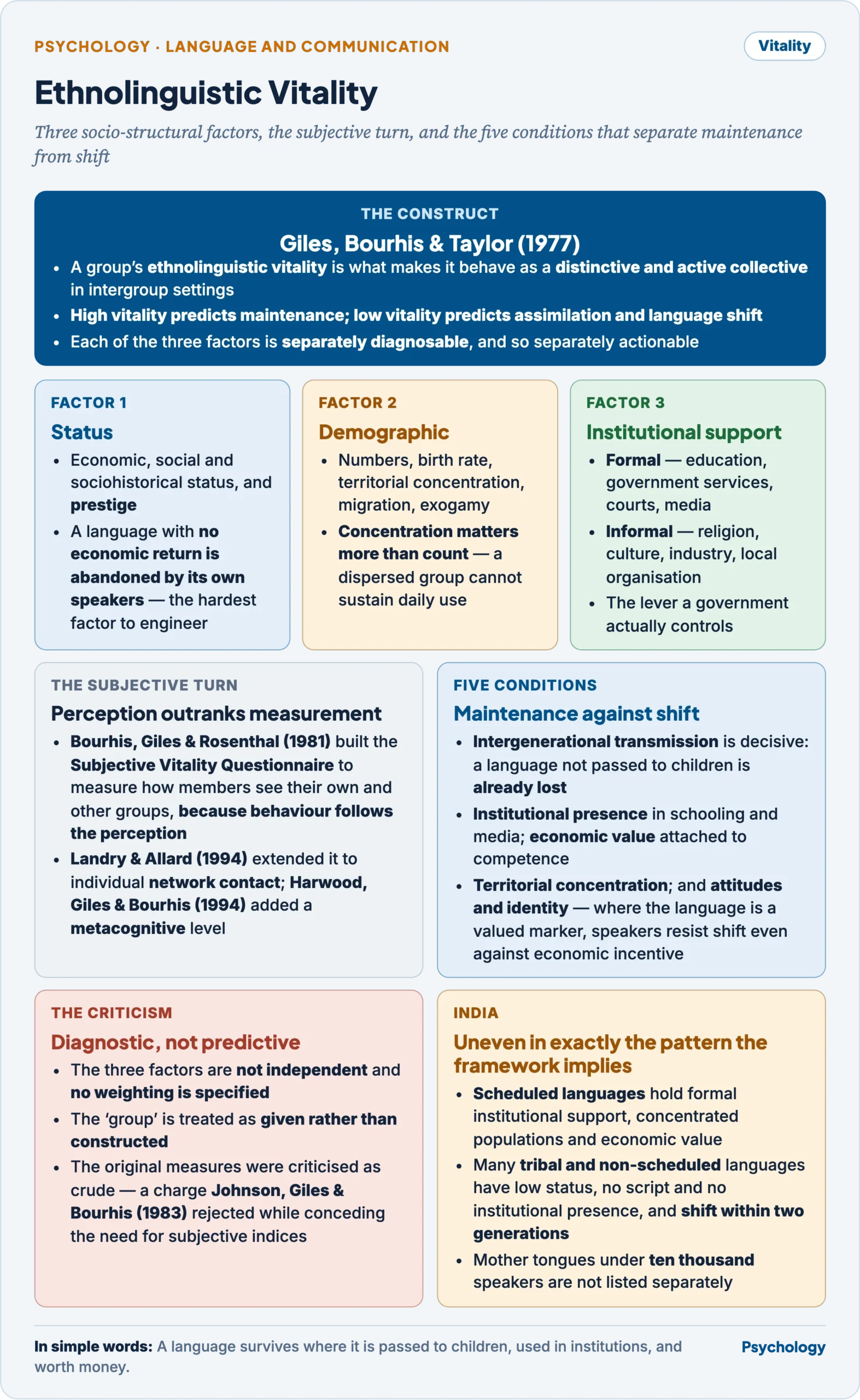
- Giles, Bourhis and Taylor (1977) define a group’s ethnolinguistic vitality as what makes it behave as a distinctive and active collective in intergroup settings. High vitality predicts maintenance; low vitality predicts assimilation and language shift.
- Vitality rests on three socio-structural factors, and the framework’s use is that each is separately diagnosable.
- Status factors — economic, social and sociohistorical status, and the prestige of the language inside and outside the community. A language with no economic return is abandoned by its own speakers.
- Demographic factors — absolute numbers, birth rate, territorial concentration, local proportion, in- and out-migration, exogamy. Concentration matters more than count, since a dispersed group cannot sustain daily use.
- Institutional support factors — presence in formal institutions (education, government services, courts, media) and informal ones (religion, culture, industry, local organisation).
- Perceived vitality matters more than measured vitality. Bourhis, Giles and Rosenthal (1981) developed the Subjective Vitality Questionnaire to measure how members see their own and other groups on the same items, because behaviour follows the perception.
- Landry and Allard (1994) extended the model to individual network contact; Harwood, Giles and Bourhis (1994) added a metacognitive level.
- Five conditions separate maintenance from shift, drawn from this literature and from language-endangerment work.
- Intergenerational transmission is decisive: a language still spoken by adults but no longer passed to children is already lost.
- Institutional presence in schooling and media, which makes it usable beyond the home; and economic value attached to competence in it, which is why status is the hardest factor to engineer.
- Territorial concentration, which urbanisation and labour migration erode.
- Attitudes and identity: where the language is a valued identity marker, speakers resist shift even against economic incentive.
- Criticism. The three factors are not independent, no weighting is specified, and the “group” is treated as given rather than constructed. The original measures were criticised as crude, a charge Johnson, Giles and Bourhis (1983) rejected while conceding the need for subjective indices.
The Indian context: multilingualism as the normal condition
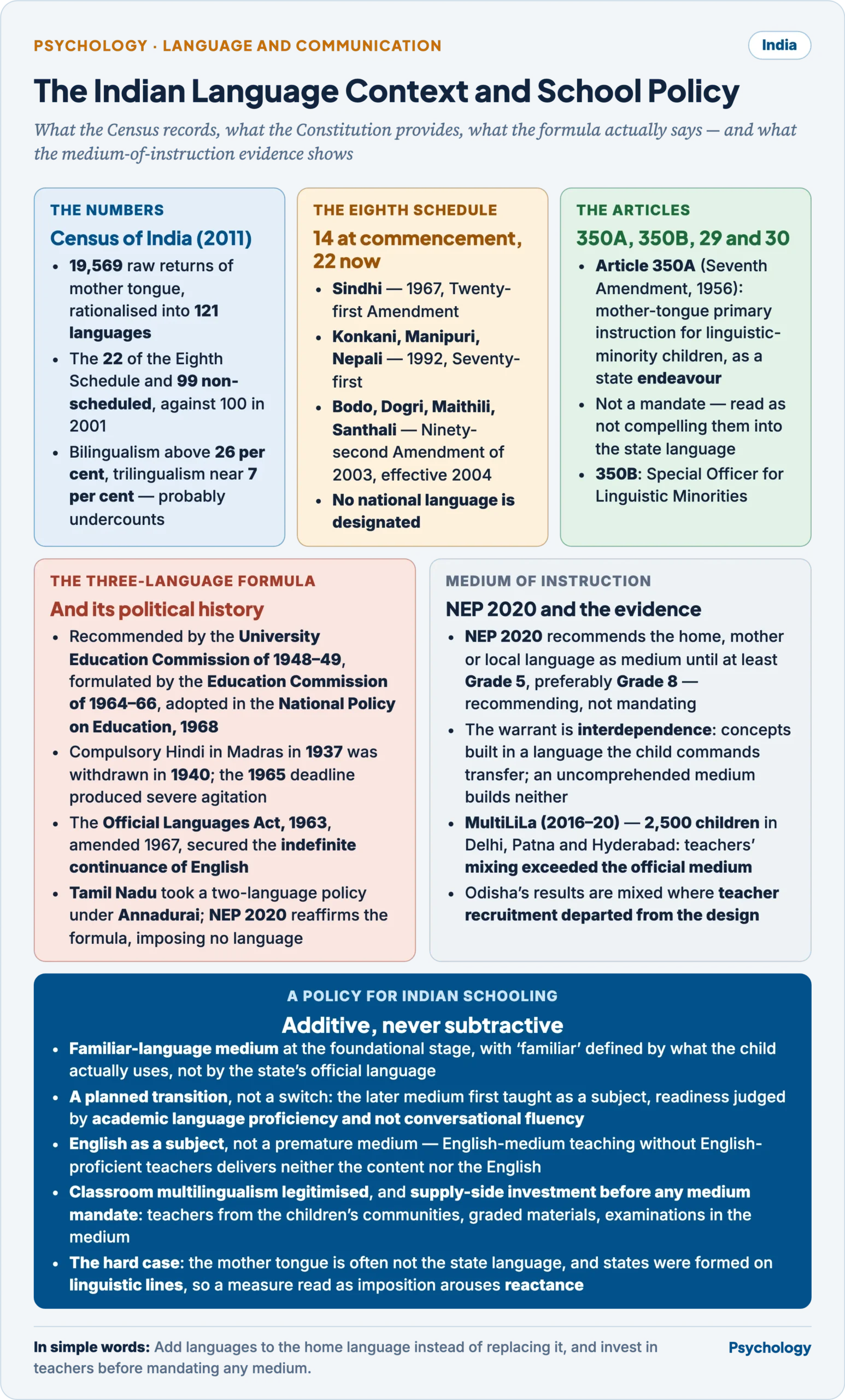
- The Census of India (2011) recorded 19,569 raw returns of mother tongue, rationalised into 121 languages — the 22 of the Eighth Schedule and 99 non-scheduled, against 100 non-scheduled in 2001.
- The Language Atlas derived from the Census of India (2011) puts the national bilingualism rate above 26 per cent and trilingualism near 7 per cent — both the highest recorded, and both probably undercounts.
- The consequence is methodological. Where daily use of several languages is unmarked, the monolingual comparison group the Western literature depends on barely exists, so the usable variable is configuration — which languages, in which domains, at what proficiency.
- The constitutional frame is the institutional-support side of vitality, in legal form.
- The Eighth Schedule listed 14 languages at commencement and now lists 22. No language is designated a national language.
- Sindhi was added in 1967 by the Twenty-first Amendment; Konkani, Manipuri and Nepali in 1992 by the Seventy-first; Bodo, Dogri, Maithili and Santhali by the Ninety-second Amendment of 2003, effective 2004.
- Article 350A, inserted by the Seventh Amendment in 1956 after the linguistic reorganisation of states, makes it the endeavour of every state to provide facilities for instruction in the mother tongue at the primary stage to children of linguistic minority groups.
- It is an endeavour, not a mandate, and the Supreme Court has read it as not empowering a state to compel linguistic-minority children into the state language as medium.
- Article 350B provides a Special Officer for Linguistic Minorities; Articles 29 and 30 protect minority cultural and educational rights.
- The Eighth Schedule listed 14 languages at commencement and now lists 22. No language is designated a national language.
- The three-language formula, and its political history.
- Recommended in substance by the University Education Commission of 1948-49, formulated by the Education Commission of 1964-66, and adopted in the National Policy on Education, 1968.
- In its standard form it pairs the regional language or mother tongue with the official language and a third modern Indian or European language, differently constituted in Hindi-speaking and non-Hindi-speaking states.
- Resistance predates it: compulsory Hindi introduced in Madras in 1937 was withdrawn in 1940, and the 1965 deadline for Hindi as sole official language produced severe agitation. The Official Languages Act, 1963, amended in 1967, secured the indefinite continuance of English.
- Tamil Nadu adopted a two-language policy under Annadurai and has not implemented the formula. NEP 2020 reaffirms the formula while stating that no language will be imposed on any state.
- Medium of instruction, and the evidence for it.
- NEP 2020 (Ministry of Education) recommends the home language, mother tongue or local language as medium wherever possible until at least Grade 5, preferably to Grade 8 and beyond. It recommends rather than mandates, and endorses bilingual explanation in class.
- The psychological principle is the interdependence hypothesis: foundational literacy and concepts built in a language the child commands transfer to the second, whereas instruction in an uncomprehended medium builds neither.
- The evidence supports it at the foundational stage and is highly sensitive to implementation.
- Mother-tongue-based multilingual education for tribal children in Odisha has been evaluated with mixed results, one district study finding lower achievement where teacher recruitment departed from the design — an implementation finding, not a verdict on the pedagogy.
- The MultiLiLa project (2016-20) assessed about 2,500 children in Standards IV and V in Delhi, Patna and Hyderabad.
- Teachers’ language mixing exceeded use of the official medium in both English-medium and regional-medium classrooms, and the number of home languages, with whether any was used at school, related to school and cognitive performance.
- Poverty and limited print exposure did not automatically produce cognitive disadvantage.
- The hard case is that the mother tongue is frequently not the state language, so mother-tongue medium at the primary stage means provision in a language the school system does not staff for.
- Language and identity.
- Language is among the most salient markers of group membership, so social identity processes apply directly: the language is not a tool the speaker holds but a category the speaker belongs to.
- Language attitudes are among the oldest findings here: speech characteristics are salient at first meeting and drive inferences about competence, class and trustworthiness — within Indian English through accent and through English proficiency itself.
- Subtractive conditions are produced by aspiration, not only by coercion. Where English-medium schooling is the marker of mobility, families themselves devalue the home language, which is the configuration associated with poor outcomes in both languages.
- Because states were formed on linguistic lines, language is an organising axis of politics, so a measure read as imposition arouses reactance.
- Vitality in India is uneven in exactly the pattern the framework implies.
- Scheduled languages hold formal institutional support, large concentrated populations and economic value.
- Many tribal and non-scheduled languages have low status, no standardised script, no institutional presence and dispersing populations, and shift to the dominant regional language within two generations.
- The Census practice of not separately listing mother tongues returned by fewer than ten thousand speakers compounds the invisibility.
A language policy for Indian schooling
- Additive, never subtractive. Every language is added to the home language rather than substituted for it, and the home language keeps status in the classroom. The rest follows from this.
- Familiar-language medium for the foundational stage, with “familiar” defined by what the child actually uses at home and in the neighbourhood, not by the state’s official language.
- A planned transition, not a switch. The later medium is first taught as a subject, its academic register taught explicitly, with readiness judged by academic language proficiency and not by conversational fluency.
- English as a subject, not as a premature medium. English-medium instruction without English-proficient teachers delivers neither the content nor the English, which is the commonest failure in the present system.
- Classroom multilingualism, legitimised. Teachers already mix languages to make content land, so policy should license, train and resource the practice instead of prohibiting what it cannot prevent.
- The three-language formula retained, with genuine state choice, because a language perceived as imposed produces resistance no pedagogy survives.
- Supply-side investment before any medium mandate — teachers recruited from the children’s language communities, graded materials in those languages, examinations set in the medium of instruction.
- Provision for non-scheduled and tribal languages beyond the primary stage, with script standardisation, community teacher recruitment and local-language assessment — the institutional-support lever policy actually controls.
- Measurement that can settle the matter: learning outcomes reported in the medium of instruction and disaggregated by home language, since present data cannot show whether a medium is working.
- Constitutional anchoring in Article 350A’s existing endeavour and NEP 2020’s flexibility clause, so the policy extends obligations already accepted rather than creating a contested new mandate.
Criticisms and limitations
- “Bilingual” is not one construct. Age of acquisition, proficiency in each language, balance, switching frequency, domains of use and societal status vary independently and are rarely measured together, so bilingual-monolingual comparisons are often comparisons of non-comparable groups.
- The executive-function literature has a well-documented publication-bias problem, small samples and a dependence on task choice, and the advantage does not survive bias correction in the largest adult meta-analysis.
- The dementia literature turns on its design, with retrospective clinic samples and prospective community samples pointing opposite ways, and referral, migration and onset-by-recall unresolved.
- The classic positive findings carry selection confounds. Peal and Lambert’s balanced bilinguals were selected on a variable plausibly caused by ability.
- Threshold and interdependence are not precisely operationalised, which makes them difficult to falsify, and the BICS-CALP distinction has been used in practice to classify minority-language children as deficient.
- Ethnolinguistic vitality’s three factors are neither independent nor weighted, so the framework diagnoses well and has little predictive power, and it treats group boundaries as given.
- Indian Census language categories are administrative rather than linguistic: mother tongues are grouped under language heads by official rationalisation, returns below the ten-thousand threshold are not listed separately, and decade-to-decade comparison is affected by changes in that rationalisation.
- The research base does not cover the Indian case. Almost all bilingual-cognition work uses two-language, migrant, Western samples; stable societal multilingualism with diglossic domain allocation, the Indian norm, is barely represented.
- What survives is substantial and specific.
- Metalinguistic awareness as the reliable cognitive consequence; total conceptual vocabulary as the valid vocabulary measure; and the small lexical-access cost, which replicates where the large control advantage does not.
- Code-switching as rule-governed, which settles the deficit question on grammatical rather than political grounds.
- The additive-subtractive distinction as what outcomes actually track, relocating the problem from the child’s bilingualism to the status accorded the home language.
- Familiar-language medium at the foundational stage, with implementation quality as the binding constraint.
- Vitality’s three factors as a working diagnostic for which languages survive and which levers a government holds.
Previous Year Questions
- 2022Discuss the factors involved in ethnolinguistic vitality in the Indian context.
- 2017Explain the importance of Critical Periods in language development. In what ways are bilingualism and cognitive development related?
- 2014Commenting on bilingualism and multilingualism in the Indian context, outline a language policy relevant to schooling.