

Official syllabusPaper I · Unit 13 · Language and Communication
Process and types of communication – effective communication training.
Definition
“The major barrier to mutual interpersonal communication is our very natural tendency to judge, to evaluate, to approve or disapprove, the statement of the other person or group.”
Rogers (1952)
Effectiveness is therefore defined by correspondence rather than by delivery: communication is effective when the message as received and acted upon matches the message intended, which the receiver’s evaluative reflex is the first thing to prevent.
Two claims organise the topic. Effectiveness is a property of the fit between source, message, channel and receiver, not of a technique; and the skills producing it are trainable, though the evidence for how well is far weaker in the workplace literature than in the clinical one.
What effective communication is
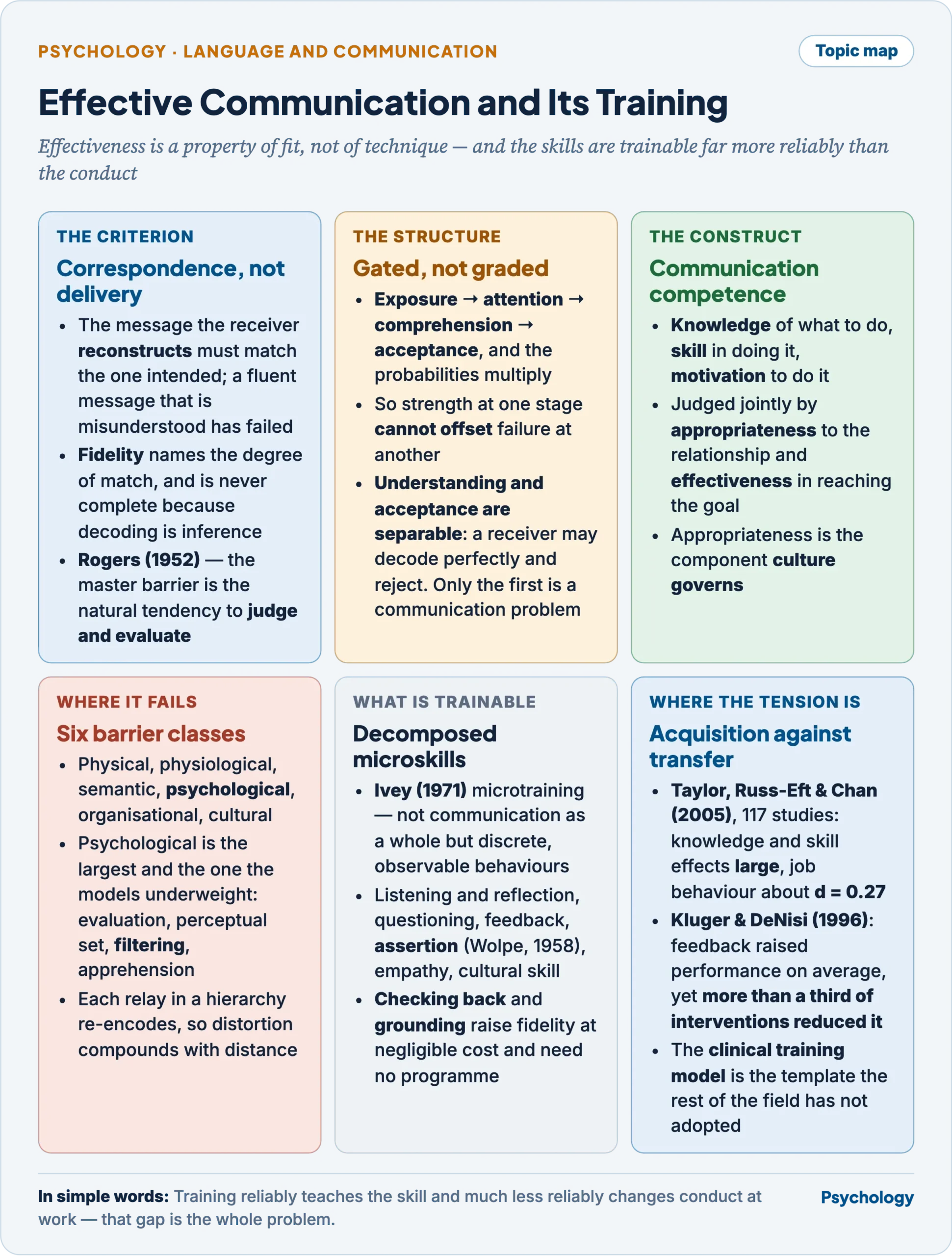
- Correspondence is the criterion. The message the receiver reconstructs must match the one intended; a fluent, well-delivered message that is misunderstood has failed.
- Fidelity names the degree of that match. It is never complete, because decoding is inference; the aim is enough fidelity for the purpose, which grounding achieves.
- Effectiveness is gated, not graded. A message must pass exposure, attention, comprehension and acceptance before it can be retained or acted on, and because the probabilities multiply, strength at one stage cannot offset failure at another.
- Understanding and acceptance are separable. A receiver may decode perfectly and reject. Only the first is a communication problem; the second is persuasion, and conflating them is the commonest error in applied work.
- Communication competence is the dispositional construct behind the skills: knowledge of what to do, skill in doing it, motivation to do it — judged jointly by appropriateness to the relationship and effectiveness in reaching the goal. Appropriateness is the component culture governs.
- Further criteria apply where fidelity alone is insufficient: efficiency, fidelity per unit of effort; relational maintenance, whether the exchange leaves the relationship usable; and reciprocity, each party knowing the other has understood.
The sources of effectiveness
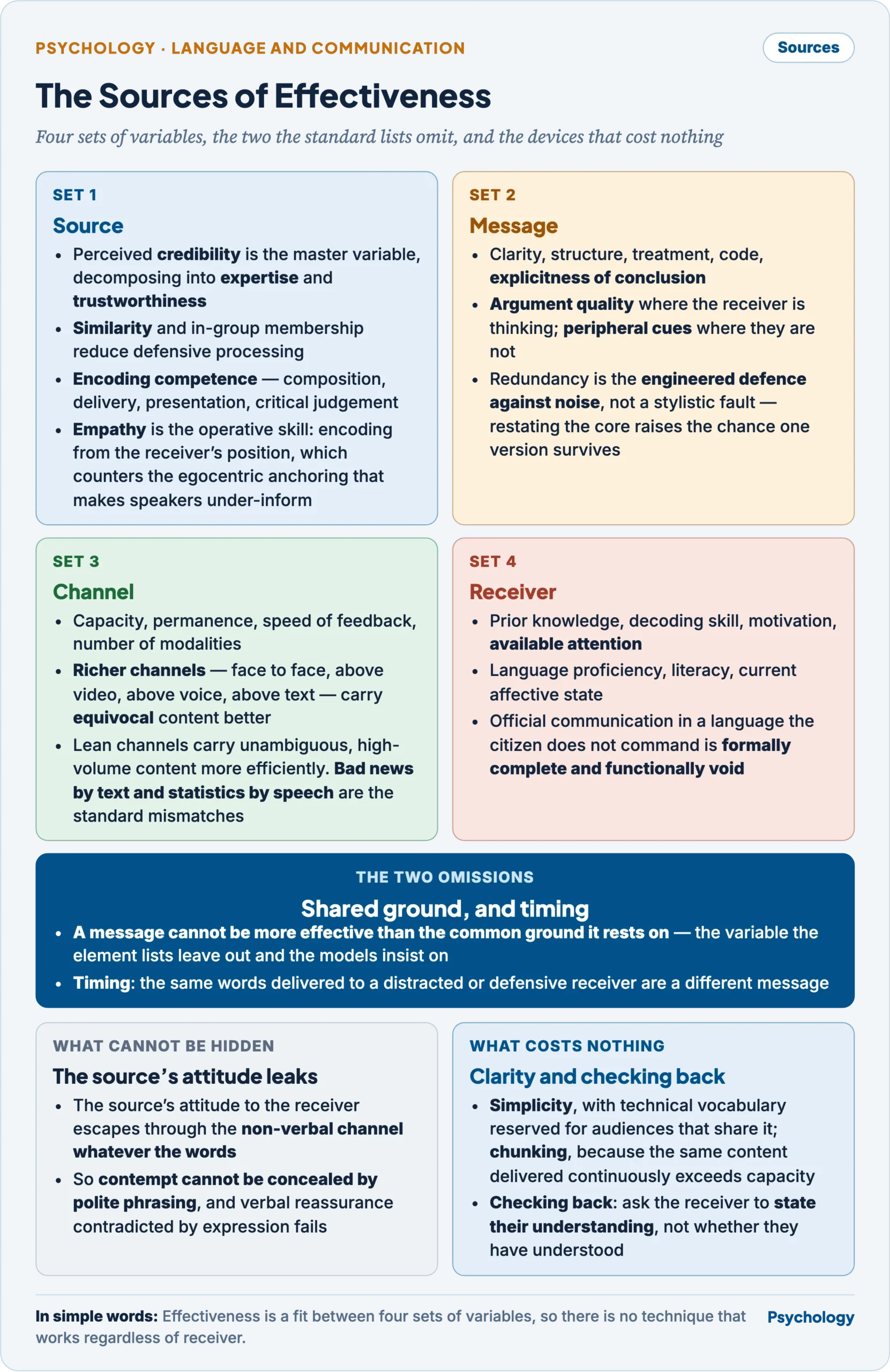
- Source variables. Perceived credibility is the master variable, decomposing into expertise and trustworthiness. Similarity and in-group membership reduce defensive processing. Encoding competence — composition, delivery, presentation and critical judgement — governs whether the intention survives translation into words.
- The source’s empathy is the operative skill: encoding from the receiver’s position rather than one’s own, which counters the egocentric anchoring that makes speakers systematically under-inform.
- The source’s attitude to the receiver leaks through the non-verbal channel whatever the words, so contempt cannot be concealed by polite phrasing.
- Message variables. Clarity, structure, treatment, code and explicitness of conclusion; argument quality where the receiver is thinking and peripheral cues where they are not.
- Channel variables. Capacity, permanence, speed of feedback, number of modalities. Richer channels — face to face above video above voice above text — carry equivocal content better; lean channels carry unambiguous, high-volume content more efficiently.
- Receiver variables. Prior knowledge, decoding skill, motivation, available attention, language proficiency, literacy, current affective state.
- Shared ground is the variable the lists omit and the models insist on: a message cannot be more effective than the common ground it rests on. Timing is the other omission — the same words delivered to a distracted or defensive receiver are a different message.
- The experimental research on source and message variables — credibility, the sleeper effect, one-sided against two-sided appeals, order effects, discrepancy, fear appeals, framing and the elaboration models — is carried in the persuasion and attitude change through communication article.
Barriers to effective communication
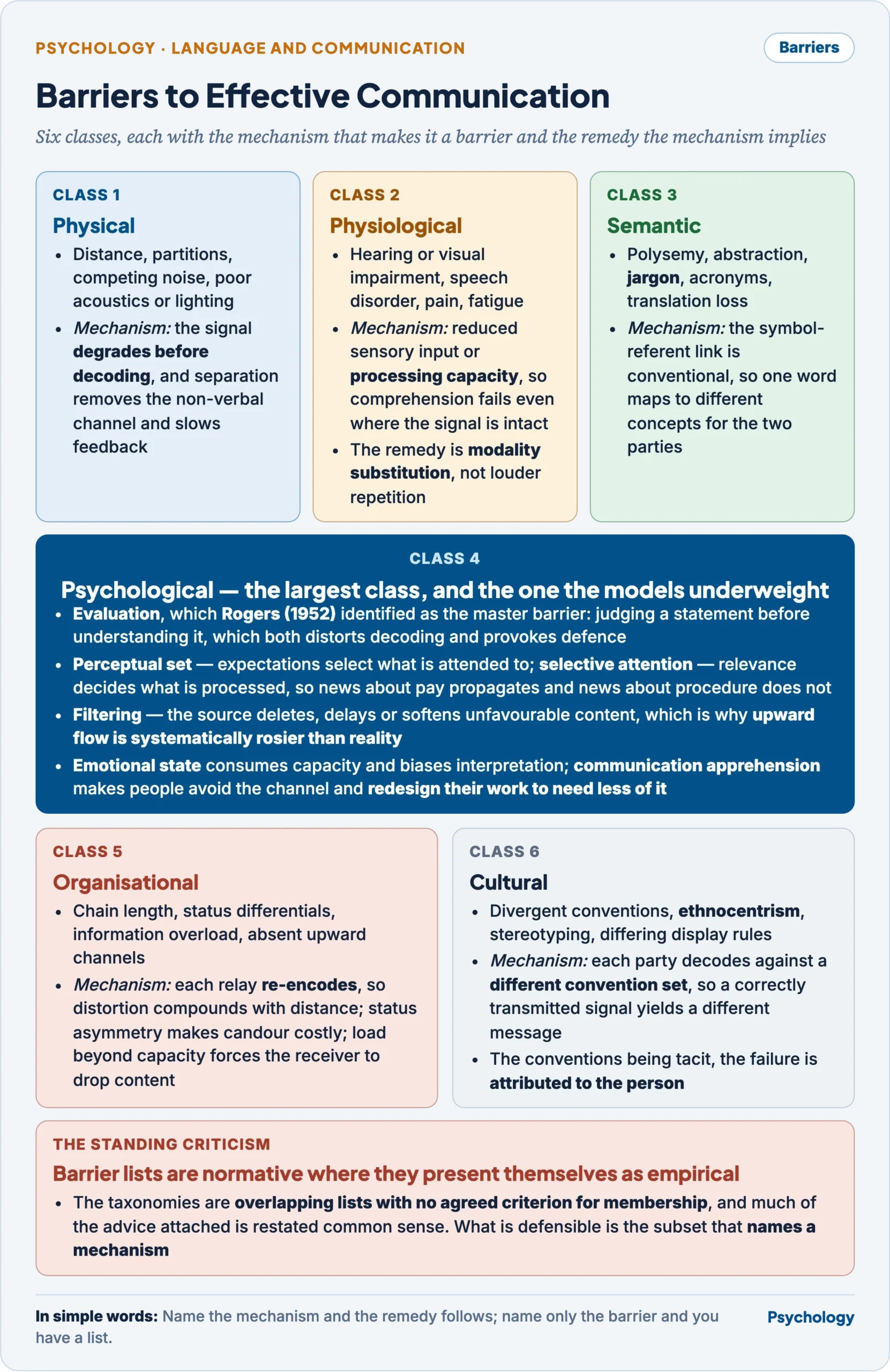
- Physical barriers — distance, partitions, competing noise, poor acoustics or lighting.
- Mechanism: the signal degrades before decoding, and separation removes the non-verbal channel and slows feedback, so error goes uncorrected.
- Physiological barriers — hearing or visual impairment, speech disorder, pain, fatigue, hunger.
- Mechanism: reduced sensory input or reduced processing capacity, so comprehension fails even where the signal is intact. The remedy is modality substitution, not louder repetition.
- Semantic barriers — polysemy, abstraction, jargon, acronyms, translation loss.
- Mechanism: the symbol-referent link is conventional, so one word maps to different concepts for the two parties. Jargon compresses meaning inside a group and blocks it outside.
- Psychological barriers — the largest class, and the one the models underweight.
- Evaluation, which Rogers identified as the master barrier: judging a statement before understanding it, which both distorts decoding and provokes defence.
- Perceptual set — expectations select what is attended to and how it is organised. Selective attention — relevance decides what is processed, so news about pay propagates instantly and news about procedure does not.
- Filtering — the source deletes, delays or softens unfavourable content, which is why upward flow in a hierarchy is systematically rosier than reality.
- Emotional state — anger, anxiety, grief and defensiveness consume capacity and bias interpretation.
- Communication apprehension — persistent anxiety about speaking, writing or both, leading people to avoid the channel and redesign their work to need less of it.
- Organisational barriers — chain length, status differentials, structural ambiguity, information overload, absent upward channels.
- Mechanism: each relay re-encodes the message, so distortion compounds with distance; status asymmetry makes candour costly; load beyond capacity forces the receiver to drop content.
- Cultural barriers — divergent conventions, ethnocentrism, stereotyping, differing display rules, high- against low-context expectations.
- Mechanism: both parties encode and decode against different convention sets, so a correctly transmitted signal yields a different message. Because the conventions are tacit, the failure is attributed to the person rather than the mismatch.
Listening: active and reflective
- Listening is an activity, not a reception. Treated as passive it yields a fraction of what arrives; treated as active, the listener regulates the exchange by signalling what has and has not been understood.
- Active listening — the Rogerian technique — means attending to content, affect and behaviour together, holding evaluation in suspense, and working from the speaker’s internal frame of reference rather than one’s own external frame.
- “You are frightened at the news” is an internal-frame response; “you should have been in control” is an external-frame one. The first continues the exchange and the second closes it.
- Brems (2002) sets out six failure modes of listening, each with its own consequence for the speaker.
- Inadequate listening — inattention, so the speaker does not feel heard. Evaluative listening — judging, which costs objectivity and produces advice.
- Filtered or selective listening — hearing what prejudice expects, so the speaker feels misrepresented. Fact-centred listening — attending to overt content and missing the affect, which reads as intrusive and over-questioning.
- Rehearsing while listening — composing a reply during the speaker’s turn, producing well-phrased, off-target responses. Sympathetic listening — over-identification, so the speaker feels heard but not helped, and the listener loses distance and burns out.
- Roadblocks are the verbal moves that end exploration: ordering, warning, advising, persuading with logic, moralising, judging, praising everything, labelling, interpreting, reassuring, excessive probing and changing the subject. Each is useful in its place and destructive when the task is to understand.
- The observable indicators of active listening are the trainable units.
- Minimal encouragers — brief verbal and non-verbal signals sustaining the turn without redirecting it. Remembering — recalling earlier content, which builds trust and makes later clarification possible.
- Questioning — open rather than closed, to extend rather than to test. Reflection — restating content or feeling in the listener’s own words, which demonstrates and checks understanding at once.
- Clarification and summarisation — the explicit grounding moves, converting assumed understanding into confirmed understanding.
- Reading incongruence is the advanced skill — between words and expression, between two non-verbal channels, among thought, feeling and action. Incongruence is information, not noise.
- The evidence is best in the helping professions and thin elsewhere.
- Weger, Castle Bell, Minei and Robinson (2014) had trained confederates respond with active listening, with advice, or with simple acknowledgement. Active listening produced a greater sense of being understood than either comparison, though conversational satisfaction did not separate it from advice.
- Elliott (1985), classifying client-identified helpful events in brief counselling, found understanding the predominant category on the interpersonal side.
- Hettema, Steele and Miller (2005), reviewing motivational interviewing, found reflective, non-confrontational methods outperformed confrontational alternatives across several behaviour-change targets.
- A single session does not make a reflective listener; the skill decays without practice, which is the finding that governs programme design.
Feedback that works
- Mechanism: feedback closes the loop, converting one-way transmission into a correctable process. Without it the source has no evidence of fidelity, and error persists undetected.
- The properties of usable feedback.
- Descriptive rather than evaluative; specific and behavioural, so there is something to change; timely, before behaviour and consequence decouple.
- Actionable, since a problem named without a route out produces defence; and solicited where possible, because unsolicited feedback is read as an attack on standing.
- Kluger and DeNisi (1996) meta-analysed 607 effect sizes across 23,663 observations.
- Feedback interventions raised performance on average (d = 0.41), but more than a third reduced it, and the sign of the feedback did not account for which.
- Their feedback intervention theory locates the mechanism in attention: feedback that holds attention on the task and on task learning helps, while feedback that moves attention to the self impairs performance, because self-relevant processing displaces the processing the task needs.
- The rule that follows is psychological rather than etiquette — address the behaviour, not the person’s worth.
- Upward feedback needs structural provision, because filtering suppresses it by default: suggestion systems, hotlines, employee surveys, and meetings that deliberately cross levels.
Assertiveness, aggression and passivity
- Assertiveness is the direct, honest expression of one’s own thoughts, feelings and rights in a way that does not violate the rights of the other party. It is a behaviour class, not a trait, and therefore trainable.
| Passive | Assertive | Aggressive | |
|---|---|---|---|
| Own rights | Surrendered | Asserted | Asserted |
| Other’s rights | Respected | Respected | Violated |
| Goal | Avoid conflict | State position, seek workable outcome | Win, dominate |
| Typical form | Apology, silence, hinting | “I” statement, specific request | “You” accusation, threat, sarcasm |
| Non-verbal | Low volume, averted gaze, closed posture | Steady volume, open posture, direct gaze | Raised volume, intrusive distance, glare |
| Long-term result | Resentment, loss of standing | Standing and relationship preserved | Retaliation, relationship damage |
- Mechanism. Passivity is maintained by avoidance learning: not speaking removes anticipated conflict, the relief reinforces the silence, and the capacity for assertion never develops.
- Salter (1949) gave the first learning-theoretic account of unassertive behaviour. Wolpe (1958) built assertion training on reciprocal inhibition — the assertive response is incompatible with the anxiety response, so practising it in graded situations extinguishes the anxiety. Alberti and Emmons (1970) carried the method into general use.
- Aggression works by the opposite contingency: it produces immediate compliance, which reinforces it, while its relational cost arrives later and is attributed elsewhere.
- Trainable techniques, each with a mechanism.
- “I” statements — describing one’s own state and request rather than the other’s character, which removes the attack that triggers defence.
- The broken record — calm repetition of the request, resisting diversion without escalating. Fogging — acknowledging the grain of truth in a criticism without conceding the whole, which deprives it of force.
- Negative assertion and negative enquiry — accepting one’s own error, or inviting more detail about the criticism, both reducing the anxiety criticism arouses. Workable compromise, where interests conflict but self-respect is not at stake.
- The evidence is modest. Assertion training reliably raises assertiveness on self-report and in role play; generalisation outside the setting is weaker, and gains require rehearsal in situations resembling the target ones.
- Assertion is culturally graded. Direct contradiction of a senior reads as competence in low-power-distance settings and as insubordination in high-power-distance ones. In Indian institutional settings the effective form is usually assertion of the interest without public contradiction of the person.
Empathy and perspective-taking
- Empathy in the communicative sense is apprehending the other’s frame of reference and conveying that apprehension, so it can be confirmed or corrected. It differs from sympathy, which shares the feeling and loses the vantage point needed to help.
- Cognitive empathy — inferring what the other knows and intends — and affective empathy — resonating with what they feel — are separable, and the first is what communication depends on.
- Mechanism. Perspective-taking corrects the egocentric default in language use, the documented reason speakers under-inform listeners.
- The failure is predictable: the addressee’s perspective is a slow correction to one’s own, so time pressure and load collapse it back. Empathy is therefore a procedure to be practised, not a sentiment to be felt.
- Cultural skill is perspective-taking at group level: recognising that behaviour, values and silences differ in meaning across communities, declining to treat group members as interchangeable, and removing from one’s repertoire the phrases that mark an out-group as deviant — an ethnorelative rather than ethnocentric stance.
Clarity, redundancy and channel choice
- Simplicity, with technical vocabulary reserved for audiences that share it. Chunking follows: content in small units with pauses is retained, the same content delivered continuously exceeds capacity and is lost.
- Redundancy is the engineered defence against noise, not a stylistic fault: restating the core message in another form, or on another channel, raises the probability that one version survives. Repetition also raises attention and, through mere exposure, liking.
- Channel choice follows equivocality. Ambiguous or relationally consequential content needs a rich channel with immediate feedback; unambiguous or archival content belongs in a lean one. Bad news by text and statistics by speech are the standard mismatches.
- Checking back is the most reliable single device: asking the receiver to state their understanding, rather than asking whether they have understood.
Effective communication training: content, sequence and evaluation
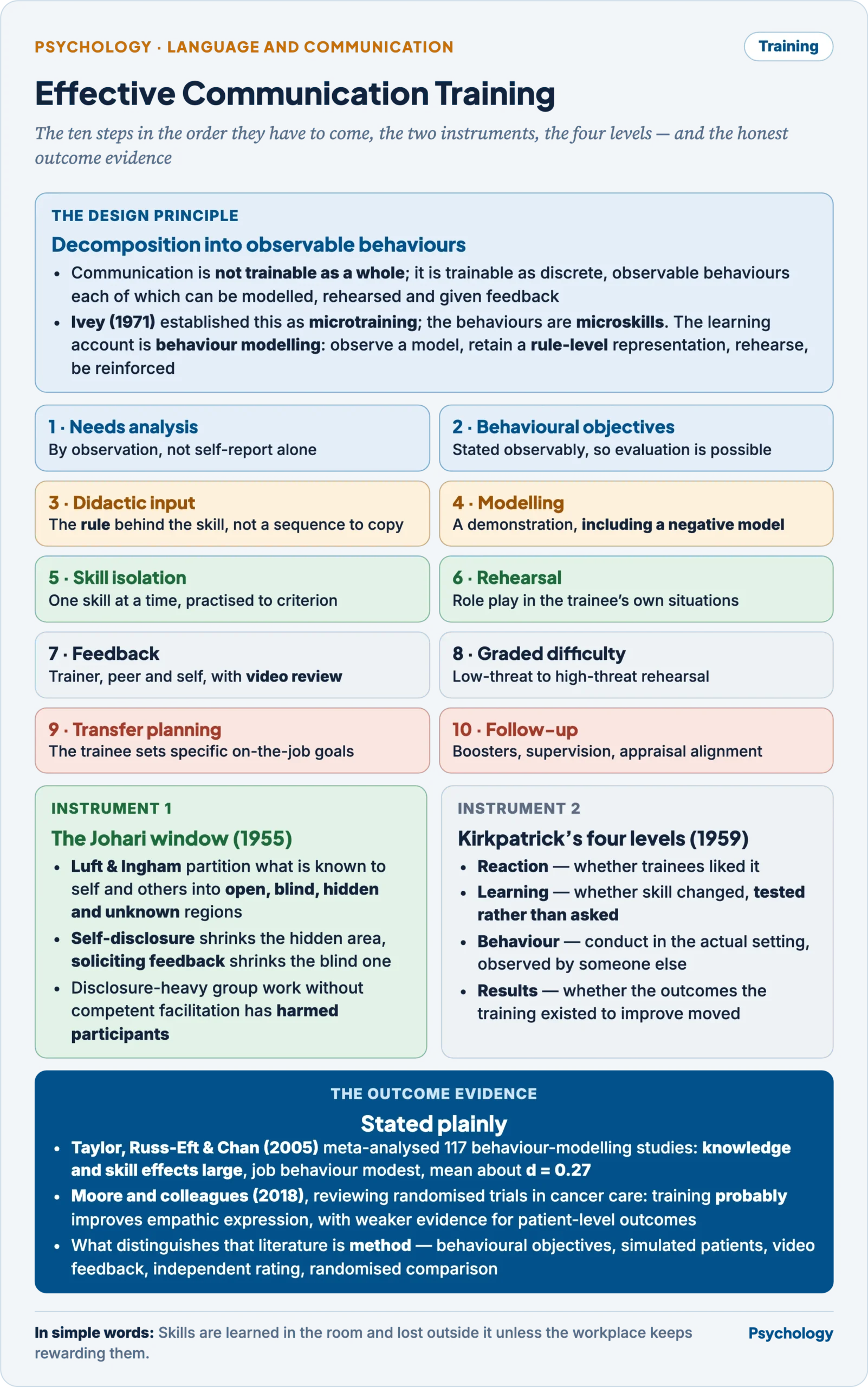
- The design principle is decomposition. Communication is not trainable as a whole; it is trainable as a set of discrete, observable behaviours each of which can be modelled, rehearsed and given feedback. Ivey (1971) established this as microtraining, and the behaviours it isolates are microskills.
- The underlying learning account is behaviour modelling, from social learning theory: a complex skill is acquired by observing a model, retaining a rule-level representation, rehearsing it, and being reinforced for performing it.
- The sequence of a programme, in the order the elements have to come.
- Needs analysis — which behaviours are deficient, for whom, in which situations, established by observation rather than self-report alone.
- Behavioural objectives — what the trainee will be able to do, stated observably, which is what makes later evaluation possible.
- Didactic input — a short account of the skill and the rule behind it. Transfer improves when key points are given as rules rather than as a sequence to copy.
- Modelling — a demonstration, live or recorded, including a contrasting negative model, so the discrimination is learned as well as the behaviour.
- Skill isolation — one skill at a time, practised to criterion before the next is added.
- Rehearsal — role play, simulated interviews and structured triads, with situations from the trainee’s own setting rather than generic scenarios.
- Feedback — trainer, peer and self, with video or audio review; descriptive, specific, task-focused and immediate.
- Graded difficulty — rehearsal moving from low-threat to high-threat situations, where the anxiety-reduction component works.
- Transfer planning — the trainee sets specific goals for on-the-job behaviour, since transfer improves markedly when they do.
- Follow-up and reinforcement — boosters, supervision or coaching, and alignment of appraisal with the trained behaviour. Without this, gains decay.
- Typical content, in the order usually sequenced: self-awareness and self-monitoring; attending and non-verbal reading; listening and reflection; questioning; giving and receiving feedback; assertion; difficult conversations; cultural skill; written and presentational skill.
- Self-awareness instruments support the first stage. The Johari window — Luft and Ingham (1955) — partitions what is known to self and others into open, blind, hidden and unknown regions.
- It names the two mechanisms that enlarge the open region: self-disclosure shrinks the hidden area, soliciting feedback shrinks the blind one. Group methods — sensitivity training, T-groups, structured observation — build on those same two mechanisms.
- Evaluation uses the four levels Kirkpatrick set out in a series of articles in 1959, and the distinction between them is where most programmes fail.
- Reaction — whether trainees liked it. Almost always collected, and almost uncorrelated with the rest.
- Learning — whether knowledge and skill changed, tested rather than asked.
- Behaviour — whether conduct changed in the actual setting, which needs observation by someone other than the trainee.
- Results — whether the outcomes the training existed to improve moved.
- The outcome evidence, stated plainly.
- Taylor, Russ-Eft and Chan (2005) meta-analysed 117 behaviour-modelling training studies: effects on knowledge and skill were large, while effects on attitudes and job behaviour were modest, with a mean effect on job behaviour of about d = 0.27.
- So such training reliably teaches the skill and much less reliably changes conduct at work. The gap is the transfer problem, not a defect of the teaching.
- The clearest positive evidence comes from one applied domain. Moore and colleagues (2018), reviewing randomised trials of communication skills training for health professionals in cancer care, concluded that training probably improves empathic expression and some communication behaviours, with weaker evidence for patient-level outcomes.
- What distinguishes that literature is method, not subject matter: behavioural objectives, simulated patients, video feedback, independent observational rating, and randomised comparison. The corporate literature largely lacks all five.
Advertisements and the factors that enhance effectiveness
- An advertisement is persuasive communication under three constraints absent from the laboratory: the audience is unmotivated, exposure is brief and incidental, and the message competes with many others.
- Attention before anything. Exposure not attended to is expenditure without effect, so distinctiveness, novelty, movement, placement and the opening seconds do the first and largest part of the work.
- Route depends on involvement. Where the purchase matters, argument quality drives response; where it does not, peripheral cues do — attractiveness, music, apparent consensus, production quality. Most consumer advertising operates in the second condition, which is why it looks evidentially empty without being ineffective.
- Source factors — credibility, expertise within the domain, trustworthiness, likability, similarity to the target. Endorsement works where there is a plausible match between endorser and product, and transfers nothing where there is not.
- Message factors — a single clear claim rather than several; concreteness and ease of imagination; emotion and narrative, which bypass the counter-arguing an explicit claim invites; and an explicit, easy action.
- Repetition and its limit. Mere exposure raises liking, and repetition allows fuller processing, so strong messages gain from it. Weak messages lose, since repetition exposes their flaws, and beyond a point all suffer wear-out.
- Threat appeals require an efficacy component. Threat supplies motivation; perceived efficacy decides whether that motivation produces the recommended action or avoidance. A frightening public-health advertisement naming no feasible action produces denial.
- Consistency across elements. Verbal claim, imagery, music and tone must agree, since incongruence is resolved in favour of the non-verbal. Memory encoding rather than momentary persuasion is the realistic objective: distinctive, repeated assets that bring the brand to mind at the moment of choice.
- The honest evidence is sobering. Lodish and colleagues (1995) meta-analysed 389 real-world split-cable television advertising experiments: increasing advertising weight did not reliably increase sales, the relation between weight and sales was not monotonic, and new products responded more than established ones.
- Indian public campaigns illustrate the same principles where the product is a behaviour.
- Pulse Polio Immunisation (Ministry of Health and Family Welfare) paired a memorable verbal anchor with repetition, mass reach and local in-group messengers, and attached one free, feasible action — the threat-plus-efficacy structure in applied form.
- Swachh Bharat Mission (Ministry of Jal Shakti for the rural component) worked on the perceived norm rather than on beliefs about sanitation, the easier target where behaviour is publicly observable.
- Both carry the standing limitation of mass media — high reach, strong agenda-setting, weak attitude change relative to interpersonal channels — which is why campaigns that convert rely on local intermediaries.
Criticisms and limitations
- “Communication skill” is not one construct. Measures of listening, assertion, non-verbal decoding and written clarity correlate only modestly, so a global score has little predictive value and a global training claim means little.
- The applied literature is normative where it presents itself as empirical. Barrier taxonomies are overlapping lists with no agreed criterion for membership, and much of the advice attached to them is restated common sense with no mechanism.
- The outcome evidence in workplace training is weak. Most evaluations stop at reaction, use trainer-developed self-report measures, and lack control groups and follow-up. Where behaviour is measured properly, effects are modest.
- Transfer is the binding constraint, not acquisition. Skills demonstrably learned decay where the setting does not reinforce them, so a programme without supervision, appraisal alignment and boosters fails however well designed.
- Cultural narrowness runs through the prescriptions. Direct eye contact, assertion, explicit verbal statement and self-disclosure are the norms of low-context, low-power-distance settings; exported as universal skill they produce behaviour that reads as rude or insubordinate elsewhere.
- Feedback is not benignly positive. In the Kluger and DeNisi (1996) data more than a third of feedback interventions reduced performance, so feedback is an intervention with side effects rather than a universal good.
- Active listening’s evidence base is narrow — strong in counselling and health-professional settings, largely absent for the managerial and sales applications in which it is most often taught.
- Assertion training generalises poorly, and the construct is partly circular, since effective assertion is often identified by the very outcome it was supposed to explain. Sensitivity and encounter methods carry real risk: disclosure-heavy group work without competent facilitation has harmed participants.
- What survives is specific and usable.
- Decomposition into observable microskills, modelled, rehearsed and given video feedback, is the one method with consistent evidence for producing skill; transfer planning and post-training reinforcement are what convert that skill into conduct, and are the components most often omitted.
- Rogers’s identification of evaluation as the master barrier, and the internal-frame response that follows from it, remain the field’s most durable contribution.
- Checking back and grounding improve fidelity at negligible cost and need no programme. Feedback addressed to the task rather than the self, and threat coupled with efficacy, are mechanism-based rules holding across settings.
- The clinical training model — behavioural objectives, simulated patients, independent observational rating, randomised comparison — is the template the rest of the field has not adopted.
Previous Year Questions
- 2023What are the steps for effective communication training? Discuss in detail.
- 2021Describe the strategies of effective communication training.
- 2020Discuss the steps involved in effective communication training.
- 2014Considering some successful advertisements witnessed by you, describe the key factors that enhance the effectiveness of communication.
- 2012What is meant by effective communication? Evaluate various sources of effective communication.
- 2007What is effective communication? Discuss the role of message and communicator variables in ensuring effective persuasive communication.
- 1997In order to have effective communication how far should one learn the body language and relate it to verbal communication?