

Official syllabusPaper I · Unit 13 · Language and Communication
Process and types of communication.
Definition
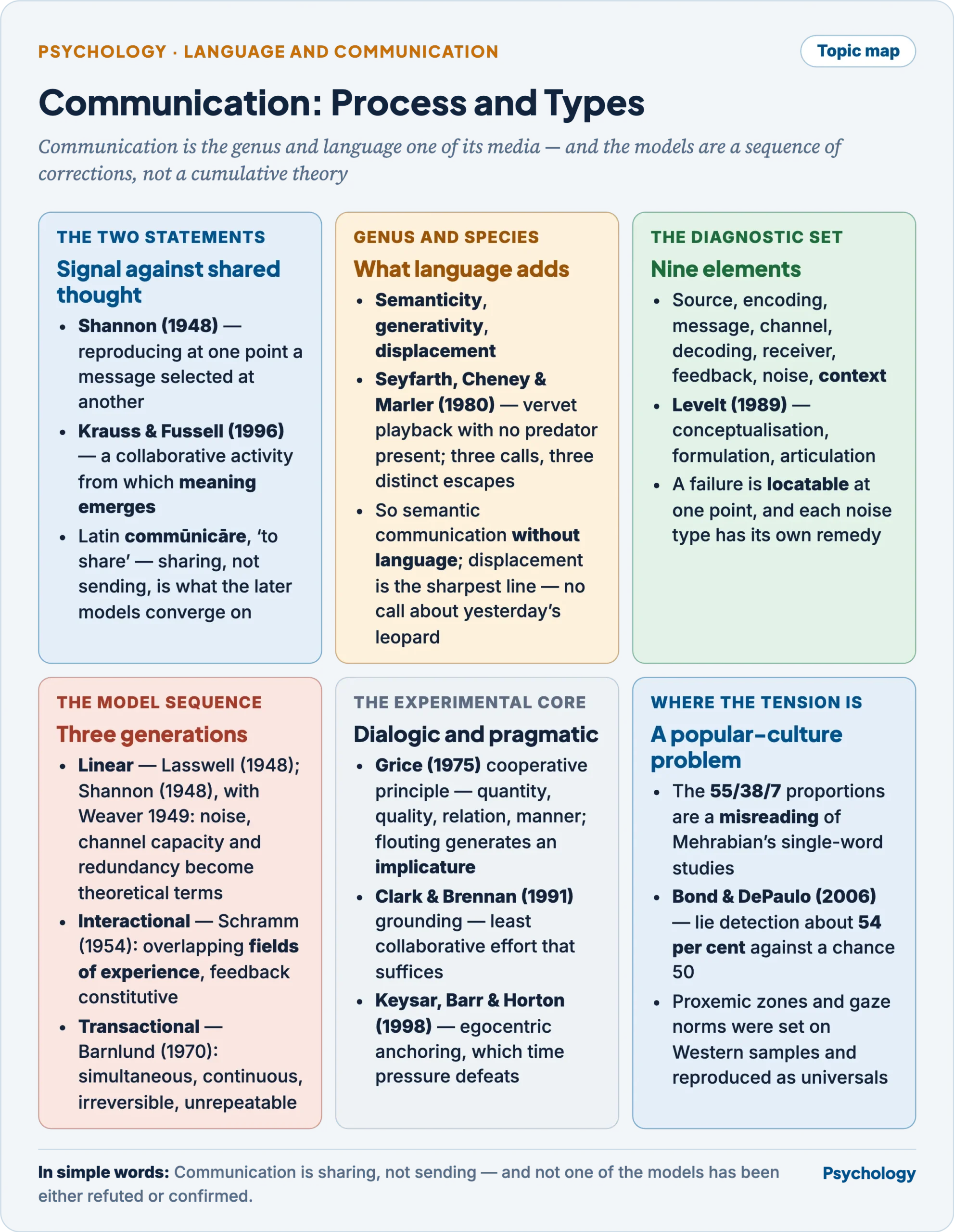
“The fundamental problem of communication is that of reproducing at one point either exactly or approximately a message selected at another point.”
Shannon (1948)
That is the engineering statement. Krauss and Fussell (1996) give the psychological one: communication is a collaborative activity from which meaning emerges, so reproducing a signal and sharing a thought are not the same achievement.
Communication is the genus and language is one of its media. Every species signals; only humans signal with a system that is semantic, generative and displaced, and the gap between the two statements above is where the psychology sits.
What communication is
- The word descends from the Latin commūnicāre, “to share”, and the etymology is not decorative — sharing, not sending, is what the later models converge on.
- Working definition: the exchange of information such that meaning is transmitted and received, which requires the information to be intelligible to the receiver, not merely that it leave the source.
- Two kinds of signal operate in any system. A sign is causally related to what it conveys — smoke for fire, a flinch for pain. A symbol stands for its referent only by social convention, so it must be learned and can be misread.
- Seyfarth, Cheney and Marler (1980) played back recorded vervet monkey alarm calls with no predator present.
- Three acoustically distinct calls produced three distinct escapes: to the trees for the leopard call, looking up for the eagle call, scanning the ground for the snake call.
- Playback rules out reaction to the predator itself, so the call carries referential information — semantic communication without language.
How communication differs from language
- Language is a rule-governed sign and symbol system, a conventionalised code shared by a community, organised into phonological, morphological, syntactic, semantic and pragmatic subsystems.
- Language confers three properties other signalling systems lack, and the difference consists in these.
- Semanticity — signals stand for things, so they carry meaning rather than merely triggering responses.
- Generativity, or productivity — a finite symbol inventory recombines to produce an unbounded set of novel messages.
- Displacement — reference to what is remote in space or time, or absent. A vervet cannot call about yesterday’s leopard.
- Displacement is the sharpest line: however eloquent an animal’s signalling, it cannot report its parentage or a counterfactual. Ape-language work narrows the gap without closing it — trained chimpanzees and bonobos acquire large symbol vocabularies and some combinatorial use, with no recursive syntax.
- Three consequences follow. Communication is possible without language — infants, other species, an embrace. Language is not only for communication — it also serves inner speech, rehearsal and thought. And language makes communication decontextualised and cumulative, the precondition for instruction and culture.
- The internal structure of language, and the child’s passage from pre-linguistic gesture to speech, are treated in the human language: properties, structure and the linguistic hierarchy article; how the system is acquired is in the cognitive, social-interactionist and connectionist accounts article.
The elements of the communication process
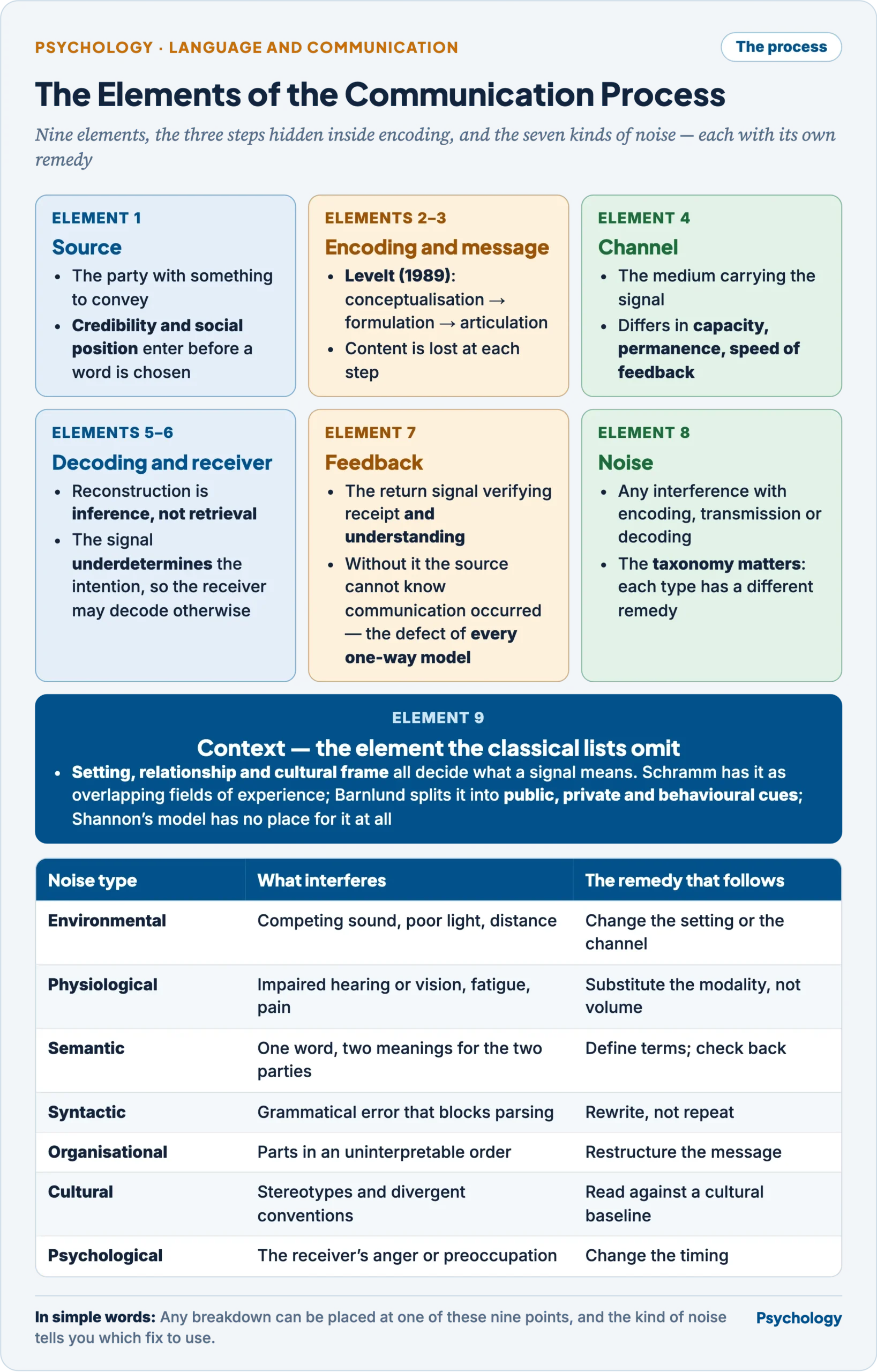
- Source — the party with something to convey. Credibility, knowledge, attitudes and social position enter the message before a word is chosen.
- Encoding — translating intention into transmittable symbols. Levelt (1989) decomposes speaking into conceptualisation, formulation and articulation, each a step at which content is lost.
- Message — the encoded content, which has structure and treatment as well as substance; one proposition in two orders is two messages.
- Channel — the medium carrying the signal. Channels differ in capacity, permanence, speed of feedback and number of modalities engaged.
- Decoding — the receiver’s reconstruction of meaning, which is inference rather than retrieval, since the signal underdetermines the intention.
- Receiver — who perceives the symbols and may or may not decode them as intended.
- Feedback — the return signal verifying receipt and understanding. Without it the source cannot know whether communication occurred, which is the defect of every one-way model.
- Noise — any interference with encoding, transmission or decoding. The taxonomy matters because each type has its own remedy.
- Environmental — competing sound, poor light, distance. Physiological — hearing or vision impairment, fatigue, pain.
- Semantic — one word carrying different meanings for the two parties. Syntactic — grammatical error that blocks parsing. Organisational — parts arriving in an uninterpretable order.
- Cultural — stereotypes and divergent conventions that bias interpretation. Psychological — the receiver’s anger, anxiety or preoccupation.
- Context is the element the classical lists omit: setting, relationship and cultural frame all decide what a signal means.
Linear, interactional and transactional models
- Lasswell (1948) reduced the problem to a formula — who says what in which channel to whom with what effect.
- It organised the research agenda and remains the checklist for diagnosing any communicative act.
- But it is a list of headings with no mechanism, and it assumes an effect occurs.
- Shannon (1948), elaborated with Weaver in 1949, gave the first formal linear or transmission model: information source, transmitter, channel, receiver, destination, with a noise source acting on the channel.
- What it added: noise became a theoretical term rather than a complaint, channel capacity set a limit on what a medium can carry, and redundancy emerged as the defence against noise rather than a stylistic fault.
- What it gets wrong: it is one-way, with no feedback; it locates meaning in the signal rather than the receiver’s construction; it has no place for context, relationship or culture.
- Psychologists reject it as mechanistic, the constructivist alternative holding that meaning changes over the course of an interaction.
- Schramm (1954) replaced the line with a circle, in the interactional model.
- Each party is simultaneously encoder, interpreter and decoder, so there is no fixed sender and receiver.
- Communication succeeds only where the parties’ fields of experience overlap; the shared region, not the signal, sets the ceiling on understanding.
- Feedback becomes constitutive rather than an addition.
- Its limits: it still models alternating turns, assumes roughly equal fields of experience, and says little about asymmetries of power or about mass communication, where feedback is negligible.
- Berlo (1960) specified the components in the SMCR model — source, message, channel, receiver — and listed the factors under each.
- Source and receiver are each analysed by communication skills, attitudes, knowledge, social system and culture, which makes the model psychological rather than engineering. The message is analysed by content, elements, treatment, structure and code; the channel by the five senses.
- Its defect is that it carries neither feedback nor noise and stays linear, so it is a better inventory of variables than a model of a process.
- The transactional view, associated with Barnlund (1970), treats communication as simultaneous rather than sequential.
- Both parties send and receive at once: a listener’s posture is a message while the speaker talks.
- Barnlund distinguishes public cues from the setting, private cues from one’s own senses, and behavioural cues generated by the participants.
- Communication is continuous, irreversible and unrepeatable — nothing said can be unsaid, and the relationship is altered by the exchange.
- Its weakness is generality: by making everything relevant it yields few testable predictions, and it has generated far less experimental work than the models it supersedes.
The four paradigms behind the models
- Krauss and Fussell (1996) distinguish four paradigms, each isolating one dimension of the process: encoding-decoding, intentionalist, perspective-taking and dialogic.
- Encoding-decoding treats language as a one-to-one code and fails because utterances are not uniquely decodable. On the intentionalist view the listener recovers the speaker’s intention rather than the literal content.
- Schober (1993) found speakers describing spatial arrangements usually formulate relations from the addressee’s viewpoint rather than their own, which is perspective-taking in operation.
- Keysar, Barr and Horton (1998) argue for an egocentric basis to language use: one’s own perspective is the default anchor and the addressee’s is a slow correction that time pressure defeats. Fussell and Krauss (1991) found the matching bias in estimates of what others know.
- Clark and Brennan (1991) describe grounding, the dialogic mechanism: participants jointly establish what has been understood, by acknowledgement, repair and reformulation, settling for the least collaborative effort that suffices.
- Grice (1975) supplies the governing convention, the cooperative principle, with four maxims — quantity (as informative as required, no more), quality (be truthful), relation (be relevant) and manner (be clear). Flouting a maxim generates an implicature, which is how irony, hints and polite refusals work.
Types of communication
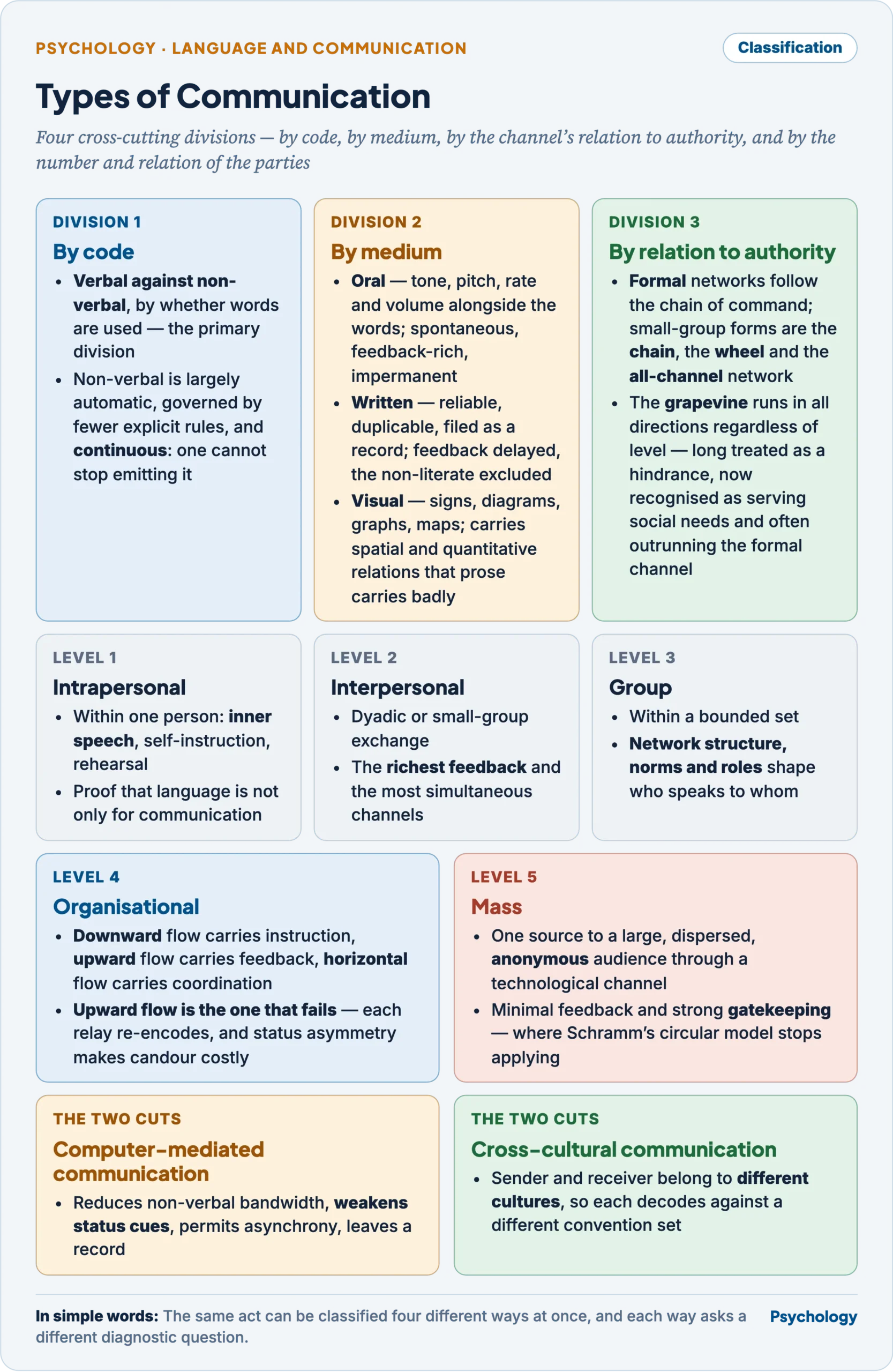
- Verbal and non-verbal is the primary division, by whether words are used.
- Verbal communication subdivides by medium.
- Oral — speech, carrying tone, pitch, rate and volume alongside the words. Spontaneous, feedback-rich, relationship-building, impermanent.
- Written — reliable, duplicable, suited to lengthy or technical content, filed as a record. Feedback is delayed, presence absent, the form rigid, the non-literate excluded.
- Visual — signs, diagrams, graphs, maps and images, carrying spatial and quantitative relations that prose carries badly.
- Formal and informal, by whether the channel follows the authority structure.
- Formal networks carry task content along the chain of command. Their small-group forms are the chain, the wheel and the all-channel network, differing in speed, accuracy and leader emergence.
- The grapevine is the informal system, running in all directions regardless of level. Long treated as a hindrance, it is now recognised as serving social needs and often outrunning the formal channel.
- By the number and relation of the parties, which is the levels taxonomy.
- Intrapersonal — within one person: inner speech, self-instruction, rehearsal.
- Interpersonal — dyadic or small-group exchange, with the richest feedback and the most simultaneous channels.
- Group — within a bounded set, where network structure, norms and roles shape who speaks to whom.
- Organisational — through a structure, with downward flow carrying instruction, upward flow carrying feedback, and horizontal flow carrying coordination. Upward flow is the one that fails.
- Mass — one source to a large, dispersed, anonymous audience through a technological channel, with minimal feedback and strong gatekeeping.
- Computer-mediated communication cuts across these, reducing non-verbal bandwidth, weakening status cues, permitting asynchrony and leaving a record. Cross-cultural communication is a further cut, defined by sender and receiver belonging to different cultures.
The non-verbal channels
- Non-verbal communication is the part of communication that is not words — gesture, touch, expression, gaze, spacing, timing, appearance, and the vocal properties of speech other than its lexical content.
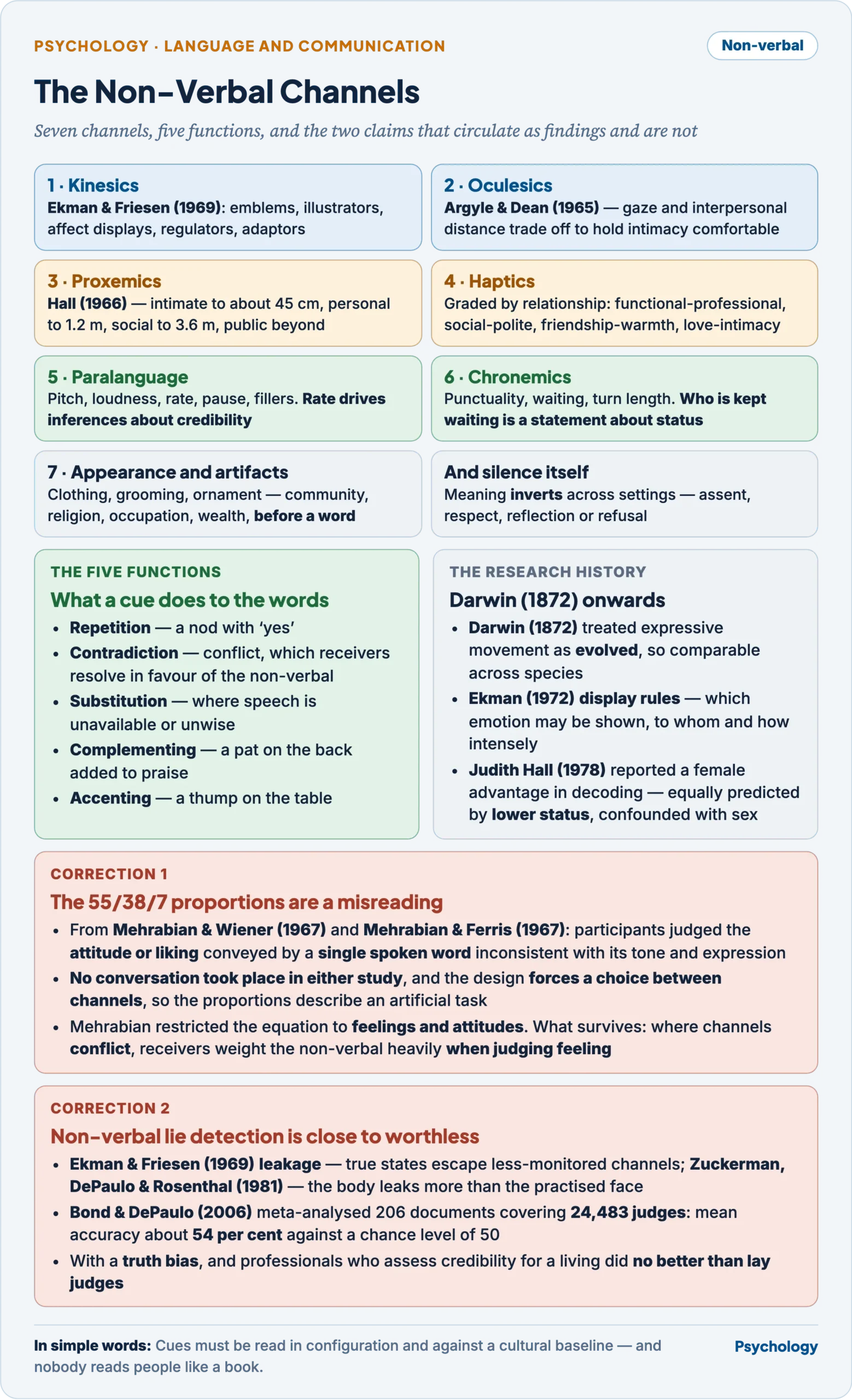
- Its research history begins with Darwin (1872) on the expression of the emotions, which treated expressive movement as evolved and so comparable across species.
- It differs from verbal communication in three ways: it is largely automatic and unintentional, it is governed by fewer explicit rules, and it is continuous — one cannot stop emitting it.
- Five functions classify what a cue does to the accompanying words.
- Repetition — a nod with “yes”. Contradiction — conflict, which receivers resolve in favour of the non-verbal.
- Substitution — where speech is unavailable or unwise. Complementing — a pat on the back added to praise. Accenting — a thump on the table.
- The channels, with what each carries.
- Kinesics — body movement, posture, gesture and facial expression. Ekman and Friesen (1969) classify these as emblems (gestures with a direct verbal translation), illustrators (movements tied to the accompanying speech), affect displays, regulators (nods and gaze managing turn-taking) and adaptors (self-directed movements serving personal needs).
- Oculesics — gaze, mutual gaze, blink rate, pupil dilation. Gaze regulates turn-taking, signals attention and indexes liking. Argyle and Dean (1965) showed gaze and interpersonal distance trade off against each other to hold intimacy at a comfortable level.
- Proxemics — the use of interpersonal space. Hall (1966) distinguished intimate distance (contact to about 45 cm), personal (about 45 cm to 1.2 m), social (about 1.2 to 3.6 m) and public (beyond about 3.6 m).
- Haptics — touch, graded by relationship into functional-professional, social-polite, friendship-warmth and love-intimacy levels. Harlow’s contact-comfort work made touch a developmental necessity, not a courtesy.
- Paralanguage, or vocalics — pitch, loudness, rate, timbre, pause and verbal fillers. Pitch marks urgency and question status, volume marks intensity, rate drives inferences about credibility.
- Chronemics — the communicative use of time: punctuality, waiting, turn length, speed of reply. Who is kept waiting is a statement about status.
- Physical appearance and artifacts, or objectics — clothing, grooming, ornament and possessions, signalling community, religion, occupation, marital status, wealth and authority before anything is said.
- Judith Hall (1978), pooling seventy-five studies quantitatively, reported a female advantage in decoding non-verbal cues — a different researcher from the Edward Hall of the proxemic zones above. The same pattern is predicted by lower social status, which is confounded with sex in most samples.
- Accurate judgement needs the whole configuration. The social meanings approach holds that cues work in combination, so reading a folded arm in isolation is the standard error of popular body-language writing.
Channel conflict, deception and the proportion claim
- The claim that the face carries 55 per cent of meaning, the voice 38 and the words 7 is a misreading of Mehrabian and Wiener (1967) and Mehrabian and Ferris (1967), and it is worth knowing why.
- Participants judged the attitude or liking conveyed by a single spoken word that was inconsistent with its tone and the accompanying expression. No conversation took place in either study.
- The design forces a choice between channels, so the proportions describe how a conflict is resolved in an artificial task, not how meaning is distributed in ordinary speech.
- Mehrabian restricted the equation to feelings and attitudes and cautioned against generalising it to communication as a whole.
- What survives the correction is the real finding: where the channels conflict, receivers weight the non-verbal heavily when judging feeling. The percentages applied to all communication are not defensible.
- Deception is where channel conflict is studied directly, and the findings are modest rather than dramatic.
- Ekman and Friesen (1969) introduced non-verbal leakage: because attention goes to what is said, true states escape through less-monitored channels. Their 1974 study then tested the claim by separating body from face. Zuckerman, DePaulo and Rosenthal (1981) found the body leaks more readily than the practised face.
- Pitch tends to rise when lying, and liars hesitate more, make more speech errors, use fewer self-references and more negative-emotion words, and describe events in less cognitively complex terms.
- Bond and DePaulo (2006) meta-analysed 206 documents covering 24,483 judges: mean accuracy in discriminating lies from truths was about 54 per cent against a chance level of 50.
- There was a truth bias — more statements judged truthful than were — and professionals who assess credibility for a living did no better than lay judges.
- So non-verbal lie detection is close to worthless, and the claim that one can read people like a book is false.
- Display rules — Ekman (1972) — are the culturally learned conventions governing which emotion may be shown, to whom and how intensely. They are why expression recognition is comparatively universal while expression production is not.
Limitations of verbal communication
- The symbol is not the thing. Words relate to referents by convention alone, so nothing guarantees that source and receiver attach the same meaning — the origin of semantic noise, ambiguity, polysemy and vagueness.
- Encoding is lossy. On Levelt’s account the speaker conceptualises, formulates and articulates under real-time pressure; what is said is a compression of what was meant, and it is not recoverable.
- Perspective-taking fails systematically. The egocentric anchoring Keysar and colleagues describe, with the overestimation of shared knowledge Fussell and Krauss report, means a speaker routinely says less than the listener needs; time pressure and preoccupation worsen it.
- Pragmatic failure. Functional meaning diverges from literal meaning, so the words can be fully understood and the message entirely missed — the risk in indirect requests, understatement, irony and polite refusal.
- Capacity limits. Speech arrives faster than it can be fully processed and the verbal channel is serial, so information overload degrades comprehension once the rate exceeds what the receiver absorbs.
- Jargon compresses complex ideas efficiently inside a group and blocks communication outside it, so the same term is an asset and a barrier depending on audience.
- Some content resists words. Spatial relations, textures, faces, music, bodily sensation and the fine grain of emotion are carried better visually, by demonstration, or non-verbally.
- Affect is weakly encoded — the defensible core of the proportion claim. Words state positions well and convey feeling badly, so verbal reassurance contradicted by expression fails.
- Lexical gaps. Vocabularies are not equivalent across languages, so translation loses distinctions the source marks and the target does not — acute where an interpreter stands between the parties.
- Medium-specific defects. Oral messages are impermanent and misremembered; written messages carry no presence, invite misreading of tone, and are slow to correct. Words are also the easiest channel to falsify, being the most consciously monitored.
- Literacy and language access. Written communication is unavailable to the non-literate, and official communication in a language the citizen does not command is formally complete and functionally void — a standing constraint in a multilingual polity.
- Communication apprehension — persistent anxiety about speaking, writing or both — leads people to avoid the channel and redesign their work to need less of it, suppressing the information they hold.
Culture and the communication process
- Hall (1976) distinguished high-context from low-context communication.
- High-context exchange locates meaning in the shared relationship and setting and leaves much unsaid; low-context exchange puts meaning in the explicit message.
- Indian practice sits towards the high-context end, which is why one party reads an instruction as vague and the other as sufficient.
- Non-verbal conventions diverge most, and the Western defaults these literatures assume are not the Indian ones.
- Greeting. The namaste with folded palms is a non-contact greeting and touching an elder’s feet marks deference; a handshake or embrace imports a different relational claim.
- Oculesics. Sustained eye contact with a senior reads as frankness in low-power-distance settings and as impertinence in many Indian ones, where a lowered gaze signals respect rather than evasion — a real risk in interviewing and clinical assessment.
- Kinesics. The lateral head movement that signals assent across much of India is read elsewhere as hesitation; emblems are the least translatable of all cues.
- Haptics. The left hand is avoided for giving, eating and contact across much of South and West Asia; same-sex contact between friends is unremarkable where cross-sex contact in public is not.
- Proxemics. Hall’s zones derive from middle-class North American adults and are reproduced as universals. Conversational distance is markedly smaller in crowded urban India, so a Western-calibrated reading of intrusion is wrong there.
- Chronemics. A linear conception treats time as irrecoverable and makes punctuality a moral property; a cyclical conception does not, so slippage carries far less insult than a monochronic interlocutor infers.
- Silence is itself a cue, and its meaning inverts across settings — assent, respect, reflection or refusal — making it the most misread signal in cross-cultural exchange.
- Two barriers follow from this. Ethnocentrism treats one’s own conventions as the standard; failure to perceive differences assumes shared goals beneath surface variation, and produces stereotyping.
Criticisms and limitations
- The models are a sequence of corrections, not a cumulative theory. Shannon’s is mechanistic, Schramm’s assumes alternating turns and comparable fields of experience, and Barnlund’s is too inclusive to yield predictions. None has been refuted and none confirmed.
- The element lists are inventories. Naming source, message, channel and receiver organises description without explaining why a message works — the same catalogue problem the persuasion literature met; the research on source and message variables is carried in the persuasion and attitude change through communication article.
- The non-verbal literature carries a popular-culture problem unusual in psychology: the proportion claim, single-cue readings and lie-detection folklore all circulate as findings.
- Cultural narrowness is built into the measurements. Proxemic zones, gaze norms and display conventions were established on Western samples and reproduced as universals; the work correcting this is largely descriptive rather than experimental.
- The sex-difference findings are confounded with status and mostly small, so the common statement that women are better communicators is not supported in that form.
- Measurement is weak throughout — self-report, confederate ratings, single encounters between strangers with nothing at stake.
- What survives is usable as it stands.
- The element set — source, encoding, message, channel, decoding, receiver, feedback, noise, context — remains the diagnostic checklist: a failure is locatable at one of those points, and each noise type has a distinct remedy.
- Grounding, the cooperative principle and the perspective-taking failures are the field’s solid experimental core.
- Channel conflict resolves in favour of the non-verbal where feeling is at issue, so congruence between word and body matters; and cues must be read in configuration, against a cultural baseline.
Previous Year Questions
- 2018Explain various limitations of verbal communication.
- 2015Illustrate with suitable examples the non-verbal process of communication.
- 2004Explain the role of language in communication. Give a brief theoretical account of language development.
- 2003What is communication? Describe the processes involved in communication.
- 1997In order to have effective communication how far should one learn the body language and relate it to verbal communication?