

Social intelligence.
Official Syllabus: Paper I · Unit 10 Intelligence and Aptitude
“The ability to understand and manage men and women, boys and girls — to act wisely in human relations.”
— Thorndike (1920), defining social intelligence
Social intelligence is the oldest of the proposed additions to the ability literature and the least settled. It was named before emotional intelligence, measured badly, pronounced dead, and recovered on a different kind of evidence — and the question that killed it in 1960 has still not been answered: is there a social ability distinct from general intelligence pointed at people, or is the second description the whole of it? The case for the construct now rests less on test correlations than on a dedicated neural system and on behavioural criteria.
A construct that was abandoned and recovered
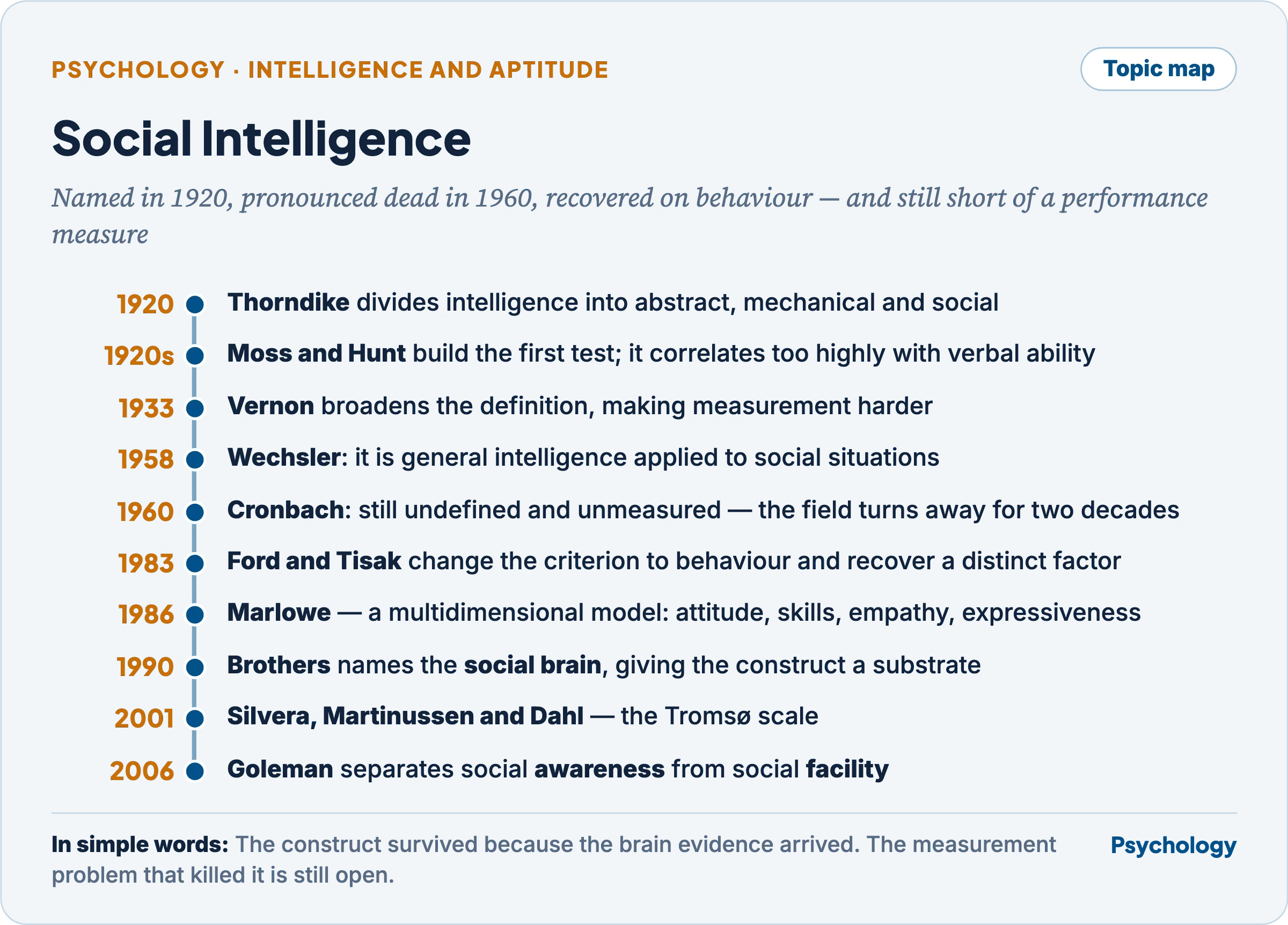
- Thorndike (1920) introduced it, dividing intelligence into abstract, mechanical and social, and defining the third as the ability to understand and manage people and to act wisely in human relations.
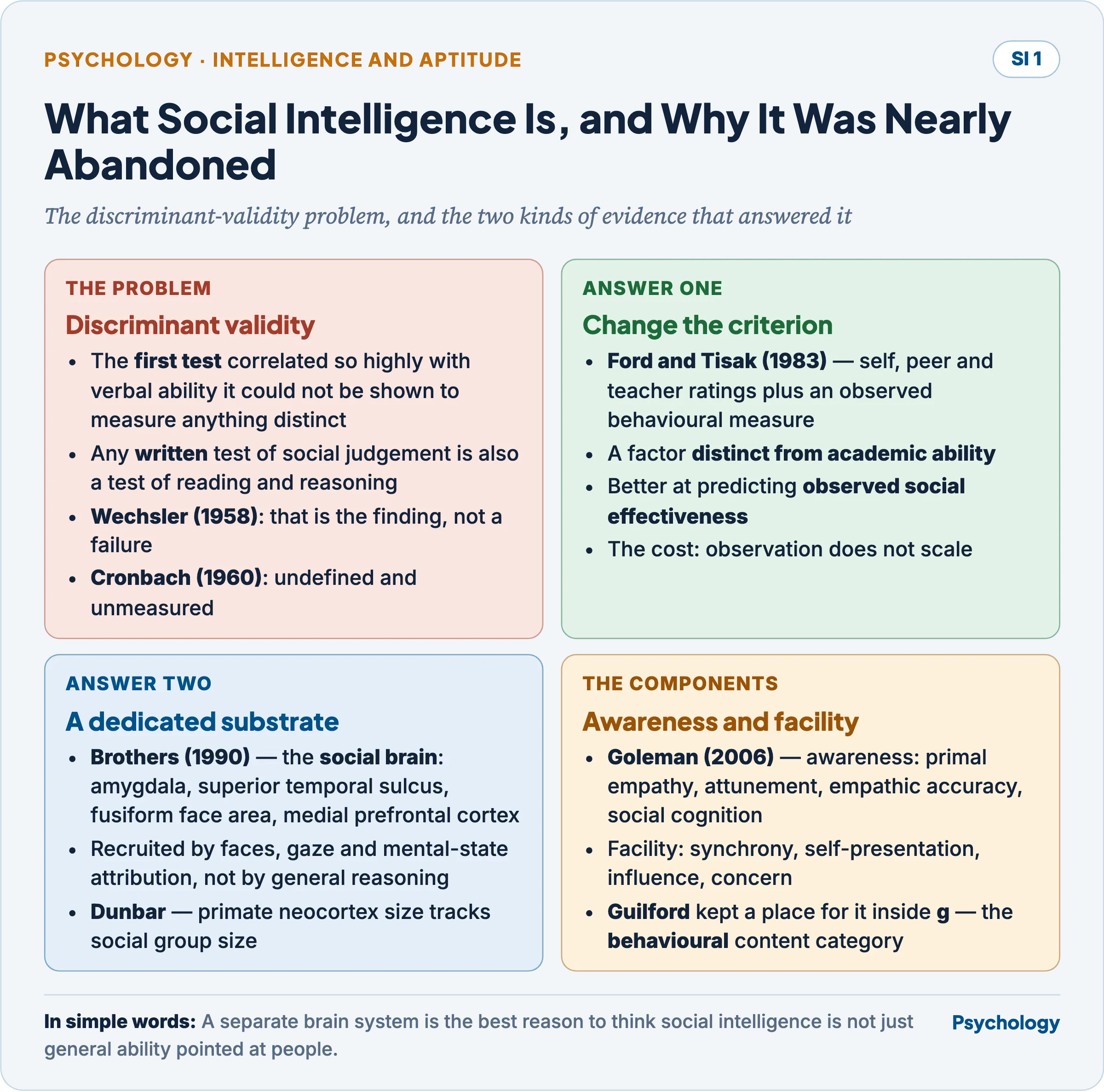
- Early measurement failed, and the failure is instructive. The George Washington Social Intelligence Test (Moss and Hunt, 1920s) asked testees to judge social situations and recognise mental states, and correlated so highly with verbal ability tests that it could not be shown to measure anything distinct. This is the discriminant validity problem that has shadowed the construct ever since: any written test of social judgement is also a test of reading and reasoning.
- Two deflationary verdicts followed. Wechsler (1958) held that social intelligence is simply general intelligence applied to social situations, so the correlations that defeated Moss and Hunt were the finding rather than a failure. Cronbach (1960) concluded that after half a century the construct remained undefined and unmeasured and advised the field to turn elsewhere, which it largely did for two decades. Vernon’s (1933) broader definition — getting along with people, social technique, and insight into the moods of strangers — made measurement harder, not easier, while Guilford kept a theoretical place for it, including behavioural content in his structure-of-intellect model and building tests of its behavioural-cognition cells with O’Sullivan.
- The revival came from changing the criterion. Ford and Tisak (1983) found that self, peer and teacher ratings of social competence together with a behavioural measure defined a factor distinct from academic ability and better at predicting observed social effectiveness. Moving from a written test to behaviour recovered what written tests had obscured. Marlowe (1986) then treated social intelligence as several loosely related capacities — prosocial attitude, social skills, empathy skills and emotional expressiveness.
- Later models separate awareness from facility. Goleman (2006) divided it into social awareness — primal empathy, attunement, empathic accuracy, social cognition — and social facility — synchrony, self-presentation, influence and concern. The Tromsø Social Intelligence Scale (Silvera, Martinussen and Dahl, 2001) measures social information processing, social skills and social awareness by self-report.
- The neuroscience gave the construct a substrate. Brothers (1990) named the social brain — amygdala, superior temporal sulcus, fusiform face area and medial prefrontal cortex — recruited by faces, gaze and mental-state attribution rather than by general reasoning, and Dunbar’s social-brain hypothesis relates primate neocortex size to group size, supplying the evolutionary argument. A dedicated neural system is the strongest evidence that social intelligence is not simply general ability pointed at people.
Nurturing it early, and conflict resolution later
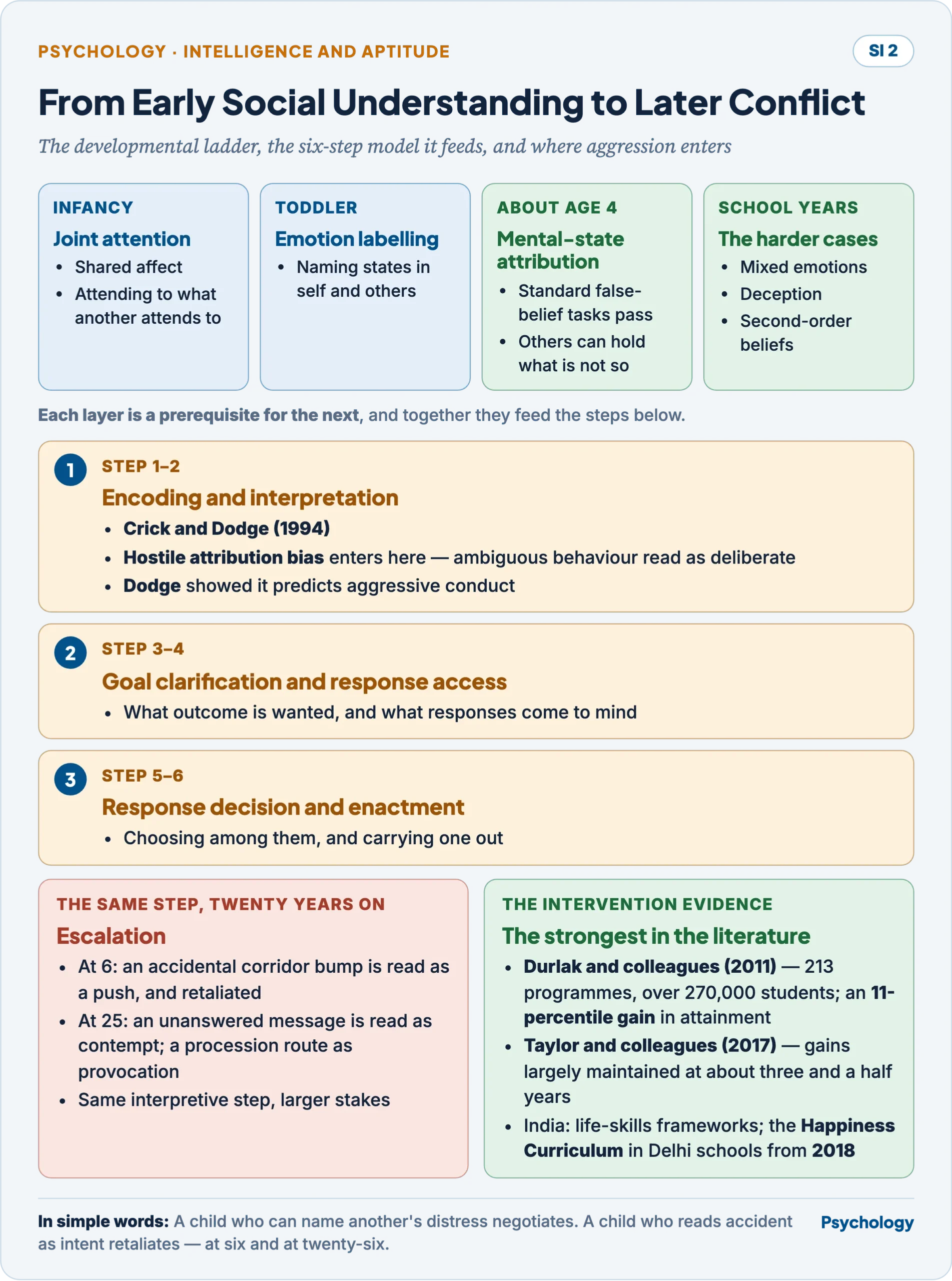
- The developmental mechanism is specifiable. Early social understanding is built from joint attention and shared affect in infancy, emotion labelling in the toddler years, and mental-state attribution — passing standard false-belief tasks around age four — then the understanding of mixed emotions, deception and second-order beliefs in the school years. Each layer is a prerequisite for the next.
- The link to later conflict runs through social information processing. Crick and Dodge’s (1994) reformulated model sets out the steps a child executes in a social encounter — encoding cues, interpreting them, clarifying a goal, accessing responses, deciding and enacting — and a deficit at any step produces aggression by a different route. The best-documented is hostile attribution bias, the tendency to read ambiguous behaviour as deliberately hostile, which Dodge showed predicts aggressive conduct. Early social understanding is what makes the benign interpretation available at the interpretation step.
- The examples make the mechanism concrete.
- A four-year-old who can name another child’s distress treats a disputed toy as a problem with two wants in it and proposes turns; a child who cannot read the distress sees only an obstacle and grabs. The capacity, not the temperament, produces the negotiation.
- A child with hostile attribution bias reads an accidental corridor bump as a deliberate push and retaliates. The same interpretive step at twenty-five reads a colleague’s unanswered message as contempt, or a neighbouring community’s procession route as provocation — and the retaliation is larger because the stakes are.
- Pretend play with siblings and peers requires holding another’s imagined perspective alongside one’s own, and children with more of it show earlier mental-state understanding. Peer-mediation programmes then convert the capacity into an exercised procedure and reduce disciplinary referrals.
- The intervention evidence is the strongest in this literature. Durlak and colleagues (2011) meta-analysed 213 school-based social and emotional learning programmes covering more than 270,000 students and found significant gains in social-emotional skills, attitudes and behaviour, a reduction in conduct problems and emotional distress, and an eleven-percentile-point gain in academic achievement. Taylor and colleagues (2017) followed up with a meta-analysis of studies having post-programme follow-ups averaging around three and a half years and found the gains, including reduced conduct problems, largely maintained.
- The Indian programmes exist and are young. Life-skills and health-and-wellness curricula are prescribed in school boards’ frameworks; the National Education Policy, 2020 commits to socio-emotional learning across the curriculum; and the Happiness Curriculum introduced in Delhi government schools in 2018 devotes a daily period in the primary and middle years to mindfulness, stories and reflective activities. Independent evaluation of the last has reported gains in classroom relationships and self-awareness, with effects on harder outcomes not yet established — a fair description of where the Indian evidence stands.
The management of people
- The managerial work social intelligence does is specifiable, and it is distinct from what general ability does. General ability carries the analytical load — diagnosing a problem, evaluating options, drafting precisely. Social intelligence carries the influence load, which is the part of managing people that cannot be done by being right.
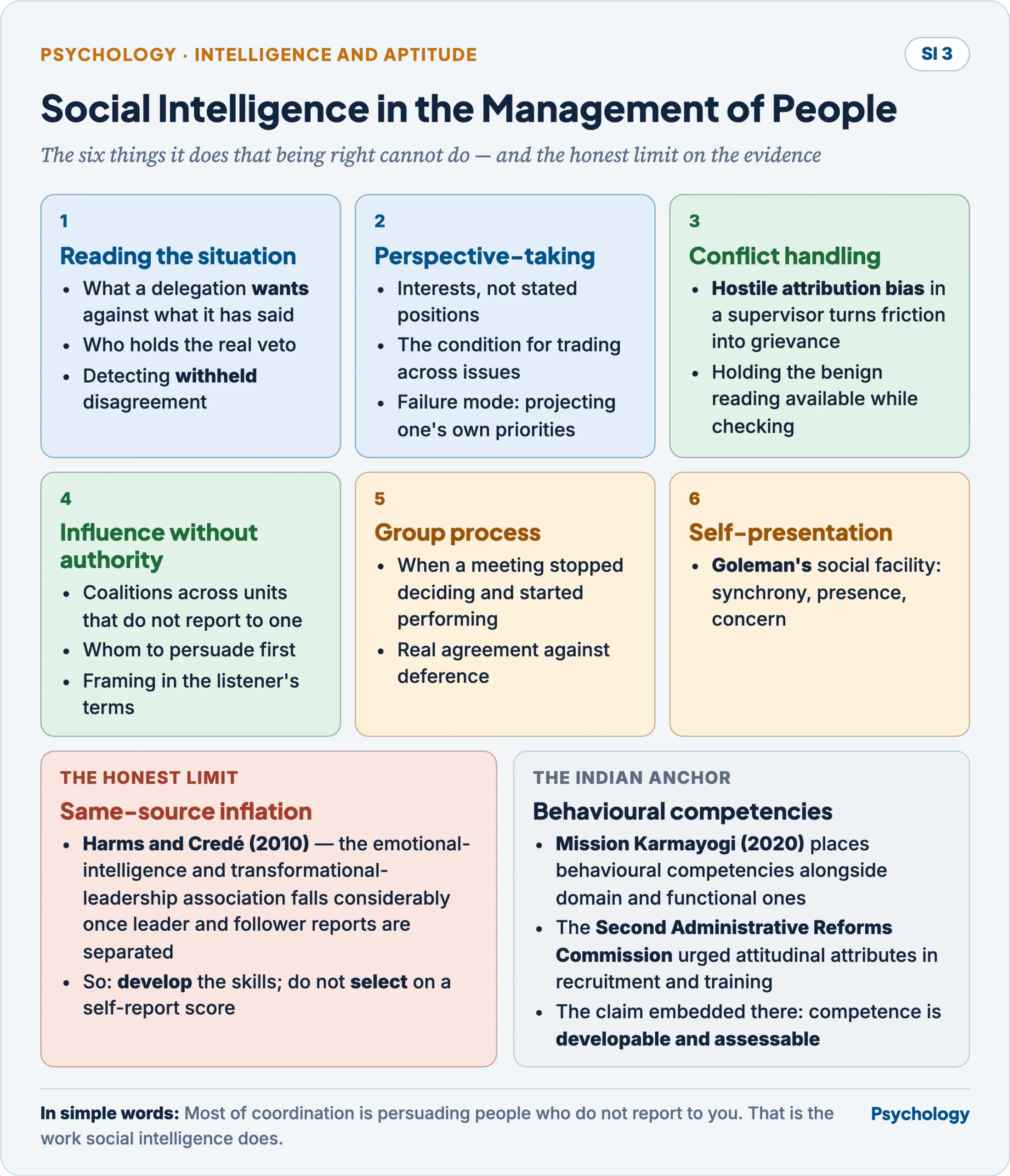
- Reading the situation. The first component is social perception — identifying what a subordinate, a delegation or a counterpart actually wants as against what they have said, recognising who in a group holds the real veto, and detecting withheld disagreement. A manager who cannot detect silent dissent discovers it only at implementation.
- Perspective-taking in negotiation. Mental-state attribution applied to a counterpart supplies their interests rather than their stated position, which is the condition for trading across differently valued issues instead of splitting a single one. The failure mode is projecting one’s own priorities onto the other side.
- Conflict handling. The developmental mechanism above operates in adults unchanged: the manager who reads an ambiguous act as deliberate hostility escalates it, and hostile attribution bias in a supervisor converts ordinary friction into a grievance. Social intelligence here is largely the capacity to hold a benign interpretation available while checking which is true.
- Influence without authority, which is most of coordination work — building a coalition across units that do not report to one, sequencing whom to persuade first, and framing a proposal in the terms the listener values. This is where Ford and Tisak’s (1983) finding bears directly: social ability predicted observed social effectiveness where academic ability did not.
- Group process. Attunement to a group’s state — when a meeting has stopped deciding and started performing, when agreement is real and when it is deference — and the synchrony and self-presentation components Goleman (2006) grouped as social facility.
- The evidence is honest about its limits. Social and emotional competence correlate with rated managerial and leadership effectiveness, but the correlations are inflated where the predictor and the criterion come from the same person. Harms and Credé (2010) found the association between emotional intelligence and transformational leadership falling considerably once leader and follower reports were kept separate. The defensible claim is that social ability matters most where the work is dense in human dealing, and that it is better developed than selected on, because the available selection instruments are self-reports.
- The Indian institutional anchor. Mission Karmayogi, the national programme for civil services capacity building approved in 2020, rests on a competency framework placing behavioural competencies alongside domain and functional ones. The Second Administrative Reforms Commission had similarly urged that attitudinal and behavioural attributes enter recruitment and training rather than knowledge alone. The structural significance is that behavioural competence is treated as developable and assessable — which is what the training evidence supports and what selection on self-report scores does not.
Measurement
- The problem is older than the solutions. A test of social judgement must have a criterion of correctness, and what the right reading of a social situation is remains contested. Where the criterion is the modal answer, the test measures agreement with the majority; where it is expert judgement, it measures agreement with the expert’s culture.
- Self-report scales are what exist in practice — the Tromsø Social Intelligence Scale (Silvera, Martinussen and Dahl, 2001) with its social information processing, social skills and social awareness components, and the various social-skills inventories. They are quick and reliable and measure perceived social competence, which correlates with extraversion and agreeableness.
- Performance measures have been attempted repeatedly. Guilford and O’Sullivan’s behavioural-cognition tests asked testees to infer mental states from photographs and vignettes; later work has used filmed interactions with the participants’ own reported states as the criterion, which is the most defensible answer to the correctness problem.
- Behavioural and peer criteria remain the strongest design. Ford and Tisak (1983) combined self, peer and teacher ratings with an observed behavioural measure, which is how the distinct factor was recovered at all — and also why the approach has not scaled, since it requires observation rather than a form.
- The neuroscientific measures are indirect but convergent: performance on face and gaze processing, emotion recognition and mental-state attribution tasks, which load on the social-brain network and dissociate from general reasoning after focal damage.
Criticisms and limitations
- Discriminant validity is the central unresolved problem. Written tests of social judgement correlate heavily with verbal ability, as they did when the first such test was built in the 1920s, and self-report scales correlate heavily with personality. Neither has demonstrated a social ability factor clearly distinct from both.
- Cronbach’s challenge stands. More than sixty years after he judged the construct undefined and unmeasured, there is no widely accepted performance measure establishing a social factor independent of general ability — which is why Wechsler’s deflationary reading remains live.
- The definitions are too broad to constrain measurement. Vernon’s list runs from social technique to insight into strangers’ moods; Marlowe’s spans attitude, skills, empathy and expressiveness. A construct defined that widely cannot be falsified by any one instrument failing.
- The construct is culturally loaded. What counts as socially skilled — directness, deference, the handling of disagreement in a group — differs across societies, so items keyed to one culture’s norms measure acculturation partly as ability.
- It is not a moral property. Accurate reading of others and skilled influence are the equipment of manipulation as much as of care, and high social intelligence is as consistent with exploitation as with leadership.
- The applied literature has outrun the research. Social-intelligence instruments and training are sold widely on an evidence base that is thin, same-source and mostly cross-sectional, and the school-based social and emotional learning evidence — which is good — is evidence for teaching the skills, not for the validity of the ability construct.
Previous Year Questions
- 2022Nurturing social intelligence at early developmental stages can play a critical role in conflict resolution at later stages. Explain with the help of examples.
- 1998What specific role does social intelligence play in the management of people?