

Emotional competence and the related issues.
Official Syllabus: Paper I · Unit 9 Motivation and Emotion
“An emotional competence is a learned capability based on emotional intelligence that results in outstanding performance at work.”
— Goleman (1998)
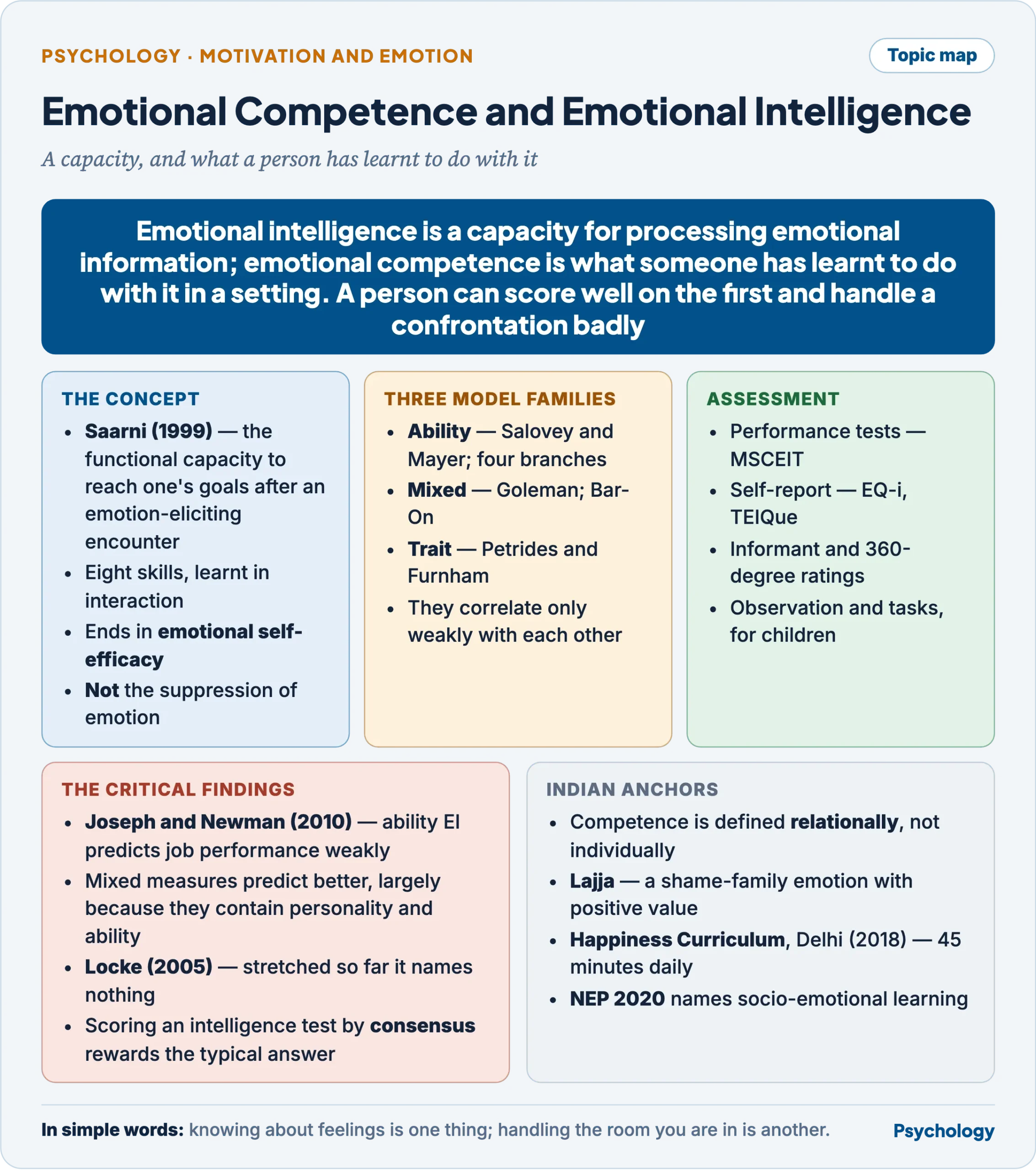
The clause names a competence, not a trait, and the distinction carries the whole topic. Emotional intelligence is a capacity for processing emotional information; emotional competence is what a person has actually learnt to do with it in a particular setting. A person may score well on the capacity and handle a confrontation badly, which is why the two are measured differently and why only the second can be taught.
Emotional competence: the concept
Saarni (1999) gave the developmental account that defines the field: emotional competence is the functional capacity to reach one’s goals after an emotion-eliciting encounter, and it is built from skills acquired in social interaction rather than from a fixed endowment. Her formulation makes emotional self-efficacy — the belief that one can live with and act on what one feels — the end-point of emotional development.
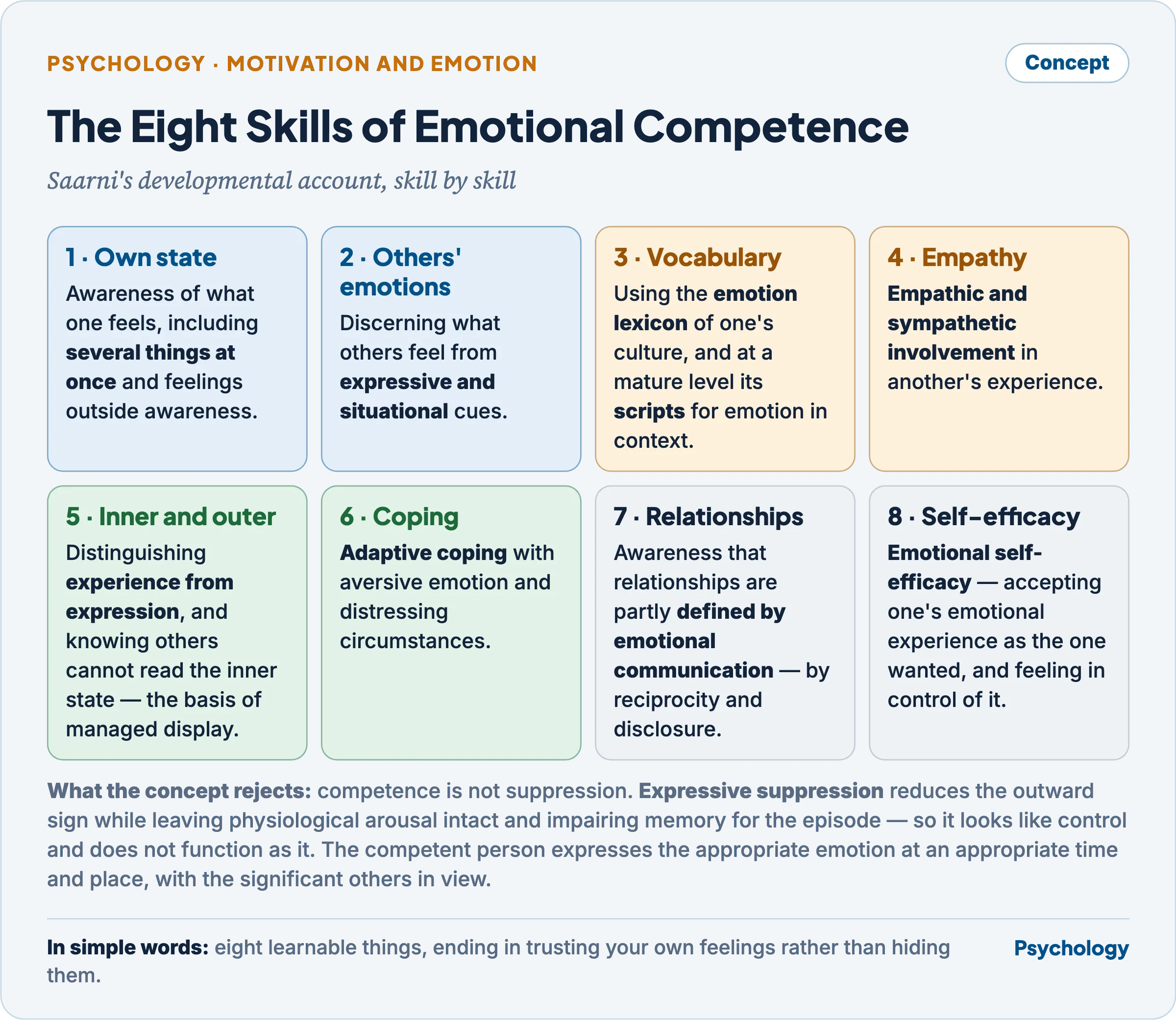
The eight skills of emotional competence, as Saarni set them out:
- Awareness of one’s own emotional state, including the recognition that one may feel several things at once and that some feelings are outside awareness.
- Discerning others’ emotions, using expressive and situational cues.
- Using the vocabulary of emotion available in one’s culture and, at a mature level, its scripts for emotion in context.
- Empathic and sympathetic involvement in others’ emotional experience.
- Distinguishing inner experience from outer expression, and understanding that others cannot read the inner state directly — the basis of managed expression.
- Adaptive coping with aversive emotions and distressing circumstances, using self-regulatory strategies.
- Awareness of emotional communication in relationships, including by how emotion is reciprocated and disclosed.
- Emotional self-efficacy — accepting one’s own emotional experience as the one that is wanted, and feeling in control of it.
What the concept rejects. Emotional competence is explicitly not the suppression of emotion. The competent person expresses the appropriate emotion at an appropriate time and place with the significant others in view; chronic suppression is the opposite of competence, and it carries measurable costs, since expressive suppression reduces the outward sign while leaving physiological arousal intact and impairing memory for the episode.
Emotional intelligence: the three model families
| Ability model | Mixed model | Trait model | |
|---|---|---|---|
| Principal authors | Salovey and Mayer (1990); Mayer and Salovey (1997) | Goleman (1995); Bar-On (1997) | Petrides and Furnham |
| EI is | A set of cognitive abilities for processing emotion | A composite of abilities, traits, motives and competencies | A constellation of self-perceptions, within personality |
| Measured by | Performance tests with right answers | Self-report and 360-degree ratings | Self-report inventories |
| Example instrument | MSCEIT | EQ-i; ESCI | TEIQue |
| Strength | Conceptually clean; genuinely a form of intelligence | Predicts workplace criteria; directly trainable | Psychometrically coherent |
| Weakness | Weak prediction of outcomes; scoring is contested | Not an intelligence; overlaps personality heavily | Little to do with ability |
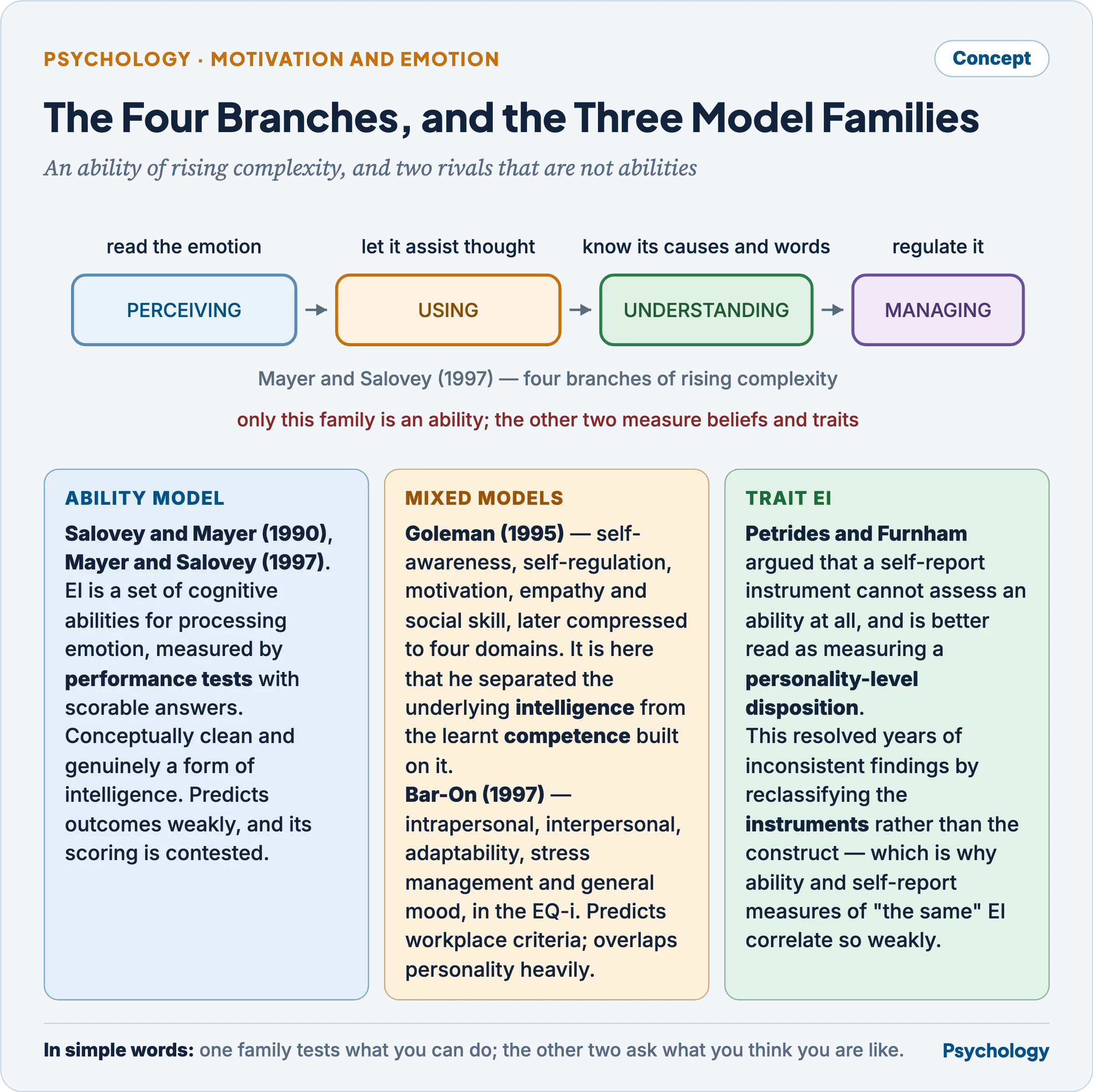
- The ability model. Mayer and Salovey (1997) define EI as the ability “to perceive emotions, to access and generate emotions so as to assist thought, to understand emotions and emotional knowledge, and to reflectively regulate emotions so as to promote emotional and intellectual growth”, organised in four branches of increasing complexity: perceiving emotion, using emotion to facilitate thought, understanding emotion and its vocabulary and causes, and managing emotion in oneself and others.
- Mixed models. Goleman (1995) popularised EI as a broad set of capacities — self-awareness, self-regulation, motivation, empathy and social skill, later compressed into four domains of self-awareness, self-management, social awareness and relationship management — and it is within this framework that he distinguished the underlying intelligence from the learnt competence built on it. Bar-On (1997) built a model of emotional-social intelligence around intrapersonal, interpersonal, adaptability, stress-management and general-mood components, operationalised in the EQ-i.
- Trait EI. Petrides and Furnham argued that self-report measures cannot assess an ability at all and are better understood as measuring a personality-level disposition, which resolved years of inconsistent findings by reclassifying the instruments rather than the construct.
How emotional competence is assessed
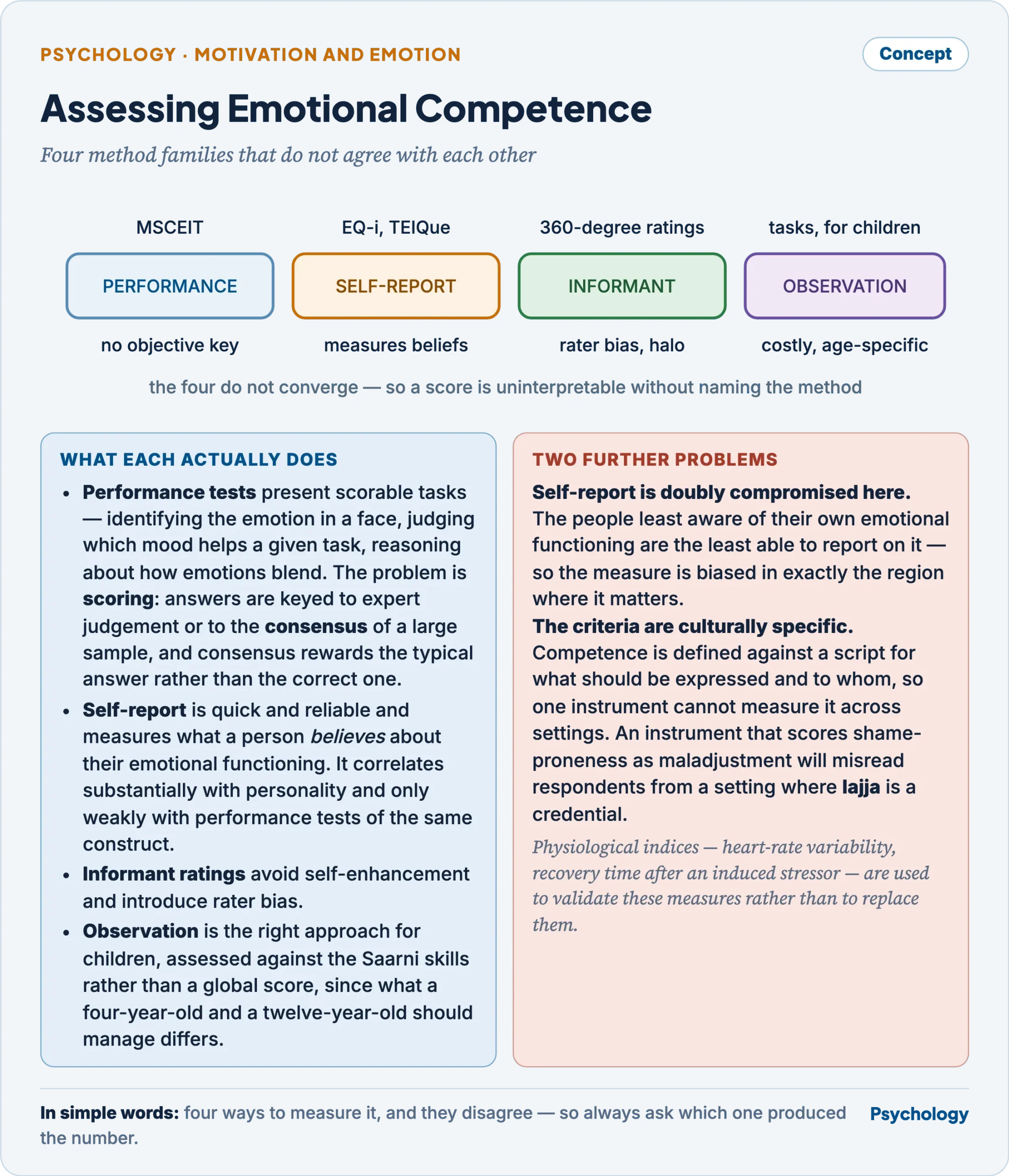
- Performance (ability) tests. The MSCEIT presents tasks with scorable answers — identifying the emotion in a face, judging which mood helps a given task, reasoning about how emotions blend and change. Its distinctive problem is scoring: there is no objective key for an emotion item, so answers are scored against either expert judgement or the consensus of a large sample, and consensus scoring rewards the typical answer rather than the correct one, which is a strange property in an intelligence test.
- Self-report inventories. The EQ-i, the TEIQue and the Schutte scale are quick, reliable and widely used, and they measure what a person believes about their emotional functioning. They correlate substantially with personality, especially emotional stability and extraversion, and only weakly with performance tests of the same construct — a discriminant-validity problem that is the central psychometric fact of this literature.
- Informant and 360-degree ratings. Supervisors, peers and subordinates rate observed emotional behaviour, as in the competence inventories built on Goleman’s model. They avoid self-enhancement and introduce rater bias and halo effects instead.
- Behavioural and observational measures, which are the appropriate ones for children: emotion-recognition tasks with faces and vignettes, delay-of-gratification tasks, emotion-regulation ratings by teachers and parents, and structured observation of peer conflict. Developmental assessment follows the Saarni skills rather than a global score, because what a four-year-old and a twelve-year-old should be able to do differs.
- Physiological and performance correlates are used to validate rather than to assess: heart-rate variability as an index of regulatory capacity, and recovery time after an induced stressor.
- The assessment problem. Stated plainly, the three method families do not converge. Ability tests, self-report and informant ratings of the same person yield only modestly correlated scores, which means they are not interchangeable measures of one thing, and a claim about “emotional competence” is uninterpretable without naming which was used.
Effects of emotion on behaviour
Assessment matters because emotion changes behaviour measurably, and the experimental evidence is where the claim stops being intuition.
- Judgement. Schwarz and Clore (1983) found reported life satisfaction tracked the weather on the day of the telephone interview, and the effect vanished when the interviewer first mentioned the weather — so the feeling was being used as information about life, until its real source was made salient.
- Decision making. Bechara, Damasio and colleagues (1994, 1997) showed on the Iowa gambling task that healthy participants produced anticipatory skin-conductance responses to risky card decks before they could say which decks were bad, while patients with ventromedial prefrontal damage produced no such signals and kept choosing badly even when they could describe the task correctly. Emotional signals guide choice ahead of explicit knowledge.
- Memory. Emotional arousal enhances memory for the central material of an event and impairs it for peripheral detail; Cahill and McGaugh showed the enhancement is abolished by beta-adrenergic blockade, which locates the effect in amygdala-modulated consolidation rather than in rehearsal.
- Attention and performance. Arousal narrows the range of cues used, which helps on simple tasks and harms on complex ones, and anxiety occupies the working memory a skilled performance needs — Beilock and Carr (2001) found choking under pressure was worst in those with the highest working-memory capacity, precisely because their performance depended on the resource anxiety consumed.
- Prosocial behaviour. Isen and Levin (1972) found participants who had just found a coin in a telephone booth were markedly more likely to help someone who dropped a sheaf of papers.
- Processing style. Positive mood shifts processing towards heuristics, schemas and global structure, and Bless and colleagues (1996) showed this is a change of strategy rather than of capacity: happy participants relied more on scripts and simultaneously performed better on a secondary task.
Emotional competence, internal control and intrinsic motivation
Are emotionally competent people internally controlled? Partly, and the qualification matters. Emotional competence correlates with an internal locus of control (Rotter, 1966) and with self-efficacy, because both involve the belief that one’s own responses determine outcomes, and Saarni’s emotional self-efficacy is that belief applied to feelings. But the competent person is not someone whose emotions are governed from inside irrespective of the situation: competence includes reading the display rules of the setting and adjusting expression to it, which is responsiveness to external context. The accurate statement is that emotional competence involves an internal locus of control over one’s responses together with accurate perception of external demands — and a rigidly internal orientation that ignores context is a form of incompetence, not its opposite.
- The regulatory distinction. Internal control in the competent sense means reappraisal, which changes the emotion itself, rather than suppression, which changes only its display. Suppression is externally driven — it is performed for an audience — and carries the costs noted above, which is why it looks like control and does not function as it.
- Enhancing intrinsic motivation in young adults. The levers follow from the needs that intrinsic motivation depends on — autonomy, competence and relatedness — and the full treatment belongs with intrinsic motivation. In compressed form: give real choice over how and when the work is done; set optimally challenging tasks, slightly beyond current skill, which is also the condition for flow; supply informational feedback about competence rather than controlling evaluation; avoid surveillance, imposed deadlines and contingent tangible rewards for work that is already engaging; build relatedness through a supportive group; and support internalisation, by giving the rationale for work that is not inherently interesting so that regulation becomes identified rather than merely external. Emotional competence contributes directly here, since a young adult who can tolerate the frustration of early incompetence is the one who stays long enough to become competent.
Emotional competence in childhood and schooling
- Why the school is the relevant site. Emotional competence is learnt in interaction, and its skills develop on a timetable: emotion labelling in the preschool years, understanding of mixed and hidden emotions by middle childhood, and display-rule knowledge and deliberate regulation strategies later. Early competence predicts later peer acceptance, fewer behaviour problems and better academic engagement.
- Socialisation is the mechanism. Parental and teacher responses to a child’s emotion — coaching it, dismissing it, or punishing it — shape the child’s later capacity, and the pattern varies by culture. Cheah and Rubin (2004) compared Euro-American and Mainland Chinese mothers’ reported responses to children’s aggression and withdrawal and found the Chinese mothers favoured teaching and discussion strategies while the Euro-American mothers more often reported punitive or directive responses to aggression. Matsumoto and Kishimoto (1983) found Japanese children aged four to nine performed less well than American children on emotion recognition, which is consistent with a cultural script that locates emotional information in context rather than in the face.
- The strongest evidence that it can be taught. Durlak and colleagues (2011), meta-analysing 213 school-based universal social-and-emotional-learning programmes covering over 270,000 students, found significant gains in emotional skills, attitudes and behaviour, and an academic gain equivalent to 11 percentile points, with programmes delivered successfully by ordinary school staff. The achievement gain is the finding that matters for the comparison with intellectual competence, because it shows the two are not in competition.
- Is emotional competency more important than intellectual competency? For schoolchildren the evidence supports a weaker and more defensible claim. Cognitive ability remains the single best predictor of academic attainment — the finding Deary and colleagues established on whole national cohorts — and no study shows emotional competence displacing it. What emotional competence adds is incremental: it predicts behaviour, peer relations, conduct, school engagement and mental health better than cognitive ability does, and it predicts attainment over and above cognitive ability — partly because regulation is what allows ability to be deployed in a classroom. It is also the more malleable of the two, which makes it the better target for intervention even where it is not the stronger predictor. The strong form of the claim, that emotional competence matters more than intellect, was popularised ahead of the evidence and the evidence has not caught up with it.
Indian context
- The Indian understanding is relational, not individual. Where the Western models locate competence in the management of one’s own states, Indian socialisation ties it to duty, deference and the maintenance of group harmony, so that the behavioural criteria differ: listening, accommodation and restraint count as competence where assertion would count elsewhere. Dalal and colleagues (1988) found social concerns — the well-being of others, the fulfilment of one’s obligations — operating within achievement goals themselves, with social skills such as respecting elders treated as means to them. The self that is being regulated is an interdependent one.
- Lajja is the clearest case. It translates variously as shame, shyness, modesty and propriety, is gendered in its expectation, and carries a positive evaluation in Indian usage, unlike shame in the Western literature. An emotion whose possession is a credential rather than a deficit is not accommodated by any of the three EI models.
- The shame–guilt distinction matters for cross-cultural assessment. Both are self-conscious emotions, and Lewis (1992) distinguished them by attribution: shame attributes failure to the global self, guilt to a specific act — which is why shame is harder to discharge. Collectivist settings, in which deviation from group standards is the salient failure, generate shame where individualist settings generate guilt, so an instrument scoring shame-proneness as maladjustment will misread respondents from the first kind of setting.
- The Happiness Curriculum, Government of NCT of Delhi (2018) — a compulsory daily 45-minute class from nursery to grade 8 in Delhi government schools, built from mindfulness practice, stories with reflective discussion, activities and expression, reaching over 800,000 students in around 1,000 schools. It operationalises emotional competence as a timetabled, teachable practice rather than an incidental outcome, and it is the largest school-level implementation of the construct anywhere in India.
- The National Education Policy, 2020 (Ministry of Education) names socio-emotional learning among the capacities that school education must build, and places experiential and discussion-based pedagogy in the foundational and preparatory stages, which is the policy opening through which emotional competence enters the Indian curriculum. Manodarpan (Ministry of Education, 2020) added psychosocial support for students through helpline and counselling services.
- The gap. Indian work on emotional competence is mostly correlational and scale-based, using instruments translated from Western models and validated on convenience samples of students; there is little longitudinal or intervention evidence, and the Happiness Curriculum’s evaluation is still thin relative to its scale.
Criticisms and limitations
- The construct is not one construct. Ability EI, mixed EI and trait EI correlate weakly with each other, so findings do not aggregate, and the literature’s disputes are frequently disputes about different variables sharing a name.
- Incremental validity is the real question, and the answer is modest. Joseph and Newman (2010) found ability-based EI a weak predictor of job performance, with mixed-model measures predicting better largely because they contain cognitive ability and personality; later work found self-report EI’s apparent validity is substantially explained by those other constructs. EI adds something, and much less than its popular claims.
- The conceptual objection. Locke (2005) argued that EI as commonly defined is invalid as a concept, because it has been stretched to cover so many unrelated attributes that it no longer names anything, and that what is being described is better handled as the application of ordinary intelligence to emotional material.
- Scoring an intelligence test by consensus is a standing problem: the typical answer and the correct answer are not the same thing, and no independent criterion for emotional correctness exists.
- Self-report is doubly compromised here, since the people least aware of their own emotional functioning are the least able to report on it, which biases the measure in exactly the region where it matters.
- Cultural specificity of the criteria. Competence is defined against a cultural script for what should be expressed and to whom, so a single instrument cannot measure it across settings, and the Indian material above is a demonstration rather than a footnote.
- Trainability is assumed more than shown in adults. The school evidence for teaching these skills is good; the corporate-training evidence is weak, rarely controlled, and usually evaluated on self-report.
Previous Year Questions
- 2022“Emotional competency is more important than intellectual competency.” Discuss in the context of schoolchildren.
- 2018Are emotionally competent people internally controlled? Explain. What are the ways to enhance intrinsic motivation of young adults?
- 2009How is emotional competence assessed? Discuss the effects of emotion on behaviour. Cite experimental evidence.